Hundreds of residents of Khindu parish in Kyanamukaka Sub County and the surrounding areas in Masaka District received free medical services during a three-day medical camp.
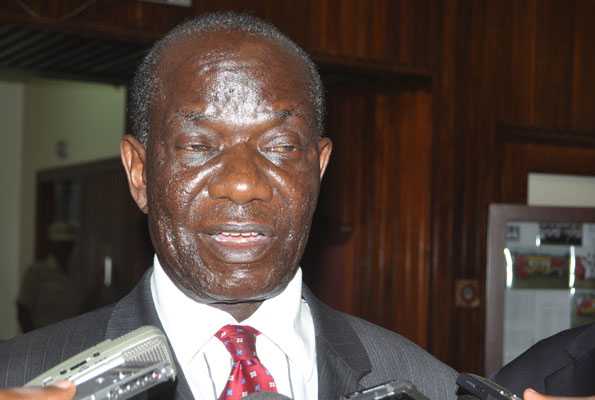
Opening the camp, Vice President Edward Kiwanuka Ssekandi urged community leaders to focus efforts on community hygiene to guarantee the health of their people.
VP Ssekandi lauded a group of American volunteers from Virginia, USA, and local health professionals participating in the exercise which included assessing different health conditions and providing treatment for some of the patients.
Also, under the program the health personnel sensitized residents on general well-being, including working together to improve the community sanitation for facilities like water wells, roads and the environment and household amenities.
The medical professionals also provided free dental procedures including teeth extraction, scaling, filling, replacing of teeth especially among the aging people.
The function was also attended by the Korean Ambassador Park Jong-Dae, who earlier on visited ‘mindset change activities’ being spearheaded by youth leaders who have been trained under the Korean model of community participation development, where all community members work together for a common good.
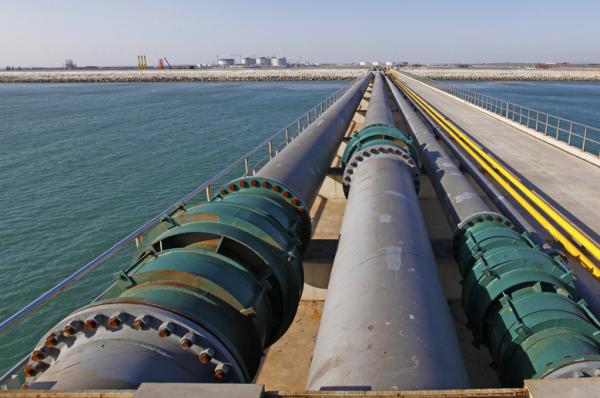
Presidents Yoweri Museveni and John Magufuli of Tanzania laid a foundation stone last weekend in Tanzania for the construction of a US$3.55 billion-crude export pipeline that would pump Ugandan oil for export.
The 1,445 km-project, set for completion by 2020, will run from Uganda’s western oil rich district of Hoima, where crude reserves were discovered in 2006, to Indian Ocean seaport of Tanga in Tanzania.
If completed, the project will become “the longest electrically heated crude oil pipeline in the world,” said Guy Maurice, Senior Vice President of Africa at Total Exploration and Production.
Total is one of the owners of Ugandan oilfields, alongside China’s Cnooc and Britain’s Tullow Oil.
Both Presidents Magufuli and Museveni urged the three joint venture partners to speed up construction of the pipeline.
“We don’t need to delay the completion of the project for almost three years. They can do it even night and day to ensure the project is completed as quickly as possible,” Magufuli said, urging the companies to finish the project before 2020.”
Uganda estimates overall crude reserves at 6.5 billion barrels, while recoverable reserves are seen at between 1.4 billion and 1.7 billion barrels.
Uganda Tanzania opted to pass the pipeline via Tanzania because it was a “least cost and least risky”. But also Tanzania offered several concessions to make the pipeline profitable in spite of the falling global crude oil prices.
Tanzania, located South of Uganda also agreed to waive taxes, offered to take up shares in the pipeline project and charge a tariff of US$12.2 per barrel to make the project feasible, he said.
The function was attended by Tanzanian Vice President Samia Suluhu, the Prime Minister Kassim Majaliwa and the Tanzanian First Lady Janet Magufuli.
On the Ugandan side were First Deputy Prime Minister and Minister for East African affairs Kirunda Kivejinja, the Energy and Mineral development Minister Irene Muloni, the Finance Minister Matia Kasaijja and the State Minister for Bunyoro Affairs Ernest Kiiza among others.
The project will create 10,000-15,000 direct jobs while temporary ones will peak to 30,000.
Eng. Irene Muloni, Uganda's Minister of Energy and Mineral Development
The Uganda government has agreed to core project terms for the Uganda Refinery Project with the Albertine Graben Refinery Consortium (AGRC) to develop a greenfield oil refinery in the south-western district of Hoima.
According to the latest press release by the Ministry of Energy and Mineral Development, the selection of AGRC follows a thorough review process of over 40 companies that expressed interest to develop the much-anticipated oil refinery.
The AGRC consortium is made up of General Electric (GE) Oil and Gas, YAATRA Ventures LLC, Intracontinent Asset Holdings Ltd (IA) and Saipem SpA, as an Engineering, Procurement and Construction (EPC) partner.
According to the press release the Consortium has proposed to Government a financing approach and a path to establish, develop and operate a commercially viable refinery company with a strategic benefit to the country and the region.
The agreement of the core project terms signals the start of Government discussions and negotiations with the Consortium on the Project Framework Agreement (PFA).
“The PFA will detail the proposed solutions, validation of the solutions, risk mitigation measures, and additional due diligence necessary for accelerating investments and financing for the project,” the press release reads in part.
The Project Framework Agreement is expected to conclude and be signed within the next two months, with the Consortium having benefit of exclusivity during the period of negotiations.
“Should the parties agree on all terms, the Consortium will be granted the rights and licenses to develop and manage the refinery as lead investor in a joint venture partnership with Government,” the press release reads.
The signing of the Project Framework Agreement will in turn pave the way for commencement of pre-Final Investment Decision (FID) activities such as Front End Engineering and Design (FEED), Project Capital and Investment Costs Estimations (PCE), Environmental and Social Impact Assessments (ESIA).
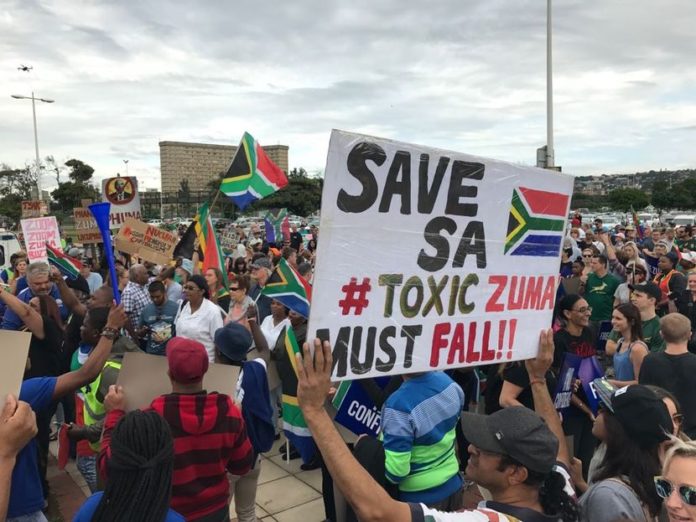
A series of protest marches both against and in support of President Jacob Zuma will be staged across the country over the next two days.
More than 20 civil rights and faith-based organisations are taking part in a march today afternoon in Cape Town.
Protest organiser Bruce Baigrie says: “The principal aim is to send a message to the MPs, especially those who are with the ANC, to recall President Zuma and to honour their constitutional obligations.”
The march will start in Keizergracht Street at 3pm and then proceed to Parliament.
Event organisers say that they are particularly targeting members of the ruling party.
Civil rights organisations like the Right2Know Campaign, Social Justice Coalition, and the Treatment Action Campaign will form part of the expected mass action.
Axed deputy Finance Minister Mcebisi Jonas is named as one of the speakers at the gathering.
“This is a very significant milestone for the country. This is probably the beginning of what could well be a national movement that begins to write to a new agenda for the country.”
National Assembly Speaker Baleka Mbete is expected to announce today whether the no-confidence vote will take place in the form of a secret ballot vote or not.
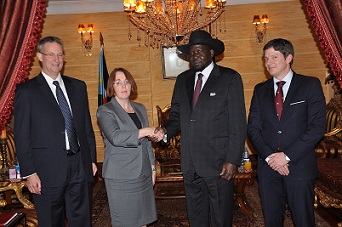
TO BE REPLACED? US Ambassador to South Sudan Mary Catherine Phee presents her credentials to President Salva Kiir. Photo credit/state.gov
The United States has nominated Thomas J. Hushek to be its Ambassador to South Sudan, to replace Mary Catherine (Molly) Phee who has been US Ambassador to the troubled country since July 2015.
The White House said President Donald Trump intends to nominate Hushek, a career member of the Senior Foreign Service, class of Minister-Counselor, who has served as an American diplomat since 1988. He is currently the Principal Deputy Assistant Secretary (Acting Assistant Secretary) in the Bureau of Conflict and Stabilization Operations at the Department of State.
A three-time Deputy Chief of Mission and senior official at the State Department, Hushek has extensive experience in management and communications, coordination of humanitarian programs, and crisis management. Mr. Hushek has served at eight US Missions overseas.
He earned a M.I.A. from Colombia University and a B.A from the University of Wisconsin, Madison. He speaks Russian and Persian (Dari), a according to a statement released by The White House.
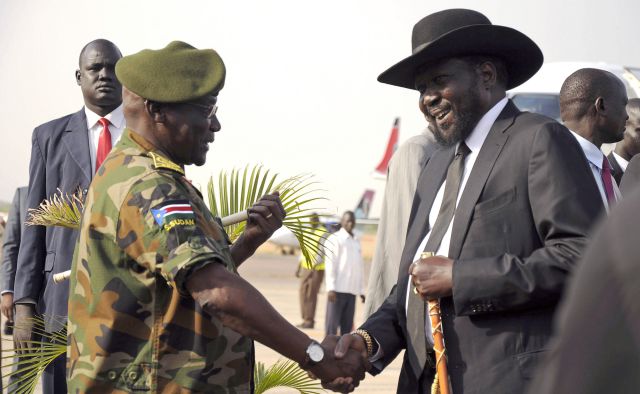
DURING HAPPIER TIMES: President Salva Kiir with former SPLA commander Gen. Paul Malong Awan
South Sudan President Salva Kiir has denied arresting Paul Malong Awan, former Chief of General Staff of the Sudan People’s Liberation Army whom he ousted out of office last May.
President Kiir, according to Daniel Awet Akot, his adviser on military affairs and a leading member of the political bureau of the governing Sudan People’s Liberation Movement (SPLM), has not arrested General Malong, a former ally who played a key role in the conflict which erupted in 2013.
“There have been reports and people calling me to inquire whether Paul Malong has been arrested and my answers were no, I am not aware. When these calls persisted, I decided to ask the President and he told me no, he had not ordered any arrest for Malong,” Awet Akot said.
“The President also told me he did not receive any report about his health. If he was sick, the President would have been informed. There are people with him,” he added.
But while Akot denied the arrest of Awan, Lucy Ayak, Gen. Paul Malong Awan’s wife called President Salva Kiir to allow him (Malong) to travel out of the country for a medical attention, saying she was concerned about the health of her husband.
“The last time I spoke to you Mr President, you promised me that my husband would not be harmed, and I took you at your word because I believed that you are a man that stands by your words Mr President. But I should bring to your attention the fact that my husband is not currently in good health, as I am also sure that you well know. He has been having routine checkups and treatment both in Juba and Nairobi over the time he has been working under your command,” wrote Ayak.
She said the condition under which her husband was being held and the tension surrounding the house was becoming a cause of concern to the family. She further underscored that he has no access to his doctors or any other medical personnel.
“I, therefore, appeal to your usual humanity and sense of correctness your Excellency, please allow my husband to seek the medical help he urgently needs because it is the right thing to do to him and the family at the moment,” she called.
The South Sudanese security services kept briefing President Kiir that Malong has been working to evict him and take the lead of the leadership of the country. His role in the military confrontation in Juba in July 2016 and the initiatives he had taken however convinced many in the country that he had no consideration for his hierarchy.
After his removal, the General Malong denied intention to rebel against the government.
In a speech delivered at a public rally held in Yirol town, Eastern Lakes State, where he suspended his travel to his home region of Aweil, he asserted that all that had been said against him were just rumours and that he only wants peace to prevail in the country.
When comedian MC Mariachi came up with jokes about Muslims, perhaps he thought all would end with him receiving his pay cheque, but the situation has turned nasty, with a top Muslim cleric stopping short of ordering him to flee the country.
Indeed, everything appears to have backfired for MC Mariachi and with mounting pressure, the comedian who was accused of mortifying Islam, was quick to ‘apologise’ but still did that in a comical way!
The comic apology was rejected by the spokesman of the Kibuli Muslim faction, Sheikh Nuhu Muzaata, who said it was mockery, and warned the comedian to either flee the country or increase his security “otherwise Muslims are going him make him pay for mocking their religion.”
But Mariachi was quick to sense the danger and escorted by other comedians, trekked to Kibuli Hill and apologised. Knees to the ground, Mariachi asked for forgiveness and pledged never to come up with similar jokes.
He was ‘forgiven’ but warned of dire consequences if he repeated similar jokes.
Paris Saint-Germain (PSG) has today unveiled Neymar Junior after activating the €222million (£199million) release clause in his contract, making the Brazilian forward the most expensive player in football history.
Neymar’s world-record transfer is reported to be worth about £450m in total, taking into account fees and wages, which will see the forward earn around £540,000 a week after tax.
Formerly with Barcelona, Neymar Jr will be officially presented to fans on Saturday and is committed to PSG for 5 years until June 2022.
The 25-year-old, who joined Barcelona for £48.6m from Brazilian club Santos in 2013 leaves after winning 1 champions league, 2 La liga titles, 3 Copa Del Rey titles, 1 uefa supercup winner, 1 spanish super cup winner and 1 Fifa club world cup winner.
The Parisian club’s official website also announced that Neymar will wear the No.10 jersey at the Parc de Princes. Javier Pastore has given up his shirt number in order to welcome Neymar to the club.
La Liga had rejected an attempt by Neymar’s representatives to pay the sum that would trigger his release clause at Barcelona but the money was later accepted by the club at Camp Nou.
Televangelist Gilbert Deya of the ‘miracle babies’ infamy has been deported from United Kingdom to Kenya.
Mr. Deya, who was arrested in London by the Metropolitan Police on December 13, 2006 and faces child abduction and trafficking charges, arrived at the Jomo Kenyatta International Airport at 4.40 am on Friday August 4, aboard a Kenya Airways flight.
A police spokesman said Mr. Deya was detained under an arrest warrant issued by Kenyan authorities, and was ordered by a court on November 8, 2007, to be extradited from the UK to Kenya to face five counts of child trafficking.
He is set to face child trafficking charges after being handed over to the Kenyan authorities following accusations that he coordinated the trafficking of children, who his church would later present as ‘miracles’ for barren mothers. Police also alleged that Deya stole five children between May 1999 and December 2004 from Pumwani Hospital to facilitate his ‘miracle babies’ project.
Earlier in 2005, Mr. Deya’s wife Mary Deya was handed a three-year jail term after she was found guilty of stealing a child from the Kenyatta National Hospital in Nairobi. Mary falsely claimed that the baby was hers, but it was later confirmed that she had stolen it.
Deya was ordained by the United Evangelical Church of Kenya and styles himself ‘Archbishop’. He was an evangelist in Kenya in the late 1980s to early 1990s, but moved to the UK, establishing Gilbert Deya Ministries in 1997.
DEMO: Parents and pupils of Bridge International Academies protest the closure of their schools outside Parliament. Photo/nbstv.
A coalition of 174 civil society organisations has called on international donors, including the UK government, to drop support for the Bridge International Academies (BIA), a private school company operating in Africa including Uganda.
BIA provides technology-driven education in more than 500 primary and nursery schools in Uganda, Kenya, Nigeria, Liberia and India, and Bill Gates and Mark Zuckerberg are among the high-profile philanthropists from whom the American startup has received funding.
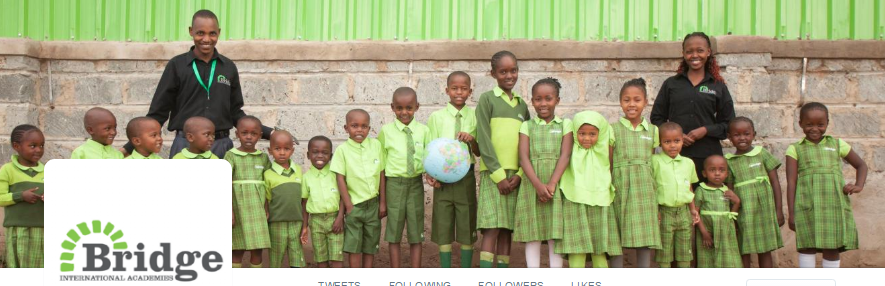
Pupils of the Bridge International Academies (BIA) in Uganda
But late last year Uganda’s high court ordered the closure of 63 Bridge schools last year, ruling that they provided unsanitary learning conditions, used unqualified teachers and were not properly licensed. No schools have been closed and Bridge is in dialogue with a government team, that includes among other stakeholders the Minister of Education Janet Museveni, who has previously expressed skeptism about the operations of Bridge schools in Uganda.
And in a statement, ‘anti-Bridge’ campaign groups said the firm charges prohibitively high fees and that teachers are poorly paid, receive little training, and are given inflexible, scripted lessons to read from tablets. The organisations also accused BIA of intimidating its critics, a claim the company has denied.
The statement, signed by organisations from 50 different countries including Global Justice Now and Amnesty International, cited research suggesting that the poorest students cannot afford to attend Bridge schools.
“BIA’s model is neither effective for the poorest children nor sustainable against the educational challenges found in developing countries,” said the campaigners, who alluded to “mounting institutional and independent evidence that raises serious concerns about BIA” and warned of “significant legal and ethical risks associated with investments” in the company.
In Kenya, sending three children to a Bridge school is estimated to represent almost a third of the monthly income of families living on $1.25 (94p) a day, according to a joint study by Kenya National Union of Teachers and Education International, a federation representing 32 million teachers and support staff. The researchers noted that teachers are required to work between 59 and 65 hours a week for a monthly salary of $100.
In April, following an inquiry into UK aid spending on education, the chairman of the UK parliament’s international development committee questioned whether grant funding should have been provided to Bridge.
“The evidence received during this inquiry raises serious questions about Bridge’s relationships with governments, transparency and sustainability,” Stephen Twigg wrote in a letter to the international development secretary, Priti Patel.
But Bridge’s model, under which teachers are given electronic tablets containing lesson plans, is seen by some as an answer to improving access to education in low-income countries.
And responding to the criticism from civil society groups, BIA said it provides high-quality education to marginalised and remote communities across Africa. The company pointed out that it costs an average of just under $7 (£5) a month to send a child to Bridge, and that 10% of students are on scholarships. BIA added that teachers work about 54 hours a week and are given high-quality training before and during their careers, with salaries – between $95 and $116 a month in Kenya – higher than in other non-formal schools.
“Our pupils are outperforming their peers in national exams over consecutive years. Our model means that we’re able to attract new investment towards solving one of the world’s most pressing problems: hundreds of millions of children who are not learning,” the Bridge statement said.
“Public schools and Bridge schools can and do operate side by side to serve communities in countries where there are major shortages of nurseries and primary schools. We help governments quickly address the gap between how many schools they have and how many they need.”
The UK Department for International Development said: “We have supported over 11 million children in primary and lower-secondary education from 2011-15, including over 5.3 million girls.
“Many of the world’s poorest countries rely on privately run schools to provide an education where state provision is failing. Without privately-run schools, millions of children would be denied an education.”