Stanbic Bank
Stanbic Bank
20.2 C
Kampala
Stanbic Bank
Stanbic Bank
Home Blog Page 1800

Uganda improves in the power rankings ahead of 2017 FIBA AfroBasket

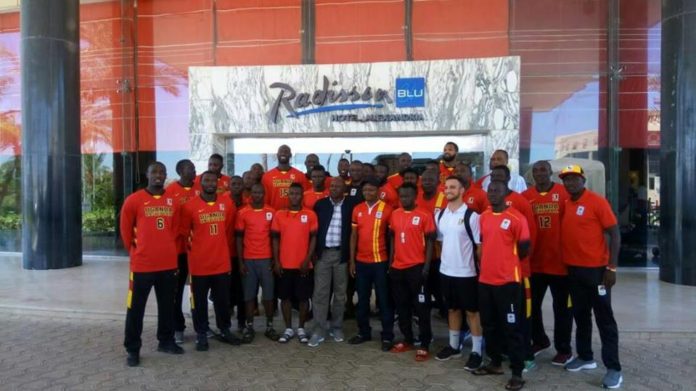
FUFA President Moses Magogo, who was in Egypt for the Uganda Cranes World Cup qualifier against the Pharoahs, meets the Silverbacks

As the clock continues ticking fast for the 2017 FIBA AfroBasket to be co-hosted by Senegal and Tunisia from September 8-16, the participating teams have been ranked based on their competitiveness, rosters and preparation plans.

The Uganda basketball team improved by two spots to the 9th out of the 16 teams in the competition. Tunisia and Senegal, the favorites to win the tournament, maintain the top two spots.

The ‘Silverbacks’ of Uganda remain confident ahead of the major tournament, and the huge aspirations could see the East Africans cause some noise in Dakar, where they will play the Group Phase against Morocco, the Central African Republic and Angola.

The Silverbacks completed their 12-day camp in Egypt and are now on their way to Dakar, Senegal where the group stages will be held. Uganda kicks off its campaign on the Sept. 8 against Angola.

There are four groups and the top two teams from each group will advance to Tunis, which will also host the Final Phase (Quarter-Finals, Semi-Finals and Finals) from September 14-16.


Rankings:

  • Tunisia
  • Senegal
  • Nigeria
  • Angola
  • Dr congo
  • Egypt
  • Morocco
  • Ivory Coast
  • Uganda
  • Rwanda
  • Guinea
  • Mali
  • Central African Republic
  • Cameroon
  • Mozambique
  • South Africa


Uganda squad:

Joseph Ikong Anyuru, Jonathan Egau, Jimmy Enabu, Samuel Kalwanyi, Syrus Kiviiri,Ben Komakech, Stanley Mugerwa, Stanley Ocitti Ochaya, James Okello, Stephen Omony, Robinson Odoch, Opong Jonah, Karma Otim, A’darius Pegues


Group A: Nigeria, DR Congo, Mali and Ivory Coast

Group B: Angola, Central African Republic, Morocco and Uganda

Group C: Tunisia, Guinea, Rwanda and Cameroon

Group D: Senegal, Mozambique, Egypt and South Africa

Stories Continues after ad

Judicial officers defer industrial action

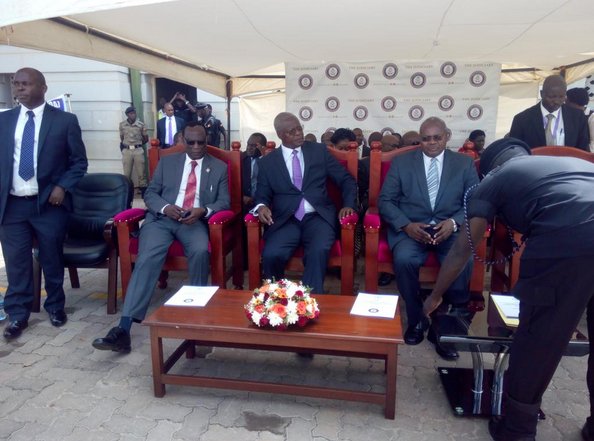
Juciacial officers during their meeting today

Judicial officers have, through the umbrella organization the Uganda Judicial Officials Association (UJOA), this afternoon agreed to return to work as government fine-tunes plans to settle their grievances.

Since August 25 the judicial officers have been on strike demanding better pay and on Monday this week government pledged to offer them security, transport and office equipment as it tries to effect salary enhancement and harmonisation across the board.

Weighing in on the mater Justice and Constitutional Affairs Minister Major General (rtd) Kahinda Otafiire revealed that a Bill regarding comprehensive pay for government workers will be concluded in October basing on ‘equity, sustainability and affordability’.

“There will be no salary increment before the salary harmonisation exercise, we therefore ask them to return to work, immediately,” Gen. Otafiire was quoted as saying at the Uganda Media Centre, hours before the judicial officers agreed in a meeting at the High Court, to return to work.

Contacted on the matter Gen. Otafiire said: “I am very happy because they have agreed to report back for duty.”


Stories Continues after ad

Sudhir drags city lawyers Mpanga, Masembe to court over conflict of interest

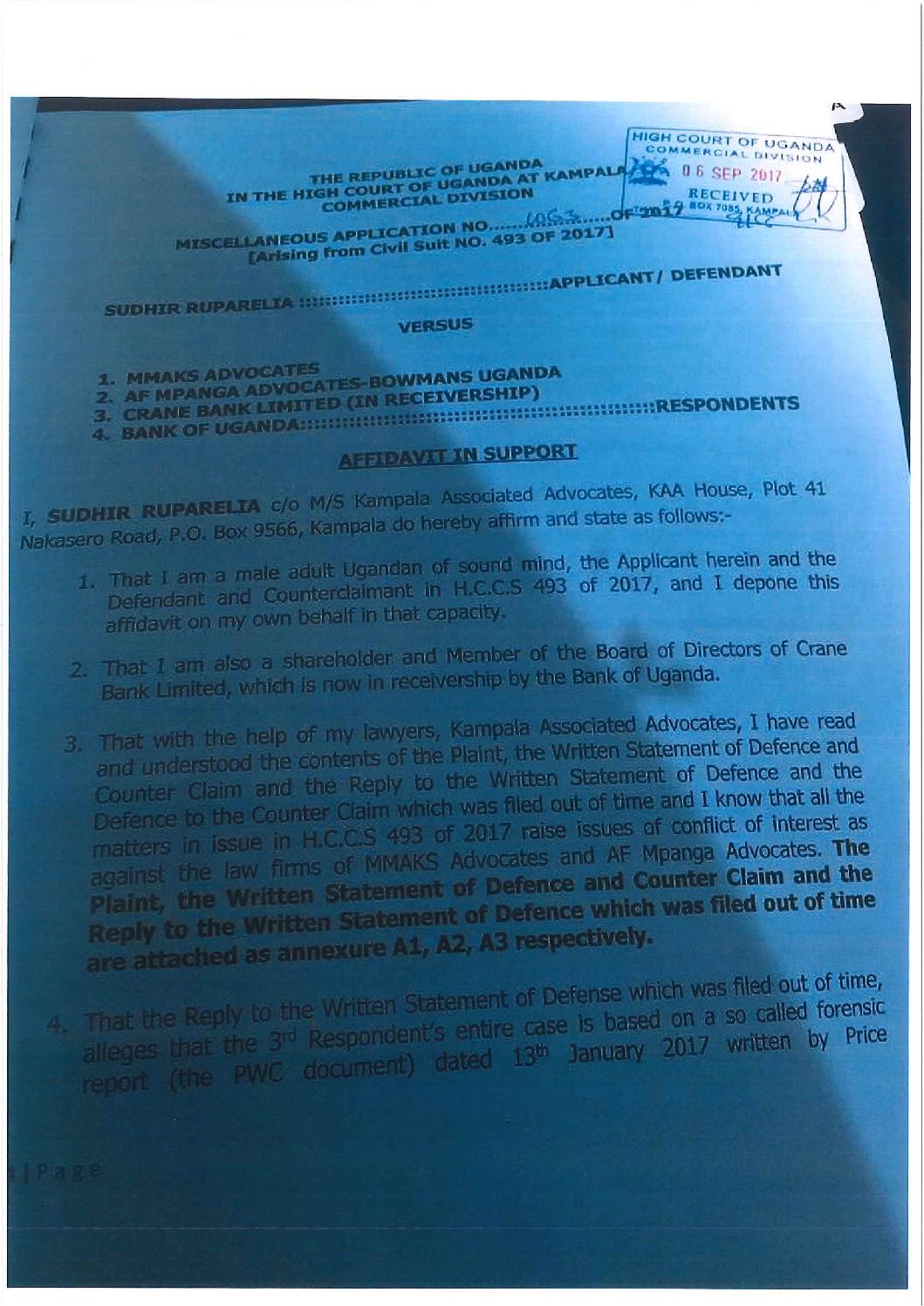
CONFLICT OF INTEREST DEPONE: Mr. Sudhir Ruparelia's depone in court against MMAKS and AF Mpanga Advocates

Billionaire businessman Sudhir Ruparelia has dragged two city law firms to court, over  conflict of interest in the Bank of Uganda-Crane Bank saga.

Filed under Miscellaneous Application No. 1063 of 2017, Sudhir lists MMAKS Advocates, AF Mpanga Advocates-Bowman’s Uganda, Crane Bank and Bank of Uganda as respondents in a 14-page ‘depone’ drawn by Ms. Kampala Associated Advocates (KAA) that links the law firm of AF Mpanga Advocates, the 2nd Respondent, to a damaging report about the businessman that was authored by the audit firm PriceWaterhouseCoopers (PWC).

‘I have read and understood the contents of the Plaint, the Written Statement of Defence and Counterclaim, and Reply to the Written Statement of Defence to the Counterclaim which was filed out of time and I know that all the matters in HCCS No. 493 of 2017 raise issues of conflict of interest against the law firms of MMAKS and AF Mpanga Advocates…’ Mr. Ruparelia deponed.

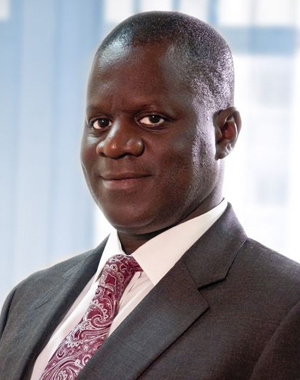
David Mpanga

He added: ‘I have read the PWC Report and note that each allegation made by PWC is backed up by alleged “Independent Legal Advice”, or “Legal Analysis” all of which were as per the document authored by the 2nd Respondent. I have been advised by my lawyers, Kampala Associated Advocates, which advice I believe to be true, that AF Mpanga is a necessary, material, competent and compellable witness to speak to the veracity of the contested PWC document.

Mr. Ruparelia deponed following a ‘Reply to the Written Statement of Defence’ filed by the two law firms, challenging the businessman’s demand of US$8 million from the Bank of Uganda, after the latter failed to file its defence in time, as per the Civil Procedure rules.

In the depone Mr. Ruparelia avers that the PWC document was adversely referred to in the defence by the two law firms, yet it contains contestable information given by ‘Bowman’s Uganda, another name for the law firm of AF Mpanga Advocates’.

… That the Reply to the Written Statement of Defence to the Counterclaim which was filed out of time alleges that the 3rd Respondents entire case is based on a so called forensic report (the PWC document) dated 13th January 2017, written by PriceWaterhouseCoopers and is attached to the 3rd Respondents late reply to the statement of defence as annexure M,’ Mr. Ruparelia further deponed.

Timothy Masembe

Meanwhile, in a related development, last week Mr. Ruparelia’s lawyers, KAA, wrote to the Commercial Court Registrar, informing him about the failure by the BoU lawyers to file a defence in the stipulated of 15 days, as per Order 5 Rule 10 of the Civil Procedure Rules.

‘It is not in dispute that Bank of Uganda, which is the second counter Defendant in the counterclaim and a separate party, was served on August 11 and receipt acknowledged by the Secretary to the Bank of Uganda who stamped on them and returned them to the process server. To date the Bank of Uganda has elected to ignore the legal requirement to put in a defence in answer to the claim against it.

‘In so far as the issue of receipt of service on Bank of Uganda remains uncontested, we reiterate our prayer that in accordance with the Civil Procedure Rules, judgment in default be entered against Bank of Uganda for USD8, 000, 000 (United States Dollars eight million only)’.

We therefore pray as per our latter dated 29 August 2017, that default judgment be entered against Bank of Uganda’, the KAA letter states in part.


Stories Continues after ad

Coffee sector projection of Shs20m bags hit by challenges

Policy implementers in the coffee sector will not be able to effect President Yoweri Museveni’s 2015 directive to accelerate coffee production from the current Shs3.5 million 60 kilogrames bags to Shs20 million bags by the year 2020.

President Museveni issued the directive while launching the Coffee Roadmap, but now a top government official says the target is unlikely to be achieved due to a number of factors including the effects of climate change, narrow acreage, diseases and pests and, disorganization of the farmers.

“We are not likely to achieve the 20 million bags target but we are seeing progress,” Dr. Ezra Suruma, the Head of the Delivery Unit in the Office of Prime Minister, said yesterday during a Cabinet retreat organized to analyse performance of government ministries and departments in the financial year 2016/17.

To actualise this directive, in December 2015, the Uganda Coffee Development Authority (UCDA) in collaboration with the Prime Minister’s Delivery Unit convened a stakeholders’ meeting in which an agenda for a Coffee Lab was agreed upon. The stakeholders agreed on potential strategies for government action in FY 2016/2017 pending design of a Coffee 2020 Roadmap (effectively, the results of the aforementioned Coffee Lab).

And in April 2016, the Prime Minister Dr. Ruhakana Rugunda directed UCDA to hold another stakeholders’ consultative meeting in which a post seedlings distribution and management framework was developed for the FY 2016/17.

Subsequently, President Museveni attracted the goodwill of McKinsey & Company Limited, a renowned global consulting firm to support the transformational process through developing a comprehensive medium-to-long term roadmap for the coffee subsector. This was to be undertaken through a Rapid Delivery Coffee Lab which was held in March 2017.

The Coffee Lab identified nine key transformative initiatives that focus on putting Uganda on the path to achieving Shs20 million bags of coffee production per year by 2025. They hinge on three pillars which will catalyse the transformation of the coffee sector in Uganda namely Demand and Value Addition, Production and Enablers. These are further broken down into nine specific initiatives.

Among the initiatives is building structured demand through country to country deals, especially with China; branding Ugandan coffee to drive demand and improve value by up to 15 per cent; supporting local coffee businesses for value addition, including primary processing and a soluble coffee plant and strengthening farmer organisations and producer cooperatives to enhance commercialisation for smallholder farmers and ensuring broad access to extension, inputs, finance and aggregation.

Others are: supporting joint ventures between middle-class owners of underutilized land and investors to develop coffee production; providing and promoting concessions for coffee production on large underutilized tracts of land; improving the quality of planting material (seeds and seedlings) through strengthened research and multiplication of improved varieties and improving access to quality inputs by reducing counterfeiting (fertilizer, pesticides, herbicides) from current 40-60 per cent.

Further, government zeroed on developing a coffee finance programme with the Central Bank and Treasury to provide financing to farmer organisations, including on-lending to smallholders, coffee businesses and investors.

Stories Continues after ad

Jumia Travel appoints new CEO

Jumia Travel has appointed Joe Falter as its new Chief Executive Officer

Jumia Travel has appointed Joe Falter as its new Chief Executive Officer, succeeding Paul Midy who has exited the top post to take a different position in the larger Jumia Group.

Falter, who is also the Founder and CEO of Travel’s sister company Jumia Food, assumes the role as part of efforts outlined to further bolster the company’s operations.                                     

“I could not be more excited to join this dynamic team which is revolutionising the way that people travel in Africa and beyond. With by far the biggest hotel inventory and market leading innovations, Jumia Travel is a clear leader in travel, tourism and hospitality, and I am thrilled to be leading the business forward,” says Mr. Falter.

Previously a management consultant at McKinsey in London, and with a track record of scaling companies in Europe and Africa, Mr. Falter brings with him a unique shift in strategic management that will help capitalize on emerging business opportunities.

Commenting on his first move as the new travel company’s boss, he said: “Jumia Travel has grown exponentially in the last 2 years and the immediate objective is to continue this rapid growth trajectory while further strengthening our offering to customers and hoteliers. Our 30,000 hotel partners in Africa and hundreds of thousands of customers will be treated to exciting new developments online and offline.”

“I am confident that Joe is the right leader to accelerate Jumia Travel to become the only prefered travel agency in Africa and beyond,” says Jumia Co-Founder Sacha Poignonnec.

Founded in 2013, Jumia Travel has built a track record in ecommerce and technological innovation, becoming the leading online travel agency in Africa. It offers online hotel and flight booking services as well as tailor made packages for its large inventory of customers, both individual and corporate.


Stories Continues after ad

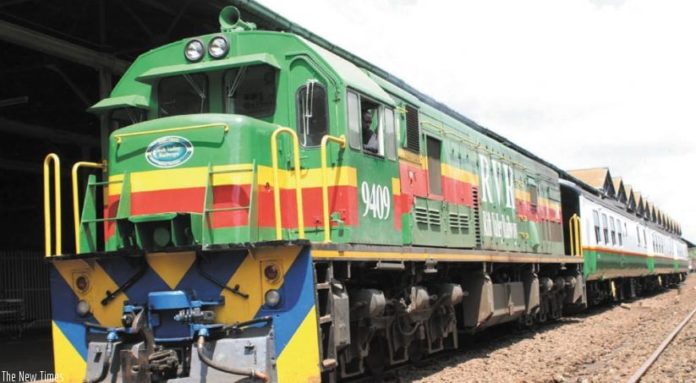
Uganda terminates RVR contract today

AN RVR ENGINE: The company's contract was terminated by the government of Uganda over nonperformance.

The Ugandan government has confirmed it will terminate Rift Valley Railways’ (RVR) concession to operate the country’s 1918km metre-gauge network over poor performance of the concessionaire.

The Minister of Works and Transport Monica Azuba Ntege yesterday said in Kampala that RVR’s contract would be terminated today, having given the concessionaire notice of the intention to do the same some time back.

“The performance of RVR concession has remained unsatisfactory and is due for termination in September,” Minister Azuba said while addressing participants at the Cabinet Retreat yesterday, where ministers were presenting annual performance reports for 2016/17.

The minister said RVR had failed to invest in the assets acquired as agreed in the contract signed in the year 2006, for duration of 25 years. She added that government intends to invest in the railway now that RVR has failed.

“After the termination of the concessionaire, URC will invest in the track, rolling stock and human resource to revamp railway operations,” Azuba said.

According to government, RVR has since the signing violated the contract terms despite several reminders to rectify the errors. RVR had been given three-month ultimatum to implement the contract terms or else face a termination of its concession by the two partner states Uganda and Kenya. Kenya recently terminated the contract.

RVR was to rehabilitate, operate and maintain the rail networks as one railway system so as to improve the management, operation and financial performance of the two rail networks in a coordinated manner.

But it appears the company has failed to raise US$150 million to revamp the existing railway infrastructure. Uganda wants to develop the Standard Gauge Railway line as Kenya has completed the Mombasa-Nairobi standard gauge railway route.

RVR system has 219 locomotives (175 in Kenya and 44 in Uganda) and approximately 7500 wagons and three water ferries (6000 wagons and one ferry in Kenya and 1433 wagons and two ferries in Uganda).

And on June 8, while presenting the country’s Shs 29 trillion 2017-18 national budget, Uganda’s Finance, Planning and Economic Development Minister Matia Kasaija told the Parliament that the management of the Uganda railway would revert to the Uganda Railways Corporation (URC).

The concession system included about 87% and 35% of KRC’s and URC’s railway networks respectively. The railway network comprises of the main line from Kenya to Uganda, which runs from Mombasa through Nairobi, Nakuru, Eldoret, Malaba, Jinja, and Kampala to Kasese in western Uganda (a distance of approximately 1660 km). A branch line runs from Nakuru to Kisumu on Lake Victoria (217 km), from where there is a wagon ferry link with Jinja and Port Bell in Kampala.

Though legally separate, the objective of the joint concession process was to seamlessly operate the two concessions as one railway system. This was particularly important for Uganda, a landlocked country, which depends on the Kenyan port of Mombasa for sea access.

RVR was supposed to embark on an investment program which would include rehabilitation of the track to allow safe passage of trains at designed speed, upgrading and modernisation of the locomotive fleet, rehabilitation of the rolling stock, purchase of new locomotives and wagons, renovations of buildings, workshops, depots and machinery, and installation of new information technology systems.

The investment program, when implemented, was expected to create significant economic and social benefits in both Kenya and Uganda, would also ensure more effective transportation of freight and passengers.


Stories Continues after ad

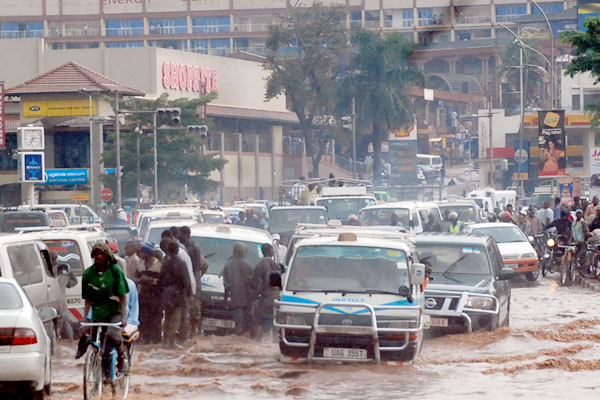
UNMA warns of landslides and floods as heavy rains expected

FLOODED ROADS IN KAMPALA:

The Uganda National Meteorological Authority (UNMA) has said much of Uganda will receive above normal rainfall in the months of September to December 2017 that might culminate in the continuous occurrence of landslides and floods across the country.

‘Cases of flooding and landslides may be experienced in areas such as Mt.Elgon areas of Bududa and Bulambuli plus Bundibudyo, Kasese areas around Mt. Rwenzori,” UNMA warns in a statement.

According to UNMA, farmers should plant both short and long term maturing crops like millet, rice, sorghum, maize, cassava, sweet potatoes, legumes and vegetables to ensure food security.

The Authority however advised farmers to avoid planting crops in flood and landslide prone zones, saying this could cause losses.  It also advised the farmers to carryout soil and water conservation practices such as digging trenches, mulching and ripping.

Meanwhile, UNMA says while south western Uganda and Karamoja region will receive average and below normal rains respectively.

The districts of Kisoro, Kabale, Rubanda, Rukiga, Rukungiri, Kanungu, Ntungamo, Ibanda, Bushenyi, Buhweju, Mitooma, Sheema, Rubirizi and Kasese are all expected to receive average rains from mid-September with the peak rains setting in late October and mid-November. But the rains are expected to lower in mid-December, the statement that gives an overview of rain patterns across the country, indicates.

“The districts Ntungamo, Mbarara, Kiruhura, and Isingiro, following the dry conditions experienced in June and July are expected peak rains in October but reduce in December. Overall, near normal with the tendency to below normal rainfall conditions are expected to prevail over this region,” UNMA says.

Central Western regions which has districts of  Bundibugyo, Ntoroko, Kabarole, Kyenjojo, Kyegegwa, Kamwenge Masindi and others, UNMA says have been experiencing substantial amounts of rain since July but are expected to reach the peak levels around mid-October to early November.

According to UNMA, the districts of Nakasongola, Luwero, Kyankwanzi, Nakseke, Kiboga, Mubende, are expected to receive peak rains in mid-October with a steady decline expected to set late November and continue up to early December.

And, despite experiencing occasional outbreaks of showers and thunderstorms, UNMA says seasonal rainfall is expected to reach the peak around mid-October in the districts of Mukono, Buikwe, Kayunga and Buvuma and the cessation is expected around early December.

The districts of Kalangala, Kampala, Wakiso, Masaka, Lwengo, Mpigi, Butambala, Kalungu, Bukomansimbi, Gomba, and Mityana districts, UMC says the rains are expected to reach the peak levels around mid-October and reduce around early December.

In the districts of Kamuli, Iganga, Luuka, Namutumba, Buyende, Kaliro, and Butaleja districts, the rains are expected to continue up to early September ,  peaking up mid or late October, reduce in mid-December.

For the districts Amuria, Katakwi, Moroto, Kotido, Nakapiripirit, Abim, Napak, Amudat, and Kaabong) districts. The peak rainfall levels are expected around in early or mid-October, with the cessation of the rainfall season expected around late November.

Lira, Kitgum, Agogo, Otuke Dokolo and Kabrramaido districts which received rains in June will reach the peak in mid-October but reduce in November and early December.

The districts of Gulu, Apac, Pader, Lamwo, Nwoya, Amuru, Amuru and Kiryandongo are expected to continue with the rains till late November when dry season prevails.


Stories Continues after ad

Canadian company on the spot over arms sales to South Sudan

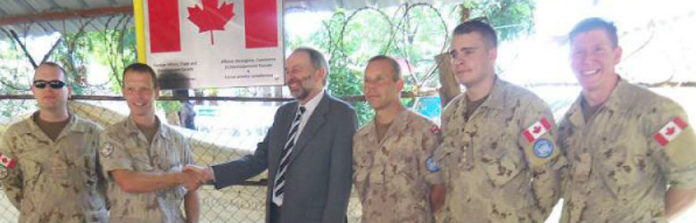
Nicholas Coghlan with Canadian troops in South Sudan

A former Canadian ambassador has questioned the ethics of a Canadian company’s sale of dozens of armoured vehicles to South Sudan’s military, which deployed them in a civil war that has killed tens of thousands of civilians.

In a newly published memoir, Nicholas Coghlan said he spoke to Ottawa officials and raised questions about the armoured vehicles sale when he learned of it while he was serving as Canada’s ambassador to South Sudan.

The Globe and Mail reported last year that Canadian-owned Streit Group had sold the vehicles to South Sudan, where they were used in combat. A report by United Nations experts last year said South Sudan had purchased 173 armoured vehicles from Streit in 2014, after the war began.

Mr. Coghlan said he was tipped off to the export deal in early 2015 by someone on social media who sent him a photo of the South Sudan military using the armoured vehicles to attack rebel positions.

“I followed up and the allegation was correct,” Mr. Coghlan writes in his book, Collapse of a Country, published this month by McGill-Queen’s University Press.

Lawyers in the federal government told him the vehicle export could not be prohibited by export-control laws because the vehicles were manufactured at an overseas Streit factory in the United Arab Emirates, even though the company itself was Canadian, he said.

“The legal case was watertight; it seemed to me that the ethical case was not,” he wrote in the book.

He also noted the vehicle export made it possible for people to accuse Canadian diplomats of “hypocrisy” for criticizing South Sudan’s crimes while a Canadian company was simultaneously selling arms to the country.

UN reports and other human-rights reports have documented a long pattern of massacres, rapes and destruction by South Sudan’s army since the war erupted in December, 2013. It has become one of the bloodiest wars in the world.

Over the past two years, The Globe has investigated a series of Canadian arms exports to countries with poor human-rights records, including a $15-billion deal to sell weaponized armoured vehicles to Saudi Arabia.

Mr. Coghlan’s book contains some ominous warnings for the future of South Sudan if the civil war continues. He quotes the retired Canadian lieutenant-general Roméo Dallaire, commander of UN peacekeepers in Rwanda during the 1994 genocide, who visited South Sudan in 2015 and told him that he noticed similarities between South Sudan and pre-genocide Rwanda.

The former ambassador described one of South Sudan’s war-ravaged cities, Malakal, as a haunting vision of what the entire country could become: “a lawless wasteland where all that mattered was your ethnicity and the calibre of your weapon.”

Mr. Coghlan was first posted to South Sudan’s capital in 2012, a year after it won independence and became the world’s newest country. He served as head of the Canadian office for two years, was formally appointed ambassador in 2014 and completed his term last summer.

Canada and other Western countries were strong supporters of South Sudan after its independence, but failed to see the growing likelihood of bloody internal conflict as its leaders feuded.

Analyzing how the country collapsed into war within two years of its independence, Mr. Coghlan says the donor countries – including Canada – failed to put enough emphasis on the process of peace and national reconciliation inside South Sudan in 2012 and 2013.

When the war erupted, the UN and humanitarian agencies soon became “scapegoats” and targets for the warring parties, Mr. Coghlan says. Dozens of humanitarian workers were killed, food convoys were looted and relief agencies were harassed by government troops and rebels as the agencies tried to provide aid to starving civilians.

In one incident, South Sudanese soldiers hijacked and looted a large convoy of UN food aid, including $300,000 (U.S.) in Canadian food aid, Mr. Coghlan said. But the UN insisted that the attack should be kept quiet, so that the UN wouldn’t jeopardize its difficult relationship with the government.

In another incident, after Uganda sent troops and military equipment to help South Sudan’s government, a Canadian doctor of South Sudanese origin was killed by a rocket from a Ugandan helicopter, Mr. Coghlan said.

Mr. Coghlan makes it clear that he disagreed with some of the Canadian government’s own decisions at the beginning of the South Sudan crisis, when Stephen Harper was prime minister.

After the war began in mid-December of 2013, hundreds of panicking Canadian citizens sought desperately to leave the country, and the Canadian Department of National Defence offered to send a C-130 Hercules aircraft to help evacuate the Canadians. But the offer was rejected by Mr. Harper’s foreign minister, John Baird, forcing the Canadian diplomats into the “embarrassing” position of depending on the generosity of other countries that were sending airplanes, Mr. Coghlan said.

Later that month, he said, Ottawa ordered him and his wife to leave the country immediately, refusing to listen to his request to stay and help the remaining Canadians, even though his workload with the desperate Canadians was as heavy as ever.

After he relocated to neighbouring Kenya, it took “lengthy and tedious negotiations with a risk-averse HQ” before he was allowed to make brief visits back to South Sudan to help evacuate more Canadians, he said.


Stories Continues after ad
UCC suspends ABS TV license

Some of the presenters on ABS TV

Uganda Communications Commission has indefinitely suspended ABS Television’s broadcasting license until when the commission is satisfied that the Kawala based station has modified and harmonized its programming content as per the law.

According to the Executive Director UCC, Godfrey Mutabazi, on October 28, 2016, ‘Pastor’ Augustine Igga’s station was fined Shs25 million for constant breaching of minimum broadcasting standards and the station vowed to desist from broadcasting offensive programs.

According to a letter dated September 5, signed by the Mutabazi, ABS TV management has been ordered not to bother UCC over its suspension.

Stories Continues after ad

IGG, city lawyer to review BOU top official ‘false’ wealth declarations

Embattled former Executive Director in charge of Supervision at Bank of Uganda Justine Bagyenda.

The Inspectorate of Government (IGG) is set to begin investigations into allegations that the Bank of Uganda (BOU) Director of Supervision Justin Bagyenda, made incorrect declarations contrary to the Leadership Code, 2002.

Sources speaking on condition of anonymity said officials from the IGG’s office will later this month meet with city lawyer Dennis Nyombi, to ascertain whether Ms. Bagyenda made false declarations about her assets including land and houses.

Among the property she allegedly falsely-declared are houses in the leafy suburbs of Ntinda, Naguru, Bugolobi and Kulambiro.

“When I wrote the letter I got confirmation from the IGG and I was to get an appointment with the official handling the matter but later on the person went abroad and we have now scheduled between September 10th and 20th to meet,” lawyer Nyombi, who is representing ‘whistleblower’ Dick Kimeze, said.

In his allegations, Mr. Kimeze also avers that the properties owned by Ms. Bagyenda are way above what she has earned during her employment over the years.

Contacted IGG spokesperson Ali Munira confirmed their office had received the petition against Ms. Bagyenda.

“Some lawyer wrote requesting for a meeting to discuss the wealth of the lady (Bagyenda); the meeting has not taken place,” Ms. Munira said on phone.

Over the past few months Ms. Bagyenda has been in the news, most notably for the manner in which she allegedly paid little attention to the supervision of Crane Bank, leading to its takeover by dfcu early this year.

Indeed, her critics charge that she failed to execute her mandate as the BoU Director of Bank Supervision, in respect to the-now defunct bank in which Uganda’s leading businessman Sudhir Ruparelia was one of the principal shareholders.

As a result of the closure and takeover, Mr. Ruparelia says that Crane Bank had assets deposited as security worth about Shs600 billion, whose accountability including proceeds from disposal has not been made by BoU.

Stories Continues after ad