Arsenal star Mesut Ozil will have one year left on his contract in the summer and the playmaker is demanding a weekly wage of £300,000 a week ($387,480 per week) to commit his future to the Gunners.
The World Cup winner with Germany is the top earner at the Emirates on a £140,000 a week ($180,824 per week). Media reports indicate Arsenal were ready to offer him £250,000 a week ($322,900 per week) to keep him at the club beyond the next season.
Ozil has decided against agreeing to the pay rise as he still feels the Gunners £50,000 short of his expectation. Should Arsenal agree to his demands, he will receive a pay rise close to 115%. However, the Gunners believe the former Real Madrid star’s demand is not value for money.
He has seven goals and six assists in the league from 28 appearances and his form against the top six sides has been below average this season. Arsene Wenger saw his side suffer a 2-0 defeat at the hands of Tottenham Hotspur at White Hart Lane.
The 28-year-old was subjected to heavy criticism from a section of Arsenal supporters and pundits for his poor form in the north London derby. In addition to this, the coaching staff at the club raised concerns over the ex-Bundesliga player’s commitment in the training sessions.
Arsenal’s No 10 is currently in a fix as he has failed to attract interest from any other club for his services, reports the Daily Mail. This is due to the player’s high wage demands, which many clubs are unwilling to match.
The situation could force Ozil to agree for a pay rise of £250,000 a week. Ozil is not the only player whose contract will run down in 2018. Alexis Sanchez will also have one year left on his contract in the summer.
Wenger earlier admitted the contract talks with Ozil and Sanchez will resume after the end of the season. Arsenal will be pressing for a quick decision from the German international. Should he decide against signing a new deal, the Gunners will be ready to cash in from his sale in the summer rather than letting him go for free a year later.
Arsenal’s problems are beyond Ozil’s contract situation. Wenger’s contract runs down after the end of the season and a decision over his future is yet to be revealed.
They are currently sixth in the table with 60 points from 33 games and are six points behind fourth place Manchester City. Arsenal have an advantage of a game in hand and will host manchester United in the league tie on May 7. A defeat at the hands of Jose Mourinho’s side is likely to end their hopes of qualifying for the next season’s Champions League
The High Court has dismissed an appeal by a one Steven Lubwama, seeking orders to overturn a ruling made by a lower court in regard to a land dispute.
In the appeal, he argued that the LC1 and LCII which entertained the dispute earlier did not have jurisdiction to handle the disputes in respect of ownership of the suit Kibanja henceforth requesting for a court order nullifying the decision.
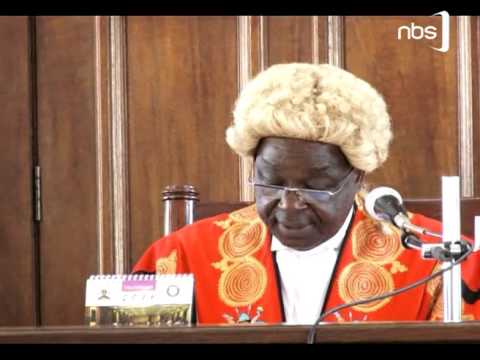
But in a ruling made Tuesday by Justice Andrew Bashaija of the High Court, the appeal was dismissed, with the ruling that the LC courts had the jurisdiction to handle the matter.
“Under section 10(1) (a) LCCA and 2nd Schedule to the same Act, the LCCs have jurisdiction to handle matters of trespass and in section 10(1) (b) and 3rd Schedule, disputes in respect of land held under customary tenure. Under section 10 (e) (supra) the LCCs have wider jurisdiction to handle matters relating to land generally. I therefore find no merit in grounds 2 and 3 of appeal as well,” Justice Bashaija ruled.
He further added that Lubwama had a chance of raising the objection at the lower courts but he did not.
“As such, this court (High Court) is not required to re-evaluate the evidence which is essentially the duty of the first appellate court. Even where the trial court has erred, the appellate court will only interfere where the error has occasioned a miscarriage of justice. The 2nd appellate court may only interfere with the decision of the immediate lower appellate court, if that court misapplied or failed to apply the principles of the law or the decision was manifestly erroneous.
“The LCCA under section 12 also provides for objection to jurisdiction. The Appellant had all his chances to object but he did not. Therefore, the objection being raised now is an afterthought which did not occasion a miscarriage of justice on the part of the Appellant. The appeal has no merit and it is accordingly dismissed it with costs to the Respondent.”
Background of the case
Lubwama bought a Kibanja from Ms. Painento Kaggwa Serina, a member of the Muganzilwazza Growers Co-Operative Society, on 21/05/1972. The Kibanja had clear boundary marks which had been in existence for 32 years. However, disputes later developed over the boundaries between Lubwama and the Muganzilwazza Growers Co-Operative Society, which had sold him the land.
Muganzilwazza Growers Co-Operative Society claimed that Lubwama had extended the boundaries and encroached on the Kibanja that belonged to the Respondent. The dispute was referred to the LC1 court of Katooke which decided in favor of Lubwama.
Muganzilwazza appealed to the LCII court of the area which also ruled in favour of Lubwama.
Muganzilwazza then filed an appeal in the LCIII court of Nabweru and still lost.
It then filed an appeal in the Chief Magistrate’s Court of Nabweru, with then Chief Magistrate Joy K. Bahinguza ruling in the Coop society’s favour.
The trial court then ordered Lubwama to immediately remove any structures that he had constructed on the disputed land, and each party was to meet their own costs.
Dissatisfied with the judgment and orders of the trial court, the Appellant was and filed this appeal advanced three grounds of appeal as follows:
That the learned trial magistrate erred in law and fact when she held that the Muganzilwazza is a legally existing co-operative society whereas not.
That trial magistrate erred in law and fact when she entertained and upheld proceedings from the L.C Courts which had handled the subject matter without jurisdiction to do so.
That the trial magistrate erred in law and fact when she relied on the L.C 1 and L.C II judgments which had been passed by the said courts when did not have jurisdiction.
At the hearing of this appeal, Lubwama was represented by Kenneth Kajeke while the Muganzilwazza was represented by Counsel Twinamatsiko.
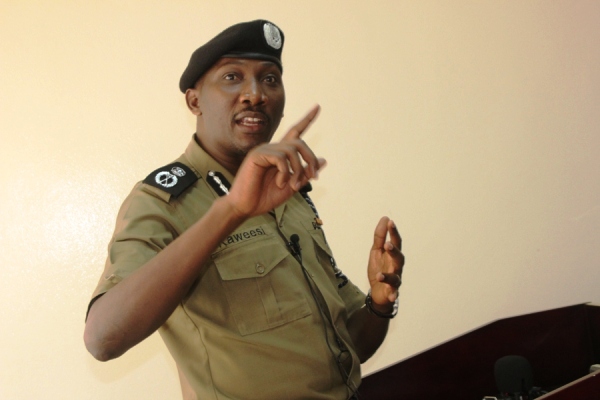
INVESTIGATIONS ONGOING INT DEATH: AIGP Felix Kaweesi.
Andrew Felix Kaweesi
On March 17 this year, Assistant Inspector General of Police (AIGP) Andrew Felix Kaweesi, his bodyguard Kenneth Erau and Driver Geoffrey Mambewa were killed in a hail of bullets by unidentified gunmen near his home in Kulambiro.
The shocking death was however eclipsed by the ensuing confusion as investigations were underway, with a policeman intruding the scene of crime and attempting to pick soil samples allegedly on the orders of a senior police officer, Assistant Commissioner of Police (ACP) Jonathan Baroza, a former aide to the Inspector General of Police (IGP) General Kale Kayihura.
The intruding policeman was stopped in his tracks by AIGP Fred Yiga and since then nothing much is known about his whereabouts. But ACP Baroza, the officer who allegedly sent him, has been sent to Algeria to ostensibly pursue further studies, a development we are told, has not gone down well in some police circles.
It is imperative to note that as all the hullaballoo over AIGP Kaweesi’s murder raged on, President Yoweri Museveni weighed in, ordering IGP Kayihura to ‘clean up his house’, which he said, had been ‘infiltrated by mafia’.
However, as all that goes on several people have been arrested in connection with AIGP Kaweesi’s murder, with the Mayor of Kamwenge Geoffrey Byamukama allegedly tortured for being linked to the death. Also, a very experienced intelligence operative, Lt Godfrey Musisi, formerly of the Internal Security Organisation (ISO) is being held at the Nalufenya police Special Operations facility in Jinja, while 13 other suspects have already been arraigned before court to answer to the Kaweesi murder charges.
Currently, not much is known about the case but police says investigations are progressing.
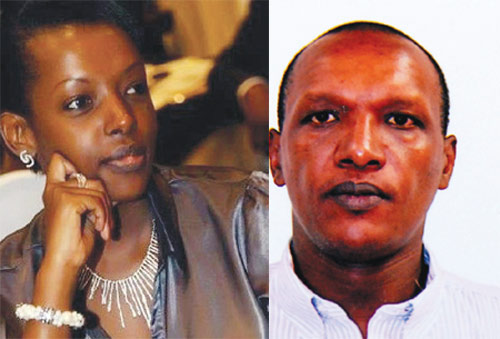
Juvenal Kananura/Jackie Nsenga Kananura
Jackie Nsenga Kananura (R) and husband Juvenal Kananura (L) RIP.
In January 2013 city tycoon Juvenal Kananura was killed by his estranged wife Jackie Nsenga, who knocked the deceased with a car at his home in the leafy Bugolobi suburb.
Immediately after Kananura’s death all seemed to have been settled, with the tycoon father Donat Kananura exonerating Jackie of any mischief in relation to the knocking down of her husband.
However, all this was to nastily turnaround, with new claims by Kananura’s family that Jackie killed Juvenal Nsenga intentionally. This followed other claims linked to the deceased’s property and its inheritance. Sources say the older Kananura was peeved when Jackie claimed all the properties yet the family had allegedly turned a ‘blind eye’ to the killing of their son, ostensibly to focus on the future of the deceased’s children.
As the feud raged on, several big names including President Yoweri Museveni, Inspector General of Police (IGP) General Kale Kayihura and other police officers came up, with Kayihura allegedly shielding Jackie, who is said to be his in-law, from the ensuing pressure.
At the time, reports indicate, Mr Museveni intervened and prevailed over those involved with the case to handle it expeditiously, at the prompting of Donat Kananura, who had allegedly since changed positions and blamed his daughter-in-law for the death of Juvenal Kananura.
Kenneth Watmon Akena/Mathew Kanyamunyu
KILLED: Kenneth Akena Watmon
In November 2016 social worker Kenneth Watmon Akena was shot dead, allegedly by Mathew Kanyamunyu, who was in the company of a female friend, Cynthia Munangwari. This assumption is based on the ‘dying declaration’ allegedly made by Akena to his brother who had rushed to his assistance at Nakasero Hospital.
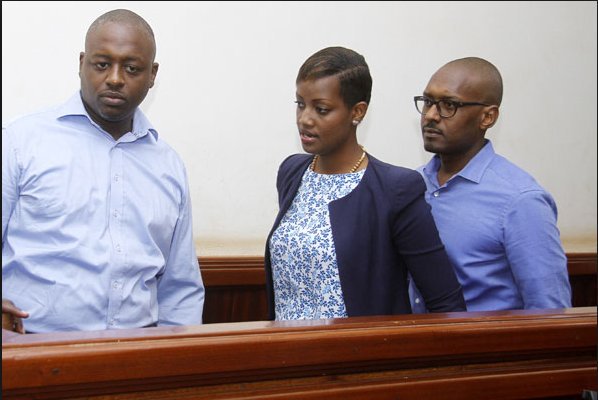
L-R Joseph Kanyamunyu, Cynthia Munangwari and Mathew Kanyamunyu in the dock.
However, immediately after Akena’s death, things started unfolding negatively, with the killer gun missing, reportedly with the connivance of Kanyamunyu’s brother Joseph, who had also rushed to Nakasero Hospital at the beckon of his now distressed brother.
Mathew Kanyamunyu’s lady friend Cynthia Munangwari in the car
Meanwhile, the other would-be exhibit, Kanyamunyu’s car, had been cleaned.
Subsequently, murder charges were preferred against the Kanyamunyu brothers, Mathew and Joseph, together with Ms. Munangwari and the trio remanded in Luzira Prison.
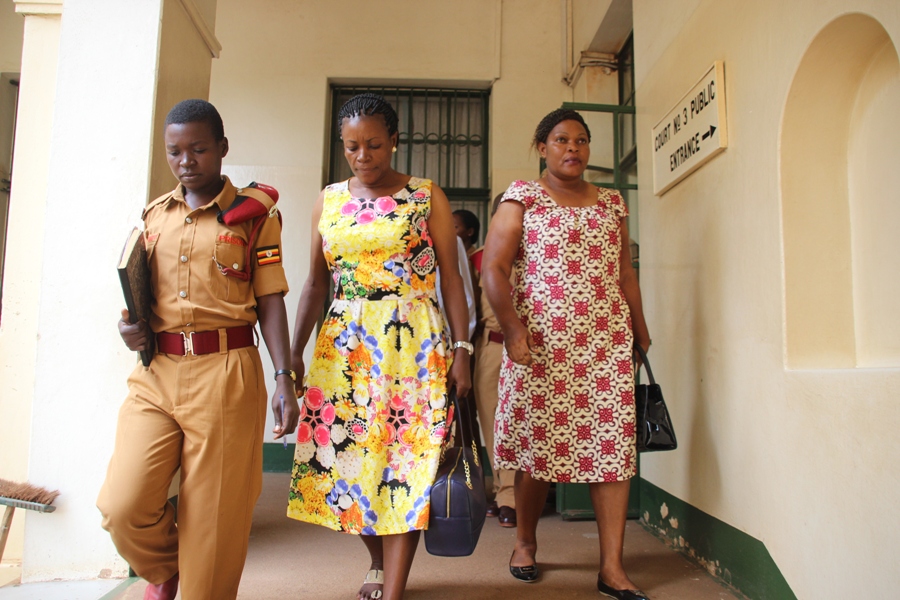
Winnie Byanyima, an aunt to Mathew Kanyamunyu while in court to stand surety for her nephews.
Since then Joseph and Cynthia have been granted bail but this was before politics took the better of the case, with politicians Odonga Otto and Beatrice Anywar turning it into a North-West feud when Mathew’s aunt, Oxfam Executive Director Winnie Byanyima appeared in court to stand surety for her nephew, Mathew. Winnie is wife to opposition Forum for Democratic Change flag bearer Dr. Kizza Besigye.
Mr. Samuel Odonga Otto and his colleagues at Jinja Road police station, to make a follow up on Akena’s shooting.
Both Odonga Otto and Anywar are opposition FDC MPs, and the former, on seeing Winnie in court, vowed to ensure her husband Dr. Besigye ‘never sets foot’ in Northern Uganda. Odonga Otto also vowed that should police investigations get botched, he would mobilise for the exhumation of Akena’s body from the deceased’s ancestral home in Northern Uganda and have it reburied in Western Uganda, and subsequently ditch the FDC party altogether.
Eria Bugembe Sebunya aka Kasiwukira/Sarah Nabikolo and others
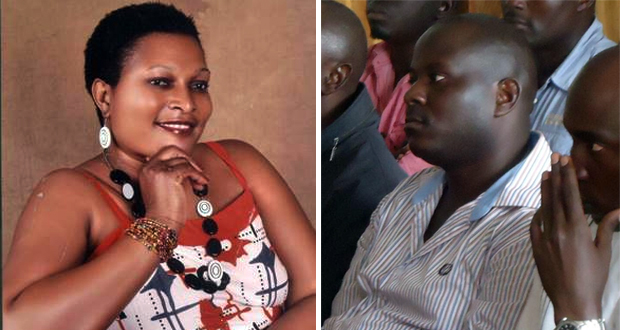
Sarah-Nabikolo-and-Nakungu-Sandrah
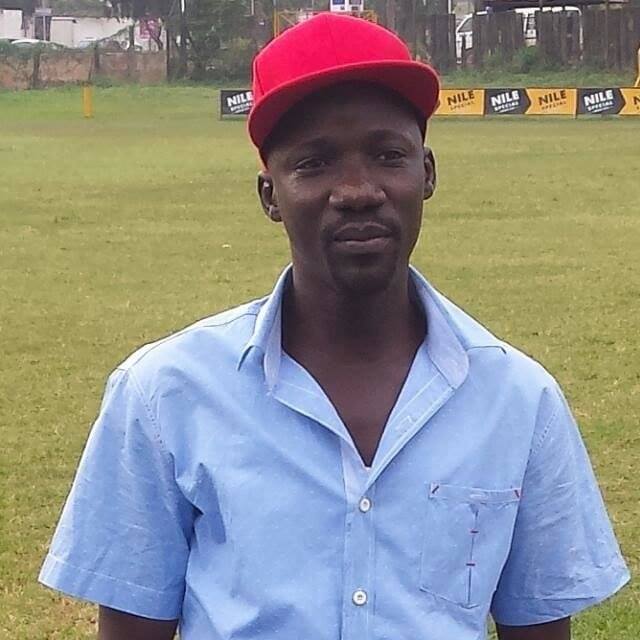
Just like tycoon Juvenal Nsenga, another tycoon Eria Bugembe Sebunya aka Kasiwukira was knocked by a car in the morning as he left his home for a jog.
Eria-Sebunya-Bugembe-aka-Kasiwukira
And, despite believing that Kasiwukira had been murdered, there were murmurs by family and friends of the billionaire-laden Kwalagalana Group, that police had failed in its duties to apprehend the suspects.
“Police have been putting up rewards for people who help to identify criminals but are yet to do so on this case. Why? As members of Kwagalana group we shall not sit back but announce a big reward for any person who leads to the arrest of people involved in this murder.”
In fact, during that time there emerged rumours that one of the Kwagalana Group members, who owed billions to the deceased, was responsible for the murder of Kasiwukira. However, there were also some pointing fingers in the direction of Kasiwukira’s wife Sarah Nabikolo, who was allegedly embroiled in a bitter family quarrel with her husband.
But frustrated by the slow pace and seemingly tired wheels of Uganda’s justice system, the Kwagalana Group members subsequently put up a reward of Shs15m as a reward for anyone with information that could lead to the arrest of Kasiwukira’s murder suspects.
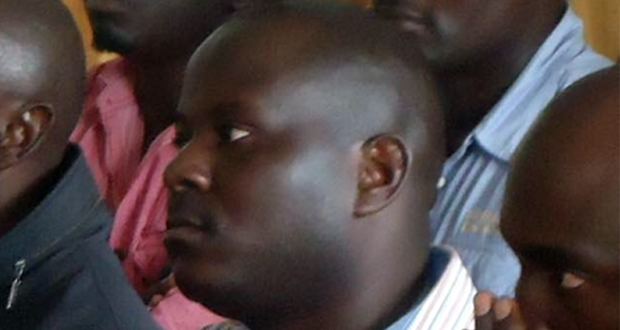
Reading the frustrated mood, the police swung in action and arrested the suspects: Kasiwukira’s wife Sarah Nabikolo, her sister Sandra Nakungu and one police constable, Ashraf Jadin. Intriguingly, the tycoon who had been cited in the murder never made the suspect list.
However, in summary, Nabikolo, her sister Nakungu and PC Jadin were convicted and are currently serving their sentences in Luzira Prison.
That all the cases cited above have had been surrounded by controversy is a worrying indictment on our justice system, which calls for the immediate intervention by the respective authorities.
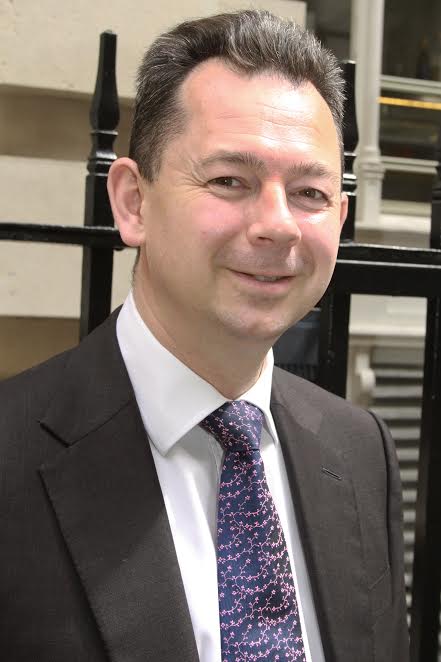
The Director Public Service – Institute of Chartered Accountants in England and Wales (ICAEW’S) Ross Campbell gave the interview below on Public Finance Management in Uganda, and focused on issues regarding reforms, corruption, donors and taxation among other issues.
This was during the 4th Africa Congress of Accountants from 2nd – 5th May 2017 under the theme ‘Accountancy and Accountability: Transforming Africa’s Economies’ at Speke Resort Munyonyo.
Below are the excerpts:
What does public finance management generally entail?
At its highest level public finance management entails ensuring that public funds are spent in accordance with the public good, that this spending represents value for money and that the continued expenditure is sustainable within realistic projections of government revenue. This also requires good record keeping to ensure accountability to tax payers, effective risk management, and, critically, that future spending plans can be financed wisely which then promotes the creation of a stable economy.
What are the strong pillars that make up an effective public finance management system?
There are many pillars which support the creation and functioning of a stable and effective public finance management system. Among them are:
A strong accounting profession with qualified individuals who hold internationally recognised professional qualifications.
Robust international standards for accounting and audit to which professionals must adhere.
A strong independent audit profession which promotes transparency and accountability.
Ensuring that those holding senior management finance roles are appropriately qualified.
Creating and implementing appropriate systems and processes to guide the profession and ensure that professionals operate with integrity and accountability.
Publishing comprehensive information about public finances to promote trust in the profession.
Despite the enactment of a number of public finance management reforms since the 1990’s, Uganda continues to face many scandalous cases of misappropriation of public funds. What steps would you advise the government of Uganda to take to curb the vice of corruption altogether?
The single most important thing that any government can do to address corruption, whether in the present or the future, is to increase transparency by publishing up-to-date information which clearly and concisely presents how public funds have been used and what benefits these have resulted in for the society. This must be backed up by a strong independent audit function. In so doing, the government makes it much more difficult, if not impossible, for individuals who seek to engage in corrupt activities.
The public service has been riddled with corruption scandals mainly because of the weaknesses within financial management in government entities. What recommendations would you give to solve weak accountability that comes with soft controls and widespread corruption within the political and bureaucratic frameworks?
In order to bring in strong controls you need people who understand what such a system looks like and how it operates. Generally speaking, these are professionally qualified accountants or auditors who have successfully achieved very rigorous qualification, usually of an international standard. Moreover, these professionals will be held to standards of behaviour by the professional body with which they qualified, with disciplinary consequences if any unethical behaviour on their part has been proven. In fact, this is a key requirement to address accountability: there must be consistent and enforced controls which safeguard the integrity of the profession.
Continuous corruption in Uganda has prompted several donor agencies to suspend budget support to Uganda over the years since 2012. What advice would you give regarding attracting these donors back?
Fundamentally, these donors have to trust the system. In order to either build or regain their trust, governments who require this funding, whether in Uganda or elsewhere in the world, must bring in reforms to ensure there is strong oversight and that that system of oversight and audit is itself subject to quality checks. And the more independent that system is of government and the more it uses international standards for quality assurance and good practice, the more confidence these donors will have in it. This is the most critical way of restoring confidence and proving to these donor agencies that their support is appreciated and that their concerns are being seriously addressed.
The effectiveness of Uganda’s public finance management has also been affected partly by limited internet, infrastructure coverage, and a shortage of technical capacity expertise to operate the systems. What is your advice on improving Uganda’s public finance management?
Any system, in order to be effective, must be supported by a strong infrastructure which includes having professionals with the necessary skills and qualifications, systems that are resilient and capable of supporting the management and clear, transparent and auditable business processes. All three must be implemented together as they support each other. Having one without the others is not enough to ensure a robust public finance management system.
Citizens in Uganda continuously feel hard-pressed with taxes. How better can government of Uganda articulate the importance of paying tax to its citizens?
Again, this is a question of trust. In any society, the people must see how their taxes are being used and what benefits they are receiving. In other words, governments must justify the implementation of various forms of taxation. This is done, as mentioned earlier, through the publication of clear, concise, comprehensive, and independently audited information about public finances to promote trust in the profession and that their money will not be misappropriated. Only then will people believe in the importance of paying taxes.
Should the government of Uganda be accountable to its citizens for each expenditure? If so, how?
Yes, of course. Any government must if it wishes to build trust in the system of public financial management. The way to do it, again, is through the publication of clear, concise, comprehensive, and independently audited information regarding how funds have been used and the benefits to society.
WROTE LETTER: Fred van Leeuwen, the EI General Secretary
An international organisation, Education International (EI), a body that brings homosexuals together has written to Uganda National Teachers’ Union (UNATU), requesting the officials to develop education programmes aimed at fighting intolerance and prejudice against homosexuals.
Fred van Leeuwen, the organisation’s General Secretary wrote: “They must provide professional guidance to class room teachers to carry out these programs effectively. This is not just a matter of sex education and removing stereotyping in textbooks. The trade union movement can play an important role as well.”
Some of the organisation’s expectations from UNATU include fighting for the right of teachers to be open about their sexual orientation at the workplace.
“I see three important tasks for trade unions in general and for national education unions in particular: Number one is of course to protect their gay and lesbian members. We must fight against open or covert discrimination by employers public authorities, by colleagues, by parents, or by students, with all available means. Here there is no room for compromise.
If we believe that teachers have the right to be open about being gay or lesbian we must create the environment in which they can be themselves without fear. Subsequently, unions should be actively engaged in the establishment of anti-discrimination legislation and equal treatment policies in the education sector and in society at large,” reads the letter.
“As for teachers, which I strongly believe should have that right I go even further. I believe teachers should be open about being gay or lesbian. Today our students are led to believe that they are being taught only by heterosexuals – or worse, by non-sexuals. Yet, if we want to effectively fight prejudice and at the same time help students cope with discovering their own sexual orientation, we should stop being so uptight about who we are and what drives us.”
The statement further states that they have made huge progress in, “although the Catholic Church and its allies make every possible effort to protect the continent from what they consider to be moral decline. In Argentina, thanks to the EI member organisation, social security rights now also cover partners of gay and lesbian teachers. Interesting developments also in Brasil, Mexico and in Costa Rica, where dismissals on grounds of sexual orientation, is no longer accepted.”
But unlike Latin America and Europe, the letter states that their efforts in Africa and Asia are yet to yield any positives results.
“The situation in Africa and Asia-Pacific, however, is less encouraging. With the exception of a few countries, many of our member organisations in these regions are not eager to address questions around gay and lesbian rights.”
Education International claims to have a membership of 26 million teachers “in virtually every country on this planet, which includes between one and a half and two million homosexuals. EI will continue advocating their rights and the rights of the students they teach. We cannot expect them to come out as long as these rights are not respected”.
“But we will only be successful if our global initiatives are combined with action at the national and local levels, the kind of action which I hope and believe will be the result of this Conference.”
It is worth noting that the 1995 Constitution of Uganda prohibits same sex engagements.
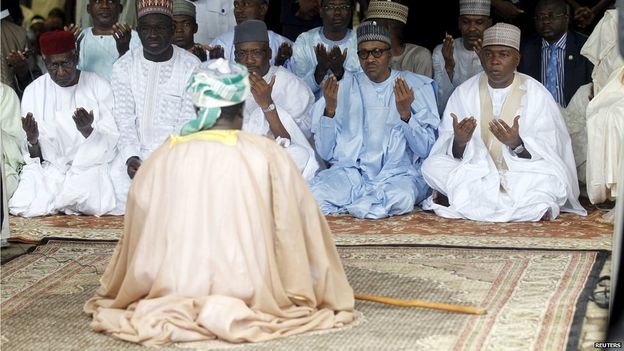
Nigeria President Muhammadu Buhari (second right in blue) attending prayers some time back. Reports indicate his health has 'deteriorated'.
A group of prominent Nigerians has called on President Muhammadu Buhari, 74, to take medical leave, amid growing concern about his health.
There was an ‘apparent deterioration’ in his health following his failure to attend the last two cabinet meetings, the group said.
The development follows a meeting that was reportedly held on Monday by three former Presidents: Chief Obasanjo Olusegun, General Ibrahim Badamasi Babangida and General Abdusalami Abubaker, to discuss Mr. Buhari’s health challenges.
Mr Buhari took about seven weeks of medical leave in January, and flew to the UK for treatment.
When he returned home in March, he said he had never been so ill in his life.
Mr Buhari has not disclosed his illness, but hinted that he had had a blood transfusion.
Information Minister Lai Mohammed said that the president’s health was ‘a personal matter’. Nigerians have been kept aware of his condition, he added.
The 13-member group included some of the Nigeria’s most influential civil society figures, including lawyer Femi Falana, political analyst Jibrin Ibrahim, and Transparency International Nigeria head Anwal Musa Rafsanjani.
In their statement, they said the president had not been seen in public for the last week, and his absence from the cabinet meetings, as well as the weekly Friday Muslim prayers, ‘has fuelled further speculation and rumours’ about his medical condition.
The 13 said they felt ‘compelled’ to ask Mr Buhari “to heed the advice of his personal physicians by taking a rest to attend to his health without any further delay”.
Mr Buhari’s personal assistant Bashir Ahmed said the president had met Justice Minister Abubakar Malami and other officials at the presidential villa on Tuesday as part of his official duties.
Last week, presidential spokesman Garba Shehu said Mr Buhari was “taking things slowly, as he fully recovers from the long period of treatment” in the UK.
Buhari’s unhealthy start to 2017
19 January: Leaves for UK on “medical vacation”
5 February: Asks parliament to extend medical leave
10 March: Returns home but does not resume work immediately
26 April: Misses second cabinet meeting and is “working from home”
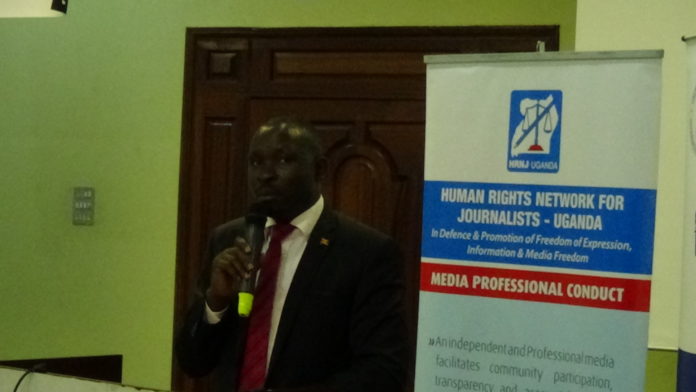
HRNJ Coordinator Robert Sempala addresses the participants
There could be tough times ahead for journalists as the Press Freedom Index Report of 2016 shows how political intolerance stifles media.
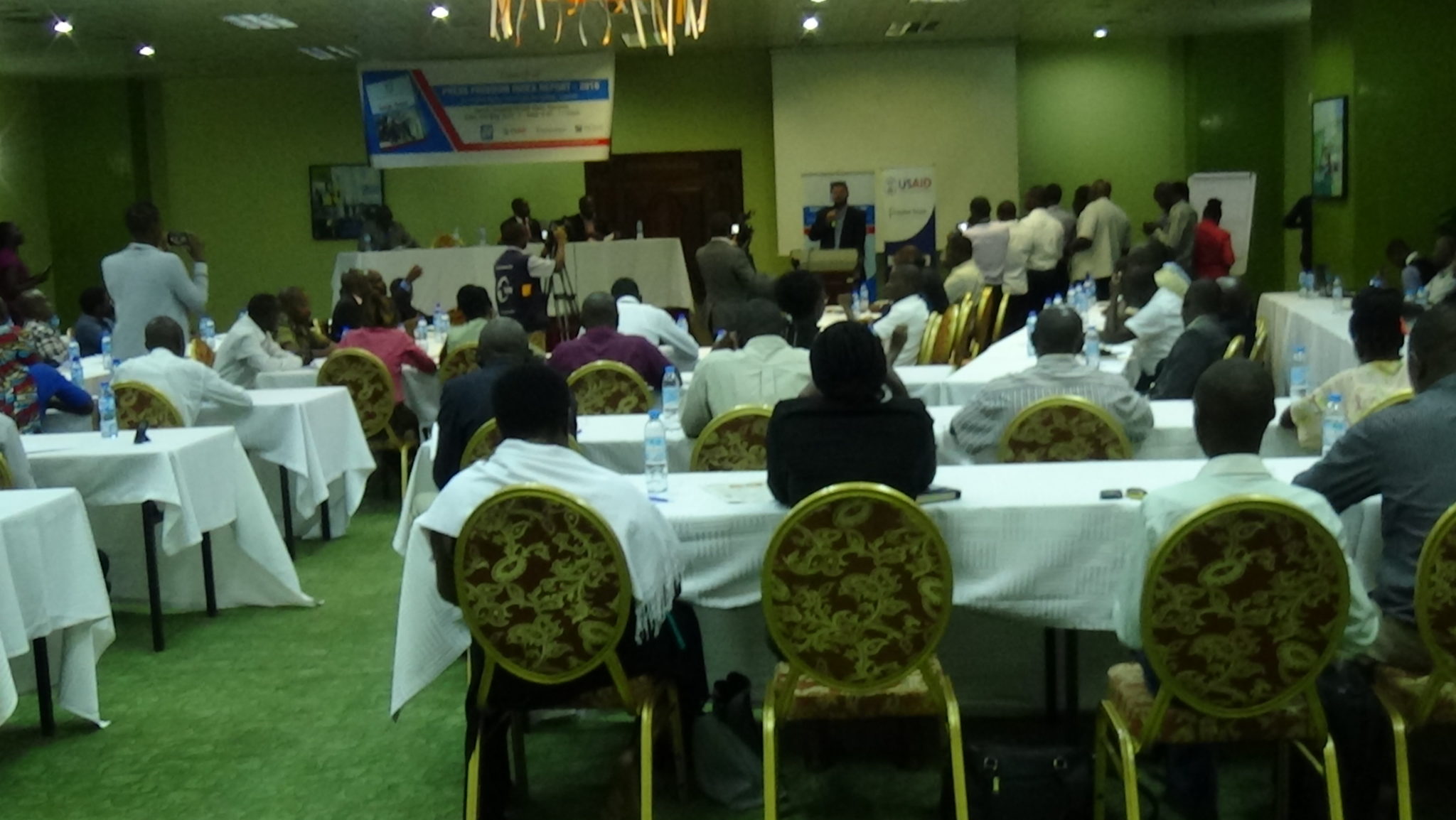
Participants follow proceedings
In Uganda the report indicates that the police tops the list of violators of media freedom for the 4th year running, and quotes the Human Rights Network for Journalists (HRNJ) National Coordinator Robert Sempala said all media platforms in the country irrespective of the ownership were covered through investigations for the over 135 cases reported, and that the Uganda police force topped the list with 83 cases, about two-thirds of the total violations.
Giving an overview of report Sempala added that most of the attacks have been directed at the female journalists. He also said that the election year (2016) exposed journalists to unprecedented attacks, adding that there was no government intervention to improve the legal and policy framework to enhance the media freedoms.
Nils Mueller, the Uganda Director for Democracy, Governance and conflict programs for USAID launched the FRIR 2016
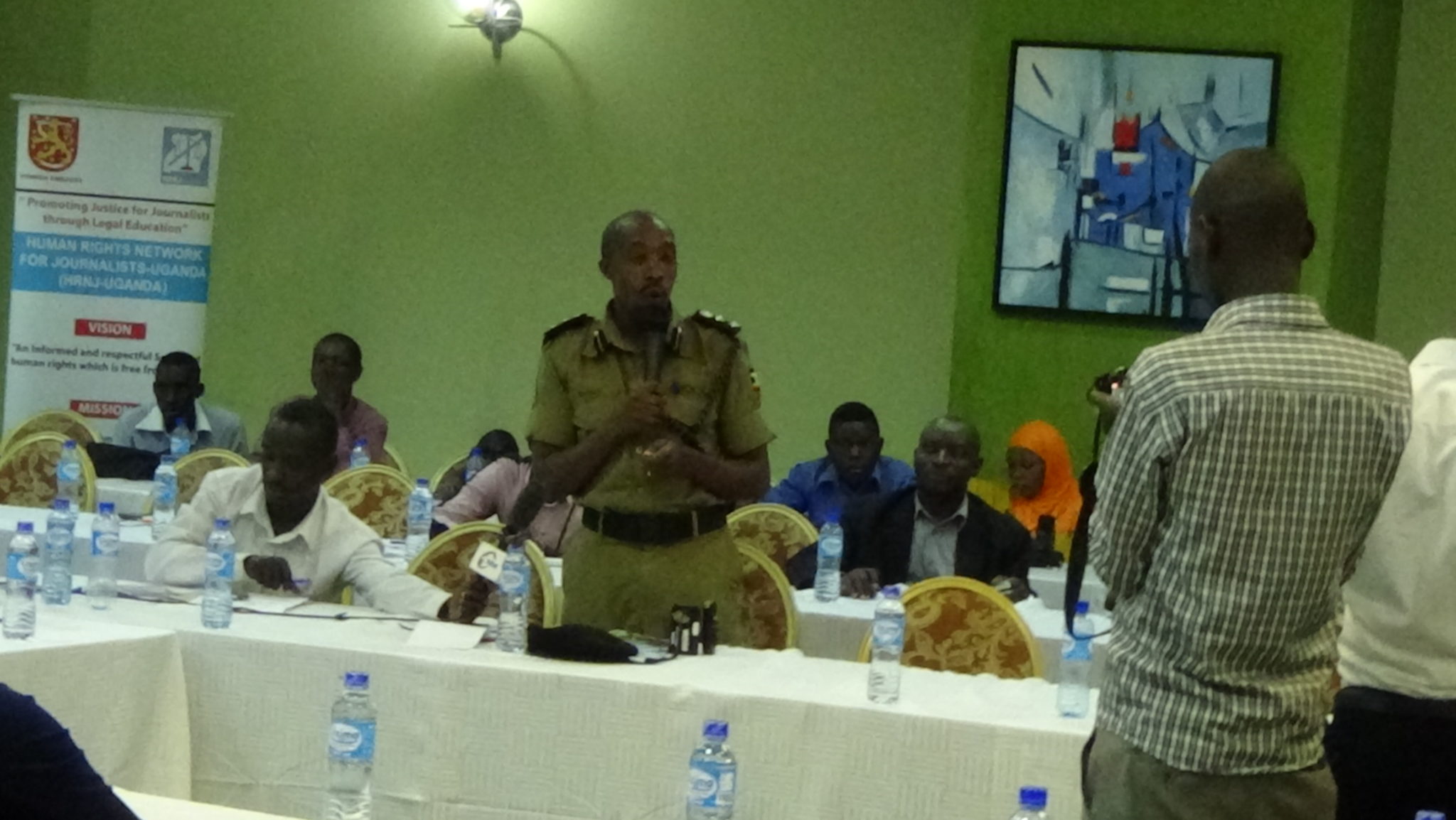
Nils Mueller, the Uganda Director for Democracy, Governance and conflict programs for USAID launched the FRIR 2016, and speaking during the launch Emillian Kayima, the Kampala Metropolitan Police (KMP) spokesperson cautioned journalists about professionalism in line with their duty and also asked a team from HRNJ-U to schedule a meeting with the Uganda police.
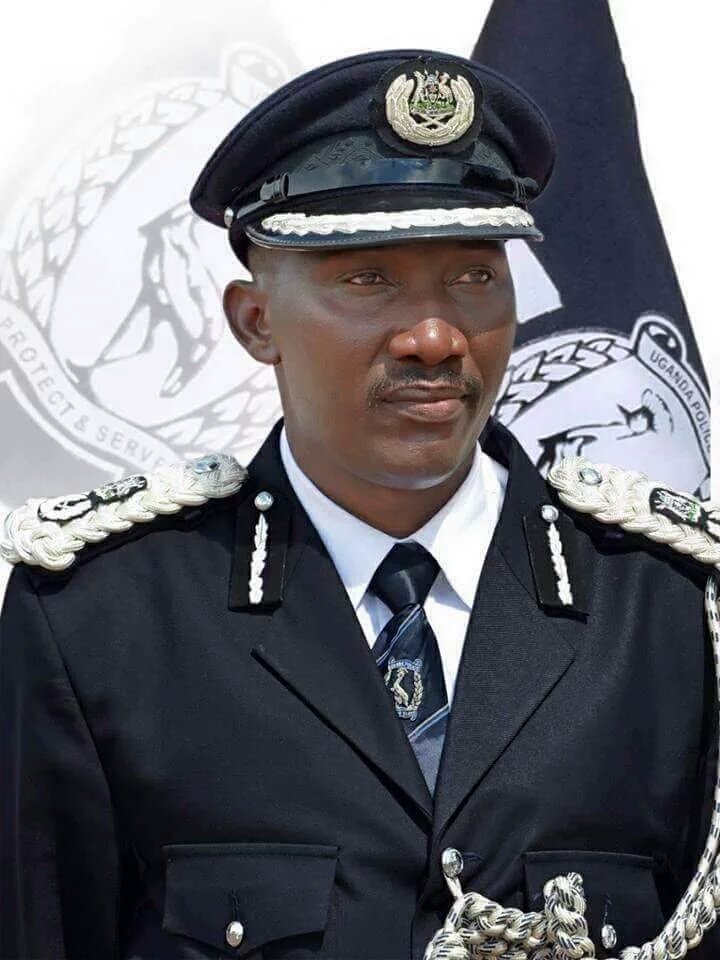
CALLED FOR MEDIA/ POLICE FRATERNISATION: KMP Spokesperson Senior Superintendent of Police (SSP) Emillian Kayima
‘’I would like to ask Robert (Sempala) and his team to sit with the Uganda police leadership and analyse all the cases and give updates, and have the resolutions included in the next PRIR,” Senior Superintendent of Police (SSP) Kayima implored.
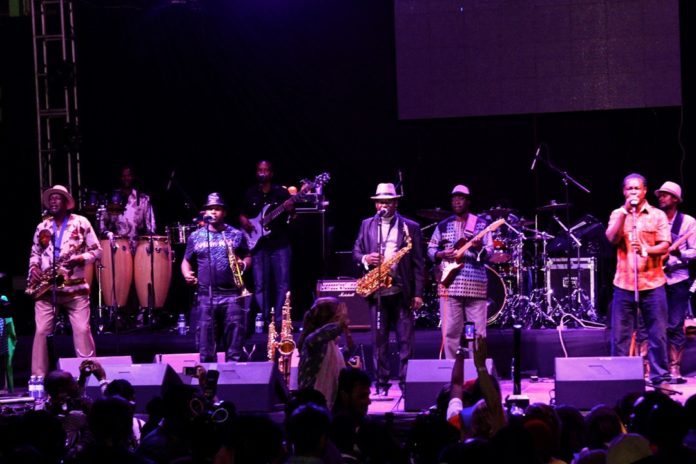
DOWN MEMORY LANE: members of Afrigo Band entertain revellers at the Blankets and Wine
The 17th edition of the Tusker Mall Lager sponsored and House of Deejays organized Blankets and Wine Kampala was one to remember as revelers turned out in numbers to grace the most sought after event on Uganda’s social scene calendar.
Revellers at the Blankets and Wine fete at Lugogo cricket Oval
Despite the earlier rain scare, revelers flocked Lugogo Cricket Oval for what was to be a memorable Sunday evening. With an electrifying lineup consisting of Cindy, Afrigo Band, Kenya’s Muthoni the Drummer Queen, Scandinavian group band – Daniel Lemma & Hot This Year, Fena Gitu, Kager Mungai, Pelindah, Byg Ben, Apio Moro, Joash, Mayonde, Essie, DJ Beekay & RPM and DJ Rachel, the evening was set to be a fun filled one.
DJ Rachel set the day’s funfair rolling with her mixes and later revelers were treated to performances from rising stars Pelindah, Joash, Essie, Apio Moro and Byg Ben who had the crowd dancing to some afro-fusion music in the afternoon.
As the night fell, Daniel Lemma and Hot this Year took to stage to and performed some of their big hit songs such as; Call you, Still water, Mr. Hibbert, among others.
By the time Afrigo Band took to stage, revelers were in anticipation for yet another memorable experience as they sang and danced to the band’s timeless hits such as; Olundelebu, Okwagalana kwaffe, Ekitobero, Mundeke, Nantongo.
Tusker Malt Lager treated revelers to their pitchers of Draught beer as they enjoyed a memorable music experience.
Kenya’s Muthoni the Drummer Queen later came to stage to an already psyched up crowd and continued to fire it up with her hit songs such as; Squad up, Life, Make it right, and Turn on the lightswhere she featured Uganda’s Hip Hop star The Myth.
When the day’s main act Cindy Sanyu came to the stage, she was welcomed by an enthusiastic crowd that went on to sing along to her songs. Cindy’s dance crew entertained the revelers with astonishing dance moves as fans pitched in to dance along.
Maureen Rutabingwa, the Tusker Malt Lager brand manager said; “We gave the line-up a boost of energy and people enjoyed discovering new talent! For Tusker Malt, we will continue to always make Blankets and Wine a memorable time and show appreciation to our consumers by giving them the best premium experience.”
A quarterly, picnic style music festival, Blankets and Wine is proudly sponsored by Tusker Malt Lager alongside other partners. Tusker Malt Lager is 100% Malt and 100% African and aims at giving consumers a premium experience by showcasing our very own African Talent and LIVE performances by a wide array of artists.
In line with its support for responsible drinking, Tusker Malt Lager will be maintaining a strict ‘over 18 only’ policy for sale of alcohol.
Over the years, the justice system in Uganda seems to be wobbly, with so many unexplainable inconsistencies. As a result, there have been a number of murders, both high and low profile, which have gone unanswered, thanks to the seemingly rusty justice system that appears to reward evil and turn a blind eye the good.
In Uganda the principal executors of the law are the police force, the Directorate of Public Prosecutions (DPP) and the courts of law, with the former two supposed to play a crucial role in criminal prosecutions, while the courts must ensure that justice is served in both criminal and civil proceedings.
Other institutions that play equally crucial but incendiary roles to the three principals include among others the Executive (which oversees the police and DPP); the Parliament of Uganda which plays an oversight role over all government functions; the Inspectorate of Government (IGG), the Auditor General, the Financial Intelligence Agency (FIA) and the media which, unfortunately, in the eyes of the other institutions of accountability is viewed as ‘intrusive’ and the least ‘powerful’ of the incendiary players in Uganda.
Needless to say, much as the performance of the above-mentioned institutions is very wanting, and to say the least, there are those institutions like the police and judiciary which have distinguished themselves as harbingers of injustices, nefariously appearing on top of almost all accountability reports by the statutory rights bodies like the IGG and the Uganda Human Rights Commission (UNHRC).
The same institutions also feature highly on international rights platforms like the US State Department; Human Rights Watch and Amnesty International, among others.
For instance, the US State Department Country Report for Uganda in 2015 details a number of injustices committed by the State through police action that led to the ‘arbitrary or unlawful deprivation of life; disappearance; torture and other cruel, inhuman, or degrading treatment or punishment; prison and detention center conditions’.
Against such a background, it has become a herculean task to call the wayward State actors to order, a situation that has eroded the public trust and probably also led the non-state actors to take the law in their hands to settle scores, in the hope that perhaps the long arm of the law might not catch up with them, or if it does, then the possibility of circumvention of the due process is open to the criminals.
That said, it is important to point out that over the years a number of Ugandans have met their death occasioned by non-State actors. Unfortunately, often the process to bring those suspected of causing the deaths to book seems fraught with inconsistencies, leaving the public to vent out its anger on social media and other channels of communication including ‘word of mouth’.
RIP: Deceased Assistant Inspector General of Police (AIGP) Andrew Felix Kaweesi.
Such cases that have drawn media attention include the ‘high profile, middle and low class’ killings of among others the Assistant Inspector General of Police Andrew Felix Kaweesi; former Mukono District Police Commander (DPC) James Aurien; 10 Muslim clerics (the suspects are currently facing trial); businessman Eria Bugembe Sebunya aka Kasiwukira; businessman Juvenal Kananura (wife Jackie Nsenga convicted); businesswoman Donah Katusabe; 12-year old Joseph Kasirye; the nine residents of Rakai (suspect Ponsiana Lwakataka was acquitted) Brenda Karamuzi, (boyfriend Tom Nkurungira aka Tonku was convicted); social worker Kenneth Watmon Akena ( main suspect on remand) and Badru Kateregga, whose alleged killers including city businessman and rally driver Andrew ‘Desh’ Kananura, his brother Raymond Kananura and three others were acquitted last week.
INTRUSION? Former IGP’s Personal Assistant ACP Jonathan Baroza
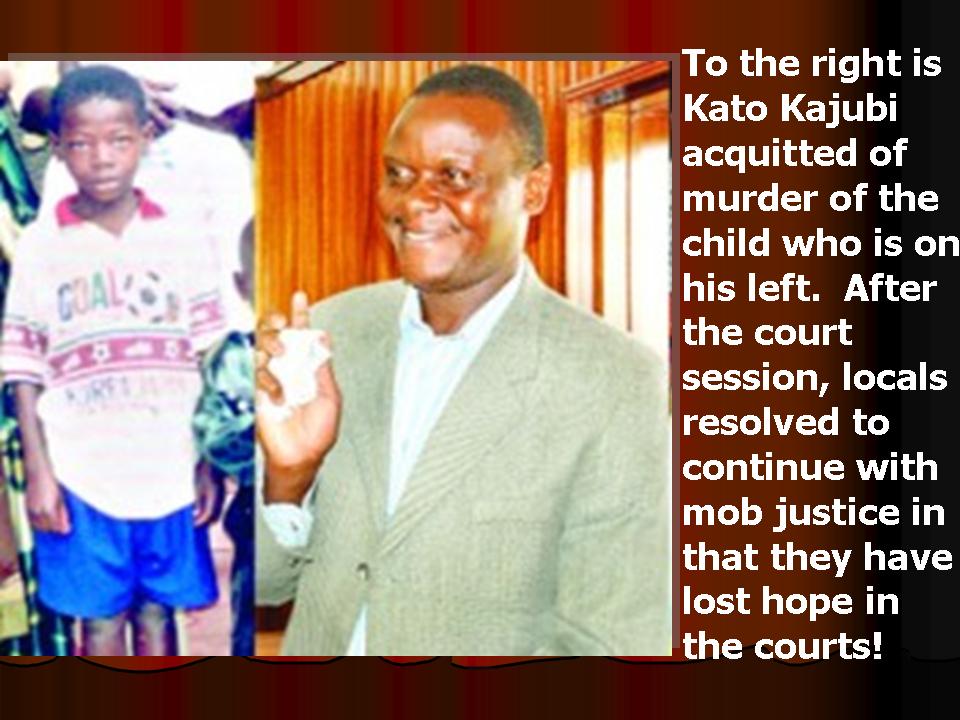
It is instructive to note that in all the above murders the due process has often not been without controversy; the ‘scene of crime’ intrusion in investigations into the killing of AIGP Kaweesi, allegedly carried out on the orders of ACP Jonathan Baroza; the alleged botched investigations and cover-up in Ms. Katusabe’s killing; and the shame investigations and nefarious trial and subsequent acquittal of Kato Kajubi, youthful Kasirye’s killer.
Some of the controversial cases
Andrew ‘Desh’ Kananura and others (murder of Badru Kateregga)
Last Friday, High Court Judge Joseph Murangira acquitted murder suspects Andrew ‘Desh’ Kananura, his brother Raymond Kananura, Cyrus Maganda, Samuel Muzolewa and Jacob Onyango, all of who had been accused of killing Badru Kateregga, a barman at Panamera Bar owned by Desh Kananura.
The trial and subsequent acquittal of the five suspects has caused skeptism among the public and in the corridors of the DPP, with spokesperson Jane Kajuga Okuo bitterly criticizing the Judge and also saying her office would appeal the ruling.
“It is our considered opinion that he (the Judge) did not evaluate the evidence at all. We don’t understand how he came to this conclusion,” Ms Okuo Kajuga, a Senior Principal State Attorney ranted.
However, even before one jumps to her defence, the Judge observed that the police officers who investigated the case had not been brought to testify before court on claims that they feared for their lives, something that appears suspicious, given that they handled a sensitive part of the case that also involved collecting ‘scene of crime’ information. So the question arises: ‘why did the DPP not bring the policemen to give evidence in court, knowing very well that their input was a critical ingredient in determining the culpability of the suspects?
Indeed, from the onset the case against Kananura seemed destined to encounter challenges; for how could a murder suspect be allowed to fly out of the country amid such flying accusations of Kateregga’s murder against him?
RECUSED SELF: High Court Judge Wilson Masalu Musene
Also, the case that dragged on for five years is reputed to have had the highest number of High Court Judges, three in number, handling a single case, with one of them, Justice Wilson Masalu Musene, recusing himself after a tabloid wrote he had a ‘personal interest’ in the case.
The other Judge, Justice Lameck Mukasa had earlier in 2014 granted Desh bail of Shs20 million, even after the suspect had been on the run for about a year.
Needless to say, it is such developments that usually place the judiciary and police in the limelight, all for the wrong reasons.
Also, Kateregga’s father Hamuza Weere (RIP), a man who had dedicated his meager resources to ensuring his son gets justice, died a very dissatisfied man largely because he spent sums of money that would otherwise have helped look after his family, instead on trying to establish the real killers of his son to no avail.
Godfrey Kato Kajubi and others (murder of Joseph Kasirye)
Kato Kajubi (R) and his victim Joseph Kasirye (L)
On October 27, 2008 three suspects: a one ‘Stephen’, Umaru Kateregga and his wife Mariam Nabukeera, participated in the murder of 12-year old Joseph Kasirye, and gave his body parts to businessman Godfrey Kato Kajubi. A case of murder for ritual sacrifice against the four was sanctioned but dragged on for about a year before going on trial before Kateregga and Nabukeera were let off the hook.
‘On 23.7.2009, the case was by consent of counsel fixed for hearing on 6th and 7th August, 2009. When the case came up on 6th August, 2009 the Learned Principal State Attorney, Mr Wagona Vincent informed court that he had been instructed by the DPP to withdraw charges against Kateregga Umaru alias Bosco (Al) and Nabukeera, reads part of the Masaka High Court record HCT-06-CRSC016/2009 of the case that was to be heard by Justice Moses Mukiibi.
In his ruling on Justice Justice Mukiibi acquitted Kato Kajubi, sparking off a public outrage of huge magnitude, prompting the Prosecution to rush to the appellate court in 2010 and filing an appeal under Criminal Appeal No.39 that was scheduled before Justices Amos Twinomujuni, Steven Kavuma and Augustine Nshimye.
On appeal the Prosecution led by Senior Principal State Attorneys Jane Okuo Kajuga assisted by Andrew Odit listed nine grounds which they said had been overlooked by the High Court trial judge, Justice Mukiibi.
In summary, the Judges of the Court Appeal agreed with the prosecution that it had satisfied all the four ingredients necessary to sustain a case of murder, and in their wisdom, ordered that another judge be assigned the case.
Part of the Court of Appeal ruling:
‘We now consider whether the prosecution had proved the four ingredients of murder to the degree required to establish a prema facie case. On page 9 to 18 of the ruling, the learned trial judge considered this matter and found that the prosecution had proved the three ingredients of murder as follows:-
(i) That the deceased Joseph Kasirye was killed on the nigh of 27th October 2008. (ii) That the killing was unlawful. (iii) That the killing was done with malice aforethought.
The court, however, found that the 4th element of murder, namely the participation of the accused (respondent) was not proved to the required standard mainly because the evidence of PW3 and PW4 which implicated the respondent was declared to be worthless, because the witnesses were held to be accomplice. We have now held that they were not accomplices and their evidence together with other circumstantial evidence corroborating their testimony heavily implicated the respondent.
We hold that the prosecution did prove all the four elements of murder to the degree required to establish a prema facie case against the respondent. The respondent should have been called upon to answer a pram facie case.
In light of this finding, we have considered whether we should order the respondent to be put on his defence before the trial judge or before another judge. We have rejected the first option as not being feasible. We do not think it is fair to the parties and to the trial judge to order him to continue with the trial. He seems to have taken certain fundamental positions on various matters in the trial that may be too late to revise now. We do understand the awkward situation he may find himself in being human, like all human beings are.
We do not consider it feasible either, to order that the trial continues before another judge. It is not practicable to expect another judge to continue a case of this magnitude on the evidence of 22 witnesses he/she neither saw nor heard in the witness box in court.
This case shocked the entire nation. It is in the interest of the respondent and the people of Uganda that a just solution be found. At the risk of an amount of delayed justice, we think the only viable resolution of the conflict between justice and impunity is to order that there be a retrial in the High Court of Uganda before another judge.
In the result, this appeal succeeds. We order a retrial of the indictment in the High Court as soon as is practicable but bearing in mind that delayed justice is injustice or a denial of it.
Businessman Muhammad Sebuwufu/woman Donah Katusabe
NABBED: Pine Car Bond boss Muhammad Sebuwufu in court
In October 2015, businessman Muhammad Sebuwufu of Pine Car Bond on Lumumba Avenue allegedly tortured Centenary bank staff Betty Donah Katusabe, who had reportedly bought a car from him for about Shs20 million but had failed to clear the balance of Shs9 million.
Victim Betty Donah Katusabe (R) and Pine car Bond boss, suspect Muhammad Sebuwufu (R)
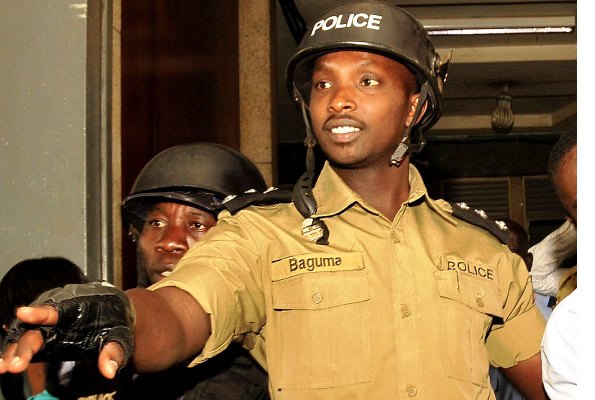
A story is told of how then DPC of the Central Police Station Aaron Baguma witnessed the torture, but left Ms. Katusabe at the hands of her tormentors, something that reportedly led to her death.
COMMITTED TO HIGH COURT: SP Aaron Baguma is accused of murder.
In the ensuing period, and after the arrest of Sebuwufu on murder charges, Superintendent Baguma and police officers from the Criminal Investigations and Intelligence Department (CIID) were involved in a cat and mouse game, with calls for Baguma to be arrested going unanswered for some time. During that period Baguma was sent for further training at the Bwebajja-based Senior Police Staff College (SPSC) even as the calls for his arrest intensified.
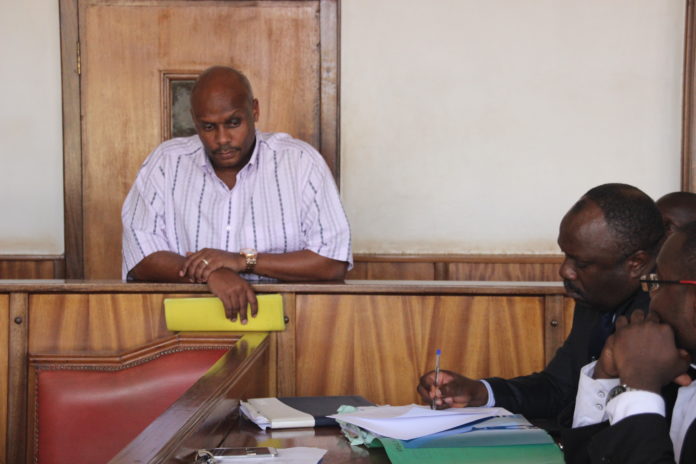
Subsequently, he was ‘arrested’, appeared before Buganda Road court, was charged with murder, aggravated robbery and kidnap and was remanded to Kigo Prison for about three weeks. When he next appeared in court, Baguma was granted bail and is still out, albeit with little mention on the progress of the case.
Amid all the confusion, Alex Masereka Epafura, the ‘father’ of Ms. Katusabe wrote to the Director of Public Prosecution (DPP) Mike Chibita wa Duallo, calling for the release of SP Baguma, with claims that he had helped them get the culprits.
“Yes, we are not lawyers but at least we have basic legal background. Baguma may have committed certain commissions or omissions but at least from the testimony of the witnesses he did not commit the crime. We all know who killed our sister,” the families two page letter signed by Epafura, reads in part.
“From the day we got to know about the death of our sister, it is Aaron Baguma who, as DPC of CPS helped us in uncovering the rot that some other officers in police had done in ensuring that the murderers of our sister walk away scot free,” the media quoted Mr. Epafura as saying. However, the DPP did not budge.
On the other hand Sebuwufu and other suspects Shaban Oduttu and Godfrey Kayizza were also arrested, remanded to Luzira Prison for about a year and later the Pine Car Bond boss was granted a Shs100 million bail. He is also still out.
Samuel Abisai (R) has said he will never bet again.
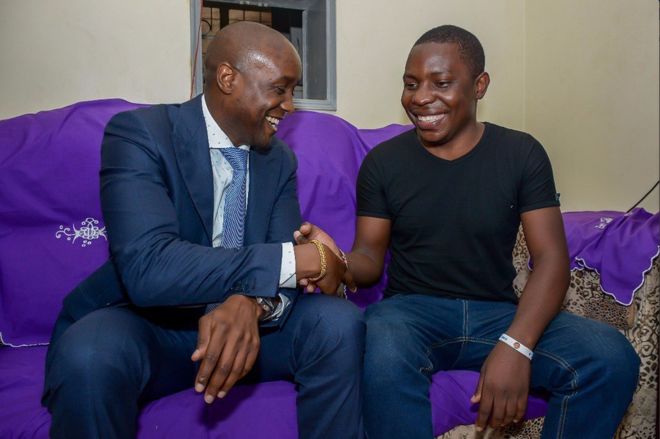
A Kenyan punter has won more than $2m (£1.6m) approximately Shs7 billion in Uganda currency after correctly predicting the outcome of 17 football matches.
Samuel Abisai placed about $2 on two separate jackpot picks, betting firm SportsPesa says.
The company’s boss Ronald Karauri led a convoy, including a stretch limousine, to pick up Mr Abisai from his home in the small town of Thika 45km (27 miles) north-east of the capital, Nairobi.
The payout is reportedly one of the biggest ever paid in Africa.
The betting industry is rapidly growing across the African continent.