Stanbic Bank
Stanbic Bank
25.8 C
Kampala
Stanbic Bank
Stanbic Bank
Home Blog Page 2097

Arrears, guild elections might affect Makerere semester opening

SEAT OF AUTHORITY: Makerere University Main Building, where decision affecting the university are made.

As Makerere University staff demand for arrears from government, the student guild contestants have had to wait for a re-election for over five months now, two developments that might affect the re-opening of the university.

The Makerere University Electoral Commission presented 13 students for the guild elections of the 2016/2017 academic year, and announced Basil Biddemu Mwota, a student majoring in Arts with Education, winner.

CHALLENGED RESULTS: Roy Ssembogga, the aggrieved contestant for Makerere University Guild Presidency.

However, his close competitor Roy Ssembogga, former varsity EC chairperson, disputed Mwotta’s election and petitioned the Tribunal, which suspended the process.
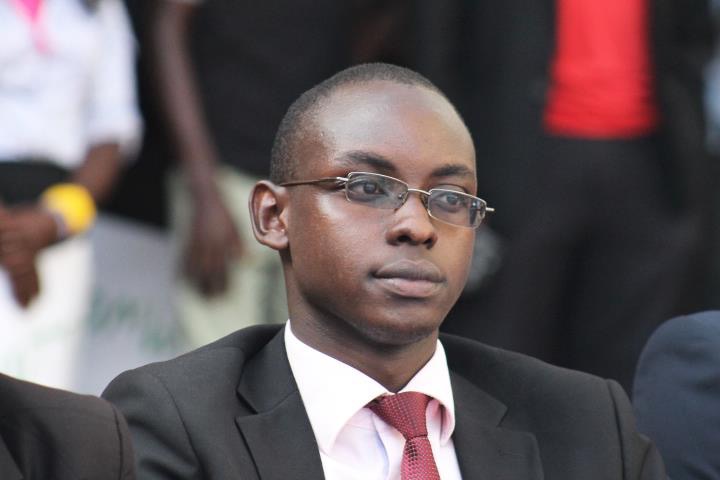
WAITING: Basil Biddemu Mwotta, the declared winner of the disputed Makerere University Guild elections

In response, Mwotta sought reprieve in the High Court, which was futile, paving the way for the tribunal’s stand to hold sway. The tribunal comprises the Dean of Students Cyriaco Kabagambe, who is the secretary to the tribunal, a legal advisor, Imaam of the MUK mosque; the chaplains of St. Augustine and St. Francis chapels, and the Guild Speaker and his deputy.

“The elections in one of the polling centers, specifically the School of Education where the initial winner resides, had a lot of irregularities,” Ssembogga, a student offering Bachelor of Medicine in Surgery, said.

However, Mwotta denied any such allegations saying: “There cannot be vote rigging in Makerere since the votes keep around the polling centers and students safeguard their votes till when the results are announced.”

For the last five months the Students Guild is conducting its affairs through the Office of the Dean since the outgoing Guild Council was technically dissolved, but the incoming student leadership is yet to be sworn in due to the tribunal’s delay in resolving Ssembogga’s grievances.

Efforts by EagleOnline to get comment from the Dean of Students Mr Kabagambe were futile, as he hung up and did not answer repeated calls.

However, the tribunal had promised to communicate to the candidates the date for the re-election as soon as the university opens for the new semester. But this development has been affected by the strike by the non-teaching staff, who are demanding that the Ministries of Finance and Ministry of Public Service honor a pledge made to them by the President in 2015.

‘’The Ministry of Finance Planning and Economic Development and that of Public Service promised to pay the non-teaching staff in the next financial budget since they were not included in the 2014/2015 financial budget, however, the Permanent Secretary who had given this ultimatum has again tried to resort to the same trend of pushing our money to the next year which we are not allowing,’’ Pascal Kyalimpa, the Chief Custodian of Nsibirwa Hall said.

 

Stories Continues after ad

US$71m approved for rural electrification in Northern Uganda

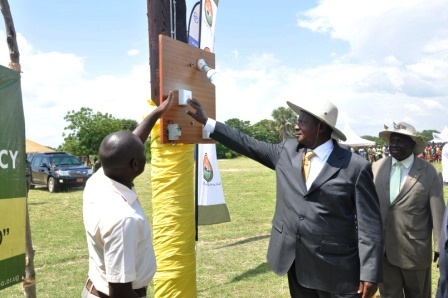
UNIVERSAL ACCESS TO ELECTRICITY BY 2040: President Yoweri Museveni switches on power in a rural district of Uganda. Photo credit/rea.org

Cabinet sitting at Parliament Buildings has today approved a US$71 million World Bank loan to finance the grid expansion and reinforcement project to strengthen the rural electrification strategy (RESP) for 2013-2022, a roadmap to increase power access to 26 percent by 2022.

The loan will finance a series of investments in power distribution and off-grid solutions in the northern districts of Gulu, Lira, Nebbi, Arua, Kole, Oyam and Nwoya.

Also approved by Cabinet was consideration and approval of a request from the Minister of Energy to allow her issue three petroleum production licenses to Total E&P Uganda Bv, over discoveries in exploration area one of the Albertine graben, that is, Ngiri, Jobi-Rii and Gunya to be operated by total E&P Uganda BV.

The ministers agreed that the production licenses to be issued have a 25-year duration and can be renewed for an additional five years as provided for in the Production Sharing Agreement (PSA). The licenses also provide that where there are oil fields which extend across boundaries of license areas, the oil fields be developed as one unit.

‘The final investment decision is planned to be taken in 18 months after issuance of the production licenses and first oil is expected in the financial year 2019/2020’, they said.

According to the cabinet minutes, the Petroleum Authority of Uganda will regulate the licensed companies while the National oil company will participate in all licenses to take care of government’s commercial interests.

Stories Continues after ad

Cabinet defers US$59m loan for refugee projects, directs on South Sudan trade

CABINET: members of the cabinet led by Prime Minister Dr Ruhakana Rugunda. Others are foreign minister Sam Kutesa and third Deputy Prime Minister and East African Community Affairs minister Kirunda Kivejinja

The Cabinet has today deferred a US$50 million World Bank request from the Ministry of Finance, to support refugee hosting areas and communities.
‘While cabinet members appreciated the problem refugee hosting communities face, they noted the need for;  the loan to be comprehensive and cover all  refugee hosting areas of the country and a policy on how government can sustainably support refugee hosting communities with or without a loan,’ a release states in part.

The loan will be brought back to cabinet after wider consultations have been carried out on the areas cabinet raised.
Also discussed at today’s Cabinet meeting was the plight of Ugandan exporters to South Sudan market that suffered non-payment on account of the instability there.

As a result, the ministers directed the ministries of finance and foreign Affairs to liaise with the government of South Sudan on modalities for the repatriation of proceeds of Ugandan companies held in commercial banks and also pursue government of South Sudan to expeditiously form a joint cooperation commission to arbitrate the pending claims of Ugandans against South Sudan individuals.

‘A cabinet subcommittee comprising of Attorney General, ministers of Trade and finance has been tasked to oversee the whole process of negotiations of the modalities with the government of South Sudan,’ the release adds.

Meanwhile, that Cabinet today resolved that any future borrowing should never finance components of administration and capacity as these are always catered for in ministries’ domestic budgets.

The ministers also directed that loan beneficiary entities and Ministry of Finance -the contracting entity, should never procure or sign off any loan before all the preparatory activities are in place to avoid delayed implementation that results into financial penalties on un-utilized loans.

‘This is in furtherance of the resolutions of the recently concluded Kyakwanzi retreat that termed this tenure of government ‘Kisanja Hakuna Mchezo’, they noted.


Stories Continues after ad

Strong Cranes team named for the Buganda regional tour

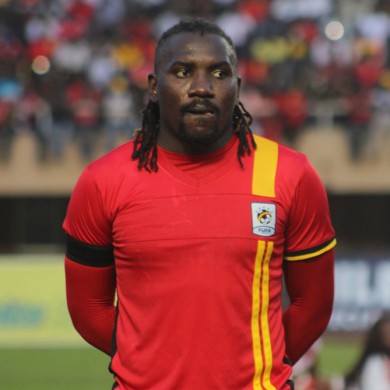
OPTIMISTIC: Cranes captain Hassan Wasswa Mawanda

Uganda Cranes continue preparations for their final AFCON 2017 qualifier match against Comoros with the team getting ready for the upcoming Buganda regional tour on Saturday.

The Cranes coach, Micho Srejovic named the squad for the tour during the weekly press conference on Wednesday at FUFA house in Mengo, Kampala.

The team will be captained by midfielder Hassan Wasswa Mawanda. Mike Sserumaga has been recalled after a long time while one guest player, Sulaiman Luzige from Sweden is also among the players to travel with the team.

The last training session in Kampala will be on Thursday evening at Phillip Omondi stadium, Lugogo before the team sets off for Masaka on Friday morning to Masaka Recreational Stadium where it will hold a training session that evening.

The match will be played on Saturday, August 6, 2016 at 4 pm.

Previously the Cranes have also visited the Western Region (Mbarara), North East (Soroti), Northern (Gulu), Kitara (Masindi), West Nile (Arua) and the Eastern Region (Mbale).


The full team:

Goalkeepers: Benjamin Ochan (KCCA) and Yasin Mugabi (SC Villa)

Defenders: Nicholas Wadada (Vipers), Joseph Nsubuga (SC Villa), Hassan Musana (Bul), Hassan Wasswa Mawanda – Al Shorta, Iraq, Rashid Toha (Onduparaka), Timothy Awanyi (KCCA), Halid Lwaliwa (Vipers), Bernard Muwanga (SC Villa)

Midfielders: Ivan Ntege (KCCA), Kezironi Kizito (Vipers), Mike Sserumaga (SC Villa), Vincent Kayizzi (KCCA), Abdumalik Tabu (SC Villa), Martin Kizza (SC Villa)

Strikers: Geofrey Sserunkuma (KCCA), Erisa Ssekisambu (Vipers), Shaban Muhammed (Onduparaka), Musa Esenu (Soana), Edrisa Lubega (Proline)

Guest Player: Sulaiman Luzige (Vaxjo, Sweden)

Stories Continues after ad

Egyptian Nobel Prize winner dead

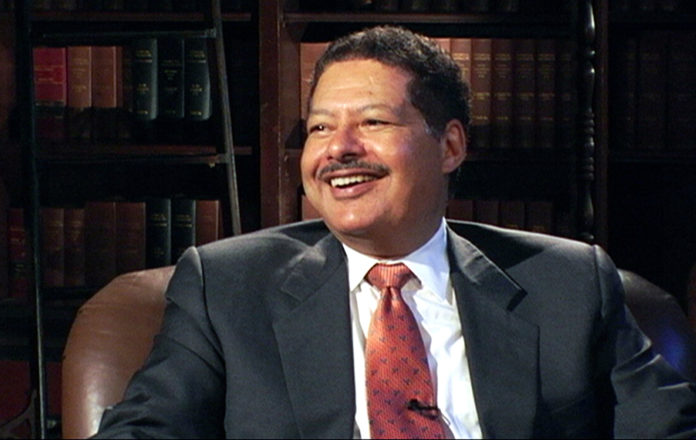
NOBEL PRIZE WINNER: Egyptian Ahmed Zewail

The Egyptian-born Nobel-winning scientist Ahmed Zewail has died in the US, aged 70.

Mr Zewail won the Nobel chemistry prize in 1999 for his pioneering work in femtochemistry, the study of chemical reactions in ultra-short time scales.

A professor at the California Institute of Technology, he was a science advisor to President Obama and the first Arab scientist to win the Nobel Prize.

Mr Zewail became a naturalised American in 1982 after studying there.

No immediate cause of death was given.

In 40 years working at the California Institute of Technology , he experimented with lasers to monitor chemical reactions at a scale of a femtosecond, which is a millionth of a billionth of a second.

He is also credited with developing a new research field dubbed four-dimensional electron microscopy, which helps capture fleeting processes and turn them into a kind of digital film.

Mr Zewail was appointed US science envoy to the Middle East, and became outspoken on political issues in his native country.

In 2014, he wrote an opinion piece for the Los Angeles Times that urged the US to avoid cutting aid to Egypt after a military coup that ousted the elected president Mohamed Morsi of the Muslim Brotherhood.

He argued that constructive engagement was important in keeping Egypt as a partner in the war on terrorism.

Egyptian President Abdel-Fattah al-Sisi expressed his condolences over the death, saying the country had lost a son and role model.


Stories Continues after ad

Armed groups block S. Sudan refugees from fleeing to Uganda – UN

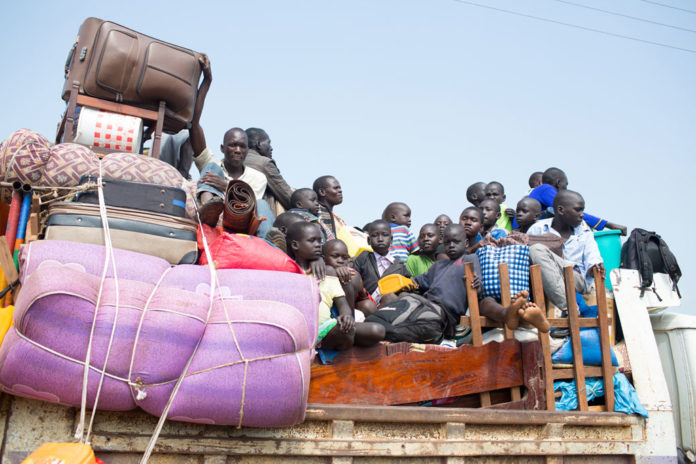
Refugees from South Sudan arrive in Elegu, northern Uganda Photo credit: UNHCR

Armed groups operating along the South Sudan roads leading to Uganda are blocking distressed people fleeing the fighting in the war-torn country.

According to the United Nations High Commissioner for Refugees (UNHCR) about four thousand South Sudan refugees cross into Uganda every day, with most striving to evade the marauding armed men attempting to thwart their journey to safety.

According to the UNHCR, over 60,000 people have fled South Sudan’s recent violence in the capital city of Juba, bringing the overall number of South Sudanese refugees in neighbouring countries since December 2013 to nearly 900,000.

Refugee flows from South Sudan into Uganda have doubled in the past ten days, bringing the total to more than 52,000 since violence escalated three weeks ago. Kenya has reported the arrival of 1,000 refugees in the same period, while 7,000 have fled to Sudan, the UNHCR has said.

“The refugees bring disturbing reports that armed groups operating on roads to Uganda are preventing people from fleeing South Sudan,” Melissa Fleming, UNHCR chief spokesperson said in Geneva.

More than 85 per cent of the refugees arriving in Uganda are women and children under the age of 18, she added. Many children have lost one, or both of their parents. Most are from Eastern Equatoria, with smaller numbers from Juba and Upper Nile state. Many took advantage of the opportunity to flee alongside Ugandan military convoys evacuating Ugandan nationals.

“Improving conditions and capacities at existing reception facilities in Uganda is a key priority,” Ms. Fleming said. Collection points in border areas have now been significantly decongested, although transit centres and reception centres remain severely stretched. Efforts are underway to rapidly open a new 100,000 capacity refugee settlement area in Yumbe district.

Both Uganda and Kenya are reporting rising cases of severe malnutrition, particularly among very young children, she said. Those found to be suffering are being placed on food nourishment programmes to bring them back to health.

The spokesperson said that UNHCR is reminding all parties to the conflict in South Sudan of a fundamental human right to seek asylum and urging them to ensure that civilians are provided with unhindered access to safety as the number of refugees crosses a worrying milestone.

The recent fighting between rival forces – the Sudan People’s Liberation Army (SPLA) loyal to President Salva Kiir and the SPLA in Opposition backing First Vice-President Riek Machar – erupted in and around Juba, on July 7.

New arrivals from Yei say they received letters warning them to evacuate the town in anticipation of conflict between rebel and government forces, the spokesperson said. Refugees have also reported that armed groups operating across different parts of South Sudan are looting villages, murdering civilians and forcibly recruiting young men and boys in to their ranks.

With over 2.6 million of its citizens forcibly displaced, the world’s youngest nation currently ranks among the countries with the highest levels of conflict-induced population displacement globally, she said, warning that half the population relies on humanitarian aid.

South Sudan was founded in July 2011, after it gained independence from Sudan. The country descended into conflict in December 2013 due to internal struggles between rival factions.


Stories Continues after ad

Kiir reshuffles cabinet, fires Garang son Mabior

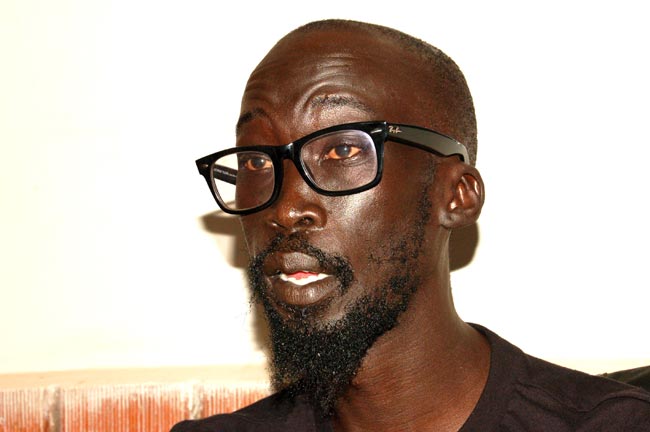
ISSUED STATEMENT: Mabior Garang de Mabior. Photo credit/upperniletimes.net

Embattled South Sudan President Salva Kiir has reshuffled six SPLM-IO ministers and fired Mabior Garang De Mabior, the former Minister of Water Resources and Irrigation.

Garang De Mabior, a son of the late Sudan Peoples Liberation Movement (SPLM) founding leader John Garang de Mabior and his wife, SPLM/A stalwart Rebecca Nyadeng Garang, has been replaced with Sofia A. Gai.

The younger Garang has also been fired alongside two deputy SPLM-IO ministers in a decision that many say has unclear effects on the country’s floundering peace deal.

The changes come after Lam Akol resigned as Minister of Agriculture, calling the peace deal dead. It was also unclear how much involvement the First Vice President Taban Deng had in Kiir’s decisions. Under the peace deal signed in August, the SPLM-IO were given a voice in which of their ministers were appointed.

But in a Decree, President Kiir relieved Alfred Lado Gore, the Minister of Interior and replaced him with Michael Tiangjiek Mut. Gore was named the Minister of Land, Housing, and Urban Development, replacing Mary Alfonse Nadio Lodira. Gore was one of the officials who appeared with Taban Deng when he announced he would replace Riek Machar as First Vice President.

Kiir also replaced Dak Doth Bishok, the Minister of Petroleum, with Ezekiel Lul Gat, while the former Minister of Higher Education Peter Adwok Nyaba has been replaced with Yien O.L. Tut.

Peter Marcello, the Minister of Labour, has been replaced with Gabriel Duop Lam.

The Deputy Minister of the Interior Duop Lam has been replaced with Rieu Gatliek Gai.

The Deputy Minister of Labour Elizabeth Achuei has been replaced with Allan Natake.

Gabriel Yol Dok has also been replaced as the Presidential Advisor for Social Service Delivery, and Michael Mario Dhuor has been named the Presidential Advisor on Reforms, Monitoring and Evaluation, while Ramadan Hassan Laku has been named adviser on Good Governance and Rule of Law.


Stories Continues after ad

South Sudan threatens Mogae’s JMEC with expulsion

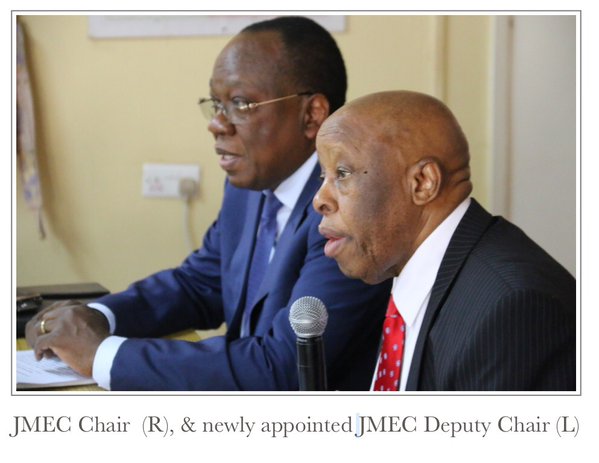
JMEC chair former Botswana president Festus Mogae and his newly-appointed deputy Francois Fall of Guinea

South Sudan’s government spokesman Michael Makuei Lueth has threatened to deny entry to the Joint Monitoring Evaluation Commission (JMEC) or to expel the group altogether unless they reopen their office in Juba and cease carrying on business in other places outside the country.

This comes after a meeting of diplomats of the JMEC Partners Forum – the guarantors of the August 2015 peace deal – held recently in Khartoum, as well as meetings by the JMEC Chairman Festus Mogae at the African Union summit and elsewhere.

Makuei, who is also an influential member of cabinet as information minister, was enraged by the holding of the partners meeting in Khartoum and by the evacuation of JMEC personnel from Juba. Festus Mogae decided to evacuate the secretariat personnel last month after days of fighting in Juba made it insecure. Since then, however, JMEC has called for the resumption of meetings of the parties together with JMEC in Juba.

But the information minister criticized the group saying: “It is high time for JMEC to come back or otherwise we don’t need it.”

“It is unfortunate that JMEC did not serve the objectives for which it was established and if JMEC wants to go back then they must come back with new understanding of the situation because after all we are the government of South Sudan and can even decide now and deny them entrance,” he said.

Makuei, who was behind the expulsion of the JMEC chief of staff several months ago, was opposed to the signing of the peace deal last year and he has also previously threatened the UN Mission in South Sudan with expulsion.

In his remarks Tuesday, Makuei accused the peace monitoring body of a ‘conspiracy’. His comments are in line with increasingly aggressive government posture toward international insitutions, particularly those involved in calls for sending more peacekeepers to South Sudan.

“Now they take themselves out, leave South Sudanese, they go and conspire in Khartoum in the name of JMEC… they go and conspiracy in Khartoum and they create a lot of dash against the events that are unfolding here,” he said.

He further criticized the peace group’s appeal to cease waging attacks on Riek Machar’s forces.

“There in Khartoum… they demand intervention and they call on President Salva to stop pursuing Riek Machar and then people go to Addis Ababa for talks. Why are we South Sudanese been sidelined or has it become a forum whereby things be done outside South Sudan?” Makuei said during a news conference at his office.

“I think there is something wrong with JMEC, JMEC must prove himself a Joint Monitoring and Evolution Commission, otherwise JMEC in its current situation is useless and will not serve the interest of South Sudanese and will not help the implementation of the peace agreement,” he said.

Makuei further added that the office of JMEC has even evacuated the country and has remained closed. He said this is the time for JMEC to be around instead of leaving the country.

The peace monitors have recently called on the South Sudanese government and opposition to resolve their differences peacefully.


Stories Continues after ad

Police, UPDF clean Masaka town

KEEP MASAKA TOWN CLEAN: The police and army have today embarked on cleaning Masaka town.

The Police and men and officers of the Uganda Peoples Defence Forces (UPDF) have today embarked on cleaning the Central Business District (CBD) of Masaka municipality, a source has said.

By press time it was not possible to establish the scope of untidiness that had characterised the town but the source said heaps of garbage littered along the streets like Elgin and Kampala Road in the CBD had been cleared during the exercise.

Located in the central region Masaka, a town on the western shores of Lake Victoria with a population of about 104,000 people, has for long been plagued by grubbiness, prompting the district officials and the security organs to initiate the cleaning exercise.

Once the cleanest and biggest town and the business hub of central Uganda, Masaka town is currently famous for grasshoppers, which provide a source of livelihood to a big number of its residents, some of who earn as much as Shs50 million annually. Other activities include meat processing; and the manufacture of furniture, footwear, crafts and baked products. The town is about 140 kilometres from Kampala and visitors there have to cross the Equator, which is about 37 kms from the Masaka CBD.

Masaka was devastated during the 1979 war in which former President Iddi Amin was ousted and 35 years later it has failed to recover to its past glory.

Stories Continues after ad

Kiir backtracks on foreign troop deployment pledge to Museveni

President Yoweri Museveni and his South Sudan counterpart Salva Kiir during their July 23 meeting at State House Entebbe.Photo credit/africanews.com

South Sudanese President, Salva Kiir, has declared total rejection to the deployment of a regional force, backtracking on the earlier reported assurance he gave to President Yoweri Museveni during a meeting last Saturday, July 23, and also to Festus Mogae, the chairman of the Joint Monitoring and Evaluation Commission (JMEC), on July 25.

President Kiir and his officials argued that countries which have experienced foreign forces intervention have never regained peace and stability.

“I have heard some people have resigned. Okay let them go but if it is connected to pressure on the government to implement their agenda that will not work. South Sudan is a sovereign state and we will not allow foreign troops to come here no matter the amount of pressure and noise they will make. We don’t need foreign troops. Already we have enough of them here,” President Kiir told confidants on Monday after learning of the resignation of the minister of agriculture and food security, Lam Akol.

President Salva Kiir with the Chief of General Staff Gen Paul Awan Malong. Photo credit/nyamile.co.
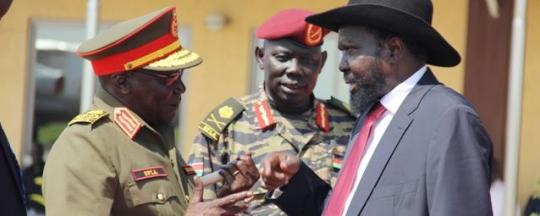
President Salva Kiir (R) with the Chief of General Staff Gen Paul Awan Malong (L). Photo credit/nyamile.co.

President Kiir, according to a presidential aide who spoke to on Tuesday, was commenting while in a meeting with the Chief of General Staff of the South Sudanese army, Paul Malong Awan, and the Minister of National Security, Isaac Mamur Mate.

Minister Mate later gave a statement in which he rejected a regime change agenda, citing a political and security situation in Somalia, Libya and Iraq as the basis of rejecting foreign intervention force.

“They want to destabilize this country to go the Somalia way. They intervened in Somalia, did they succeed. Has Somalia become a country now? What happened in Libya has Libya become a country? And Iraq what happened there? Did they succeed? We don’t want this regime change. A change must be peaceful and we have a legal and democratically elected government that should be consulted before making such decisions,” explained Minister Mate in a statement broadcast on Monday evening.

The top security official declared that any unilateral deployment of a foreign force will not be accepted.

Information minister, Michael Makuei Lueth, also issued a statement on Tuesday denying clashes have taken place around Juba and that the government was not aware of the rapes carried out by its soldiers.

“The media has been abuzz with news of fighting throughout the country, however, we want to assure the region and the whole world that the ceasefire, which was recently ordered by the president, is firmly holding, and that all those reports are false and baseless. They are concocted to justify the demands of intervention force by the enemies of peace who are usually delighted in anarchy and perpetual unrest in the republic of South Sudan,” the August 2, 2016 president’s statement reads in part.

Lueth reiterated rejection of the government to welcome deployment of foreign troops in the country.

“The TGoNU [Transitional Government of National Unity] would like to urgently call on IGAD [Intergovernmental Authority on Development] member states to be cognizant of the fact South Sudan may slide into anarchy if the region military meddles in its internal affairs and that the repercussions of such a hasty undertaking will negatively impact the overall security of the region,” said Makuei, speaking to reporters at the ministry headquarters.

Previously, IGAD countries and African Union (AU) have approved request by UN Secretary General, Ban Ki-Moon to send extra-troops to boost the United Nations Mission in South Sudan (UNMISS) in Juba with a new mandate to militarily fight the warring SPLM factions under President Salva Kiir and former First Vice President, Riek Machar, following outbreak of clashes early last month.

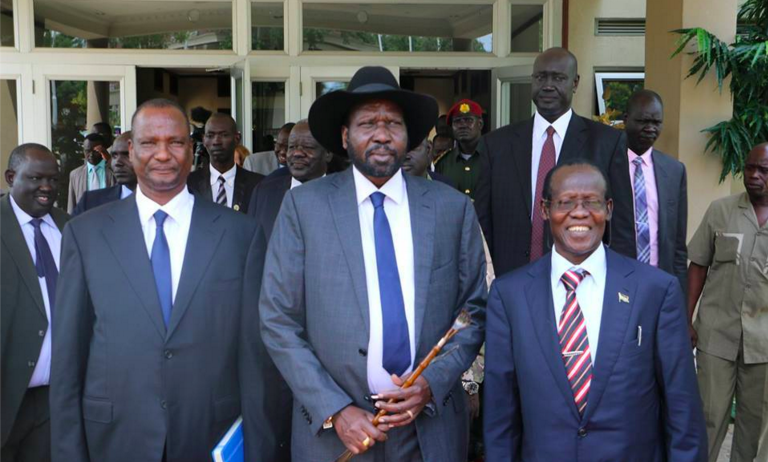
President Salva Kiir, his First Vice President Taban Deng Gai and Second Vice President James Wani Igga after the swearing in of Taban Deng as FVP. Photo credit/nyamile.com

The UN Security Council is deliberating the possible intervention force – a move opposed by President Kiir and supported by Machar. SPLM In Opposition faction in Juba has replaced Machar with Taban Deng Gai – a move dismissed by Machar’s supporters as illegal.

Minister Lueth said the government has not succumbed to regional and international pressure as reported by the media.

Lueth also dismissed claims by SPLM-IO faction loyal to Machar that the government was spearheading Taban Deng’s appointment.

“Dr. Riek Machar is neither the SPLM/A IO nor the Agreement and therefore we are moving forward with the implementation of the agreement for the overall interest of the people of South Sudan,” he said.


Stories Continues after ad