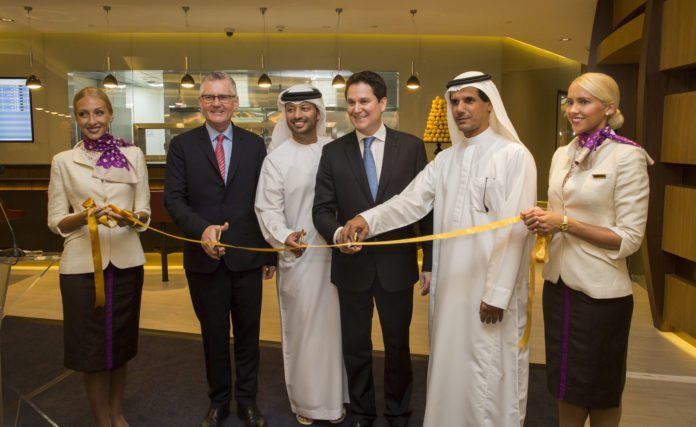
Pictured flanked by Etihad Airways First Class lounge staff are, from left: Shane O’Hare, Etihad Airways Senior Vice President Marketing; Mohammed Al Katheeri, Acting Chief Operations Officer of Abu Dhabi Airports; Peter Baumgartner, Etihad Airways Chief Executive Officer; and Khaled Almehairbi, Etihad Airways Senior Vice President Abu Dhabi Airport Operations, celebrating the opening of the new First Class lounge at Abu Dhabi International Airport today.
Etihad Airways has today officially opened its new flagship First Class Lounge & Spa at Abu Dhabi International Airport’s Terminal 3. The spectacular new space showcases the airline’s commitment to providing unparalleled and aspirational hospitality experiences.
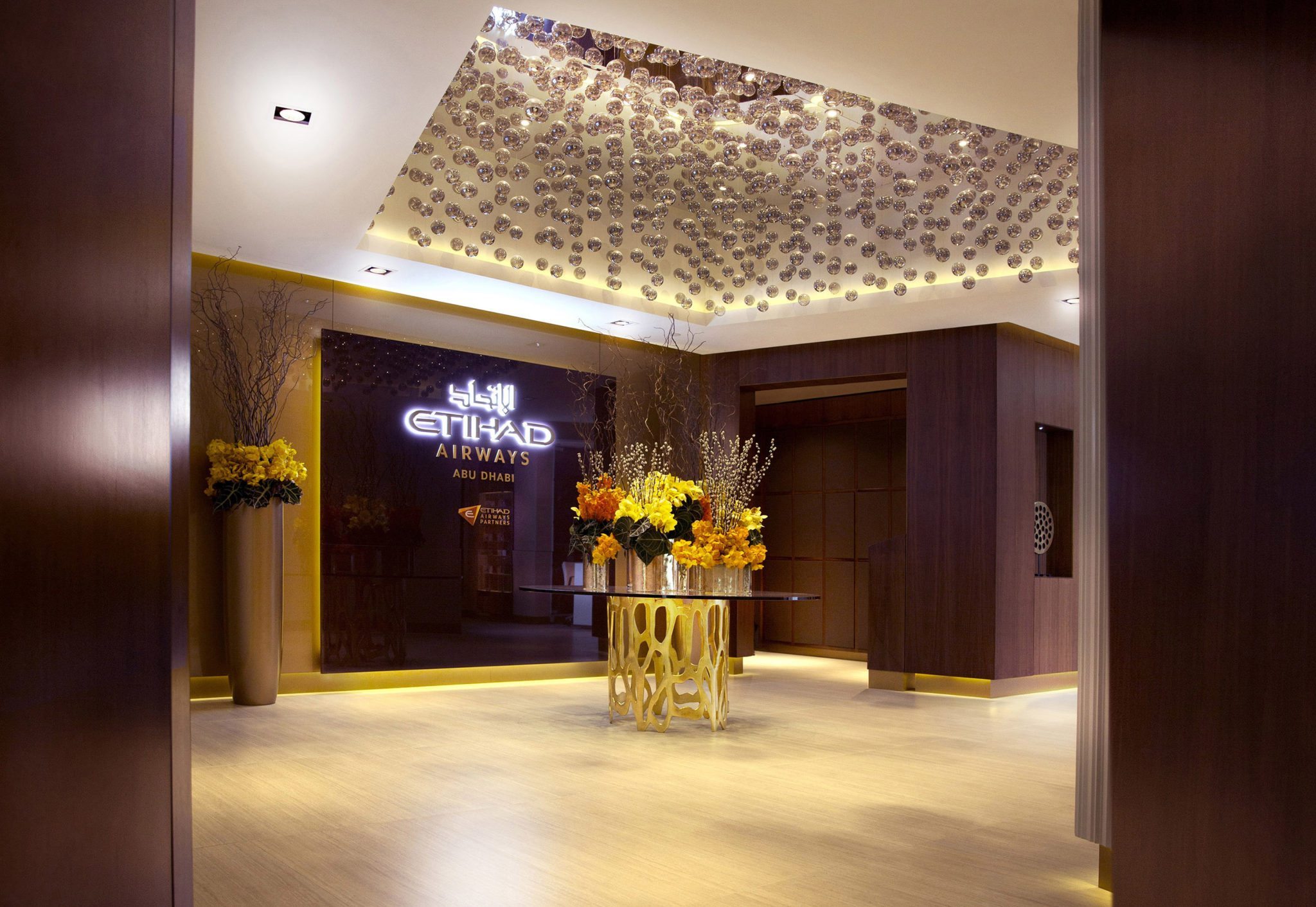
Entrance to the lounge. All photos/courtesy
The new facility adds to the airline’s expanding collection of 14 Premium Lounges including those recently launched in New York and Melbourne in addition to Premium Lounges in Abu Dhabi (Terminals 1 and 3), Frankfurt, London, Manchester, Dublin, Paris, Washington DC., and Sydney. At Abu Dhabi Airport, Etihad Airways also operates a dedicated Premium Lounge within the unique US Preclearance facility, and a Premium Arrivals Lounge. A new First and Business Class Lounge at Los Angeles LAX airport will follow in the coming months.
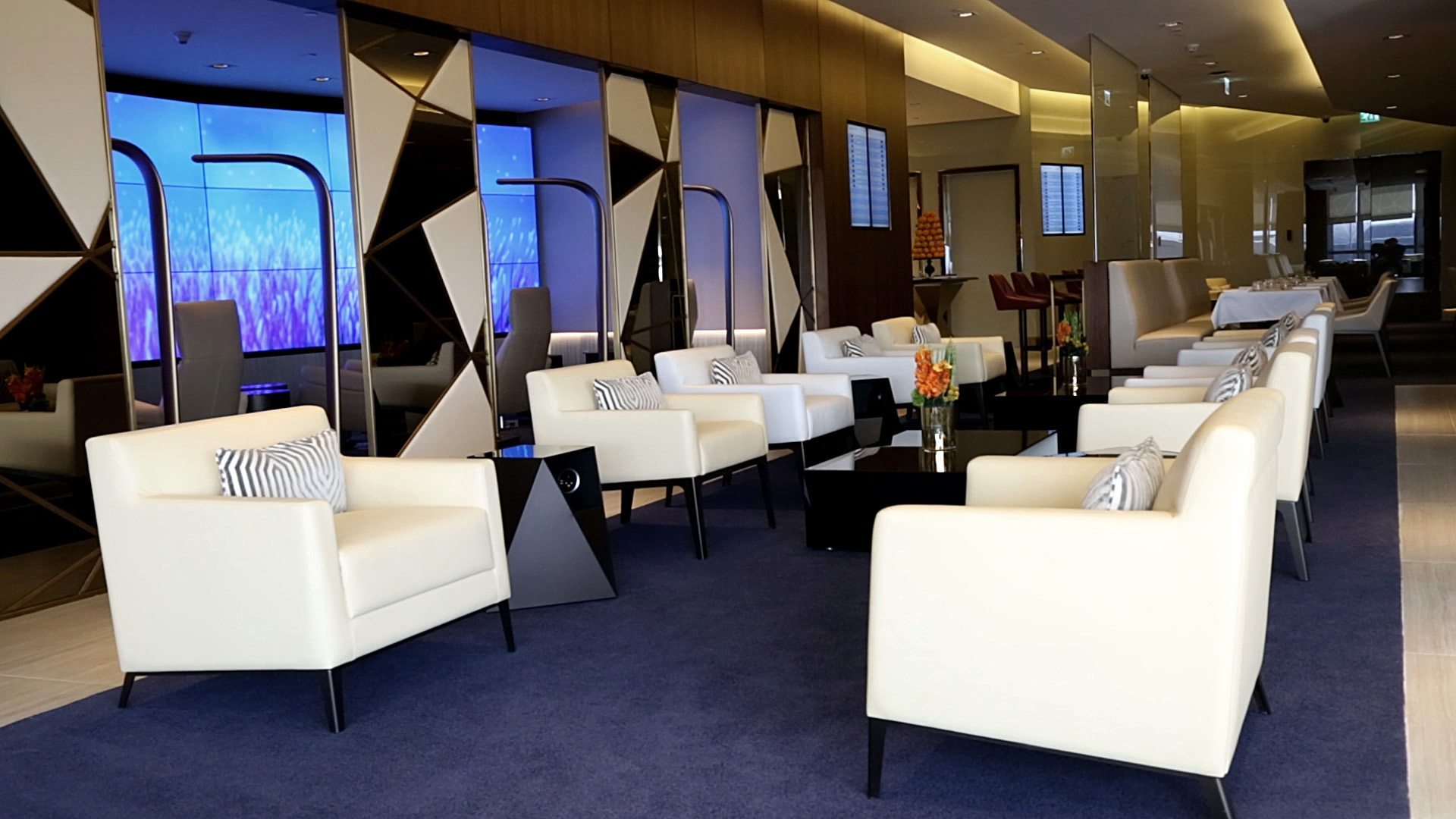
Inspired by the world’s most prestigious hotels, private members’ clubs and fine dining establishments, the lounge is an ultra-exclusive lifestyle environment which tells the airline’s acclaimed guest experience and hospitality story with unrivalled design, style and comfort, world class dining, and bespoke beauty and relaxation services.
Exquisite Lounge at Abu Dhabi Airport
The lounge features 16 unique zones designed to ensure that guests can relax, re-energise and be entertained in total luxury before boarding their flight. An à la carte restaurant, showcase bar, fitness room, cigar lounge, Six Senses Spa, Style & Shave barbers, nail bar, TV room, secluded relaxation room, prayer room and children’s play room ensure that all guests receive a highly personalised experience and intuitive service.
Peter Baumgartner, Etihad Airways’ Chief Executive Officer, said: “Our new First Class Lounge & Spa is the jewel in the crown of our new lounge offerings worldwide and represents the best of our home city of Abu Dhabi. It is a showcase of intelligent product design, innovation, and superlative hospitality and service. This is not just a lounge but the ultimate airline hospitality experience and one which perfectly mirrors Etihad Airways’ evolution into the best airline in the world.
“Continuing our journey of innovation, this new dedicated First Class environment demonstrates our on-going commitment to developing world-class products as we continue to reimagine travel.”
Measuring just under 1,700 m², and boasting expansive views of the airport, the new facility is open round-the-clock for the exclusive use of guests of The Residence, Etihad First Class, Etihad Guest Exclusive, Etihad Guest Platinum members (plus one guest), Etihad Airways Partner (EAP) airline First Class guests, EAP ‘Invitation only’ members (plus two guests) and EAP equivalent Platinum members (plus one guest).
“We are reimagining service and hospitality. Whilst this physical environment is truly remarkable, we have placed special emphasis on creating an aspirational luxury lifestyle space in line with our legendary inflight service offering. The result is the finest airline lounge and spa experience in the world,” Shane O’Hare, Etihad Airways’ Senior Vice President Marketing, said.
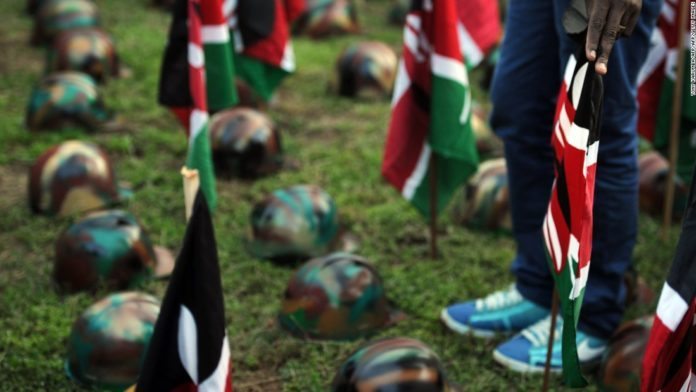
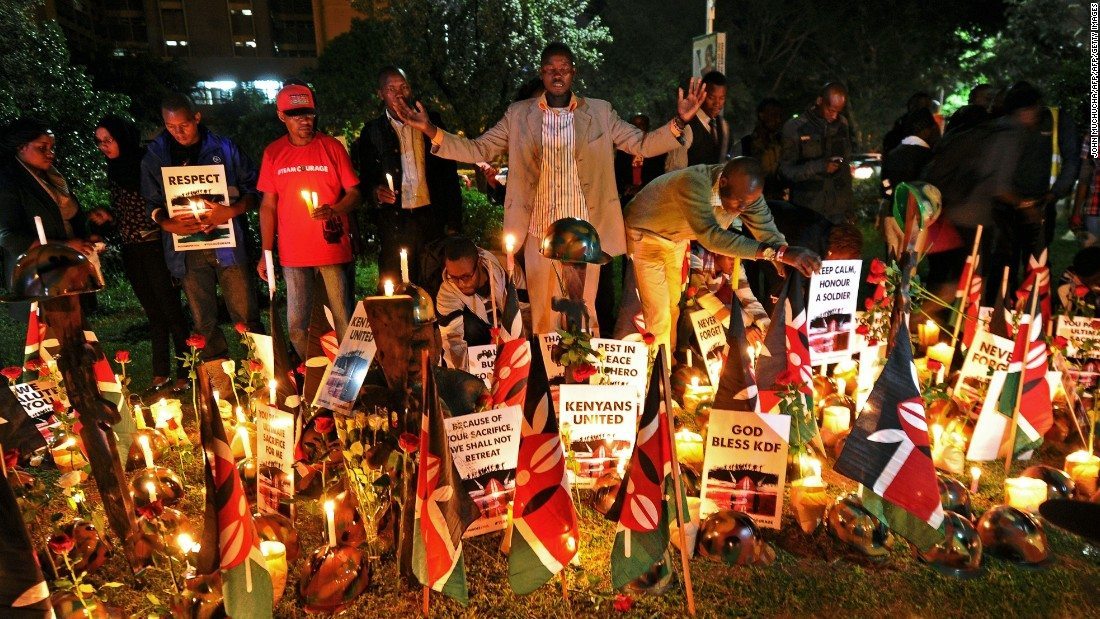
Mourners attend a vigil in Nairobi in honor of Kenyan soldiers killed at El Adde base in Somalia.
Nairobi, Kenya –On January 15, a massive blast shattered the dawn calm at El Adde military base. A suicide bomber had detonated a truck loaded with explosives, the cue for hundreds of fighters clad in camouflage gear to attack.
The raid lasted the entire day; thousands upon thousands of bullets fired by some 300 Al-Shabaab militants in a brutal assault on Kenyan soldiers stationed in Somalia to fight the terrorist group.
By the time the sun set, as many as 141 Kenyan soldiers were dead — some shot at point-blank range. That figure would make what happened at El Adde Kenya’s largest military defeat since its independence in 1963.
But in the months since, there has been no national day of mourning, no roll call of honor, and no explanation.
The only clues to what happened are contained in a propaganda video made by Al-Shabaab itself.
The exact details of what went on at El Adde — and just how many Kenyan troops died there — remains shrouded in mystery.
The Somali government says 200 Kenyan soldiers, key to the African Union’s fight against al-Qaeda-linked Al Shabaab, were at the base that day.
Al Shabaab, which is known to exaggerate its figures, claims to have killed 100 Kenyans.
This time, though, the terror group may actually be underestimating: Two officials familiar with the recovery operations have told CNN that the Kenyan death toll from that day is at least 141.
Kenya’s government is yet to release official figures. On the day of the attack the Kenyan Defense Force (KDF) first said its soldiers were helping to repel an attack on a Somali National Army base before stating that the KDF had incurred unspecified losses.
But as the hours wore on and rumors intensified of just how fierce and bloody the fight for El Adde was, the press releases stopped and the KDF’s media wing went silent.
Information surrounding the attack needed to be handled “carefully” and “meticulously,” Cabinet Secretary for Defense Rachael Omamo explained, “for the benefit of the families of our soldiers.”
The KDF did not respond to CNN’s repeated requests for comment and information about the attack.
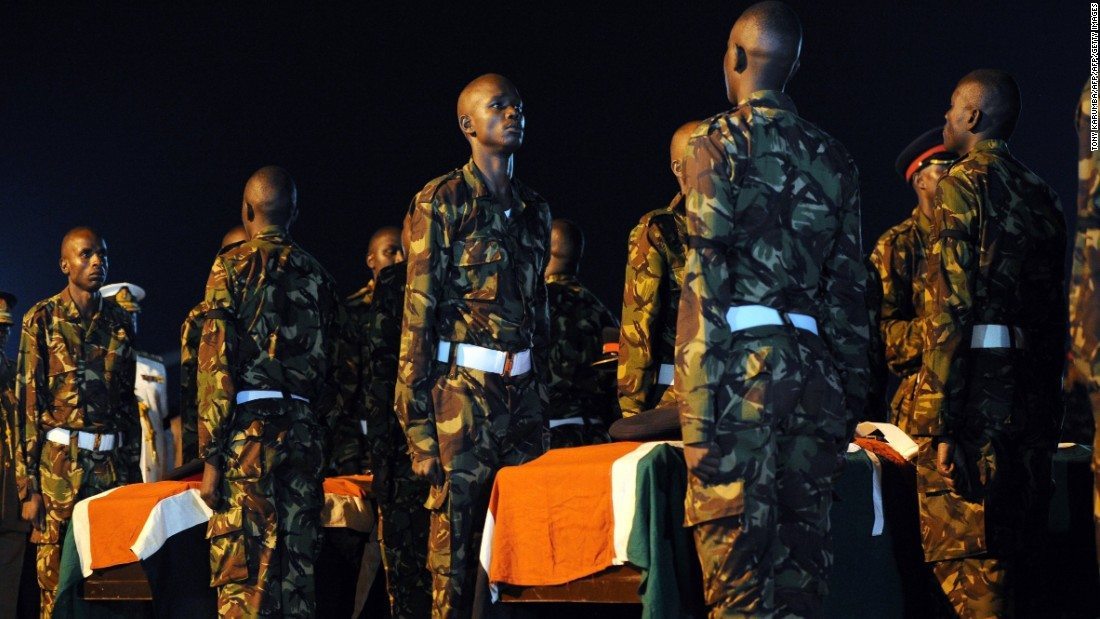
Its only public admission of what happened at the base since then has been the return of four flag-draped caskets home to Kenya.
Kenyan President Uhuru Kenyatta paid tribute to the four acknowledged casualties from the raid as they were brought home: “Their bravery is undimmed. And for this, we as a nation are grateful to all of them.”
In the months since, more coffins, more bodies have been quietly handed over, one by one, to the soldiers’ grieving families, often bringing with them more questions than they do answers.
Kenyan soldiers stand over caskets bearing the remains of four slain comrades.
Corporal James Saitoti Kuronoi’s remains were subjected to seven DNA tests before they were finally identified and handed to his loved ones for burial, three months after he was killed.
As his body was lowered into a grave near that of his mother, in a quiet farming village near Narok, his eight siblings — their faces wet with tears — clutched each other for support.
Kuronoi’s was one of some 30 burials linked to El Adde that have been reported by local media in Kenya, but there are said to have been many more services that they could not cover.
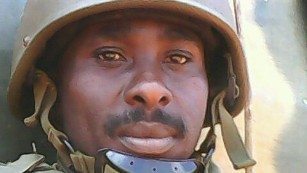
Corporal James Saitoti Kuronoi was killed when Al-Shabaab militants attacked El Adde military base.
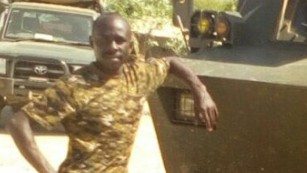
A tank driver and father of two, Kuronoi sent photos and talked regularly to his wife, brothers and sisters from his “new home” at El Adde. He was on his second deployment to Somalia.
“[He was] our baby brother,” said Kuronoi’s sister Jackqueline. “He was always jolly. He had a permanent smile … And I don’t know, even in the family, who will ever fill that gap.”
A week before the attack, Kuronoi sent a message to his family asking them to pray for him. It was their last contact; after Al-Shabaab attacked the base, there was no news from him, he was nowhere to be found.
A KDF tank driver and father of two, Kuronoi was on his second tour of duty in Somalia when he was killed.
Jackqueline Kuronoi says the family went through weeks of uncertainty in the wake of the raid.
“You are looking for somebody … you don’t know where,” she told CNN.
“You hear that some people were taken by Al-Shabaab, others are still in hiding, others were hiding and killed, some were burned beyond recognition, and you don’t know where you belong. Where is our person?”
She praises the Kenyan Defense Force for its support of their family in the aftermath of her brother’s death, but with no official information released by the government, she has many questions about what happened that day.
“We would like to know who these people are? They died together. How many were they?” she said.
“It is a question that will live in our minds forever, because even if you have the body, what about the rest? How many were they? How many were rescued? You don’t know.”
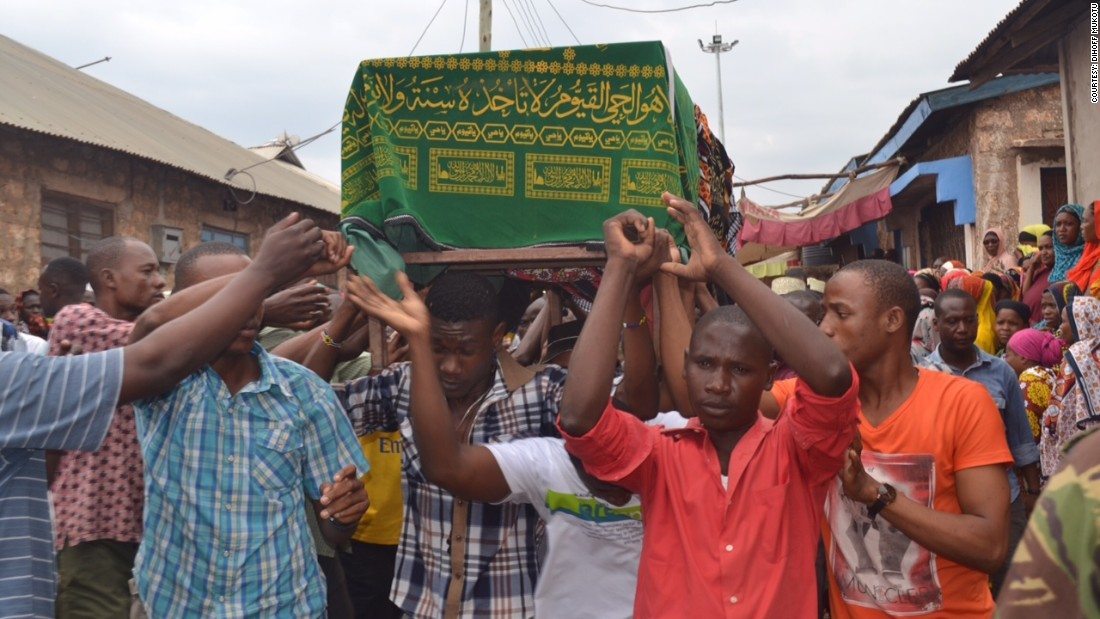
The coffin of Sergeant Juma Zahoro, who died at El Adde, is carried to his funeral in Mombasa.
Sergeant Juma Zahoro, 41 and a father of three, served in the Kenyan Defense Force’s intelligence unit. He was approaching his tenth year of service on that fateful Friday in January.
Weeks later, his family offered prayers over his body at a mosque in Mombasa, before burying him in the city’s Mshale cemetery in a funeral attended by hundreds of family members, friends and fellow soldiers.
His father-in-law, Mwalim Rama, told those gathered at the steamy burial ground that young people should not be put off joining the military because of attacks like the one in which Zahoro was killed.
“Fighting and dying for your country is something one should be proud of,” he told the mourners. It is a message echoed by military commanders and Kenya’s Commander in Chief, President Uhuru Kenyatta.
But with so few details of the raid out in the open, it has been left to the attackers themselves to tell the story of El Adde.
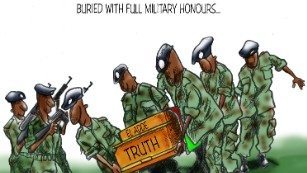
Cartoonist Patrick Gathara believes the truth about El Adde is being hidden from the Kenyan public.
Well known for sophisticated propaganda techniques, Al-Shabaab released a flashy, high-definition video three months after the attack.
It shows tracer rounds lighting up the sky as a massive firefight for the base begins: Al-Shabaab militants fire AK-47s, rocket-propelled grenades and machine guns at the Kenyan troops.
The bodies of 50 soldiers can be counted; many of the men are killed execution-style on camera, while others are seen surrendering in terror. A soundtrack of gunfire is laid over the entire 48-minute long film.
“Who died for you in El Adde?” Gathara believes there is a deliberate attempt “to avoid accountability.”
In one heart-wrenching scene, a Kenyan soldier stands and tries to climb out through the hatch of his burning tank, arms raised in surrender, eyes wide as the enemy army encroaches. Al-Shabaab’s cameraman focuses on the man as he is shot multiple times, sliding back inside the tank.
The apparent ease with which the militants breached barriers at El Adde has surprised many security analysts — especially since the same style of assault had been seen before in bloody attacks on AMISOM forces.
One Western diplomat based in the Somali capital, Mogadishu, told CNN this was clearly a “tactical disaster” for the Kenyans.
“How can two hundred Al-Shabaab walk across a field in broad daylight without the Kenyans noticing? Where were the KDF’s machine guns?” he asked. “This is contrary to everything they have been taught, and should be doing in a hostile environment.”
Tactical disaster’ for Kenya
The apparent ease with which the militants breached barriers at El Adde has surprised many security analysts — especially since the same style of assault had been seen before in bloody attacks on AMISOM forces.
One Western diplomat based in the Somali capital, Mogadishu, told CNN this was clearly a “tactical disaster” for the Kenyans.
“How can two hundred Al-Shabaab walk across a field in broad daylight without the Kenyans noticing? Where were the KDF’s machine guns?” he asked. “This is contrary to everything they have been taught, and should be doing in a hostile environment.”
Added Gathara, “It is all very deliberate and designed to avoid public demands for senior officials and officers to be held responsible for failures.
“The truth about El Adde is being hidden from Kenyans, not from Al-Shabaab.”
Tellingly, Al-Shabaab’s propaganda video uses the Kenyan authorities’ own words against them, highlighting the inaccurate KDF press release sent in the immediate aftermath of the attack, and accusing the KDF of “distorting the truth and blatantly lying to their public.”
Analysts say the KDF’s lack of transparency has only provided more fodder for Al-Shabaab’s ideological battle.
“Although they cite national security reasons, what they end up doing is creating an opportunity for Al-Shabaab to propagandize their victories, perhaps exaggerate them,” said Peter Pham, director of theAtlantic Council’s Africa Center.
“But there’s no way of countering that narrative because there is no real narrative coming from the government.”
Kenyans in Nairobi pray at a candlelit vigil in honor of Kenyan soldiers on January 21, 2016.
“The AU [African Union] would be better served by contesting the Al-Shabaab narrative, not ceding ground to it,” said Paul D. Williams, Associate Professor of International Affairs at George Washington University, who specializes in reporting on peacekeeping missions.
“Silence is not a winning strategy in the world of strategic communications,” he told CNN in late January, shortly after the attack.
James Saitoti Kuronoi, Juma Zahoro and dozens of their comrades died — unassisted and outnumbered — at El Adde. Four months on, however, their own government refuses to acknowledge their sacrifice.
Their families remember them by name as soldiers, sons, husbands, and fathers. But to the country they served, they remain only uncounted and unknown.
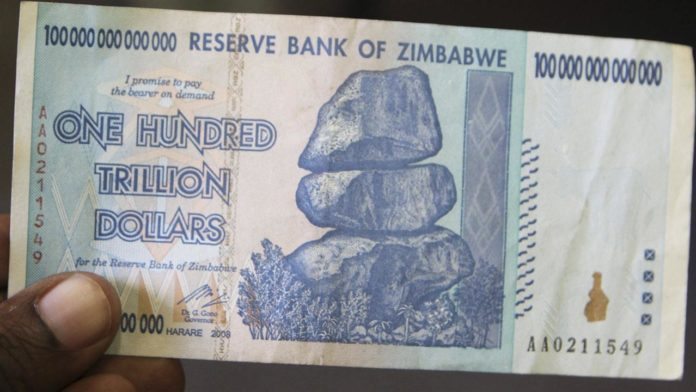
A 'One Hundred Trillion Zimbabwe Dollar' note issued at the time when inflation in the country hit the 500 billion mark
There has been a mad rush for the banks after the government of Zimbabwe announced that it will issue a new unit for business transactions called the Bond Note between August and October this year.
According to the Central Bank of Zimbabwe (CBZ), the Bond Notes will be printed by a ‘German company’ after the Bank accessed a US$200 million from Afreximbank to back the loan.
Following the announcement of the introduction of the Bond Note, there was public outrage in Harare, with Zimbabweans running to the banks to withdraw their ‘hard dollars’ and saying they were ‘returning to the dark past of Zimbabwe Dollars’.
‘Many fear that Mr Mugabe’s latest decision will trigger economic catastrophe all over again. And they are rushing to withdraw their US dollars from the banks while they still can,’ The Daily Telegraph wrote.
According to the newspaper, the authorities in Zimbabwe have imposed withdrawal limits for as low as US$20, and ‘banned anyone selling a house or business from sending the proceeds out of the country’.
But CBZ Governor John Mangudya has denied the Bond Note will replace the US Dollar as the national currency. Instead, he says, the new currency is to facilitate export business.
Since 2009 when inflation in Zimbabwe reportedly hit the 500 billion mark, sending the citizens in abject poverty, the former Southern African food basket has been using the US Dollar as ‘convertible currency’.
South Sudan’s armed opposition has accused Ugandan troops of allegedly crossing back into South Sudan and redeploying inside the country this week in violation of the August 2015 peace agreement which demanded their withdrawal from the territories of the war-ravaged nation.
According to the Sudan Tribune, a local daily in the world’s newest state, the development was relayed by a senior military official of the Sudan People’s Liberation Army in Opposition (SPLA-IO) under the leadership of the First Vice President, Riek Machar.
By press time efforts to contact Uganda’s Defence and Army Spokesperson Lt Col Paddy Ankunda over the matter were futile, as he did not pick his phone.
However, the newspaper quoted the SPLA-IO official as saying convoys of hundreds or thousands of forces of the Ugandan People’s Defense Forces (UPDF) were seen sneaking back into South Sudan on Tuesday and Wednesday.
“Ugandan troops have crossed the borders back into South Sudan. We don’t know about their intention. This is a serious violation of the peace agreement. They were told to withdraw, and they did, then now why should they come back? To do what again?” the anonymous senior SPLA-IO military officer, who is also a member of the Joint Monitoring Ceasefire Committee (JMCC) that monitors implementation of the permanent ceasefire and security arrangements, said.
He further explained that the Ugandan forces have allegedly re-entered South Sudan through Parjok payam in Magwi county of Eastern Equatoria state, east of the national capital, Juba, and another convoy crossed the border through Paluar payam of Keji-Keji County of the newly created Yei state of Central Equatoria, south of Juba.
Eyewitnesses in Magwi County also confirmed seeing Ugandan forces crossing the border again back into South Sudan, five months after their withdrawal from the territories of the northern neighbor.
They however said the foreign troops claimed to be hunting for suspected Uganda’s opposition forces being allegedly trained inside South Sudan.
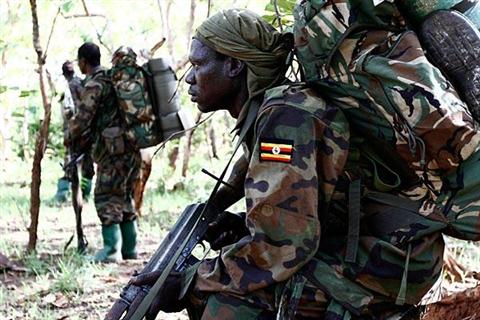
The South Sudanese peace agreement brokered by the East African regional bloc, IGAD, and signed by top rival leaders, President Salva Kiir and opposition leader, Riek Machar, only allowed Ugandan troops based in Western Equatoria under the African Union (AU) mandate to continue hunting for rebels of the Ugandan Lord’s Resistance Army (LRA) under the leadership of Joseph Kony.
The opposition’s official of the SPLA-IO said the sudden and illegal redeployment of the UPDF inside South Sudan is a violation of the country’s territorial integrity and sovereignty which he also said raised suspicion about their intention this time of peace.
He said the regional and international bodies, such as IGAD, AU and the United Nations (UN) should put pressure on Uganda to withdraw its forces and stop ‘meddling’ in the internal affairs of South Sudan.
Before the civil war, UPDF crossed the border into South Sudan days before the December 15, 2013 crisis and eventually took part in the direct combat against the opposition forces of Machar in assisting President Kiir’s forces.
When strategic Bor town, the state capital of Jonglei state was overrun and captured by the opposition forces in January 2014, three weeks after eruption of the war, it took the Ugandan troops to recapture it and took control of the town for almost two years.
Thousands of Ugandan forces backed by helicopter gunships, tanks and other armoured vehicles pushed back poorly armed opposition forces, mainly of armed young civilians from the Lou-Nuer community in Jonglei state.
The troops of the southern neighbour also provided much of the security for the capital, Juba, including the airport and protection of the top leadership in the capital during the 21 months of the civil war.
Uganda argued that it sent troops in order to avoid genocide from occurring in South Sudan.
But opposition faction of the SPLA-IO accused the UPDF of instead taking sides in the internal war and prolonging it.
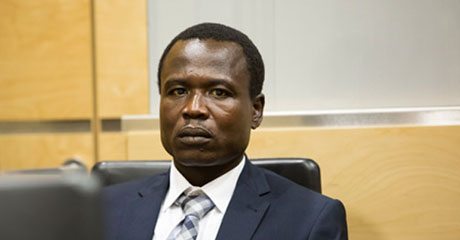
The International Criminal Court (ICC) has scheduled the opening of the trial of ex LRA commander Dominic Ongwen for December 6, this year.
On May 2, 2016, the Presidency of the ICC constituted Trial Chamber IX to be in charge of the case of The Prosecutor v. Dominic Ongwen, who faces seventy charges of crimes against humanity and war crimes, including murder, enslavement and pillaging in Lukodi IDP Camp in 2004..
Ongwen will be tried by Judge Bertram Schmitt from Germany, Judge Peter Kovacs of Hungary and Philippines national Raul C. Pangalangan.
Background
Earlier this year (from January 21 to 27 2016), three judges at the Hague, Netherlands based court held a pre-trial chamber II hearing.
Then on March 23, 2016, Pre-Trial Chamber II confirmed 70 charges brought by the Prosecutor against Ongwen, an alleged former Commander in the Sinia Brigade of the Lord’s Resistance Army (LRA), and committed him to trial.
The confirmed charges concern crimes against humanity and war crimes allegedly committed during attacks against the Pajule IDP (October 2003), Odek IDP (April 2004) Lukodi IDP (May 2004) and Abok IDP camps (June 2004). He is also accused of sexual and gender-based crimes; crimes of conscription and use in hostilities of children under the age of 15, committed in northern Uganda between July 1 2002 and December 31, 2005.
Mr Ongwen was surrendered to the ICC on January 16, 2015 pursuant to an ICC warrant of arrest and transferred to the ICC custody on January 21, 2015.
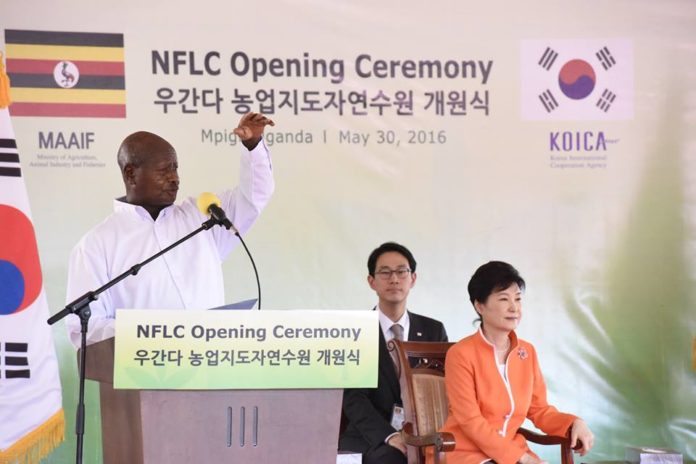
President Museveni gestures during his speech at the launch of National Farmers Leadership Centre at Kampiringisa a Shs9 billion rural project in Mpigi District. (Photo/PPU)
Local entrepreneur and activist Frank Gashumba has been given a lot of stick for referring to Uganda’s youth as ‘fantastically’ lazy.
But we doubt he would want to use the same superlatives when talking about a narrative from the head of state, that in the world, Ugandans are among the most extravagant and ‘are spendthrift when they are poor’.
When it comes to such subjects President Yoweri Museveni is a man whose opinion carries most weight.
Mr. Museveni has always been worried about the pace at which rural and agricultural development policies in Uganda progress.
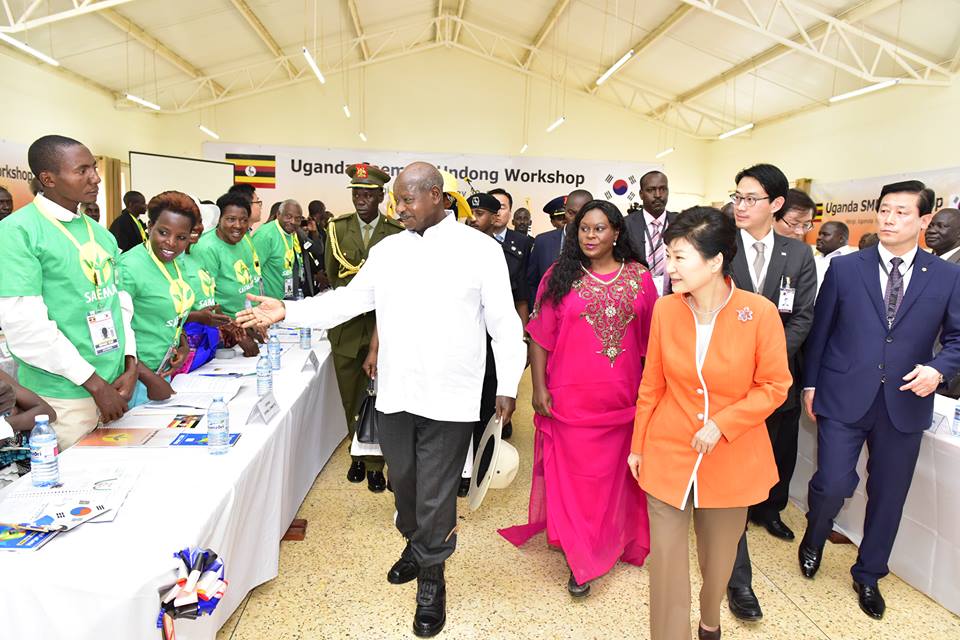
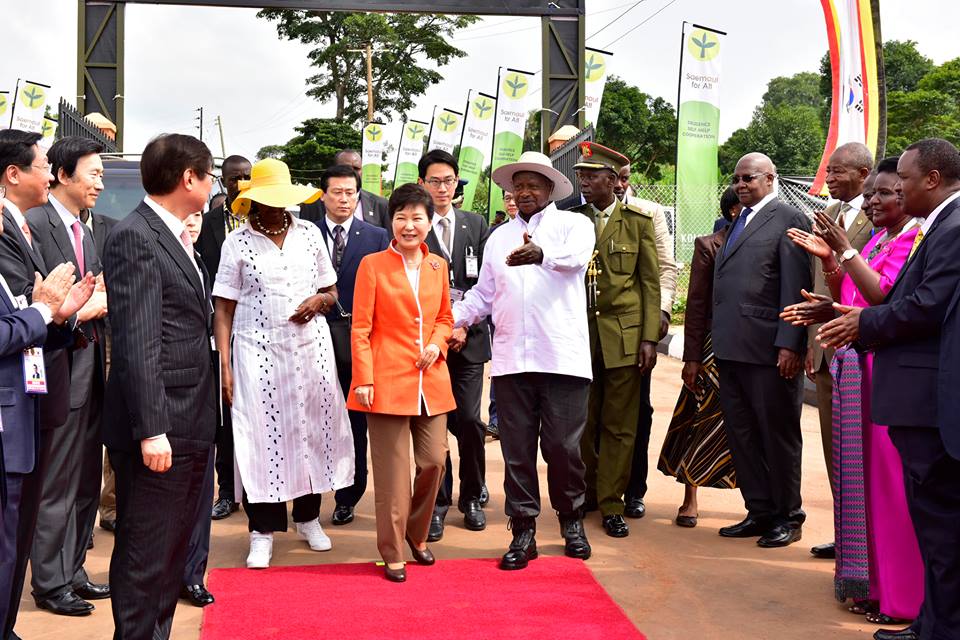
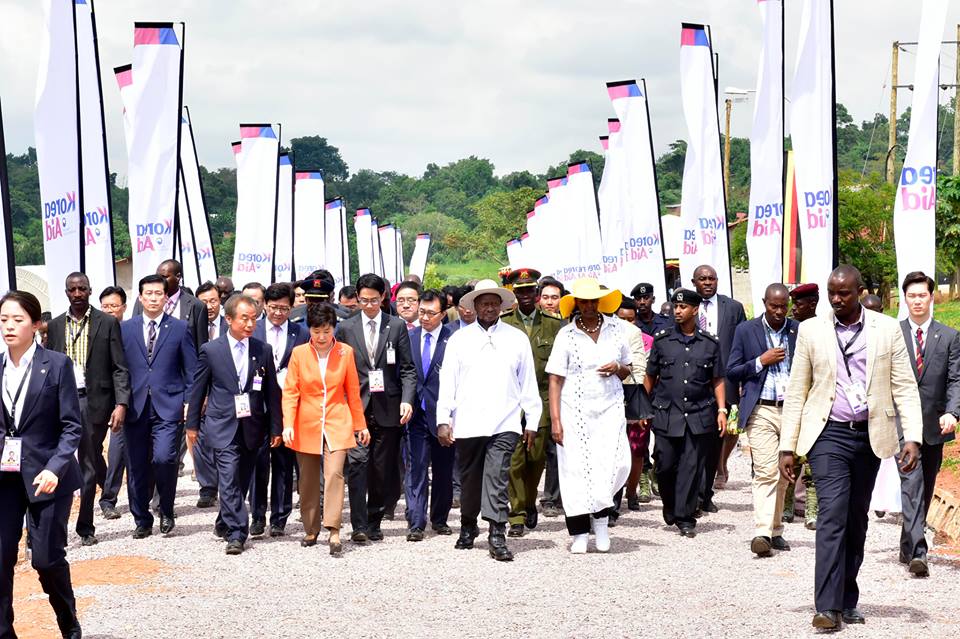
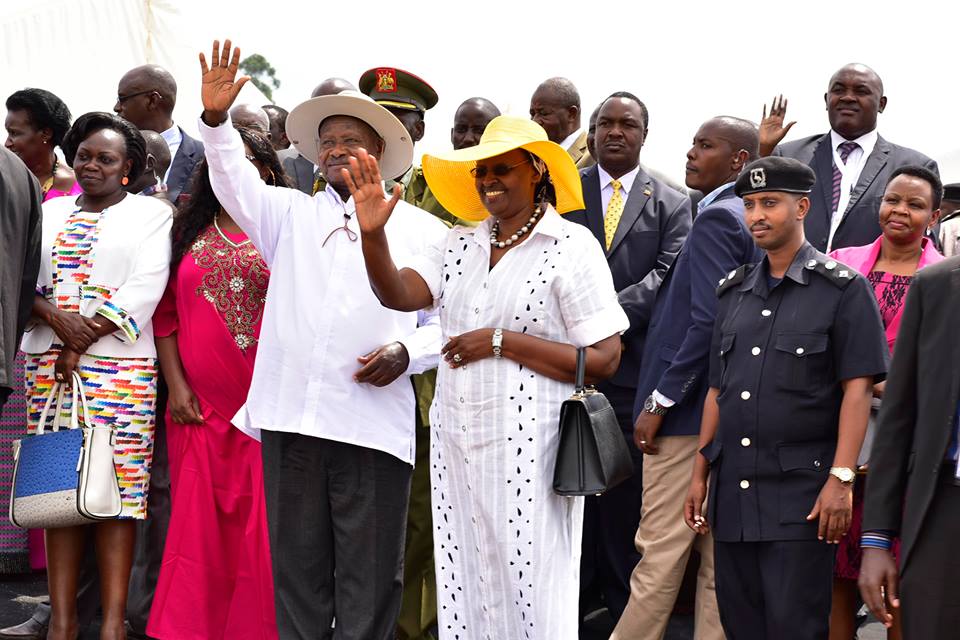
As such, President Museveni on Monday revealed how optimistic he was about the positive impact the freshly launched National Farmers Leadership Centre at Kampiringisa, a Shs9 billion rural project in Mpigi District, would create. He was in the company of visiting South Korean leader Park Guen-Hye who today will be in Kenya.
The centre that is funded by the South Korean government is modelled on the Korean philosophy of ‘Saemaul Undong’ (SMU) that has spurs rural development through mindset change.
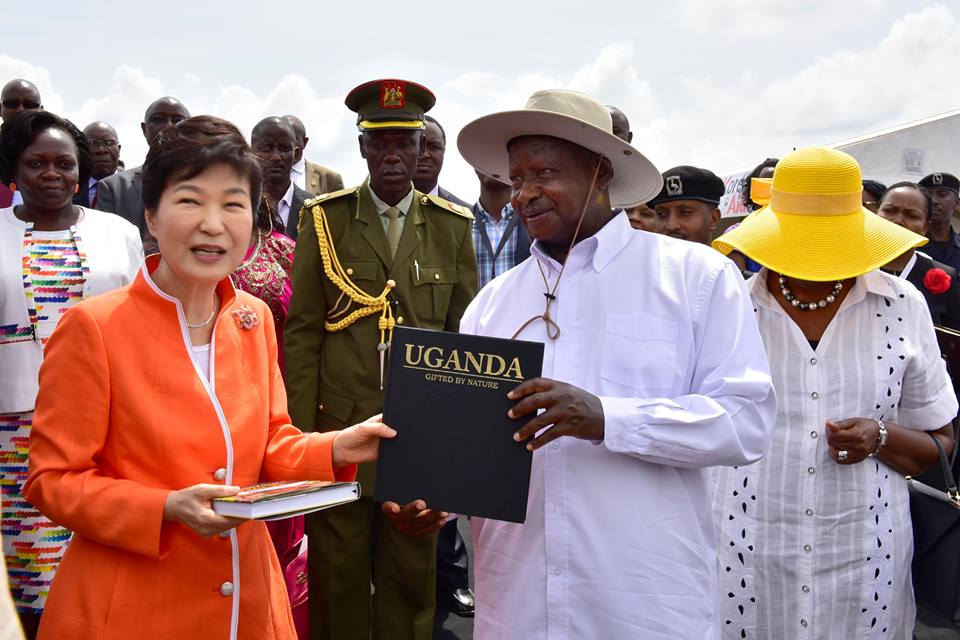
Museveni for three days hosted South Korean leader Park Guen-Hye
Mr. Museveni said: “Many Ugandans are extravagant and ‘are spendthrift when they are poor’ but Koreans are now telling us they got out of poverty because they were economical.”
“The philosophy of South Korean rural development model initiated by President Geun-Hye’s father in the 1970s will train the beneficiaries in hardwork, frugality and communal service. This movement which creates mindset change to transform rural communities has worked well for them.”
He however noted the philosophy is not new to Uganda.
Many of our communities have these beliefs. For example, we have a proverb ‘an unwise man eats seeds on account of hunger and when planting comes, the teeth smile helplessly at the garden,” Mr Museveni said adding: “The lessons for us therefore are; frugality, hard work and unity. The last we already see in our ‘bulungi bwansi’ initiatives.”
Further, the President urged Ugandans not to get carried away the promotion of loose lifestyles.
“Our people should not get carried away by the media that promotes loose lifestyle, profligacy, etc. We should borrow a leaf from South Korea on being economical, working hard and community service,” he said.
Mr Museveni said many Ugandans are extravagant and “are spendthrift when they are poor but “Koreans are now telling us they got out poverty because they were economical”.South Korea president Park Geun-hye (Centre) being given a tour around the Kampiringisa facility by President Museveni and wife Janet Museveni on MondayThe Kampiringisa programme seeks to lift the Ugandan economy through agriculture into industry
The Port Management Association for Eastern and Southern Africa (PMAESA) in collaboration with Cruise Indian Ocean Association (CIOA), Seychelles Ports Authority and Ministry of Tourism Seychelles has organized a one day cruise tourism workshop to deliberate on strategies to market the region as a cruise destination.
According to a May 31 release by the PMAESA Communications Officer George Sunguh, the event scheduled for June 14, 2016 is expected to attract chief executives of Port Authorities, Tourism Boards, Cruise operators and stakeholders from within Eastern and Southern Africa region as well as the islands on the Western Seaboard of the Indian Ocean.
Key speakers will deliberate on various topical issues during the workshop followed by open forum discussion by the participants, with Mrs Catherine Wairi, Acting Managing Director of Kenya Ports Authority is expected to discuss the Role of Cruise Terminal Design in the Indian Ocean Emerging Markets; her Seychelles counterpart Col Andre Ciseau will take the workshop through Matching the shore excursion experience to the aspirations of cruise passengers, while Mr. Saad Omar who is the chief executive of Djibouti Ports Authority will talk about Trends and challenges faced in marketing and distribution of cruise tourism destinations.
The President of Inter-cruises shoreside and port services Mr Mark Robinson from Barcelona, Spain, will discuss How Europe and North Africa are leveraging on their vast cruise potential. At the same time Mr. Vukile Khuzwayo, CIOA’s Secretary General will talk about benchmarking of past seatrade conventions while a representative of MSC Cruises will make a presentation on matching the shore excursion experience to the aspirations of cruise passengers. The workshop will be followed on day two, by a brain storming session which is expected to come up with a cruise strategy for the Indian Ocean region.
‘The cruise strategy meeting will be attended exclusively by CIOA and PMAESA members. This meeting will formulate the best means and ways of jointly promoting Eastern and Southern Africa and the Western Seaboard of the Indian Ocean islands as a market to the world as an attractive and worthwhile cruise destination capitalizing on its common strengths and highlighting individual member states’ unique and multifaceted tourist attractiveness,’ the release adds.
The Seychelles Cruise Workshop is in line with the African Union’s Maritime Strategy (AIMS) 2050 which seeks to exploit Africa’s Blue Economy and a follow up to a recent study on the Potential for Cruise Development in the PMAESA region. The study, among other things found out that ‘the efficient promotion of a cruise port as a destination can only be done by bringing all key involved shareholders to work together.’
The Cruise Workshop and the Strategy session will give way to the CIOA and PMAESA Mid Term Board meetings.
The Port Management Association of Eastern and Southern Africa (PMAESA) is an Intergovernmental Organization operating under the auspices of the United Nations Economic Commission for Africa (UNECA) with its Secretariat in Mombasa, Kenya. PMAESA was founded in April 1973 drawing its membership from 25 countries.
The Association has two other sister Associations, covering the North African Ports Association (UAPNA), and the Port Management Association of West and Central Africa (PMAWCA) also created, with similar objectives.
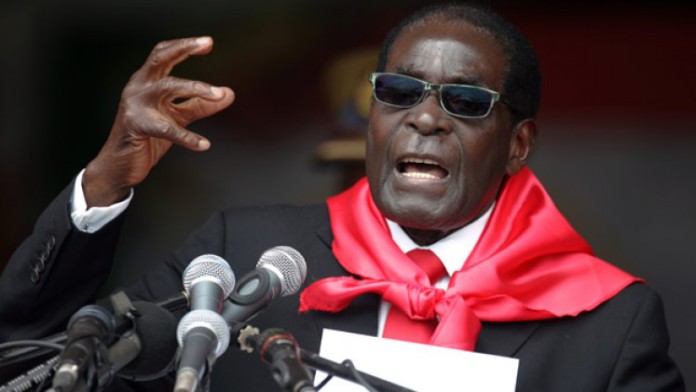
I AM STILL AROUND! Zimbabwe President Robert Mugabe
Zimbabwe President Robert Mugabe is the only Head of State attending the African, Caribbean and Pacific (ACP) meeting underway in the Papua New Guinea (PNG) capital of Port Moresby, NewsDay has learnt.
Early this year, Mugabe was also due to attend a low-key Indian Cultural Festival and later left in a huff under the guise of security concerns, as it emerged that even the host country’s leader, President Pranab Mukherjee, had snubbed the event.
Deputy Minister of Information, Thokozile Mathuthu said it was not Mugabe’s problem that other leaders did not attend.
“We are not doing the accreditation of delegates, but it is up to organisers to deal with that. We only attend where we are invited and if other people decide not to attend, then it is up to them. I would not know,” she said.
The Zimbabwean leader, whose penchant for travel has become legendary, finds himself among ‘four vice-presidents, 13 Prime Ministers, one deputy Prime Minister, a Speaker of Parliament, 14 ministers and 16 ambassadors from more than 50 registered ACP countries’, according to media reports from the Pacific Ocean enclave.
“Mugabe will be the only President attending this meeting. Mugabe’s advance parties, including six other African nations, are already in Port Moresby doing preparatory work for the arrival of their delegations,” the Pacific Island Report said at the
weekend.
Mugabe, as has become the norm, took with him an entourage that includes Foreign Affairs minister Simbarashe Mumbengegwi and Information ministry permanent secretary George Charamba, among other government officials.
Mugabe has, in the past, also attended an obscure youth summit in New York, the United States, where he was the only Head of State.
Africa’s biggest economy, Nigeria, is represented by its vice-president Yemi Osinbajo.
The Central African Republic is represented by Prime Minister Matheu Simplice Sarandji, who arrived on Friday, while Namibian deputy Prime Minister, who doubles up as International Relations and Co-operation minister, Netumbo Nandi-Ndaitwah, “arrived in Port Moresby via Singapore with a handful of her entourage”.
PNG Prime Minister Peter O’Neill officially opened the summit yesterday, with the closing ceremony set for today.
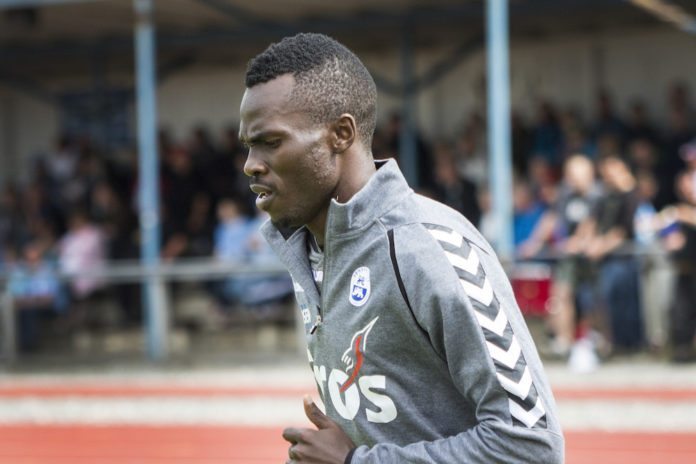
Uganda Cranes and Denmark based striker Emmanual Okwi believes today’s game against Zimbabwe “presents a shot at redemption” for the national team after their dismal display against Burkina Faso a few months ago.
Uganda will face Zimbabwe in a friendly in Harare to be played on the Rufaro astro turf at 4pm (EAST, 3pm local time) in preparation for the upcoming Afcon 2017 qualifier against Botswana on June 4 in Francistown.
The Cranes need maximum points against Botswana and Comoros in September to guarantee a place in Gabon next January.
And SønderjyskE forward Okwi is expected to be one of 19 players to be given a kick about by Milutin ‘Micho’ Sredojevic in the friendly is confident Cranes’ “great generational shift” will pay dividends in this campaign.
“Wearing the shirt of the national team is always beautiful and special, and it’ll be a hotly-disputed match against Zimbabwe,” he said before the team left on Monday.
“We have to give everything to the national team. Qualification this time looks realistic and we’re focused.
“I feel comfortable in any position that I’m put and playing where the Coach needs me.”
“We didn’t have a good game at Namboole, but the two next fixtures this week present a shot at redemption. There’s been a great atmosphere in the camp and we shall make Uganda happy.”
Coach Micho and technical team are yet to release details about his selection ahead of today’s match.
Cranes players in for Zim, Botswana games;
Goalkeepers: Denis Onyango, Robert Odongkara
Defenders: Denis Guma, Isaac Isinde, Joseph Ochaya, Murushid Juuko, Godfrey Walusimbi,
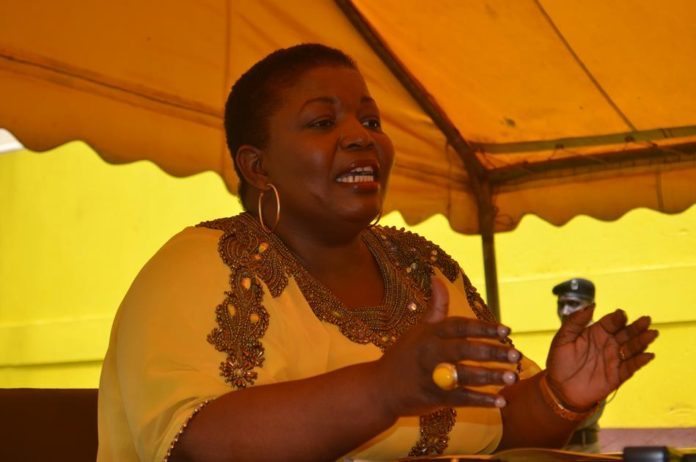
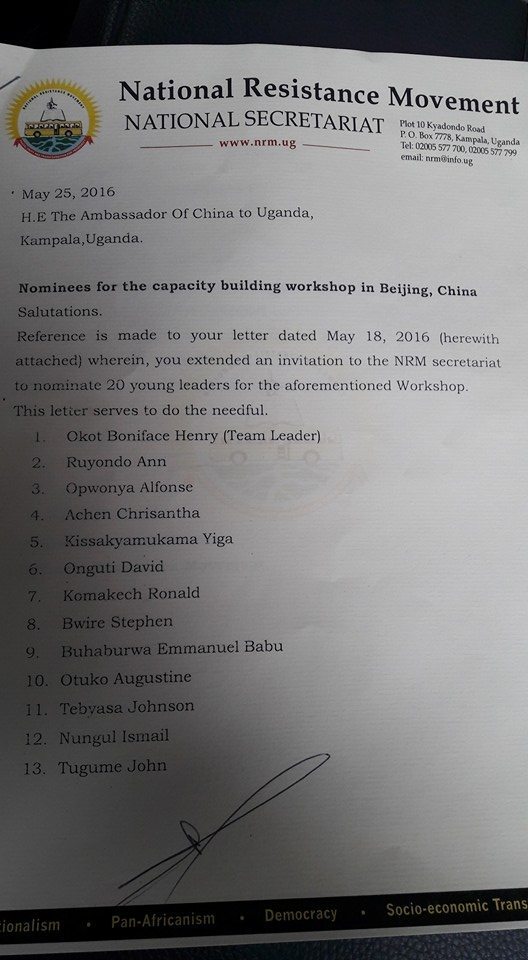
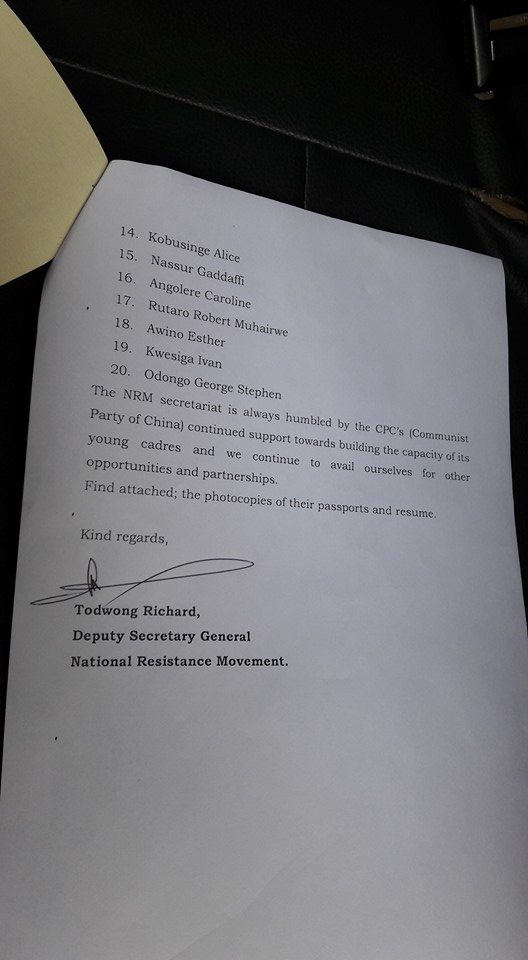
NATIONAL Resistance Movement party Secretary General, Kasule Lumumba is on spot after she ordered the Ambassador to drop the name of the party youth leader who had been nominated for training in China in favour of her tribemate.
According to a source, Lumumba drove to the Chinese Embassy in Kololo and told the Ambassador 8to drop the name of Robert Rutaro who was nominated by the Deputy Secretary General, Richard Twodong. Rutaro had been nominated among the 20 youth to train for capacity building in Beijing China. The trip and training is sponsored by the Chinese ruling party.
Lumumba instead replaced Rutaro with the name of former Luuka legislature Meddie Mulumba who is also a commissioner at Uganda Human Rights Commission.
The move by Lumumba show the poor working relationship between top NRM party officials especially the Secretary and her Deputy.
Rutaro works at the NRM secretariat and is among the youth the NRM party Chairman, Yoweri Museveni picked from Makerere. Rutaro has previously served as NRM Secretary General for the youth league and before that, he was a Guild President Makerere University
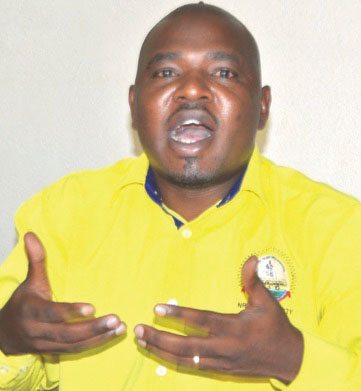
Robert Rutaro
Below is Rutaro’s narration of events
The Rt .Hon Richard Todwong recommended me (Rutaro Robert) to travel to China on a powerful delegation to attend a Youth Conference due on the June 3-13, 2016 in Beijing. The trip is wholly sponsored and financed by the Chinese government. Today morning the china embassy called me to go for and pick my visa, on reaching the embassy around 11 am I found the Secretary General Kasule Lumumba driving out of the said embassy. On reaching the counter to collect my visa I was informed that my Secretary General left orders that my name should be PUT OFF THE LIST OF 20 MAN DELEGATION, emphasizing that she is not comfortable with my name on that list. She replaced me with the one and only Meddie Mulumba. The changes only affected me. The trip is on June 2, 2016.
Question is why would the Secretary General remove my name off the delegation without consulting her deputy who nominated me to travel?
Secondly, was the matter so important that the secretary General had to drive to the embassy personally just to effect that min-reshuffle on the delegation?
Thirdly, why wouldn’t my Secretary General inform me of her decision early enough so that I don’t prepare for the trip, later on waste my time and fuel to go to the embassy to collect the said visa? Up to now, I have not heard a word from her!
The Secretary General’s directive was communicated to the visa counter by none else but the Chinese Ambassador himself with instructions to cancel and withdraw my visa, after holding lengthy discussion my Secretary General which lasted over two hours. So I was turned away with the bad news, assured that I will not travel on that delegation as per the directive of my Powerful Secretary General.