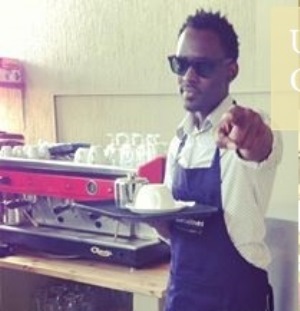
‘Mwooyo’ singer Maurice Kirya is proving to be an astute businessman after all. His Sound Cup coffee shop is officially reopening tonight at anew and more spacious location … nearly tripled its seating and showed off a hip, modern decor with the renovation with its new locality at Village Mall, Bugolobi.
“The Sound Cup is unique,” Kirya said. “It’s a center point for many people to have their meetings here and especially for bringing the music lovers together.”
“A place where good sounds meet good food and drinks plus lovely service”. What he doesn’t mention though is the atmosphere at the café and the lovely crowd that visits the place.
Opened on 2nd November, 2013 The Sound Cup is still a newbie on the Kampala restaurant scene. What’s impressive to note though is that Kirya, seems to have done his homework. He claims to have done research for over eight years before opening up the café at the now silent Garden City Mall but with a more vibrant Bugolobi commune, Kirya is going to make a kill!
Today (March 24th) features an invite-only for Kirya’s loyal customers, press and friends.
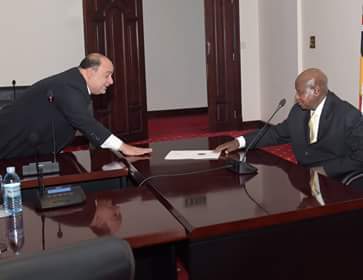
President Museveni receives President Fatah Al Sisi's message from the Egyptian
Ambassador to Uganda, Mr. Ahmed Abdel Aziz
Mostafa
President Yoweri Museveni has received a special
message from President Abdel Fattah el-Sisi
Egypt.
The message was delivered by the Egyptian
Ambassador to Uganda, Mr. Ahmed Abdel Aziz
Mostafa at State House, Entebbe.
Mr Museveni and the Egyptian envoy discussed
issues pertaining to the relations between Egypt
and Uganda, particularly trade between the two
countries.
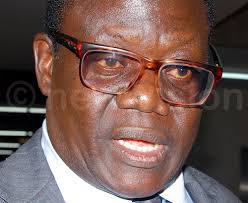
HAS CASE TO ANSWER: Former Minister of Works Abraham James Byandala
After an incident in which former Minister of Works Mr Abraham James Byandala allegedly punched TV journalist Judith Naluggwa in the lower abdomen at the Anti-Corruption Court yesterday, some Ugandans have taken to social media urging the embattled minister to apologise and resign.
Most of Facebook users on the Ugandans at Heart platform have termed Mr. Byandala’s reported actions as shameful and that they symbolise the rot in the Ugandan society.
A one Pamela Ankunda, wrote: “If this video is what it is and it looks like it is, do the only honourable thing left: Apologise and Resign.”
Former Uganda Investment Authority (UIA) boss Maggie Kigozi termed Byandala’s actions as ‘intolerable behaviour’ and wished the victim, Nalugwa a quick recovery.
“If Byandala who is learned and holds a high post can punch a woman, then what do ordinary men do?” wondered Kawuma Mirundi on his page.
Some, however, called for objectivity from those criticising Byandala’s actions, saying the minister had been put under pressure.
“The journalist was punched for putting the camera in Byandala’s face, let’s be objective and look at both sides of the coin,” JB Kalyango wrote.
Mr Byandala, the Minister without Portfolio in the President’s Office, is currently facing corruption charges, with Prosecution alleging that while serving as works minister, he was involved in swindling funds meant for the construction of the now controversial Mukono-Katosi road, where government lost Shs 24 billion in shoddy deals.
Meanwhile, Nalugwa, a Bukedde TV Reporter has reported a case of assault to Jinja Road Police Station, where a file has been opened against the embattled minister.
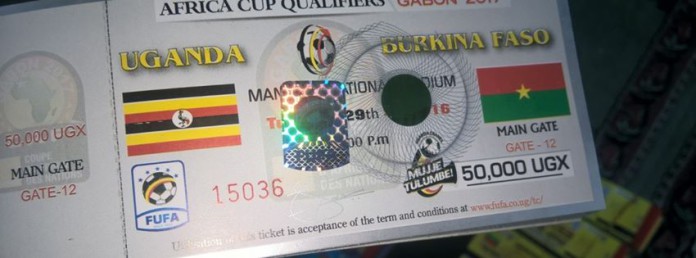
The Cranes take on Burkina Faso on Saturday, March 26 away and host the return leg three days later at Namboole. Uganda last reached the finals in 1978.
FUFA the body that runs the game has grown strong both in character and experience. 39 years in the wilderness of continental football has given us a wealth of experience to turn obstacles into opportunity with magnificent results. The federation’s new found strength exudes belief, character and never say die attitude which has trickled down through the players of the national team.
The recent form on the road by the uganda cranes has been impressive. It has gone places where African power houses crumbled and got positive results. Accra Ghana 1-1 where Ghana had to pass through the eye of the needle, a win in Lagos Nigeria and a win away to Comoros, Moroni. These all point to national team resilience and maturity.
Rankings- the recent ranking by FIFA/CAF show the progress of Ugandan football overall. Remarkable strides are being made behind the curtains of soccer and they are beginning to bear fruit. The cranes being way above their Burkinabe counterparts give us a good chance to have a result away from home.
Glorious start- The cranes have never enjoyed a more perfect start from a tournament than a six points out of two games record. This should give us a calmness of table leaders and the ruthlessness of an assassin. Being at the top of the table is not by chance but by hard work, talent and experience of recurrent failure. The Burkinabe will learn the hard way.
Best 18: In ages- Uganda cranes has never been found wanting in talent. These eighteen players present the coaches with a selection headache, a good one. The teams that usually qualify with, consistency for tournaments such as these are with a vast selection of professional players. Only one of the players that travel to Burkina Faso will be locally based. That is a huge statement! No wonder we have maximum points.
Good form- our form from the recent games speaks volumes about the team. From both the junior and senior teams minus tournaments its 8 wins two draws zero losses! Stopping a team that is on such a strong run will take massive effort from Burkina Faso. I wonder if they possess the mettle to bring down the mighty cranes.
Onyango- singling out one person in a team sport to be the difference has always been so hard for me. Dennis Onyango’s form for both club and country has been magnificent. He must be the only link to why his club and country are leaders of their respective tables. If Onyango gives us his best game in Burkina Faso, my money will be on Uganda qualifying as table leaders.
Silence the critics- the cranes have not had it the easy way most of the time. Some people will argue that sometimes it was rightly so, but many times they have had it unfairly rough from the Ssekamates and Kabuletas of Uganda. They have questioned their character and will to win; sometimes even their allowances were doubted. Their performances have been sarcastically equated to $100 bonuses. This is what their performances equated too not the $2000 that they actually and truly receive. Cranes this time round is here to bury the hatchet with the media doubters and they are here to shut them up with outstanding performances on the pitch.
9.Loyality- the cranes want to pay back to the their fans who have stuck with them through thick and thin, tears and laughter, sweat and blood with a qualification to the AFCON. It is not only a good thing but it’s also a worthy present. Dear fans turn up in big numbers in Namboole Tuesday 29th for the grand prize.
We need this qualification more! Of the two teams, the cranes need this qualification more. We are hungrier and thirstier for the AFCON. We have been in the darkness of continental football for much too long and this is our time!
Facebook has written back to prominent city lawyer in response to letter complaining over damaging comments posted by a one TVO to the effect that he received Shs900 million bribe to abandon the presidential petition filed by his client John Patrick Amama Mbabazi.
The faceless and sharp critic of the Kampala regime, Tom Voltaire Okwalinga aka TVO post last week that under the headline ‘Betrayal in City’ that Mr Muwema had allegedly received a bribe of Shs900 million from Information and National Guidance Minister, Maj. Gen. Jim Muhwezi and thereafter jumped out of the 2016, presidential petition.
“Amama Mbabazi’s lawyer Muwema sold out to M7,after he was given 900 million in a deal brokered by Jim Muhwezi ,and thereafter jumped out of the petition case, locked his office before stage-managing the raids at the twio law firms, and steal the signed affidavits and other evidence on petition. So Muwema was part of the evidence theft from his own and Mohammed chambers” TVO posted.
Okwalinga further claimed that Mr Muwema ran off with 157 affidavits that were signed and then claimed police took everything, thereafter he passed on information to the state agents who started arresting and harassing witnesses, and the remaining Amama lawyers started all over again to get the new affidavits.
Below is Facebook reply to Muwema
Re: NOTIFICATION OF INFRINGING DATA MESSAGES
Hi,
We are in receipt of your letter dated 2016-03-22, a copy of which is attached to this message for your reference. Thank you for bringing this matter to our attention. We are writing to get additional details so that we can better understand your recent report. Based on the information you provided, it is unclear where the content you wish to report appears on our site. In almost all instances, the best way to help us locate content is to provide us with active web addresses (URLs) leading directly to that specific content.
In the report you filed, you did not provide any URLs (or one or more of the URL(s) you provided seems to be incomplete or inactive), and you did not otherwise provide a description of the location of the content sufficient for us to be able to find it.
If you are trying to report a Wall post or story in your news feed, you can find its direct URL by clicking the time and date that appears in gray with the content (for example: “8 hours ago” or “August 11 at 10:30am.”).
If you cannot provide URLs leading directly to the content you wish to report, please be sure to include information reasonably sufficient to permit us to locate the content, such as a description of the content and where it appears (e.g., on a particular timeline, in a photo album, etc.), dates/times of when the content was posted (usually indicated below the content), names of responsible users, and/or quotes of the content you wish to report as it appears on Facebook.
Please note that it is possible that the content you wish to report has already been removed from the site. If that is the case, you do not need to respond to this email.
Once you have provided information sufficient for us to locate the content you wish to report, we would be happy to look into this matter further.
The United Nations plans to reduce its peacekeeping troops in the Democratic Republic of Congo (DRC) by 1700 personnel.
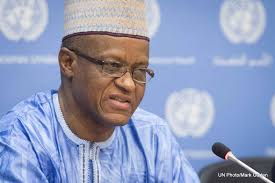
Addressing the United Nations Security Council (UNSC), Maman Sambo Sidikou, the head of the UN Organisation Stabilisation Mission in the DRC (MONUSCO), said the move is in line with the Secretary General’s recommendations.
With a force of over 20.000 troops from over 30 countries, MONUSCO is the biggest peacekeeping force in the world and spends millions of dollars in sustenance annually. It was established in November 1999 and has to date spent over US$8.5 billion of operations in the vast and troubled central Africa state.
Meanwhile, Mr Sidikou has raised the proverbial red flag, saying rising tensions in the DRC ahead of elections in November could lead to violence if unaddressed.
“First, credible and meaningful political dialogue is needed to overcome the impasse in the electoral process,” Mr Sidikou was quoted saying, adding: A strong message on the need for political consensus and an agreed, sustainable way forward will be important, while also emphasizing the link between a credible electoral process and upholding fundamental human rights.”
He also called for a national disarmament, demobilization and reintegration process, to pave the way for ex-combatants to go back to their communities or countries of origin.
“Neutralizing armed groups goes beyond military operations and requires enhanced efforts to extend State authority and find durable solutions for former combatants,” Mr Sidikou said, before underlining his priority to fully implement MONUSCO’s ‘zero tolerance’ policy against sexual exploitation and abuse (SEA).
“Under my leadership, MONUSCO will take all possible steps to prevent SEA, punish those responsible to the maximum extent possible, and address the needs of victims.”
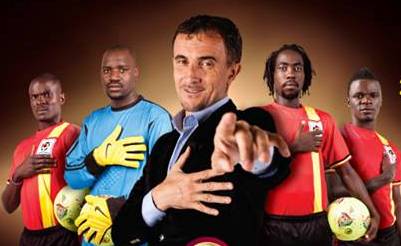
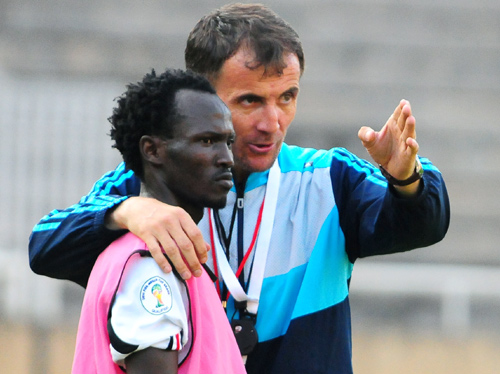
There were no surprises in the final squad announced by Uganda coach Milutin ‘Micho’ Sredojevic traveling for the Afcon 2017 qualifier against Burkina Faso on Saturday.
Youthful El Merrick goalkeeper Salim Jamal and teenage PROLINE FC striker Idris Lubega did not make the cut in a squad that is largely made up of players who did duty for Uganda in the previous 3-0 win over Togo in qualification to the 2018 World Cup group qualifying stage in November.
Sonderjsyke (Denmark) striker Emmanual Okwi has another chance to revive his international career after making the final 18 while goalkeeper Denis Onyango who had been held up in Congo Brazzaville due to travel restrictions also makes the team.
Skipper Geofrey Massa will be joined by, Standard Liege forward Farouk Miya, Okwi and Hamis ‘Diego’ Kiiza in the hunt for goals. Cranes are top of their group on maximum points, following successive wins over Botswana and Comoros. They leave for Ouagadougou which is approximately 3988 kilometres or 2478 miles on Thursday aboard Ethiopian Airlines.
The final list:Goalkeepers: Dennis Onyango (Mamelodi Sundowns, South Africa), Robert Odongkara (St George, Ethiopia)
Opening at Cinema Magic Naalya, Thursday 24th March 2016
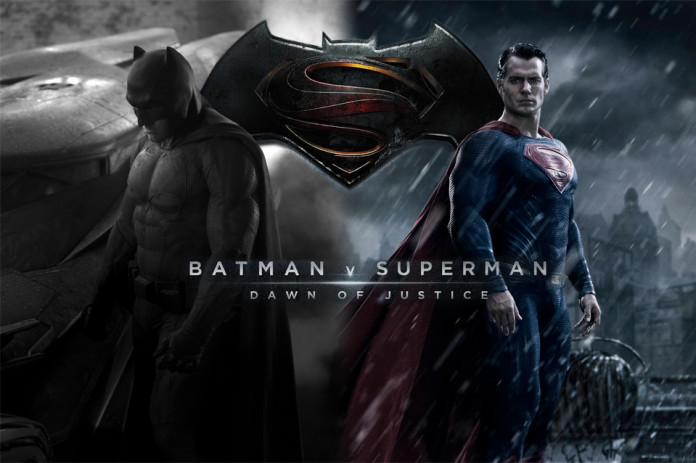
BATMAN V. SUPERMAN: DAWN OF JUSTICE in 3D
Director Zack Snyder proves he just might be the biggest fanboy of all by creating a superhero movie suitably epic for having Batman, Superman, Wonder Woman and all their derring-do.
Is that a good thing for Batman v Superman: Dawn of Justice, though? Well, not always in this massive though improved sequel (*** out of four; rated PG-13; in theaters Friday) to Snyder’s Man of Steel. BvS does well laying groundwork for a cinematic universe that could hold an entire Justice League. But it unpacks too much material for even a 2½-hour film, leaving Dawn of Justice a superpowered jumble at times.
But that takes a backseat to the joys of watching Gal Gadot’s awesome Wonder Woman smile gloriously in the middle of a fight, Ben Affleck turning in a strong take on an older Dark Knight and his alter ego Bruce Wayne, and a story about two orphans.
Batman plays a major role from the start, as a quick recounting of his origin leads to Bruce driving into the 9/11-type destruction of Metropolis and seeing the carnage wrought by Superman’s Man of Steel battle against Zod.
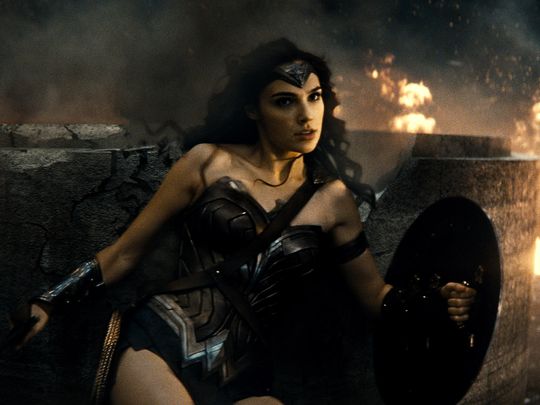
Wonder Woman (Gal Gadot) lives for battle in “Batman v Superman: Dawn of Justice.” (Photo: Warner Bros. Pictures)
Fast-forward 18 months, and Superman becomes part of another incident saving his love, Lois Lane (Amy Adams). Enough’s enough for three folks: Sen. June Finch (Holly Hunter), a congresswoman who wants to hold Superman accountable; Lex Luthor (Jesse Eisenberg), a xenophobic villain planning to annihilate this alien interloper; and Batman, who’s waging his own war against criminals while figuring out what to do about the Man of Steel.
BvS starts losing its way when Lois secretly meets with government officials, someone tries to sneak a dirty bomb into Gotham City, Lex is conniving in pretty much every way, and Batman has a post-apocalyptic nightmare that involves evil Superman, a large Omega symbol, a locale that looks like Dark Knight: Fury Road and a fleeting superhero sighting.
The subplots dovetail decently into the big finish, one Snyder pulls off with a surprise return, one huge shocker and the promised throwdown between Batman and Superman. For those wondering why these two have to fight, there is a very good storyline reason for the two frenemies coming to blows, and in the director’s action-packed movie resume (300, Watchmen), that faceoff and their inevitable alliance with Wonder Woman against Lex’s vicious monster Doomsday vault to the top of Snyder’s best-told fight sequences.
Henry Cavill is again a solid Superman (and Clark Kent), even more the second time, though Affleck and Gadot are really special in their debuts. Whether skulking around in an evening dress or brandishing bulletproof bracelets in costume, Gadot proves to be just as entertaining and watchable as either of the headlining heroes.
Affleck’s Batman is a surprisingly emotional one. A few scenes showcase a strong, even flirty chemistry between him and Gadot, rivaling that of Cavill and Adams and of the cinematic Caped Crusaders over the years, Affleck seamlessly moves between Batman and Bruce Wayne.
BvS will please those either waiting for the two main players to lock horns on a movie screen, or those who’ve just been pining for Wonder Woman forever. And for the nerdier crowds, a fleeting glimpse at other superheroes hints this is the Dawn of something potentially sensational.
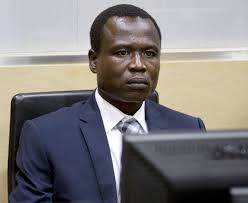
“Today, 23 March 2016, Pre-Trial Chamber II of the International Criminal Court (“ICC” or “Court”) issued a decision confirming 70 charges brought by the Prosecutor against Dominic Ongwen and committed him to trial before a Trial Chamber” reads the statement posted on Website.
Ongwen, aged 40, was charged with 70 counts of war crimes and crimes against humanity in northern Uganda, where the group originated, according to Human Rights Watch (HRW).
He was forcefully abducted from northern Uganda into the LRA ranks around age 10 and the rebel group gave him military training. He rose to become a senior commander implicated in serious abuses across Central Africa, says HRW.
The LRA rose up against the government in northern Uganda under the leadership of warlord Joseph Kony in the late 1980s and is notorious for having abducted tens of thousands of children to serve as fighters and sex slaves and has killed and wounded thousands of civilians.
Having earned a reputation for carrying out massacres and mutilating civilians, the LRA left Uganda about a decade ago and has roamed across parts of Democratic Republic of Congo (DRC), South Sudan and CAR since then, eluding efforts to defeat them.