Stanbic Bank
Stanbic Bank
17.8 C
Kampala
Stanbic Bank
Stanbic Bank
Home Blog Page 2271

Kenya schools ordered to close

Striking teachers in Kenya demanding for a salary increase ordered by the Supreme Court in August, have led to the forced closure of all public and private schools in the country.

According to media reports, the decision by the Kenyan government will, beginning Monday September 21, affect pupils from Standard One to Standard Seven and students from Form One to Form Three.

Kenya follows an 8-4-4 system of education, meaning the pupils and students in candidate classes of Standard 8 and Form 4 awaiting their Kenya Certificate of Primary Education (KCPE) and Kenya Certificate of Secondary Education (KCSE) examinations respectively, are not affected.

Schools re-opened for the third term on August 31, but midway the Ministry of Education, in a circular, said they should close on September 21.

The closure follows three weeks of persistent non-teaching by the striking teachers, who got a reprieve from highest court, ordering government to pay them a 60% increase in salary. This means that the decision is incontestable, a development that might have galvanized the teachers into recalcitrance.

It is not clear what the teachers, who coalesce under the powerful Kenya National Union of Teachers (Knut) and the Kenya Union of Post Primary Education Teachers (Kuppet) will do, but last week some of the teachers took the strike to the streets of Nairobi, demanding that government honours the court ruling.


Stories Continues after ad

Thousands attend Gen Aronda’s prayers

Gen Aronda's widowed wife, Linda Kahoza eulogising her husband.

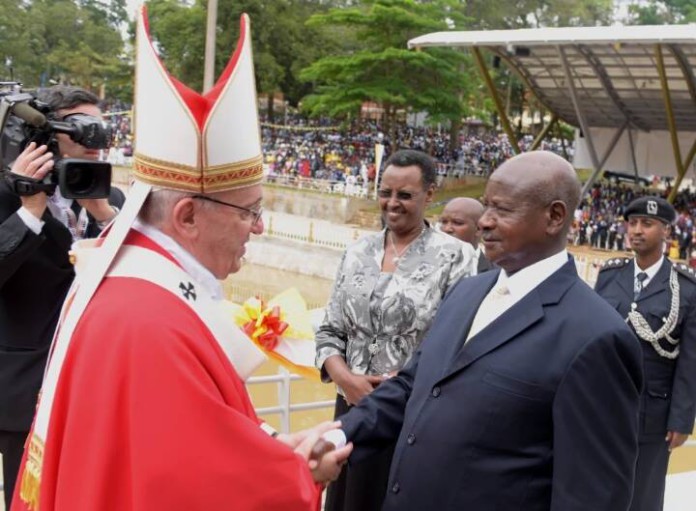
Tens of thousands have today thronged the Kololo Ceremonial Grounds for prayers held in tribute to the late General Robert Aronda Nyakairima who died of acute heart failure last Saturday as he returned from a working visit to South Korea.

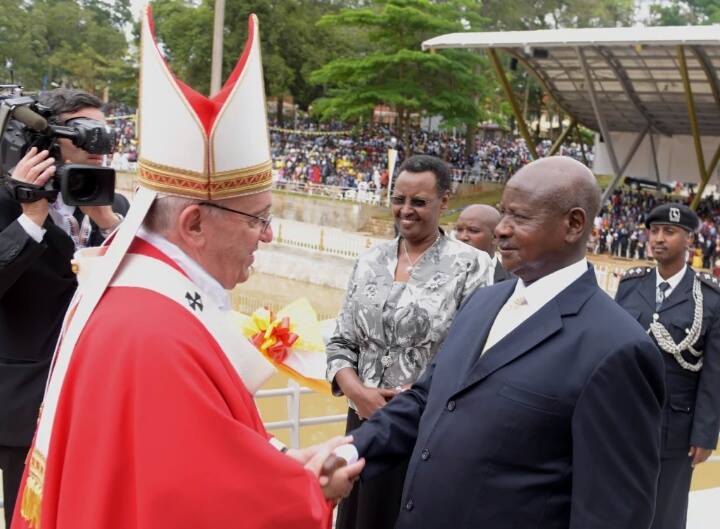
The prayers led by the Anglican Archbishop Stanley Ntagali were attended by President Yoweri Museveni, the widow and relatives, several senior army officers including service commanders from armies in the region, staff of the Ministry of Internal Affairs and people from other walks of life.

Gen Aronda's widowed wife, Linda Kahoza eulogising her husband.
Gen Aronda’s widowed wife, Linda Kahoza eulogising her husband.

The chief mourner President Yoweri Museveni said he was annoyed that Aronda died of a medical condition which was poorly handled.

“Actually Aronda complained of dizziness. He said ‘I am feeling dizzy’. That was in South Korea before entering the plane,” Museveni said before calling up the government officials who travelled with Aronda to South Korea’s capital Seoul before the latter’s death last Saturday.

The President explained that he investigated Aronda’s death and interviewed the officials in the Minister’s entourage to South Korea because “I never leave anything to chance.”

Museveni then narrated: “Aronda said ‘I am feeling dizzy’. They tried to go to the hospital but South Koreans said that they cannot allow someone to go to the hospital without insurance.”

“That’s nonsense. Surely, they must have emergencies. They must have treated him and see whether he will not pay,” a peeved Museveni said. The President further said there was “a gap of medical checkup. Even when we did the post mortem he had had previous heart attacks – small ones.”

“The body is carbon paper. Whatever happens will be recorded. He had two heart attacks before. This one was very big he couldn’t survive.”

“Apparently, they had not told me and he had not told me that he had some sort of mild hypertension for many years,” Museveni added.

On his part Archbishop Ntagali said he knew Gen Aronda as a man of integrity and God fearing with high morals. He lauded Gen Aronda for successfully spearheading the national ID project, which had previously failed to take off under his predecessors.

Other speakers at the service also extolled Gen Aronda, with the Chief of Defense Forces (CDF) General Katumba Wamala describing the deceased as an exemplary officer who served his country diligently. Comforting the bereaved family, Gen Katumba Wamala, who succeeded Gen Aronda as CDF, said the deceased had left a legacy that would ensure a good future for them.

James Baba, the State Minister for Internal Affairs described Gen

Aronda as a very hardworking and dedicated man, who knew almost all his subordinate staff and the challenges or opportunities each faced.

“He took interest in almost everyone under him,” Mr Baba said.

Meanwhile, in a brief speech Gen Aronda’s widow Linda said her husband had never suffered from any ailment known to her in the past.

“This heart disease they are talking about might have been there but for the twenty years I have been with my husband, I did not know him to have such an ailment,” she said and added that the deceased ‘was always full of energy’.

She praised her late husband for being caring, loving a dedicated public servant.

Gen Aronda died at the age of 56 and is survived by the widow Linda Kahoza Nyakairima, and two children. His burial will take place on Sunday, September 20 at his ancestral home in Rukungiri.


Stories Continues after ad

Mubiru gets 10 years for sodomy

The name Chris Mubiru will not surface in football administration in Uganda for the next ten years, following today’s sentencing of the former Cranes Team Manager for sodomy.
Buganda Road Chief Magistrate Flavia Nabakooza, who convicted Mubiru last week for sodomising Emmanuel Nnyanzi, said the convict survived a life sentence. She also ordered Mubiru, once a Team Manager with SC Villa and Vipers FC at different times, to pay the 23-year old Nnyanzi Shs50 million in compensation.
Magistrate Nabakooza advised Mubiru to appeal the sentence if he felt discontented, advice which the convict’s lawyers led by Isaac Ssemakade said they would pursue in a higher court.
Mubiru was charged under section145 (a) of the Penal Code Act that prohibits same sex sexual acts and presents a life imprisonment punishment once found guilty.
The ruling has excited a cross section of persons including sport loving fans, Christian leaders and human rights activists including a jubilant Pastor Solomon Male, who was present at the court.
Stories Continues after ad

Cranes off to Masindi

Cranes vs Kitara Region, Boma Grounds,Masindi.
Tomorrow: 4pm
The Cranes regional tours aimed at boosting the national team’s fan base and scouting talent around the country have now reached Masindi.
The 23-man team accompanied by eight officials will play against Bunyoro Kitara at4pm tomorrow, before the coaches identify possible players that could be included in the national football engagements especially in the upcoming CHAN 2016 qualifiers against Sudan.
While in Masindi the Cranes will stay at the Kabalega Resort Hotel.  
The tours begun last year and so far the Cranes players have been to Mbarara in the west; Gulu in the north and Soroti in eastern region.
Beneficiaries of the campaign include Farouk Miya and Derrick Tekwo.
Meanwhile, Eagleonline has leant that four of the seven Vipers’ players summoned did not turn up at the departure point at Sky Hotel in Naalya.
The four are goalkeepers Ismail Watenga and Robert Alitho, and players Kezironi Kizito and Deus Bukenya.
THE PLAYERS
Goal keepers: Matthias Kigonya and Stephen Odongo.
Defenders: Dennis Okot, Shafik Bakaki, Richard Kassaga, Isaac Muleeme, Julius Ntambi, Henry Katongole, Joseph Ochaya, Martin Mpugga and Hassan Dazo.
Midfielders: Lwanga Tadeo, Ivan Ntege, Muzamir Mutyaba, Hakim Senkumba, Feni Moses Ali, Farouk Miya (Capt) Martin Kiiza and Ambrose Kirya.
Strikers: Robert Ssentongo, Ceaser Okhuti, Jonah Semazi and Frank Kalanda.
Head coach: Micho Sredojevic
Assistant coaches: Moses Basena and Fred Kajjoba.
Stories Continues after ad

Heineken Uganda treats Rugby fans to Rugby World Cup Launch

Heineken Uganda will this evening treat Ugandan fans to an epic Rugby World Cup Launch at Legends Sports Bar. While the grand opening ceremony will be going on at Twickenham, Heineken Uganda will be giving rugby fans and heineken consumers a one of a kind experience at the home of Rugby here in Kampala.

The world of sport will have its eyes firmly fixed on the Rugby World Cup in the upcoming months. Amid a growing interest in Rugby amongst Ugandans, Heineken, a worldwide partner of Rugby World Cup 2015, has kicked off its latest campaign ‘This is Rugby’ at Legends Rugby Club in Kampala.

The 2015 tournament ​is poised  to be a spectacular event, laced with unpredictability. The party wont stop either as Heineken promises to give rugby fans the ​ultimate screen experience that brings another level of enjoyment to the Tournament and really opens Rugby World Cup 2015 from the opening game to the finals on 31st October.

The Rugby world cup start match between England and Fiji kicks off at 10am local time. Heineken is offering fans a chance to predict and win goodies that include caps, polo shirts​ and jumpers.

Stories Continues after ad

KIU take on champions City Oilers


As the 2015 Airtel National Basketball League comes to an end, the basketball fraternity awaits the game between KIU Titans and back-to-back champions City Oilers today at the YMCA court at 8:30pm.

The much-anticipated game between the two best teams is one of basketball and supremacy, with the Kansanga-based side proving it can compete for this season’s trophy against other strong sides like Falcons, Tiger Head Power, Stanbic Warriors and champions City Oilers, commonly known as ‘Mafuta’.

The Oilers (14-2) come to this game with five straight wins against a KIU (14-3) which has only two back-to-back wins against relegated sides Bush Courts and Diamonds.

The rivalry between KIU Titans and Oilers dates back to last season, where both sides won against other in the league. It was renewed again when KIU walloped Oilers in the finals of the KIU Invitational early this year.

KIU, City Oilers and UCU Canons have already qualified for the play offs but today’s game will renew the rivalry of the two teams with bragging rights.

And, contacted for comment KIU Titans captain Chris Omanye said: “Its a game and a challenge between men and clubs, our mission is to win and go forward. We shall do our best as usual and make them fight for their money.”

But Oilers captain Jimmy Enabu was also confident of his team’s performance.

“KIU is big team with experienced players, its good challenge for us as we prepare for Zone V championships. We look forward to a strong challenge tonight,” Enabu said.

The battle for the title has intensified after the Titans acquired respected players like Henry Malinga, Geoffrey Solo, the Blick brothers together with old home boys in Captain Chris Omanye, and Francis Kasekende among others.

The champions also boast of Kami Kabange, Samuel Kalwanyi, Jimmy Enabu, Burundian Landry Ndikumana and James Okello, who was man of the match in the tie in the first round.

KIU lost to Oilers in the first round by a margin of two points and today’s game gives the Kansanga-based a chance to avenge the loss.


TODAY @ 6pm.

UCU Vs Sharing Youth.

Stories Continues after ad

EABC signs MoU with Norwegian business agency

The East African Business Council has signed a five-year Memorandum of Understanding with a top Norwegian business agency, Innovations Norway, to facilitate trade-related of the respective stakeholders.

The MoU was signed by EABC Chairman Denis Karera and Innovation Norway Chief Executive Officer Ms Anita Krohn Traaseth, and witnessed by East African Community (EAC) Secretary General Dr Richard Sezibera and the Norwegian Minister for Trade and Industry, Ms Monica Maeland, at the EAC Secretariat in Arusha, Tanzania.

‘Some of the main areas of cooperation will be in the petroleum and education sectors with the latter focusing on the information and communication technology sector. The two parties further agreed to increase market access through information sharing; promote investment in both regions, and; capacity building and technical assistance,’ a release indicates.

The EABC is the apex body of private sector associations in the EAC region, while Innovation Norway’s regional office for East Africa serves as the Commercial Section of the Norwegian embassies in the East African region.

Meanwhile, on the sidelines, Dr Sezibera and Ms Maeland held bilateral talks, mainly focusing on the upcoming negotiations between the European Free Trade Area (EFTA) and the EAC.

Founded in 1960, EFTA is an inter-governmental organization which comprises Ireland, Liechtenstein, Norway and Switzerland, and it promotes free trade and economic integration among its member which have expressed interest in strengthening ties with the EAC partner states.

‘…have proposed a Joint Declaration on Cooperation between the two Parties. It is hoped that the Joint Declaration on Cooperation will be signed in November this year’ the release adds..


Present at the function were the Norwegian Ambassador to Tanzania and the EAC, Ms Hanne-Marie Kaarstad; the EAC Deputy Secretary General (Planning and Infrastructure) Dr Enos Bukuku; the Director General Customs and Trade Mr Peter Kiguta and other senior officials.

Stories Continues after ad

EALA in Kiswahili promotion drive

The use of Kiswahili in East Africa has got a shot in the arm, as members of the East African Legislative Assembly (EALA) are currently undergoing a capacity building course in the widely spoken language, ‘to shore up their efforts in sensitising the citizens in the region’.

At the five-day workshop, the EALA members will also focus on the Medium Term Expenditure Framework (MTEF) and auditing in a bid to strengthen the oversight function of the assembly.

According to the EALA, its committees on accounts and general purpose, called for the enhancement of capacities in order to improve on their oversight role.

As the integration deepens and specifically with the Common Market Protocol in effect, it is important for all EAC citizens to speak Kiswahili to avoid lagging behind. It is also expected to serve as an important tool in forging the much awaited Political Federation in the region“, EALA Speaker, Rt. Hon Daniel Fred Kidega said adding that Kiswahili is “a key uniting factor for the region and in strengthening the integration process.”

Kiswahili is the lingua franca of the Community as envisaged under Article 137 of the EAC Treaty, with a Kiswahili Commission established as an institution of the EAC and is based in Zanzibar.

As an Assembly, we also have no choice but to perfect our Kiswahili.  Already many of us are quite comfortable with Kiswahili, but this is no excuse for we need to be articulate, knowledgeable and fluent if we are to fully sensitise the citizens of this great region“, the Speaker added.

Stories Continues after ad

  Relocation okay, sensitization needed

The government has secured land to resettle about 1000 families in the disaster-prone areas of Bulambuli district. According to the Office of the Prime Minister the overall number planned for relocation is 5000.

For long most of the hills and low-lying areas of the Elgon region have been deathtraps in waiting, with the landslides of Bududa in March 2010 in which an estimated 100 people died, providing yet the most unforgettable incident in recent times.

Unfortunately, records have indicated that most residents have ‘historical attachments’ to these risky places and are wary of being relocated, even at the risk of losing their lives.

Indeed, some of the recalcitrant residents even argue that the soils in these areas are of high quality, providing an enabling environment for them to feed themselves and also sell off the excess produce. But this type of thinking is sketchy, and should not be entertained.

So, as the Office of the Prime Minister moves to carry out the relocation, there is necessity to educate the populace about the dangers of not agreeing to the plan.

For instance, the residents should be told that in the event that floods or landslides occur, their farming activities will be disrupted and that even their ‘valued’ cash and food crops will be destroyed.

Then there is also the issue of health hazards, with possible outbreaks of water-borne diseases like malaria, bilharzia and diarrhea, which impact negatively on the financial position of the area residents, who have to pay for health services.

The residents should also be encouraged to avoid destroying the environment and instead adopt measures like planting trees and digging trenches, activities which are essential in mitigating the effects of the disasters.

In all these efforts, the Uganda Red Cross Society and other humanitarian agencies can come in handy.

Stories Continues after ad

Burkina Faso coup: Compaore ally named ruler

New Coup leader Gen Diendere has dissolved the interim government.


New Coup leader Gen Diendere has dissolved the interim government.


Presidential guard officers in Burkina Faso have seized power in a coup, with reports of more than 10 deaths amid protests in the capital, Ouagadougou.

A close ally of former President Blaise Compaore has been named the country’s new leader, state television reports.

French President Francois Hollande condemned the coup in the former French colony.

Those killed were shot dead by presidential guard forces in the capital, a civil society group said.

The claim by the influential Balai Citoyen group could not be independently verified.

Other reports said protesters had been assaulted and detained.

The coup leaders have imposed a night-time curfew across the West African state, and have ordered the closure of land and air borders, AFP news agency reports.

People have taken to the streets to protest against the coup.

‘Sequestrated’

The headquarters of Mr Compaore’s Congress for Democracy and Progress (CDP) party were ransacked in Ouagadougou as news of the coup spread, it adds.

Mr Hollande called for the immediate release of interim President Michel Kafando and Prime Minister Isaac Zida, who were detained at a cabinet meeting in the president palace on Wednesday.

Their transitional authority was due to hand power to a new government after elections on 11 October.

  • It is one of the world’s poorest countries – its main export is cotton
  • A former French colony, it gained independence as Upper Volta in 1960
  • Capt Thomas Sankara seized power in 1983 and adopted radical left-wing policies – he is often referred to as “Africa’s Che Guevara”
  • The anti-imperialist revolutionary renamed the country Burkina Faso, which translates as “land of honest men”
  • Mr Compaore took power in the coup that killed Mr Sankara, and ruled for 27 years, until he was ousted last year following street protests
  • People in Burkina Faso, known as Burkinabes, love riding motor scooters
  • It is renowned for its pan-African film festival, Fespaco, held every two years in Ouagadougou

The ‘heroes’ of Burkina Faso’s revolution

The rise and fall of Blaise Compaore

Guide to Burkina Faso

Mr Compaore was ousted in a popular uprising last year after 27 years in power, and is currently in exile.

He was accused of committing widespread abuses, and trying to change the constitution to extend his term in office.

Some of his key allies had been barred from contesting the election.

A statement issued by the coup leaders said the West African state would be led by Gen Gilbert Diendere, Mr Compaore’s former chief-of-staff.

An earlier announcement on state television said wide-ranging talks would be held to form a new interim government that would organise “peaceful and inclusive elections”.

Transitional parliamentary speaker Cheriff Sy said the move was “clearly a coup”.

He said the presidential guard had “sequestrated” the interim government, and he urged people to protest on the streets.

“We are in a resistance situation against adversity,” My Sy added.

The elite presidential guard has been trained, in part, by the US. It is the most powerful armed group in Burkina Faso and often disrupted the activities of the transitional government as it tried to cling to the privileges it enjoyed under Mr Compaore’s rule.

It is seen to be close to him, and is not popular on the streets. So its seizure of power could be a recipe for serious violence.

The transitional government might have made two mistakes – preventing politicians loyal to Mr Compaore from running in next month’s elections and allowing the Reconciliation Commission, formed to heal wounds after the end of his authoritarian rule, to release a report calling for the presidential guard to be disbanded.

Some argue that a newly elected president would have had greater legitimacy to take such action.


Stories Continues after ad