Stanbic Bank
Stanbic Bank
21.3 C
Kampala
Stanbic Bank
Stanbic Bank
Home Blog Page 2292

FDC announces Besigye nomination date

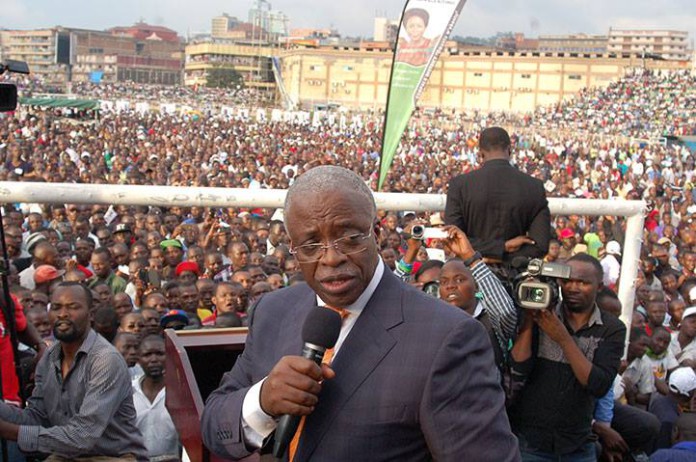
Dr Besigye trying to calm his supporters at Silver Springs hotel in Bugolobi this evening.

Opposition Forum for Democratic Change flag bearer is set to be nominated as a presidential candidate on November 3, 2015, the party has confirmed.
In a letter to the Electoral Commission, the FDC Chief Electoral Commissioner, Michael Kabaziguruka pointed out that the development has been occasioned by the alteration of the nomination exercise by the Electoral Commission.

The Electoral Commission extended nomination dates for presidential aspirants from October 6 to November 4 as the deadline for returning nomination forms. Presidential campaigns will now begin on November 9 and run for 120 days to February 10, 2016.
EC chairman Dr Badru Kiggundu says the extension is to allow candidates comply with the change in electoral laws passed on
Thursday, adding that the decision was taken without pressure from government.

Stories Continues after ad

Burundi’s Minister accuses Rwanda of training rebels

nyamitwe1

Burundi has accused neighbouring Rwanda of training rebels seeking to destabilise the country.

It is hosting Burundi’s failed coup leader, and helping rebels launch cross-border attacks, Foreign Minister Alain Nyamitwe told the BBC.
Rwanda denies the allegation, and says Burundi is trying to deflect attention from its own problems.
The two governments have a tense relationship, with both countries sharing a similar ethnic make-up.
 Africa Live: BBC news updates
 What Burundi could teach Rwanda about reconciliation
Burundi has been hit by a spate of assassinations and attempted assassinations since President Pierre Nkurunziza won disputed elections in July.
He survived a coup attempt in March. It was led by renegade Gen Godefroid Niyombare, who opposed his bid for a third term.
Gen Niyombare has not been seen in public since then.
About 70,000 Burundians are living in refugee camps in Rwanda after fleeing the unrest.
Mr Nyamitwe told the BBC Kinyarwanda service that Rwanda was “facilitating” attacks that the coup plotters were orchestrating in Burundi.
“We also have extensive information about recruitments in refugee camps, especially in Mahama refugee camp, where refugees are taken for military training, and some of the trainers are Rwandans,” he added.
On Tuesday, Rwanda’s foreign ministry official Olivier Nduhungirehe accused Burundi of harbouring rebels from the Democratic Forces for the Liberation of Rwanda (FDLR) group, which was linked to the 1994 genocide in Rwanda.
Mr Nyamitwe said a fact-finding team, sent to Burundi by regional leaders, found there was no truth to the allegation.
The team visited Burundi after Rwanda made similar allegations in the past, he added.
Both Rwanda and Burundi have long experienced ethnic conflict between a Hutu majority and a Tutsi minority which has traditionally been dominant.
Rwanda sees the mainly Hutu FDLR as a major threat to its stability, and is pushing for its disarmament.
Mr Nkurunziza is a Hutu former rebel leader, while his Rwandan counterpart Paul Kagame is a Tutsi.
However, the unrest in Burundi is not linked to ethnic divisions, analysts say, and the two presidents used to enjoy good relations, even playing football together.

Stories Continues after ad

Germany commits 37m Euros for EAC integration

The Federal Republic of Germany has committed 37 million Euros to the East African integration process.
According to a release by the EAC Secretariat, 10 million Euros with be used to prevent and control the spread of epidemics and communicable disease; 10 million Euros will be used for water resource management on Lake Victoria, while 17 million Euros will go towards strengthening the EAC Secretariat and economic integration between 2016 and 2018.
‘The programme is focussing on institutional strengthening of the EAC Secretariat and on supporting the implementation of the Customs Union, Common Market Protocols and Monetary Union. This includes the elimination of Non-Tariff Barriers such as tax harmonisation as well as Mutual Recognition Agreements for qualifications. At the same time Germany will support the EAC in promoting private investment especially in the pharmaceutical sector, including the establishment of a regional quality infrastructure for the pharmaceutical sector, the release states in part.

‘’We have truly benefited from the German support which has catalyzed other development Partners to support our projects and programmes. In addition, Germany has given the EAC a permanent home by financing  the construction of the new Headquarters that today houses the Secretariat, the Court and the Assembly under one roof thus greatly easing the EAC Organs interactions and communication’’, the  EAC Deputy Secretary General in charge of Finance and Administration, Mr Liberat Mfumukeko said during the talks at the EAC headquarters in Arusha.

He highlighted the successes achieved through German support in the realisation of the fully fledged Customs Union, the Common Market, and the commitments to support the realisation of the Monetary Union in the succeeding programme.
Mr Georg Rademacher, Head of the German delegation, said: “Our support underlines the importance we give to the East African Community. The EAC is a role model and pace-setter in Africa and we are proud working closely with you in order to contribute to the well-being and prosperity of the citizens of this region”.
He underlined that Germany is also supporting substantial regional infrastructure projects with promotional loans of the German Development Bank, KfW.

Last week Ambassador Kochanke and Secretary General Ambassador Richard Sezibera signed a financial agreement to commit 30 million euros for live-saving vaccines in the EAC and the establishment of the EAC Regional Centre of Excellence for Health Supply Chain Management in Kigali.

With a view to strengthen the pandemic preparedness in the EAC, Germany had announced its willingness to provide an additional 3 million euros in technical assistance for the region`s crisis response capacity (out of special funds for 2016).
Since cooperation began in 1998 the total volume of German support to the EAC amounts to almost 213 million euro. Germany also has substantial bilateral cooperation with all five EAC member states.

Stories Continues after ad

Kabila man defects over ‘third term’

Moise Katumbi

The ‘third term effect’ has dogged the East and Central Africa region, recently catching up with the Democratic Republic of Congo (DRC) where Moise Katumbi, one of the staunch supporters of President Joseph Kabila’s Peoples Party for Reconstruction and Development (PPRD) has resigned from the party over attempts to alter the Constitution to allow the President run for a third five-year term.
Katumbi, who also resigned his post as Governor of Katanga Province, has been critical of Kabila’s political machinations to extend his rule beyond 10 years.

Moise Katumbi
Moise Katumbi

“If I have resigned, it’s because I am myself a democrat. I will get together with my brothers, with active forces to save democracy in our country. You know, I have been governor for eight and half years. I want to take a break and then I will be listening to the people so we can have a nice country where democracy will continue to prevail. All Congolese are free to participate in the reinforcement of our young democracy. And I will be here also as a citizen for that,” Katumbi, the owner of TP Mazembe Football Club and one of the DRC’s richest men, was quoted telling BBC.
There have been speculations that Katumbi, a Jewish-Congolese might run for office in 2016 after Kabila’s two terms come to an end.
In the recent past president Kabila has faced several challenges associated with his attempts to amend the Constitution to run for a third term, with opposition party, the UDPS breaking off negotiations for national dialogue on the electoral process.
Also, seven respected politicians, some of them allied to Kabila, recently signed an ‘open letter’ to the President, asking him to respect the Constitution.
The East and Central region is likely to experience serious political shifts since most of its leaders’ mandates are expired or nearing expiry. In Burundi President Pierre Nkurunziza was the latest leader to face the wrath of voters in his country, after they thronged the streets of Bujumbura protesting against his third term aspirations.
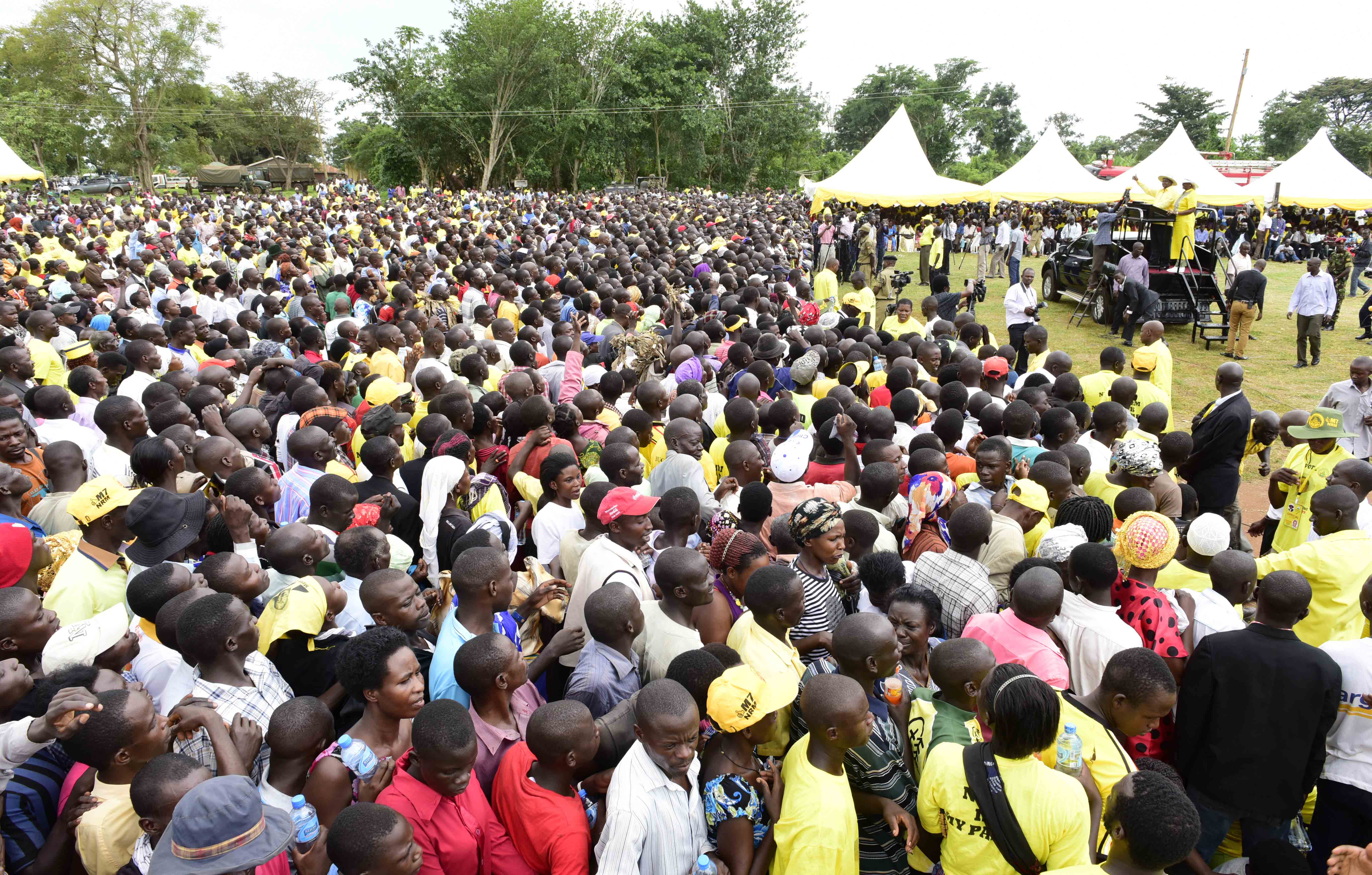
Also, in Burkina Faso protesters took to the streets last year, kicking out long-serving President Blaise Campoare, while in Uganda Parliament amended the Constitution to remove term limits in 2005. Since then long-serving President Yoweri Museveni has been elected twice, bringing the cumulative number of years he has ruled Uganda to 29, with elections looming in 2016 where he has been endorsed by his party, the National Resistance Movement (NRM) as ‘sole candidate’.
Meanwhile, in Rwanda the people there seem content with extending the mandate of President Paul Kagame beyond his two seven-year term which ends in August 2017.

Stories Continues after ad

Palestinian flag raised at UN

Palestinian flag at the UN would be a “proud day”
The Palestinian flag has been raised for the first time at United Nations headquarters in New York, at a ceremony attended by the President of the Palestinian Authority Mahmoud Abbas.
Addressing the UN General Assembly, Mr Abbas said it was unconscionable that the question of Palestinian statehood remained unresolved.

He also warned that the PA no longer felt bound by agreements with Israel he claimed were “continually violated”.
“As long as Israel refuses to cease settlement activities and to release of the fourth group of Palestinian prisoners in accordance with our agreements, they leave us no choice but to insist that we will not remain the only ones committed to the implementation of these agreements,” Mr Abbas said.
“We therefore declare that we cannot continue to be bound by these agreements and that Israel must assume all of its responsibilities as an occupying power.”

Israeli Prime Minister Benjamin Netanyahu’s office said Mr Abbas’s speech was “deceitful and encourages incitement and lawlessness in the Middle East”.
“We expect and call on the Authority and its leader to act responsibly and accede to the proposal of… Israel and enter into direct negotiations with Israel without preconditions.”
Mr Abbas has in the past threatened to dissolve the PA and hand sole responsibility for the West Bank to Israel if there is no chance of a peace deal.
The PA was set up as an interim administration for the major Palestinian cities in the West Bank and the Gaza Strip after the 1993 Oslo Accord. It was envisaged that a comprehensive treaty would be concluded within five years.
However, more than two decades of talks with Israel have failed to achieve a final peace settlement and an independent Palestinian state. The last round of negotiations collapsed in April 2014.

On Tuesday, Mr Abbas had said the raising of the Palestinian flag at the UN would be “a most emotional and proud day”.
raising of the flag was a “blatant attempt to hijack the UN”
The UN General Assembly passed a motion earlier this month to raise the Palestinian and Vatican flags. Israel voted against the motion, along with the United States and six other countries. Forty-five countries also abstained.
Israel’s permanent representative to the UN, Ron Prosor, said at the time that the move was a “blatant attempt to hijack the UN”. He insisted that the only way Palestinians could achieve statehood was through direct negotiations.
In 2012, the UN General Assembly voted to upgrade the status of the Palestinians to that of a “non-member observer state” – the same position that the Vatican holds.
It followed a failed bid by the Palestinians to join the international body as a full member state in 2011 because of a lack of support in the UN Security Council.
The BBC’s Kevin Connolly in Jerusalem says Palestinians faced with falling living standards and life under Israeli occupation on the West Bank are growing impatient for some sign of progress in their quest for a Palestinian state.
Raising the flag at the UN may not be as effective as raising that issue further up the world’s diplomatic agenda but it is a tangible achievement and it was within Mr Abbas’s power to deliver immediately, our correspondent adds.

Stories Continues after ad

Uganda ranked 75 in FIFA rankings

Uganda National team, the Cranes.

Football governing body Fifa has today announced the world rankings, with Uganda coming in at 75.
Through the Coca Cola monthly football rankings announced in Geneva, Switzerland, Uganda is the top-ranked country in East Africa despite dropping five places from 70th in the world.

The October rankings have also seen neighbours Rwanda in 93rd; Burundi in 113th, rivals Kenya in 131st and Tanzania in 136th.
Uganda, which garnered 455 points, is also ranked 18th on the African continent behind South Africa and Zambia, among others.
For the last three months, the Uganda Cranes have not lost a game having beaten Botswana 2-0, Tanzania 3-0 and Comoros 1-0.
Uganda last played at African Cup of Nations in 1979 where they lost to Ghana 2-0 in the finals played in Accra.
Meanwhile, Algeria remains Africa’s number one footballing nation and 19th in the world.

In Africa the North Africa nation is followed by African Champions Ivory Coast in the second position; Ghana, Tunisia, Senegal, Cape Verde, Cameroon, Congo Brazzaville, Egypt and Nigeria that conclude the top ten positions in Africa.
On the global footballing scene, South American giants Argentina have retained the number one position followed by World Champions Germany, who have moved from 3rd to 2nd position.
Belgium, Portugal, Columbia, Spain, Brazil, wales, Chile and England wrap up the world’s top positions.
Somalia and Djibouti are the least ranked nations in Africa in 203 and 206 positions, respectively, while the Bahamas and Anguilla are last in the world.
The world’s newest state, South Sudan, was a surprise package as the war-torn country climbed 54 positions to clinch 144th position from 198th last month.

Stories Continues after ad

Kyambogo, Mubs renew rivalry


Today at 2:00pm

UFL: Kyambogo vs MUBS

Giants of the Nile Special University Football League meet today for a mouth-watering encounter that is expected to draw huge crowds.

2014 finalists Kyambogo University and Makerere University Business School (Mubs) will square it off at the Kyambogo grounds, in a match many will liken to last year’s finals, where Mubs edged Kyambogo 1-0 at the Mandela National Stadium, Namboole.

The win against Kyambogo gave rise to rivalry, and many at Kyambogo are today bracing for revenge in the first leg of the quarter-finals, served at home.

Kyambogo coach Deo Sserwada in an interview with Eagleonline said: “We are well prepared for Mubs and my boys are in good shape ready to tackle any war. I know Mubs is a good team because we lost to them in the finals last year but that was then, now is today, we are ready”.

His opposite number, experienced Charles Ayiekoh commonly known as ‘Mbuzi’ said his team was ready for the away match.

“Kyambogo is a hard team to beat and the fact that, they are at home, the game will be tense but my notes are clear, face the game as it is and play as a unit. There is no time for excuses because my weapons are ready to attack and defend my territory,” Ayeikoh, who also coaches Azam Premier League side Soana FC said.

Today’s game will be the last game of the first leg of the UFL and action resumes next week as Makerere host KIU (2:1) and Nkumba host Ndejje (1:2) in the return and final leg of the quarterfinals.

Meanwhile, both Kyambogo and Mubs have been cautioned against poor fan behavior and according to UFL Manager Anthony Tumwesigye, this time round the university competitions committee has improved on officiating and security through the deployment of police.

According to Tumwesigye, credit should go to the university officials and coordinators who have sensitized their teams and also strengthened the rules to include penalties against those found culpable.

In another development, the Nkozi-based Uganda Marty’s University beat the Mukono-based Uganda Christian University (UCU) 2-0, thanks to a Douglas Owor brace.

Stories Continues after ad

Nigeria President wants oil ministry

Prof.Jeffrey D. Sachs is the Director of The Earth Institute, Quetelet Professor of Sustainable Development, and Professor of Health Policy and Management at Columbia University. He is Special Advisor to United Nations Secretary-General Ban Ki-moon on the Millennium Development Goals, having held the same position under former UN Secretary-General Kofi Annan. He is Director of the UN Sustainable Development Solutions Network. He is co-founder and Chief Strategist of Millennium Promise Alliance, and is director of the Millennium Villages Project. Sachs is also one of the Secretary-General’s MDG Advocates,

Nigeria’s President Muhammadu Buhari finally submitted names to serve in his cabinet, four months since taking office and after announcing he intended to take personal charge of the country’s crucial oil portfolio.

The long-awaited list of nominees was submitted to Senate president Bukola Saraki at the National Assembly buildings in Abuja, the leader of the upper chamber of parliament wrote in a tweet.

Names of the nominees were not immediately disclosed.

Today is a public holiday in Nigeria to mark the 55th anniversary of independence from Britain, meaning senators will not reach a decision to approve the candidates before parliament resumes next Tuesday.

Buhari, who has been running the country with permanent secretaries (civil servants) at government ministries, on Tuesday evening said he would appoint himself minister of petroleum resources.

A junior minister will oversee the day-to-day affairs in the sector, which provides the majority of government revenue, his spokesman Femi Adesina confirmed to AFP.


Buhari, 72, has made stopping the rot in the oil sector a priority, as he seeks to cut graft and put the country’s crippled, crude-dependent finances on a firmer footing.

OPEC-member Nigeria — Africa’s number one crude producer and biggest economy — has been hit badly by a slump in global oil prices since last year, squeezing government revenue.

Oil accounts for some 90 percent of Nigeria’s foreign exchange earnings.

The president has vowed to recover “mind-boggling” sums of stolen oil cash, starting with a drastic overhaul of state-run oil firm, the Nigerian National Petroleum Company (NNPC).

The NNPC has become a byword for corruption and last year was accused of failing to remit $20 billion (18 billion euros) in revenue to the central bank.


The former military ruler Buhari has vowed that corruption and the corrupt will have no place in his government and vetting of candidates has been seen as delaying his nomination of senior ministers.

Buhari has prior experience of dealing with the oil industry. In 1977, he was oil minister under General Olusegun Obasanjo and helped establish the NNPC.

He was later in charge of the Petroleum Trust Fund during the time of General Sani Abacha in the 1990s.

A committee advising Buhari on policy before he took office has recommended he streamlines the number of ministries and ministers.

He has already moved to revamp the NNPC, sacking the entire board, announcing a probe into opaque accounting practices and appointing a new boss to make the company more transparent and profitable.

Malte Liewerscheidt, senior Africa analyst at risk consultancy Verisk Maplecroft, said Buhari’s decision “furnishes him with maximum power to push through necessary reforms” in the oil sector.

It also demonstrated the importance he places on overhauling the industry but the analyst cautioned that concentrating powers “could send the wrong signal for the reform path ahead”.

“Concentration of powers is among the chief reasons for the poor performance of Nigeria’s oil sector governance,” Liewerscheidt said in an email.

“Buhari will need to make clear that combining the roles of president and petroleum minister will only be an extraordinary and temporary measure to accelerate reforms.”

Obasanjo also oversaw the oil ministry when he was civilian president from 1999 to 2007 and Buhari will have to guard against the perception of a potential for abuse.

“Buhari’s self-appointment is a high-risk strategy, as it links his fate as president with successful reform of the oil and gas sector,” he added.

“If he fails to deliver tangible successes soon, there will be no minister to shift the blame to.”


Stories Continues after ad

Museveni, King of Jordan discuss security in the Horn of Africa

King of Jordan-Museveni


President Yoweri Museveni has held a bilateral meeting with the King of Jordan Abdullah II at the sidelines of the 70th United Nations General Assembly.

The two leaders discussed the security situation in the Horn of Africa and Uganda’s contribution to the task force to tackle the threat of Al shaabab in Somalia and the region.

President Yoweri Museveni said Uganda is ready to be part of the task force and would be willing to contribute to its efforts through the African Union. He extended an invitation to the King to visit Uganda.

King Abdullah II consoled President Yoweri Museveni and the people of Uganda upon the loss of Gen. Aronda Nyakairima.

The meeting was attended by Uganda’s Minister of State for Foreign Affairs Okello Oryem and Uganda’s Permanent representative to the UN Dr. Richard Nduhuura.

Stories Continues after ad

Museveni meets former Mayor of New York Bloomberg

Museveni Jordan meet

President Yoweri Museveni has held a meeting with Michael Bloomberg, former mayor of New York City and United Nations Secretary General’s Special Envoy for Cities-Climate change.

The meeting held at the sidelines of the 70th United Nations General Assembly meeting at Uganda House. The two leaders discussed various issues concerning US-Africa relations and climate Change.

Michael Bloomberg, a three term Mayor of New York is a billionaire businessman and also Chairman of the Bloomberg Philanthropies.

Bloomberg Philanthropies are some of the major sponsors of the US-Africa Leadership Summit.

Stories Continues after ad