President Yoweri Museveni has urged Ugandans to embrace growth and development at all levels.
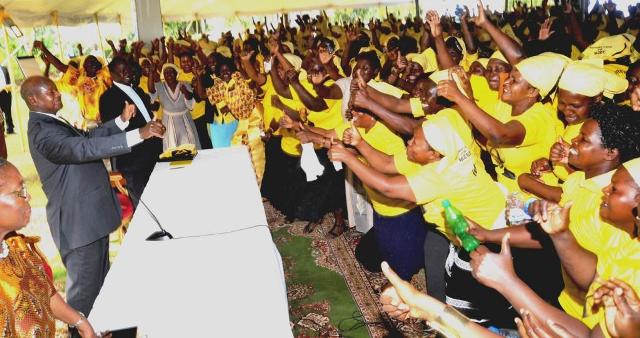
The President, who is also the National Chairman of the NRM party, was yesterday addressing over 1000 NRM Women’s League members from all districts of Uganda at State House Entebbe.
The group led by Mrs. Susan Muhwezi, was told by Museveni that the NRM party came to power to solve problems that had failed previous governments.
He said the NRM government has achieved several milestones since 1986 including destroying sectarianism and concentrating on the country’s interests in order to achieve peace and stability.
Further, Mr Museveni said the country has now achieved minimum economic recovery through economic stability and has managed to promote physical-infrastructure development, social economic development and improved education and health services.
He said the country has now achieved total peace as a result of a disciplined and capable Army, the UPDF which is one of NRM’s greatest achievements.
The President urged the NRM Women’s League members to take advantage of government programmes such as NAADS and Operation Wealth Creation to engage in income generating projects so as to improve their standards of living at household level.
The meeting was attended by the Speaker Rebecca Kadaga, NRM Deputy Secretary General Richard Todwong and all NRM women Members of Parliament.
Azam Premier League champions Vipers Football Club have confirmed participation in the CAF Confederations league 2015/16, while Uganda Cup champions Sports Club Villa has only up to Friday, July 31 to do the same.
Addressing the weekly media conference at the FUFA House in Mengo, Ali Mwebe, the FUFA competitions head, asked SC Villa to sort out their issues before the deadline.
“Vipers have confirmed their involvement in the league but club Villa is yet to-do so. Confirmation deadline is Friday 31st 2015. Failure to comply, FUFA will inform CAF for further assistance and act according to the regulations,” Mwebe said.
KCC was supposed to be Uganda’s representative to the CAF Champions League in 2014/15 but failed due to internal wrangles, paving the way for URA to step in.
Recently, while appearing before the Parliament’s public Accounts Committee (PAC) the Kampala Capital City Authority (KCCA) Executive Director Jennifer Musisi Semakula accused some members of the committee of extortion.
According to Ms Musisi, accounting officers of various public institutions like the KCCA have fallen victim to wayward PAC MPs, who demand bribes in exchange for shielding the public officers from scrutiny in respect to their institution’s accountability issues.
The PAC is an important arm of the legislature, charged with following up on accountability in the public domain, that is why its chairperson and his/her deputy are by law and design, supposed to belong to the Opposition.
To rub it in, the framers of our Constitution, in the spirit of presenting a Uganda that desired to belong to the ‘civilised world’ deemed it fit that in order to effect accountability, ruling party MPs were not the best suited for the two top jobs of PAC, for obvious reasons.
This could possibly explain why PAC chairperson Alice Alaso was at pain to admit that her members are involved in acts of a criminal nature; she passed the buck back to the accounting officers, accusing them of attempting to bribe the MPs in order to modify damaging reports.
But the ping pong between Ms Alaso and Ms Musisi notwithstanding, there is a general feeling that neither the PAC members nor the accounting officers in public institutions are ‘angels’; it is believed most of them cannot explain their acquired wealth vis-a-viz their salaries or emoluments.
That put aside, the allegations by Ms Musisi are serious because they are criminal in nature, warranting immediate attention and action by the police.
Luckily, the Kampala ED is a lawyer and one does not expect her to make sweeping statements that she cannot defend when put to strict proof. That is why the police should pick interest in her statements.
However, it is surprising that despite her legal background Ms Musisi did not tell PAC that she had reported any such case against her to the police or even advised any of her affected colleagues to seek solace in the law.
But if Ms Musisi did report to police, as is expected of her, then the force owes the public an explanation.
Media experts from all over the world will converge in South Africa for a symposium organized by international award-winning station, Radio 786, a leading broadcaster in the country.
According to a release, the symposium to be held on September 10 under the theme ‘Bolstering the African Voice – A chance for African media stakeholders to shape the continent’s future’ will focus on media networking, dialogue and collaboration.
“The symposium will bring together international experts from America, the Pacific, Latin America and Africa and offer an exciting opportunity to network, dialogue and collaborate in media development. Stakeholders are also invited to submit papers for presentation at the symposium,” a release by the African Press Organisation indicates.
Professors Seif Dana (University of Wisconsin-Parkside (US); Steven Friedman (Universities of Rhodes and Johannesburg); Peter Alexander (University of Johannesburg and Anti-Apartheid activist who also doubles as the President of the Pan African Psychology Union (PAPU) Professor Saths Cooper will present papers at the symposium at the
Kirstenbosch Gardens in Cape Town.
“In an era of the African renaissance and with renewed interest in Africa from both the east and west, Africa should be telling its own story. As the media landscape develops, African media must develop their own model to reflect the aspirations, ideals and challenges of the continent. The Radio 786 Media Symposium offers the opportunity to develop this strategy and borrow from the expertise of fellow media in other parts of the world,” the release states further.
Africa50, a new and innovative infrastructure investment platform promoted by the African Development Bank has raised US$830 million as share capital, contributed by 20 African countries.
During its Constitutive General Assembly on July 29 in Casablanca, Morocco, the Africa50 Chairman of the Boards of Directors Dr Donald Kaberuka noted that the enthusiasm with which the initiative was received is indicative of a Africa’s commitment to infrastructure development.
“The large presence of African States and their financial commitments are a testimony to a shared vision to find new ways to accelerate the provision of infrastructure. Africa50 will be a step change for infrastructure financing and development in Africa,” Dr Kaberuka said.
The founding countries are Benin, Cameroon, Congo, Djibouti, Egypt, Gabon, Ghana and Ivory Coast. Others are Madagascar, Malawi, Mali, Mauritania, Morocco, Nigeria, Niger, Senegal, Sierra Leone, Sudan, The Gambia and Togo.
“While this first closing was available only to African countries, it is anticipated that the second and subsequent closings will be available not only to African countries that are yet to invest in Africa50, but also non-sovereign investors both in Africa and outside Africa,” a release by Africa Press Association, states. The second closing is expected before the end of 2015.
Africa50’s raison d’être is to mobilize long-term savings within and outside Africa for the financing of commercially viable infrastructure projects across Africa. Through an integrated approach, Africa50 will invest in African infrastructure projects at scale along the entire project finance value chain leveraging its innovative Project Finance and Project Development windows.
“The strong expression of commitment today by the African countries is a necessary first step towards attracting institutional investors, including sovereign wealth funds, pension funds, insurance companies and other sources of long-term finance around the world,” the release indicates and adds that Africa50’s medium term capitalization is projected to reach USD 3 billion.
During the Constitutive General Meeting, Africa50’s founding members signed the articles of incorporation, which enshrine the highest standards of corporate governance. Africa50 is headquartered in Casablanca, Morocco. A headquarters agreement was signed with the Kingdom of Morocco that confers upon Africa50 a range of privileges and immunities similar to those enjoyed by the African Development Bank. Other decisions taken at the meeting included the appointments of the members of the Boards of Directors of the Project Finance and Project Development vehicles and also the appointment of KPMG as external auditors.
Mr. Mohamed Boussaid, the Minister of Finance for the Kingdom of Morocco stated that Africa50 is an idea whose time has come and that the Constitutive General Assembly is an important first step towards making it a reality.
The newly elected Boards of Directors met after the Constitutive General Assembly and launched the recruitment of the Chief Executive Officer of Africa50 through an international competitive selection process.
Meanwhile, the Board has appointed Mr. Alassane Ba as the acting Chief Executive Officer, as part of measures to immediately operationalize Africa50, which expects to start developing and financing projects before the end of 2015.
Kampala Capital City Authority, Uganda’s flag bearers, at the ongoing CECAFA Clubs championship (Kagame Cup) have qualified for the semifinals of the annual tourney at the expense of Al Ahly Shendi in a match played at the National Stadium in Dar es Salaam on Wednesday under scorching sunny conditions.
Joseph Ochaya, Tom Matisko and Muzamiru Mutyaba scored for the 1987 CECAFA champions, with left winger, Ochaya giving the Ugandan side the lead on 16 minutes for a 1-0 goal command by half time break.
Fifteen minutes into the second half KCC won a penalty after skipper Tom Matisko was fouled and Mutyaba perfectly converted to double the lead.
Masiko made it 3-0, slotting home after good work inside the area from Ochaya.
KCCA FC will now face Azam Football Club on Friday in a repeat of the group stage fixture where the Tanzanian giants won 1-0.
Azam F.C beat Yanga in the semifinals following a 5-4 post match penalty shootout that followed a barren draw in normal time.
The Uganda Handball Association has named 24 players to represent the country at the International Handball Federation U-20 continental zonal championships.
The four day tournament will run from 4 to 8 August in Addis Ababa, Ethiopia, where the Ugandan players, who qualified after beating Kenya in August last year will be under the guidance of coaches Jimmy Remie Oroti and Michael Ssempira.
The team has three goal keepers: Mustapha Kilaga, Ivan Kisa and Musa Okiria with the other 21 outfield players, all of who are currently training at the Police Training School grounds in Kibuli.
Participants at the intercontinental tournament are the winners of the different African zones where Uganda won the Zone B IHF Challenge trophy that was hosted at the Uganda Christian University, Mukono in August 2014.
During the qualification games at UCU the Ugandan girls were beaten in the finals by Kenya and failed to make it for this tournament.
The seven zone winners in both men’s and women’s competition will face off each other in order to secure a position and participate in the Intercontinental Tournament slated for October this year.
The tournament for both Competitions will first play a preliminary round where teams will be divided in two groups (one group of four and one group of three). The best two teams will precede to the semi-finals and the medal matches while the rest of the teams will play in the placement round.
In the women’s Competition last cycles’ winner; Congo did not qualified making it quite an exciting tournament since it will provide a new champion. National teams of Senegal, Kenya and Burkina Faso compose the group A, while the host Ethiopia is paired alongside Madagascar, Chad and Mozambique in Group B.
Given the groups, it would be very difficult to determine a favorite as all teams go in the competition with equal chances.
The men’s competition carries last cycle’s winner Nigeria over to the Continental stage, and as title defenders they enter the tournament as favorites.
Nigeria is drawn in Group B together with Mozambique and Cape Verde, while Group A is made of Ethiopia (host), Uganda, Madagascar and the Democratic Republic of Congo.
The winners in Addis Ababa will join Bulgaria, New Zealand, Martinique and Uzbekistan, who have already qualified in the women’s competition, while the men join the Faroe Islands, Tahiti, Colombia and Uzbekistan in the competition for the InterContinental Phase of the IHF Trophy.
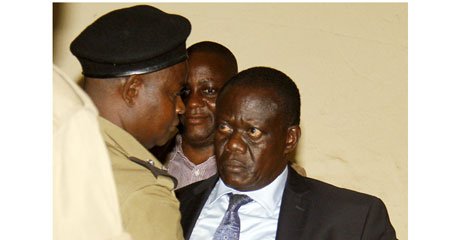
File Photo: Byandala being led out of Anti Corruption Court to Luzira Prison.
Byandala being led out of Anti Corruption Court to Luzira Prison.
In 2011, when president Museveni appointed Eng. Abraham Byandala as Minister of Works and Transport, it was an elevation that called for jubilation for the representative of the people of Katikamu County North.
However, little did Eng Byandala know that four years down the road his appointment to the hitherto ‘sensitive ministry’ that handles trillions for road construction would lead him to Luzira Prison.
So, yesterday the Anti-corruption Court, after hearing charges ranging from two counts of abuse of office, disobeying lawful orders and influence-peddling, sent Eng Byandala on remand to Luzira Prison, a few hours after his arrest by agents from the Inspectorate of Government (IGG).
Byandala, together with the former Ag Executive Director of the Uganda National Roads Authority(UNRA) Eng Ssebugga Kimeze; Joe Ssemugoma, a former UNRA Acting Director of Finance and Administration),Marvin Baryaruha, (former UNRA legal counsel), Apollo Ssenkeeto(businessman) and Isaac Mugote, a former banker with Housing Finance Bank, were remanded till August 11.
This follows the way he handled the Mukono- Kyetume- Katosi-Nyenga road contract when he served as the Minister of Works and Transport at a time the government reportedly lost at least shs24bn in the now controversial contract, awarded to Eutaw Construction Company.
It is said that Byandala wrote a letter to the Uganda National Roads Authority (UNRA) asking them to award the contract to Eutaw before a complete due diligence was carried out.
Eutaw, purporting to be based in America, secured the contract and was paid Shs24 billion even before thorough investigations were carried out to establish the credibility of the company.
Even when he was under fire, with claims that Eutaw was non-existent, Minister Byandala insisted that the company was genuine and that his predecessor John Nasasira had paid a visit to its headquarters in 2011.
He also reportedly said the company showed key documents that proved its authenticity, contrary to investigations by the Inspector General of Government (IGG), Parliament and the Police.
Mysterious as it was, Eutaw procured the Katosi road deal which according to the IGG and Public Procurement and Disposal Authority (PPDA), should have been advertised. The IGG and PPDA also reportedly discovered that the company (Eutaw) had forged insurance bonds (rather than bank guarantees) to dupe UNRA officials into giving them the money.
Meanwhile, when the procurement process began, a number of firms competed for the lucrative construction deal and Eutaw Construction Company emerged the ‘best evaluated bidder’.
But before the road works gained momentum, the Ministry of Finance and Planning Permanent Secretary Keith Muhakanizi wrote to Byandala, indicating that he had received reports that there was fraud in the way Eutaw had procured the Katosi road project.
On July 9, Muhakanizi also wrote to the IGG asking for urgent investigations to establish the truth regarding the entire procurement process. In her investigations the IGG Lady Justice Irene Mulyagonja and her team, among other things, probed the circumstances under which Eutaw had been paid the Shs24 billion.
Subsequently, it appears she uncovered some irregularities and issued a report in nine days, ordering the project halted, with protestation against Eutaw’s decision to sub contract, 100 per cent, the construction of the road to a Chinese company, Chongqing Construction. The IGG also queried how UNRA had paid out the Shs 24 billion (through Housing Finance Bank) without sufficient due diligence.
For instance, the IGG noted that then Ag Executive Director Eng Ssebuga Kimeze was on leave but sanctioned the payment to EUTAW’S account in January 2014, ‘well knowing that the due diligence was to be done in February 2014’.
On the spot was Eng Abraham Byandala, the political head at the works ministry, who had the desire to have the Katosi project delivered expeditiously by 2016, ostensibly to popularize government ahead of the general elections next year.
According to a special investigations report of the police, on noticing discrepancies on the Eutaw file, the UNRA Executive Director reportedly notified Eng Byandala, who was directly supervising the project.
Unfortunately, it was a little late to rectify the mess, the reason Eng Byandala, the current Minister without Portfolio in the Office of the President, is now behind bars together with some of the UNRA officials who handled the project.
Before joining elective politics as the legislature for Katikamu North, Eng. Byandala had served at the then Kampala Capital City (KCC) as chief engineer but presided over the expansion of potholes. However, before thinking of joining politics, Byandala was implicated in a corruption report at KCC and by deciding to join National Resistance Movement (NRM) party as its flag bearer for Katikamu North where he dislodged Amb. James Kinobe, Byandala was trying to get a soft landing and indeed, his star rose when he was elected chairman of the physical infrastructure in the 8th Parliament.
It is also known that while at the committee, as its chairperson, Byandala silently opened a war on the then Works and Transport Minister Eng. John Nasasira where he allegedly would use his committee powers to ridicule and expose Nasasira and team as a failed group at the Ministry of Works. It is based on the above fact that when the Mukono-Katosi road saga started, Byandala pointed his fingers at Nasasira.
Another person whom Byandala underestimated was the Presidency Minister and KCCA, Frank Tumwebaze, Byandala remained a true an African mourner who accuses anybody when death strikes a member of a family and goes around accusing each and everyone around as responsble and this is the same scenario Eng. Byandala was in when he pointed fingers at Tumwebaze.
Yes, the truth on Mukono-Katosi aren’t yet out to know who did what or influenced but what has befallen Byandala looks like an end of road in his career as a politician.
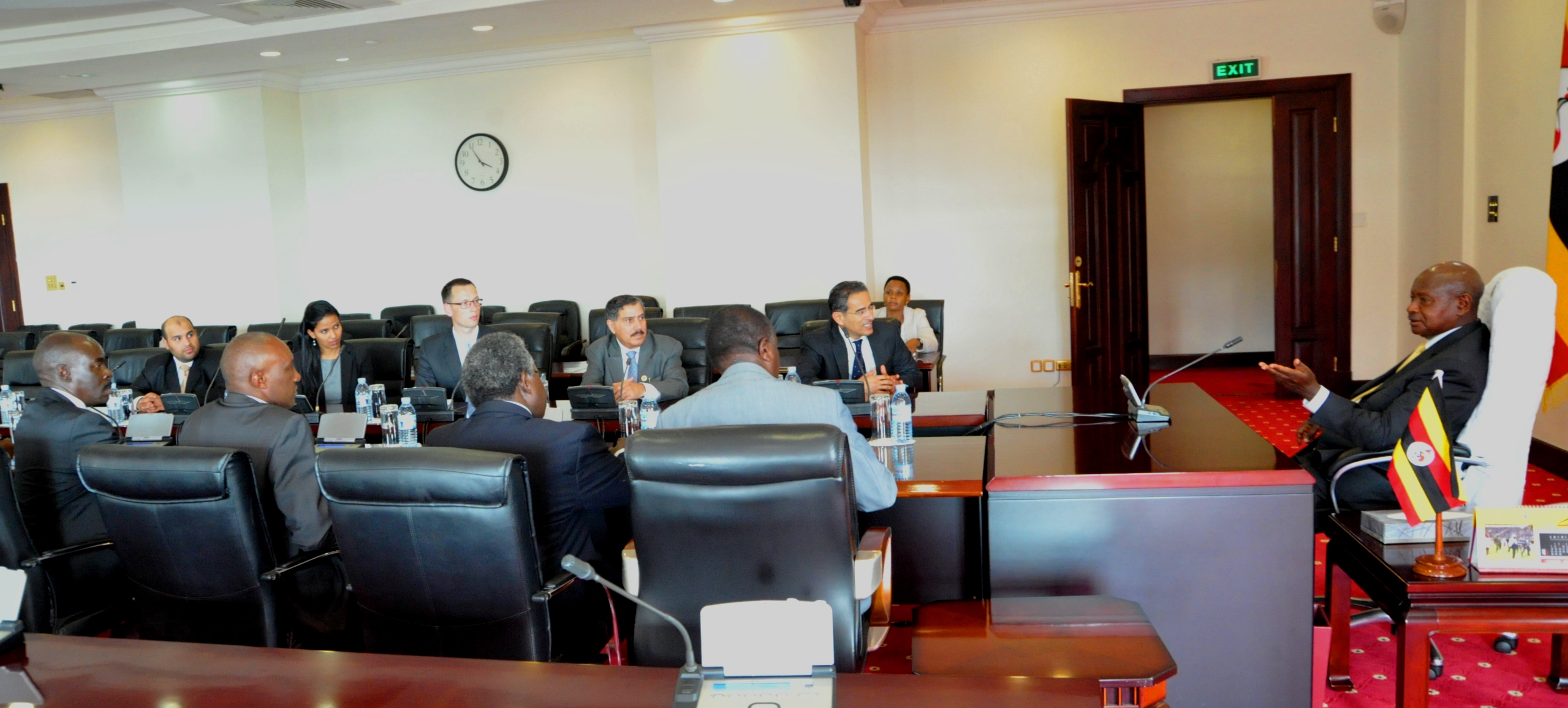
Kampala-President Yoweri Museveni has held a meeting with Mr. Mohamed Alabbar, Chairman of the Al Emaar Properties during which they discussed prospects of constructing a satellite city near Luzira, a Kampala Suburb.
In a press statement sent to newsrooms, Presidential Press Lind Nabusayi, the meeting that took place yesterday July 28, at State House, Entebbe, where the Mr Museveni and his guests discussed plans by Al Emaar Investment International to focus on the development of the real estate sector and boost the Ugandan economy.
Al Emaar Group is a leading global property developer and provider of premium life styles through world class real estate, malls and hospitality assets.
The meeting was attended by the Minister of Lands, Housing and Urban Development, Hon. Daudi Migereko and State Minister for Higher Education, Science and Technology Prof. Tokodri Tagboa.
The Supreme Court in Rwanda has today heard a case lodged by opposition party, the Democratic Green Party of Rwanda,that sought to block President Paul Kagame from having an extended rule after his two term mandate.
On July 8, the DGPR filed a case in the Supreme Court challenging any constitutional amendment that would pave the way for Kagame to get another term in office after the completion of his two seven-year term that ends in 2017.
The case was adjourned by a nine-member panel of Judges led by Chief Justice Sam Rugege, after lawyers for the DGPR failed to turn up in court.
Led by
the DGPR has remained the lone voice against Kagame’s possible stay in power beyond 2017, with arguments that the move would stifle democracy.
The DGPR has also claimed that lawyers fear to take up their case.
By filing time it was not clear what had transpired in the Supreme Court, but analysts say the court is unlikely to pass judgment in favour of the DGPR.
Kagame became president of Rwanda in 2002 after then President Pasteur Bizimungu was relieved of his duties by Parliament.
In 2003, after the promulgation of the country’s new Constitution, Kagame was elected President for a seven-year term by adult suffrage, ending his first mandate in August 2010.
In the same month he was elected for a second seven-year term, which is ending in 2017. But even before the date nears, millions of Rwandans including the political class have all called for a constitutional amendment to Article 101, to pave the way for a post-2017 Kagame presidency, something the DGPR and other development stakeholders like the US, have opposed.
It should be recalled that while addressing the African Union in Addis Ababa yesterday, President Barack Obama castigated African leaders who ‘stick’ to the presidency, noting they were detrimental to development in their respective countries.
Meanwhile, a report carried out has indicated that out of the 53 African leaders, 47 of them have been in power for more than 10 years.