Stanbic Bank
Stanbic Bank
18.8 C
Kampala
Stanbic Bank
Stanbic Bank
Home Blog Page 231

Ssekikubo releases list of MPs who signed motion to censure commissioners 

MP Theodre Ssekikubo

Lwemiyaga Member of Parliament Theodore Ssekikubo and Tororo Woman MP Sarah Opendi have released a list of legislators who signed the censure motion to censure four commissioners of parliament who allocated themselves Shs1.7 billion.

Last month, a section of legislators led by Ssekikubo embarked on the process of collecting signatures to censure Parliamentary Commissioners including the former Leader of the Opposition Mathias Mpuuga. 

According to the list, at least 142 MPs of the 177 needed to table the motion have appended their signatures.

The Parliamentary Commission’s leaked documents show how in May 2022 the former Leader of the Opposition (LoP), Mathias Mpuuga, commissioner Solomon Silwany, Prossy Akampurira, and Esther Afoyochan met and shared the money.

According to these documents, Mpuuga was awarded a one-off service payment of Shs500 million, while three commissioners from the National Resistance Movement each received Shs400 million. The biggest opposition party in Parliament, the National Unity Platform (NUP), resolved to recall Mpuuga as the Parliamentary Commissioner but failed because according to the parliamentary procedures, it’s majority in parliament who can censure a commissioner

The commissioners are faulted because proposal was supposed to first go through the legal and parliamentary affairs committee before it is tabled before the whole House for debate and approval. Every individual who gets retirement benefits, be it the speaker, vice president, or others, has to have it discussed and passed by parliament.

Stories Continues after ad

Among rallies girls to defy parents about teenage pregnancies, early marriages

Speaker Among pose for a group photos with school children at parliament.

Speaker of Parliament Anita Among has asked parents and cultural leaders to put an end to teenage pregnancies and child marriages, saying the vice is encouraged by the unfortunate practice of viewing girls as a commodity.

Launching the Parliamentary Forum to End Child Marriages and Teenage Pregnancies, where she was named its patron, Speaker Among sounded a call to action to parents and cultural leaders, who she said carry the magic wand to end the scourge of teenage pregnancies and early marriages.

In her emotional story as someone who almost fell prey to the practice, Speaker Among said the girls, too, should put up a fight and not easily give in to early marriages.

“The issue of eliminating teenage pregnancies is a reality; I happened to be a victim of this particular practice; the challenge is that the moment a parent sees a girl developing breasts, they say she is ready for marriage,” she said.

Adding “I was going to primary seven when I almost got forced into a marriage; I took off from home, went and became a house girl, stayed in some other people’s homes, and managed to pay for my own education,” she said.

She blamed poor parenting for the increase in the vice and offered her support to the forum in creating awareness to end the practice and put the girls to school.

“One of the causes of early marriages and child pregnancy is an issue of parenting, but it also comes back to you: what do you want in life? You can be taken through all that, but the resilience to move on is very important,” she said.

Speaker Among thanked the United Nations Population Fund (UNFPA) and development partners for supporting efforts to eradicate the practice, saying it is time to take the fight to parents and cultural leaders, who should end practices that encourage the vice.

MP Ronald Olema Afidra (NRM, Lower Madi Constituency), who is the chairperson of the forum, said society should not give up on the victims but still extend to them an opportunity to go back to school.

“Let us give them [the girls] the opportunity to go back to school where they can; we need the girls growing up to be girls, not to prematurely become mothers,” he said.

He added: “The girls who get married early have limited education opportunities; they will also not be able to deliver well, which sadly contributes to maternal deaths in Uganda.”

Laura Criado Lafuente, who represented the UFPA Country Representative, Gift Malunga, pledged support for the new forum, saying their intervention will be evidence-based, using demographic statistics to mount a laser-focused challenge against teenage pregnancies and marriages.

Stories Continues after ad

Proud to be an Ally: Standing with LGBTQ+ Communities Across the World

By Winnie Byanyima

The events of this year’s PRIDE month are showing the world the power of inclusivity. It is by only insisting on acceptance, and rejecting criminalization, discrimination and stigmatization, that we can ensure a fairer, safer, future for all. We are all invited to be allies.

PRIDE has always been a protest and commemoration as much as celebration. The first marchers in New York more than 50 years ago understood PRIDE as a way to reject the shame that others sought to impose on them, and to honour the memory of people who had been mistreated and defamed.

For them, defiance and joy were not opposites; their joy was defiance. The LGBTQ+ community have refused to accept subjugation and have stood in solidarity with all marginalized people.

PRIDE has always been about collective action for justice. The determination of LGBTQ+ communities and of allies to ensure inclusion for all people has been core to the advances that have been made in recent decades on human rights and in public health.

It is not a coincidence that it was the networks of gay activists built up from the late 1960s who went on to pioneer the community response to HIV at the onset of the AIDS pandemic in the 1980s. They helped mitigate the spread and impact of the virus by providing peer-to-peer information about HIV and delivering care and support at a time when no one else was willing to do so.

They reached out in partnership to defend all minorities from discrimination and violence, and they founded campaigns to overturn the laws and attitudes which violate human rights and obstruct people’s access to services.

As HIV treatment and prevention innovations expanded, it was groups spearheaded by LGBTQ+ activists including ACT UP in the United States and the Treatment Action Campaign in South Africa who drove the campaigns to break the monopoly hold on production of medicines so that all who needed medicines to treat and prevent HIV could access them.

So much has been won. At the beginning of the AIDS pandemic most countries criminalized LGBTQ+ people — but today more than two thirds of countries do not criminalize them. Since 2019 alone, Botswana, Gabon, Angola, Bhutan, Antigua and Barbuda, Barbados, Singapore, Saint Kitts and Nevis, Cook Islands, Mauritius and Dominica have all repealed laws that had criminalized LGBTQ+ people.

But the progress that has been made is in danger. LGBTQ+ people are under attack, and alongside the attacks on LGBTQ+ communities are attacks on the rights of women and girls, on migrants, and on ethnic and religious minorities.

Leaders fearful of their status and power are whipping up hatred of minorities to divert attention from economic and political woes. They are pushing for draconian laws and enabling vigilantes to follow through on their verbal violence with physical violence.

Meanwhile, at a time when solidarity with human rights defenders is vital and urgent, funding support for civil society organizations is shrinking as donor countries cut their budgets.

We are at a hinge moment, a crossroads: the end of AIDS as a public health threat is realizable in this decade, but progress is imperiled; we can win the battle for human rights for all, but only if we join together to fight for it. Our collective future will be set by what we do now. Courage and urgency in support of everyone’s human rights is essential to protect everyone’s health.

It is the people at the toughest intersections of injustice who are leading the way. But they cannot succeed alone; they need allies not only on their side but by their side. Stigma kills; solidarity saves lives.

The United Nations is clear: be proud of who you are and be proud to be an ally for the human rights of everyone.

Winnie Byanyima is Executive Director of UNAIDS and Under-Secretary-General of the United Nations.

Stories Continues after ad

Police to search homes of 3 arrested MPs

Mr Yusuf Mutembuli, MP Bunyole East.

The police are conducting a search in the respective homes of the three nabbed MPs, as Eagle Online can reliably report.

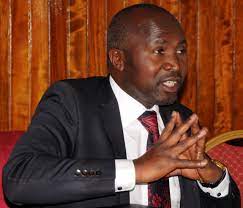
The three legalstors, who include Lwengo District Woman MP Cissy Namujju; Busiki County MP Paul Akamba; and Bunyole East county MP Yusuf Mutembuli were arrested yesterday when they went to record statements at the Criminal Investigations Directorate (CID) headquarters in Kibuli.

The MPs were quizzed and later detained at Kira Police Divisional Headquarters, where they spent a night. They were earlier today picked and driven to various locations, and according to sources, they were heading to their respective homes for a search.

The search is aimed at gathering more evidence for bribery and corruption charges that are allegedly levelled against them. The development comes at a time when Parliament is at the centre of controversy over corruption and bribery. 

During the State of the Nation last week, President Museveni said: “I have been getting good information about corrupt actors among public servants but also among political actors. With some evidence, we shall crush these traitors.”

“I have been hearing, but now I have proof. I have been hearing from the Ministry of Finance; they arrange for accounting officers of ministries to come to parliament. Working with some people there to provide certain funds, provided you take a share, I didn’t believe it, but now I have proof,” Museveni said.

On May 30, 2024, the US government sanctioned Speaker of Parliament Anita Among and four other Ugandan officials for their involvement in significant corruption or gross violations of human rights.

According to Mathew Miller, the spokesperson of the US state department, Speaker of Parliament Anita Among, is designated due to her involvement in significant corruption tied to her leadership of Uganda’s Parliament.

Former Minister of Karamoja Affairs Mary Goretti Kitutu, former Minister of State for Karamoja Affairs Agnes Nandutu, and Minister of State for Finance Amos Lugolobi are being designated due to their involvement in significant corruption related to conduct that misused public resources and diverted materials from Uganda’s neediest communities. All four officials abused their public positions for their personal benefit at the expense of Ugandans.

The leaked May 2022 resolutions of Parliament implicated the former Leader of the Opposition (LoP), Mathias Mpuuga, Commissioner Solomon Silwany, Prossy Akampurira, and Esther Afoyochan.

The document indicates that Mpuuga was awarded a one-off service payment of Shs 500 million, while three commissioners from the National Resistance Movement each received Shs 400 million. The biggest opposition party in Parliament, the National Unity Platform (NUP), resolved to recall Mpuuga as the Parliamentary Commissioner.

Stories Continues after ad

Uganda Prisons joins regional security organs for EAC Field Training Exercise in Rwanda

Uganda Prisons Service (UPS) has joined the sister regional security organs in the 13th East African Community Field Training Exercise (FTX) in Rwanda, aimed at enhancing regional cooperation and capacity building.

The Uganda Prisons delegation is attending a 3-day Pre-FTX orientation clinic at Rwanda’s Military Academy – Gako, alongside other EAC countries. The clinic focuses on building cohesion and standardizing approaches among EAC Armed Forces; UPDF, Uganda Police, Kenya Defence Forces, Kenya Police, Rwanda Defence Force and Rwanda National Police, Civilian components, and other stakeholders, and understanding the roles of each of the Exercise participants.

Led by Mr. Frank Baine Mayanja, Senior Commissioner of Prisons (Deputy Director CCA/Service Spokesperson), the contingent includes: Apollo Akankunda Bakwate, Commissioner of Prisons (NRIC), Doreen Asiimwe Kazoora, Senior Superintendent of Prisons (NRIC), Papus Muhurizi, Superintendent of Prisons (Assistant Commandant PATS/Parade Admin) and Samuel Opio Eneku, Assistant Superintendent of Prisons (D.O.P-PATS)

The exercise, codenamed “Ushirikiano Imara 2024”, promotes regional harmony and cooperation among EAC member states. This year’s 13 edition of FTX is themed on 4 key areas, namely; Peace Support Operations,  Disaster Management,  Counter Terrorism and Counter-Piracy.

UPS’ participation demonstrates its commitment to sharing experiences, learning from others, and enhancing skills in peacekeeping, disaster risk reduction, and humanitarian assistance.

The exercise execution will conclude on June 16, 2024 while the activity will conclude on 23rd June with the departure of all Contingents.

Stories Continues after ad
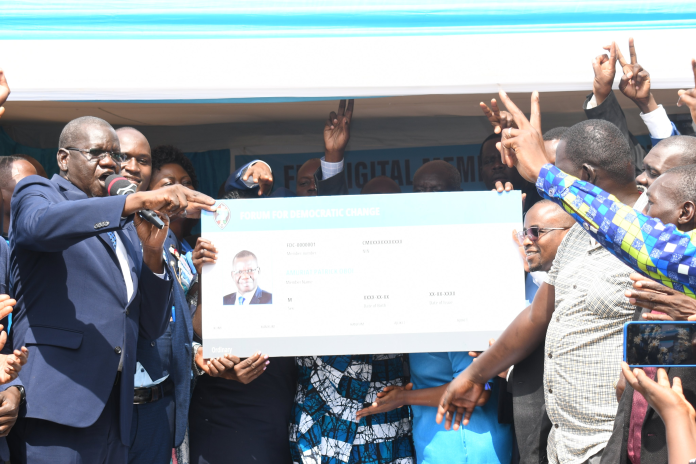
FDC launches first-ever digital membership registration Portal

The Forum for Democratic Change (FDC) party, based in Najjanankumbi, has launched a digital membership registration (DMR) portal to replace the former paper registration, which is believed to have been expensive and inefficient.

The FDC Party President the Hon. Eng. Patrick Oboi Amuriat while presiding over the launch of DMR, stressed that it’s a significant milestone in the Party’s history since FDC is the first Party in Uganda and the second in the East African region after CHADEMA – the main Opposition Party of Tanzania to embrace this user-friendly online registration process, marking the beginning of a new era in membership and electronic data management and engagement.

The portal is aimed at providing a platform for members to engage and participate in party activities and also strengthen the Party’s internal dynamics and organization.

Amuriat said that an ordinary party card will cost Shs5000, a blue-code membership card will cost Shs50,000, a bronze membership will cost Shs1 million, a silver membership will cost Shs2 million, a gold membership will cost Shs3 million, a platinum membership will cost Shs5 million, and a life membership card will cost Shs10 million.

“So, if you keep away from this registration, then you have excluded yourself from the decision-making of this party; you do not qualify to be a leader in this party; you will not have the opportunity to vote. The biggest question is whether registration is going to take place in Katonga or on the streets of any town. But it will be controlled by FDC under my leadership,” Amuriat said.

“We call upon our friends who have been making noises against us to come now and register here. What we expect from them is to stop the noise, put their tails between their legs, and come back to me and get registered as members of the party,” he added.

Amuriat also challenged the National Resistance Movement for being in power for close to 40 years without embracing technology of that magnitude, stating they are running the party on the technology of the 21st century.

According to Robert Centenary, the former Member of Parliament (MP) for Kasese municipality, FDC is the first political party to launch digital membership registration ahead of the 2026 general elections.

“We are proud as a party to be the first political party to introduce this online registration for people all over the country to register as party members without putting in money to look for paper cards,” Centenary said.

Yusuf Nsibambi, the FDC party whip in Parliament, said that the digital registration will help the party fight fraud and clear the party register, stating that those who are out of Najjanankumbi should know that constitutionally, only FDC Najjanankumbi will issue membership cards to help any member participate in party activities.

“It’s only this office that legitimately issues the membership card. The other colleagues at Katonga are our mobilizers, and we call upon them to come here and enjoy this new technology,” Nsibambi said.

This technological advancement demonstrates the Party’s commitment to modernization and adapting to the changing political landscape, ensuring a stronger, more inclusive, and tech-savvy FDC for the future.

Stories Continues after ad

EFRIS will ensure VAT taxpayers pay their fair share of tax- says URA Boss

Mr Musinguzi

John Musinguzi, Commissioner General, Uganda Revenue Authority has defended the enforcement of Electronic Fiscal Receipting and Invoicing System (EFRIS), saying Uganda has been losing around Shs4Trn annually in uncollected Value Added Tax and the new system will ensure that all VAT taxpayers pay their fair share of tax.

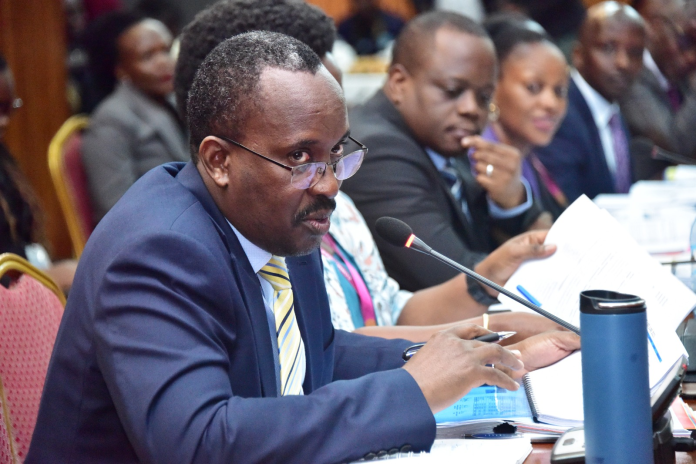
Musinguzi made the remarks while appearing before the Committee of Commissions, Statutory Authorities and State Enterprises (COSASE), where URA had been summoned to respond to queries raised in the December 2023 Auditor General’s report.

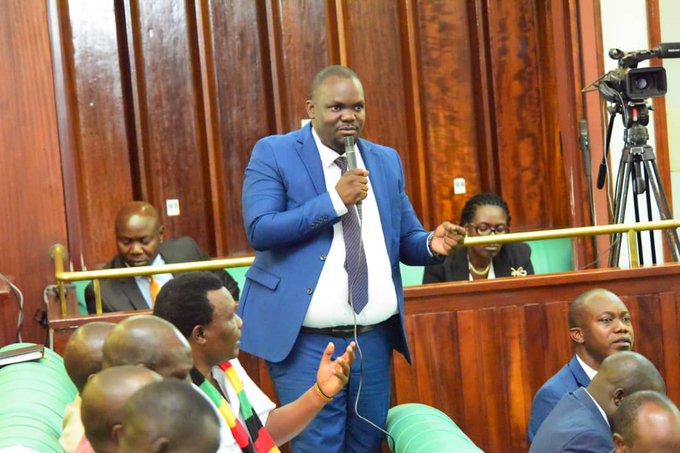
Musinguzi’s remarks were in response to a question posed by Medard Sseggona (Busiro East) who tasked the Commissioner General why the tax body caused paralysis in the business community with the EFRIS to the extent of exposing President Museveni to a standoff with the traders at Kololo, a standoff he said caused embarrassment in Uganda.

Sseggona said, “I know you have been grappling with the issue of Electronic Fiscal Receipting and Invoicing System (EFRIS) and you know how far it has stretched us including attracting a major standoff between URA and our major collection points, the traders.”

“Would you like to use the platform of Parliament to tell us what EFRIS stands for and why it has become controversial lately and why such a matter couldn’t be resolved without escalating into strike and involving the Head of State who had to get into a standoff with the traders publically that embarrassed the nation? Is it work methods, is it misconception of it is sheer hate that people don’t want to pay taxes?” added Ssegona.

The Commissioner General attributed the standoff between traders and URA, on the tough penalties provided for in the law of enforcing EFRIS, which he said were high, but these penalties have since been waived and now URA has embarked on education and sensitization of traders across the country, adding that EFRIS is already being used by manufacturers, corporate companies and after the campaign with traders.

“The penalties for enforcement were quite high, so irrespective of what you are trying to sell without the E-receipt, the penalty was Shs6M. So, I think the toughness in the penalty and the toughness in the enforcement campaign caused this. However, following the meetings and guidance, we stopped issuing penalties and we went back to engagements and more sensitization. And this is what we have been doing for the last one month, we have stopped enforcement operations, we have educated and we have even waived the penalties that were issued to the new people who hadn’t easily understood EFRIS,” said Musinguzi.

According to URA, the standoff between Government and traders isn’t unique to Uganda, as the same opposition to EFRIS was witnessed in Tanzania and Rwanda and Musinguzi went on to reveal that after the traders adopt EFRIS, the system will be extended to all VAT taxpayers in Uganda.

“We have also checked the trends of all countries that have adopted this technology, especially within our environment-the East African Community. Tanzania has been using the same technology for more than 19years, Rwanda has been using the same system for more than 10years, even Kenya, when you are starting, there is always resistance, closure of businesses, there are standoffs, but as we explain and engage home, people understand that this system is good for them, it is good for the Government,” added Musinguzi.

Stories Continues after ad

Gov’t contracts Turkish firm to construct 20,000-seater stadium

First Lady and Education and Sports Minister and the Summa Construction company bosses after sign the contract to construct Hoima Stadium.

Government has contracted Summa, a Turkish firm to construct a 20,000-seater Hoima multi-purpose stadium ahead of the 2027 Africa Cup of Nations.

Hoima Stadium is among those that Uganda plans to host matches during the 2027 Africa Cup of Nations (AFCON), which it will co-host with Kenya and Tanzania. The stadium will be constructed within 18 months and is required to be ready by December 2025. The construction work will be supervised by the Ministry of Works and Transport.

Dr. Bernard Patrick Ogwel signed on behalf of the Government of Uganda and the National Council of Sports in his capacity as the Secretary General of NCS, while Selim Bora signed on behalf of Summa Construction Company. The process was guided by John Bosco Suza, the Director of Legal Advisory Services, who represented the Attorney General.

Before the contract signing, the Minister of Lands, Housing, and Urban Development, Judith Nabakooba, handed over a land title of 34.9 acres for the Hoima City Stadium. The title, in the name of the National Council of Sports, was given to the First Lady and Minister of Education and Sports, Mrs. Janet Museveni, who then handed it to the Chairman of the National Council of Sports, Ambrose Tashobya.

“Today marks the culmination of the tireless efforts of various people from both the government and the private sector who have gone beyond the call of duty to ensure that we begin the process of developing sports infrastructure in preparation for the Africa Cup of Nations 2027,” said Mrs. Museveni.

She said that following the wise counsel of President Museveni, M/S Summa was secured to undertake construction works for the stadium in Hoima City within 18 months. This is because it is highly recommended as the contractor that has changed the face of sports infrastructure with our friends and neighbors in Rwanda, Senegal, and other countries across the world.

Mrs Museveni appealed to Summa to ensure that Uganda has a 20,000-seater multi-sport stadium of international standards ready for inspection by the Confederation of African Football (CAF) by December 31, 2025. “Do not let Ugandans down because hosting the Africa Cup of Nations is a golden opportunity whose benefits go beyond football to a country,” she said.

She said the government is taking deliberate action to invest in sports infrastructure in order to develop and professionalize the abundant talent in different disciplines and to generate revenue. Therefore, she tasked the Minister of State for Sports with developing a concept for the management of all sports facilities to ensure that the government benefits from its investments.

The Sports Minister, Peter Ogwang, reported that Summa has done an excellent job in the construction of the Kigali Arena and the renovation of the state-of-the-art Amahoro Stadium. He requested M/S Summa not to abuse the trust that Uganda has placed in them as the constructors of the Hoima Stadium, but to deliver an excellent job on the people’s project by December 31, 2025.

He pointed out the need for Uganda to develop holistic plans to tap into sports tourism to generate revenue for the country. He cited Rwanda as an example, which he said generates almost one billion US dollars for the government every year from sports tourism.

Stories Continues after ad

Museveni directs landlords to stop illegal evictions of bibanja holders

President Museveni addressing the audience.

President Yoweri Kaguta Museveni has directed landlords to stop illegal evictions of bibanja holders.

Museveni said this during the 35th Heroes’ Day celebration, which was held at Mpenja Church of Uganda Primary School playgrounds in Mpenja Sub-county, Gomba District.

He ordered that whoever has excessive nominal rent fees (obusuulu) should return them to bibanja holders immediately or risk being arrested.

“The landlords who have been charging more than the agreed busuulu fees by the district must return it back, and if they try to evict our people, we shall arrest them. You must pay back all the money you have taken from these people, and the evictions are illegal,” Museveni said.

He added “We said a landlord has no power to evict a Kibanja person, especially the one who was on that plot of land (Kibanja) by 1983. The only thing was to provide some nominal rent (busuulu), and that was to be fixed by the district land boards. The landlords must accept what we agreed in 1995 because Idi Amin had actually abolished mailo land, but we restored ownership in order to allow a win-win situation, but these landlords don’t listen to the NRM, and they think it’s a joke,” he said.

It should be remembered that in 1995, a new constitution was established and land rights were clarified, which stated that the land in Uganda belonged to its people and reinstated private land ownership. President Museveni was, however, dismayed to learn that landlords have decided to ignore the agreed-upon nominal fees paid by the bibanja holders on their land and are going ahead to evict them.

According to Gomba District LC5 chairperson, Geoffrey Kiviiri, the approved nominal fee paid to the landlords is Shs10,000 per year, but landlords have since declined such payments, leading to the escalation of land wrangles in the area. The president said new policies will be put in place to safeguard this.

“Maybe what we have to resolve in the NRM parliamentary caucus is to provide that if the landlords don’t accept, the rent fees should be taken and kept at the sub-county. All this suffering is not following what was put in the law,” Museveni directed.

He further asked the Resident District Commissioner-RDC for Gomba, Harriet Nakamya, to record all those under threat of eviction due to the nominal fees and see how to resolve the matter with their landlords.

At the same ceremony, the Minister for Lands, Housing, and Urban Development, Judith Nabakooba, issued land titles to 446 people in Kanoni, Gomba.

In tandem, 49 people were awarded medals for their exceptional contribution towards the socio-economic transformation of the country.

Among the awardees was Sheikh Mohammed Bin Maktoum Bin Jumah Al Maktoum from the United Arab Emirates (UAE), who received a distinguished Order of the Crested Crane first-class medal. He is a businessman and a member of the Dubai Royal Family.

Stories Continues after ad

Centenary Bank unveils Flexcube banking system to enhance operational efficiency

Centenary Bank has unveiled a new core banking system, Flexcube, in order to enhance system stability, operational efficiency, customer experience, and drive innovation in the banking sector. The 18-month project, worth $14 million, was driven by the need to stay ahead of the bank’s rapid growth and dynamic needs.

“Our decision to adopt the Flexi-cube Banking System was driven by the need to stay ahead of the rapid growth and dynamic needs of our business, and we needed a more robust solution to remain competitive,” said Fabian Kasi, Managing Director of Centenary Bank.

“Our strategy as a bank is to become a smart bank where our customers can operate seamlessly, either through their phones, agents, or internet banking, with instant loan origination and faster access to loans,” Kasi added.

The Flexcube Banking System brings numerous benefits, including automated archiving, reusable APIs, and an intuitive web-based interface, making banking more accessible and enjoyable for customers.

“This monumental achievement would not have been possible without the dedication and collaboration of our various stakeholders,” Kasi said. “We are setting a new standard in banking, and I am excited about the future we are building.”

The successful implementation of Flexcube is a testament to the bank’s commitment to innovation and customer satisfaction, setting a new standard in banking.

Centenary Bank is confident that this new system will enable it to deliver unparalleled services to its customers and remain competitive in the banking industry.

Stories Continues after ad