Masaka- A man claiming to be a Uganda Peoples Defence Forces soldier is being held by police in Masaka on charges of obtaining money by false pretence.
The 35 year old Ezia Kanuuni aka Muhwezi reportedly conned retired High Court Judge Justice Vincent Kibuuka Musoke of twelve million, eight hundred and fifty thousand shillings, claiming the Judge’s deceased daughter, Sofia Namutebi, had left him in charge of a herd of cattle, which herd he wanted to beef up using the said sum.
Kanuuni, who claimed he was attached to Kasajjagirwa Army Barracks, was arrested on Monday and according to the officer charge of Masaka police station Moses Kakiryo, he will be charged with obtaining money by false pretence and impersonation under reference number CRB/1287/2015.
This was after Justice Kibuuka Musoke, a resident of Matanga village, Mukungwe Sub County , made a statement at police, giving details the details of Kanuuni’s theft.
“The suspect came at my place of residence in Matanga and lied to me on the project of herds of cattle my daughter left to him” reads part of Justice Kibuuka Musoke’s statement.
He further asserts that Kanuuni introduced himself as a UPDF soldier, and friend to the late Namutebi and the man then asked for the said 12 million, the subject of the charges the suspect now faces. “I gave him the money without inspecting the location of the project, but whenever I called him on his phone, he would tell me that he was on duty in Mbale and other districts but later, I learnt that he was fraudster,”. The retired Judge further asserts.
But Kanuuni has denied the charges, insisting the Judge could not have given big sums of money to someone he doesn’t know.
Meanwhile, Brig. Joseph Ssemwanga, the UPDF Commander in Masaka said there are no records indicating that Kanuuni belongs to the Kasajjagirwa barracks.
There is emerging information that the combined opposition in Uganda has this morning started the process of finding a joint flag bearer for the 2016 elections.
Information trekking in is that the selection process is being carried out in Nairobi, Kenya. It is not clear why the opposition has opted for a foreign capital for this all important event, but fingers are being pointed at fear of possible infiltration by NRM moles, intimidation and other challenges that might stifle the holding of a peaceful assembly.
Whether this process delivers for the opposition the desired effect, there are concerns that the Opposition is divided. And, given that any opposition is regarded as a Government in waiting, it is pertinent that they show a level of cohesion that will leave the citizens in no doubt about their capacity to run the affairs of state.
But Alas! This is not to be, if one considers that most of the opposition parties seem to be in disarray.
The oldest political organization in the country, the Democratic Party, the Uganda People’s Congress and the Forum for Democratic Change are all embroiled in internal power struggles that might have the notorious effect of denying them a clear shot at ruling Uganda.
And one can say that the opposition has learnt nothing from Uganda’s electioneering processes, and possibly forgotten everything that can bring them to power, because these internal power squabbles in the opposition date back a long way, they can be traced to the 1996 elections, the first time the opposition failed to field a joint presidential candidate, with each party thinking it had the capacity to take on Yoweri Museveni and the NRM.
But since they are in Kenya, they can possibly reach out to members of the former National Rainbow Coalition, NARC, which managed to pull off the challenging issue of fielding a joint presidential candidate. That candidate was none other that Mwai Kibaki, who ousted long serving Kenyan president Daniel Arap Moi.
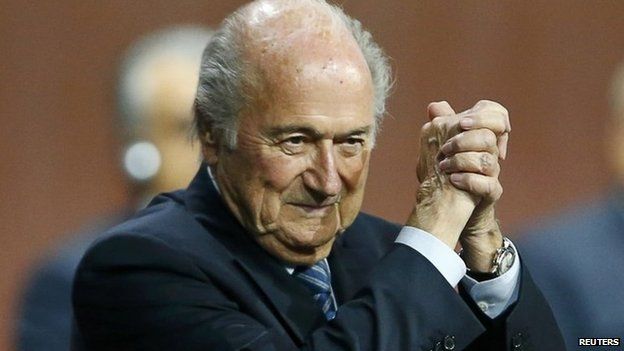
Sepp Blatter was close to tears as he urged the staff to "stay strong"
Sepp Blatter was close to tears as he urged the staff to “stay strong”
Fifa president Sepp Blatter has been given a 10-minute standing ovation by some 400 staff as he returned to its Zurich headquarters a day after announcing he was to step down.
Reportedly close to tears, he urged his “fantastic team” to “stay strong”.
Mr Blatter stood down just days after he was re-elected, amid a corruption scandal engulfing world football.
Mr Blatter reportedly addressed staff in the same hall in which he announced he was resigning a day earlier.
He emphasised the reform work that Fifa now needed to undertake.
Director of communications Walter de Gregorio told the BBC that reform of Fifa’s executive committee was key and that members should undergo integrity checks.
He said it was not right for the president to say he was unable to monitor all of the executive committee members all of the time.
Mr Blatter had made those comments as he responded to the arrest in Switzerland last week of seven senior Fifa members – including two vice-presidents – as they awaited the Fifa congress, arrests that precipitated the latest crisis.
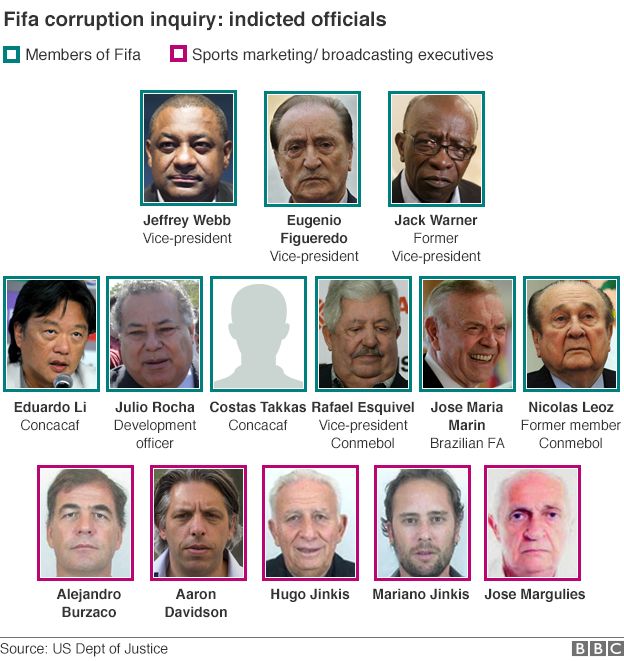
They were detained as part of a US prosecution that has indicted 14 people on charges of racketeering and money laundering. The US justice department alleges they accepted bribes and kickbacks estimated at more than $150m (£97m) over a 24-year period.
US officials quoted in the New York Times also said on Tuesday that Mr Blatter, 79, was under investigation as part of the inquiry. They said they hoped some of the Fifa figures charged would help to build a case against him.
Despite the arrests and the indictments last week, Mr Blatter was re-elected Fifa president two days later.
However on Tuesday, Mr Blatter said it appeared his mandate “does not seem to be supported by everyone in the world of football”.
He said he would continue in his post until an extraordinary congress was called to elect a new president. It is expected to take place between December 2015 and March 2016.
One outgoing Fifa vice-president, Jim Boyce, told BBC Northern Ireland he did not think Mr Blatter would be found guilty of corruption but that the president should have dealt with “criminals” in his organisation earlier.
A separate criminal investigation by Swiss authorities into how the 2018 and 2022 World Cups were allocated is also under way.
Australian football chief Frank Lowy said in an open letter on Wednesday that the race to win the 2022 bid, which was awarded to Qatar, was “not clean” and that he had shared what he knew with the authorities.
South African Sports Minister Fikile Mbalula has meanwhile launched a passionate defence of the country’s integrity over its hosting of the 2010 World Cup.
US officials allege South Africa paid a $10m bribe in exchange for support for its 2010 bid from Mr Warner and several other members of the North, Central American and Caribbean Association Football (Concacaf).
Mr Mbalula denied South Africa had paid a bribe, saying the money in question was above board and went towards an approved programme to support football among the African diaspora in the Caribbean.
Mr Mbalula railed against those who sought to be “world policemen”, adding “we believe in multilateralism not unilateralism”.
He added: “It is for the British and the Americans to fight their battles and… we’ll never be part of the vested interests. We have fought colonialism and defeated it and we still fight imperialism and we will fight it whenever it manifests itself.”
The Fifa official named by the New York Times and other media as the person responsible for the transfer of the $10m, secretary general Jerome Valcke, on Wednesday denied any wrongdoing.
“I have nothing to blame myself for and I certainly do not feel guilty so I do not even have to justify my innocence,” he told the France Info radio station.
Analysis: Richard Conway, BBC Sport, Zurich
Sepp Blatter’s key advisers cut dejected figures last night as their boss announced he was stepping aside.
The air of despondency in Zurich contrasts sharply with that in the rest of Europe. English Football Association chairman Greg Dyke and others who have pushed for reform rejoiced at the news that the man who has controlled Fifa with an iron grip since 1998 was finally going.
The question now turns to who will replace Sepp Blatter. What sort of Fifa will the winner inherit if the promised radical reforms take place? What next for the World Cup hosts Russia and Qatar?
Unless the electoral process changes dramatically, Asian and African countries will once again be the power brokers.
Given anti-European sentiments amongst many nations in those continents, the winner will need to be acceptable to all sides.
With Prince Ali of Jordan backed by Uefa, could he now return and claim the Fifa crown he was denied by Sepp Blatter last Friday?
How has Fifa changed the game of football you play and watch? What are the good and bad things that have happened under Sepp Blatter? Emailhaveyoursay@bbc.co.uk with your stories.
If you would be happy to speak further to a BBC journalist, please include a contact telephone number.
Thousands of Christians on Wednesday flocked Namugongo martyrs shrine for prayers in commemoration of 45 Ugandan Christians killed on orders of the king of Buganda for their conversion and devotion to Christianity beliefs over 130 years ago.
The 45 Christians killed between 1885 and 1887, have now become martyrs and their lives are celebrates by pilgrims from all over the world
At least 2,000 pilgrims from Tanzania attended the service. Others travelled from Rwanda, Kenya, Malawi, Nigeria, Kenya, Tanzania and DR Congo and Europe.
Security was tight as the army and police deployed heavily around the player venue and the roads leading to Namugongo shrine.
President Museveni was the Chief Guest, who promised to rehabilitate the shrine and upgrade the road from Kireka and Namugongo.
Mr Museveni took advantage of the event to tell worshippers that his government would not heed demands by public servants to have their salaries increased. He said government prioritise infrastructure development
“People did not know the value of roads, railways and electricity. Some want salary increments. Others want to construct roads. But infrastructure must come first before salary increments.” He said.
Last month, teachers were on strike demanding a 10 percent increment and government promised it would gradually increase their salaries.
Wafula Oguttu, The Leader of Opposition in Parliament
Kampala-Uganda’s opposition parties and civil society leaders on Wednesday left for Nairobi, Kenya to discuss a possibility of fielding a coalition presidential candidate against the ruling party in 2016 elections.
The Leader of Opposition in Parliament, Mr Wafula Oguttu told Eagle Online the conference is going to discuss “a wide range of issues affecting the opposition,” but said the main item on the agenda is the “modalities” of agreeing on having one candidate for the forthcoming elections.
“Yes, I am going to be part of the meeting and yes, a coalition candidate is one of the major issues for discussion” Mr Oguttu said.
However, the former FDC President, Kizza Besigye told Eagle Online he wasn’t aware of the meeting because he had not been invited.
“I don’t know whether I am on the list or not. I haven’t received the invitation and I am not aware[of the meeting].”
In response to why Dr. Besigye was not attending, Mr Oguttu said: “I don’t know. But what I can say is that most opposition leaders are going to attend”
Earlier, the former Assistant Bishop of Kampala Diocese, Dr. Zac Niringiye said the meeting was going to discuss “a peaceful transition from Mr Museveni to another leader”.
“Who says it is only opposition? this is a meeting of all those opposed to the Museveni regime and our focus now is to have a peaceful transition from Museveni” he said.
KCC FC head coach Abdallah Mubiru has said his players suffer no distress ahead of their Uganda Cup final in Ntungamo on Saturday.
While travelling in a separate car from the main squad (in a club bus), David Obua, Savio “Ginola” Kabugo & Joseph Ochaya were involved in nasty accident at Nekongolero, about 30Kms to Mbarara town on Tuesdayevening.
“The players have overcome the incident and we’re set for the cup final,” Mubiru noted.
Obua & Ochaya escaped unhurt while Kabugo was rushed to Lyantonde hospital were he spent a night but he’s been discharged this morning (Wednesday) though with mild chest pains.
Kabugo has been slowly recovering from a shin surgery on both of his legs and he’s yet to make a debut for KCC since his switch from SC Victoria.
KCC FC players stare at the vehicle that was involved in accident
KCC will play a friendly game with Mbarara United this evening (Wednesday) as the team acclimatizes to the conductions in western part of the country ahead of the cup final.
KCC FC is set to play SC Villa in the 41st edition of the Uganda Cup at Kyamate play grounds in Ntungamo on Saturday, both clubs have won the Uganda Cup 8 times a piece.
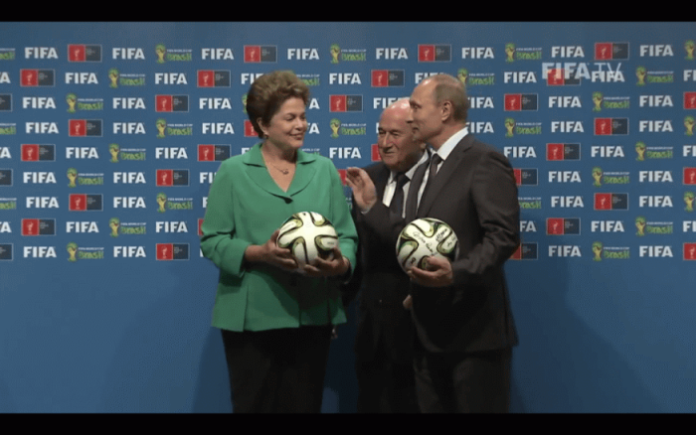
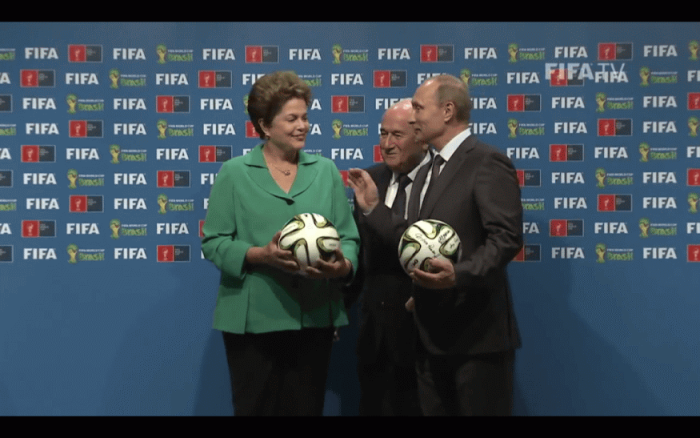
From Brazil to Russia, symbolic hand-over as Sepp Blatter FIFA president stands between Russian President Vladimir Puttin and Brazilian president Dilma Rousseff
From Brazil to Russia, symbolic hand-over as Sepp Blatter FIFA president stands between Russian President Vladimir Puttin and Brazilian president Dilma Rousseff
The FBI’s move against seven FIFA officials on charges of corruption is seen by most countries as a desperate Western effort to isolate Russia and re-open the bids for the 2018 and 2022 World Cups.
Forget the analogies about football being more important than life and religion. The Beautiful Game has always been all about politics among nations – on and off the pitch. And now, it’s reaching Cold War levels.
On Friday, as soon as Sepp Blatter was elected president of the international football federation (FIFA) for another term, he was surrounded by African delegates, who shook his hands, hugged and kissed him.
Then came the Asians followed by Latin Americans. Earlier, when Blatter delivered his victory speech – a breathless jumble of platitudes — delegates from Africa, Asia and Latin America, Russia and Oceania gave him a standing ovation.
For a man who had been declared dead by the Western media just 24 hours ago, it was an incredible resurrection.
At FIFA’s convention hall in Zurich, as Blatter was being feted by the big bosses of regional and national federations, his challenger Prince Ali bin al-Hussein of Jordan sat in the front row with a long face.
Giving him company in sorrow was Michel Platini, the former French footballer and president of the European football federation (UEFA). After the Jordanian conceded defeat, Platini look shattered, trying to figure out what went wrong.
A day earlier, the Frenchman had hailed Prince Ali as the great hope for football and an antidote to corruption because “he is a prince and he doesn’t need the money”.
But few delegates, except UEFA members and their American partners, bought Platini’s theory.
This was FIFA’s bloodiest election ever. With the 209 members of the football body divided into two camps – Europe (minus Russia and Spain) and North America versus the rest of the world – it was clear that a winner would emerge only after some serious bloodletting.
But just two days before the Blatter-Prince Ali face-off, the United States weighed in with full force as the Federal Bureau of Investigation arrested seven high-ranking FIFA representatives on corruption charges following a raid on their Zurich hotel.
Soon after the officials – all from Central and South America – were taken into custody, US attorney-general Loretta Lynch called them “criminals” and demanded that the World Cup allotted to Russia (2018) and Qatar (2022) be cancelled.
But a day is a long time in football politics. Twenty-four hours after Lynch’s barbs against FIFA and Blatter, the Swiss football administrator was back in control.
On Saturday morning, he blasted the US for “targeting” football’s world body and slammed Europe’s football bosses for a “hate” campaign.
Corruption is real, so is geopolitics
It’s an open secret that there is rampant corruption in football – at all levels. It’s no state secret that FIFA is run like the most private of private clubs with little public accountability.
Though all football federations and officials had been aware of the American investigation into allegations of bribery, going back to 1991, nobody expected early morning raids and arrests.
The raids were strategically timed, but if the purpose of the arrests was to make Blatter’s backers fall in line, it backfired.
“It happened like an intelligence operation. Our phones were tapped. The police came to the hotel and picked these officials up as if they were being kidnapped,” says a Brazilian football federation (CBF) official, speaking on condition of anonymity.
“Why arrest them just 24 hours before the election? They were not running away. Why did the cops come with three American journalists in tow? FIFA is based in Switzerland.
All its official business is done in Switzerland. How come the Americans suddenly jumped into it even as a Swiss probe in going on?” he asked.
As soon as news of the arrests spread among the delegates at the Zurich hotel, officials of various federations went into emergency meetings.
“The Europeans did not have the courage to arrest anyone. So they called the Americans to force everyone to vote for Prince Ali. It was clear to us that they wanted to get rid of Blatter and put their stooge in his place,” says the Brazilian who was in Zurich, when the drama unfolded.
“As things turned very ugly, even those of us who had doubts about Blatter’s leadership decided to vote for him?”
Blatter, even in his own words, is not perfect. Far from it. A smooth operator and great survivor, he has friends and enemies in equal numbers.
But why has this Swiss man suddenly become a villain for Europe and the US? Has Blatter damaged the Beautiful Game more than his predecessors, who too had to bow out in disgrace, in his 17 years at the helm? Why are the Americans so interested in “cleaning up” a game that has been managed mostly by Europeans so far?
Blatter’s main crime may not be corruption. It could be his reluctance to play geopolitical games as demanded by Europeans and Americans that has suddenly made him a villain.
Blatter’s problems with the US began in 2005 when he declined the then US Secretary of State Condoleeza Rice’s demand for Iran be thrown out of the 2006 World Cup as part of sanctions against the Asian country.
Things became worse when the Palestinians were allowed to join the global football association.
“While Blatter has been trying to make football bigger and better by taking it to all parts of the world, the Europeans have been worried about losing control. For Americans, the game is an instrument of their politics and Blatter became a hurdle in it,” says the Brazilian official.
With 209 members, FIFA is bigger than the International Olympic Committee as well as the United Nations.
But it has been dominated by Europeans for most of its history. Under Blatter, things changed dramatically as he took the World Cup to new regions, especially to emerging countries.
“The past two editions of the World Cup have been played in South Africa and Brazil. The next one is in Russia. All three are BRICS countries. It’s obvious that the west is not very happy with this. All this talk about corruption is an attempt by Europe and America to bring the game back into their sphere of influence,” says Thiago Cassis, a reputed Brazilian football writer.
“There is a lot of corruption in European football too. They do not talk about it. This whole game is not about tackling corruption, but regaining control.”
In the good old days of European domination, nobody could have imagined that the World Cup would one day go to Africa, as it did in 2010, or that three emerging countries would host the mega-event back-to-back.
Now with China eyeing the 2026 tournament, which the US also wants to host, there is panic in the West as the emerging countries, with their growing economies and huge TV audiences, threaten to take the game away from them.
Even India, which has been given the Under-17 World Cup in 2017, may make a bid for a future World Cup.
Enter the FBI
This change has happened because of Blatter’s efforts at making football a truly global sport.
Under him, FIFA has invested millions of dollars in infrastructure and projects in Africa and Asia.
Despite the western media dubbing this as Blatter’s way of “buying” influence and indulging in corruption, the delegates from these regions stood by him on Friday.
They have seen some real change in their part of the world. “Blatter himself has always been a strong supporter of the African and Asian countries in football.
He’s basically broken with the duopoly that Europe and Latin America traditionally had in the sport.
He has made it more global and he has brought in people from these two vast regions, and they are grateful to him, and they support him,” Alexander Mercouris, international affairs editor for Russia Insider magazine, said in an interview just after the FIFA vote.
On Thursday, as the western media was providing running commentary on the “storm” in FIFA and baying for Blatter’s blood, 47 members of the Asian Football Confederation and the 54-member African Football Confederation declared their support for him. The South and Central American federations, some of whose members were not so sure about their support to Blatter, also decided to back him after the hotel raid. “Why did they arrest officials only from our federations and that too in Switzerland? Why didn’t they approach our governments through Interpol? Is it because they knew that extradition from South America to US is impossible?” asks a CBF official.
There was also anger about reports in the western media about the CBF chief Marco Polo Del Nero “fleeing” Zurich for Brazil as he “feared” arrest. In fact, when papers like the Guardian and New York Times were reporting Del Nero’s “escape” from the FIFA meeting, the Brazilian official was still in Switzerland. “They brought all this pressure on us to force us to vote for Prince Ali. They have been lobbying with us for months. When they didn’t see it working, they conducted the raid followed by veiled threats to others that they could be arrested too. Some British and American journalists were part of this pressure tactic,” the Brazilian official alleged.
From the versions of the Zurich raid given by some South American officials, it appears that the FBI, Swiss police and a few western reporters hunted them together. “As the Asian and African vote was solidly behind Blatter, they wanted the votes from the Americas for Prince Ali. They were desperate to make the prince the new chief of FIFA as he could re-open the bids for the 2018 and 2022 tournaments,” says a Paraguayan official who was in Zurich on the day of the drama. “Since the UK and the US lost the 2018 and 2022 bids respectively, they have been working to somehow cancel the World Cups in Russia and Qatar. They haven’t accepted the fact that they lost the bids in a fair contest.”
It is difficult to say if there was no corruption in these bids or that none of the arrested officials were involved in bribery. But there is also an element of truth in the allegation that Western governments and federations have been working together to tarnish the process by which Russia and Qatar won the right to host the event.
On Thursday, soon after the news about the arrests in Zurich broke out on wires, Ryu Spaeth, a columnist for The Week magazine, in an article titled “Why the next World Cup should be held in the U.S.A” said that the “bidding must be done again, and if it is too late, then the World Cups in 2018 and 2022 should be hosted in countries that already have the infrastructure to absorb a massive sporting event, such as the United States, which was among the countries that lost the 2022 bid to Qatar.”
This was very much in line with the official US position on the World Cup in Russia. Basking in the glory of the FBI’s move, Lorreta Lynch had made a similar demand on Thursday. In fact, neoconservative commentators in the US have been training their guns at Russia for quite some time. The attacks have become more intense since last year’s Ukrainian crisis which resulted in Crimea’s “accession” to Russia and Ukraine turning into almost a failed state. In recent weeks, Republican hardliner John McCain repeatedly called on FIFA to “oust” Blatter because of “his continued support for Russia.” According to Neil Clark, a British journalist, Blatter has been in the American firing line because he “went to Moscow not that long ago and said that there was no question of the World Cup being taken away from Russia.”
Power, money and partnership
With Russia still under Western economic sanctions following the Crimean takeover, the US is keen to further squeeze Moscow and deny it a chance to showcase its soft-power to a global television audience of a billion-plus people. Besides, there is serious money at stake. The World Cup is the most lucrative sporting event in the world, eclipsing even the Olympics. The 2014 qualifying rounds and final tournament brought in $4.8bn over four years and it gave a much-needed boost to small businesses and tourism in Brazil, besides creating a positive image of the country for millions of foreign visitors. A similar boost for the Russian economy and its image in the world could negate the West’s efforts to isolate Russia in the international community.
While the Americans have their geopolitical games to play, the Europeans are concerned about power. Dependent on South America and Africa for football talent, and, increasingly Asia for TV audiences, the Europeans know they are losing control. “Europe wants to import all the labour from us because that gives them a global TV audience and lots of money. But they do not want to give us World Cups or share any power with us,” says an African delegate who voted for Blatter.
Demonised in Europe and the US, Blatter remains popular outside the West because he took football where no other FIFA boss dared to. “The game is for the poor, not for the elite. And Blatter brought it to them in Africa, in Asia, and that’s why most of Africa and Asia voted for him,” Talal Badr, President of Union of Arab National Olympic Committees, told journalists on Saturday. “We don’t like governments to interfere with sports or federations. We don’t want these governments to control the results or impose on us where the game goes,” Badr added.
Whether or not Blatter is involved in corruption can only be revealed by an honest probe. The FBI investigation may become bigger and indict him later. For the present, however, Blatter remains in command of world football as most countries believe what the ‘West’ is trying to do is rob ‘the Rest’ of the chance to be equal partners in the only truly global game.
Shobhan Saxena is an independent journalist based in Rio de Janeiro. He has covered the FIFA Confederations Cup in 2013 and the FIFA World Cup in 2014, besides writing extensively on Brazilian and South American football
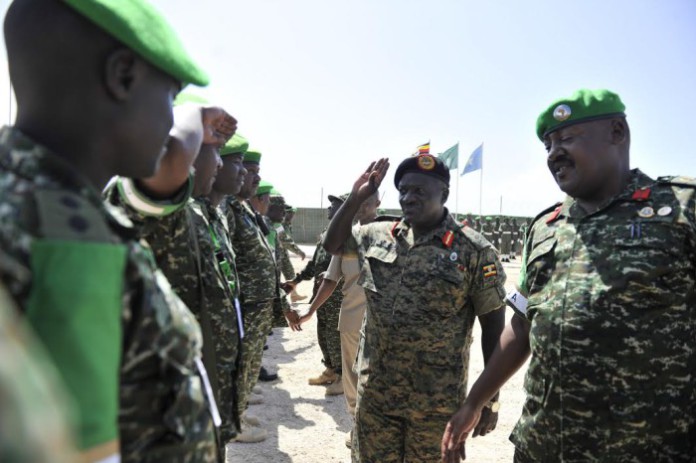
CDF Gen. Katumba Wamala (c) and commander of Ugandan contingent in somalia, Brig. Sam Kavuma (R) in Barawe, 220km south of Mogadishu
CDF Gen. Katumba Wamala (c) and commander of Ugandan contingent in somalia, Brig. Sam Kavuma (R) in Barawe, 220km south of mogadish
KAMPALA: The Al Shabaab on Tuesday lost control of key town to African Union forces from Ugandan contingent, South West of Capital Mogadishu.
A statement issued by Ugandan army says in operation code named “Western Sweep,” Uganda Battle Group XV, under the command of Col Silvio Aguma, drove away the militants from Torotoro town, 100km South West of Mogadishu.
The AMISOM forces started the advance from Awdigile to Torotoro at 1500hr on June 1, 2015 and by5:35am, on June 2, 2015; they had covered 40kms and fully captured the town.
“We can confirm that we are fully in charge of the town but we are making a firm base in case of a counter attack.” Col Aguma said in telephone interview, a few minutes after the capture of the town.
He added that the defeated Al shabaab force fled westwards towards Dugul and Bulwakaba which is 40km away from Torotoro. “Intelligence indicates that they are likely to settle at a presumably safe distance from us of up to 100km at Dinsur. But there is no where safe for them,” Col Aguma said.
The town of Torotoro had continued to provide a safe haven to Al shabaab militants since the liberation of Mogadishu and key towns of lower Shabelle by AMISOM and Somali National Army. The Al shabaab had freely operated in this area recruiting, training, indoctrinating and laying Improvised Explosive Devises along Afgoye – Marka – Barawe routes.
“The town also harboured key Al Shabaab leaders, including foreign fighters who planned and coordinated terrorist activities in Mogadishu and Lower Shebelle” Col Aguma said.
Having been displaced from Marka, Jannale, Awdigile and Qoryooley and Barawe, the terrorist misfit had resorted to Torororo as the nearest place of aboard to Mogadishu. Recently, they attempted to overrun a Somali National Army unit at Awdigile, springing their attack from Torotoro.
“Following their attempt on Awdigile, it was urgent that we took this town. They are now on the run. I don’t think it’s wise for a person to be on the run forever. Its time they denounced terror and joined in National Peace building,” Said Col Aguma.
In coordination with the Somalia security forces and international partners, AMISOM forces have showed determination to defeat violent extremism which undermines the peaceful, prosperous and democratic character of the Somali State.
Sepp Blatter was close to tears as he urged the staff to "stay strong"
Fifa’s Sepp Blatter won an election on Friday
Sepp Blatter says he will resign as president of football’s governing body Fifa amid a corruption scandal.
In announcing his exit, the 79-year-old Swiss has called an extraordinary Fifa congress “as soon as possible” to elect a new president.
Blatter was re-elected last week, despite seven top Fifa officials being arrested two days before the vote as part of a US prosecution.
But he said: “My mandate does not appear to be supported by everybody.”
Fifa was rocked last week by the arrests on charges of racketeering, wire fraud and money laundering as part of a US prosecution that also indicted 14 people.
A separate criminal investigation by Swiss authorities into how the 2018 and 2022 World Cups were allocated is also under way.
“I am very much linked to Fifa and its interests. Those interests are dear to me and this is why I am taking this decision,” added Blatter.
“What counts most to me is the institute of Fifa and football around the world.”
Gunmen attacked the airport in eastern Democratic Republic of Congo’s largest city, Goma, in an overnight raid in which four government soldiers and three suspected assailants were killed, a local official and a witness said on Tuesday.
A Congolese security official involved in the clashes and a Goma-based diplomat said the assailants were Mai-Mai fighters, members of one of the dozens of armed militias that control large parts of Congo’s mineral-rich eastern borderlands.
Residents of Goma, home to around 1 million people and capital of Congo’s volatile North Kivu province, said they heard intermittent heavy gunfire for several hours beginning around 1 a.m. on Tuesday (1900 ET, Monday).
“They attacked the depot at the airport. There was a heavy exchange of gunfire,” North Kivu governor Julien Paluku told Reuters, referring to the attackers only as “bandits”.
Paluku said soldiers from the Congolese army’s elite Republican Guard repelled the attack and pursued the assailants from the airport, which lies on the edge of the city, into the city center where the shooting continued.
A Reuters witness saw the bodies of four Republican Guard soldiers at the airport along with those of three alleged assailants. Two of the government soldiers had their throats slit, while the two others had been shot.
The witness also saw four men, dressed in Congolese army shirts but wearing civilian trousers, that army officials at the airport said had been taken prisoner during the clashes.
The security official, who asked not to be named, said that in addition to the four soldiers killed, another six were seriously wounded, adding that the army had taken 10 prisoners during the fighting.
Governor Paluku had earlier confirmed that one soldier was killed in the raid.
A second witness said there was no visible damage to the airport terminal itself and planes were continuing to use the runway, though sporadic bursts of gunfire could still be heard throughout the morning.