Stanbic Bank
Stanbic Bank
20.4 C
Kampala
Stanbic Bank
Stanbic Bank
Home Blog Page 2387

US$10bn spent on energy products annually in Africa

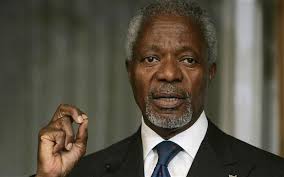
former UN Secretary General Kofi Annan
Poor people in Africa spend about US$10 billion a year to buy charcoal, kerosene, candles and carbide batteries for lighting torches.
This disturbing state of affairs is contained in a report compiled by a panel led by former UN Secretary General Kofi Annan that has called for scaling up of investments in the energy sector, noting that over 600 million Africans lack access to electricity.
According to the 2015 Africa Progress Report compiled by the 10-man panel and titled ‘Power, People, Planet: seizing Africa’s Energy and Climate Opportunities’,  there is need for a ten-fold increase in power generation if all Africans are to have access to electricity by 2030.
Such an increase, the panelists note, will help reduce poverty and inequality and also boost growth across the continent.
“African governments, investors and international financing institutions must significantly scale up investment in energy to unlock Africa’s potential as a global low-carbon superpower,” a release by the Africa Press Organisation states in part.
According to the report, compared to the rich, the poor in Africa spend 20 times more on energy-related products.
‘Households living on less than US$2.50 a day collectively spend US$10 billion every year on energy-related products like charcoal, kerosene, candles and batteries,’ the panelists note.
Giving an example of Nigeria, the report notes that 95 million citizens of the oil-exporting powerhouse still use charcoal and (fire) wood for their energy needs.
 
Such an awful situation can be reversed by African governments if, the panelists argue, ‘the US$21 billion spent on loss making utilities and electricity consumption, which benefit the rich, can be redirected to towards connection subsidies and renewable energy investments that deliver energy to the poor’.
 
The panelists further note that the poor in Africa pay about ten times the amount paid by electricity users in the United Kingdom and the United States of America.
‘By comparison, the national average cost for electricity in the United States is US$0.12/kWh and in the United Kingdom is US$0.15/kWh’, the reports states.
Meanwhile, the financing gap for the energy sector in Africa needs to be bridged in line with the US$35 billion annual investments in plant, transmission and distribution and, the US$25 billion spent annually on universal access up to 2030.
Stories Continues after ad

KCC, Villa set for Cup glory

Uganda Cup trophy
Uganda Cup trophy
Uganda Cup trophy (courtesy photo)

The Uganda Cup final is well and truly on the horizon as KCC FC and SC Villa face-off at the Kyamate sports ground in Ntungamo this Saturday.

It’s the fourth time both Kampala city rivals square off in the final, having won the Uganda Cup 8-times each, victory for either side will bring with it a 9th title.

KCC holds the edge having won the 1987 and 1990 finals. Villa got one up on the Lugogo based side in the 1983 final.

Villa’s last piece of silverware was secured in June 2009. A 2-1 win over URA FC at Nakivubo stadium brought the Uganda Cup on that occasion.

But for KCC, their last Cup triumph was in 2004. After a 1-1 draw with Express FC, KCC won the penalty shoot-out.

“We’re ready, after we lost to Vipers in the league and our title chances went up in smoke, the players heads dropped. But the Uganda Cup is a different ball game and the players are anxious and motivated to win it.” Abdallah Mubiru, the KCC coach noted.

Herman Wasswa will lead KCC's hunt for goals
Herman Wasswa will lead KCC’s hunt for goals (courtesy photo)

With the millions of cash that the current Villa top brass invested in the team at the beginning of the season, and having drawn a huge number of fans in stadium during league games, its clear winning a Cup this year was paramount.

“It’s a title we want to win for different reasons, for the fans and club ambitions,” Villa’s interim coach Ibrahim Kirya said.

Villa’s Steven Bengo (white) and Tom Masiko of (yellow) are set for a midfield battle
Villa’s Steven Bengo (white) and Tom Masiko of (yellow) are set for a midfield battle (courtesy photo)

Apart from the 2-0 loss they suffered against Vipers SC in the penultimate league game, Villa were able to collect ten points from a possible fifteen in their last five games. On the contrary, KCC only picked up three points from a possible fifteen.

Ali Mwebe, FUFA Competitions Director said, Besides the glittering trophy, the winner of the Uganda Cup gets U.shs 7M cash prize with a privilege to represent the country at the CAF Confederations Cup.

The runners up will take a cash prize of U.shs 2M. There are several cash rewards set for the top performers (top scorer, MVP and the different media personnel).

Uganda Cup (formerly Kakungulu cup) Winners since 1971:

1971 –Coffee F.C

1972-1975-Not Held

1976- Gangama F.C

1977- Simba F.C

1978 – Nsambya F.C

1979 – KCC F.C

1980 – KCC F.C

1981 – Coffee F.C

1982 – KCC F.C

1983 – SC Villa F.C

1984 – KCC F.C

1985 – Express F.C

1986 – SC Villa F.C

1987 – KCC F.C

1988 – SC Villa

1989 – SC Villa

1990 – KCC F.C

1991 – Express F.C

1992 – Express F.C

1993 – KCC F.C

1994 – Express F.C

1995 – Express F.C

1996 – UEB S.C

1997 – Express F.C

1998 – SC Villa

1999 – Mbale Heroes S.C

2000 – SC Villa

2001 – Express F.C

2002 – SC Villa

2003 – Express F.C

2004 – KCC F.C

2005 – URA F.C

2006 – Express F.C

2007 – Express F.C

2007/8 – Victors S.C

2008/9 – SC Villa

2009/10 – Victors S.C

2010/11 – Simba S.C

2011/12 – URA F.C

2013/2013 – Sports Club Victoria University

2013/2014 – URA F.C

2014/15 – KCC or SC Villa ??

Stories Continues after ad

A weakened FDC needs a strong Secretary General; this is where Nandala Mafabi fits the bill

From the onset, the Forum for Democratic Change set itself apart as an opposition party with a bare-knuckles approach to push for good governance and political change in the country.
Through that approach, spearheaded by the unrelenting Col Dr Kizza Besigye (Rtd), the party became a darling of many, especially the urban and rural youth; a crop of young supporters who, one can comfortably say are now politically and financially mature, eleven years since the formation of the party in 2004.
For eleven years now, the party has been doing very well in the city, if the following Dr Besigye commands when he attempts to walk through the city is anything to go by.
It has also continued doing very well among Jua Kalisupporters, who were once referred to by Mr. John Nagenda, the Presidential Adviser on Media as “the unwashed of the city”, in urban towns across the country.
In institutions of higher learning where FDC has taken leadership, there has been hardly a trickle down improvement in the general support of the party among the students and the elected student leaders have on most occasions used their positions for self-elevation into national politics.
You hear of little or no intellectual political discourse at universities where FDC is in charge- we can obviously blame it on government clamping down on free political discourse.
However, what about debates on public policy and governance as it used to be the case in the past?
What I have elucidated amounts to weaknesses: that although it is now in its eleventh year, FDC did not manage to grow with many of its earlier youthful supporters who would currently be serving as voluntary mobilizers schooled in the party ideology and spreading it to the rural areas where the party is doing really badly.
That, with many of the former young supporters probably in employment or business eleven years since its formation, the FDC has also not fully rallied the working class into its fold. This group of young folks, although not happy with the current system has chosen the line of ‘better the devil you know than the angel you do not know’.
Therefore, Ugandans are currently stuck with an opposition party with a potential to deliver the country to the ‘Promised Land’ but one that has surrounded itself with an elite and passive supporting group, a few in civil society and an active Jua Kali support group in the urban areas.
Here is the problem with the two latter groups; the passive elite and working group has no impact on inspiring undecided voters. They are also too detached from the peasantry, a majority group that the current government has mastered in courting.
The Jua Kali groups in urban areas around the country are widely associated with drugs and violence and therefore cannot mobilize the peasantry whose main target in any political activity is securing their subsistence survival and not pushing for democracy or yet still, better standards of living.
The youth in tertiary institutions are also in the wilderness; they do not know who to go with and FDC is currently not doing enough to prove to them that it is the best alternative.
Most unfortunate was the FDC change of strategy from an aggressive go-getter party to a mild courtship approach. First of all, by going for the meek-courtship, many supporters who feel that you need ‘to answer fire with fire’ were alienated.
Secondly, the peaceful ‘courtship’ and ‘court’ approach is already represented by the Democratic Party, so people who are interested in such an approach would find more comfort in the DP. So, for the last two or so years, the FDC has thus had to contend with a disenchanted core clientele and untrusting would be new entrants.
 In political strategy, there is what is called believability; this is where the voters trust that you are the right candidate to deliver on an aspect.
In Uganda (and indeed the whole of the East African region), President Museveni has cut out a niche as one who can deliver on security; DP has a record of pursuing justice through courts, while the FDC brand was the abrasive engagement of the regime-what former party President Dr. Kizza Besigye repeatedly said that the regime cannot be massaged out of power.
FDC however has a chance in redeeming itself. It has a chance of redefining its outlook, not only for the coming general elections, which they may not win, but for the 2021 elections, a general election the party can run away with it they put the right people in the right positions come this June 12. And one of these is Nathan Nandala – Mafabi; he suits so well in this arrangement, as FDC Secretary General.
A Secretary General is the accounting officer and run around officer of a party.
The FDC needs someone who is capable of not only running the paper assignments at the Secretariat but one who is also capable of rallying the different categories that I have pointed out that are currently in disarray.
FDC needs an SG who will win back the trust of the youth, working class and also rebrand the party among the peasantry.
Nandala Mafabi currently represents Budadiri West, which is a rural constituency and the mere fact that he could organize peasants to resist government intimidation during the 2011 elections shows that he has an experience to bring to the party in regard to mobilizing the rural folks.
Administratively, he has been at the helm of Bugisu Cooperative Union –the only thriving union in the country.
Though with some government interference, it was reported in the media recently that the BCU had set aside 250m as fees loans for farmers’ children in higher institutions of learning.
Nandala Mafabi had pledged in his manifesto for FDC presidency to organize women and youth into cooperatives in an effort to improve their economic livelihood.
…let people work in the morning, have something in their pockets as they come to work for the party…….. The manifesto says in part.
Administratively, he had pledged to improve communication by setting up offices across the country, fully equipped with computers and internet to ease back-and-forth communication between headquarters and upcountry.
He had also pledged to provide motorcycles for district chairpersons to ease mobilization across their districts. As overall administrator and policy strategist, the office of Secretary General fits so well in implementing  these proposals and once effected, this would cause a feel of the party across the country and there is no doubt some fire would be generated once again.
But you can only take a politician’s word with a pinch of salt, so they say.
When I contacted one FDC party member, he was skeptical, arguing that there is a person who once promised 50million (to FDC) per month once elected to office, he got the office but the money has never come.
To the skeptic, even when the pledge was made during earlier campaigns, for party members it is still binding and incumbent on the one who made the pledge to make good on his promise.
When this paper contacted Nandala Mafabi to ascertain whether he would carry his presidential pledges to the office of Secretary General, he re-affirmed his stance and said he needed one year to effect three quarters of what he pledged to do.
Up to you FDC.
Richard Wanambwa is a senior reporter
Eagle Online
Stories Continues after ad

Islamic Development Bank to hold biggest meet in Africa

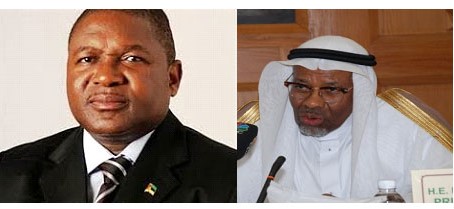
Filipe Nyusi & Dr Ahmad Mohamed Ali
Filipe Nyusi  &   Dr Ahmad Mohamed Ali
The Islamic Development Bank is set to hold it’s biggest ever gathering on the African continent in Maputo, Mozambique, when senior officials and finance and economic affairs ministers from the 56 IDB member countries meet for the 40th annual meeting of the IDB Board of Governors scheduled for June 10.
According to the President of the IDB Group Dr Ahmad Mohamed Ali, the meeting, the first of its kind in the southern part of Africa that is being held under the patronage of Mozambican President, Filipe Nyusi, will also be attended by private sector players and officials from Islamic financing institutions.
Host country Mozambique became an IDB member in November 1995 and has since benefitted from key sector projects worth about US$208bn supported by the IDB.
 “The meeting of the Board of Governors will consider a number of important items and reports on its agenda such as a report on the Ten-Year Strategic Framework of the IDB Group, which was approved by the Board of Governors last year in Jeddah with a view to helping the IDB Group react more effectively to social and economic developments in its member countries,” a release by the Africa Press Agency quotes Dr Ali as saying.
Annual meetings of the Islamic Corporation for the Insurance of Investment and Export Credit (ICIEC), the Islamic Corporation for the Development of the Private Sector (ICD), the International Islamic Trade Finance Corporation (ITFC) and the Islamic Solidarity Fund for Development (ISFD), will also take place on the sidelines of the 40th Annual Meeting of the IDB Board of Governors.
Also taking place is the 10th Global Islamic Finance Forum entitled “Exploring Innovative Solutions for Affordable Microfinance in Africa”.
Stories Continues after ad

Top Golfers assemble for Tororo Open

Veteran Golfer Kabuye will look to reclaim his title
Veteran Golfer Kabuye will look to reclaim his title (courtesy photo)

Strong field of golfers are expected to tee off for the 2-day 2015 Tororo Cement Golf Open edition this weekend.

Golfers from all over golf-clubs in the country and guests from Kenya (Mumias, Kakamega, Eldoret and Kitale in Western Kenya) will battle the course in Eastern Uganda at the par 72, 9-hole picturesque course.

Scratch golfer, Gerald Kabuye easily over came a strong field of over 80 golfers returned the best gross score of 149 (145 nett) over the 2 day tourney to take the overall prize last year.

The Annual event that is organised by Tororo Club and is sponsored by Tororo Cement with the professional players expected to play in the two day tournament with 5 million shillings as they kitty for the event.

Dennis Angugo carded an amazing score of 147 to top the other 14 professionals that included Kenyan top professional, Dismas Ndiza.

The ladies’ category, Lugazi golf clubs’ Ritah Mukasine will look to defend her crown, last year she returned a total gross score of 185 over 36 holes to emerge winner for the overall prize.

It will be a perfect build up for golfers from various regions in the country ahead of the much anticipated Castle Lite Inter Region golf tournament that will be held at the par 71 Entebbe Club in Entebbe next weekend.

Stories Continues after ad

Govt won’t privatize UDB – Museveni

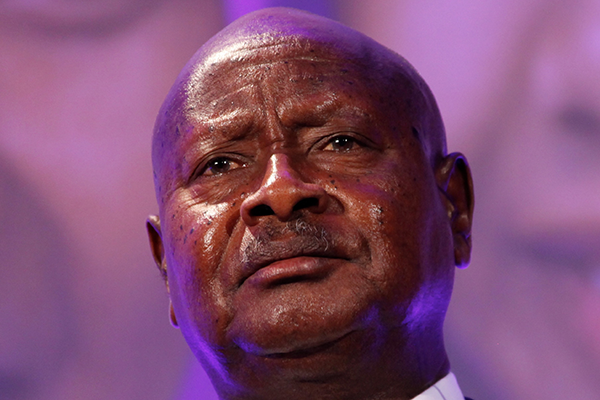
President Museveni
President Museveni
President Museveni
President Museveni

Kampala-Government will not privatize Uganda Development Bank but will instead capitalize it to give lower loan interest rates to Ugandans, President Yoweri Museveni has said.

“UDB will not be privatized, will instead be capitalized for development. We have already put money in UDB and we shall put more money Shs500 billion in 2017 so that bank can lend to farmers, manufacturers at interest rate of 5 percent.” Mr Museveni at the State of the Nation address.

Museveni was giving his State of Nation Address at the opening of the 5th session of Parliament at Serena Hotel Conference Centre in Kampala.

Museveni said the country has been able to sustain itself since 2006 because the National Resistance Movement (NRM) government has prioritized among priorities.

Infrastructure

“We have boosted the Ministry of Works from Shs374 billion to Shs3328 billion today by denying ourselves elsewhere and put it here. By concentrating on Ministry of Works, you can see the results. I enjoy driving comfortably sleeping. I was only disturbed between Nebbi and Pakwarch.”He said

Adding “I need an inquiry and I have put a young lady and whoever ate that money has to explain.”

“The road between Tororo and Mbale and Soroti had become a problem but the other day I was there I just had to sleep. The other day I was in Kisoro and you saw what we have done.” he said noting that this was a decision the NRM took in 2006 and Ugandans are now seeing the benefits.

The President said when all power generation projects are complete; the country will have a capacity of 4360 mega watts of electricity. He however noted that there “small” mistakes that were done in the Energy sector.

Museveni said the earlier agreements in the Bujagali project in which a unit of electricity was to cost US$4.9 cents rose to US$10.1 Cents but was quick to add that the government would find cheaper money to re-finance and have the project developers paid.

He added that on completion of all the power projects, the cost of power generation from Karuma will be at US$5 cents, Isimba US$4.8 Cents and Geo-thermal at US$8 Cents. Museveni also said manufacturers will not pay for power exceeding US$5 Cents while other users will pay slightly higher.

He also said only four districts out of 112 districts are without power but towns like Nwoya and Buvuma will be connected to the power grid by 2016 and 2017 respectively.

Security

The president said there is total peace in the country. He observed that it’s only the rampant murders, tax envision, corruption and other crimes in the country. He said CCTV cameras will be put up first in Kampala and other urban areas to make it difficult for criminals to operate in towns.

“One of them (methods to curtail crime) we have done is the computerization of the National Identity cards. When we add cameras, we shall expedite the process of getting these criminals.”

“Otherwise Uganda is one of the most peaceful countries in the World. Managing the crowds in Namugongo (on Martyrs Day) was not as simple as one would think. It’s one reason we should assist Police to do their work with ease”

Speaker

Meanwhile the Speaker of Parliament Rebecca Alitwala Kadaga urged the Cabinet to carry out early submission of bills as they require time for consultations before being debated.

She also complained of absenteeism and lack of quorum by Members of Parliament due to demands from the public to attend funerals and social events in their respective constituencies. Kadaga urged the president to help the public understand the role of an MP.

“Once elected, the work of a Member of Parliament is in Kampala. This is not to stop members going to their constituencies but it must be understood.”

Kadaga reminded the MPs that they are on duty until May 2016 and should attend House business despite the elections due in February 2016.

jmazige@eagle.co.ug

Stories Continues after ad

President preaches optimism in State of Nation Address

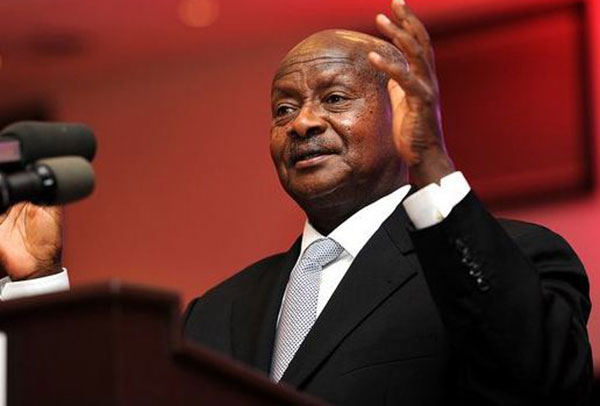
President Yoweri Museveni

KAMPALA: President Museveni appeared bullish about the state of the country’s economic, social and political state, in his State of Nation Address delivered today evening at the Kampala Serena Hotel.

In his address to the last session of the ninth parliament, Mr Museveni pointed out key priorities, infrastructure development, Energy and Defence and Security which he said were key in Uganda’s lead forward to becoming “a middle class income in the coming years.”

His confidence comes barely a week to the reading of next financial year’s 2015/2016 budget on June 11th which is expected to detail how government plans to spend the Shs24 trillion that was approved by parliament last week on Friday.

In a roughly 1 hour and 40 minutes address presented with humour and laced with anecdotes that included attacks MPs whom he accused of wasting time on what he termed as peripheral issues and leave out the core issues that affect Ugandans and “poor investors”, the president exuded optimism and said Uganda was on a steady path to growth.

He however, intentionally sidestepped discussing politics, saying “matters concerning politics should be handled in accordance with constitutional provisions.”

Defending drown envelopes

Cresting the fifth address in his fourth term, the president also made a strong case for the practice of handing out brown envelopes to voters. He said handing out brown envelope was a wrong practice, but when accosted by opposition MPs on whether he is walking the talk, he said he does hand out envelopes because he is President.

“My sister Cicila Ogwal, [Opposition Chief Whip] here is saying that I am the one who has brought the bad culture by giving out envelopes. But I am president, you are not president…,” he said as congregation burst out in laughter.

“Those envelopes, I really find it difficult.  I am a president, and I live in Kampala. I come once in the rural area. The people will not see me for another five years,” he noted “And according to most of those people’s cultures, I am a Madit [a big person in Acholi]. I have to give them something.”

 Address in bits

The President says the government will support value addition to ensure that the country is liberated from the slavery of exporting raw materials. He explains that copper from Kasese will be taken to Cable Corporation of Uganda to turn it into cable that is ready for the market. The sugar factory in Amuru, according to Museveni, has been delayed by some MPs which is abuse of power.

He says the global demand for milk is 625 million metric tonnes which means that if each rural household had six cows, Uganda would get millions of dollars from supplying such huge markets. He says coffee production is being promoted to reach the country’s target of getting $1. billion from coffee exports from the current $400 million.

Security is now assured in the entire country. He says the pending problems to handle are murder, corruption, tax evasion, money laundering among others. He says police is defeated because they are still using rudimentary methods of investigating crime. He says all major towns in Uganda will have CCTV cameras to improve security. He says the computerised identity card project is part of the effort to reduce crime and expedite investigations.

After handling roads and electricity, effort will be channeled to supporting scientific research and innovation in Uganda.

He says other dams like Ayago, will be constructed when the money from oil starts coming in. This, he says will give Uganda a capacity of 4,356 megawatts. He says Uganda now generates 1,974 megawatts. He, however, says this is very small compared to countries like UK that produce 55,000 megawatts. In 1986, Uganda’s generation capacity was 60 megawatts.

President Museveni says many leaders over the years concentrate on peripheral issues and fail to address the core issues, which has affected development. Without foreign aid, he says, Uganda has been 1,627 kilometres of electricity transmission line since 2006. He says 328 million dollars were used to start the construction of Isimba and Karuma power dams without waiting for money from Chinese companies.

rwanambwa@eagle.co.ug

Stories Continues after ad

Shs5 billion ivory headed for Singapore seized at Entebbe airport

KAMPALA: Police has revealed today an ivory contraband worth Shs5 billion was intercepted at Entebbe International Airport on Sunday in transit to Singapore through Turkish Airlines.

Police spokesperson Fred Enanga told journalists the contraband weighing Shs740 Kilograms was intercepted by the Aviation Police, hidden in six boxes. The ivory was detected using the airport radiography machines shortly after being cleared.

“We are looking for the clearing agent who is on run after the cargo was intercept with hopes that he will reveal the company or individuals behind the smuggling of this Ivory,” Mr Enanga said.

The ivory, according to Mr Enanga, worth Shs54 billion ($1.8 million) is believed to have been passing through Uganda possibly from Tanzania.

Civil Aviation officials said they were looking into the matter; how the ivory was cleared before being detected.

This is the second time this year Police is bursting ivory smuggling at the airport. In February ivory contraband worth shs1 billion was seized at the airport en route to Asia

The development also comes on heels of an ongoing wide ranging investigation by the Inspector General of Government (IGG) of the police, airport and Uganda Wildlife officials over the recent increase in ivory smugglings.

Last year unknown people broke into a Uganda Wildlife Authority (UWA) store and took off with ivory worth Shs10 billion seized from various operations.

The United Nations last year in June raised a red flag about ivory seizures in Uganda, Kenya and Tanzania which it said accounted for 80 percent of what was seized around the world. The reasons exacerbating ivory trade, the UN said, are weak governance and poverty.

editorial@eagleonline.co.ug

Stories Continues after ad

Army impostor held for stealing Judge’s 12m

Masaka- A man claiming to be a Uganda Peoples Defence Forces soldier is being held by police in Masaka on charges of obtaining money by false pretence.

The 35 year old Ezia Kanuuni aka Muhwezi reportedly conned retired High Court Judge Justice Vincent Kibuuka Musoke of twelve million, eight hundred and fifty thousand shillings, claiming the Judge’s deceased daughter, Sofia Namutebi, had left him in charge of a herd of cattle, which herd he wanted to beef up using the said sum.

Kanuuni, who claimed he was attached to Kasajjagirwa Army Barracks, was arrested on Monday and according to the officer charge of Masaka police station Moses Kakiryo, he will be charged with obtaining money by false pretence and impersonation under reference number CRB/1287/2015.

This was after Justice Kibuuka Musoke, a resident of Matanga village, Mukungwe Sub County , made a statement at police, giving details the details of Kanuuni’s theft.

“The suspect came at my place of residence in Matanga and lied to me on the project of herds of cattle my daughter left to him” reads part of Justice Kibuuka Musoke’s statement.

He further asserts that Kanuuni introduced himself as a UPDF soldier, and friend to the late Namutebi and the man then asked for the said 12 million, the subject of the charges the suspect now faces. “I gave him the money without inspecting the location of the project, but whenever I called him on his phone, he would tell me that he was on duty in Mbale and other districts but later, I learnt that he was fraudster,”. The retired Judge further asserts.

But Kanuuni has denied the charges, insisting the Judge could not have given big sums of money to someone he doesn’t know.

Meanwhile, Brig. Joseph Ssemwanga, the UPDF Commander in Masaka said there are no records indicating that Kanuuni belongs to the Kasajjagirwa barracks.

jkamoga@eagle.co.ug

Stories Continues after ad

The Opposition has to style up if it wants Uganda’s Presidency

There is emerging information that the combined opposition in Uganda has this morning started the process of finding a joint flag bearer for the 2016 elections.

Information trekking in is that the selection process is being carried out in Nairobi, Kenya. It is not clear why the opposition has opted for a foreign capital for this all important event, but fingers are being pointed at fear of possible infiltration by NRM moles, intimidation and other challenges that might stifle the holding of a peaceful assembly.

Whether this process delivers for the opposition the desired effect, there are concerns that the Opposition is divided. And, given that any opposition is regarded as a Government in waiting, it is pertinent that they show a level of cohesion that will leave the citizens in no doubt about their capacity to run the affairs of state.

But Alas! This is not to be, if one considers that most of the opposition parties seem to be in disarray.

The oldest political organization in the country, the Democratic Party, the Uganda People’s Congress and the Forum for Democratic Change are all embroiled in internal power struggles that might have the notorious effect of denying them a clear shot at ruling Uganda.

And one can say that the opposition has learnt nothing from Uganda’s electioneering processes, and possibly forgotten everything that can bring them to power, because these internal power squabbles in the opposition date back a long way, they can be traced to the 1996 elections, the first time the opposition failed to field a joint presidential candidate, with each party thinking it had the capacity to take on Yoweri Museveni and the NRM.

But since they are in Kenya, they can possibly reach out to members of the former National Rainbow Coalition, NARC, which managed to pull off the challenging issue of fielding a joint presidential candidate. That candidate was none other that Mwai Kibaki, who ousted long serving Kenyan president Daniel Arap Moi.

Stories Continues after ad