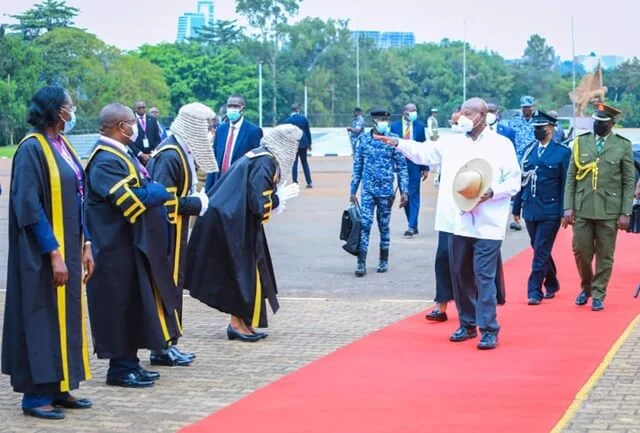
The Parliament of Uganda has restricted physical attendance at this year’s State of the Nation Address and directed invited guests to follow the proceedings virtually as the government intensifies precautionary measures against Ebola despite reporting no new infections in the country.
In guidance by the Office of the Clerk to Parliament, Adolf Mwesige Kasaija, on May 22, Parliament announced that attendance for the June 4 State of the Nation Address at Kololo Ceremonial Grounds will be limited following advice issued by the Ministry of Health on the current public health situation and standard operating procedures.

Adolf Mwesige stated that only Members of the 12th Parliament and selected parliamentary officials will physically attend the national event presided over by President Yoweri Museveni.
“Only Members of the 12th Parliament and select officials of Parliament will attend the function,” he stated.
Parliament further suspended physical participation by previously invited guests and instead directed that alternative arrangements be used to enable remote participation.

“All guests earlier invited are advised not to attend physically as Parliament has made arrangements for virtual attendance of the proceedings,” the notice added.
The guidance also indicated that the public will continue to access the address through live broadcast coverage.
“All Parliament social media platforms and the National Broadcaster will air the State of the Nation Address live for the general public,” the communication said.
The decision comes as Uganda continues heightened surveillance following concerns over the Ebola outbreak in neighbouring Democratic Republic of Congo, where health authorities and international partners are responding to an expanding outbreak.
Providing an update on the regional situation, Director General of the World Health Organization, Tedros Adhanom Ghebreyesus, said the outbreak in DRC remains a serious concern and that available figures likely represent only part of the actual situation on the ground.
“The Ebola situation in DRC is deeply worrisome. So far, 82 cases have been confirmed, with seven confirmed deaths. But we know the epidemic in DRC is much larger,” Dr Tedros said.
According to the WHO chief, surveillance and laboratory testing continue to uncover more suspected infections and fatalities, with close to 750 suspected cases and 177 suspected deaths under investigation.
He noted that intensified insecurity and violence in affected areas continue to undermine response efforts and make outbreak control more difficult.
The WHO chief revealed that additional WHO personnel had already been deployed to Ituri, the epicentre of the outbreak, to strengthen support for affected communities and coordinate with national authorities.
“I am in regular contact with government officials of the affected countries to coordinate response actions,” Dr Tedros said.
WHO has also revised its assessment of the outbreak, raising the national risk level in DRC to very high while maintaining the regional risk at high and the global risk at low.
Dr Tedros said Uganda’s public health measures have so far prevented further spread despite imported infections linked to cross border movement.
“The situation in Uganda is stable, with two confirmed cases in people who travelled from DRC, with one death reported. There have been no new cases or deaths reported,” he said.
He credited Uganda’s containment approach for preventing additional infections and singled out contact tracing and restrictions on mass gatherings among the most effective interventions.
“The measures taken in Uganda, including intense contact tracing and cancelling the Martyrs Day commemoration, appear to have been effective in preventing the further spread of the virus,” Dr Tedros said.
WHO also disclosed that Uganda and DRC continue to lead the response with support from international partners, while emergency resources have been mobilised to strengthen surveillance, treatment and community engagement.
The organisation has deployed 22 international staff to support field operations and released $3.9 million from its Contingency Fund for Emergencies, while additional humanitarian support has been mobilised through the United Nations system.
Dr Tedros further noted that the outbreak presents an added challenge because it is being driven by the Bundibugyo strain of Ebola, for which there are currently no approved vaccines or therapeutics.
“As you know, unlike many previous Ebola outbreaks caused by the Zaire virus, this outbreak is caused by the Bundibugyo virus, for which there are no approved vaccines or therapeutics,” he said.
He added that WHO has already convened scientific and technical teams to accelerate work on vaccines, therapeutics and diagnostics, including prioritising monoclonal antibody research and evaluating antiviral treatments for high risk contacts.
Health authorities have meanwhile maintained that Uganda currently has no ongoing transmission beyond the earlier confirmed imported cases and continue to encourage vigilance, public cooperation, and adherence to health guidance.