Such vehicles that bear foreign number plates are a target.
Uganda Revenue Authority (URA) has kicked off a two-week long joint operation with Uganda Traffic Police and the Military targeting foreign registered motor vehicles with red plates, duplicate number plates and forged ones.
Following intelligence reports, a number of checkpoints are being staged around the Kampala city suburbs. Each location is manned by five officers who ensure that the operations are carried out seamlessly.
During last week’s operation, more than 750 vehicles were verified against their profiles in URA systems like E-TAX and relevant information recorded from the drivers.
According to John Olowo, one of the enforcement officers, a total of 125 motor vehicles were impounded, 78 of these were foreign registered while 47 had red number plates; implying that they were abusing duty-free exemptions.
“Most foreign registered motor vehicles are owned by Ugandans while others are owned by foreigners whose permanent residence is in Uganda especially South Sudanese,” Olowo explained.
For now, the owners of the intercepted vehicles are willing to have their vehicles registered in Uganda, an idea URA is supporting.
In terms of penalties, so far, Shs129,200,000 ($34,000) has been collected and 13 vehicles have been forwarded to the customs warehouse to pay taxes and register. Out of the whole exercise, the process is projected to generate more than Shs500 million.
Ibrahim Bbossa, the URA Spokesperson noted that URA is expected to collect more revenue this financial year so continuous driving of non-authorized vehicles on the road affects the taxes URA collects for improved service delivery.
He also added that the authority is committed to cracking the vice to ensure that every Ugandan pays their fair share of revenue.
“I urge persons with foreign registered number plates to adhere to the EAC customs processes and legislation for importation of foreign registered vehicles or follow the registration process and acquire the Ugandan number plates,” Bbossa emphasized.
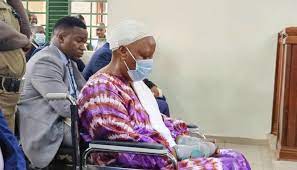
The Crimes Division of the High Court has further denied bail to Molly Katanga, the widow of the late city businessman Henry Katanga.
Molly Katanga is accused of killing her husband, Henry Katanga. The businessman was allegedly shot dead by his wife on November 2, 2023, at their home in Mbuya, Nakawa Division, Kampala City.
Through her lawyers of Kampala Associated Advocates alongside Tumusiime and Kabega Company Advocates, Mrs. Katanga applied for bail following her committal to the high court in February.
She contended that she is of advanced age and requires specialised medical treatment after undergoing multiple surgeries on her head and her hands to address the injuries she sustained on the fateful day of her husband’s death.
She noted that she has a fixed place of residence in Mbuya, which is within the court’s area of jurisdiction. She also told the court that she is the sole breadwinner of her family and a mother of tender children, which requires her presence.
After appearing before High Court Judge Isaac Muwata, Mrs. Katanga was denied bail. He ruled that she was not too old to be in jail, and the medical officers at Luzira Women’s Prison had not informed the court that they had failed to manage her health.
“Since the matter has been fixed for hearing, it is better that the applicant prepares for trial,” he ruled.
Following the denial of bail, Molly didn’t relent; she filed a new application. Appearing before High Court Judge Isaac Muwata, Molly’s application was objected.
“I find no new ground indicating that your ailment can’t be managed at Luzira Prison. Accordingly, the application can’t be granted,” the court ruled.
Molly is charged alongside her two daughters, Martha Nkwanzi and Patricia Kakwanza; George Amanyire, a shamba boy; and Charles Otai, a health worker.
Nkwanzi and Kakwanza are accused of tampering with evidence at the crime scene, rendering it unidentifiable for judicial proceedings. Amanyire and Charles Otai, a health worker, are accused of assisting others involved in the crime.
The four were last month granted Shs2 million in cash bail, while their sureties were bonded at Shs20 million and ordered to surrender their passports.
The trial of Molly and other suspects is set for July 1, 2024.
Parliament’s Public Accounts Committee (PAC) has halted the consideration of the December 2023 Auditor General’s report about the Ministry of Trade’s after Geraldine Ssali, the Permanent Secretary, accused the Auditor General of authoring a biased report.
During the audit exercise, the Auditor General accused ministry officials of refusing to hand over documents about the accountability for cooperatives’ compensation funds.
Muwanga Kivumbi (Butambala County) accused the Ministry of Trade PS, who appeared before PAC on Monday, of trying to impeach the powers of both the committee and Parliament when she questioned the authenticity of the Auditor General’s report.
He wondered why Ssali did not seek a legal opinion from the Attorney General on addressing her concerns on the report and instead opted to use desk office lawyers.
Muwanga said: “I would be the last person to consider a response where an Accounting Officer is attempting to impeach the powers of the Committee and Parliament on matters of approval. Is it your legal person who did this? You have the Attorney General and he is the same for Parliament and if you wanted the Attorney General’s opinion, you should have written to him, expressed your concerns, sought his opinion, and got his opinion to us. Did you get the opinion of the Attorney General on this interpretation?”
However, Ssali denied accusations of attempting to impeach powers of Parliament.
Ssali said, “I don’t even want to use the word impeachment because I remember how that word was over used in the US, it was alien to me, it isn’t anything that we intended to impeach powers of Parliament in anyway and it isn’t possible that we can do that. If our submissions came out in any way to suggest that, insinuate we apologize for that.”
Ssali also accused the Attorney General, Kiryowa Kiwanuka of ignoring her two requests for legal interpretation on how the Ministry of Trade should proceed with Cooperatives and how her ministry was meant to disburse money to third parties, saying the two times she sought an opinion, she never got a written response.
“I didn’t think it was fair for the Auditor General to say that records of the cooperative unions were missing and I think there was a miscommunication between my office and Auditor General office but at that time when records were requested, of the 8 cooperatives were requested, they were given,” said Ssali.
Parliament was reviewing the Auditor General’s report about the Ministry of Trade for the period ending December 2023.
The parliamentary committee on trade in its report recommended that Ms Ssali be further investigated and prosecuted after making several findings against her husband, Mr Victor Busuulwa, who is accused of having irregularly received some of the money advanced to a cooperative on behalf of his wife.
The committee investigated an August 25 directive by House Speaker Anita Among. The directive was to “conduct an inquiry into the status, governance, resourcing, and value for money for public funds allocated to Cooperatives during the period of Financial Year 2011/12 to 2022/23.”
In the letter, the Speaker raised concerns that there were queries regarding the budgetary allocations and disbursements to various cooperatives. The queries raised red flags about whether public funds were indeed disbursed to beneficiary cooperatives and utilised for their intended objectives. The Committee conducted visits and public hearings to selected cooperative societies in various regions of Uganda.
On November 25, for example, more than Shs1.7 billion was paid to Masaka Diocesan Treasury on behalf of Bwavumpologoma Growers Cooperative Union Limited. The Cooperative Union received its Registration Certificate on March 4, 2022, yet the parallel verification committee was instituted on March 21, 2022, a clear indication that Bwavumpologoma Growers Cooperative Union Limited was paid prior to its re-registration and verification.
The committee found that since its re-registration, Bwavumpologoma Growers Cooperative Union Limited did not follow the prescribed procedures laid down in Section 4 of the Cooperative Societies (Amendment) Act, 2020. Its re-registration was therefore deemed irregular.
Ms Ssali, according to the committee, used her position as permanent secretary to influence payment to Bwavumpologoma Growers Cooperative Union Limited after she was appointed the Permanent Secretary in the same Ministry.
The committee established that the re-registration of Bwavumpologoma Growers Cooperative Union Limited was irregular since it was handled by Ms Ssali in her own private capacity and having vested interests in its revival.
The committee found that there were several substantial withdrawals from the bank accounts of Bwavumpologoma without corresponding requisitions.
On May 16, 2021, for example, Bwavumpologoma deposited on an account held by Wilson Kasule Martin Shs350m and on the same day he withdrew the same amount. That very day, Shs300m was deposited in Mr Busuulwa’s account in Centenary Bank Kabalagala Branch. Mr Busulwa is Ms Ssali’s husband.
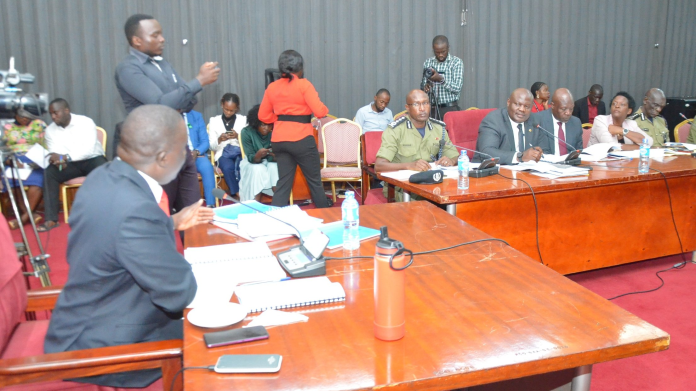
Police officials before PAC Chairman Muwanga Kivumbi.
The Public Accounts Committee of Parliament has criticized Uganda Police for the deplorable and inhumane living conditions suspects under detention are living, after the Auditor General revealed that many police stations are forcing women, men and children to use buckets as toilets, while sharing the same cells.
In the December 2023 Auditor General’s report, it was noted that out of the 72 sampled station across Uganda, only 11 stations had separate cells for the women, children and men, with police revealing that Uganda has 2,131 police stations, the MPs argued that the results from the samples taken by the auditors indicated that the problem is highly pronounced.
Aggrey Wunyi, Under Secretary, Uganda Police acknowledged the challenges raised by the auditors and noted that the situation is being addressed with the construction of new police stations across the country that cater for these amenities.
“We had challenges in the old structures and mostly where the Police is renting. But where the Police have constructed our own office accommodation, we have separate cells for male, female and juveniles. When we are building new police stations now, we have detention facilities for the male, female and juveniles,” said Wunyi.
Sarah Opendi (Tororo DWR) described the current conditions as unacceptable saying the sharing of cells among men, women and children could exacerbate the issue of domestic violence in case some of the women leave cells while pregnant.
“I find this unacceptable considering that the Police has a construction unit and if it really looks at this as an issue, it would definitely construct those structures however small they may be. It is really a shame that in this era when the population of Uganda has greatly increased, that out of the sample, 11 facilities don’t have various cells for the women, men and children. Maybe we can start with you, we hold you today in one cell, men and women so that you experience it. Some people may leave the cells pregnant and you are actually causing domestic violence,” said Opendi.
Muwanga Kivumbi (Butambala County) wondered why Police isn’t issuing these suspects bond instead of holding them for days, lengthy detentions he says is hampering suspects from participating in production, which in the end affects the growth of the economy.
“There are 2131 Police stations and the Auditors just sampled 42 and in just those, the Auditor General made a yield of 362 and some of the police stations are in shops without proper facilities. This brings the number to 1815. That was the number at the time of the audit, you could have over 1800 Ugandans detained without trial for more than 48hours unconstitutionally. How can those performances give you a good record?” said Kivumbi.
The Public Accounts Committee also quizzed Uganda Police Force over the Shs921,250,559 approximately Shs11,055,006,708 per annum paid to 1,655 staff who had retired, deserted or deceased but were not immediately deleted from the payroll as of 30th June 2023, with auditors warning that the failure to delete these individuals means Police’s payroll and manpower were overstated.
The MPs also queried the 2,042 ‘ghost workers’ found on Uganda Police’s payroll after these never appeared for the February 2023 verification exercise conducted by the Auditor General, of which, 1,347 individuals were confirmed dead, absconded or retired, while 695 had received salaries worth Shs355 million but could not be accounted for by Police.
The Auditors also discovered that 17,636 staff on Police’s main payroll had inconsistencies in their names (1,736), NINs (292), date of birth (15,162) and gender (446) as captured on payroll and NIRA records.
On Monday May 13, 2024, Uganda Energy Credit Capitalisation Company (UECCC) invited Energy Service companies operating within the solar space for a consultative/training workshop on the Results Based Financing (RBF) programme under the Electricity Access Scaleup Project (EASP).
The main objective of the workshop was to engage the shortlisted ESCOs on the expectations of the RBF Program and to specifically introduce to them the Prospect Digital Platform that will be utilized to automatically collect, aggregate, analyse and display data from the ESCOs as the sales to beneficiaries take place.
The Results Based Financing program is one out of the four programmes being implemented by UECCC under the Financial Intermediation component of the Electricity Access Scaleup Project. The program will provide Grants, price subsidies or price cuts through shortlisted Energy Service Companies aimed at addressing the upfront affordability barriers associated with the purchase of clean technologies for lighting, clean cooking solutions and productive uses of energy. Ugandans will be able to access the discounted products at the counters of the Energy Service companies with branch networks and agents spread throughout the Country.
The Program will also provide higher incentives on a per unit sold basis to ESCOs which register discounted sales in underserved and remote rural areas of Uganda. The delivered price cuts /price subsidies will be refunded by UECCC to the ESCOs after an independent verification has been done by a reputable audit firm confirming that sales have taken place. The entire process is designed to ensure transparency and accountability.
The UECCC Managing Director, Mr Roy Nyamutale Baguma gave introductory remarks at the official opening of the workshop and mentioned that UECCC conceptualised the use of a digital platform and obtained support from the World Bank. As a result, UECCC entered into an agreement with A2EI of Germany to provide a digital platform (Prospect Digital Platform) that will enhance real time or near to real time information about the sales being closed by the shortlisted Energy Service Companies across the Country. The digital platform will enable the companies to upload sales to beneficiaries as the selling of eligible technologies takes place. The IT platform will also facilitate quick verification by the independent verification agent.
Mr Samuel Ocanya the Project Manager for the EASP asked the ESCOs to fully engage and understand the workings of the digital platform. ESCOs will be required to connect to the digital platform in order to onboard discounted sales details to facilitate timely verification of their submitted claims.
Mr Mwaka Agoba the Programme Manager-Results Based Financing & Clean Cooking advised that the RBF sales are expected to begin in July 2024 after the ESCOs have signed their grant agreements with UECCC and that the company will contribute towards the market sensitization and awareness creation to support their sales efforts.
The workshop was attended by over 50 shortlisted ESCOs and the three day engagement period was highly interactive. One of the participants, Retired Honorable David Ebong the CEO of Clean Energy Partnership Africa, reiterated that the platform would be great for the transparency of the program. “The platform that has been created is user-friendly and makes it easier to capture data and generate reports. All ESCOs also have full visibility of the data they have captured, everything is done in the open”.
The expected outcomes of the Program will include increased use of clean energy for lighting, cooking and productive uses such as water pumping, irrigation, refrigeration and cooling, water heating and grain milling; thus, eliminating negative environmental impacts such as Green gas emissions, deforestation and poor health conditions associated with the use of traditional lighting and three stone cooking, and other open fire cooking methods.
The Project provides an opportunity for ESCOs to partner with Government through UECCC to do business in an environmentally friendly manner. Protecting the environment is everyone’s responsibility. The Electricity Access Scaleup project is about access to clean energy and clean energy is synonymous with protecting the environment.
About UECCC
The Uganda Energy Credit Capitalisation Company (UECCC) is a Government institution set up under the Companies Act as a Company Limited by Guarantee and not having share capital. It was operationalised in 2009 primarily to facilitate investments in Uganda’s Renewable Energy Sector, with a particular focus on enabling private sector participation.
The Company’s main objective is to provide financial, technical, and other support for Renewable Energy Projects and Programmes.
UECCC is also the administrator of the Uganda Energy Capitalisation Trust (“The Trust”) which is a framework for pooling resources from Government and Development Partners for the development of Renewable Energy Projects.
The Criminal Investigations Directorate of Police has placed a Shs10 million reward to whoever reveals the whereabouts of Dr. Lawrence Erone, a wanted Kyambogo University lecturer.
Dr. Eron, whose case file was sanctioned on December 13, 2023 is being accused of aggravated defilement of a 16-year-old disabled girl who is a beneficiary of his project of “All we see is possibility”. After his arrest and release from custody last year, Dr. Eron has since gone missing.
Police Spokesperson Fred Enanga has appealed to anyone with information leading to the arrest of Dr. Eron to give it to the CID in confidence, noting, “we believe that he is still in the country.”
Enanga further warned friends and relatives who may be hiding Dr. Eron, saying that it is criminal to do so. He however said that there are also other processes in place to ensure that Dr. Eron is arrested from wherever he may be outside of the country.
Earlier, Enanga confirmed that the suspect is HIV positive.
The facts gathered indicate that the suspect travelled as a caretaker with four students including the 16-year-old, disabled victim to Nairobi-Kenya, for a conference, and returned on December 10, 2023. He picked his car that he had left at the Airport and gave a lift to the students. He first dropped two students from Gulu University at Namayiba Taxi Park, and they travelled to Gulu. And went on to drop the third student at North Hall, Kyambogo University and remained with the victim, who had a visual impairment, in the car (she can only see during day time while using glasses but cannot see at night.
ATC Uganda has partnered with Kyambogo University to offer students an unparalleled opportunity to gain valuable knowledge, insights, and career guidance directly from esteemed experts within the telecom industry.
The Student Career Fair serves as a dynamic platform bringing together students, professionals, and industry leaders for networking, learning, and invaluable career advice.
Stella Ssekweyama, ATC Uganda’s Head of HR, who represented the Chief Executive Officer at the fair, emphasised the importance of skilled education in driving socio-economic development.
“ATC believes in enhancing graduates’ skills to enable them to compete favourably for job opportunities as they progress in their careers.” She noted.
ATC Uganda has a track record of supporting and preparing university students for the job market through initiatives like the recent two-day mentorship programme with students from Makerere and Kyambogo University, aimed at inspiring more girls to pursue careers in Science, Technology, Engineering, and Mathematics (STEM).
Additionally, ATC Uganda is running a 12-month Graduate Trainee Programme designed to identify and train young talents for enhanced skills and employability across various fields.
The partnership between Kyambogo University and ATC Uganda underscores a mutual commitment to nurturing and grooming talent for excellence by bridging the gap between theoretical knowledge and practical experience.
Kasadha Agabo, President of the Kyambogo University Engineering Society, expressed gratitude for this partnership, acknowledging that it equips students with hands-on skills crucial for their success in the industry.
With an annual output of 400 graduates, these career fairs play a pivotal role in enabling students to excel in their respective fields and contribute significantly to the country’s development.
At least two creatives, Gloria Awori and Maganda Shakul, have received $6,000 (Shs23.7 million) in funding grants after winning the Africa Creative Challenge.
This innovative competition aims to support creatives in the early stages of business development and ignite creative innovation within Uganda’s creative landscape.
The winners presented exceptional ideas in art, craft, and environmental sustainability, surpassing eight other teams to secure the award.
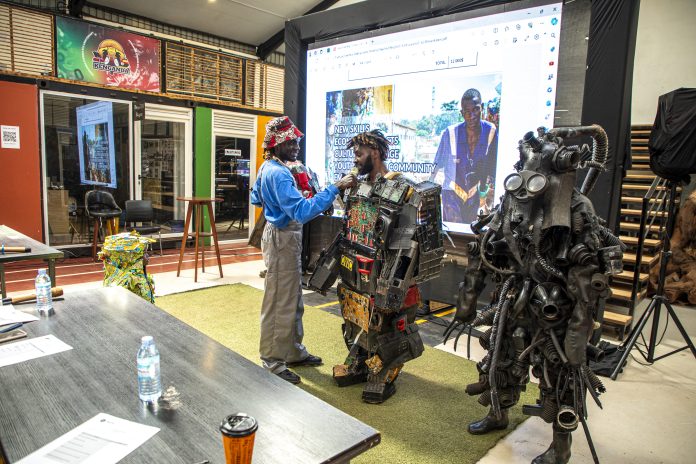
Shakul Maganda pitched “Street Flash Mob,” a project focused on transforming waste materials into new and useful artistic productions. This year-long initiative aims to raise environmental awareness and equip communities with the skills, knowledge, tools, and resources to convert waste into valuable resources, thus enhancing their income.
Gloria Awori proposed a contemporary jewelry school that offers in-person training in jewelry making (metalsmithing) and design. This venture seeks to cultivate a passionate community of professional jewelry designers and makers in Uganda whose creations can thrive in both local and international markets.
Judging Criteria
Rachel Magoola, Chairperson of the Parliamentary Forum for Creative Arts and one of the judges, stated, “The Challenge provided a vital platform for creatives to showcase their unique talents and original concepts.
“Our judging criteria were meticulously designed to identify and reward the most promising creative talents. The winners chosen demonstrate ideas that are highly adaptable, innovative, and sustainable. Their concepts were not only novel and imaginative but also practical and capable of being implemented effectively.”
She added, “The ideas align with the broader goals of the creative economy as per the government agenda, thereby contributing to its expansion and dynamism.
“This initiative not only celebrates the diverse nature of our creative disciplines but also provides a platform that empowers creatives to take advantage of the myriad opportunities within the sector. By providing a stage for innovation and creativity, the Challenge fosters a vibrant cultural landscape that drives economic growth and social transformation,” said Magoola.
Winners Speak
According to Maganda Shakul, the team leader of Street Flash Mob, winning the grant is an opportunity to engage with indigenous communities across the country on the waste management challenges posed by rapid urbanisation and population growth.
“With the grant, we will focus on empowering youth and adults in the districts of Jinja, Gulu, Mbarara, and Kampala by sharing knowledge and skills from professional artists necessary for effectively managing and repurposing waste materials. Through targeted waste management and recycling workshops facilitated in these areas, our initiative seeks to instill practical waste management techniques while simultaneously fostering creativity, self-confidence, and artistic expression,” Shakul said.
Gloria Awori, founder of Gloria Awori Craft Studio, stated that the funds will be invested in expanding her contemporary jewelry schools to further grow the art community and enhance the adoption of local craftsmanship, skilling, and domestic jewelry production.
Marie Fordjoe, Lead of MoTIV West Africa, commented, “All participants exhibited passion for their projects; however, many needed more time to refine and polish their ideas.
“Beyond financial support, the winners will gain access to various capacity-building sessions here at MoTIV. They will benefit from mentorship, networking opportunities, and venture development tools, giving their ideas the best chance of evolving into sustainable and profitable businesses.”
The Africa Creative Challenge emphasized the adaptability of the concepts presented. Projects that can easily integrate into existing frameworks or inspire new ways of thinking within the creative sector are particularly valued. This holistic approach fosters the development of an innovative, resilient, and forward-thinking creative community in Uganda, Fordjoe said.
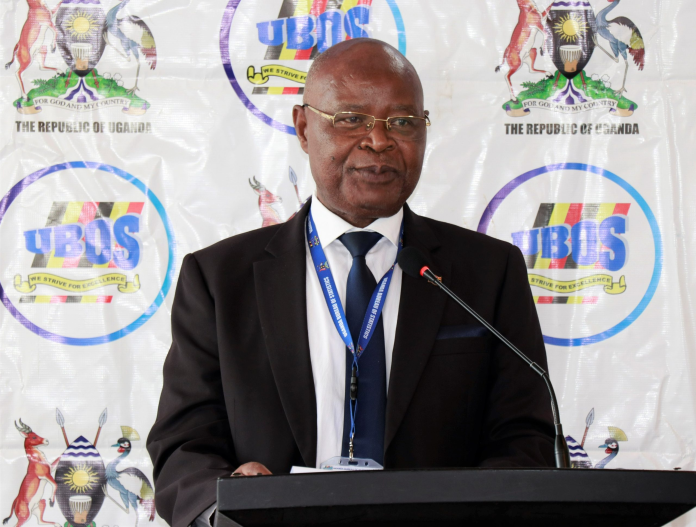
The Uganda Bureau of Statistics (UBOS) has announced an extension of the national population and housing census, which was initially slated to end on May 19 to May 25, 2024.
According to UBOS Executive Director and Census Commissioner, Dr. Chris N. Mukiza, the extension is aimed at ensuring that everyone is counted and no one is left behind.
“We want to guarantee that all households and individuals are enumerated, and this extra time will enable us to reach those who may have missed the initial period,” Dr. Mukiza explained.
The census exercise, which began on May 10, has faced some challenges, including login difficulties and incomplete listing during mapping, which affected some enumeration areas. The extension provides an opportunity for households that have not yet been enumerated to make an appointment with their LC1 Chairpersons to agree on a date and time for enumeration before the end of the waiver period.
Supervisors have been urged to ensure complete coverage and quality assurance during this period. The data collected will be used to inform development planning, policy decisions, and resource allocation.
The public is encouraged to take advantage of this extension and make sure they are counted. By doing so, they will be contributing to shaping Uganda’s future.
“Remember, the census is a crucial exercise that helps the government understands the needs and characteristics of the population, and it’s essential that everyone participates. Don’t miss this opportunity to be counted,” Mukiza said.
The Bureau has meanwhile advised members of the public who have not yet enumerated to reach out to their respective Local council 1 chairpersons to book for the same.
“Due to challenges experienced at the start of enumeration, we do not want to leave anyone behind and thus found it prudent to have an extension of the Census exercise. In case you haven’t been counted, this is your time. Also, reach out to your L.C to have an appointment booked for you to be counted”. Noted Mr. Mukiza
The Ugandan government is working around the clock to redevelop Arua Airfield into a full-fledged international airport, according to recent announcements by the Director General of the Civil Aviation Authority (CAA), Fred Bamwesigye.
This project aims to elevate Arua Airport’s status as a critical hub for passenger and cargo air traffic between Uganda, the Democratic Republic of Congo and South Sudan.
During a site inspection tour, also attend by State Minister for Transport, Fred Byamukama, Mr. Bamwesigye revealed that the Civil Aviation Authority had secured land for the airport’s expansion and signed a Memorandum of Understanding with East of Eden, an investor partner, under the Private Public Partnership framework. The partnership will conduct feasibility studies and related assessments to pave the way for the airport’s transformation.
Mr. Bamwesigye further revealed that a Memorandum of Understanding has already been signed between the government and East of Eden under the Private Public Partnership framework to undertake feasibility studies and related assessments.
Arua Airport’s strategic location makes it an ideal center for regional air traffic, and its upgrade will complement Entebbe International Airport as a major entry point into Uganda. The airport’s modernization plans, initially announced in 2009, stalled due to a compensation dispute with local landowners. However, with the new partnership and government support, the project is now back on track.
Upon completion, Arua Airport will join Entebbe International Airport, Kabalega International Airport (currently under construction), Gulu Airport, and Kasese Airport as Uganda’s five international airports. This development is expected to boost tourism and economic growth in the region.