Stanbic Bank
Stanbic Bank
25.8 C
Kampala
Stanbic Bank
Stanbic Bank
Home Blog Page 2403

Micho summons 44 for busy schedule

Summoned Squad
 Summoned Squad
Summoned Squad

National teams’ head coach Mulitin ‘Micho’ Sredojevic held a second training session at the at the Phillip Omondi stadium, Lugogo on Sunday.

With a joint Uganda Under-23 and CHAN squads, 44players have been called upon ahead of the 2016 Africa Olympic qualifiers against Rwanda while the CHAN team prepares to face Tanzania.

“This was our last joint training session. Next Sunday, we shall separate the players and focus on specific approaches.

We shall focus more on the U-23 because their game is soon” Sredejovic said after the training.

The U-23 side will face Rwanda on Saturday 23rd May, 2015 for the first leg and the reverse fixture a fortnight later, the latter eliminated Somalia to Set Date with Uganda.

The winner of the tie will meet Egypt in the last round of qualification for the quadrennial CAF U-23 Championship scheduled for December 5-19 in Senegal that will attract eight teams.

Home based players’ face Tanzania in the first round, first leg of the 2016 CHAN qualifiers in Dar es Salaam on June 20, and the return leg is on July 4, at Mandela National stadium, Namboole.

Uganda Cranes play Botswana in the 2017 AFCON game qualifier on June 13, 2015 at Mandela National stadium, Namboole.

Squad Summoned: Watenga Isma (Vipers), Muwanga Bernard (Bright Stars), Saidi Kyeyune (URA), Isaac Muleme (SC Villa), Yasser Mugerwa (URA), Martin Mpuga (SCVU), Farouk Miya, (Vipers), Mutyaba Muzamiru (SCVU), Dan Birikwalira(Vipers), Jimmy Lule (Bright Stars), Kikoyo Hassan (Bright Stars), Umaru Kasumba (Police), Julius Mutyaba (Lweza), Taddeo Lwanga (Express), Ibrahim Kiyemba(Lweza), Joseph Nsubuga(Bright Stars), Mathius Kigonya (Bright Stars), Sadat Kyambadde (Police), Brian Bwete (URA), Nicholas Sebwato (SC Villa), Nkata Fred (Kira Young), Alitho James (Vipers), Tekkwo Derrick (Kira Young), Ivan Sserunkuuma (Express FC), Godfrey Lwesibawa(Express FC), Ntambi Julius (Kira Young), John Semazi (Express), Kirizestom Ntambi (SC Villa), Maxwell Okello (Maroons), Bakaki Shafiq (Express), Denis Okot Oola (SCVU), Fred Segujja (Sadolin), Silvester Okello (Maroons), Henry Katongole (Express), Kalanda Frank (URA), Jimmy Kulaba(URA), Denis Kamanzi (Villa), Hassan Wasswa (Villa), Robert Sentongo(URA), Brian Ochwo (SCVU), Fahad Muhamad Toko (SCVU), Abel Eturude(Maroons), Tom Masiko, Joseph Ochaya, Martin Kizza, Benjamin Ochan, William Wadri, Herman Wasswa, Hakim Ssenkumba and Timothy Awanyi (KCC FC).

Stories Continues after ad

South African mercenaries’ secret war on Boko Haram

Colonel Eeben Barlow, a former commander in the South African Defence Force,

Mercenaries from South Africa have proved quietly decisive in helping the Nigerian military turn around its campaign against Boko Haram, writes Colin Freeman in Abuja

With their roots in South Africa apartheid-era security forces, they do not fit the standard image of an army of liberation. But after just three months on the ground, a squad of grizzled, ageing white mercenaries have helped to end Boko Haram’s six-long year reign of terror in northern Nigeria.
Run by Colonel Eeben Barlow, a former commander in the South African Defence Force, the group of bush warfare experts were recruited in top secrecy in January to train an elite strike group within Nigeria’s disorganised, demoralised army.
Some of the guns-for-hire cut their teeth in South Africa’s border wars 30 years ago. But their formidable fighting skills – backed by their own helicopter pilots flying combat missions – have proved decisive in helping the military turn around its campaign against Boko Haram in its north-eastern strongholds.
• Who are Nigeria’s Boko Haram Islamists?
The Islamists have now fled many of the towns they once controlled, leading to the freeing of hundreds of girls and women last week who were used by Boko Haram as slaves and bush wives.
The role of Col Barlow’s firm in turning around one of the most vicious African insurgencies of modern times has been kept largely quiet by Nigeria’s outgoing president, Goodluck Jonathan, who lost elections six weeks ago to ex-general Muhammadu Buhari.

Nigeria's outgoing president Goodluck Jonathan
Nigeria’s outgoing president Goodluck Jonathan

But last week, Col Barlow discussed his company’s role in a seminar at the Royal Danish Defence College, and in a separate interview with a Sofrep.com, a special forces website, he described in detail the “aggressive” strike force that was created to push Boko Haram onto the back foot.
“The campaign gathered good momentum and wrested much of the initiative from the enemy,” said Col Barlow, 62. “It was not uncommon for the strike force to be met by thousands of cheering locals once the enemy had been driven from an area.”
He added: “Yes, many of us are no longer 20-year-olds. But with our age has come a knowledge of conflicts and wars in Africa that our younger generation employees have yet to learn, and a steady hand when things get rough.”
During apartheid, Col Barlow served with the South African Defence Force, a mainly white military unit that defended the regime against insurrection and fought border wars in neighbouring Angola and what is now Namibia.
In 1989, as apartheid was beginning to crumble, he co-founded Executive Outcomes, a private military company made up of many ex-members of South Africa’s security forces. One of the first modern “private armies”, in 1995 it successfully helped the government of Sierra Leone defend itself against the rebels of the Revolutionary United Front, notorious for chopping off the arms of their enemies.

Simon Mann in Zimbabwe in 2007

Another co-founder of Executive Outcomes, which dissolved in 2000, was Simon Mann, the Old Etonian later jailed in Equatorial Guinea over his attempts to plot a coup there.
Col Barlow’s new company is known as STTEP, which stands for Specialized Tasks, Training, Equipment and Protection. It is thought to have sent around 100 men to Nigeria, including black troopers who previously served in elite South African units. Others even fought as communist guerrillas against the South African Defence Force.
It is not known how much the Nigerian military has paid for STTEP’s services. But the fact that the Nigerian government felt it necessary to bring them in raises questions about the level of help that it was receiving from the British and US militaries, who offered mentoring packages in the wake of Boko Haram’s kidnapping last year of more than 200 schoolgirls from the north-eastern town of Chibok.
Describing Boko Haram as “a bunch of armed thugs who have used religion as the glue to hold their followers”, Col Barlow said the initial plan was for his men to train up a team to help free the schoolgirls. However, as Boko Haram continued to run amok across northern Nigeria, massacring hundreds at a time in village raids, the plan turned to schooling Nigeria’s largely traditional army in “unconventional mobile warfare”.

The leader of the Islamist extremist group Boko Haram delivering a speech

Key to this was a tactic known as “relentless pursuit”, which involved mimicking Boko Haram’s hit-and-run tactics with non-stop assaults. Once the insurgents were on the run and their likely route established, members of the strike force would be helicoptered into land ahead of them to cut off their likely escape routes, gradually exhausting them.
The South Africans even used bush trackers to work out where their enemies were going, an old-fashioned art that proved vital in Boko Haram’s forest hideouts. “Good trackers can tell the age of a track as well as indicate if the enemy is carrying heavy loads, the types of weapons he has, if the enemy is moving hurriedly, what he is eating, and so forth,” said Col Barlow.
While the Nigerian government has insisted the South Africans’ role was mainly as “technical advisers”, Col Barlow suggested his men had been involved in direct combat. His air power unit was “given ‘kill blocks’ to the front and flanks of the strike force and could conduct missions in those areas,” he said. His forces also helped with intelligence gathering, troop transportation and evacuation of casualties.
Mr Jonathan’s decision to hire STTEP came just ahead of March’s elections, when his government’s failure to either tackle Boko Haram or free the kidnapped Chibok schoolgirls was a major issue. He has promised that when Mr Buhari takes over at the end of this month, Boko Haram will be a spent force, although it is not yet clear whether the Buhari government will renew STTEP’s contract.
Col Barlow warned that while the Nigerians had done well within three months that he had been contracted to mentor them, “the enemy was able to flee the battlefield with some of their forces intact, and will no doubt regroup and continue their acts of terror.”
The involvement of STTEP in Nigeria will inevitably reignite the debate over whether private military companies should be used in conflicts. Human rights groups question whether they are publicly accountable, and in South Africa especially, their background in the apartheid-era makes some uneasy.
However, Col Barlow, whose firm has a code of conduct for behaving “in a legal, moral, and ethical manner” said that private companies were often better than UN or Western trainers of African armies. The latter were often hamstrung by political baggage and a failure to understand how either African armies or their enemies worked, he said. The advisers that Britain and America have sent to Nigeria are also not permitted to take part in operations on the ground, partly because of the Nigerian’s army’s poor human rights record.
Noting that even the US military appeared to regard his firm with distrust, Col Barlow added: “Some like to refer to us as ‘racists’ or ‘apartheid soldiers’ with little knowledge of our organisation. We are primarily white, black, and brown Africans who reside on this continent and are accepted as such by African governments.”

Stories Continues after ad

Iryn Namubiru gets new Manager

Iryn Namubiru
Iryn Namubiru

After firing her brother Thaddeus Mubiru as her manager singer Iryn Namubiru has spent more than a year without a manager. She was earlier last year signed up to and International management label, Grajoh limited which only takes care of her international events and had no intensions of working with her locally.
However, Eagle Online has reliably learnt that Namubiru is now signed to Spotlyte management which deals in corporate events, music, and entertainment. This happened last week when Namubiru was spotted on Thursday May 7, with the SpotLyte management boss, Richard Sebadduka famously known as “Mr Flava” who was initially the manager of dancehall giant Fidempa before he shifted back to Kenya because of family issues.
Our sources tell us Mr Flava is going to manage Namubiru locally in Uganda and across Africa Grajoh the international Management label will be in charge of her management outside Africa.

New manager
Mr. Flava, New manager

Mr Flava is likely to manage Namubiru because of the experience he has in the entertainment industry. SpotLyte management has managed events like The East African Award Biggest Brand Awards that happened last year on July 19, at Serena Hotel which brought together many East African corporate companies and several other events. We surely can’t wait for what Mr Flava has got to cook for the very inpatient Namubiru when it comes to managers.

Stories Continues after ad

Take community service order to another level-Gen. Aronda to judiciary

Aronda3

The internal affairs minister General Aronda Nyakayirima, cautioned judiciary to take community service order to another level by making it of more impact to community.

Community service order is a devised measure to decongest prison facilities in the country, where minor offenders are sentenced to doing community services instead of being handed custodial sentences.

General Aronda Nyakayirima, planting a tree

However, Nyakairima who officiated at the launch the devised environmental-centered community services order project, he earmarked with tree planting at the Masaka High court on Saturday noted that with a history of its commencement in Uganda since 1999, the system has not had visible impacts to the community.

He said, although the judiciary claims to have many petty offenders sentenced to community service orders and accomplish the punishments, there are hardly many visible results to show to the public.

Mr. Nyakairima called on the judiciary should cooperate with the respective district security committees to identify those activities that make more impacts to community to be awarded as sentences to such offenders and have them strictly monitored and popularized for public advocacy.

‘We need to make a more serious impact because there is a good hierarchy from national to district and sub country, so can we identify those activities that can be promoted to make visible results,” he urged, instructing RDC’s to involve the magistrates in their security committee discussions.

Although Nyakairima appreciates the approach as suitable towards decongesting the extremely filled Ugandan prisons, there is still much need to prevent more people getting to jail.

He suggests for multi-sectoral measures to combat all other factors contributing to crime, like rampant unemployment, drug abuse, excessive gambling among others.

But in a report by Justice Flavia Ssennoga Anglin, the chairperson of the community service committee in the judiciary, the process mainly focuses at moral rehabilitation of law breakers within their community.

“The new launched project has mainstreamed on environmental protection where the sentenced offenders will be required to massively plant trees along the roads and other public places as an approach to supplement the Go-green campaign undertaken by government to re-afforestate the deforested areas and afforestation,” she explained.

Justice Ssennoga however cited needs to popularize the program, saying this could be the reason community have not been acknowledging it as punishment hence less impact.

Masaka High Court Resident Judge, Margret Oumo Oguli
General Aronda Nyakayirima shaking hands with Masaka High Court Resident Judge

But the Masaka High Court Resident Judge, Margret Oumo Oguli, insists that majority of previously convicted offenders have fully accomplished their community services order sentences and that records indicate very few abscondment

She revealed that last year 86 of 89 people accomplished their sentences in various field while 76 are currently doing their sentences for 2015.

Besides the new program, judiciary in Masaka has in only this year launched sessions of Plea-bargaining and Civil-Case mediation sessions, all intended to decongest the highly strained prisons.

Hon Benny Nmugwanya addressing people
Stories Continues after ad

Seven varsity students bag ‘resilience’ dollars

Chris Baryomunsi launching resilience Africa 2015

Seven successful participants drawn from 15 universities across Africa have been awarded grants that range from US$20,000 and US$100,000, to find solutions to community problems.
The money that will help the recipients to engage in research on community resilience interventions was delivered by the State Minister for Higher Education Prof. Tickodri Togboa, at the launch of State of African Resilience Report 2015 at Makerere University on May 8.
The contest drew 600 participants from the 15 sub Saharan universities, and in his speech Prof Togboa urged the seven successful recipients to use the grants wisely.
The report, dubbed ‘State of African Resilience’ and the first of its kind, is the work of Resilience Africa Network (RAN), a project under the Makerere School of Public Health.

Chris Baryomunsi handing a report

Speaking at the launch presided over by State Minister for Health in charge of General Duties Dr. Chris Baryomunsi, who represented chief guest Prime Minister Dr. Ruhakana Rugunda, the RAN Deputy Chief of Party Prof. Roy William Mayega noted that despite saving lives through providing aid during disasters, international organisations have not emphasized resilience.
“After disasters many communities in Africa find a hard time resettling no matter how much aid is provided; emphasis on resilience is needed in order to help the affected communities to fully recover from disasters and other social problems,” Prof Mayega said at the launch on May 8 at Makerere University.
“We want to break the gap between the university and the community,” emphasized Prof. Mayega.

Prof. James Fishkin, Director, Center for Deliberative Democracy at Stanford University

Prof. James Fishkin, Director, Center for Deliberative Democracy at Stanford University also emphasised the need for dialoguing with the people that face the consequences of social problems and disasters and noted that many girls in Ugandan rural communities drop out of school because the schools are far. He suggested small community schools and health facilities to established, to ease access to services.
He also noted that resilience is a powerful tool that can be used to change many lives. “The solutions should be tailored around psychosocial problems so that we can deal with them,” Prof. Fishkin said and added: “if we don’t deal with the problems using resilience, we are making our people more vulnerable.”
The Director United States Agency for International Aid (USAID) and U.S Global Development Lab, David Ferguson commended RAN for its efforts and said that USAID and its partners were willing to support life changing projects. “Partnerships between NGOs, business organizations, governments and communities bring different ideas,” Mr. Ferguson noted.”
In his speech, premier Rugunda said organisations like RAN are needed at all universities since they provide the best local solutions to Uganda’s problems.
“Our universities must strive to be the core educators but also the core of innovation,” Dr. Rugunda, who acknowledged the respective partnerships, said.
The State of African Resilience report 2015 highlights findings by Resilience Africa Network (RAN), a partnership targeting 20 Sub-Saharan African Universities. The report is based on research and analysis of the RAN, a partnership that includes 15 African Universities that engage with local communities to understand how best prevent, mitigate and overcome various social problems. RAN is funded by USAID and led by Makerere University in partnership with Tulane University, Stanford University and Center for Strategic and International Studies (CSIS).
RAN is one of the eight development labs under the Higher Education Solutions Network (HESN).

Prof Mondo Kagonyera chancellor MUK
Prof Mondo Kagonyera chancellor MUK at the launch

The launch was also attended by among others Makerere University (Mak) Chancellor Prof. Mondo Kagonyera, Prof. Dumba Sentamu, the Vice Chancellor Prof. Ddumba Sentamu, the Director Dean of Mak School of Public Health Prof. William Bazeyo, Members of Parliament, officials from USAID and, dignitaries from over 20 local and international universities and NGOs.
Awardees
The winners were Dr Robinah Kulabako, team leader for Rapid Agricultural Produce (US$20,000); Mr. Swaibu Douglas the Village Egg Bank team leader (US$36,750); Steven Sekamya of Kungula Freshit (42,350); Dr Percy Mugyenyi of Better Farming Better Me (US$43,729); Dr. Julius Gutume (US$44,450); Gerald Kyeyune of Mushrooming Livelihoods (US$44,900) and, Eng. Daniel Byamukama, the team leader Electronic Dollar a Day Saving Box who received US$100,000.

Stories Continues after ad

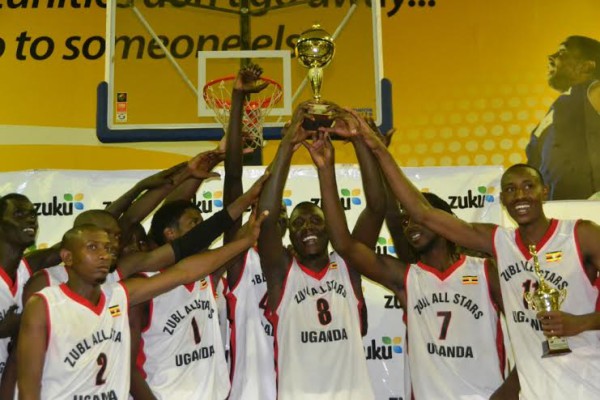
Uganda All Stars star in Zuku basketball tourney

All Stars in Zuku basketball

Most Valuable Player Jonah Otim and Makerere Basketball Team captain Tonny Drileba, were the stars of the match as Uganda beat Kenya in the Zuku Uganda Basketball League (ZUBL) All Stars game. Showing skillful dribbles and passing, the duo ensured that Uganda gets the edge, winning 73-55, in a match that was disrupted by persistent power outages especially before the start of men’s game at the Lugogo Indoor arena.
Indeed, despite the Kenyans exhibiting good dribbling skills they lacked the shooting accuracy, making MVP Otim latch onto that deficiency to ‘own’ the first quarter.
The incredible partnership of Otim and Drilega in the quarters was central to the eventual Uganda scorecard to the extent that when the two were substituted, the Kenyan team ball possession soared.
“I thank all my colleagues for the win,” Otim said and implored appreciated the organisers to schedule more such games, saying this would make university basketball in the country improve.

ladies game Uganda
ladies game Uganda

In the ladies game Uganda managed to snake past the Kenyans with a narrow margin, after the former beat the latter 71-70 in an exciting match characterized by a display of team spirit.
The Kenyans however, had themselves to blame for narrowly losing the game as stumbles in team coordination cost them the title.
“We fought for the win towards the end which was not good enough. This has though given us a chance to learn most important lessons,” said team captain Mercy Nyambura.
Having lost both titles, the Kenyan teams are set to go back to the drawing board, in preparation for the ZUBL next season.
The fans that came to watch the games got entertainment from one of the Ugandan musicians, Irene Ntale.

Irene Ntale Entertaining funs

Various awards were given out after the match with UCU’s Vilma Achieng named MVP; Sylvia Nakazibwe of Makerere bagging Most Offensive Player, while the award for Most Defensive Player went to Purity Odhiambo of UCU.
In the men’s award, James Okello from Ndejje was named this season’s MVP, Most Offensive Player went to Sedar Segamba from St. Lawrence University, while Most Defensive Player went to Brian Namake.

Stories Continues after ad

Vipers regain summit, Villa held

Vipers regain summit
    Friday Results
    Vipers 1-0 Express FC
    SC Villa 1-1 SC VU

A Uganda Premier League title race that just keeps on giving took another twist on Friday with three rounds to play.

Having held Vipers to a draw last week, SC Victoria returned the race button back to former after holding SC Villa to 1-all draw yesterday.

Midfielder Sadam Juma scored the only goal in the second half as Vipers edged Express FC in Bukiwe to reclaim top-spot on 63 points, two ahead of SC Villa.

“We continue to work hard, three games are many and the pressure that comes with the title race” said Coach Richard Wasswa.

Victoria shocked a packed Nakivubo stadium with an hour played when Dan Nsubuga gave the visitors the briefly before VictorEmaneyo leveled matters six minutes later to salvage a point for Villa

“We must make our game in-hand count, it’s never easy to win a league title and Victoria has proved this” Ibrahim Kiirya (Villa coach) noted.

Villa have a chance to regain top-spot if the League record champions can beat relegation threatened Kira Young on Tuesday, before hosting Vipers next Friday at Nakivubo stadium.

Stories Continues after ad

Lweza, Simba can smell survival

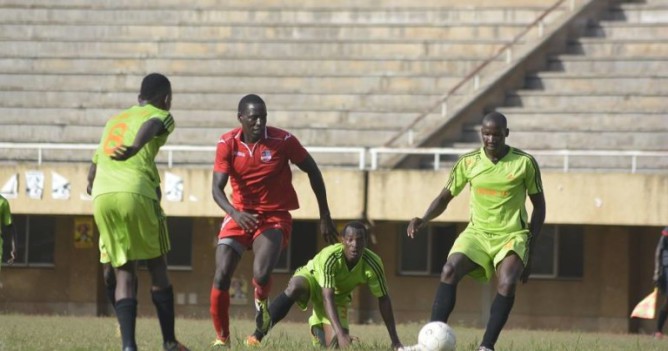
Lweza in Green
Lweza in Green
Lweza in Green

Friday Results

    Kira Young 0-1 Lweza
    Sadolin 1-0 Entebbe
    Police 3-0 Bul
    Bright Stars 0-2 Simba
    KCC FC 1-0 URA FC

    Lweza and Simba picked vital wins as the battle to stay in Uganda Premier League nears with three rounds to play.

    Former Cranes international Geoffrey Sserunkuma scored the games’ solitary goal as Lweza edged relegation rivals Kira Young at Namboole, yesterday.

    “It’s better than it was two weeks ago, but we can’t spend too much time patting ourselves on the back. We have still got a lot of work left to do” said Hamza Kalanzi, the Lweza coach.

    With the win, Lweza moved into 11th place on 30 points two ahead of Kira Young on 28points though the latter has a game in hand.

    Moses Bansena’s Simba picked up maximum points with a 2-0 victory away to Bight Stars, as the army side moved a step closer to survival.

    Herman Wasswa scored the only goal of the game as outgoing champions KCCA FC edged URA FC 1-0 at Lugogo stadium.

    In the other games played, Ben Ocen, Umar Kasumba and Sadat Kyambadde scored as Police saw off Bul FC 3-0, while Sadolin beat Entebbe 1-0 at Bugembe stadium.

    Stories Continues after ad

NSSF mourns Kyayonka

Kyayonka, NSSF Board Chairman

Kampala– National Social Security Fund Managing Director Richard Byarugaba has described the passing on of their board chairman as devastating at the time when the pension sector is set to be liberalized.
Speaking to EagleOnline, Byarugaba, who is currently out of the country, said Kyayonka’s death is a blow to the management of NSSF and the entire worker force because the deceased was an asset in the field of private sector liberalization. He sent condolences to the family of the deceased.
“We are saddened by the passing away of our board chairman at this critical moment when the pension sector is under liberalization and it is unfortunate that he has died before we could conclude that process. He managed the board that had many stakeholders and he will be missed dearly,” Mr Byarugaba said, adding “and I want to pass on my condolences and that of the management of NSSF to his family especially his wife and children.”
A cricket enthusiast, Kyayonka died on Friday evening in the Kenyan capital Nairobi where he had gone for specialized treatment.
Kyayonka was serving his last term at NSSF as a board chairman. He had previously served at Shell Uganda (now Vivo Energy) for a long time as the company managing director.
Meanwhile, by press time Bank of Uganda Governor Emmanuel Tumusiime Mutebile had reportedly been flown out of the country to South Africa for treatment.

Stories Continues after ad

Interview-Enanga talks about love

Fred Enanga Police Spokesperson

She used to steal glances at me – Fred Enanga
The soft spoken spokesperson of Uganda Police Force Fred Enanga is always in the media talking about foiled robberies, issuing terror alerts, warning against demonstrations and other security related issues. Today, he shares with Eagle Online’s Grace Amme about the sunlit side of his life.
Are you always this soft-spoken?

Yes, that’s how I talk. I have that deep voice which makes me talk like this.
Are you single?
I am a married man though I don’t know how you look at marriage. We are married customarily. We have plans of getting wedded but we still have a few things to put up as a family.
How did you two meet?
We met in 1997 when I was still in my third year at the university. She was this beautiful girl in the neighborhood who used to steal glances at me and we connected. Of course you know the effect of those glances.
Did you immediately start living together when you became a couple?
We didn’t start right away. Of course it involved getting to know one another. She used to stay with her aunt who unfortunately passed away around 2002 or 2003.
What crazy things did you do for her?
We were still young and I would wait when her aunt was not around then we would sit and chat at the verandah. We could connect because she always had stories for me and I also had stories for her.
What do you think about sex before marriage?
It is not good. When you look at all our traditions, it is a taboo that you as a boy or girl gets engaged in sex before marriage. It is good to have sex with a person meant for you. When you start experimenting you do it for fun yet it’s for love and intimacy.
Do you have any children?
We have three boys and three girls and we are stopping at that.

What are some of your memorable high school experiences?
In S.4, I had friends from S.6 and we would ‘pool grab’. Those guys ‘worked’ on my grab and consumed it all. We had oddi (grinded ground nut and sim-sim paste) and as a member of the cubicle, I was entitled to it. One morning, I chocked on it while trying to swallow it down so I wouldn’t get caught by the other boys. There was no water and yet I needed to communicate. A certain guy saw me through the window and I tried communicating using sign (language) but he couldn’t understand.
How old are you?
I am 41 years old. I was born on June 23, 1973.
What do you do for fun?
I don’t go out so often but we have a club where me and my friends sit every evening and discuss issues about business and also relate with each other, man to man.
What would you prefer, a date or soccer?
Laughs… both are good but it would be more interesting if your date loved soccer so that you can have a date over soccer.

Stories Continues after ad