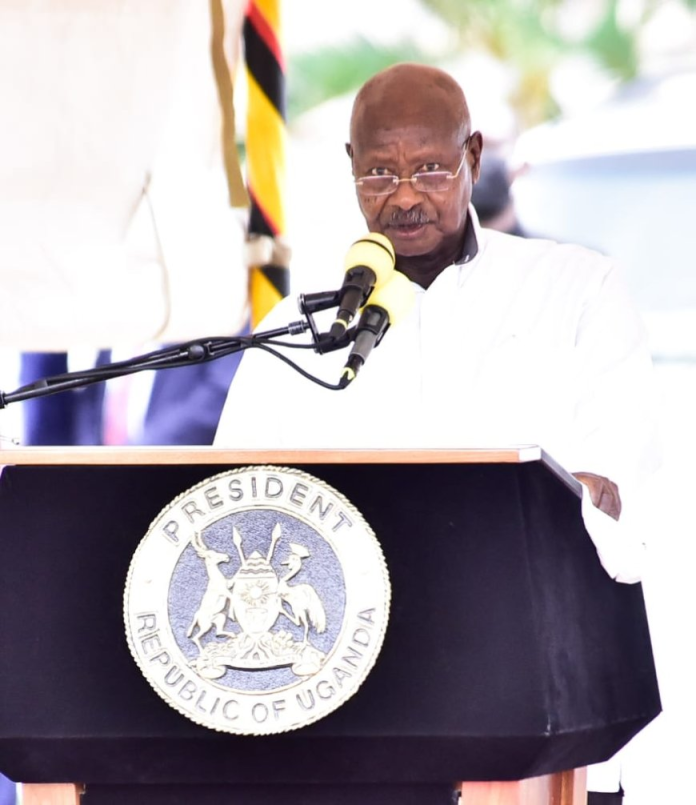
President Yoweri Museveni is expected to deliver a highly anticipated state of nation address today at 2pm.
This key address will cover the current state of the nation, highlighting the government’s achievements over the past year and outlining future plans and priorities.
“Fellow Ugandans, especially the Bazzukulu, I will deliver my speech on the State of the Nation this afternoon at 2 pm,” Museveni posted on his X (formerly twitter) handle.
Museveni’s address comes just a few weeks to the reading of the 2024/25 national budget slated on June 13, 2024.
The passed national budget for the Financial Year 2024/25 is Shs72.130 trillion up from an earlier proposed total of Shs58 trillion which indicates a Shs20 trillion increment from the last financial year budget of Shs52 trillion.
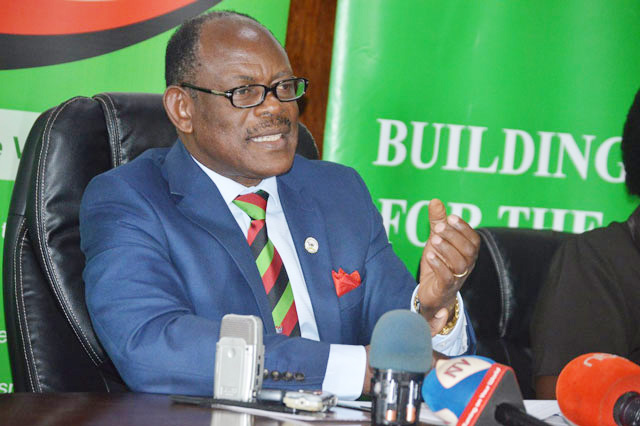
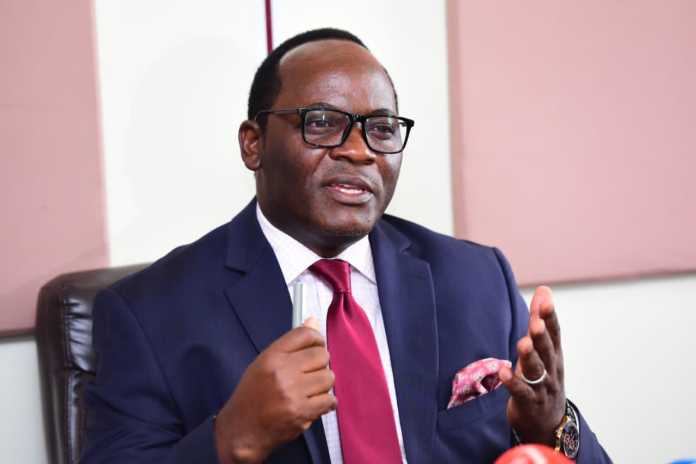
Prof. Nawangwe, Vice Chancellor Makerere University.
Makerere University Joint Staff Associations have taken strong exception to the Vice Chancellor, Prof Barnabas nawangwe’s decision to suspend all the activities of the Dean’s Forum.
In a letter dated 29th May, 2024 to the Acting Deputy Vice Chancellor (Academic Affairs), Nawangwe noted that he received complaints regarding the legality of the Dean’s Forum and ordered for indefinite suspension of the forum’s activities.
“I have received complaints regarding the legality of the Deans Forum. Pending resolution of the legality of this forum, all activities of the forum are hereby suspended,” read Nawangwe’s letter.
However, the Joint Staff Associations challenged Nawangwe’s orders and noted that the forum’s overall aim is to promote academic excellence through collective action, capacity building and hannessing each other’s capabilities, experiences and the best practices.
“The Deans Forum is one of the hundreds of the informal associations at Makerere University. These associations, which contribute greatly to the University’s vision, are rightly protected by Article 29 of the Constitution of Uganda. The Constitution of Uganda (1995) as amended does not cloth you with any powers to deny Article 29, and you must not treat the Deans Forum differently from similar associations like Makerere’s Academic Leaders’ Forum and Professors’ Forum of which you are a member,” read part of Joints Staff Associations letter.
“To contribute to the University’s work and to realize their full potential, staff and students depend on assurance that exercising their freedom of association, conscience shall not lead them to conflict with management. Yet your suspension of the Deans forum, recent stance on examination L1210 from the school of Law inevitably deprives the staff and students of this assurance. Moreover, such actions even if eventually vacated leave indelible scars of self-censorship, to the detriment of staffs’ and students’ productivity. Moreover, even if many suspensions by you were found inappropriate and annulled by the Appoints Board., staff Tribunal and High Court, these suspensions left indelible dents on the University’s image. The Association added in the letter.
In the letter, the association further stated that although academic staff invariably expect and accept scrutiny of their work and are accountable as is by law required, they are synchronously entitled to due process, including resumption of innocence.
“Hence, it is unconscionable that you elected to purport to suspend a forum of such noble membership and aspirations over mere complaints by people that you did not specify and which have not been investigated let alone substantiated,” the Association noted.
The Joints Staff Associations letter further guided that the suspension of the deans Forum, if at all, should have followed investigations and not the other way round. Adding, “You (Nawangwe) should also have been legally vested with the powers to suspend the Forum. Otherwise, you appear to be using verification of the legality of the Deans Forum as a pretext for committing illegalities. This casts the University in a bad light.”
The Association purposely demanded Nawangwe to rescind his impugned suspension of the Dean’s Forums.
“We demand you to refrain from attitudes and actions that are prejudicial to the fundamental human rights and academic freedoms of members of the Makerere University. This will give the community confidence that you, and others in the University’s management, will not illegally constrain and violate their inherent human rights and academic freedom. Alternatively, members of the University community will be forced to appeal to other human rights protectors,” guided in the letter.
Government has released Shs3,043,000,000 to 1,269 verified civilian veteran beneficiaries from Greater Luwero.
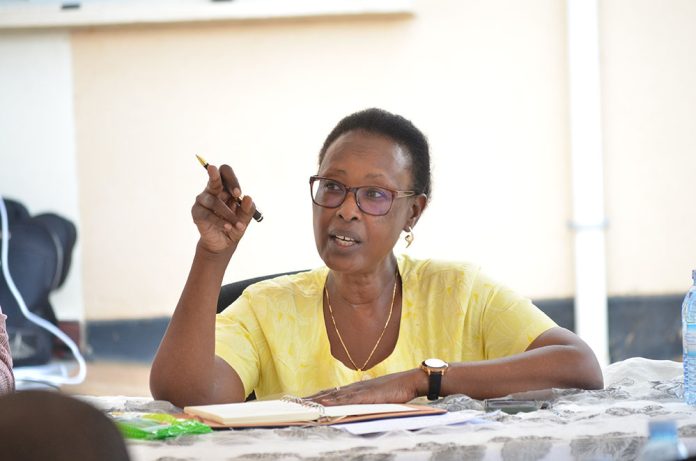
The revelation was made by Alice Kaboy, the State Minister for Luwero Triangle.
The beneficiaries were cleared by the Veterans Verification Committee under the 51st schedule from the districts of Luwero, Nakasongola, and Nakaseke. Effective 2008, when the Akasiimo Programme started.
To date, the government has verified and paid 87,269 beneficiaries in recognition of the support and contribution they gave during the liberation struggle (1981–1986).
The Veterans Verification Committee will continue verifying the civilian veterans that have not yet been considered, and my office will ensure that the allocated funds for Akasiimo are paid to the right beneficiaries.
She said Akasiimo is not commensurate to one’s contribution but rather a ‘thank you’ in recognition of one’s contribution.
“The lists of 1,269 Akasiimo beneficiaries, indicating their names, National Identification Numbers (NIN), amount received, subcounty, and district, will be displayed on the notice boards of the respective beneficiary districts and the Luwero Regional Office for ease of reference.” She said.
Coca-Cola Beverages Africa (CCBA) has reassured its commitment to environmental sustainability as World Environment Day draws near.
CCBA Chief Public Affairs, Communication and Sustainability Officer, Tshidi Ramogase said, “At Coca-Cola Beverages Africa (CCBA), our sustainability strategy is centred around people—consumers and our employees—and driving sustainable solutions that build resilience into our business to respond to current and future challenges, while creating positive change for the planet.”
Ramogase added that water is a priority for the Coca-Cola system because it is the first ingredient in all our beverages and is essential to the communities we serve.
“The Coca-Cola Company’s 2030 Water Security Strategy focuses on increasing water security. We work with partners to provide access to a steady supply of clean water for people and ecosystems in the areas where we operate and source ingredients,” he said.
“We do that by contributing toward sustainable, clean water access that improves livelihoods and wellbeing while protecting against water-related disasters,” he added.
He further noted that Coca-Cola’s operations are committed to regenerative water use. This means using less water as well as re-using and treating wastewater.
“For example, in Kenya we opened a new wastewater treatment plant at our Equator Bottlers plant in Kisumu, which will promote more sustainable water use and help reduce the factory’s environmental impact. The new plant will enable us to treat and recycle wastewater generated from the production facility, which will be used for non-potable purposes such as irrigation and cleaning,” he highlighted.
He noted that their subsidiary, Coca-Cola Beverages Botswana, signed an agreement last year with the Botswana University of Agriculture and Natural Resources to donate water from its newly installed water treatment plant for agricultural irrigation at the campus. The new state-of-the-art water treatment plant has made the company fully effluent compliant by ensuring that clean water is returned to the environment.
“For our packaging, we seek to drive a circular economy because this helps to reduce waste and carbon emissions. We’re working to use more recycled content in our packaging, to expand our use of refillable bottles, and to collect packaging for recycling through Coca-Cola’s World without Waste initiative. We also partner to design new solutions for packaging,” he said.
As an example, Coca-Cola and other like-minded industries came together in 2004 to set up the PET Recycling Company (PETCO) in South Africa to promote and regulate the recycling of PET plastic, taking responsibility for recovering and recycling beverage PET plastic bottles.
The PETCO model has proven so effective it has been extended to three other markets, Kenya, Tanzania and Ethiopia, with plans to include additional countries like Namibia.
“While we strive to make progress on our own, we are committed to fostering partnerships that drive collective impact in areas including water stewardship, packaging circularity, climate action and many more.” He noted.
“We engage with stakeholders, including governments, NGOs, communities, suppliers, business partners, customers and consumers in all the markets where we operate, in many forums and formats. Feedback from our stakeholders allows us to learn and improve, and informs our business and sustainability strategy,” Ramogase said.
Allan Mwesigwa, a green enterprise business owner supported by Equity Bank Uganda Limited(EBUL).
Equity Bank Uganda Limited has always been at the forefront of social responsibility, with a strong focus on environmental conservation.
The bank’s commitment to the environment is evident through initiatives like the Equi Green Loan, designed to support projects dedicated to clean energy, environmental preservation, and combating climate change.
One of Equity Bank Uganda’s flagship projects is its tree-planting initiative, aimed at promoting sustainable practices for preserving natural habitats and mitigating climate change effects. As part of the wider Equity Group’s ambitious goal to plant 35 million trees across the countries it operates in, Equity Bank Uganda has already made significant strides in areas such as Ntungamo, Nyakasura Hill, Rubaga, Kasese, and Mwiri Hill.
Collaborating with the National Forestry Authority and Million Trees International, these efforts showcase the bank’s dedication to environmental sustainability. According to Global Forest Watch, Uganda lost 13 percent, or 1.03 million hectares, of tree cover between 2001 and 2022. This makes Equity Bank Uganda’s reforestation efforts even more critical in reversing the country’s rapidly diminishing forest cover. To date over 15,000 trees have been planted so far while loans worth Shs15.12 billion have been disbursed towards projects targeting climate change.
Furthermore, Equity Bank Uganda is actively involved in promoting clean energy solutions. By offering loans to customers for the purchase of clean energy products from various partners, the bank is not only supporting eco-friendly practices but also contributing to the reduction of respiratory diseases, thus safeguarding human health. Working with partners like the Uganda Energy Credit Capitalisation Company (UECCC) and aBi Trust, the bank has disbursed over Shs14.75 billion for solar system financing targeting households and SMEs. This has resulted in the adoption of 1,339 clean energy kits sold to households, further aiding the transition to clean energy.
In addition to these initiatives, Equity Bank Uganda is extending its impact to the education sector by constructing school kitchens that use clean energy in various schools, including one upcoming project in Ntungamo scheduled for launch in June. This initiative aims to transform school kitchens from traditionally using firewood to clean energy cooking stoves, thus addressing the fact that an estimated 93 percent of Ugandan households depend on biomass for energy, and a majority of institutions like schools, hospitals, and prisons also use firewood for cooking.
Equity encourages the shift to clean energy to lessen dependence on wood fuel, charcoal, and fossil fuels like kerosene. This transition directly improves health by reducing household air pollution, benefits the environment by lowering carbon footprints, and aids in combating climate change.
Equity Bank Uganda’s unwavering dedication to environmental conservation serves as a shining example of how financial institutions can lead the way in promoting sustainability and fostering a greener future for all. Through these initiatives, the bank continues to showcase its commitment to integrity, transparency, and making a meaningful impact on the world around us.
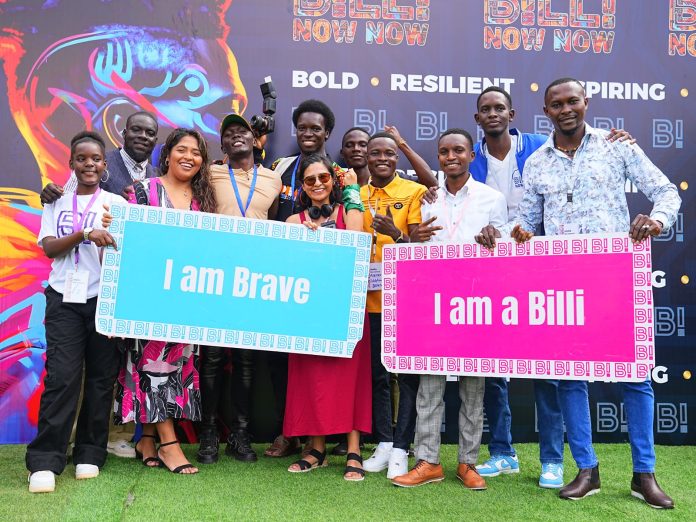
The second Billi Now Now! (BNN) Youth Summit has commenced at MoTIV Bugolobi bringing together young leaders from across Africa and beyond to be equipped with the tools to connect and contribute to Agenda 2063 – the African Union’s strategic framework for socio-economic development.
The three-day summit is being implemented by Reach A Hand Uganda on behalf of Planned Parenthood Global under the theme “Brave and Coordinated Youth Action in Advancing Agenda 2063”.
It has attracted delegates from Kenya, South Sudan, Peru, Ethiopia, Benin, Senegal, Burkina Faso, Uganda, and Rwanda to catalyse the development of tailored initiatives and action plans that drive tangible change.
Some of the topics to be discussed include the inseparable link between sexual and reproductive health and mental health while calling for increased advocacy for comprehensive health initiatives within communities. Furthermore, the summit is looking to amplify the voices of young Africans towards increasing access to critical services, education, and advocacy in Sexual and Reproductive Health and Rights (SRHR).
While addressing guests and delegates, Hon. Evelyn Anite – the State Minister of Finance for Investment and Privatisation, who made an impromptu stop over at the summit – promised to lend her support towards addressing the high taxes levied on the raw materials used to produce sanitary products – which is one of the issues that were raised by the young people as negatively affecting the reproductive and mental health of young girls and women in Africa.
The summit will also purposefully aim at arming young people with the necessary tools, skills, and networking opportunities to enact meaningful change within their communities and beyond.
While addressing the delegates, Achieng Akumu, the Regional Director of Planned Parenthood Global (PP Global), said, “This is your opportunity to amplify your voice and learn the tools that will help you embrace your destiny. It’s also very important for you to understand your power dynamic and the role you must play regarding accountability. This is 2024 and young people are the largest population on this continent. How do you own that responsibly and engage with those that hold the power so that you can access and implement your rights?”
The event featured a panel session titled ‘Echoes of Progress’ which highlighted the achievements and goals of the BNN Movement and urged the youth to prioritise accountability and action.
While speaking during the panel discussion, James Tumusiime, the Country Director of Reach A Hand Uganda, said, “We want to thank PPG for giving us this opportunity once again. We believe that this is an opportunity to learn from one another as several partners have come together to share a lot of the programming that influences and affects the health and wellbeing of young people.”
The delegates from the different countries formed mixed-country groups to foster collaboration and exchange ideas as the summit saw an increase in the number of participating countries from seven last year to nine this year.
Some of the partners include the Hewlett Foundation, Development Dynamics, Mr. and Ms. Ability East Africa, Unique Abilities Foundation of Africa (UAFA), UG Teen, CEHURD, SRHR Alliance Uganda, Samasha, Aquafina Uganda, Kyetume C.B.H.C. Program and Awesome Mind Speaks.
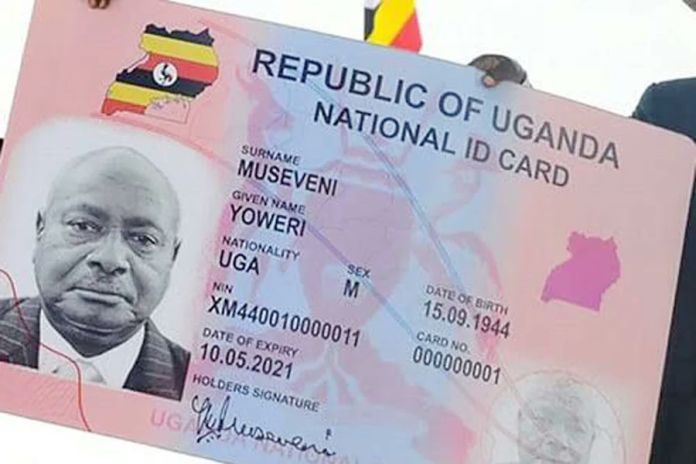
The Executive Director of the National Identification and Registration Authority (NIRA), Rosemary Kisembo, announced that the mass enrolment and renewal of national identity cards, initially set to commence on June 1, has been pushed to July at a yet-to-be-confirmed date.
“However, due to unforeseen delays in the procurement process, the exercise did not take off,” said Rosemary Kisembo. “Nevertheless, by the end of July 2024, the exercise will commence.”
According to her, the government is taking all necessary measures to ensure that IDs are renewed before the 2026 general elections.
“Aware of the Electoral Roadmap and the expiry of some cards beginning August 2024, the Government is taking all necessary measures to ensure that the delays do not affect service delivery and the roadmap,” she said, adding that consultations in that regard are underway.
She added, “In consultation with the Attorney General’s Chambers, measures are being put in place to ensure that the public suffers no disadvantage because of the delays.”
The first process of National ID registration started in 2014.
“In 2014, a similar exercise was successfully carried out in a period of four months. Therefore, the Ministry of Internal Affairs and the National Identification and Registration Authority would like to assure the public that the Government will deliver this exercise successfully within the stipulated timelines,” said Rosemary Kisembo.
However, Kisembo said that NIRA will continuously update the public on progress in this matter.
At least 143 legislators have signed a censure motion against the Parliamentary Commissioners, EagleOnline has learnt.
“The number of signatures for those seeking to censure the four Commissioners of Parliament has risen from 143 to 152,” the mover of the motion, MP Theodore Ssekikubo said.
He noted that they are yet to realise the 177 required signatures and urged more MPs to sign the censure motion.
Last month, a section of legislators led by Lwemiyaga County MP Theodore Ssekikubo and Sarah Opendi embarked on collecting signatures to censure Parliamentary Commissioners. The commissioners are accused of allocating themselves Shs1.7 billion.
The Parliamentary Commission’s leaked resolutions from May 2022 implicated the former Leader of the Opposition (LoP), Mathias Mpuuga, commissioner Solomon Silwany, Prossy Akampurira, and Esther Afoyochan.
According to a leaked document, Mpuuga was awarded a one-off service payment of Shs500 million, while three commissioners from the National Resistance Movement each received Shs400 million. The biggest opposition party in Parliament, the National Unity Platform (NUP), resolved to recall Mpuuga as the Parliamentary Commissioner.
The party said that although he responded to the NEC’s request to show cause why he should not be recalled from the Parliamentary Commission, he did not provide any satisfactory explanation for engaging in this grave action, which goes against the mission, values, and objectives of the party. In particular, he did not make any attempt to respond to the specific accusations leveled against him.
The proposal allegedly has to go through the legal and parliamentary affairs committee before it is brought to the floor of parliament for discussion. Every individual who gets retirement benefits, be it the speaker, vice president, or others, has to have it discussed and passed by parliament.
According to Rule 95 of the Parliamentary Commissioner Rules of Procedure, a parliamentary commissioner may be removed from office on grounds of incompetence, misconduct, failure, or refusal without justifiable reason to execute the duties of the Office of Commissioner.
The rules indicated that a motion for a resolution for the removal of a Commissioner shall be initiated by a notice in writing to the Clerk, signed by not less than one-third of all the voting Members of Parliament, indicating their intention to move the motion for the removal.
A motion for resolution under this rule shall be placed on the order paper fourteen days from the date on which notice to remove the commissioner shall have been communicated to the clerk. A Parliamentary Commissioner shall later be removed upon the vote of at least half of all voting Members of Parliament.
Legislators have announced plans to probe circumstances under which drugs weighing 2322Kgs and valued at Shs121, 238,895 expired in the stores of Mubende Regional Referral Hospital, yet during that same time patients were sent away & ordered to buy medicines from the private clinics.
Gorreth Namugga, Vice Chairperson, Public Accounts Committee while meeting officials from Mubende Hospital, where they had been summoned to respond to queries raised in the December 2023 Auditor General Report noted that despite the health facility grappling with challenges of drug stock outs occasioned by late deliveries from National Medical Stores even some of the drugs delivered late got expired and ended up being destroyed.
“We are going to find out where the problem was, if these medicines were delivered to you with all factors constant and it was because of your negligence, of the failure to supervise your people that we had expired drugs, you will make good of the loss. This money will be paid by you. That is why you have to provide all information adequately. You must put your case clear. We are going to carry out more investigation with National Medical Stores (NMS) to find out where the problem was. If it was with Mubende hospital, you are going to pay for these drugs,” said Namugga.
“We pay taxes for purchase of drugs, they come to Mubende and you lock them in the stores, because the expiry is at times due to the failure to give these drugs to the users. So, you have to explain why you have expired drugs to the tune of 2322Kgs? The challenge with expired drugs is that we lose money throughout, you spend money buying them, and also spend money disposing them off, so after looking for money to buy the drugs, you also look for money to dispose off,” added Namugga.
Grania Nakazibwe (Mubende DWR) urged the Committee to probe the issue of delivery of drugs in Mubende saying the constant stock outs have affected access to health services noting, “The fact that NMS doesn’t deliver on time actually affects the kind of service which is delivered to the people and that is why actually, that is why we see so many private facilities mushrooming around regional referral hospitals and I believe this is the gap created by the delivery of medicines.”
Emmanuel Batibwe, Mubende Regional Referral Hospital, Director, informed the Committee that the facility has been experiencing challenges in maintaining adequate stocks of the different medicines in the hospital, mainly because of the shortfalls in the quantities versus orders made and the challenge is further compounded by the delays by NMS to deliver the requisitions made by the Facility.
He also attributed the huge volumes of expired drugs to the changes in the treatment line for HIV and Tuberculosis patients, who saw many health facilities abandon the older line of treatment.
“Overall, you find we have stock outs of many items and if they have been delivered, again they run out faster than you would have expected and that kind of scenario sees patients being requested to procure drugs outside the hospital. There were changes which occurred in some of our drug regimen and as result of that, we had expiry especially those treating HIV and Tuberculosis and if there are changes, you can’t use them nationally,” said Dr. Batibwe.
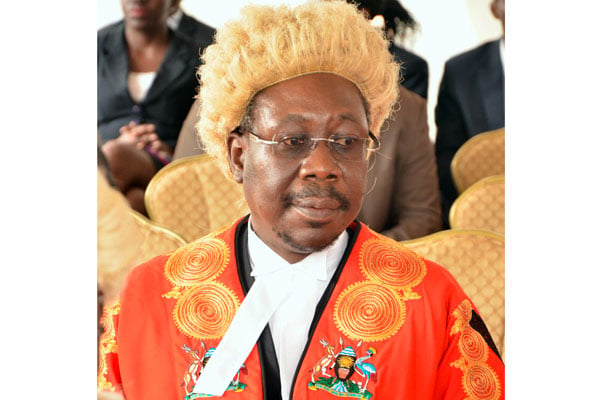
Justice Christopher Izama Madrama has been appointed chairperson of the management committee of the Uganda Law Development Center (LDC).
His appointment was confirmed by Justice Paul Kahaibale Mugamba, the outgoing chairman of the management committee of LDC.
The committee, which was named by the attorney general, Kiryowa Kiwanuka, will commence its work effective today.
Justice Christopher Izama Madrama is a Justice of the Supreme Court of Uganda. Over the years, he has served as a Justice of the Court of Appeal within various divisions of the High Court, including the Commercial and Execution Divisions. He has also authored several publications, including The Problem of HIV/AIDS: A Discourse on Laws, Marriage, and the Subordinate Status of Women in Uganda.
Conversily, the former president of the Uganda Law Society, Simon Peter Kinobe was named a member of the committee.
He will serve alongside Joanita Gertrude Bushara, an advocate of the High Court, the Notary Public and Commissioner for Oaths, and Adar John Patrick, an advocate of the High Court.
The official members include: the principal, School of Law, Makerere University; the solicitor general, Ministry of Justice and Constitutional Affairs; and the Permanent Secretary, Ministry of Education and Sports.
The Management Committee is the governing body of the Law Development Center, charged with policy formulation and implementation and general strategic oversight of the Center.