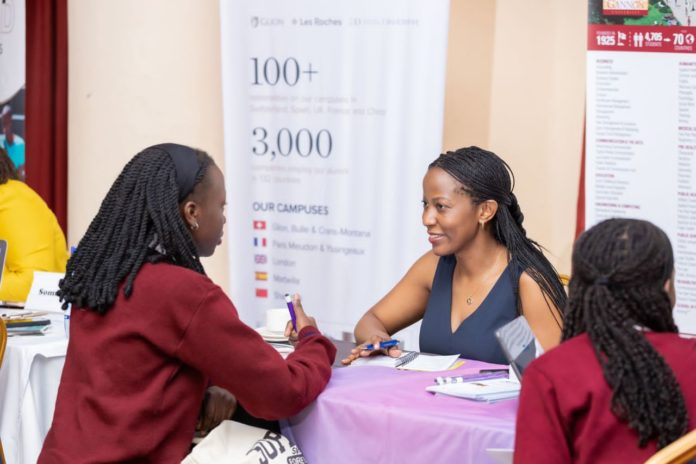
Sharz Borderless Study Consults today announced its first ever Annual Education Fair that will be held in Kampala on February 29th and March 1st, 2024.
The Fair will be held at Golf Course Hotel in Kampala and is expected to attract hundreds of participants including Students, parents and educators who will participate as exhibitors to showcase their programme offerings for students studying in Uganda.
Educators who have been invited to attend include some of the leading universities in Ireland, Canada, USA, UK, Germany, Malaysia and most other popular study destinations.
“This Fair is open to all University and Colleges, including those that don’t have active partnership agreements with Sharz. We want to avail the best possible study opportunities for students who wish to go and study abroad,” said Hairah Kibuuka, the Managing Director of Sharz.
“We are excited that after all these years of offering customer-focused education placement services, now we have an opportunity to bring students and educators together in one room. We look forward to an exciting experience for our students, partners and the wider public,” she added.
Day Two of the Fair (Friday March 1st) will be held at Rainbow International School Kampala. The Fair is sponsored by the British Council IELTS Programme, Next Media, MTN Pulse, True North, PC Tech Magazine and Eversend.
In addition to attracting hundreds of participants to the venue, Sharz expects to reach thousands of others through media and digital promotional activities, and projects as many as 50 million digital impressions by the time the event is completed.
For car owners, the maintenance of your vehicle is not only a matter of pride but a critical factor in ensuring the longevity and optimal performance of your cherished automobile. Among the various aspects of car maintenance, one crucial element that often escapes attention is the regular change and use of lubricants.
Lubricants play a pivotal role in the well-being of your vehicle’s engine. They serve to reduce friction between moving parts, prevent wear and tear, dissipate heat, and contribute to overall engine efficiency. Without proper lubrication, your engine becomes susceptible to damage, leading to costly repairs and a shortened lifespan.
To keep your engine running smoothly, it is imperative to adhere to a consistent lubricant change schedule. The frequency of oil changes depends on several factors, including the type of oil used, driving conditions, and the manufacturer’s recommendations. In Uganda, where the climate can be diverse, and road conditions vary, it is advisable to change your lubricants every 5,000 to 7,500 kilometres or as recommended by your vehicle’s manufacturer.
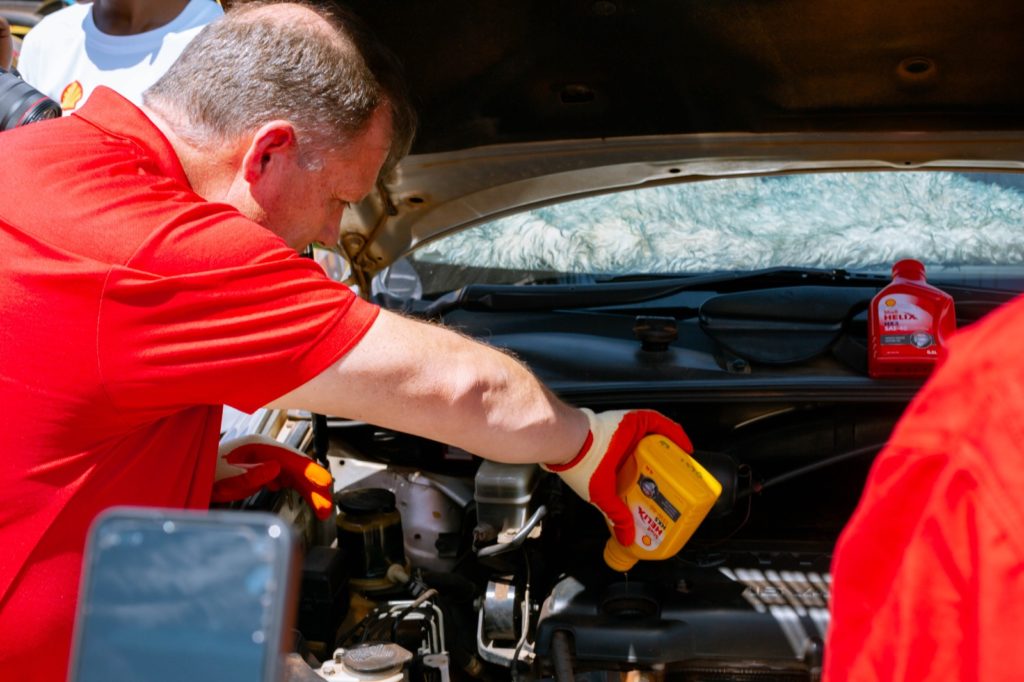
When considering lubricants, one brand that has earned the trust of car enthusiasts worldwide is Shell Helix. Renowned for its high-quality lubricants designed to meet the specific needs of modern engines, Shell Helix ensures optimal performance and protection.
Recent statistics proudly name Shell as the world’s top lubricant supplier for an impressive 16 years in a row, with Shell Helix leading as the best premium lubricant. Shell Helix has consistently demonstrated superior performance in various driving conditions. Independent tests reveal that Shell Helix lubricants exhibit enhanced engine cleanliness, reduced wear and tear, and improved fuel efficiency compared to competitors. These statistics underscore the brand’s commitment to providing top-notch lubrication for your vehicle.
Shell Helix offers a diverse range of lubricants tailored to different driving conditions and engine types. Whether you are navigating the bustling city streets of Kampala or tackling the challenging terrains of rural Uganda, Shell Helix has a variant that suits your car’s specific requirements.
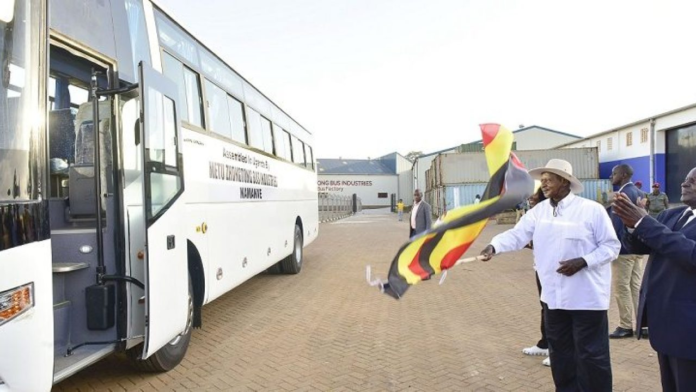
President Yoweri Museveni has directed the Prime Minister, Robinah Nabbanja to give exclusive permission to Mr. Metu Katabazi to run mass transit services for buses in Kampala and the surrounding towns using the buses he has fabricated in Uganda.
He also directed Nabbanja to consider the other players that wanted to run the city bus service using locally fabricated buses.
“To further empower our manufacturing sector, it is better Mr. Metu does both the fabrication and the transport operation,” Museveni directed.
Museveni said that this gives him more cash for expanding Uganda’s manufacturing. Adding, “Do not forget that the Foreign Service providers, transporters in this case, eternalize some of the money they earn in Uganda.”
“When, therefore, you have an actor who both produces the goods (vehicles in this case) and provides the service (transport), you should not miss such an optimal combination,” Museveni said.
He approved that therefore, Mr. Metu is to both fabricate the buses and run the transport service.
However, he urged that if Kabatazi’s transport service needs more buses than those he is manufacturing, he should then only buy from Kiira motors.
“He should never import foreign made buses to use in this transport business,” Museveni cautioned.
A suspected ADF rebel who had come from Democratic Republic of Congo to plant bombs and kill peaceful People in Uganda has fled back to his country ‘Congo’ after his criminal schemes were made impossible by the security forces’ vigilance, President Museveni revealed.
Museveni said that his bomb in Kikuba-Mutwe exploded prematurely before he planted it where Ugandan pork-lovers were having their legitimately earned meal and the one in Nabweru exploded in the empty house where the criminals were keeping it because the security forces were hard on the heels of those pigs.
“I have advised the security forces not to make the mistake of mounting roadblocks and such other blind and panicky measures that inconvenience huge masses of People that have nothing to do with the criminals,” Museveni said.
He added that on the Uganda side, the roads are good (do not be fooled by the potholes in parts of Kampala), the traffic is huge and fast and movement is 24 hours a day. Besides, the borders are porous and somebody can even walk into Uganda from Congo cross-country.
“We shall not tamper with this fast tempo of the human activities – cross border – of the fraternal Peoples of Uganda – Congo and East Africa in general,” he guided.
He added, “In the Kasese area, we are hunting for the Congolese Kamusu who survived when the Marines wounded and captured Njovu on Lake Edward.”
“However, the main effort is to wipe out the ring-leaders in Congo – in the forests and in the Trading Centres. On account of the mistakes of the past Congo Governments and the international community (UN, SADDEC, etc.), those pigs have had the free use of big chunks of Eastern Congo for their criminal activities such as camping, training, mining gold, cutting timber, harvesting and selling for themselves the Wanainchi’s Cocoa, trading in vitenge and extorting money from the Wanainchi for the last 20 years, ever since UPDF withdrew from Bunia in 2003, under the International agreement of Lusaka,” Museveni said.
He noted that this had misled them into thinking that they are invulnerable and safe. With these modern means, the rebels are now discovering that those forests are actually death traps.
He said that the 20 years they were given of the free use of that area and the free resources there-in, by the Congo Government and the International Community, they should have been a much bigger force.
Following the intense hunt for these rebels, yesterday, Jinja central police arrested one Nyanza, a Congolese national following a tip-off from residents. During the arrest, they recovered two bullets, and several documents indicating the schools, government installations, and other facilities of their planned attacks.
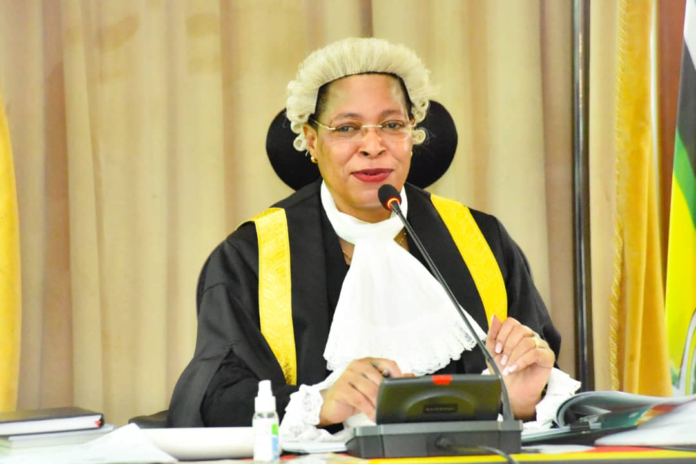
Speaker of Parliament Anita Among has confirmed that the United States government canceled her visa over her stand against homosexuality in Uganda.
Among revealed this today while chairing the parliamentary session and confirmed that she is not afraid of the cancellation since she has and loves her home ‘Uganda’ very much.
Among was the first victim to have her visa revoked over the passing of the Anti-Homosexuality law.
“As of May, 12, 2023, you don’t possess a valid travel visa to the US though you are welcome to apply again. Forward your passport to the embassy through the Ministry of Finance so that we can make necessary modifications to your visas,” US earlier directed Among.
On Monday, the United States Secretary of State Antony Blinken announced sanctions against current and former Ugandan officials who committed human rights abuses against opposition leaders and other groups including homosexuals.
Speaker Among with a host of security chiefs are among the top Ugandan officials the United States has slapped with sanctions.
Blinken said that the expansion of the visa restriction policy to include current or former Ugandan officials or others who are believed to be responsible for, or complicit in, undermining the democratic process in Uganda or for policies or actions aimed at repressing members of marginalized or vulnerable populations.
“These groups include, but are not limited to, environmental activists, human rights defenders, journalists, LGBTQI+ persons and civil society organizers,” he said.
He added that the immediate family members of such persons may also be subject to these restrictions.”
Effects of climate change as seen from this photo taken on the suburbs of Kampala Uganda.
Members of Parliament are set to consider government’s decision to borrow Shs1.227 trillion from the World Bank group to finance the Uganda climate smart agricultural transformation project.
The project is aimed at increasing productivity, market access and resilience of select value chains in the project area and to respond promptly and effectively to an eligible crisis or emergency.
When approved this will be the second loan the government is seeking following the World Bank’s decision to stop funding Uganda’s projects after the enactment of the Anti-Homosexuality Act 2023. The law protects the traditional family by prohibiting any form of sexual relations between persons of the same sex and the promotion of such acts.
Meanwhile, MPs will consider another Shs5 54.689 billion from the Export -Import Bank of China to finance the e-government infrastructure project phase five.
The Debt Statistical Bulletin and Public Debt Portfolio Analysis for financial year ending June 2023 under the Directorate of Debt and Cash Policy by the Ministry of Finance, Planning and Economic Development indicated that external debt increased from $12.8 billion (Shs47.915 trillion) in June 2022 to $13.79 billion in June 2023.
The domestic debt increased by $1.27 billion from $8.2 billion in June 2022 to $9.4 billion in June 2023. Consequently, external debt now constitutes 59% of the total debt stock, while domestic debt shares 41% of the same indicator.
Currently, Uganda’s public debt stands at Shs87 trillion with the report highlighting that the total public debt stock increased from $20.97 billion (Shs78.495 trillion) as of June 2022 to $23.22 billion (Shs86.918 trillion) as at the end June 2023.
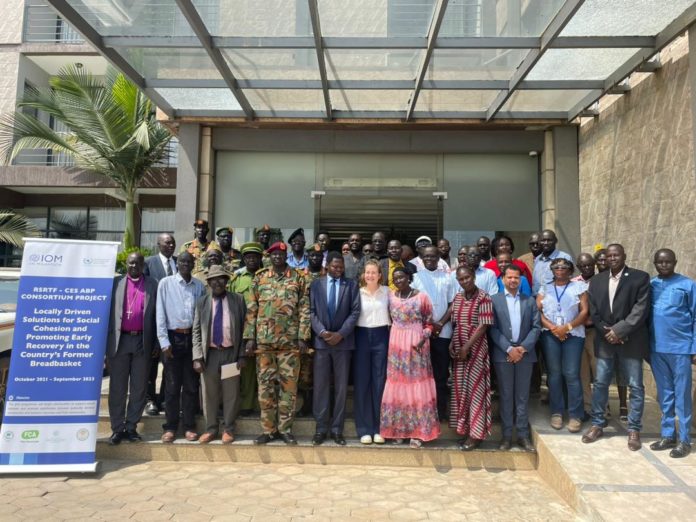
December 6, 2023 (JUBA) – The Government of South Sudan, United Nations Mission in South Sudan (UNMISS) and Community Empowerment for Progress Organization (CEPO) in cooperation with International Organization for Migration (IOM) have developed an action plan implementation matrix to improve relations between civilians and the military in the Greater Yei.
This activity was conducted within the framework of the Reconciliation, Stabilization and Resilience Trust Fund (RSRTF) programme in Central Equatoria, led by IOM and its consortium including CEPO, UNMISS, Finn Church Aid (FCA), Whitaker Development Initiative (WPDI) and Support for Peace and Education Development Programme (SPEDP).
Organised by CEPO, UNMISS and supported by IOM, the one-day aimed at disseminating the resolutions of the ten civil-military dialogues of phase one and at developing an action plan with high-level government and military representatives to ensure the implementation of these resolutions and their sustainability.
About 63 participants, including community representatives, paramount chiefs, religious leaders, women and youth leaders, high-level defense forces and government officials attended the event.
The 10 civil-military dialogues implemented in the four counties of the Greater Yei identified key issues, including mistrust and misunderstandings among civilians and the army: harassment, intimidation, raping, killing, displacement and looting of properties, checkpoints and roadblocks.
Some key remarks during the workshop
Gen. Duopoly Lam, the Deputy Chief of Defence
Acknowledged the facts that civilians used to provide food, water and security information to the SPLA during the war; with this role
Civilians deserve the protection of the army wherever they are,” he said
Pledged to work together with state and local governments to improve the civil-military relations. He Urged CEPO to extends the same dialogues to other parts of South Sudan in Malakal and Bentiu. He further said it is their obligation and responsibility as the leadership of the SSPDF to bring to book perpetrators of human right violations not only in Greater Yei, but throughout the country
Wayi Godwill, the Minister of Cabinet Affairs, the Acting Minister of Local Government and the Governor’s representative urged different stakeholders to work together to improve civil-military relations he asked all delegates to be ambassadors and actors of peace in the grassroots.
He furthered asked commissioners and the military commanders to protect the civilians and their properties. To follow up on these dialogues, the workshop allowed a number of resolutions to emerge from the communities and the government. These included the following points of actions that the government representatives signed and committed to implement within agreed deadlines.
He also requested local authorities to improve relations between the military and civilians;
Like swift unification, training and deployment of the unified forces, separation of politics from military and demilitarization of politics.
He said adherence to the welfare of the military (food, salary and medication), enforcement of the Governor’s order for removal of illegal checkpoints;
The gathering furthered demanded comprehensive disarmament of the civil population, continuous civil-military dialogues in the grassroots and quarterly dialogues at national level, expanding military court martial to the counties and providing psycho-social support and trauma healing for both civilians and military.
Meanwhile the need for establishment of police stations and deployment of sufficient and effective police forces at the county levels and initiating home grown solutions to address the conflict between the National Salvation Front (NAS) and the government as well as promotion of adult literacy education was emphasized.
As the world continues getting ravaged by the hard-hitting impacts of Climate Change, the Green Africa Youth Organization (GAYO Uganda) has amplified efforts aimed toward mitigating this dilemma.
This followed the recent study conducted in partnership with the Youth Climate Councils Global Alliance and the Youth Climate Council in Uganda penning down critical gaps hindering thorough youth engagement in bottom-up climate policy processes.
Among these issues captured by the report were lack of opportunities, financial resources, capacity and an organized structure for meaningful engagement in climate activism and policy discussions.
The report dubbed A Pathway to Resilience recommended an ardent need to center youth as (co) leaders in the climate movement goes a long way beyond recognizing their potential, dynamic adaptabilities and enthusiasm- to creating meaningful and safe spaces and providing adequate resources to scale up their impact and ambition.
According to Aiita Joshua Apamaku, Climate Officer Gayo Uganda said there is need for a contextual understanding of the needs and priorities of the younger generation, while creating safe spaces, providing resources to support their work.
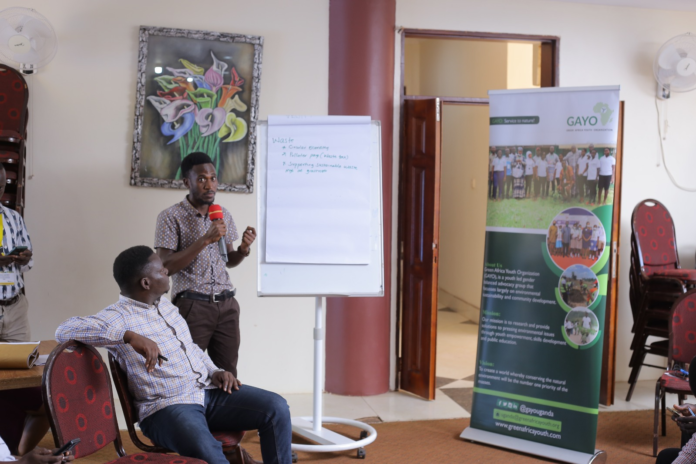
In a quest to achieve this, Gayo Uganda and Youth Climate Council in Uganda have trained 34 youth on the role of participation in climate policy.
The second edition of the policy training took place on November 27,2023 at the Grand Global Hotel in Kampala. This was in collaboration with several partners, including GIZ in Uganda, the National Youth Council, TARD Foundation, Citizens Concern Africa, and Pearl of Africa TV.
“The training was organized in order to expound extensively on a robust co-learning space between the facilitators and participants with a deep dive on increasing participants’ knowledge of UNFCCC processes and carbon market-based climate financing mechanisms.” Aiita said, adding that the full day of training attracted 34 young people from all over the country.
Isaac Ndyamuhaki, Programs Manager, Circular Economy at GAYO Uganda revealed that the rationale of the training was driven by the ever-growing need for youth to build on their knowledge and skill base- to understand and conceptualize through thematic areas, their role in contributing towards addressing the climate crisis.
Ndyamuhaki encouraged the participants and trainees to embrace intensive learning and build self-capacities around topics that matter most to their experiences, interests and professional aspirations.
“The training further sets precedent on the power of youth (co)learning spaces and how youth have continued to effectively support themselves and build their own capacities to address the critical societal challenges that arise from climate change.” Nyamuhaki said adding that Moving forward from the Workshop, GAYO Uganda in collaboration with the Youth Climate Council envisioned a long-term strategy to build the capacity of youth along thematic tracks.
“The Green Africa Youth Organization and the Youth Climate Council remain strongly committed to building the capacities of youth to identify their niche while continuing to meaningfully contribute meaningfully from an informed perspective through both policy and implementation processes.” He revealed.
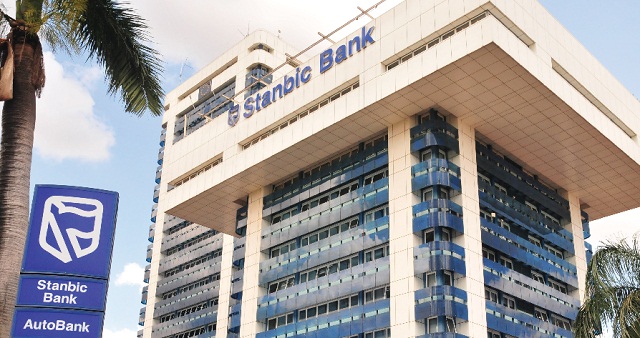
The monthly headline Stanbic Purchasing Managers Index (PMI) rose from 52.4 recorded in October to 53.4 during November, reflecting a continuing trend of sustained growth in private-sector activity, with both output and new orders rising for a sixteenth consecutive month due to solid consumer demand.
Commenting on the latest findings, Christopher Legilisho, Economist at Stanbic Bank said, “Hiring increased for an eighth month running, with firms having hired more staff on temporary bases to handle increasing orders and purchasing activity as well as to address backlogs. Of the surveyed sectors, all but agriculture caught up on outstanding work.”
The Stanbic PMI is compiled by S&P Global from responses to questionnaires sent to purchasing managers. The sectors covered by the survey include agriculture, mining, manufacturing, construction, wholesale, retail and services.
Legilisho said, “Business confidence is buoyant across the sectors on the outlook for customer demand and output over the next 12 months. Indeed, Ugandan firms increased quantities purchased to match robust customer demand. However, suppliers’ delivery times remain a sticky issue because of poor weather conditions and delayed payments.”
The PMI is a weighted average of the following five indices: New Orders (30%), Output (25%), Employment (20%), Suppliers’ Delivery Times (15%) and Stocks of Purchases (10%).
Readings above 50.0 signal an improvement in business conditions on the previous month, while readings below 50.0 show deterioration. The latest reading was also above the seven-and-a-half-year series average of 52.6.
The improving demand conditions helped lead to greater customer numbers. Firms generally expect these trends to continue over the coming year. Hopes that customer numbers will continue to rise and that existing clients will commit to new projects supported optimism in the 12-month outlook for business activity.
Around 82% of the regular 400 survey respondents were confident that output will increase, compared with less than 1% that were pessimistic.
Four of the five broad categories covered by the survey saw output increase, the exception being wholesale & retail. Respondents indicated that new customers had been secured, thereby resulting in an influx of new business. All five broad sectors saw new orders expand.
Companies increased their purchasing activity in response to improving customer demand. Despite this, a reduction in stocks of purchases was recorded, thereby ending a one-year sequence of accumulation.
Those firms that purchased inputs during the month were faced with lengthening delivery times from suppliers. Lead times worsened for the fourth month running due to delayed payments and poor weather conditions.
However, input costs rose again, in part due to higher fuel costs. Overall input prices increased midway through the final quarter of the year. As well as higher purchase prices and staff costs, respondents also signaled rises in prices for utilities such as electricity. Agriculture was the only sector to record a fall in overall input costs.
In turn, companies increased their own selling prices. Output prices increased in the industry, services and wholesale and retail sectors, but decreased in agriculture and construction.
According to the report, as has been the case in each month since April, employment increased during November. Respondents linked higher staffing levels to rising workloads, but new workers were often hired on a temporary basis. Overall job creation was centred on the construction sector, with reductions signaled elsewhere.
Sustained increases in workforce numbers meant that companies were able to reduce outstanding business again in November. Backlogs of work have fallen throughout the seven-and-a-half years of data collection so far. Agriculture bucked the wider trend and posted an increase in outstanding work.
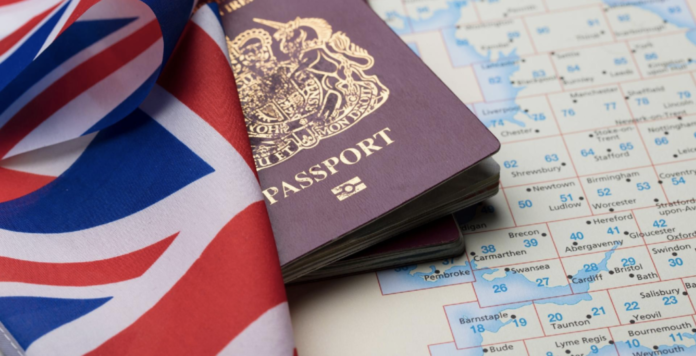
Ugandans seeking to work or study in the United Kingdom will lose the privilege of travelling with their families according to new immigration rules issued by the Home Office.
According to the new rules, only students pursuing a postgraduate research programme will be allowed to travel with their families. Workers in health and care, who are said to be the majority of the migrant labour workforce, will not be permitted to take their families.
According to the new rules that take effect next year, for anyone not in the health and care sector to be granted a work visa, they must have a job paying £38,700, up from £26,200.
“Those coming on the health and care visa route will be exempted from the increase to the salary threshold for skilled worker visas, so we can continue to bring the healthcare workers that our care sector and NHS need, and we will exempt those on national pay scales, for example teachers,” the statement reads in part
It adds: “Earlier this year, the government announced a package of measures to cut the number of student visas being issued. This included removing the right for international students to bring dependents unless they are on postgraduate research courses and removing the ability for international students to switch onto work routes before their studies are completed,”
An official at the Uganda High Commission in London says new immigration rules banning overseas workers and students from taking their families will affect Ugandans in the UK.
We could not independently verify the total number of Ugandans studying and working in the UK by press time.
Sources at the High Commission in London revealed they had not yet received official communication, adding that the control of entry and exit is a sovereign right any country enjoys
“We are still waiting…it will impact the Ugandan and we may get concerns which we will forward but that is a sovereign decision,” one official said
They added: “Here immigration is a very big issue, it was one of the factors behind Brexit. Any country governs the entry and exit. It is their right to do so,” they said.
The changes announced on December 4 apply to all countries and are aimed at cutting down the number of immigrants, prioritising domestic labour and shielding resources from a bulging immigrant population.
The British High Commissioner to Uganda, Ms Kate Airey, while addressing alumni of the Chevening scholarship last week reechoed her country’s commitment of support Ugandans to study in the UK which offers an education that promotes “.
In July, the UK announced plans to increase its visa fees to all persons entering its territories by 15 per cent.