Stanbic Bank
Stanbic Bank
20.7 C
Kampala
Stanbic Bank
Stanbic Bank
Home Blog Page 406

PICTURIAL: Nakivubo Stadium takes shape as Ham insists, construction is on progress

The construction of Nakivubo Stadium has steadily taken shape with works standing at 80%.

The construction which he is being undertaken by Hamis Kiggundu popularly known as Ham   has dispelled critics who had earlier said it had delayed and was of poor standards.

However, contrary to the allegations that it was behind schedule, lately it is being constructed day and night.

The Construction works are spear-headed by Roko Construction Company. The Stadium will have a modern athletic track and other indoor games plus multi-level parking of about 10,000 cars among others.

Ham took over the sports facility for redevelopment in 2017. Initially, the stadium was projected to end in 2019 but the construction of the facility had stalled due to #Covid-19 pandemic, politics, court battles and compensation of vendors.

Stories Continues after ad

Gov’t to build more airfields in game parks to boost Uganda’s tourism

Government has made it a priority to improve the infrastructure to make it easy for tourists by setting up airfields in different tourist destinations is top on agenda.

While addressing trade representatives, MDA’s & the private sector at the Annual Trade Representative Forum (TRF) at State House Entebbe on Tuesday, organized by the Presidential Advisory Committee on Exports and Industrial Development (PACEID) Museveni said there is need to build more Airfields near the national parks to ease movement of tourists.

“I have already told the government that we need to build more Airfields near the national parks. This is because some of the rich people don’t have time to come and land at Entebbe and drive 500 miles to Kidepo National Park. It’s only small people who can manage to do that but the rich people want to come in their private jets, land in the national park and then fly out. So, we shall have to build more hard surface airports in Kidepo, Kasese, Kihiihi, Gulu etc.,” Museveni said.

The Trade Representative Forum is an initiative by the Presidential Advisory Committee on Exports and Industrial Development PACEID headed by Mr. Odrek Rwabogo that brings together all trade representatives, allowing them to network, learn and build strategies with Uganda private sector local input.

According to the Chairman of Uganda Tourism Board Mr. Daudi Migereko, prior to Covid-19, tourism was Uganda’s number one foreign exchange earner fetching the country 1.6 million dollars and that it had been predicted that Uganda would be among the 10 fastest growing fastest destinations for leisure, travel and spending between the year 2020 and 2026.

“We need to appreciate the fact that we have already lost time with everything and we must pursue everything with urgency. We’re fortunate that ever since H.E the president launched our country’s destination brand in January 2022, our tourism has been getting very good ratings to unprecedented levels. We have received awards and endorsements from international media houses,” Migereko said, calling upon the Ministry of Works to have an emergency program to develop the roads with high tourist demand.

President Museveni tipped the gathering about the many ways of making money in Uganda especially if one is focused on adding value to the existing raw materials like coffee, Milk, cotton, tea, tobacco, fruits, beef, oil seeds, cocoa, bananas, leather, cassava, sugar, etc.

On minerals, the President said that the government has already identified investors who are setting up an integrated steel industry for the inland parts of Africa instead of importing steel from other places.

“I think we now have about 4 or 5 factories coming up to produce steel from our good iron ore, phosphates for fertilizers, cement, oil and gas, lithium (we need to produce electric batteries here for electric cars), copper, gold, tin, potassium etc.,” he added, praising PACEID group for identifying the gaps in export promotion and involving the young people.

“The other day I was in Gulu district and I saw an exhibition by the young people who are engaged in processing all our precious products for the world market and we are ready to support them.

I would really like to advise anybody who wants to work in government to understand this. If you do not understand that Uganda must be business oriented, then resign.” Museveni warned, saying Africa has for long missed out on the global money market with people until recently producing only for home consumption and not for the market.

He said that the now growing population of Uganda which will be 100 million people in the next 30 years, up from the current 43 million is an opportunity for growth.

“Now with the bigger population, competition for economic space increases. You can no longer afford to be laid back because more people now need access to resources. Nobody can compete with us once the people wake up,” President Museveni noted.

The head of state gave an example of milk which until recently was not among the exports.

“My family has been keeping cows for the last 7000 years but my father who was born 1916 and died some years ago, was not involved in the money economy for milk until he was about 80 years old when we commercialized milk in 1989 for the first time. The milk sector has now been commercialized and the production has gone up to 5.3 billion liters per year,” he further said.

According to the Chairman of the Presidential Advisory Committee on Exports and Industrial Development (PACEID) Odrek Rwabwogo, the meeting focused on strengthening coordination in order to move faster.

“If we’re not coordinated in our institutions to deliver these targets, we’ll run around, our trade reps will get us orders that we won’t be able to fulfill. So, coordination is a lesson we have learnt and that’s why we have brought these trade representatives,” Rwabogo said.

On the emergency key standards Uganda exporters need to enhance production and set the stage for value addition. The Minister for Agriculture Animal Industry and Fisheries, Frank Tumwebaze said his ministry is developing a new approach to production, informed by the market requirements.

“As you open the market for us, just know that we’ll not only give you volumes, but we’ll also give you quality volumes. We are working out a regulatory system on foods and medicines under one framework so that regulation and fighting of fakes is made easier and when you do that, you contain disease to ensure more rewards to the farmer and eventually exports,” Minister Tumwebaze emphasized.

Gen. Edward Katumba Wamala the Minister for Works and Transport presented on how key transport infrastructure can drive Uganda’s Exports Competitiveness. He said the government is addressing the few pockets of poor road networks which are making goods expensive on the market.

“We have harmonized our laws within the country and the region to support regional trade and to ease movement of goods and services. We are also implementing key infrastructural development like the one stop border posts to facilitate easy movement of goods and services and people between countries,” Gen. Katumba said, adding that as Uganda dreams of exporting 12 million bags of coffee, the government is developing the railway system to move goods across East Africa.

Stories Continues after ad

Ssewanyana, Ssegirinyana denies any negotiations with gov’t

MPs Ssegirinya and Ssewanyana

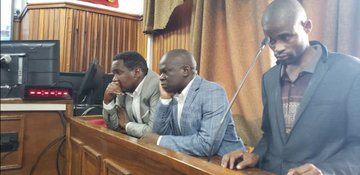
Embattled legislators, Allan Ssewanyana and MP Muhammad Ssegirinya of Makindye West and Kawempe North respectively have denied any negotiations prior to their release from Prison.

On February 13, 2023, Masaka High Court judge, Lawrence Tweyanze granted Shs20 million bail to the two legislators after spending over one year on remand.

Speaking earlier today, the two MPs said they didn’t negotiate for their release as media reports had earlier indicated that a section of Opposition MPs led by the Leader of Opposition in Parliament –LoP Mathias Mpuuga negotiated on behalf of them. Mpuuga discarded all the reports and asked for tabling of evidence pinning over that subject matter.  

“There weren’t any negotiations prior to our release. We were released because of the constant pressure that came from our people, the media, and the international community,” Ssegirinya said.

Ssegirinya said he was unlawfully arrested and he doesn’t know why he was in prison because he is innocent.

“After I was sworn in as an MP, I received Shs200 million for the car but I used the money to buy an ambulance, rented a place where I set up a hospital, and got start-up medical equipment and medicine. I know my people suffer from diseases like gonorrhea and malaria. Medicine was there,” he said.

Ssewanyana said they will continue to appeal that all political prisoners still incarcerated are given freedom.

“Fellow Ugandans, we have been there for you, we have suffered and our backs are not yet broken. In our generation no legislators have suffered for over two years on political matters except us,” he said.

The two MPs and four other suspects are accused of terrorism contrary to sections 7 (1) and (2) (d) and (d) of the Anti-Terrorism Act 2002 in count one, aiding and abetting terrorism contrary to section 8 of the Anti-Terrorism Act 2002 in count two, murder contrary to sections 188 and 189 of the Penal code Act in Counts three, four, five and attempted murder contrary to section 204 (a) of the Penal code Act.

Prosecution states that the two legislators together with other suspects -some on remand and others still at large on August 2, 2021, allegedly killed Joseph Bwanika, a resident of Kisekka Village in Kisekka Sub County in Lwengo District.

It is further alleged that on August 23 at Ssettaala Village in Masaka City, the MPs and their co-accused persons killed Francis Mugerwa Kiiza aka Nswa, Sulaiman Kakooza and Tadeo Kiyimba.

The MPs are also accused of attempting to kill Ronald Ssebyoto, a resident of the same area. They are also accused of financing the killings in the Greater Masaka region.

Stories Continues after ad

For Central Banks, less is more

Bank of Uganda

By Raghuram Rajan
Central bankers of industrialized countries have fallen tremendously in the public’s estimation. Not long ago they were heroes, supporting feeble growth with unconventional monetary policies, promoting the hiring of minorities by allowing the labor market to run a little hot, and even trying to hold back climate change, all the while berating paralyzed legislatures for not doing more. Now they stand accused of botching their most basic task, keeping inflation low and stable. Politicians, sniffing blood and mistrustful of unelected power, want to reexamine central bank mandates.


Did central banks get it all wrong? If so, what should they do?


The case for central bankers
I’ll start first with why central banks should be cut some slack. Hindsight is, of course, 20/20. The pandemic was unprecedented, and its consequences for the globalized economy very hard to predict. The fiscal response, perhaps much more generous because polarized legislatures could not agree on whom to exclude, was not easy to forecast. Few thought Vladimir Putin would go to war in February 2022, disrupting supply chains further and sending energy and food prices skyrocketing.
Undoubtedly, central bankers were slow to react to growing signs of inflation. In part, they believed they were still in the post–2008 financial crisis regime, when every price spike, even of oil, barely affected the overall price level. In an attempt to boost excessively low inflation, the Federal Reserve even changed its framework during the pandemic, announcing it would be less reactive to anticipated inflation and keep policies more accommodative for longer. This framework was appropriate for an era of structurally low demand and weak inflation, but exactly the wrong one to espouse just as inflation was about to take off and every price increase fueled another. But who knew the times were a-changing?


Even with perfect foresight, central bankers—who are in reality no better informed than capable market players—might still have been understandably behind the curve. A central bank cools inflation by slowing economic growth. Its policies have to be seen as reasonable, or else it loses its independence. With governments having spent trillions to support their economies, employment just recovered from terrible lows, and inflation barely noticeable for over a decade, only a foolhardy central banker would have raised rates to disrupt growth if the public did not yet see inflation as a danger. Put differently, preemptive rate rises that slowed growth would have lacked public legitimacy—especially if they were successful and inflation did not rise subsequently, and even more so if they deflated the frothy financial asset prices that gave the public a sense of well-being. Central banks needed the public to see higher inflation to be able to take strong measures against it.
In sum, central bank hands were tied in different ways—by recent history and their beliefs, by the frameworks they had adopted to combat low inflation, and by the politics of the moment, with each of these factors influencing the others.


The case against
Yet stopping the postmortem at this point is probably overly generous to central banks. After all, their past actions reduced their room to maneuver, and not only for the reasons just outlined. Take the emergence of both fiscal dominance (whereby the central bank acts to accommodate the government’s fiscal spending) and financial dominance (whereby the central bank acquiesces to the imperatives of the market). They clearly are not unrelated to central bank actions of the past few years.
While central banks can claim they were surprised by recent events, they played a role in constraining their own policy space.
Long periods of low interest rates and high liquidity prompt an increase in asset prices and associated leveraging. And both the government and the private sector leveraged up. Of course, the pandemic and Putin’s war pushed up government spending. But so did ultralow long-term interest rates and a bond market anesthetized by central bank actions such as quantitative easing. Indeed, there was a case for targeted government spending financed by issuing long-term debt. Yet sensible economists making the case for spending did not caveat their recommendations enough, and fractured politics ensured that the only spending that could be legislated had something for everyone. Politicians, as always, drew on unsound but convenient theories (think modern monetary theory) that gave them license for unbridled spending.


Central banks compounded the problem by buying government debt financed by overnight reserves, thus shortening the maturity of the financing of the government and central bank’s consolidated balance sheets. This means that as interest rates rise, government finances—especially for slow-growing countries with significant debt—are likely to become more problematic. Fiscal considerations already weigh on the policies of some central banks—for instance, the European Central Bank worries about the effect of its monetary actions on “fragmentation,” the yields of  fiscally weaker countries’ debt blowing out relative to those of stronger countries. At the very least, perhaps central banks should have recognized the changing nature of politics that made unbridled spending more likely in response to shocks, even if they did not anticipate the shocks. This may have made them more concerned about suppressing long rates and espousing low-for-long policy rates.


The private sector also leveraged up, both at the household level (think Australia, Canada, and Sweden) and at the corporate level. But there is another new, largely overlooked, concern—liquidity dependence. As the Fed pumped out reserves during quantitative easing, commercial banks financed the reserves largely with wholesale demand deposits, effectively shortening the maturity of their liabilities. In addition, in order to generate fees from the large volume of low-return reserves sitting on their balance sheets, they wrote all sorts of liquidity promises to the private sector—committed lines of credit, margin support for speculative positions, and so on.


The problem is that as the central bank shrinks its balance sheet, it is hard for commercial banks to unwind these promises quickly. The private sector becomes much more dependent on the central bank for continued liquidity. We had a first glimpse of this in the UK pension turmoil in October 2022, which was defused by a mix of central bank intervention and government backtracking on its extravagant spending plans. The episode did suggest, however, a liquidity-dependent private sector that could potentially affect the central bank’s plans to shrink its balance sheet to reduce monetary accommodation.


And finally, high asset prices raise the specter of asymmetric central bank action—the central bank being quicker to be accommodative as activity slows or asset prices fall but more reluctant to raise rates as asset prices bubble up, pulling activity along with them. Indeed, in a 2002 speech at the Kansas City Federal Reserve Bank’s Jackson Hole conference, Alan Greenspan argued that, while the Fed could not recognize or prevent asset price booms, it could “mitigate the fallout when it occurs and, hopefully, ease the transition to the next expansion,” thus making asymmetry a canon of Fed policy.
High asset prices, high private leverage, and liquidity dependence suggest that the central bank could face financial dominance—monetary policy that responds to financial developments in the private sector rather than to inflation. Regardless of whether the Fed intends to be dominated, current private sector forecasts that it will be forced to cut policy rates quickly have made its task of removing monetary accommodation more difficult. It will have to be harsher for longer than it would want to be, absent these private sector expectations. And that means worse consequences for global activity. It also means that when asset prices reach their new equilibrium, households, pension funds, and insurance companies will all have experienced significant losses—and these are often not the entities that benefited from the rise. Bureaucrat-managed state pension funds, the unsophisticated, and the relatively poor get drawn in at the tail end of an asset price boom, with problematic distributional consequences for which the central bank bears some responsibility.


One area in which reserve country central bank policy has consequences but their central bankers little responsibility is the external spillovers of their policies. Clearly, the policies of the core reserve countries affect the periphery through capital flows and exchange rate movements. The periphery central bank must react regardless of whether its policy actions are suitable for domestic conditions—if not, the periphery country suffers longer-term consequences such as asset price booms, excessive borrowing, and eventually debt distress. I will return to this issue in the conclusion.


In sum, then, while central banks can claim they were surprised by recent events, they played a role in constraining their own policy space. With their asymmetric and unconventional policies, ostensibly intended to deal with the policy rate touching the lower bound, they have triggered a variety of imbalances that not only make fighting inflation harder but also make it difficult to exit the prevalent policy mix, even as the inflation regime has changed to one of substantially higher inflation. Central banks are not the innocent bystanders they are sometimes made out to be.


Mission creep
So what happens now? Central bankers know the battle against high inflation well and have the tools to combat it. They should be free to do their job.


But when central banks succeed in bringing inflation down, we will probably return to a low-growth world. It is hard to see what would offset the headwinds of aging populations; a slowing China; and a suspicious, militarizing, de-globalizing world. That low-growth and possibly low-inflation world is one central bankers understand less well. The tools central bankers used after the financial crisis, such as quantitative easing, were not particularly effective in enhancing growth. Furthermore, aggressive central bank actions could precipitate more fiscal and financial dominance.


So when all settles back down, what should central bank mandates look like? Central banks are not the obvious institutions to combat climate change or promote inclusion. Often they have no mandate to tackle these issues. Instead of usurping mandates in politically charged areas, it is best that central banks wait for a mandate from the elected representatives of the people. But is it wise to give central banks mandates in these areas? First, central bank tools have limited effectiveness in areas like combating climate change or inequality. Second, could new responsibilities influence their effectiveness in achieving their primary mandate(s)? For instance, could the new Fed framework requiring it to pay attention to inclusion have held back rate increases—since disadvantaged minorities are usually, and unfortunately, the last to be hired in an expansion?

Finally, could these new mandates expose the central bank to a whole new set of political pressures and prompt new forms of central bank adventurism? All this is not to say that central banks should not worry about the consequences of climate change or inequality for their explicit mandate(s). They could even follow the express instructions of elected representatives in some matters (for instance, buying green bonds instead of brown bonds when intervening in markets), though this opens them up to the risk of external micromanagement. However, the task of directly combating climate change or inequality is best left to the government, not the central bank.


But what about their mandate and their frameworks for price stability? The earlier discussion suggested a fundamental contradiction central banks face. Hitherto, there was a sense that they needed one framework—for instance, an inflation-targeting framework that commits them to keeping inflation within a band or symmetrically around a target. Yet as Bank for International Settlements (BIS) General Manager Agustín Carstens argues, a low-inflation regime can be very different from a high-inflation regime. Depending on the regime they are in, their framework may need to change. In a low-inflation regime, in which inflation does not budge from low levels no matter the price shock, they may need to commit to being more tolerant of inflation in the future in order to raise inflation today. Put differently, as Paul Krugman argued, they have to commit to being rationally irresponsible. This means adopting policies and frameworks that effectively bind their hands, committing them to stay accommodative for long. But as argued above, this may precipitate regime change, for instance, by loosening perceived fiscal constraints.


Conversely, in a high-inflation regime, where every price shock propels another, central banks need a strong commitment to eradicating inflation as early as possible, following the mantra “when you stare inflation in the eyeballs, it is too late.” The framework-induced commitment for inflation tolerance needed for the low-inflation regime is thus incompatible with the one needed for the high-inflation regime. But central banks cannot simply shift based on regime because they lose the power of commitment. They may have to choose a framework for all regimes.


Choosing frameworks
If so, the balance of risks suggests that central banks should reemphasize their mandate to combat high inflation, using standard tools such as interest rate policy. What if inflation is too low? Perhaps, as with COVID-19, we should learn to live with it and avoid tools like quantitative easing that have questionably positive effects on real activity; distort credit, asset prices, and liquidity; and are hard to exit. Arguably, so long as low inflation does not collapse into a deflationary spiral, central banks should not fret excessively about it. Decades of low inflation are not what slowed Japan’s growth and labor productivity. Aging and a shrinking labor force are more to blame.


It is not good to complicate central bank mandates, but they may need a stronger mandate to help maintain financial stability. For one, a financial crisis tends to bring on the excessively low inflation that central banks find hard to combat. Second, the ways they typically tackle an extended period of too-low inflation, as we have seen, fuel higher asset prices and consequently leverage and further possible financial instability. Unfortunately, even though monetary theorists argue that it is best to deal with financial stability through macroprudential supervision, that has proved less than effective thus far—as evidenced by house price booms in key economies. Furthermore, macroprudential policies may have little impact in areas of the financial system that are new or distant from banks, as evidenced by the crypto and meme stock bubbles and their bursting. While we do need better coverage of the financial system, especially the nonbank shadow financial system, with macroprudential regulation, we should also remember that monetary policy, in Jeremy Stein’s words, “gets into all the cracks.” Perhaps then, with such power should come some responsibility!


What about responsibilities for the external consequences of their policies? Interestingly, central banks that are more focused on domestic financial stability will likely adopt monetary policies that have fewer spillovers. Nevertheless, central bankers and academics should start a dialogue on spillovers. A largely apolitical dialogue can begin at the BIS in Basel, where central bankers meet regularly. Eventually the dialogue can move to the IMF, involving government representatives and more countries, to discuss how central bank mandates should change in an integrated world. Pending such dialogue and a political consensus on mandates, though, refocusing central banks on the primary mandate of combating high inflation while respecting the secondary mandate of maintaining financial stability may be enough.
Will these twin mandates condemn the world to low growth? No, but they will place the onus for fostering growth back on the private sector and governments, where it belongs. More focused and less interventionist central banks would probably deliver better outcomes than the high-inflation, high-leverage, low-growth world we now find ourselves in. For central banks, less may indeed be more.


Raghuram Rajan is a professor at the University of Chicago’s Booth School of Business and was governor of the Reserve Bank of India from 2013 to 2016.

Stories Continues after ad

Who Will Win the Ugandan Premier League in 2023?

Predicting the Winner of the StarTimes Uganda Premier League

We have just passed the halfway mark of the 2022-23 Uganda Premier League Season. There are a few true contenders as well as a few teams that are already looking to next year and beyond. There are also plenty of betting opportunities to be had which is why punters should visit betting offers finder.

While there is still a long way to go, Kampala Capital City Authority FC currently paces the league with a record of 11-2-3. KCCA FC is looking to capture its first title in four years after dominating the league with 5 titles between 2013 and 2019. Even though Villa and Bul aren’t that far behind, just four and six points back respectively, it is Viper SC that Betting Offer Finder product owner – Tony Sloterman thinks fans should keep a close eye on. The squad from Wakiso is trying to follow up on a spectacular 2021-22 season in which they went 23-5-2 to claim their third title in the past five years.

One of the scary things about the Vipers is that they currently have two games in hand on both Villa and Bul. They have a very good chance of overtaking those teams and priming themselves for the stretch run. Unfortunately, they have just one game in hand on KCCA FC and they are seven points back. That’s a sizeable gap to make up for. Still, they have the best defense hand-down having only given up five goals so far in their 15 games. Their 10 clean sheets lead the league although SC Villa has nine of them.

Who Else is In the Mix?

Teams like the Wakiso Giants, Bright Stars, and even Arua Hill still have a glimmer of hope, but the difference in talent between those teams and the forerunners is simply too much. URA, Gaddafi, and Maroons are in the same boat. Arua Hill appears to be a good bet as the team most likely to crack the top five. Like the Vipers, Arua Hill has a couple of games in hand on their closest competitors which gives them a good chance to land in the top five soon. They have the offense to do it, but their defensive play is suspect.

Who is the Hottest Team Right Now?

KCCA FC and URA have both gone 3-1-1 in their last five which is pretty solid. However, the hottest team at the moment has to be Villa who has gone 6-0-2 over their last eight league games. At that rate, they could surprise a lot of fans. They still have upcoming matches against KCCA FC, Bul, and the Vipers. Those games will go a long way in determining their fate.

So? What’s the Prediction?

A lot of bettors will certainly be on the KCCA FC bandwagon. This football club has had a lot of success over the past decade and their window of opportunity remains wide open. With that said, the Vipers are the team of now. They are the defending league winners and have claimed four titles in the past eight campaigns. Again, their defensive play continues to be lights out. They won’t win the league by a margin of 18 points like they did last year, but we like their chances of having a strong enough stretch run to overtake FCCA FC and win another title.

Stories Continues after ad

Museveni to meet NRM Village chairpersons tomorrow

Museveni during NRM MPs-Elect’s retreat at National Leadership Institute in Kyankwanzi District.

President Museveni, the National Resistance Movement (NRM) chairman will tomorrow (Wednesday, March 29) have a special meeting with all NRM village chairpersons in Kampala district.

The meeting organized by the Office of the National Chairperson (ONC) and the NRM Secretariat will take place at Kololo Independence Grounds starting at 2 pm. However, the arrival time for all village chairpersons is set for 11 am, to allow prior planning of the meeting attendees.

“The NRM Secretariat hereby informs all Kampala NRM Village Chairpersons of a meeting scheduled with the NRM National Chairperson and the President of the Republic of Uganda, H.E Yoweri Kaguta Museveni the meeting will take place on Wednesday March 29, 2023, at Kololo Independence Grounds. The arrival time is 11 am, and the meeting will commence at 2 pm,” the notice from the NRM Secretariat reads.

Accordingly, all participants invited to the meeting will be subjected to mandatory #Covid-19 tests, with the preparatory tests scheduled for up to Tuesday.

“All Participants are required to undergo Mandatory covid-19 tests. The testing exercise is ongoing at the State House Land Directorate, Plot 58, Lumumba Avenue, and will end today (Tuesday) at 2pm,” reads the meeting notice.

The meeting comes hardly two days after his son Gen Kainerugaba Muhoozi met youth and traders in downtown Kampala in the pretence of cleaning Kampala. Muhoozi has declared interests to run for presidency of Uganda though it is not clear how he will contest for the top seat given that he still a serving soldier in the army.

Stories Continues after ad
Museveni applauds Russia’s cooperation in defense

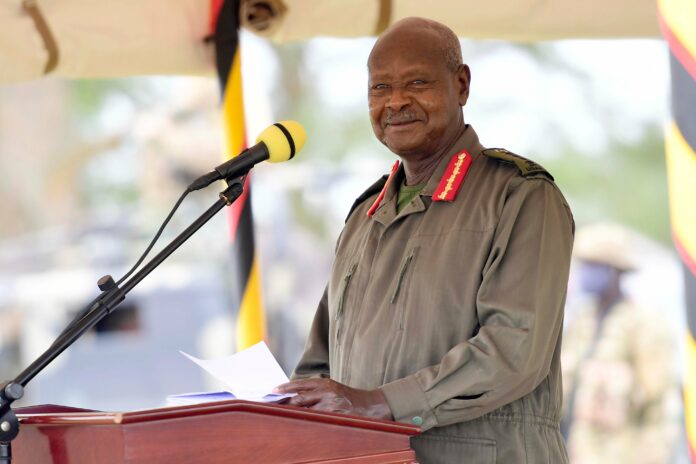
President Yoweri Museveni has revealed that Uganda highly appreciates its cooperation with Russia in defense. Museveni said in an exclusive interview with TASS First Deputy Director-General Mikhail Gusman.

“Today, we are very satisfied with our cooperation with the Russian Federation. We cooperate in the sphere of defense, and we buy high-quality weapons and technologies from Russia,” he said.

Museveni also emphasized that he was grateful for the Soviet Union’s assistance in Africa’s fight against colonialism.

Museveni made remarks amid the escalating economic crisis and the continuous sanctions imposed against Russia. The sanctions followed Russia’s invasion of Ukraine on February 24, 2022.

The invasion is a major escalation of the Russo-Ukrainian War that began in 2014. The invasion caused Europe’s largest refugee crisis since World War II, with more than 9.5 million Ukrainians fleeing the country and a third of the population displaced. The invasion also caused global food shortages.

Museveni said Uganda’s interest with Russia is that when there is progress and stability in Russia, both countries benefit because there is barter trade.

“This idea of rivalry is not part of our African Liberation Movement strategy. If we stick to the charter of cooperation among countries irrespective of their different social systems, things will be much better for the world.” he said

Stories Continues after ad
Orombi responding to treatment – Archbishop Kaziimba

Rtd Archbishop Henry Luke Orombi

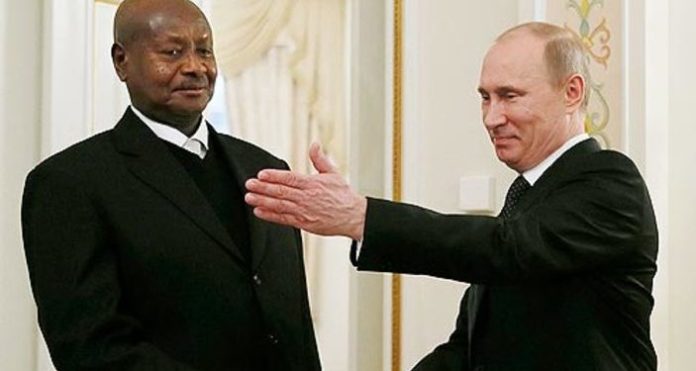
Archbishop of the Church of Uganda, The Most Rev. Dr. Stephen Samuel Kaziimba has revealed that the ailing and frail Retired Archbishop of Church of Uganda Henry Luke Orombi is better and responding to treatment.

“I have visited Bishop Henry Luke Orombi in the hospital this morning. He was able to speak to me and told me he is better. The situation is better, continue praying that God heals him completely,” Kaziimba said.

Yesterday, the retired archbishop was rushed to Naksero hospital over unrevealed health complications.

Born in Pakwach, Orombi served as Archbishop of Uganda and Bishop of Kampala from 2004 until his retirement in December 2012, two years earlier than expected. He was succeeded as Archbishop by Stanley Ntagali, who was consecrated in December 2012.

Orombi served as Bishop of the Diocese of Kampala, which is the fixed episcopal see of the Archbishop, but unlike many other fixed Metro-political sees, the incumbent is not officially known as Archbishop of Kampala, but bears the longer compound title Archbishop of Uganda and Bishop of Kampala.

Stories Continues after ad

BRAC to celebrate 50th year anniversary in Uganda

BRAC, one of the largest development organizations of the world, is set to celebrate its 50-year anniversary under the theme “50 Years of Igniting Hope from Bangladesh to the World” at Munyonyo Commonwealth Resort on March 30, 2023.

BRAC Uganda in coordination with BRAC Uganda Bank Ltd are organizing the event, where prominent guests and dignitaries will attend from different government institutions, non-government organizations, microfinance institutions, social enterprises and other notable organizations.

First Lady of the Republic of Uganda and Minister of Education and Sports, Janet Kataaha Museveni will attend as the Guest of Honour at the event. Dr Michael Atingi-Ego, Deputy Governor of Bank of Uganda, will attend as the Special Guest. Shameran Abed, Executive Director of BRAC International, Spera Atuhairwe, Country Director of BRAC Uganda, and Nkosilathi Moyo, Chief Executive Officer of BRAC Uganda Bank Limited will also be present at the celebrations.

BRAC was born in a remote village in Bangladesh in 1972. Today, BRAC partners with over 100 million people living with inequality and poverty globally, through a community-led, integrated development model, combining social development, social enterprises and humanitarian response.

BRAC first expanded its operations outside of Bangladesh in 2002 as BRAC International, now directly implements and provides technical assistance to partner governments and civil society organizations in 16 countries across Asia and Africa.

BRAC has been working in Uganda since 2006, marking this year its 17th year in the country. Its microfinance wing, BRAC Uganda Bank Ltd (BUBL) is one of the largest providers of financial services in Uganda. BUBL’s mission is to provide a range of financial services to people living in poverty, especially women, to build sustainable livelihoods.

The NGO works with communities, providing holistic services including integrated, quality health care; early childhood development through play-based education; safe spaces for adolescent girls and young women to empower themselves; vocational education and training for skills and employability; emergency response and preparedness; and time-bound interventions to help families escape extreme poverty long-term.

The organization’s 50th anniversary is a celebration of solutions that are born and proven in the Global South, and the strength, ingenuity and courage of people who partner with BRAC to solve some of the world’s toughest challenges.

Stories Continues after ad

NSSF announces a 30-day window for registration of employers

The National Social Security Fund (NSSF) has announced a 30-day window for all employers to register with NSSF in compliance with the NSSF (Amendment) Act 2022 which introduced mandatory contributions by all workers regardless of the size of the enterprise or number of employees. The campaign is termed ‘Now You Can’.

Speaking at the event, Acting Managing Director, Patrick Ayota said that President Kaguta Museveni assented to the NSSF (Amendment) Act 2022 on the 2nd of January 2022 and it became law. Among the objectives, the amendments are intended to expand social security coverage and strengthen compliance with the law.

“I am pleased to note that since the law was passed, we have seen over 3,200 employers with less than 5 employees register with and contribute to NSSF. We have also noted that a number of employers are still not registered with the Fund,” Ayota said.

He added, “Today we announce a 30-day window effective March 28, 2023, for all employers, irrespective of the number of workers employed, to register with the NSSF. Unregistered employers should take advantage of the next 30 days to avoid penalties.”

Over the next 5 years, the Fund’s target is to register over 50,000 employers and 1,200,000 new members, from the Small and medium-sized enterprises (SMEs) space, voluntary and informal sectors.

“We are targeting both employers and entities for this mandatory drive,” Ayota asserted.

This is an opportunity for every Ugandan worker, formal or informal, to take advantage of the new legal regime. This drive is a multi-stakeholder initiative.  All members have an obligation to make social security a reality for all workers in Uganda

Uganda Law Society(ULS) Chief Executive Officer, Okwalinga Moses said expressed appreciation to the Fund for considering ULS as a key stakeholder in the implementation of the NSSF Act, as amended, in particular Sections 7 & 13A, to expand social security coverage. ULS supports the efforts to expand social security.

“One of ULS’s objectives is “to promote the rule of law and human rights protection”.  We are glad to be part of the initiatives that promote adherence to the law. The right to social security is of central importance in guaranteeing human dignity for all persons,” Okwalinga said.

He added, “For our members in the legal fraternity, NSSF compliance is already a requirement by the Law Council before a practicing certificate can be issued. The advantages of compliance are very evident so let us comply.”

Mrs. Cecilia Kengoro, Investment Specialist at Private Sector Foundation Uganda, encouraged all employers to register with NSSF to comply with the law. Adding, “We shall work with the Fund to educate and support businesses in Uganda to embrace this call to secure the future of their employees.”

John Walugembe, Director Oxford Green Finance Initiative thanked the Fund for working with the Federation of small and medium-sized businesses in Uganda for the campaign urging that there are opportunities in regularizing registration with NSSF, especially for the SMEs who currently dominate Uganda’s business terrain.

“I urge our members to take advantage of this opportunity provided by the Fund to register so that we are not caught on the wrong side of the law. We shall work with NSSF to educate our members on the benefits, education is vital in this initiative,” Walugembe said.

Stories Continues after ad