Stanbic Bank
Stanbic Bank
21.2 C
Kampala
Stanbic Bank
Stanbic Bank
Home Blog Page 441

Kampala Parents’ maintains lead in PLE

The wait is over. Meet these lovely twins, Chantelle & Chanelle who scored 4 aggregates.

Kampala Parents’ School has maintained its dominance in Primary Leaving Examinations as it posted good performance in 2022 results.

Uganda National Examination Board (UNEB) released the results this morning at State House. UNEB indicated boys performed better than girls in the overall performance.

At Kampala Parents’, 400 pupils sat for exams and out of the 400, the school got 16 pupils scoring aggregate 4s.

According to the school Principal Daphine Kato, the school got 291 first division while the rest got second division.

Some of Kampala Parents’ pupils who score aggregate 4

Ms Kato said the results posted by the school are better but more is needed, however, she said the nature of the results can as well be attributed to #Covid-19 that made it hard for the education sector to operate freely.

KPS is a pioneer of private primary education in the country and has always maintained its dominance in examinations.

A total of 832,654 candidates from 14,691 centers registered for PLE. of those, 114,617 (14.1%) passed in first grade. At least 583,786 pupils who sat PLE were from the Universal Primary Education and 249,041 were non-UPE candidates.

More than 51.9 percent of the total registered candidates were females and 48.1 percent were males.

The males performed better than the females and recorded a lower failure rate overall. 60,070 (15.4%) of the males were in Division one compared to the 54,547 (12.9%) of females.

“The girls have always beaten the boys in English but then the latter surface above the former in the other subjects. This is a trend we have observed over the years,” said the Chairperson UNEB Prof. Mary Okwakol, adding that although the COVID-19 pandemic appeared to have eased compared to what it was in 2021, the board faced another challenge occasioned by the outbreak of Ebola in some parts of the country.

Kampala Parents’ School PLE results 2022

Agg 4= 16
Agg 5 =32
Agg 6= 41
Agg 7=43
Agg 8 = 42
Agg 9 = 37
Agg 10 = 31
Agg 11 = 33
Agg 12= 16

Total Division 1 = 291 out of 410

Stories Continues after ad

Five billion people unprotected from trans fat leading to heart disease

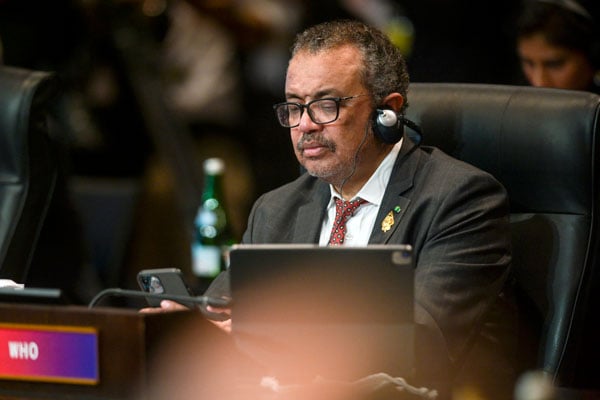
Tedros Adhanom Ghebreyesus, WHO- Director General

Five billion people globally remain unprotected from harmful trans fat, a new status report from WHO has found, increasing their risk of heart disease and death.

Since WHO first called for the global elimination of industrially produced trans fat in 2018 – with an elimination target set for 2023 – population coverage of best-practice policies has increased almost six-fold. Forty-three countries have now implemented best-practice policies for tackling trans fat in food, with 2.8 billion people protected globally.

Despite substantial progress, however, this still leaves 5 billion worldwide at risk from trans fat’s devastating health impacts with the global goal for its total elimination in 2023 remaining unattainable at this time.

Industrially produced trans fat (also called industrially produced trans-fatty acids) is commonly found in packaged foods, baked goods, cooking oils and spreads. Trans fat intake is responsible for up to 500 000 premature deaths from coronary heart disease each year around the world.

“Trans fat has no known benefit, and huge health risks that incur huge costs for health systems,” said WHO Director-General, Dr Tedros Adhanom Ghebreyesus. “By contrast, eliminating trans fat is cost effective and has enormous benefits for health. Put simply, trans fat is a toxic chemical that kills, and should have no place in food. It’s time to get rid of it once and for all.”

Currently, 9 of the 16 countries with the highest estimated proportion of coronary heart disease deaths caused by trans fat intake do not have a best-practice policy. They are Australia, Azerbaijan, Bhutan, Ecuador, Egypt, Iran (Islamic Republic of), Nepal, Pakistan and Republic of Korea.

Best-practices in trans fat elimination policies follow specific criteria established by WHO and limit industrially produced trans fat in all settings. There are two best-practice policy alternatives: 1) mandatory national limit of 2 grams of industrially produced trans fat per 100 grams of total fat in all foods; and 2) mandatory national ban on the production or use of partially hydrogenated oils (a major source of trans fat) as an ingredient in all foods.

“Progress in eliminating trans fat is at risk of stalling, and trans fat continues to kill people,” said Dr Tom Frieden, President and CEO of Resolve to Save Lives. “Every government can stop these preventable deaths by passing a best-practice policy now. The days of trans fat killing people are numbered – but governments must act to end this preventable tragedy.”

While most trans fat elimination policies to date have been implemented in higher-income countries (largely in the Americas and in Europe), an increasing number of middle-income countries are implementing or adopting these policies, including Argentina, Bangladesh, India, Paraguay, Philippines and Ukraine. Best-practice policies are also being considered in Mexico, Nigeria and Sri Lanka in 2023. If passed, Nigeria would be the second and most populous country in Africa to put a best-practice trans fat elimination policy in place. No low-income countries have yet adopted a best-practice policy to eliminate trans fat.

In 2023, WHO recommends that countries focus on these four areas: adopting best-practice policy, monitoring and surveillance, healthy oil replacements and advocacy. WHO guidance has been developed to help countries make rapid advances in these areas.

WHO also encourages food manufacturers to eliminate industrially produced trans fat from their products, aligning to the commitment made by the International Food and Beverage Alliance (IFBA). Major suppliers of oils and fats are asked to remove industrially produced trans fat from the products sold to food manufacturers globally.

The report dubbed Countdown to 2023 WHO Report on global trans fat elimination 2022, is an annual status report published by WHO in collaboration with Resolve to Save Lives, to track progress towards the goal of trans fat elimination in 2023.

Stories Continues after ad

Robot Boii thrills revelers at the Smirnoff Fiesta

Robot Boii performs at the Smirnoff Unleash Your Edge Fiesta at Sheraton Hotel

Performing at the Smirnoff Fiesta on Wednesday, Robot Boii who appeared on stage a few minutes past 11, got the crowd in a frenzy when he introduced himself with the popular phrase “Roboto Roboto” in his song Salary Salary.

Clad in black and his signature bucket hat look, Robot Boii delivered an energetic but rather brief performance that got revelers jamming to Oksalayo and everyone’s favorite, Salary salary.

Joined by DJ Lindash, the versatile Robot Boii ably pulled off the show coupled with Amapiano dance moves that only Amapiano lovers danced along to, making his performance worth every minute.

Speaking to the Fiesta, Judie Nandekya the Smirnoff brand manager said that Smirnoff is tapping into different popular culture aspects to appeal to and relate more to its consumers, one of them being music.

As one of the quickest growing music trends today, Amapiano was the best fit for the debut Fiesta to deliver a vibrant and bold experience to consumers not, she added.

The Smirnoff Unleash Your Edge Fiestas are countrywide music experiences that began with the Kampala edition and will traverse different parts of the country, giving consumers the most anticipated edgy vibe as set by the debut Fiesta.

The debut fiesta also featured music mixes from Kamapla’s DJ Vanss, Thee Ugandan Babe, Dj Etania, Melodic Inversions, DJ Kash Pro, and DJ Mark, hosted by Sammy Wetala and Zam Zion.

The next Fiesta will happen at Uganda Martyr’s University-Nkozi in February to further immerse consumers in another exciting Fiesta experience by Smirnoff.

Stories Continues after ad

Boys outperform girls in 2022 PLE

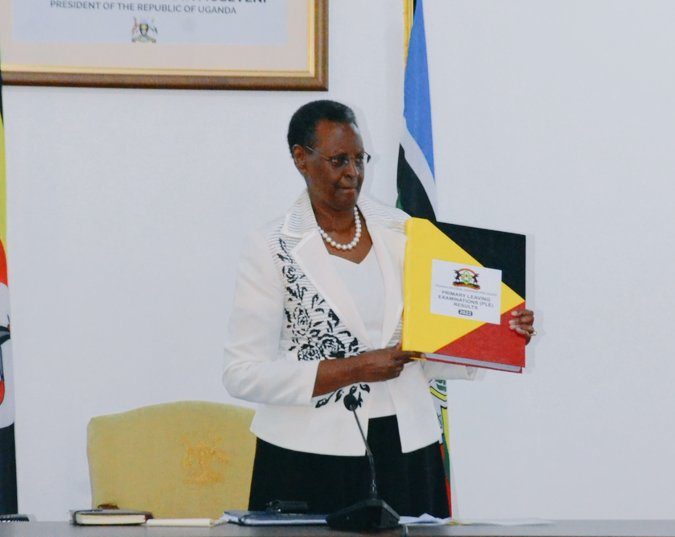
Janet Museveni officially releasing the PLE results at State House Nakasero.

Male students have outperformed girl students, the just released 2022 Primary Leaving Examinations (PLE) results indicate.

A total of 832,654 candidates from 14,691 centers registered for PLE. of those, 114,617 (14.1%) passed in first grade. At least 583,786 pupils who sat PLE were from the Universal Primary Education and 249,041 were non-UPE candidates..

More than 51.9 percent of the total registered candidates were females and 48.1 percent were males.

The males performed better than the females and recorded a lower failure rate overall. 60,070 (15.4%) of the males were in Division one compared to the 54,547 (12.9%) of females.

Table showing overall performance by gender

“The girls have always beaten the boys in English but then the latter surface above the former in the other subjects. This is a trend we have observed over the years,” said the Chairperson UNEB Prof. Mary Okwakol, adding that although the COVID-19 pandemic appeared to have eased compared to what it was in 2021, the board faced another challenge occasioned by the outbreak of Ebola in some parts of the country.

She said the examination body noted an improvement in mathematics where 6.3% of the candidates were able to score a distinction and 52% scored a credit level.

According to UNEB, 2,257 learners with Special Needs of various categories sat for the exams, including the blind, the deaf, the physically handicapped and the dyslexics, compared to 1,599 in 2020. This is an increase of 52.3%, the largest rate of increase ever.

While officially releasing the results at State House in Nakasero, the Minister for Education and Sports Janet Museveni said “I wish to congratulate all the candidates who have passed the examination, the teachers who prepared them and the parents/guardians for their support.”

Parents, candidates and other interested parties may use the Short Message Services (SMS) on mobile networks which will post results of candidates on their mobile sets instantly. Each SMS request via short code 6600 that will again be used, will cost Shs500.

Results will also be uploaded on the examination centre Portals. Each school can therefore download their results.

Overall performance
Stories Continues after ad

Court orders woman to refund Shs10 million to ex-lover after refusing to marry him

Gavel

Kanungu Grade One Magistrate’s court has directed a woman to refund Shs10.43 million she received from her ex-lover towards her education after turning down his marriage proposal.

In February 2022, Richard Tumwiine filed a civil suit number 024 of 2022 against his ex-lover Fortunate Kyarikunda for breach of marriage promise.

According to the prosecution, Tumwiine met Kyarikunda at Kiringa primary school in Kambunga sub-county, Kanungu district where he was a teacher in 2015. Kyarikunda was conducting teaching practice at the same time. In the process, Tumwiine fell in love with Kyarikunda and agreed in 2018 to get married.

Tumwiine reportedly gave Kyarikunda Shs9,439,100 to complete her Diploma in legal practice at the Kampala-based Law Development Center-LDC. After completing her bar course, the lovebirds agreed on January 10, 2022, to arrange an introduction ceremony scheduled for February 2022. 

However, Tumwiine was shocked in February 2022 when Kyarikunda backed out of the marriage plan, saying that she can’t proceed because her suitor is above 65 years of age yet she is below 35 years. In his petition, Tumwine accused Kyarikunda of breach of marriage promise. He asked the court to compel her to refund the money he injected into her education since he did it well knowing they will end up together.

In her ruling on Wednesday, the Kanungu Grade One Magistrate, Asanansio Mukobi, said that despite being served, Kyarikunda failed to file her defense. Mukobi says that since the marriage promise was not fulfilled, Tumwiine is entitled to the reimbursement of the Shs9,439,100 he spent on her.

Based on article 126 (2) (c) of the Constitution of the Republic of Uganda 1995 as amended, which provides for adequate compensation for victims of wrongs, Mukobi ordered Kyarikunda to pay one million shillings to Tumwiine as general damage for inconveniences and psychological anguish.      

 “There is no wrong without a remedy. Victims of wrongs such as the plaintiff in this case are entitled to compensation,” reads the ruling.

The court observed that the two people were engaged in a love relationship and that from the exhibits presented, arrangements for an introduction ceremony were made.

“The defendant (Kyorikunda) suggested that it takes place in February 2022 and the said date passed despite the plaintiff’s preparations for the introduction. The excuse the defendant gave was that she could not get married to an old man, the plaintiff, as if she did not see young men during their over four years courtship,” the magistrate ruled.

Stories Continues after ad

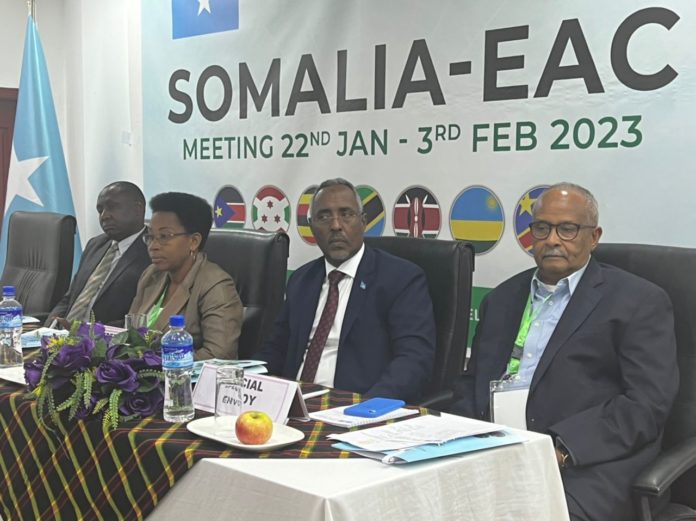
EAC launches verification mission to assess Somalia’s readiness to join the Community

The East African Community (EAC) officially launched the verification mission to assess the Federal Republic of Somalia’s readiness to join the Community.

The verification team comprising of experts from the EAC Partner States are in Somalia up to February 3, 2023, to establish the country’s level of conformity with the criteria for admitting foreign countries as provided in the Treaty for the establishment of the EAC.

Speaking during the official launch, EAC Secretary General Hon (Dr.) Peter Mathuki disclosed that the technical team in Mogadishu will engage Somalia to ensure that the verification was finalized and a report completed in time in readiness for presentation to the EAC Council of Ministers who will table it for consideration by the 23rd Summit of EAC Heads of State scheduled for the end of February 2023. 

“The verification team is set to make findings relating to the institutional frameworks in place; legal frameworks; policies, strategies, projects and programmes; areas of Cooperation with other EAC Partner States and expectations from membership,” he said.

The Secretary General further said that the team will assess Somalia’s development strategies and plans in key areas of collaboration including infrastructure, energy, education and science, peace and security, and international cooperation.

“Somalia has the longest national coastline of over 3,000 kms in Africa, linking Africa to the Arabian Peninsula, which the region will tap into to increase intra-regional trade,” he added.

The team will also review the status of Somalia in international law and establish the country’s readiness to join the EAC Customs Union, Common Market Protocol, Monetary Union and ongoing political confederation Constitutional Framework.

Somalia shares borders with one EAC Partner State, namely Kenya, and has strong historical, linguistic, economic and socio-cultural links with all the EAC Partner States.

Somalia’s Minister of Foreign Affairs and International Cooperation, Hon. Abshir Omar expressed enthusiasm for the team set to assess Somalia’s readiness to join the bloc, saying that Somalia will benefit greatly because of the free movement of people from Somalia and other countries without a visa, if they are fully in the EAC.

“Somalis are already present in the East African region. The Somalis started integrating with their brothers and sisters of the region way before the request of formalizing the decision of joining the EAC,” he said.

Further, H.E. Abdulsalam Omer, the Special Envoy of the President of Somalia to EAC, reaffirmed H.E. President Hassan Sheikh Mohamud’s appeal calling on EAC to expedite the process of admission, so that Somalia can be the 8th member of the EAC. 

“Somalia will benefit significantly through the increased movement of goods, services and people across the bloc in addition to expanding intra-regional trade. Further, the exploitation of Somalia’s blue economy resources such as fish will boost the regional economy,” he said.

The EAC verification mission is being chaired by Mrs. Tiri Marie Rose from the Republic of Burundi.

The Federal Republic of Somalia made its application to join the EAC in 2012. Since its application, the matter has been pending due to various reasons. 

The 22nd Ordinary Summit of the EAC Heads of State observed that the Verification Exercise for the Admission of the Federal Republic of Somalia into the Community had not been undertaken and directed the Council to expeditiously fast-track the verification exercise in accordance with the EAC Procedures for admission of New Members into the EAC and report to the 23rd Ordinary Meeting of the Summit. 

Under the Treaty, the Criteria for the admission of new countries into the Community include: acceptance of the Community as set out in the Treaty; adherence to universally acceptable principles of good governance, democracy, the rule of law, observance of human rights and social justice; potential contribution to the strengthening of integration within the East African region, and; geographical proximity to and inter-dependence between it (the foreign country) and the EAC Partner States. 

The other criteria for admission of a new member are: the establishment and maintenance of a market-driven economy; and; social and economic policies being compatible with those of the Community. 

Stories Continues after ad

Sergeant-at-Arms Ahmed Kagoye, 44 others get medals as NRM marks liberation day

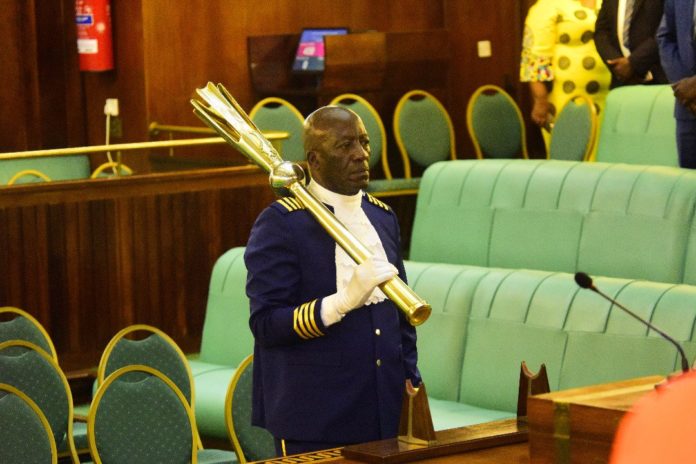
Sergeant-at-Arms of Parliament Mr Ahmed Kagoye,

The Sergeant-at-Arms of Parliament Mr Ahmed Kagoye, Kayunga District Health officer, and 43 other others have been awarded medals.

The Sergeant-at-Arms Mr Kagoye is the ceremonial custodian of the Mace and the implementer of all orders and actions requested by the Speaker. His main role is to provide a safe, clean and secure environment throughout the precincts of Parliament.

Kagoye and others were awarded during the celebrations to mark the National Resistance Movement-NRM 37th anniversary which was held at Kakeeka grounds in Kakumiro District.

The medals awarded included; the Damu medal, Nalubaale medal, golden jubilee medal, Diamond Jubilee medal, Luwero Triangle medal and National Independence medal among others.

This year’s theme was; ‘Our resolute effort to transform Uganda is a promise we shall fulfill’.

37 people were awarded the Independence medal, Nalubaale medal –five, Damu medal-two and Luwero Triangle medal –one person.

The medalists include Dr. Robert Ssentongo, a health officer who hails from Kayunga district. He is a highly trained and skilled healthcare worker with a passion for the rural population.

As the president of the Association of surgeons of Uganda, he participated in and advocated for free rural surgeon camps in all regions of Uganda. The surgical camps have since grown and are eventually emulated by other fields of medicine to reach out to the underprivileged Ugandans.

Others included Dr. Ahmed Matovu, the District Health officer for Kayunga who has ventured into research and made several publications in the field of medicine for example factors influencing uptake of prevention of mother-to-child transmission of HIV in healthcare facilities in Kabalole district and use of anti-malarial drugs a case study of Kayunga hospital.

Dr. Mukhtar Mohammed (RIP), the founder of St. John’s Ambulance Service; Mujuni Edigar, Bonny Omar, and Tebusweke Derrick took part in the designing and launch of Uganda’s first Satellite.

Speaking during the celebrations, Museveni said “Uganda already entered the middle-income country status but you need three years consecutively to be recognized as a middle-income country and in my view, all these are low targets that Uganda will easily surpass.”

He said by the end of 2023, GDP per capita will be USD 1067. “You will remember that for every middle-income category, you need a GDP per capita of USD 1039 for three consecutive years. This is now the second financial year. We have been in that category. So we have already entered the middle-income countries have been talking about.”

He said he has woken up Ugandans from this sleep of ignorance.

“We are going to add value to coffee and other raw materials. These broad-spectrum value addition movements will jumpstart our economy to a half-trillion-economy of $500bn.”

“We are going to add value to our coffee and the other raw materials like maize minerals, etc. This broad spectrum value additional movement will jumpstart our economy in a very short time to a half trillion economy of USD 500billion I don’t want to hear economy of 48 billion, 50 billion, 60 billion,” he said.

He said Patriotism, Loving in Uganda, and pan-Africanism-loving Africa reoriented the Ugandans from following the politics of identity, tribes’ religion, gender, etc.

Stories Continues after ad

Africa enters New Year with low #Covid-19 cases

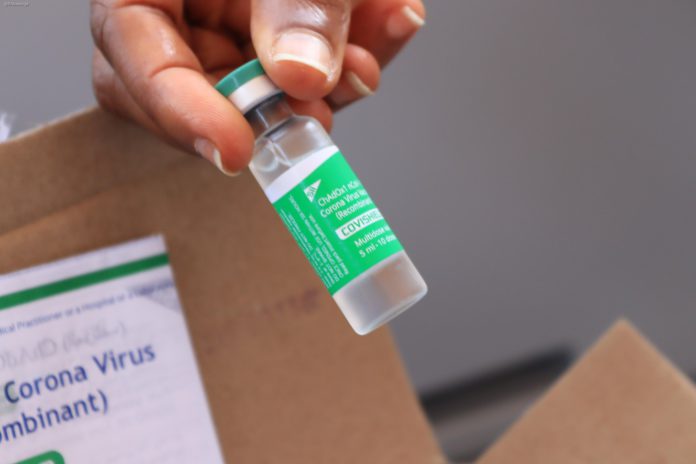
Covid-19 vaccine

For the first time since the beginning of the pandemic, Africa is emerging from the holiday season without a significant increase in COVID-19 cases.

A total of 20,552 new cases were recorded in the first three weeks of January 2023, representing a 97% drop from the same period last year. However, an increase in cases has been reported in South Africa, Tunisia, and Zambia in the last two weeks. The decline in the number of newly reported cases may be partly due to low rates of COVID-19 testing. Still, it is critical to note that hospitalizations for severe COVID-19 and deaths have decreased significantly. As of 22 January 2023, 88 COVID-19-related deaths have been reported in the Region, compared to 9,096 for the same period in 2022.

“For the first time since COVID-19 turned our lives upside down, January is not synonymous with a rise in cases. Africa enters the fourth year of the pandemic with the hope to move out of emergency response mode,” said Dr Matshidiso Moeti, World Health Organization (WHO) Regional Director for Africa. “However, with variants still circulating, it is important that countries remain alert and put measures in place to effectively detect and control any further spikes in infections.”

In 2022, Africa did not experience major pandemic peaks, outbreaks lasted an average of three weeks before fading. In contrast, in 2021, the continent experienced two pandemic waves caused by more transmissible and deadly variants.

With the number of new cases gradually slowing down over the past year, the low transmission of the virus is expected to continue in the coming months, with possible occasional increases. However, it remains essential that countries maintain their capacity to detect and respond to any unusual outbreaks of cases effectively.

Over the past year, as African countries have stepped up efforts to expand immunization, only 29% of the continent’s population has completed the primary immunization series by 22 January 2023, up from 7% in January 2022. However, the vaccination rate for adults aged 18 and older has increased from 13% in January last year to 47% currently.

However, only four countries in the African Region have vaccinated more than 70% of their population, 27 have vaccinated between 10% and 39%, while 11 have covered between 40% and 70% of their population. Immunization of high-risk populations has seen some progress with 41% of health workers fully vaccinated in 28 countries and 38% of older people in 23 countries.

To further expand immunization coverage, in addition to immunization campaigns, it is important to integrate COVID-19 vaccination into routine healthcare services that take into account the needs of the most vulnerable. So far, 12 African countries have started integrating COVID-19 vaccination into mainstream health services.

“As the trajectory of the pandemic evolves, so must our approach. We are helping countries put in place effective ways to ensure COVID-19 vaccines are available, accessible and provided over the long term,” said Dr. Moeti. “We know from experience that huge gaps in immunization can be the perfect opportunity for the resurgence of vaccine-preventable infections. Even though COVID-19 cases are declining, the pandemic can take an unexpected turn. But we can rely on vaccines to avoid a disastrous outcome.”

COVID-19 vaccination remains essential to protect against severe illness and death, as the virus continues to circulate and mutate.

In Africa, Botswana and South Africa are the only countries to have detected the Omicron XBB.1.5 sub-variant, one of the sub-lineages with public health implications. Genomic sequencing has slowed as COVID-19 testing rates have declined. Over the past week, only three countries have reached the WHO benchmark of five tests per 10,000 people per week, compared to 25 at the same time in 2022.

So far this year, 1896 sequences have been submitted. At the same time last year, 7625 sequences were made. Sequencing is essential to track variants and contribute to the preparation of a rapid and effective response.

Stories Continues after ad

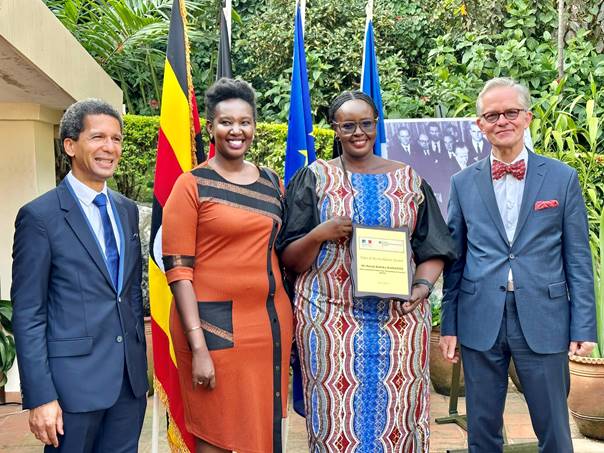
Sarah Kihika wins Franco-German Peace and Reconciliation Award 2023

French Ambassador H.E Xavier Sticker, 2021 Peace Award winner Phionah Nabaasa Wall, 2023 Award winner Sarah Kihika Kasande, German Ambassador H.E Matthias Schauer.

Ms. Sarah Kihika Kasande, a Ugandan lawyer, and advocate and Head of office of the International Centre for Transitional Justice (ICTJ) Uganda is the winner of the Franco-German Peace and Reconciliation Award 2023.

The ICTJ is an organ that works with victims of human rights violations to obtain redress and the responsible parties to account, reform and build democratic institutions, and prevent the recurrence of violence or repression.

On January 22, 1963, the signing of the Élysée Treaty by President Charles de Gaulle and Chancellor Konrad Adenauer sealed reconciliation between France and Germany for the benefit of a long and lasting era of peace and friendship between the two countries.

On January 22, 2019, President Emmanuel Macron and Chancellor Angela Merkel, signed in Aachen, a new Franco-German treaty on cooperation and integration.

To commemorate the 60th anniversary of this historic event and the fourth anniversary of the renewed partnership between France and Germany, Their Excellencies Mr. Xavier Sticker, Ambassador of France to Uganda, and Mr. Matthias Schauer, Ambassador of the Federal Republic of Germany to Uganda, hosted a Peace & Reconciliation Award Ceremony and a Reception on Friday January 20, 2023, at the French Residence in Nakasero.

Stories Continues after ad

NSSF disregards funding Tondeka Bus Project

The National Social Security Fund (NSSF) has disregarded allegations concerning the misuse of savers’ money to fund the Tondeka bus project

“We would like to clarify that this is not true. The Fund has not funded any activities of the said project as alleged,” NSSF stated.

NSSF has added that the Fund continues to preserve members’ savings through prudent investments in line with our investment policy.

“We remain committed to producing a better life for our members,” NSSF confirmed in a statement.

On 24th January, 2023 the Board Chairman National Social Security Fund (NSSF) Uganda Peter Kimbowa (PK), who is also the Founding Executive Chairman Tondeka Metro Company, was dragged to the Inspector General of Government (IGG) over alleged corruption, abuse and mismanagement of office.

The concerned citizen accused Kimbowa of diverting NSSF funds to fund the Tondeka bus project, which is a personal business.

THE PETITION READS;

As concerned members of NSSF, I wish this investigation to widen to include the activities of the chairperson of the board of directors Mr. Peter kimbowa for the following reasons:-

  1. Mr Kimbowa is a funding executive chairman, Tondeka metro company,
  2. In that capacity as funding executive chairman, Mr Kimbowa had been promising Uganda to put 900 buses on the streets of Kampala and the great Kampala metropolitan area for last 10 years,
  3. In September 2021 Mr Kimbowa was appointed chairman of the board of directors at NSSF.
  4. In mid-2022, Tondeka Company finally put over 10 buses on the streets of Kampala.

What a coincidence that no sooner had Mr Kimbowa been appointed chairman board of directors at NSSF than Tondeka was able to put buses on Kampala streets, something that had evaded them for a long time.

Could Mr. Kimbowa have used workers’ money for his personal business? And no sooner had the Tondeka buses appeared on our streets than allegations of corruption and abuse of office were raised at NSSF. I pray that your good office investigates Peter Kimbowa, the chairman of NSSF for possible corruption activities at NSSF.

Stories Continues after ad