Stanbic Bank
Stanbic Bank
24.5 C
Kampala
Stanbic Bank
Stanbic Bank
Home Blog Page 498

MTN Marathon raises Shs4 billion throughout the years

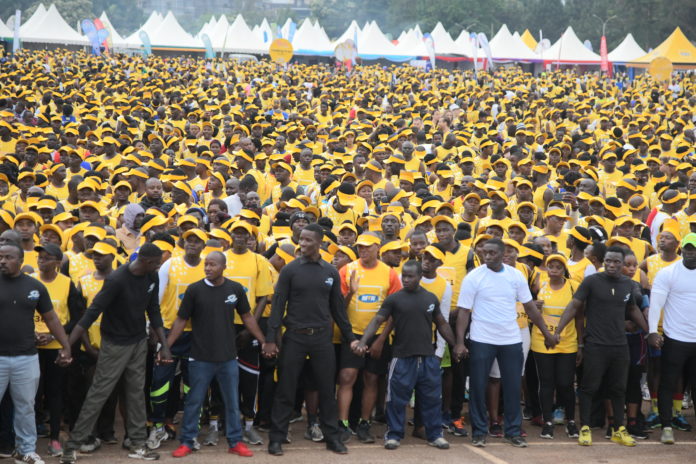
Participants at the MTN Kampala marathon

The MTN Kampala marathon is the biggest professionally run charity marathon in the region for the last 17 years garnering up to Shs4 billion plus monetary contributions over the years.

The MTN Kampala marathon was birthed in 2004 with MTN Uganda’s objective of doing good in the communities in which it operates.

Proceeds from the maiden MTN Kampala marathon in 2004 were used to support expectant mothers in the Internal Displaced Peoples (IDP) camps in Northern Uganda. The mothers who hardly had any belongings and a safe space to stay needed mama kits that would ease their child delivery process. This project was implemented by Uganda red cross.

From 2004 to 2006 the MTN Kampala marathon brought together over 7,500 participants that collectively raised Shs 82,500,000 towards the same cause for expectant mothers in IDP camps, in northern Uganda.

The goal then shifted toward the provision of resettlement kits from 2007 to 2009 to people who had been relocated back into communities having left the IDP camps in Northern Uganda. A total of Shs185 million was collected from over 46,500 people to cater to the refugees’ resettlement.

From 2010 to 2014, the MTN Kamala marathon dedicated its proceeds to water and sanitation in different communities in Northern Uganda. Different kinds of water points like boreholes were installed in the districts of Kiryandongo, Amuria, Nakapiripirit, and Kotido to improve the water supply and hygiene in these communities. In this period the marathon managed to raise close to Shs 1.5 billion from 98,000 participants.

The water points greatly improved the livelihoods of the people in these communities as they received access to clean water and no longer had to travel long distances to the water collection points.

From 2015 to 2016,Shs 1 billion was collected from 40,000 MTN Kampala marathon participants, and the proceeds were injected into the education sector, particularly in the installation and improvement of government schools around Kampala city.

A total of 10 schools got ultra-modern and hygienic toilet facilities. These schools were Kitante P/S, Kisaasi P/S, Kitebi P/S, Police P/S Nsmbya, Naguru Katali P/S, Nakasero P/S, Namungoona P/S, Munyonyo Church of Uganda P/S and Kampala school for the handicapped.

The toilets were fitted with biogas digesters to make biogas that serves the important purpose of preparing timely meals for the students using clean, effective, and environment-friendly energy.

This saved the schools from incurring high costs for cooking materials such as firewood and in turn contributed to the preservation of the environment by reducing deforestation.

In 2017 the marathon proceeds of Shs600 million were used for the improvement of maternal health and the reduction of cancer exposure in 2 facilities and one school by replacing the asbestos iron roofs. The beneficiaries were Buganda Road primary school, Komamboga, and Kiswa health centers.

Since 2018, the marathon proceeds were committed to a new cause of improving maternal health care across the country.

A total oShs600 million was collected over the two years from over 35,000 runners and the MTN Foundation made an additional contribution of Shs400 million bringing the proceeds to a whooping Shs 1.1 billion. The collected funds were used to refurbish and equip 4 health centers (HC IV) in the country.

The health centers included Muyembe HC IV in the Bulambuli district. Karugutu in Ntoroko district, Kalangala HC IV in Kalangala district, and Kawempe women and children’s hospital in Kampala.

After a two-year break, the MTN Kampala Marathon is back focusing on the still-pressing issue of maternal health. Proceeds from this year’s Marathon shall be used to improve maternal and newborn services in four selected health facilities across the country. The beneficiary health facilities include Kisenyi and Kawaala health facilities in the suburbs of Kampala plus Kachumbala and Kaboongin the Teso and Karamoja sub-regions respectively.

MTN Uganda with support from partner companies including Stanbic bank, Rwenzori beverages, NBS sports, Huawei, and New Vision with Uganda Athletes Foundation is organizing the 17th edition of the MTN Kampala Marathon, under the theme, Run for babies.

The MTN Kampala Marathon has, over the years raised over Shs 4bn and benefitted several people in the communities where beneficiary projects have been implemented.

Stories Continues after ad

Museveni meets UAE’s One Mobility Group, urges cooperation with Kiira for mass public transport system

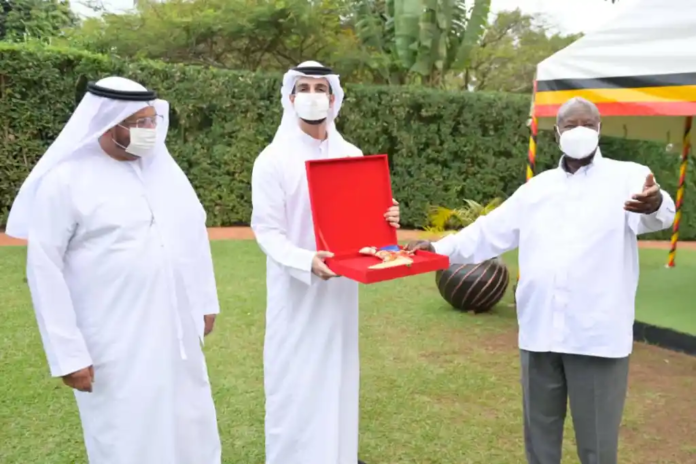
President Yoweri Museveni on Thursday met a delegation of United Arab Emirates (UAE)-based One Mobility Group at State House Entebbe. The group is a multi-national company that owns and operates companies that deal with all means of private and public transport along with the ancillary services.

During the meeting, the Group expressed interest to extend their services to Uganda by improving Kampala’s mass public transport system.

President Museveni gave them a go ahead but on condition that they must use buses made or assembled from Uganda.

“I’m very glad to hear that idea. The only point I would have added, you seem to have already worked on it because those buses I want them to be made here. You should use buses either made or assembled here because that is what we are planning. We are planning to make the buses using those people of Metu and Kiira Motors,” Mr. Museveni said.

“If you can come in and work with them to operate, that will be very good. You must work with them. We don’t want to use imported buses, we want to use our own buses here,” he further told the visiting delegation.

The President also suggested that the Prime Minister, Rt. Hon. Robinah Nabbanja calls for a meeting between One Mobility Group, Kiira Motors and Metu to see how they can move forward together.

“The benefits of this initiative are very clear; less traffic jam , less fuel  and time saving,” he added.

The Vice Chairman of One Mobility Group, Mr. Omeir Mohamed Omeir Yousef AlMheiri assured Gen. Museveni that they are very much ready to work with the two local bus manufacturing companies in order to achieve a common goal of putting an end to the traffic congestion in Greater Kampala Metropolitan Area.

“We have got broad interests in Uganda and we are here particularly today regarding the Bus Rapid Transport System. We are very keen to be part of the public transport system and we are looking forward to that with the help of our government and the support of the Ugandan government as well,” Mr. Mohamed stated.

“We are very much open to work with everyone here as long as it fits the international standards and in terms of supply if they can meet the required timeframe, we shall be more than happy to work with anyone. At the end of the day, our aim is to provide a more affordable solution to the people of Uganda to move around in a more effective manner.”

The group which so far manages and operates public transport in Abu Dhabi, other Arab Countries, North Africa, Tanzania and Kenya also plans to integrate the minibuses and boda bodas into this system.

“Your Excellency, there are millions of Ugandans travelling from sub urban areas to the city on a daily basis and that means that there’s so much time wasted in traffic and that translates to costs and expenses to the government. So with this system, we are looking to find an effective and a more lively solution to Ugandans to be able to travel efficiently,” Mr. Mohamed noted.

From managing the tremendously successful Fast Rent a Car, One Mobility Group has evolved to preside over a plethora of companies ranging from car hire, limo, taxi services and public transport services and maintenance facilities, excelling in each of these fields.

The company has grown from strength to strength, adopting a highly ambitious, quality-driven, goal-orientated business methodology that evolves with the market needs and requirements.

The meeting was also attended by Uganda’s Ambassador to UAE, Mr. Zaake Kibedi who led the One Mobility Group delegation,

Mr.Ahmed Abood Saleh Al Boasy Al Yafei – the Group Chief Executive Officer and Mr. Istvan Csuzi – the Group General Manager.

Stories Continues after ad

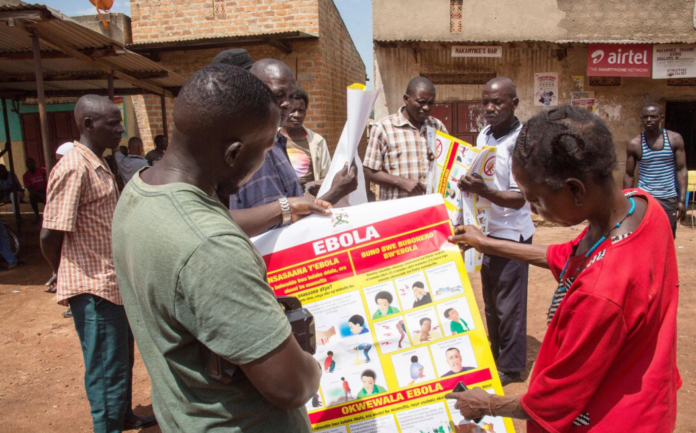
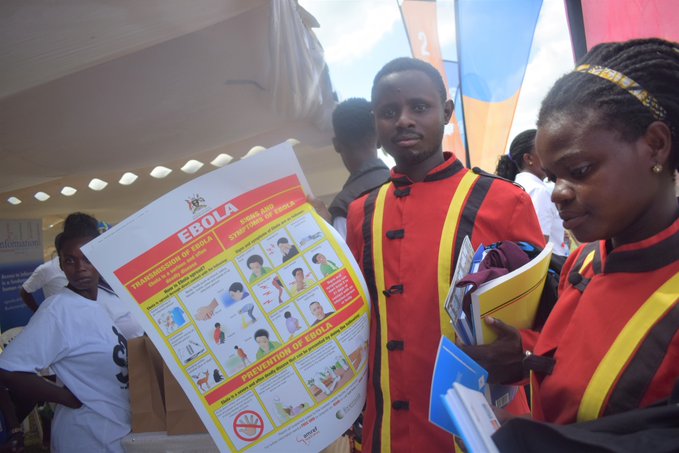
Contact tracers and Village Health Teams take on Ebola in Uganda

Ebola contact tracers

Since an Ebola outbreak was declared in Uganda on 20 September, health assistant Nyangoma Kirrungi has been on the frontline of the country’s response day in and day out, working as a contact tracer in Madudu sub-county, one of the areas affected by the outbreak.

With support from World Health Organization (WHO) and partners, the Ugandan Ministry of Health has trained and deployed around 300 contact tracers like Kirrungi, who play a critical role as the country looks to curb the spread of the disease.

As part of surveillance team, Kirrungi follows up an average of 40 contacts a day. “I work closely with the investigation unit,” she explains. “Once they record a confirmed case of Ebola, my team and I go to the field to follow up with the patient’s contacts to ensure that they are symptom-free and then we remain on alert to identify and report symptoms should they develop.”

According to Dr Bernard Logouomo, the Ministry of Health Surveillance Team Lead in Mubende District, another Ebola-hit area in the country, contact tracing is key to ending the outbreak. “When the community cooperates in the response and contacts are identified, it becomes easier to contain the disease,” he says.

Contact tracers follow a questionnaire designed to assess if a contact has Ebola symptoms. Every contact tracer works with a maximum of 10 village health workers, who are volunteers trained in diseases surveillance. Recruited by communities, village health teams help build trust and overcome fears among responders.

In addition to the deployment of contact tracers, two hotlines were created for communities to report suspected cases. Investigators follow a list of questions designed to assess the need to dispatch an ambulance or a clinical officer. Once a case in confirmed, a case investigation team establishes a list of contacts, depending on where the patient was likely to have been infected and who they may have met afterwards.

After contacts have been located and screened, village health teams take over to monitor them for any symptoms for 21 days ‒ the Ebola incubation period. Beyond this important supporting role, these teams also provide invaluable assistance in raising awareness of the disease within their communities. Since the start of the epidemic, the Ministry of Health has trained over 1200 village health team members, also with support from WHO and partners.

With only 25% of contacts followed up every day in the first days of the outbreak, contact tracing quickly improved. By mid-October, nearly 94% of 552 contacts were seen and monitored daily for 21 days.

Lydia Nasamba, a market trader and a resident of Madudu, has been a member of a local village health team for more than eight years. “Every day at 3pm, I go to the sub-county community radio station, where I raise awareness about Ebola ‒ its symptoms, preventive measures and how to report cases,” she says. “After that, I visit the identified contacts in my community to check their health status.”

While the contribution of people like Kirrungi and Nasamba is a crucial component of Uganda’s Ebola response, they face numerous daily challenges, including a lack of personal protective equipment and reliable transport. Contact tracers are often faced with community members’ fear of being stigmatized or isolated in a health facility, which puts people’s livelihood at risk. Contacts may also not be home when contact tracers visit them, which makes it difficult to monitor them on daily basis.

With support from the United States Agency for International Development and the Norwegian government, WHO has provided four Ebola kits to Mubende Regional Hospital and redeployed 108 technical staff to assist with case management, risk communication, community engagement and laboratory testing.

Back on the ground in Madudu, nothing will deter Kirrungi from the task at hand. “Since I have been involved in the Ebola response, I feel like I am saving lives. I have learned that if all contacts are identified and treated, the disease will disappear,” she says. “That’s what motivates me every day.”

Stories Continues after ad

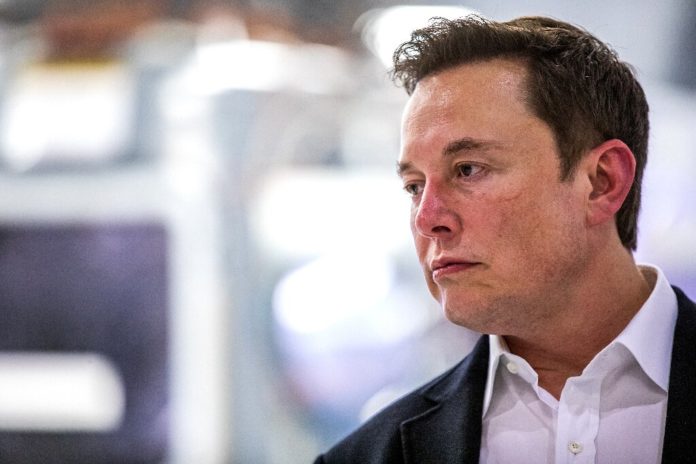
Elon Musk completes $44bn Twitter takeover

Elon Musk
  • Elon Musk has officially taken control of Twitter after finalising a $44bn deal to buy the social media network.

In one of his first decisions at the helm of the social media giant, Musk, the world’s richest man, fired three top executives including CEO Parag Agrawal, multiple United States-based media outlets reported on Thursday, citing people familiar with the matter.

Chief Financial Officer Ned Segal and Vijaya Gadde, head of legal, policy, and trust, were also let go, according to the reports.

Sean Edgett, Twitter’s general counsel, was also fired, the Washington Post reported, citing an unnamed source.

Following the reports, Musk tweeted “the bird is freed”, referencing the social media network’s bird logo.

Musk and Twitter have yet to confirm the firings.

The Tesla CEO’s purchase caps a six-month saga that saw Twitter initially resist Musk’s purchase offer and then sue the billionaire after he signalled he would nix the deal over concerns about spam accounts and whistleblower claims about lax cybersecurity practices.

Musk’s interest in the platform has become a lightning rod for the debate around free speech in the digital age. Critics have expressed concerns that Musk’s reign could mean open slather for hate speech and misinformation, while many conservatives have heralded the takeover as a corrective to Big Tech censorship of politically incorrect views.

Musk, who describes himself as a “free speech absolutist”, has criticised Twitter’s moderation policies and objected to censorship that goes beyond the requirements of the law. In May, Musk said he would reinstate former US President Donald Trump’s Twitter account, which was removed for allegedly inciting violence in the wake of the January 6 riots at the US Capitol.

Musk has also expressed discomfort with the platform’s reliance on advertising and is widely anticipated to oversee significant job cuts at the company, although he has reportedly denied a Washington Post report suggesting he plans to slash 75 percent of the workforce.

In a lengthy message posted on Twitter before the purchase deadline on Friday, Musk, who earlier changed his Twitter bio to “Chief Twit”, denied any intention to turn the platform into a “free-for-all hellscape”.

“The reason I acquired Twitter is because it is important to the future of civilization to have a common digital town square, where a wide range of beliefs can be debated in a healthy manner, without resorting to violence,” he said.

Musk, who has cast himself as a moderate, regularly weighs in on politics and has attracted criticism with unorthodox proposals for handling geopolitical flashpoints ranging from Taiwan to Ukraine.

The billionaire earlier this year announced he would vote Republican in upcoming elections as the Democrats had become the “party of division and hate”, but later said he supported moderate candidates from both parties.

Stories Continues after ad

Is lockdown a solution to stop the spread of Ebola?

Some Ugandans are already divided over the issue of whether to lockdown the nation because of Ebola or not. Some of these people include medics and politicians.

On Thursday some Members of Parliament have showed their side by being against a proposal by the President of the Uganda Medical Association (UMA) to have Kampala city put under lockdown as a measure to prevent the spread of Ebola Virus Disease

MPs have encouraged government to do designated sharpening to the general population on the significance of noticing the Standard Operating Procedures (SOPs), contending that a lockdown would extraordinarily influence the economy since Kampala is a business center.

Ronald Balimwezo, Nakawa East Division MP, noted that there ought to be cooperative endeavors to stop the spread of Ebola by including non- governmental organizations to sharpen the majority on how Ebola infection is sent and the way that it very well may be forestalled.

Workers MP, Abdulhu Byakatonda, said another lockdown would just additionally hurt businesses that are still recovering from the impacts of the Coronavirus pandemic.

It seems health workers enjoy when people are in lockdown and they are the only ones accessing everywhere.

Dr. Sam Oledo recommended a lockdown for the city as was done for Kassanda and Mubende district, the central point of the episode. Dr Oledo communicated fear that the government is perched on a time bomb, cautioning that the most terrible is on the way assuming nothing is done in the briefest time conceivable to contain the spread of the viral sickness.

Dr Oledo noticed that Ebola is certainly not a ‘political sickness’, encouraging Ugandans to take additional carefulness.

“Kampala should have restriction of movement, let us hold Kampala when it is still early. The earlier we lockdown Kampala the better. Ugandans are still taking it as something so minor. It is catastrophic that right now, people are not even reporting cases,” Dr Oledo said.

Stories Continues after ad

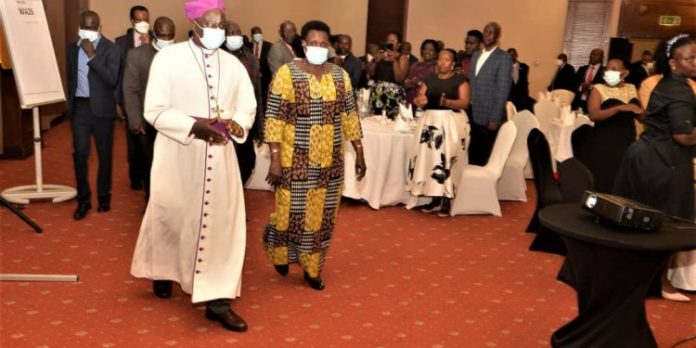
Vice President Alupo contributes heavily to Jubilee SACCO

Through her Twitter, Pamera Ankunda, a communication specialist from state house revealed that last evening, Vice President Jessica Alupo joined the Rt. Rev Bishop Twinomujuni of West Ankole at the Patrons dinner, to raise funds for the Jubilee SACCO, the business arm of the Church.

According to her, over Shs 200 million was raised in cash. The Vice President who was the guest of honor bought shares worth Shs10 million and contributed Shs20 million to the seed fund.

It started with a few collections from the pay of the clergy, but the dream has grown into the Jubilee SACCO that it is today with four main branches of Bushenyi, Sheema,Mitooma and Rubirizi, with other out reaches, over 10,552 members, an asset value of close to Shs12 billion, a share capital of Shs 2.4 billion, and a savings of Shs7.6 billion.

She congratulated the members of the SACCO for the 25 years of existence and announced a renewed partnership between the church and the Government in carrying out developmental activities.

“The church from time immemorial has been working tirelessly with the Government, in implementing different programs. Throughout the history of Uganda, religious institutions are key in the establishment of programs and institutions that have produced very distinguished people.

“As government, we value you and your efforts in the transformation of our country”, the Vice President remarked. “You are very valuable partners for the good of humanity”, she added.

Alupo expressed her appreciation to efforts by the Church, the Bishop and the members in multiplying the seed capital, the share capital and the membership.

“I want to encourage you to continue with the spirit of multiplying,” she said, while re-echoing the words by Prof Kamuntu, one of the attendees and a parishioner from West Ankole who had earlier said that the value of money increases when it is in circulation. “Multiply the money to keep it valuable”, he had remarked.

The Vice President also re-assured the audience of the Government’s continued support to SACCOs, because, she said, people in the rural areas need a strong seed capital for their SACCOs to become stronger and to grow, while leaving no one behind.

In his remarks, Bishop Johnson Twinomujuni of West Ankole Diocese expressed his gratitude to the Vice President saying her presence signified her dedication to development.

“This is yet another time you are demonstrating love for Western Ankole in particular and the church in general. Thank your Excellency for demonstrating good qualities of a leader”, he said, in a mark of gratitude.

The Bishop thanked the laity of West Ankole for being determined to bring development not just to Ankole, but to the entire country. “Our country is going to greater heights because God has blessed our country. He has blessed us with fertility, richness and good people. There is solid hope that this country is heading for a brighter tomorrow, Bishop Twinomujuni said”.

He thanked President Museveni who he said had briefed on the need for increased support to church SACCOs. “The President welcomed this idea and we look forward to it”. The Bishop added, as he expressed deeper sentiments. “Thank you for joining us to lighten our burden,” he said.

Bishop Twinomujuni also preached lightly, advising the guests that for one to make it in life, “our duty is not to see through one another, but to hold one another and see them through”, Bishop Twinomujuni said.

The Chairman of the SACCO-Jonas Tumwine gave a detailed account, describing the SACCO as the business arm of the Church. “A wealthy Christian will Glorify God”, he said, adding that Jubilee SACCO is growing the people. He gave an account of what transpired during the Covid 19 pandemic when most of the members withdrew their savings. “People thought they were going to die, and withdrew what they had, we went back to our original intention, to help communities access affordable credit and alleviate poverty. It is also our effort to bring grassroots people into the money economy, hence establishing a seed fund of the Jubilee SACCO.”

Tumwine thanked the Government for providing tranquility, where people are able to do business uninterrupted.

Winston Katushabe, the Bishop’s nominee for the Kampala Chapter and organizer of the dinner announced a seed capital pledge of Shs 70 million from members of the Kampala Chapter.

The Diocesan head of Laity-Willis Bashaasha applauded the church in complementing the Government in fighting poverty. “We try to support the transformation journey to improve household incomes for better livelihoods”, Bashaasha remarked.

Several people made donations and contributions to what they describe as a SACCO with a Difference seeking to have an economically empowered Christian community.

Over Shs 200 million was collected, including money from the Church emblem which was auctioned at the dinner.

“There are things that last forever. This is a treasure you can bequeath your children”, said Prof. Ephraim Kamuntu as he led the auction

Established in 1997 as an initiative of West Ankole Diocese, Jubilee SACCO has grown in both numbers and portfolio.

The growth of Uganda Savings and Cooperative Societies(SACCOs) in Uganda can be attributed to a number of factors, ranging from strong regulatory framework to the performance output of the existing ones.

Stories Continues after ad

I want to be President – Muhoozi

Gen. Muhoozi Kainerugaba

Gen Muhoozi Kainerugaba, a son to President Yoweri Kaguta Museveni, has promised to pay back a gift to his mother Janet Kataaha Museveni of leading Uganda as its president.

Using his Twitter account, he vowed that he has nothing to pay to his beautiful mum for good deeds to him and his family, apart from being a president of this nation.

He tweeted this Thursday afternoon, “The only way I can re-pay my great mother is by being President of Uganda! And I shall definitely do it!”

The tweet did not take netizens by surprise since he had alerted them by mentioning how he would celebrate with her the next day. In his tweet he said “My mother has always been an angel for me. She is simply perfect! Like most men feel for their mothers!!!”

The post has been welcomed by many people in both positive and negative ways. This is shown in the feedback by the different twitter users.

“The generation is very ready to vote for you General, Sir, The MK Movement is unstoppable! I know your future is great and bright, and I can’t wait to see you shine like you should. God bless you Our Generational leader!” Atuzarirwe replied.

Pinkason Ahumuza reminded the tweeting general that God chose him a long time ago as the next president of the republic of Uganda!!

Muhoozi Kainerugaba parody account affirmed it “If you want to know if a person is serious about his goals look at the reasons he is doing it for. In this case the mother, the one who holds unconditional love, watches him win”.

“You are President in Waiting Your Excellency to be Gen Just know it’s a sure deal 100%. Sit down and relax as we comb villages and towns for Votes as we await Papa Mzee to say on your marks, Songa Mbere. We are on Standby Class One Supreme Leader. We’re 65%.” Balaam Barugahare reacted.

Gen Kainerugaba has for the past two years been described as a tweeting General who engaged on so many issues, including foreign relations of this country. He has severally been hinted to becoming the next President of Uganda.

However, several opposition politicians have called on President Museveni to punish his son, Gen Kainerugaba for defying the UPDF act and commented on Partisan Politics.

Earlier this month, Gen Kainerugaba tweeted that he and his army would capture Nairobi, the capital of the neighboring Kenya in two weeks raising a diplomatic uproar.

He was later relieved of his duties as commander of the land forces and replaced by his longtime ally, Gen Kayanja Muhanga. Gen Muhoozi was however promoted by President Museveni from the rank of a Lt Gen to a full General of the Ugandan Military.

From the look of the things, campaigns are already going on by organizing parties to celebrate his birthday and many other related activities. He also now holds the MK Army that mobilizes youths across the country into several political and other income generating activities.

Gen Muhoozi is the first son of President Museveni and his wife Janet Kataaha, who is the current minister of Education and Sports. Muhoozi is followed by only girls like Natasha Karugire, Patience Rwabwogo, and Diana Kamuntu

Stories Continues after ad

Janet Museveni bids farewell to outgoing French Ambassador

The First Lady and Minister of Education and Sports Mrs. Janet Museveni has met the outgoing Ambassador of France to Uganda, H.E Jules-Armand Aniambossou at State House Nakasero and bid him farewell as she lauded the good relations that Uganda has with the French Government. 

“Uganda has had good relations with the French Government, and it is my desire to see the relations and partnerships between the French Embassy and Uganda’s Education and Sports sector continue to grow,” Janet said.

“We pray that you go in peace and remember Uganda as your second home,” she prayed.

H.E Aniambossou will now embark on his new diplomatic duties as the French Ambassador to Accra, Ghana. 

While meeting President Museveni last week, the Ambassador commended Uganda’s vibrant arts, culture, and creative industry saying the government should put more effort in discovering and supporting talent in Uganda which has the potential in fighting unemployment.

“Maybe In about 10 years from now, the creative industry will create more money than oil, People will not have to look for jobs,” H.E Aniambossou said. 

He added that the Uganda government should also consider having a minister for arts and culture.

Stories Continues after ad

Col Justus Rukondo assumes office as Wazalendo SACCO Chairman

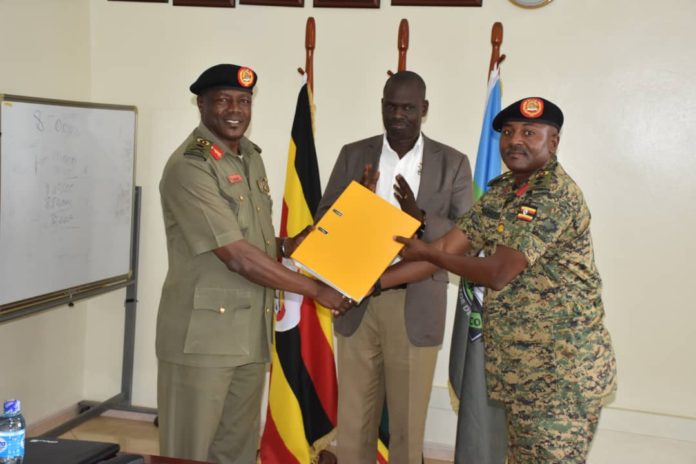
Brig Gen Simon Nicholas Ocan hands over office to Col Justus Rukondo.

The Chairman Supervisory Committee (SUPCO) of the Uganda Peoples’ Defence Forces (UPDF) Savings and Cooperative Society Limited, commonly known as Wazalendo Sacco (WSACCO) Brig Gen Simon Nicholas Ocan handed over office to Col Justus Rukondo.

The hand/take over function happened today at WSACCO headquarters in Kiwatule, Kampala.

This follows the deployment of Brig Gen Simon Ocan to Burundi as Uganda’s Defence Advisor.

Brig Gen Ocan was elected as the Chairman SUPCO during the 16th Annual General meeting held on 24th March 2022 at Uganda Military Engineering College in Lugazi, Buikwe District.

In his handover remarks, Brig Gen Ocan appreciated the UPDF leadership for the new task.

He congratulated the incoming Chairman Col Justus Rukundo and asked the SUPCO team to maintain cooperation with the Board of Directors and Management so that they collectively enable WSACCO to deliver on its mandate.

Gen. Ocan asked the three organs of WSACCO to work towards achieving the social objective of improving members’ welfare, which he said, is the purpose for which WSACCO was established.

He also thanked the Board Of Directors and Management for expanding WSACCO branch network and creating convenience to members using diverse channels of transacting including mobile banking.

At the time of his appointment as Defence Advisor to Burundi, Brig Ocan was serving as General Secretary for the National Defence College – Uganda (NDC-U) based in Jinja district.

 Gen. Ocan also served WSACCO in different capacities, including among others; Chairman SUPCO 1st March – 26th October 2022, Chief Executive Officer 2015- 2019, Chairman BOD 2010- 2012 and Vice Chairman BOD 2008-2010.

On behalf of the Board, Col Dan Tizihwayo congratulated Brig Gen Ocan upon his new appointment, saying that the Board of Directors appreciates his efforts. He pledged total support to the Committee to perform better.

WSACCO’s Chief Executive Officer Col Joseph Freddy Onata applauded Brig Gen Ocan for his commitment, zeal and the love for WSACCO towards the growth of the SACCO.

He cautioned members of SUPCO to emulate the work ethic of Brig Ocan that has enabled him to leave behind an admirable legacy.

 Col Onata pledged his commitment and support to enable SUPCO to discharge their duties.

The incoming Chairman Col Justus Rukondo extended his sincere gratitude to Gen Ocan for mentoring him and entrusting him with the responsibility of Chairman SUPCO.

Col Rukundo described Gen Ocan as a selfless leader who gives all the right information and experience to all his subordinates. “I took over as Vice Chairman SUPCO when I did not know much in terms of SACCO supervision, but through the mentorship and methods of work of Gen Ocan, I have been able to read from his notes and learn from his experience,” Col Rukundo noted.

The Supervisory Committee (SUPCO) now comprises the following members: Col Justus Rukundo as Chairman, Maj Alex Kijuma Asiimwe – Vice Chairman and Lt Asha Praise Mbwali  as Secretary.

Stories Continues after ad

Shortage of cholera vaccines leads to temporary suspension of a two-dose strategy

A strained global supply of cholera vaccines has obliged the International Coordinating Group (ICG) — the body which manages emergency supplies of vaccines to temporarily suspend the standard two-dose vaccination regimen in cholera outbreak response campaigns, using instead a single-dose approach. 

The pivot in strategy will allow for the doses to be used in more countries, at a time of the unprecedented rise in cholera outbreaks worldwide.

Since January this year, 29 countries have reported cholera cases, including Haiti, Malawi and Syria which are facing large outbreaks. In comparison, in the previous 5 years, fewer than 20 countries on average reported outbreaks. The global trend is moving towards more numerous, more widespread and more severe outbreaks, due to floods, droughts, conflict, population movements and other factors that limit access to clean water and raise the risk of cholera outbreaks.

The one-dose strategy has proven to be effective to respond to outbreaks, even though evidence on the exact duration of protection is limited, and protection appears to be much lower in children.  With a two-dose regimen, when the second dose is administrated within 6 months of the first, immunity against infection lasts for 3 years.

The benefit of supplying one dose still outweighs no doses: although the temporary interruption of the two-dose strategy will lead to a reduction and shortening of immunity, this decision will allow more people to be vaccinated and provide them protection in the near term, should the global cholera situation continue deteriorating.

The current supply of cholera vaccines is extremely limited. Its use for emergency response is coordinated by the ICG which manages the global stockpile of oral cholera vaccines. Of the total 36 million doses forecast to be produced in 2022, 24 million have already been shipped for preventive (17%) and reactive (83%) campaigns and an additional 8 million doses were approved by the ICG for the second round for emergency vaccination in 4 countries, illustrating the dire shortage of the vaccine. As vaccine manufacturers are producing at their maximum current capacity, there is no short-term solution to increase production. The temporary suspension of the two-dose strategy will allow the remaining doses to be redirected for any needs for the rest of the year.

This is a short-term solution but to ease the problem in the longer term, urgent action is needed to increase global vaccine production.

The ICG will continue to monitor the global epidemiological trends as well as the status of the cholera vaccine stockpile and will review this decision regularly.

Stories Continues after ad