Stanbic Bank
Stanbic Bank
19.8 C
Kampala
Stanbic Bank
Stanbic Bank
Home Blog Page 504

Two UTC Kichwamba officials arrested, charged over abuse of office

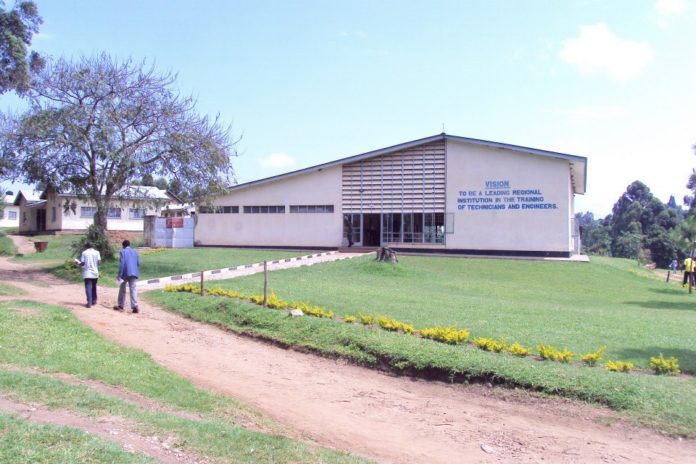
Uganda Technical College (UTC) Kichwamba

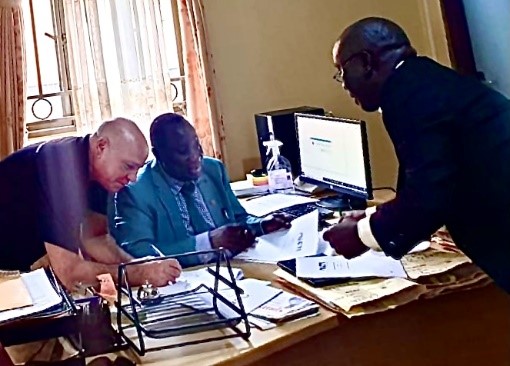
The Inspectorate of Government (IG) has arrested and charged two senior officials of Uganda Technical College (UTC) Kichwamba over abuse of office.

These include the Principal UTC Kichwamba Mr. Silver Mukwasiibwe, 58, and the Deputy Principal Mr. Joseph Nyakojo, 56.

The other official who was charged but not arrested is Mrs. Grace Tibanagwa, 58, UTC Kichwamba’s Accountant / Bursar.

Mr. Mukwasiibwe was charged with Abuse of Office contrary to Section 11 of the Anti-Corruption Act as amended.

Between July and October 2022, while performing his duties as Principal UTC Kichwamba in abuse of authority of his office irregularly procured goods and services worth Shs130,659,500 contrary to provisions in the Public Procurement and Disposal of Public Assets Act, thereby causing financial loss of Shs83,424,300 meant for various activities at the Institute, acts that were prejudicial to the interests of his employer.

Mr. Mukwasiibwe was also charged with diversion of Public Resources. While performing his duties as a Principal, UTC Kichwamba, he disposed of Shs79,825,705 to pay for various activities unrelated to those for which they were intended.

Mr. Mukwasiibwe and Mrs. Grace Tibanagwa between the months of July 2020 and June 2022 while employed as Principal and Accountant of UTC Kichwamba respectively, in the performance of their duties paid Shs 233,869,800 meant for different activities to different people for no work done with knowledge or reason to believe that their acts would cause Kichwamba Technical Institute financial loss and indeed caused financial of Shs233,869,800.

Mr. Nyakojo, Deputy Principal Academic Affairs, Research and Innovation of UTC Kichwamba between November 2021 and September 2022, stole Shs22,000,000 being the property of his employer, which he had access to by virtue of his office.

The accused are scheduled to appear before the Anti-Corruption Court today 17th November 2022 to take plea in the matter.

Stories Continues after ad

Law to strengthen operations of stock markets in offing

Keith Kalyegira CEO of CMA

Operations of stock markets are expected to be strengthened, once the proposed Capital Markets Authority (Amendment) Bill, 2022 is enacted.

Parliament, chaired by Speaker Anita Among granted Jinja South Division East MP Nathan Igeme leave to introduce the Private Member’s Bill during plenary sitting on Wednesday, 16 November 2022.

Igeme justified that the law will clearly provide for the functions of the Capital Markets Authority (CMA) and regulate the conduct of approved persons, as opposed to regulating products and activities which is the current practice.

“The CMA Act creates confusion in the mandate of the Authority by granting the power to make regulations, providing for fees to be charged for regulated activities in capital markets, yet the Act does not make provision for regulated activities but provides for approved and regulated persons,” Igeme said.

He added that the proposed law Incorporates objectives and principles of the International Organisation of Security Commissions (IOSCO) into the CMA.

“Uganda as a member of IOSCO has an obligation to incorporate the IOSCO objectives and principles of security regulation into its legal framework that governs the capital markets industry,” Igeme said.

The 2016 amendment, Igeme said, expanded CMA powers into prudential regulations which power are akin to the Bank of Uganda in the banking sector, without regard to IOSCO requirements to restrict such regulation by CMA.

The law also seeks to designate an approved stock exchange as the listing authority and to make provisions for a single entity to scrutinise, certify and approve prospectuses.

“The conduct of regulated entities has never been given a central focus in the regulation of securities markets,” Igeme said.  

Kazo County MP Dan Kimosho, who seconded the motion, said that the law is intended to attract many players in the capital markets by reducing restrictions in that sector.  

“Aware that many any other businesses are going down, this is one of the safest areas of investment and it would be in the interest of many Ugandans to get the opportunity to participate without restrictions,” said Kimosho.

Stories Continues after ad

Uganda urges ILO to avoid a one-size-fits-all approach to skilling

Betty Amongi

The Uganda Delegation, on behalf of African member states, has asked the International Labour Organisation (ILO) to avoid a one-size-fits-all approach for the successful implementation of its new strategy on skills and lifelong learning.

The Minister of Gender, Labour and  Social Development, Mrs. Betty Amongi, who led the Ugandan delegation delivered the call on behalf of the African member states at the 346th session of the ILO governing body held in Geneva between 30th October to 10th November 2022.

“Different countries are at different levels and have different approaches to skilling including lifelong learning. Therefore, as part of its preparations for implementing the strategy, the office should avail itself the opportunity of scoping the skilling typologies across the member states with the view of informing its design and targeting of the interventions,” Amongi said.

The Africa delegation further called upon ILO to support constituents in building capacity to develop job growth strategies in addition to the skilling strategies.

“Although skilling is very important it only addresses the supply-side challenge of making the labour force employable. Therefore, efforts to promote skilling should be complemented by employment-generating demand-side interventions,” Amongi said on behalf of the Africa group.

She said African member states acknowledge that skills and lifelong learning are critical for youth employability and the promotion of national development. The five pillars on which this strategy is anchored are in the opinion of the group appropriate for realising its objectives.

The strategy is a follow-up to the resolution concerning skills and lifelong learning adopted by the International Labour Conference at its 109th Session in 2021. The overall goal of the strategy is to enable the development of resilient systems based on social dialogue that provides inclusive access to high-quality skills development and lifelong learning opportunities for all, to promote human development, full, productive, and freely chosen employment, and decent work for all.

It is hinged on five pillars namely; policies, governance and financing for effective skills development and lifelong learning; strengthened skills-needs intelligence; and Innovative and flexible learning programmes and pathways.

Others are: inclusive skills programmes for diverse needs of labour markets, quality apprenticeships and work-based learning promoted for employability, productivity, and sustainable enterprises.

Stories Continues after ad

Marriage does not give a spouse an automatic half-share in matrimonial property – Court rules

Gavel

The Court of Appeal in Kampala on Tuesday, 15th November 2022 redefined the matrimonial property rights for spouses in Uganda. 

The judgement was delivered by three Justices of the Court; Elizabeth Musoke, Muzamiru Kibeedi and Christopher Gashirabake.

According to the ruling, sharing of property in divorce is more complicated than assuming 50 percent for each party depending on the impact of responsibilities in the course of marriage.

The judgement found its roots from a 2014 case in which the High Court directed one Joseph Ambayo Waigo to give his Ex-wife Jackline Aserua 50% of the property he owned, the three Justices declared that this should not be an automatic proceeding.

In the case, Justice Catherine Bamugemereire, who handled the matter at the time, ruled that Aserua was entitled to 50% of the property or its monetary value after the separation.

This prompted Ambayo to appeal against the judgement, a matter which the Court of Appeal pronounced itself on yesterday.

They ruled that a spouse is not liable to half the property unless there is proof that they have worked for it.

“The spousal contribution to the matrimonial property can be direct or indirect; monetary or non-monetary provided it enables the other spouse to either acquire or develop the property in question,” they ruled.

That each contribution is valuable and eligible for evaluation to determine the outcome of the share.

“There is no doubt that the non-monetary contribution of spouses is valuable and of great economic significance at the family and national or macro level. The non-monetary contribution usually consists of ‘unpaid care and domestic work’ rendered by a spouse during the marriage like caring for the children, elderly and the sick members of the family, household chores, cultivating food for the family subsistence et cetra,” the justices ruled.

However, instances where the recipient of the “unpaid care and domestic work” reciprocates or rewards the other spouse in monetary and/or non-monetary terms in the course of the marriage.

As in the case of the above mentioned couple, where Ambayo paid for Aserua to acquire a formal education. That the value of this education can be established by calculating its cost to the family.

“The cost of this venture can be evaluated in terms of the school fees and other money spent by the appellant towards tuition and other scholastic requirements of the respondent. This cost is usually easy to quantify. But the cost or value of the education venture can also be evaluated in terms of what the respondent was disabled from contributing towards the family good as she spent (or invested) her time, presence, and resources at school. This is what economists term as being the “opportunity cost” of the education venture.”

At the end of the court session, the Justices ruled that Aserua is entitled to 20% of the property they had before separation. The Chief Government Valuer was directed to ascertain the value of the entire property owned by the couple prior to the separation within three months from November 15 in which the man is to pay the 20% of the total sum valued within six months from the day of the ruling.

In their conclusion, the judges gave the following guidelines;

  • Marriage does not give a spouse an automatic half-share in the matrimonial property.
  • A spouse’s share in the matrimonial property is dependent on his or her contribution to it.
  • Contribution can take either monetary or non-monetary forms or both.
Stories Continues after ad

CTI Africa, Buikwe Local Government sign digital health innovation agreement to transform people’s lives

Signing the historic agreement are Godfrey Kuruhiira Akiiki, CAO of Buikwe District, center, and Gadi Yerushalmi, COO, CTI Africa, left, with Dr. Richard Bbosa, Buikwe District Health Officer, right.

CTI Africa Ltd has signed a far-reaching healthcare agreement with Buikwe District.

The agreement will transform the lives of all the district’s residents by implementing CTI’s ground-breaking LifeHealthTM software platform.

Speaking at the signing of the agreement, CTI’s CEO Dr. Michelle Barry said, “CTI will now be able to demonstrate the power of LifeHealth technology and innovation in a large-scale application. We are committed to a culturally relevant, effective, and sustainable model that bridges the gaps between technology and health, for those who have access to healthcare and those who don’t.” 

She noted that the Buikwe project will focus on the following areas:

  • Digitization of the district’s health informatics, which is currently paper-based and resource-intensive;
  • Unprecedented access to medical doctors for all 600,000 residents, through teleconsultation;
  • Giving each resident greater access to and control over their own medical records; 
  • Digital household health survey and mapping for higher precision in decision-making by the district’s health planners and providers;
  • Capacity-building for Village Health Teams (VHTs) through e-learning and scheduled training, to handle first-line intervention, such as taking vitals and first aid.

Following several months of public-private partnership strengthening, the agreement was signed on November 3, 2022, by Godfrey Kuruhiira Akiiki, the Chief Administrative Officer of Buikwe District, and Gadi Yerushalmi, the Chief Operating Officer of CTI Africa. 

Dr. Richard Bbosa, the Buikwe District Health Officer, who witnessed the signing, said “We are very excited to be collaborating with CTI/LifeHealth and bringing the future of healthcare to our people. The success of this initiative is imperative as we lead the country and Africa in deploying world-class digital innovation in the health sector. It’s like we are creating Wakanda for real!”

Michael Landau, founder and Executive Chairman of CTI, thanked the leadership of Buikwe for partnering with CTI-Life Health.

 “As we empower and enhance the lives of the citizens and support the government of Buikwe. Our goal is to improve lives and communities though our innovative healthcare solutions.” he said.

The project will be phased in over the next 12 months, with the program’s modular design ensuring scalability and replication in this and other large-scale initiatives.

CTI’s mission is to bring public and private institutions together with governments to unlock synergies that empower communities and build stronger nations. Their divisions include LifeHealthTM, LifeGrowTM, LifePayTM, and LifeDataTM.

Stories Continues after ad

URA intercepts robbed fuel truck in Mbale

The robbed truck

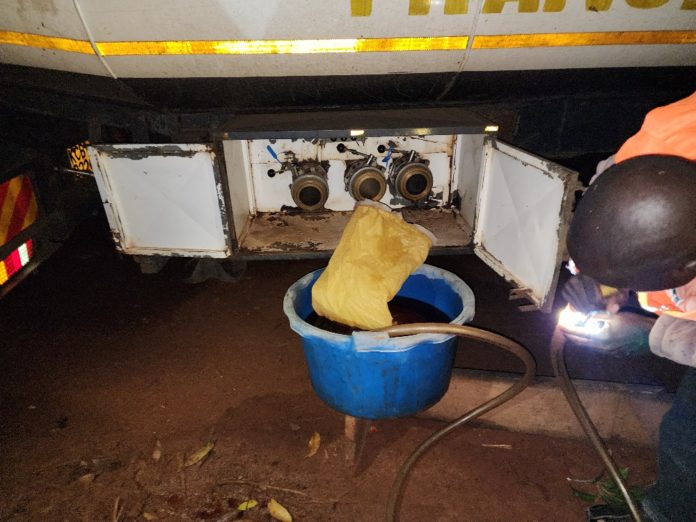
The Uganda Revenue Authority (URA) enforcement team in Mbale rescued a robbed fuel truck registration number KCB022G which was heading to Congo.

The authority said robbers threw out the driver and turn boy at gunpoint and told them to wait for an empty truck after all the fuel has been vended to small traders along the Northern route through Soroti.

Although they were handcuffed with ropes, they managed to access a phone for help. The URA team in Mbale immediately swung into action and reached out to Transit Monitoring Unit (TMU) in Kampala to get the actual location of the truck.

The TMU team reported that the truck was in Nakaloke, a suburb in Mbale city.

“At this point, we beefed up our security personnel knowing that the robbers too were armed,” Luke Kivumbi the officer behind the operation narrated.

At Nakaloke, the fuel truck was identified parked in a dark spot and the robbers were already drawing fuel.

“We knew immediately that our best weapon was the element of surprise and it worked for us as all the suspects immediately scattered in the nearby bushes when they set eyes on the Army,” Kivumbi explained.

When the robbers left, this made work easy for the URA officers to reach out to the owners of the truck.

“We guarded the truck until the owners sent another driver who drove the truck to Mbale Customs checkpoint,” Kivumbi said.

On verification, it was discovered that the robbers had already drawn fuel and also left a gun with three rounds magazine.

According to Kivumbi,the URA Customs team is responsible for monitoring goods in transit. For this case, goods had been diverted and dumped on the local market, yet they hadn’t paid taxes in Uganda. This implies that there was potential revenue loss had URA not taken charge.

For now, the truck together with its contents has been forwarded to Intelligence team for further management.

Stories Continues after ad

Museveni appoints three more Justices to Supreme Court

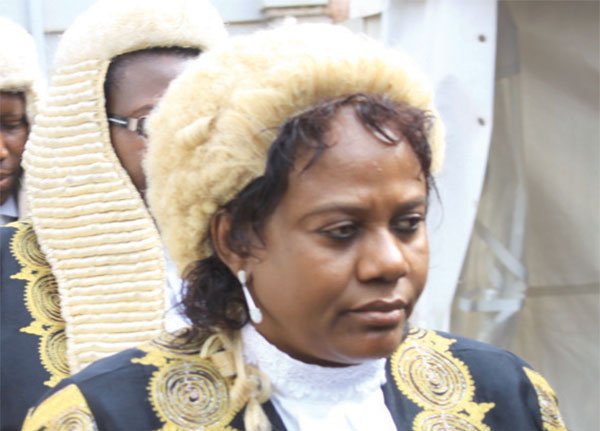
Justice Elizabeth Musoke

President Museveni has appointed three new Judges to the Supreme Court, and one to the Court of Appeal.

In the statement released by the State House, the appointed Justices join the Supreme Court bench are Christopher Madrama, Elizabeth Musoke and Stephen Musota.

“In Exercise of powers vested in the President by Article 142 (1) of the 1995 Constitution, I have, acting on the advice of the Judicial Service Commission, appointed justices of the Supreme Court and Court of Appeal,” reads part of the statement.

Oscar Kihika, who has been serving as the NRM director for legal affairs, was appointed to the Court of Appeal.

“I hereby forward their names and CVs to parliament for approval,” adds the statement.

The Supreme Court of Uganda is the highest judicial organ in Uganda. It derives its powers from Article 130 of the 1995 Constitution.

It is primarily an appellate court with original jurisdiction in only one type of case: a presidential election petition.

The Supreme Court is constituted by the Chief Justice (CJ) who is appointed by the president in consultation with the Judicial Service Commission and not less than ten justices.

He is the head of the Judiciary and he is deputized by the Deputy Chief Justice who heads the Court of Appeal and other justices of the Supreme Court who must not be less than five (5) while hearing an Appeal (this is referred to as the quorum required for the court to hear any matter).

The Supreme Court is headed by the Chief Justice and supported by ten (10) Justices with the following quorum:-Constitutional Appeal Cases 7 Judges, Criminal Appeal Cases 5 Judges, Civil Appeal Cases 5 Judges

However in the absence of the Chief Justice, the most senior member of the Court presides over the sitting of the Supreme Court.

It sits eight sessions a year with a break of two weeks between sessions to do research and write judgments.

It has powers to uphold decisions from the lower courts, reverse them and to substitute judgments or to order for a new trial.

The procedure, powers and jurisdiction of the Supreme Court are regulated by the Supreme Court rules.

Christopher Izama Madrama

He studied law at Makerere University, Uganda’s largest and oldest public university, graduating in 1989 with a Bachelor of Laws (LLB) degree. The next year, he received a Diploma in Legal Practice, from the Law Development Centre, in Kampala, the national capital. He was then admitted to the Uganda Bar. Later, he obtained a Master of Laws degree in Women’s Law, from the University of Zimbabwe.

In 1990, he took up employment as a state attorney, in the Uganda Ministry of Justice and Constitutional Affairs, working in that capacity until 1999. He was then elevated to Principal State Attorney.

Later in 1999, he left the Justice ministry and joined the Law Development Centre as a Senior Legal Officer. From 2001 until 2010, Christopher Madrama was a Principal Legal Associate at Katende Ssempebwa and Company Advocates, a large firm in the city of Kampala, Uganda’s capital. This was his last job in the private sector, prior to joining the bench.

He was appointed as a judge of the High Court of Uganda in June 2010. Over the years, he served in various divisions of the high court, including the commercial division and the executions division. In February 2018, Madrama was appointed to the Uganda Court of Appeal and was successfully vetted by the Ugandan parliament.

Elizabeth Musoke

She earned a Bachelor of Laws (LLB) degree from Makerere University, the nation’s oldest and largest public University. She also obtained a Diploma in Legal Practice, from the Law Development Centre, in Kampala, the country’s capital city. She was admitted to the Uganda Bar as a practicing lawyer.

She worked with the ministry of justice for several years and left at the rank of Principal State Attorney to join the Inspectorate of Government as Director of Legal Affairs in 1999.

In July 2013, she was appointed to serve as a judge of the High Court of Uganda, assigned to the civil division, serving in that capacity until October 2015, when she was elevated to the Court of Appeal, which doubles as the Constitutional Court of Uganda.

Stephen Musota

He is a Ugandan lawyer and judge, on the Court of Appeal of Uganda, which doubles as the country’s Constitutional Court. He was appointed to the court of appeal on 8 February 2018.

He studied law at Makerere University, Uganda’s largest and oldest public university, graduating in 1982 with a Bachelor of Laws (LLB) degree. The next year, he received a Diploma in Legal Practice, from the Law Development Centre, in Kampala, the national capital. He was then admitted to the Uganda Bar.

In 1984, he was appointed as a Magistrate Grade One, rising to the level of Senior Principal Magistrate Grade One in 1992. He went on to work as Chief Magistrate, then as Deputy Registrar and then as Registrar of the High Court.

Later in 2000, he was promoted to the position of the chief registrar of the Judiciary, serving in that capacity until 2004. In 2004 he was appointed to the bench, as a member of the High Court of Uganda. He has a special interest in Civil Law.

He was appointed as a judge of the High Court of Uganda in 2004. He served as the head of the civil division of the high court. In February 2018, Musota was appointed to the Uganda Court of Appeal and was successfully vetted by the Ugandan parliament.

Stories Continues after ad

African team squads for World Cup 2022 in Qatar

world cup trophy

With the 2022 FIFA World Cup Qatar just a few days away, the full squads for all 32 teams were finally confirmed as anticipation for kick off cranks up another notch.

The 22nd edition of the finals, is set to kick-off when hosts Qatar face Ecuador in Al-Bayt Stadium on Sunday 20 November.

Africa will be represented by Ghana, Tunisia, Cameroon, Senegal and Morocco in this year’s edition.

By reaching the quarter-finals in the 1990 World Cup, Cameroon set a benchmark that has not been bettered at this point. Senegal and Ghana also reached the last-eight, in 2002 and 2010 respectively.

Can Africa progress past the semi-final stage with the squads representing the continent?

Meanwhile, we take a look at their final squads.

Ghana Squad

Goalkeepers: Lawrence Ati Zigi, Nurudeen Manaf, Ibrahim Danlad.

Defenders: Tariq Lamptey, Alidu Seidu, Alexander Djiku, Gideon Mensah, Dennis Odoi, Daniel Amartey, Mohammed Salisu, Joseph Aidoo, Baba Abdul Rahman.

Midfielders: Andre Ayew, Mohammed Kudus, Thomas Partey, Elisha Owusu, Daniel Kofi Kyereh, Abdul Salis Samed.

Forwards: Osman Bukari, Williams Inaki, Jordan Ayew, Daniel Afriyie Barnieh, Sowah Kamal, Antoine Semenyo, Kamaldeen Sulemana, Abdul Fatawu Issahaku.

Senegal squad

Goalkeepers: Seny Dieng, Alfred Gomis, Edouard Mendy.

Defenders: Fode Ballo-Toure, Pape Abdou Cisse, Abdou Diallo, Ismail Jakobs, Kalidou Koulibaly, Formose Mendy, Youssouf Sabaly.

Midfielders: Pathe Ciss, Krepin Diatta, Idrissa Gana Gueye, Pape Gueye, Cheikhou Kouyate, Mamadou Loum Ndiaye, Nampalys Mendy, Moustapha Name, Pape Matar Sarr.

Forwards: Boulaye Dia, Famara Diedhiou, Bamba Dieng, Nicolas Jackson, Sadio Mane, Iliman Ndiaye, Ismaila Sarr.

Tunisia squad

Goalkeepers: Aymen Dahmen, Bechir Ben Said, Aymen Mathlouthi, Mouez Hassen

Defenders: Wajdi Kechrida, Mohamed Drager, Dylan Bronn, Nader Ghandri, Bilel Ifa, Yassine Meriah, Montassar Talbi, Ali Maaloul, Ali Abdi

Midfielders: Ghailene Chaalali, Aissa Laidouni, Eliyes Skhiri, Hannibal Mejbri, Ferjani Sassi, Mohamed Ali Ben Romdhane

Forwards: Wahbi Khazri, Youssef Msakni, Taha Yessine Khenissi, Issam Jebali, Seiffedine Jaziri, Anis Ben Slimane, Naim Sliti.

Morocco squad

Goalkeepers: Yassine Bounou, Munir Mohamedi, Ahmed Reda Tagnaouti.

Defenders: Achraf Hakimi, Noussair Mazraoui, Jawad El Yamiq, Romain Saiss, Achraf Dari, Yahia Attiyat Allal, Badr Benoun, Nayef Aguerd.

Midfielders: Sofyan Amrabat, Azzedine Ounahi, Abdelhamid Sabiri, Selim Amallah, Yahya Jabrane, Bilal El Khannous.

Attackers: Hakim Ziyech, Zakaria Aboukhlal, Sofiane Boufal, Youssef En-Nesyri, Ez Abde, Amine Harit, Ilias Chair, Abderrazak Hamdallah, Walid Cheddira.

Cameroon squad

Goalkeepers: Devis Epassy, Simon Ngapandouetnbu, Andre Onana.

Defenders: Jean-Charles Castelletto, Enzo Ebosse, Collins Fai, Olivier Mbaizo, Nicolas Nkoulou, Tolo Nouhou, Christopher Wooh.

Midfielders: Martin Hongla, Pierre Kunde, Olivier Ntcham, Gael Ondoua, Samuel Oum Gouet, Andre-Frank Zambo Anguissa.

Forwards: Vincent Aboubakar, Christian Bassogog, Eric-Maxim Choupo Moting, Souaibou Marou, Bryan Mbeumo, Nicolas Moumi Ngamaleu, Jerome Ngom, Georges-Kevin Nkoudou , Jean-Pierre Nsame, Karl Toko Ekambi.

Stories Continues after ad

Dembe Enterprises Limited gets Authorized Economic Operator Certification 

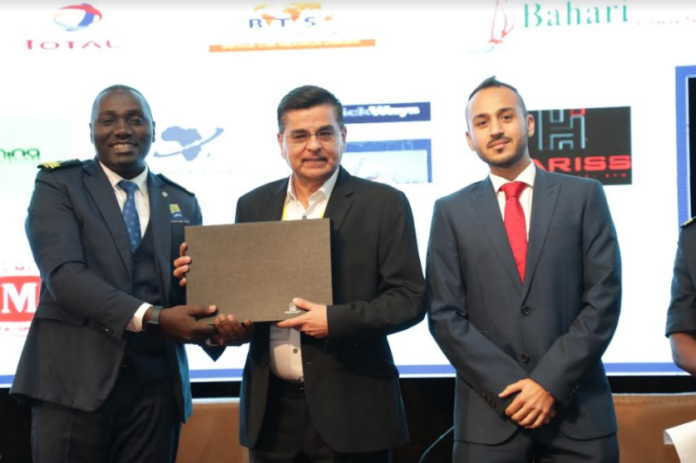
Uganda Revenue Authority (URA) has granted Dembe trading Enterprises, one of the oldest and leading distribution houses in East Africa, the prestigious Authorized Economic Operator (AEO) license in recognition of its continued compliance with the various customs rules, processes and standards.

This was during the Authorized Economic Operator Awards Conference held at Speke Resort, Munyonyo, on 11th November 2022.

AEO is a trade facilitation program on the international movement of goods that have been approved by or on behalf of the Customs administration that complies with the World Customs Organization supply chain security standards. The recognition seeks to enhance trade by reducing the cost of doing business through simplifying customs procedures hence preferential treatment for the companies. 

Receiving the certificate on behalf of the company, Mr Anil Damani, the Chief Executive Officer of Dembe Trading Enterprises Ltd applauded Uganda Revenue Authority and TradeMark East Africa for their efforts towards making cross border trade more convenient. He also commended the regulator for recognizing their contributions and granting the select few companies the AEO status to facilitate smooth business operations within Uganda and the EAC.

“We are excited to have received this certification as it signifies that we are highly compliant as a company, the certification is extremely important for us as it greatly improves the transactional speed of logistics within the landlocked confines of the state. We strive to do business according to the laws of the land and believe our foremost duty is to the citizens of Uganda. We therefore ensure we contribute to the development of the nation by complying with the tax requirements, and the relevant customs laws and regulations in our operations,” he said.

“Thank you URA and TradeMark East Africa for the role you play is ensuring that we can operate smoothly as a business and deliver on our customer promise. This certification means we can avail our products to our consumers in a timely manner since we will enjoy faster goods clearance, inspection and preferential treatment accorded at the customs and any other services by the regulator,” he said.

The primary targets for AEO are manufacturers, customs clearing agents, bonded warehouse keepers, importers, exporters, transporters, and freight forwarders.

Other benefits include priority treatment when Customs selects the goods for examination and improved cargo handling efficiency at the seaport that results in quick container and truck turn-around time to minimize demurrage and truck detention costs.

Dembe employs roughly over 1,000 people directly and many more indirectly. Dembe is a wholly owned Ugandan company and has been in existence for 25+years. 

It serves every major region, district, city, town and trading centre in the nation and manufactures a wide range of products from UBISCO biscuits to Odorex Sanitizers, wakisha, hermela, kreamy, snack attack, Rio, and snowman’s ice cream. 

Stories Continues after ad

Man arrested for stabbing wife, cousin to death over affair

Crime scene

Police in Kole District are holding Moses Ongom, a 28-year-old resident of Beiko village on allegations of killing two people at his home.

According to spokesperson of North Kyoga region, SP Patrick Jimmy Okema, it is alleged that 25-year-old Ambrose Okwir (deceased), a cousin brother to Ongom (suspect) was having an affair with Connie Adong, a 23-year-old wife to the suspect.

“The duo was at the suspect’s home on 14th November 2022 at around 2300hrs, when he found them in bed together. The suspect took the law into his hands and stabbed both of them with a knife several times killing them instantly,” Okema said.

“A case of murder has been registered at Kole Central Police Station. The scene of the crime has been visited by a team led by the OC Station of Kole, photographs were taken, a sketch map was drawn and statements from relevant witnesses were recorded.”

Okema said the knife used by the suspect in committing the crime has also been recovered and exhibited pending DNA analysis.

Both bodies have been conveyed to Lira Regional Referral Hospital’s mortuary pending postmortem, while the suspect is in police custody at Kole CPS.

Okema appealed to married and cohabiting couples to be careful when responding to the challenges in their homes and learn to respect our relationships, develop a heart of trust, and avoid extramarital affairs.

Stories Continues after ad