Stanbic Bank
Stanbic Bank
18.1 C
Kampala
Stanbic Bank
Stanbic Bank
Home Blog Page 509

MT4 vs MT5 Which Platform to use?

When it comes to trading, many different options are available to you. You can choose from a variety of different platforms, each with its own unique features. The MetaTrader platforms are the most popular among traders thanks to their easy-to-use interface that allow beginners and traders with experience to operate the market, plus more benefits that their tools give. However, it is essential to know which one is right for you. It is also essential to know if your device supports these platforms; that’s why you must ensure that the mt5 download is available. This blog post will compare MT4 and MT5 and help you decide which platform is right for you.

What is MT4?

MT4, also known as MetaTrader 4, is a trading platform developed by Russian company MetaQuotes Software Corp in 2005. It has become the industry standard for retail traders thanks to its user-friendly interface and various features such as charting tools, technical indicators, and automated trading options.

The MT4 platform offers traders the ability to trade in the Forex market. It also offers a variety of tools to help traders make informed decisions, including charting tools, technical indicators, and more. Additionally, MT4 offers automated trading options, which allow traders to automate their trading strategies. MT4 is available on a variety of devices, from desktop computers to mobile phones, for your convenience. Additionally, a web-based version can be accessed directly from your browser.

What is MT5?

MT5, also known as MetaTrader 5, is the newer version of the MT4 platform released in 2010. It offers all the same features of MT4 with some added benefits, such as more timeframes, more technical indicators, and additional order types. MT5 was created for investors to trade Contracts for Differences, stocks, and futures. MT5 is a trading platform where you can trade multiple assets and access professional technical and fundamental analysis tools while using any browser. MT5 also has great mobile device compatibility.

The biggest difference between the two platforms

The primary distinction between the MT4 and MT5 platforms is their respective functions and purposes. As we alluded to earlier, MT4 was designed specifically for Forex trading while MetaTrader 5 was created mostly for other assets.

At first glance, it would be hard to spot any significant style differences between MT4 and MT5. After all, they both were designed by the same company.

These platforms provide plenty of trading indicators and tools, but it mainly depends on the broker you’re using. The standard version of MT4 comes with approximately 30 built-in indicators, though it is highly customizable to users’ needs.

If you search online, you’ll find at least a few thousand free indicators and hundreds of paid ones. These include high-low indicators, Renko indicators, chart group indicators, and more. The same is true for MT5–you can find many predetermined indicators or create your own custom ones.

Forex charts

Forex charts on MT4 or MT5 can be customized to your preferences with dozens of time frames, various chart types, and the ability to overlay different assets on one chart. Both platforms offer various technical analysis options, including trend lines and Fibonacci retracements.

As for order types, both platforms offer market orders, pending orders (buy limit, buy stop, sell limit, sell stop), and trailing stops. In addition to these standard order types, MT5 also offers the option for hedge orders.

MT4 and MT5 have advanced features, such as automated trading via Expert Advisors (EAs). These EAs can fully automate your trading strategy or send notifications when certain conditions are met.

Programming languages

MT4 uses a programming language called MQL4, while MT5 uses MQL5. The two languages are similar in syntax and structure, but MQL5 is more advanced and offers additional features such as object-oriented programming and access to economic data calendars. MQL5 is not only more efficient, but it is also easier to use. MQL5 lets traders customize and adjust their scripts as they see fit. Also, most programs created for MT4 aren’t compatible with MT5.

Trading instruments

MT4 offers a variety of trading instruments, including Forex pairs, stocks, commodities, and indices. MT5 offers all of these instruments, futures, and contracts for difference.

Contracts for difference (CFDs) are financial derivatives that allow investors to trade the price movements of assets without actually owning the underlying asset. For example, you can trade the price of gold without having to take physical possession of the metal.

Futures are agreements to buy or sell an asset at a specific price on a specific date. Futures contracts are standardized and have strict regulations, making them less risky than CFDs.

MT4 and MT5 offer a variety of order types to suit your trading needs. With MT4, you can place market orders, pending orders (buy limit, buy stop, sell limit, sell stop), and trailing stops. MT5 also offers the option for hedge orders.

In addition to these standard order types, MT5 offers the option for futures contracts. Futures contracts are agreements to buy or sell an asset at a specific price on a specific date. They come with strict regulations and are less risky than CFDs.

Trading automation

MT4 and MT5 offer advanced features, such as automated trading via Expert Advisors (EAs). These EAs can fully automate your trading strategy or send notifications when certain conditions are met, including technical analysis of price data and opening and closing positions on specific instruments. Comparing the Expert Advisors of these two firms ultimately comes down to the programming language.

MQL4 has been around for a long time. It is older than MQL5. This means that there are more pre-written scripts and codes for MQL4 that you can use to create your Expert advisors.

However, some people might find MQL5 to be a simpler language. In that case, creating your scripts might be a little easier.

Conclusion

It is concluded that both MT4 and MT5 offer a range of customizable charts, technical analysis options, trading instruments, and order types. While MQL4 has more pre-written scripts for automated trading, some may find that MQL5 is a simpler language. Ultimately, it comes down to personal preference and trading style. Each platform offers its own unique set of features and capabilities that can enhance your trading experience. It is ultimately up to the trader to determine the best suits their needs.​

Stories Continues after ad

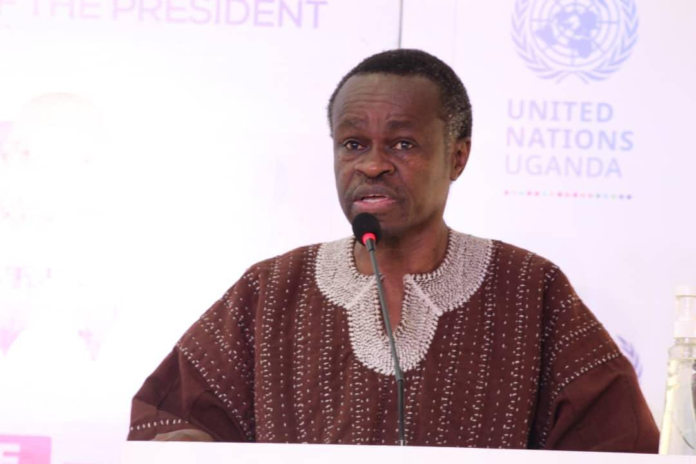
Prof. PLO Lumumba urges church leaders to offer tithes to vulnerable communities

Prof. Patrick Loch Otieno Lumumba

Prof. Patrick Loch Otieno Lumumba has urged church leaders to dedicate at least some percentage of the tithes to the vulnerable communities in order to curb diseases and hunger affecting the people.

PLO Lumumba, the keynote speaker made the urge while addressing people at the National HIV/AIDS symposium under the theme “Ending inequality among adolescent girls, young women and boys” held at Makerere University Business School in Nakawa.

Lumumba said that the churches should be so impactful in changing the lives of people since religion in Africa has been so based on moral values and behavioral change.

“Tithes and offerings are given to churches. But how much do they contribute to the noble cause of eradicating HIV? Let us give back to these communities in order to stay relevant,” Lumumba cautioned.

He has also called on the government to set up the HIV/AIDS trust fund to end reliance on dwindling funding from development partners. Apparently, the country’s HIV funding deficit stands at 450 billion shillings according to Uganda AIDS Commission.

“Create a single fund for a purposeful use to fight HIV/AIDS. We made commitments that 15% of our budgets be dedicated to the health sector and therefore by extension HIV must also be on radar,” Lumumba said.

He added, “funding of HIV must have a regional perspective. The president has recognised that the impact of HIV is not only on the health sector but also on the economic kind, political kind and social kind,” 

“We cannot win the fight against HIV in spite of regional inclusion, there is a need to have other regional countries involved in the response,” he noted.

He also said that research in Africa is not at the level which one desires it to be. The universities and other institutions of higher learning are doing their own things, not research.

“In Africa we don’t have researchers. The ones we have are mainly good at writing proposals to donors in Sweden, Canada,” he said.

He further urged the citizenry to hold the authority accountable and always speak the truth to power. Adding, “In Africa, when politics fails, everything fails.”

Stories Continues after ad

Court issues an injunction against BLB, Land Commission over Ham’s titles in Kigo

City businessman Hamis Kiggundu popularly known as Ham.

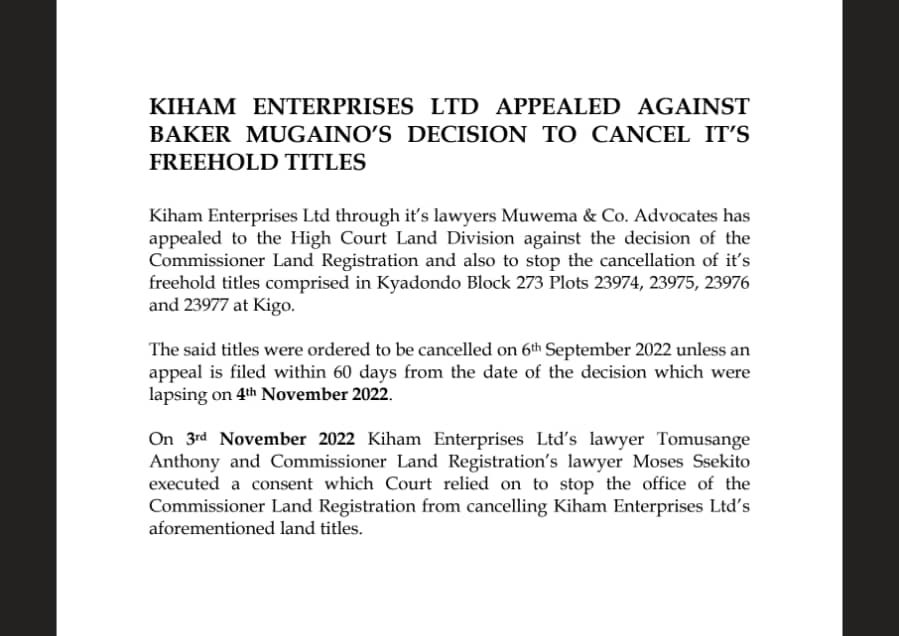
The Land Division of High Court in Kampala has issued an injunction blocking Buganda Land Board (BLB) and the Uganda Land Commission from cancelling city businessman Hamis Kiggundu aka Ham’s land titles in Kigo.

On September 6, 2022, the Commissioner of Land Registration, Mr. Baker Mugaino, declared that Ham had illegally occupied the land owned by Buganda Kingdom in Kigo.

In his ruling, Mugaino ordered for the cancellation of all four titles obtained by Ham on Kabaka’s land. He noted that the certificate of titles comprised in Kyadondo Block 273 Plot 23974, 23975, 23976 and 23977 were “illegally issued” and that there was indeed encroachment by the freehold titles on the Mailo titles.

“It is therefore my finding that the freehold titles held under plots 23974, 23975, 23976, and 23977 owned by Kiham Enterprises Limited overlap the Mailo titles owned by Kabaka of Buganda held under plots 38, 87, 99, 110 which is illegal,” the commissioner said.

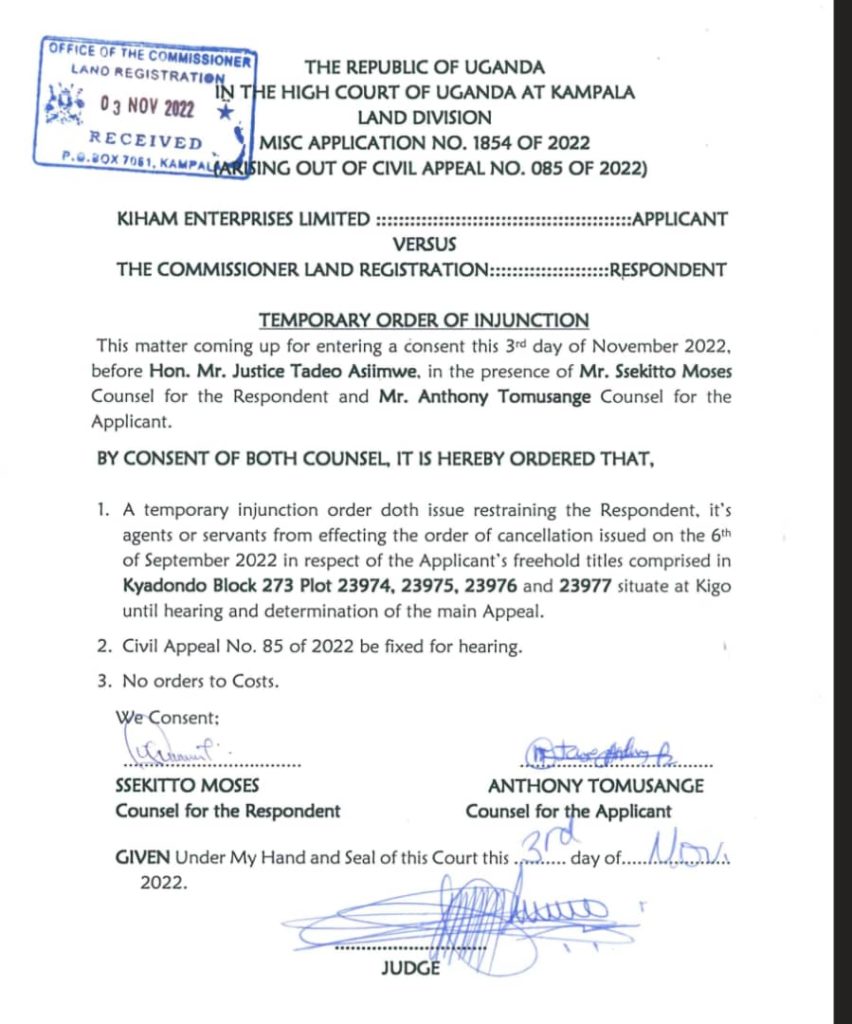
Ham ran to Court seeking to overturn the decision by Commissioner Mugaino.

“A temporary injunction order doth issue restraining the Respondent [The Commissioner Land Registration], its agents or servants from effecting the order of cancellation issued on the 6th of September 2022 in respect of the Applicant’s freehold titles comprised in Kyadondo Block 273 Plot 23974, 23975, 23976 and 23977 situate at Kigo until hearing and determination of the main appeal,” Justice Tadeo Asiimwe ordered on November 3rd.

The contested land is situated between Serena-Kigo and Mirembe Villas.

Stories Continues after ad

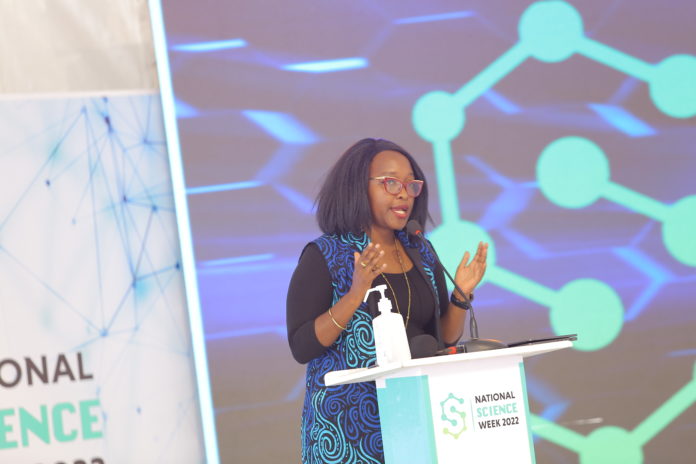
Startup investment is more than a transfer of funds – Esther Ndeti

Esther Ndeti - Investment Principle at Unconventional Capital (UnCap) delivers they keynote address during the Investor Summit

The Investment Principle at Unconventional Capital (UnCap) Esther Ndeti has urged investors in early-stage startups to expand their support to science and technology-based businesses beyond funding to incorporating transfers of skills or value addition post-investment.

Ndeti said during the Investor Summit of the 2022 National Science Week at the Kololo Ceremonial Grounds.

“When it comes to innovation-based businesses, there is a limited number of investors who have the skills to evaluate all the components of these companies and even fewer who work with such businesses in emerging markets. Investment is more than just a transfer of funds. For early-stage investors, there needs to be a transfer of skills or some form of value-added post-investment.” she said.

She said most investors don’t have enough scientists or tech-based leaders within their teams to accurately assess and add value to innovation-based businesses and that banks, for example, rarely offer customised products for innovation, which causes an overarching funding gap in the tech startup space.

According to Disrupt Africa’s annual African Tech Startups Funding Report, Uganda is one of the fastest-growing startup funding destinations in Africa, having registered growth with the likes of Zimbabwe, Rwanda and Ivory Coast.

Despite this growth, however, early-stage science and technology-based businesses still face significant challenges in accessing financing as part of the sub-Saharan Africa SME ecosystem, which faces a $330 billion funding gap, according to the World Bank.

According to Ndeti, some of the challenges faced include early-stage startup innovators include having limited awareness of the variety of investors, products and other opportunities available to them; insufficient collateral for debt financing from traditional financing institutions and; perception-based hindrances based on the fact that women- and youth-led businesses attract cultural biases which limits capital they receive.

National Science Week is a brainchild of the Secretariat of Science, Technology and Innovation and is Uganda’s annual showcase of science, technology and innovation to document the progress made towards technological advancement to steer national development.

This year’s edition included a public exhibition featuring over 200 exhibitors in Science, Technology and Innovation – specifically in the fields of Pathogen Economy; Aeronautics and Space Science; The Future of Infrastructure; Industry 4.0; Mobility and Productivity Acceleration, Import Substitution; Export Promotion and the science of support services.

It also included an Investor Summit, which was held to address the challenge of funding for early-stage science, technology and innovation ventures and attracted attendance from key financial players including venture capitalists and commercial banks.

Speaking during the forum’s opening ceremony, Dr Monica Musenero, the Minister of Science, Technology and Innovation, said “We are proactively paving the way for our science, technology and innovation start-ups to secure the funding they require for viable projects. Through this event, we will act as a bridge and provide a platform for innovators to pitch their ideas to potential investors and secure the support they need.”

Stories Continues after ad

BoU clears Cellulant’s payments operations in Uganda

Frances Diribe, Cellulant’s Chief Risk & Compliance Office

Pan-African payment technology company Cellulant, has been granted a Payments Systems Operator license by the Bank of Uganda in line with the National Payments System Act, 2020 which provides guidance in streamlining operators in the burgeoning fintech space in Uganda.

Cellulant Group founded in 2003, has a history of delivering inventive technical and financial solutions implemented with a seamless user experience.

The company today powers collections and payouts for thousands of businesses in various sectors across 35 countries in Africa.

Cellulant launched operations in Uganda in 2009 and through its single API payments gateway – Tingg enables global, regional and local businesses to collect payments online and offline serving its customers with locally relevant payment methods, including mobile money, cards & banks.

By obtaining this license, Cellulant will be able to develop its operations locally and regionally while providing reassurance to its business partners that Cellulant complies with local and international security regulations. Having partnered with 6 financial institutions and over 50 merchants within Uganda, Cellulant is availing proximity to mobile banking and checkout solutions to its merchants across the country.

According to Frances Diribe, Cellulant’s Chief Risk & Compliance Officer, “We welcome this development and are delighted that the Bank of Uganda has now licensed Cellulant Uganda as a Payment Systems Operator (large funds transfer). Uganda currently has over 800,000 registered businesses and a fast-growing digital youthful population. We’re on course to double down our work in offering these businesses and their clients’ dependable payment options. By streamlining the business payment process, they can concentrate on growing themselves.”

Cellulant boasts an 80 per cent market share in providing payment solutions for all airlines in Africa including Emirates, Kenya Airways, Jambojet, and Ethiopian Airlines, among others. They also provide solutions for the likes of Rubis, Oryx, Jumia, Kiku, MultiChoice, StarTimes, Zuku, National Water, and Umeme, among others. The company facilitates more than 300 million transactions per year with volumes in billions of dollars.

The Pan-African Payments pioneer recently announced its partnership with the global technology company, Mastercard, to empower millions of consumers across Africa to join the global digital commerce market through their virtual payment solution. Cellulant also recently partnered with LC Waikiki in Zambia and Orange Money in Botswana.

With this accreditation in the Pearl of Africa, the company looks to progress its mission to create opportunities and accelerate economic growth for all of Africa.

Stories Continues after ad

Speaker Among wants road safety operation extended countrywide

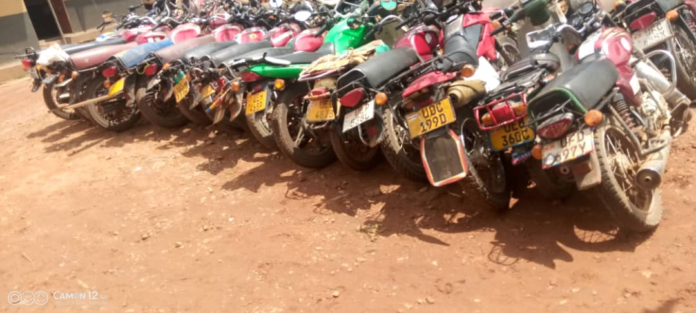
Some of the impounded motorcycles

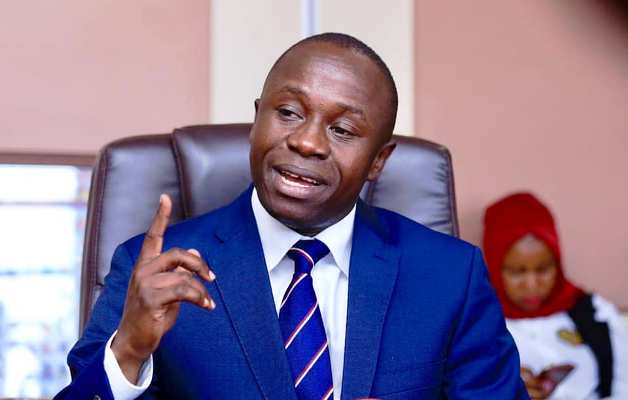
The Speaker of Parliament, Anita Among, has commended the ongoing operations by the Police to improve road safety in the Kampala metropolitan area, and urged them to extend the operations across the country.

This follows a call she made during last week’s plenary sessions, for the need to strengthen road safety interventions.

“It is not only in Kampala where we have accidents and so you should extend the operations to upcountry areas,” the Speaker said.

The Police started enforcing traffic rules targetting especially boda boda riders on Monday, 07 November 2022 in a bid to curb the road carnage, industry players say, they [boda boda riders] are greatly responsible for.

She made the comments in her communication to the House sitting on Wednesday, 09 November 2022.

She also urged Members of Parliament to encourage proper road use by Ugandans.

“As Parliament, we need to advocate for our people to drive/ride well especially the boda-bodas. They must wear reflector jackets and use the roads carefully,” Among said.

She told the House that the Chairperson of Committee on Health, Dr Charles Ayume, will present a report on the study of the magnitude of traffic injuries reported at Mulago National Referral Hospital.

Stories Continues after ad

National Sports Bill tabled for first reading

Minister of State for Sports, Peter Ogwang

Bugiri Municipality legislator, Asuman Basalirwa, has tabled the National Sports Bill, 2021 for its first reading.

The Private Member’s Bill was tabled on behalf of Budiope East County MP Moses Magogo during plenary sitting on Wednesday, 09 November 2022.

The bill seeks to repeal the National Council of Sports Act. Cap 48. The object of the bill is to consolidate and modernize the law relating to the incorporation and registration of national sports organisation and community sports clubs.

Further to that, the bill intends to provide for the management, promotion, development and regulation of professional, amateur and recreational sports in Uganda and to streamline the recreation, registration and management of national sports organisations and community sports.

Speaker Anita Among referred the bill to the Committee on Education and Sports.

Parliament deferred the first reading of the bill on 09 March 2022, with government arguing that there is a need for further consultations on the financial implication.

Magogo was scheduled to table the bill, but the then Government Chief Whip, Thomas Tayebwa, said that the bill had several connotations of financial implication which require co-sponsorship.

Attempts by the Minister of State for Sports, Peter Ogwang, to convince the House during the sitting of Wednesday, 09 November 2022 to heed the earlier position on harmonisation of the bill were futile.

“Procedure requires that before a bill is tabled, it has to go through Cabinet. Cabinet will approve the bill on Monday and it will be tabled. I request the House to permit that the consolidated bill is tabled after Cabinet approval,” Ogwang said.

Among, however, advised government to take over the bill at committee stage, if they feel the proposed law is not sufficient enough, citing a similar scenario in which government took over the Succession (Amendment) Bill, 2021 at committee stage.  

“We are bringing the bill in good faith, we are helping you to work. We cannot have a Bill laid and it takes eight months. Let us not deprive a private member of executing his constitutional mandate,” she said.  

The Speaker added that Parliament has a legislative agenda of 62 bills and yet not even a quarter of the bills have been handled.

Stories Continues after ad

Experts urge Gov’t to offer legal aid to migrant workers

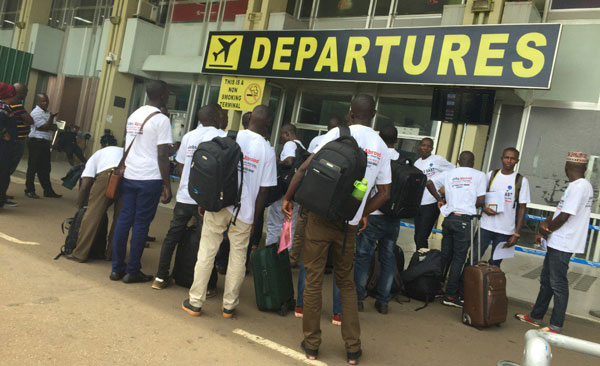
Migrant workers

Experts from the Centre for Policy Analysis (CEPA) have called on government to offer free legal services to Ugandans, whose rights have been abused while on duty abroad.

CEPA proposes that since government collects revenue from exportation of domestic workers, part of the revenue should cater for legal aid.

“Many of our migrant workers have been sexually and physically harassed, others have been denied their pay, government should in such a case be able to assist them get justice and claim their payment,” said Brighten Abaho, Programme Associate at CEPA.

He was speaking before the Committee on Gender, Labour and Social Development on Wednesday, 09 November 2022, where he made submissions to the Employment (Amendment) Bill, 2022.

Abaho suggested that once the bill is passed, all bi-lateral agreements on labour export, should be reviewed and aligned with the law to rule out any grounds for exploitation as witnessed in several reports.

He further proposed an increment in penalties for Ugandan employers guilty of employee exploitation, cognisant that the existing ones in the principal act are not deterrent enough.

“We are talking about employee harassment, and the fine of not exceeding 42 currency points an equivalent of Shs 840,000 is not deterrent enough. We propose an increment to 200 currency points for anyone who mistreats employees,” said Abaho

CEPA also wants the Minister for Gender, Labour and Social Development to update Parliament on external labour quarterly.

The committee chairperson, Flavia Kabahenda, said the US$30 charged for every domestic worker abroad does not reach the gender ministry to be able to assist migrant workers.  “The ministry lacks money to monitor the sector, all the money goes through Uganda Revenue Authority to the Consolidated Fund to do other things,” said Kabahenda.

Workers’ MP Margaret Rwabushaija, said there was need for government to pay attention to the deteriorating relationship between Uganda and countries where it exports labour.

“Where things are going, the Arab world is getting afraid of us. Even our committee which was about to go for oversight has been blocked,” said Rwabushaija. She called on government to open up to other countries for labour export.

Fellow Workers MP, Charles Bakkabulindi, was concerned that the proposed increase in penalties may not be the solution to labour exploitation and suggested strengthening of law enforcement.

“People know how to evade such fines. Therefore, the law enforcement should be the focus, hiking the penalty to so many years, or so many million shillings may not help,” Bakkabulindi said.

The committee has commenced receiving submissions from stakeholders over the Employment (Amendment) Bill, 2022.

The bill seeks to regulate employment of domestic and casual workers so as to improve their working conditions. It provides for compulsory registration and licensing of recruitment agencies for domestic workers and non-manual labourers.

Stories Continues after ad

EC seeks extra Shs20 billion for Women Council polls

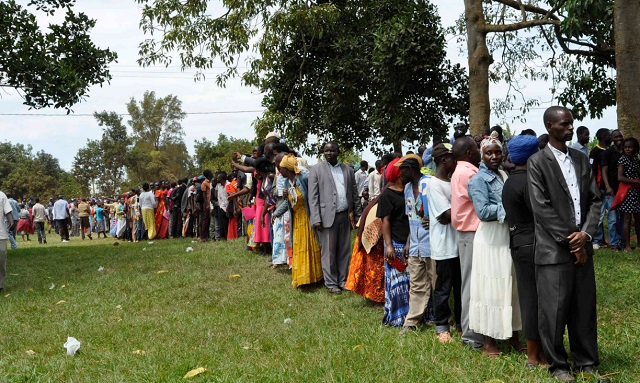
Voters line up in previous election

The Deputy Attorney General, Jackson Kafuuzi, has been directed to prepare a statutory instrument intended extend the time of office of the Women Councils.

“There is a political vacuum and we need this to be resolved. Can we have that document by next Tuesday?” Speaker Anita Among asked.

The directive followed Kafuuzi’s call to Parliament, to consider a request by the Electoral Commission (EC) for a supplementary budget of Shs20 billion to cater for the organisation of Women Council elections.

The term of Women Councils and Committees who were elected in 2018 expired and subsequently lapsed on Tuesday, 23 August 2022.

Kafuuzi also called for the immediate release of Shs15.68 billion provided in the budget, to facilitate the Women Council elections.

“This will enable the Electoral Commission to settle outstanding obligations and also fulfill the statutory requirement of organising and conducting elections for new office bearers for Women Councils from village to national level,” Kafuuzi said.

He said this while presenting a statement to the House, on the status of elections of Women Councils and Committees, on Wednesday, 09 November 2022.

He noted that ahead of the 2022/2023 financial year, the Electoral Commission presented a funding requirement for the Women Council elections of Shs35.68 billion, of which Shs15.68 billion was appropriated.

He added that this left a funding gap of Shs20 billion.

“The Electoral Commission had planned the election activities to commence in June 2022 to avert a vacuum that could arise when the term of the current Women Council office bearers expired in August this year,” Kafuuzi noted.

He also said that the Electoral Commission embarked on preparatory activities for the conduct of the elections with hopes that additional resources would be provided by the finance ministry.

“On release of details of that approved budget estimates for Financial Year 2022/2023, the Commission realised that the approved budget levels were not sufficient. The Commission thus indefinitely suspended the activities geared towards the Women Council elections,” the Deputy Attorney General noted.

Kafuuzi said the commission received non-wage funding of Shs12 billion for the first quarter, of which Shs3.613 billion catered for MP by-elections in the counties of Soroti East, Gogonyo, Bukimbiri and Busongora.

It also catered for Local Government by-elections in 26 districts.

“The Commission is constrained to pay outstanding obligations yet service providers and ad hoc staff that were engaged during the concluded activities are agitating for their pay,” Kafuzi told the House.

Stories Continues after ad

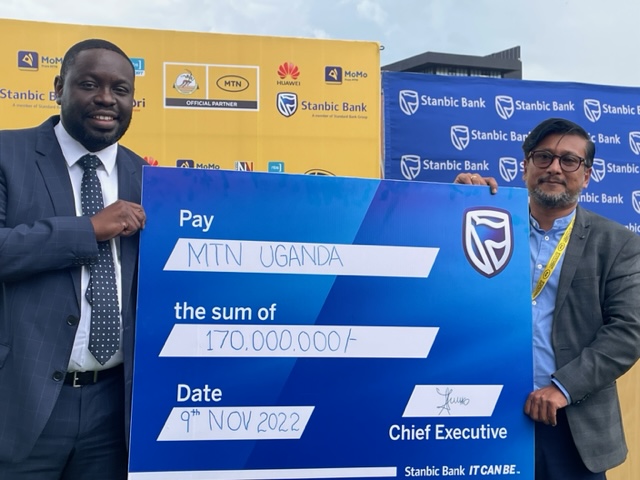
Stanbic contributes Shs170m towards MTN Marathon

MTN recieves UGX 170 million from Stanbic bank in support of the upcoming MTN Kampala marathon

Stanbic Uganda has handed over Shs170 million towards the upcoming 2022 MTN Kampala Marathon. 

This year’s run, dubbed run for babies, is scheduled for Sunday, November 20, 2022, marking a return from a two-year siesta due to Covid-19 restrictions. Stanbic has been a major corporate sponsor of the annual marathon since 2014. 

Paul Muganwa, Stanbic Bank Uganda’s Executive Head of Corporate and Investment Banking said this year’s theme for the marathon, ‘Run for Babies’ is particularly ‘close to our hearts as Stanbic.’

“Every year, we dedicate a dominant portion of our Corporate Social Investment budget to support maternal and neonatal health. Therefore, we are pleased to back this year’s MTN Kampala Marathon with Shs 170 million,” he said.

In October as Uganda marked Maternal and Neonatal health month, Stanbic donated health equipment worth Shs 354 million to the Ministry of Health which benefited over 20 health centers across the country.

In addition to the cash support, Muganwa revealed that Stanbic Uganda has also purchased 170 running kits for Bank staff and corporate runners.

Speaking at the handover ceremony, Somdev Sen, MTN Uganda’s Chief Marketing Officer hailed the corporate comradeship with Stanbic Uganda which spreads to other partnerships collectively geared towards driving Uganda’s growth.

“This corporate comradeship between MTN and Stanbic exemplified through this generous support is a strong statement that partnerships are better than the competition. We thank Anne Juuko, the Chief Executive at Stanbic Bank whose leadership has made maternal and neonatal health a top CSI agenda.”

He added that the money raised from this year’s marathon is to be used to upgrade four selected maternal and newborn facilities in health centers across the country. These include; Kisenyi and Kawaala health centers in central Uganda, Kachumbala health center in Teso as well as Kaabong health center in Karamoja. 

Runners can participate in one of four categories; the full Marathon (42Km), half Marathon (21Km), 10Km race, and 5Km wheelchair race. There is also a race for children.

Stories Continues after ad