Stanbic Bank
Stanbic Bank
16.6 C
Kampala
Stanbic Bank
Stanbic Bank
Home Blog Page 586

World Bank warns Uganda, East Africa to brace for tougher economic times

Traders-go-about-their-businesses-in-Kampala

A new World Bank report has warned Uganda and East African countries that they face  a possibility of higher global inflation than ever before due to the current global factors exacerbated by Russia’s invasion of Ukraine.

According to the World Bank’s Global Economic Prospects Report, Uganda will not escape the slowdown in global growth that has been steepened by Russia’s invasion of Ukraine and its effects on commodity markets, supply chains, inflation, and financial conditions have steepened.

The war in Ukraine has disrupted the global cereals trade and worsened food shortages. Yet, still, Uganda and its neighbours; The Democratic Republic of Congo, Madagascar, and Rwanda—which rely heavily on wheat imports from Russia and Ukraine are expected to experience persistently elevated food inflation.

A number of Ugandans have recently complained about the increasing prices of wheat. Opposition politician, Robert Kyagulanyi this week called on President Museveni to bring down the prices by reducing taxes on imports.

But the World Bank flagship report says that in addition to the adverse impact of surging living costs, the growth outlook for low incomes countries like Uganda is anticipated to be further weakened by the global economic slowdown.

According to the report, such stagflation could eventually result in a sharp tightening of monetary policy in advanced economies, which could lead to financial stress in some emerging markets and developing economies. It suggests that “a forceful and wide-ranging” policy response is required to boost growth, bolster macroeconomic frameworks, reduce financial vulnerabilities, and support vulnerable groups.

“…higher prices of grains are expected to limit the ability of farmers, especially those dependent on subsistence agriculture, to purchase enough seeds for the new planting season and feed for livestock,” reads part of the report.

Aggregate growth in low-income countries (LICs) is forecast at only 4.1 per cent in 2022 and 5.3 per cent in 2023 – 0.8 and 0.6 percentage points below the January projections. Uganda and others, according to the report have experienced planting delays because of poor rainfall.

“In some LICs, higher prices of grains are expected to limit the ability of farmers, especially those dependent on subsistence agriculture, to purchase enough seeds for the new planting season and feed for livestock,” reads part of the report.

It also finds that the war in Ukraine has also markedly disrupted global fertilizer supply, with Russia the world’s largest fertilizer exporter.

“Higher prices of fertilizers and fuels are expected to weigh heavily on farming output as well,” warns the report “Fiscal policy, already constrained by high public debt and tightening global financial conditions, have become even less accommodative.”

The researchers find that spending pressures to curb the impact of rising prices have been building in many countries (for example, fuel subsidies in Cameroon, Kenya, and Nigeria; a fuel levy reduction in South Africa), further straining fiscal positions.

“Moreover, rising core inflation in several countries including Cameroon, Nigeria, and Uganda points to broadening price pressures, further reducing room for accommodative policies. Growth in Sub-Saharan Africa is projected to decelerate from 4.2 per cent in 2021 to 3.7 per cent in 2022, as high inflation and policy tightening weaken domestic demand.”

According to the report, a growth deceleration in major trading partners is compounding these headwinds.  “Growth is projected to firm slightly to an average of 3.9 per cent in 2023-24, assuming further progress with pandemic containment measures”.

Stories Continues after ad

MTN Uganda boosts Empango celebrations with Shs30m

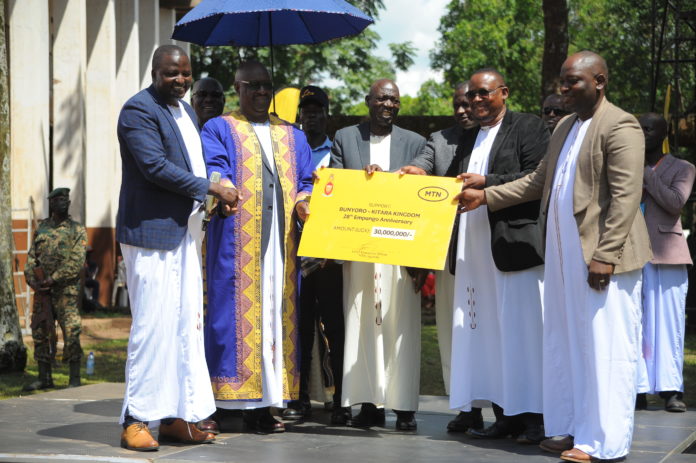
MTN MoMo MD Richard Yego hands over a cheque worth Ushs.30Million as contribution towards the 28th coronation anniversary celebrations of Omukama Solomon Gafabusa Iguru IV of Bunyoro Kingdom.

MTN Uganda over the weekend reaffirmed its partnership with the people of Bunyoro Kingdom as the monarchy celebrated the 28th coronation anniversary of Omukama (King) Solomon GafabusaIguru IV.

Following the signing of a collaboration agreement in 2019, MTN, last weekend handed over a cheque of Shs 30 million to support the Kingdom’s initiatives at the Empango celebrations in Hoima. This follows the lifting of restrictions on public gatherings that prevented the celebrations from happening over the last two years.

The cheque was handed over to the Bunyoro Kingdom officials at the Karuzika Royal Palace in Hoima by the MTN Mobile Money Uganda Limited Managing Director, Richard Yego, who graced the celebrations. Yego congratulated the Omukama of Bunyoro, who was not in attendance of the celebrations due to ill health, upon his peaceful and developmental 28-year reign.

“We are honored to join the people of Bunyoro on this auspicious day that gives us an opportunity to celebrate the friendship between MTN and the people of Bunyoro Kitara. On behalf of MTN Uganda, I congratulate the people of Bunyoro for reaching this great milestone under the great leadership of OmukamaGafabusa who has fostered peace and overseen transformation in the region,” Yego said.

Yego further added that MTN has committed resources to further champion the socio-economic and cultural wellbeing of the people of Bunyoro through supporting health, education, and sports initiatives in the Kingdom.

The Bunyoro Kingdom Prime Minister, Owek. Andrew Byakutaga, on behalf of the Omukama, thanked MTN for its continued support towards the kingdom’s initiatives.“We extend our sincere appreciation to MTN for all the work they do in our communities to extend better services to our people here in Bunyoro and beyond,” Byakutaga said.

Last year, MTN Uganda restored 50 hectares of forest cover in Kagombe forest in the Bunyoro region as part of its “Uganda is Home” campaign. Prior to that, the telecom refurbished and re-equipped the Maternity ward and theatre at Kigorobya Health Center IV in Hoima district to champion maternal and child health in the region. Furthermore, the telecom set up an ICT laboratory at the St. Simon Peter Vocation Training Institute to champion digital skilling.

This year, MTN is set to sponsor the Bunyoro football tournament and bicycle race competitions between the countries of Bunyoro.MTN is keen on working with cultural institutions because they are a strong community establishment that fosters shared beliefs and unity of purpose, which resonates with MTN’s #GoodTogether notion.

Stories Continues after ad

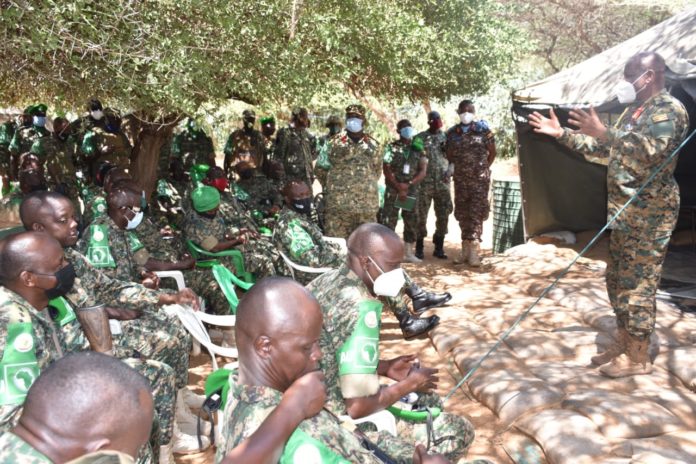
Gen Mbadi visits UPDF troops in Somalia, vows to improve their welfare

Updf troops in Somalia

The Chief of Defence forces (CDF) of the Uganda Peoples Defence Forces (UPDF) Gen Wilson Mbasu Mbadi has inspected Uganda troops in Somalia working under the African Union Transition Mission in Somalia (ATMIS).

Gen Mbadi who visited several Forward Operating Bases (FOBs) including among others Arbiska, Baledogle and Mogadishu Base Camp also held meetings popularly known as Monday Baraza in UPDF with rank and file of the troops.

Gen Mbadi thanked the troops serving selflessly in Somalia and in other parts of Africa, “I’m here to thank you for the work well done, you have served well and represented Uganda effectively, I thank you a lot, Asante sana,” Gen Mbadi said as he addressed soldiers at Baledogle Military Air Base (BMA).

The CDF further explained in detail to the troops what UPDF is doing to improve their welfare including accommodation, medical care, education of their children, salary enhancement among others.

“I visited the President of the Federal Government of Somalia H.E President Hassan Sheik Muhamud yesterday and he appreciated the work you have been doing here since 2007 and you (UPDF troops) specifically for the election security provided during election and inauguration that led him to ascend to the Presidency,” Gen Mbadi said to the troops at Baledogle 110km from Mogadishu town.

The CDF urged the troops in every FOB to continue exhibiting maximum discipline. “Before you do anything first ask yourself if it is professionally, legally, spiritually and morally correct” he advised, further saying it was different for one to go wrong if they asked their inner selves before they act.

Gen Mbadi briefed troops on the security situation in Uganda and the region and told the troops that the region cannot achieve developments without peace and security. “Money fears insecurity,” he said. He therefore reminded them of their role in bringing about peace and security in country and region at large.

The Chief of Staff Air Force (COS –AF) Brig Gen David Gonyi thanked the Air Force component for having an immediate positive impact in the ATMIS operations in Somalia.

The Deputy Commander UPDF Land Forces Maj Gen Sam Okiding thanked the troops for serving diligently, “we are proud of you for making Uganda shine, we walk with our heads high wherever we go and you have done a tremendous job.”

The Ugandan Contingent Commander in Somalia Brig Gen Keith Katungi thanked the CDF for making time off his busy schedule to talk to the troops.  He said that soldiers in operation areas gain morale when commanders from strategic leadership talk to them. “We are grateful for your coming here and we will do the same to the troops”.

Uganda was the 1st Troop Contributing Country (TCC) to deploy in Somalia in March 2007 and was later on joined by Burundi, Kenya, Ethiopia and Djibouti among others all working under African Union with support from European Union.

Stories Continues after ad

The Popularity of Sports Betting in Uganda and Finding Quality Bookmakers

Just a few years ago, betting was illegal in Uganda. However, since the intervention of President Yoweri Museveni in 2016, betting became legal, with rules and regulations established to secure punters.

Apart from the regulations created to protect online sports bettors, the national gaming board also provided licenses to bookmakers. So, aside from checking online reviews, like betPawa review, punters should be able to find the proof of licensing on the bookmakers’ website. 

Since its legalization, sports betting has become very popular in Uganda, with fans of teams making wagers to add excitement to their games. Nevertheless, fans cannot bet on sportsbooks that do not have licenses since it is illegal for those companies to operate in the country.

Sports bettors are always looking for the best bookmakers to serve their interests. This article will reveal some of the best ways to find quality bookmakers.

Things to Look Out for In a Bookmaker

  • Understand your Betting Needs

If you’re confused about what type of punter you are, you’d be most likely confused about which bookmaker to select. You need to tailor your needs to the sport you intend to bet on, the type of bonuses you want to get, and the deposit or withdrawal methods you’re willing to consider.

You also need to answer questions like the type of bet markets you’re willing to bet on consistently and your betting frequency. Answering these questions will place you on the right road to choosing a quality bookmaker.

  • Positive Reviews

The sentiment displayed in reviews gives one of the best ways to evaluate a company’s services. If other customers enjoyed the experience with the company, you’d most likely have the same experience. The internet has made reviews about a particular business easily accessible.

One good place you can find reviews is the sportsbook’s website. However, the catch is that the website will only display the reviews that give off the most optimistic voices. So, it’s often better to check for the reviews in an app store.

Perhaps the best source for reviews is an online forum. There you’d be able to sift through both positive and negative ones.

Conclusion

Sports betting in Uganda has been legal since 2016, and Ugandans have taken to betting like fish to water. Nonetheless, the flurry of bookmakers out there can get a bettor confused. That’s why one needs to look out for the qualities of a good bookmaker.

First, you need to understand what you want out of sports betting. Second, you have to look out for positive reviews on the bookmaker on app stores and forums.

Stories Continues after ad

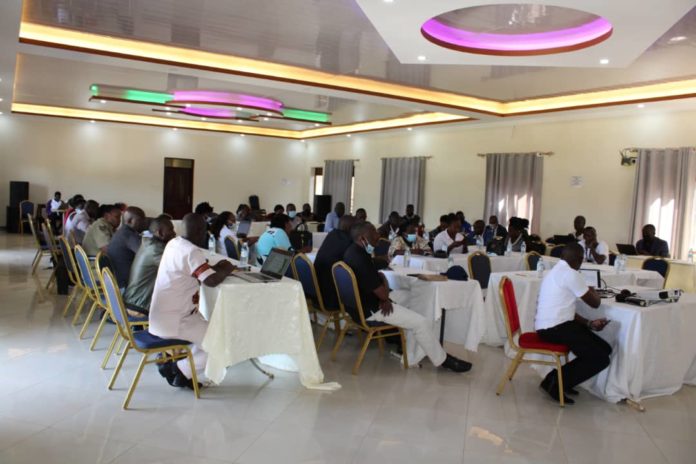
Tooro local leaders trained on Child Labour

The Ministry of Gender, Labour and Social Development has today conducted a training of over 100 local leaders in the Tooro sub-region on Government interventions on the elimination of the worst forms of Child Labour .

The training targeted the Tooro sub-region because Child Labour remains very prevalent in tea plantations in the Tooro sub-region with 15.4% of children in there involved in Child Labour, according to the 2019/20.

The training comes ahead of the commemoration of the 2022 World Day Against Child Labour,which will be celebrated at Bunyonyi Primary School in Kabarole District on Sunday 12th June. Jessica Alupo,the Vice President, is expected to be the Chief Guest.

Speaking at the opening of the training, Mr Hillary Businge, the Assistant Commissioner Labour Productivity,said the Government is committed to the elimination of Child Labour through the ratification of international conventions and the development of the National Action Plan on the elimination of Child Labour.

“Many of the stakeholders in the elimination of Child Labour have limited knowledge on the viable strategies and their application. It is important that we have vigorous training and sensitization of stakeholders to equip them with adequate knowledge on the problem of Child Labour,”Mr Businge said.

In Uganda, incidences of Child Labour increased during the COVID-19 pandemic from 21% to 36% according to the Uganda National Household Survey 2019/2020.

Further analysis of the data before and after 20th March 2020 showed that 36 percent of the children aged 5-17 years engaged in Child Labour including household chores; an increase from 21 percent registered before 20th March 2020.

The situation was exacerbated by the closures of schools because even after schools were re-opened in January 2022,1 in 10 school children did not report back to school, according to figures by the United Nations Children’s Fund(Unicef). These children are likely to have slipped into Child Labour.

The training focused on the legal and regulatory frameworks on the elimination of Child Labour which include the National Child Labour Policy, 2006 and Employment Act, 2006 as principal legal frameworks to curb Child Labour.

Stories Continues after ad

Our Heroes and Heroines birthed our security

Ambassador Henry Mayega

On January 26, 1986 President Yoweri Museveni and his NRM/Acompatriots-call them heroes/heroines marched into Uganda’s capital city, Kampala, taking over the reins of power from the Okello-Okello military junta that had grabbed government a year earlier from the Milton Obote administration. The NRM/A takeover was after a protracted guerrilla war of five years.

Those liberating compatriots included men and women extracted from a broad political spectrum that included monarchists, multi-party adherents, Marxists as well as federalists whose ultimate and collective desire was to secure and pacify the country which had, perennially, been bedevilled by war-mongering, despoliations, anarchy and outright savagery. The 1970s, for instance, witnessed Idi Amin’s most diabolic and gory regime that even claimed the life ofthe Archbishop of the Church of Uganda, JananLuwum in what was clearly a fake accident.

The most tantalizing question is: how has the Yoweri Museveni administration been consolidating security, peace and stability since 1986?

Firstly, that consolidation has resulted from Yoweri Museveni’s safe pair of hands, superb stewardship and magnanimity. As Uganda’s finest president, his administration has done it through the following:

Secondly, right from the bush days, Yoweri Museveni saw the benefits of political cohabitation between Uganda’s plethora of political forces; in 1986, the NRM/A dominant force invited others from all shades of political opinion to form what was referred to as the “broad-based government.” That, in a sign of quick-wittedness on the part of the president, helped calm the political tempers that had boiled to fever point since the 1966 crisis.Die-hard sand sane souls from the UPC, DP, CP, Mengo’s monarchists et al extractions were brought on board under that umbrella of political cohabitation that saw a level of unprecedented unity amongst hither-to sworn enemies.

Thirdly, Yoweri Museveni’s feat of convincing the army council membership in the late 1980s (save for recalcitrant Warren Kiiza Besigye who rejected the idea) to have traditional institutions restored in areas that revered them exhibited a well-articulated traction towards national healing and simultaneously persuade some hot heads out of the path to violence.After the restoration many felt accommodated and acknowledged that the injustice committed in 1966 when kingdoms were abolished by the Milton Obote government had been repudiated.

Thirdly, Ugandans should remember how the British colonizers had built the oppressive military machine hell-bent to crush any slight decent amongst the inhabitants of their “protectorate,”Uganda. The Yoweri Museveni administration, rightly, disbanded remnants of that outfit and in its place the Uganda Peoples Defence Forces was born – a truly national army.The administration simultaneously modernized the UPDF, initially the NRA,and has sinceobliterated over twenty rebel/terrorist groups including the LRA, ADF, FUNA, UNRF, Kirimutu, UPDA, FOBA, UPA, Holy Spirit Movement from Uganda’s orbit.

The army has, at the international level, also participatedin degrading the Al Shabab in Somalia(a terror group that chased the American military from that country in the 1990s), the ADF in the DRC, rebels in Sierra Leon, South Sudan and in the CAR.The UPDF has also been supportive to the Uganda Police Force’smaintenance ofsecurity in times of need plus, both agencies are not as parasitic as their predecessors as typified by their engineering units’ participation in productive work; the pavilion at Kololo airstrip, for instance, was built by the UPDF.

Never in the history of independent Uganda has the national army been closest to citizens; in these peace times, the UPDF has a fully-fledged department whose job it is to “okukwanaganyaamajjena bantu” – the chieftaincy of civil military relations,the very reason why pockets of insecurity anywhere in the country are reported and nipped in the bud precipitately.

Fourthly, the LC structure, initially mooted and tested during the Luwerobush war of 1980-1986, has been particularly instrumental in the maintenance of security. Village committees plus their higher replicas at gombolola, county as well as at the district levels have commendably ensured security, peace and stability due to their vigilance and instantaneous reporting arrangements; Their secretaries for security have commendable reinforced security agencies.

Fifthly, many elements from former fighting rebel groups who qualified were either discomfited or persuaded out of rebellion and re-integrated into initially the NRA and now the UPDF;others have been permitted space in national elective politics – a feat attributable to President Yoweri Museveni’s magnanimity and liberality.

Lastly, the disarmament exercise, especially in the Karamoja sub-region has largely helped in bringing peace to the north eastern part of Uganda despite bouts and surges of inter and intra national incursions by a kaleidoscope of raiders.

Ambassador Henry Mayega

Consul General

Dubai

United Arab Emirates

Stories Continues after ad

ICO unveils landmark International Coffee Agreement

Farmer picks coffee

In a new spirit of collaboration, the International Coffee Organization [ICO] has announced its landmark International Coffee Agreement 2022, formally welcoming to the table for the first time in 60 years the world’s biggest coffee retailers, roasters and manufacturers, together with coffee farmers.

Going forward, the private sector and civil society will participate as affiliate members in key discussions and decisions on the sustainable future of global coffee affairs with 75 coffee producing and importing nations, ICO Member Governments. The goal of the Agreement is to find new ways to improve conditions in an over US$300 billion a year industry that provides a livelihood for millions of people from farmers to baristas across the world.

Indeed, coffee farmers have suffered much in the wake of a 2019 coffee pricing crisis, extreme weather including droughts, flooding, frosts and blight, resulting in crop losses and prompting many to quit a business that had been in their family for generations. Smallholders, who only have less than one or two hectares of land each to produce coffee, for example, are the most vulnerable with incomes of just US$500 a year.

The Chair of the International Coffee Council, Ambassador Iván Romero-Martínez of Honduras, stressed that with the approval of the new Agreement the Council marked a new era for the ICO, its members, the global coffee sector and for millions of coffee farmers whose work, every day, allow us to taste a wonderful coffee.

He further pointed out that ICO members showed the world that the coffee sector is strong and united as ICO reaffirms itself as the centre of the “coffee diplomacy”, committed to making the coffee value chain more sustainable, inclusive, and resilient.

“We are entering a new era of cooperation with the private sector thanks to the landmark International Coffee Agreement 2022,” says Vanusia Nogueira, who joined in May as ICO’s first female Executive Director.

“The arrival of the world’s biggest high-street names and manufacturers as well as smallholders means that the whole coffee value chain can now address the biggest challenges facing the global sector in a way that is fair for all,” she adds.

The new International Coffee Agreement goes beyond the traditional divide between exporting and importing members as all members are committed to working together to address the increasing challenges of the coffee industry. The private sector and Government entities will coordinate strategies to address more efficiently those challenges. This will benefit producers across 50 countries as coffee growers and their associations will be able to raise their concerns directly with retailers and manufacturers.

Moreover, the new Agreement gives a clear and firm mandate to the ICO Secretariat to assist Members in putting together coffee sector development projects and mobilizing resources in areas such as pest and disease control, climate change adaptation among other mitigating strategies. This comes at a time when expanding demand for coffee will contribute to maintaining a balance between supply and demand, supporting fair market prices.

“The industry has changed dramatically in the last 30 years in terms of governance and value distribution between producing and consumer nations. We can now come together and put a bigger emphasis on the development of the global circular coffee economy. Ultimately, we want to create a brighter future for millions of coffee farmers by adhering to the United Nations’ Sustainability Development Goals and work for more transparency, quality and fair pricing for billions of consumers. The new Agreement is a huge step in this direction,” Nogueira adds.

The new Agreement represents a fresh mandate for the ICO. It is the seventh of its kind since 1962 after the first International Coffee Agreement defined coffee export quotas at the United Nations in New York. The 2022 Agreement has come a long way since then, now that the ICO can bring all parties to the table for the first time and tackle challenges through international private and public cooperation, involving its Member Governments, which represent 93 percent of world coffee production and 63 percent of world consumption. Today, the world drinks more than 2 billion cups of coffee a day.

“The new Agreement is an effective instrument to paving the way to a more unified front, establishing a consensus and shared vision on how to best implement and promote actions by governments and the private sector, while also engaging all key coffee-related institutions, NGOs, international and financial institutions plus other development partners, research bodies and academia,” says Ms Nogueira, who previously represented Brazil, the world’s biggest coffee producer, in global coffee affairs as the Executive Director of the Brazilian Specialty Coffee Association.

While the ICO will not change its intergovernmental nature, as part of the Agreement, the current Coffee Public-Private Task Force is integrated into the ICO as the Coffee Public-Private Working Party. On top of this, the Private Sector Consultative Board will be transformed into the Board of Affiliate Members, creating a new institutional framework and leading to the nongovernment affiliation since 1963 when the ICO was established in London.

The Agreement’s key points also redefine the ICO’s internal voting system and members’ contributions to better reflect the transformation in the global coffee chain over the last 30 years, accounting for distortions between producing [exporting]and consumer [importing] countries as well as Arabica versus Robusta coffee producing nations. The change in membership contributions to the administrative budget will increase the financial sustainability of the Organization and its capacity to carry out its mandate.

In terms of production, the world produces 4.18 million tonnes of Robusta coffee, or 69.67 million 60kg bags a year, and 6.07 million tonnes of Arabica, or 101.16 million 60kg bags, annually as of 2020. This is up from 1.74 million tonnes of Robusta and 4.34 million tonnes for Arabica coffee in 1991.

Stories Continues after ad

Building a circular economy for plastic waste key to preserving Africa’s marine resources

Tshidi Ramogase is the CCBA Chief Public Affairs, Communications and Sustainability Officer

By Tshidi Ramogase

The African Union has called the Blue Economy the “New Frontier of African Renaissance”, and with good reason.

As the United Nations Economic Commission for Africa has noted in a policy handbook for the Blue Economy, 38 out of the 54 African states are coastal, more than 90 percent of the continent’s imports and exports are conducted by sea, and some of the most strategic gateways for international trade are in Africa

Maritime zones under Africa’s jurisdiction total about 13 million square kilometres, including territorial seas and approximately 6.5 million square kilometres of the continental shelf.

There is, as the UN Economic Commission for Africa puts it, “another Africa under the sea”.

These marine resources, including freshwater bodies and oceans, offer significant economic opportunities, yet governance of aquatic ecosystems, goods and services is under-developed and under-resourced, resulting in degradation of ecosystems, and loss and waste of valuable resources.

As we mark World Oceans Day on June 8, it is increasingly clear that we must work together across the public and private sectors, as well as civil society, to make sustainable decisions to protect our marine ecosystems for future generations.

The issue of packaging waste features high on the list of priorities. While food and beverage packaging are an important part of our modern lives, the world has a packaging problem, which we as Coca-Cola Beverages Africa (CCBA), together with The Coca-Cola Company, have a responsibility to help solve.

We have committed to invest in our planet and our packaging to help make the world’s packaging problem a thing of the past, working in partnership with The Coca-Cola Company which launched a sustainable packaging initiative called World Without Waste in 2018.

We have the following goals in Africa:

·         Help collect an equivalent of a bottle for every one we sell by 2030

·         Focus on making all our packaging 100% recyclable by 2025

·         Have 50% recycled content in our packaging by 2025 and

·         Make 25% of our packaging reusable by 2030

We continued to make progress in 2020, despite the challenges from the Covid-19 pandemic. Plastic waste collection and recycling have bounced back remarkably from the disruption caused by Covid-19 restrictions, and CCBA achieved a 58% recycling rate for FY2021.  The recyclability of our packaging is already at more than 95%, tracking ahead of the global target of 100% by 2025.

If we are to create truly circular economies, where waste is minimised and reuse of materials is maximized, the starting point is understanding that our packaging materials have value.  Importantly, we need to find ways to capture that value to prevent our packaging from becoming waste at the end of its life.

We are improving the recyclability of our packs through a strong emphasis on shifting to homogeneous and clear bottles and have made significant progress on this already. In addition, over 20% of our revenues are already coming from returnable or refillable packs. We are strategically looking to increase the use of homogenous returnable packs in our portfolio – which has the added benefit of being environmentally friendly and decreasing the impact on our oceans.

Our biggest challenge on recycling is accelerating the collection of plastic bottles to increase polyethylene phthalate (PET) bottles feedstock for recycled PET supply to enable higher recycled content in our bottles. Consumer behaviour and accountability also remains a challenge.  We encourage all consumers of our beverages to dispose of the packaging in an environmentally responsible manner, so it can be collected and recycled for reuse.

To date, in South Africa we are at 17% recycled PET content, and we have 17% recycled PET content in 2 litre bottles in Namibia, Mozambique, Botswana and Zambia. One example of how we are getting communities involved is in Kenya. Here we leveraged our partnerships to launch the Recycling PET Bottles initiative, getting 400 schools to participate in the collection of PET bottles. A total of over 90 000kg, or 4.5 million PET bottles, were collected and recycled as a result of this initiative.

Partnership across business, government and civil society is fundamental to scaling solutions and critical to achieving a circular economy. We remain committed to help drive collective action, working with stakeholders, suppliers, non-profits, communities, customers and industry peers to invest in recycling innovation, facilities, organisations and initiatives.

In Africa and other developing markets, there is an additional layer of complexity, in that the market for recycled plastic in many countries is too small to support investment in recycling plants, yet the rules governing the movement of plastic waste across borders inhibit the economies of scale needed to achieve optimal rates of recycling, limit waste going to landfill, and create employment in the circular economy.

Engagement with various governments’ International Trade Administration Ministries is critical to review and revise policies guiding movement of recyclable waste across countries through regional economic platforms such as Southern Africa Development Council (SADC) and East African Business Council (EABC). CCBA remains committed to broader stakeholder engagement and collaboration to enable an efficient regional recycling industry. 

With the right regulatory environment to enable higher rates of collection and recycling, and continued commitment and collaboration across industry, across countries and with all interested partners, a World without Waste is possible, protecting the marine environment and allowing for the sustainable development of Africa’s Oceans Economy.

Ramogase is the CCBA Chief Public Affairs, Communications and Sustainability Officer

Stories Continues after ad

Kole Deputy RDC urges parents to prioritize taking their children to schools

Trevor Baleke

Kole Deputy Resident District Commissioner (DRCD), Trevor Solomon Baleke has urged parents to prioritize taking their children to schools other than leaving them to loiter around and grazing cattle.

Mr. Baleke said at an event where primary schools in Kole celebrated following scooping several medals in this year’s athletics.

“You should get more concerned when your neighbor’s son is not in school yet your daughter is studying and vice versa. This is because the uneducated might end up either influencing your child to drop out of school or engage them into acts that shall affect their school life,” he said.

 “If you only focus on educating the girl child when boys are loitering and grazing cattle, your educated daughter will get married to a herder who won’t even allow her to work,” he said.

He urged parents of children with special needs to prioritise taking them to schools for them to learn and equip them with skills to succeed in future. Kole district was sixth in the national athletics of primary pupils with special needs.

The Deputy RDC said sports is one of the most profitable and paying ventures in the world and urged parents and schools to explore children’s talents.

“Parents must play a greater role in instilling social skills in children before the age of three years. Proper social skills equip a child to develop advanced cognitive skills during the school years,” he said.

“My sister Caroline Angolere, the RDC has told me to assure you that we shall as the office of the president always support you in whichever activities aimed at making your future bright,” he said.

Stories Continues after ad

Landlord and Tenants Bill 2022: Landlords permitted to take possession of tenant’s property to recover rent arrears

Parliament

Parliament has passed the Landlord and Tenants bill, 2021 that permits the landlords to access the tenants’ premises and take possession of the property to recover accumulated rent arrears.

This has however, been conditioned on the landlord issuing a notice to the tenants who default on rental payment.

“Provided that where the default shall continue for a period of more than 30 days, the landlord shall be entitled to re-enter the premises and take possession thereof, in the presence of the area local council officials and the Police, without prejudice to the right to recover the rent arrears,” the bill states.

The bill intends to regulate the relationship between landlords and tenants, to reform and consolidate the law relating to letting of premises, to provide for the responsibilities of landlords and tenants in respect to the letting of premises.

The Vice Chairperson of the Committee on Physical Infrastructure, Hon Robert Kasolo who presented the report on the bill said that the Bill makes it mandatory for the landlord and tenant to enter a tenancy agreement before occupying a premise. 

The lawmakers also passed a provision in the law where the landlord issues a 60 days’ notice prior to increasing the rent charges.

“Increment of the rent should not exceed 10 per cent of the rent remitted at the when landlord considers to revise the rent charges,” the bill states in part.

The House also passed a provision that the currency of transaction between landlord and tenant shall be Uganda Shillings.

Kasolo said that the Shilling has continuously depreciated against the dollar.

The Bill grants a tenant the possibility to agree with a landlord on paying an amount equivalent to the dollars.

This therefore resolves the contention that was previously between landlords and tenants as the former demanded that their clients remit rent in dollars.

The new law will also see penalties for landlords who are found liable of unlawfully evicting their tenants. This conditions the landlord to compensate a tenant three months equivalent of rent dues.

The new law will also see a restriction of increment on rent being put to not more than 10 per cent annually.

Furthermore, the law proposes that a notice for increment of rent should be issued 60 days before its implementation.

Stories Continues after ad