Stanbic Bank
Stanbic Bank
27.6 C
Kampala
Stanbic Bank
Stanbic Bank
Home Blog Page 634

Stanbic Bank, Salaam Charity Foundation give back to Police

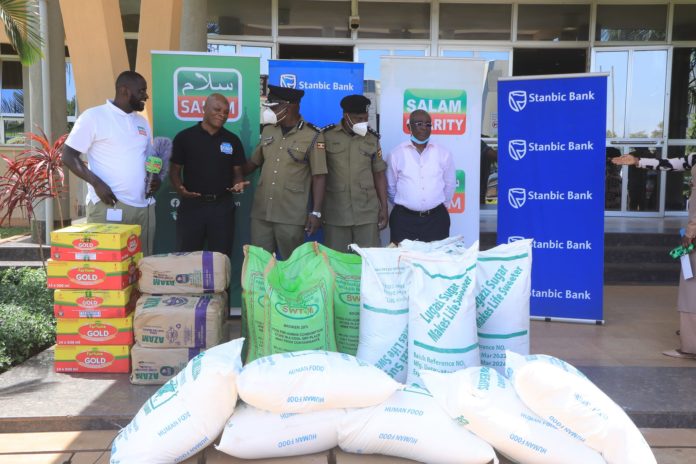
Stanbic Bank in collaboration with Salaam Charity Foundation have joined hands and donated “Iftar” to Police Muslim fraternity as part of their Corporate Social Responsibility (CSR).

The items donated include, Sugar, rice, cooking oil, baking flour and Maize flour.  These will enable Muslims in the force easily breaking their fast during this holly month of Ramadhan.

Stanbic Bank regional manager, Haji Ali Lwanga who handed over the items to Police felt privileged with the giveback to police which provides security especially during night prayers (Taraweeh).

“We appreciate the role played by the Police in providing security especially during night prayers (Taraweh). It’s a month of fasting and we are privileged to give and share with the Muslim fraternity in Uganda Police to assist in breaking their fast,” Ali said.

He was flanked by Hajji Haruna Mubiru, the General Manager Salaam Charity Foundation.

The ramadhan items were received by Assistant Commissioner of Police, Hajji Jamaal Basalirwa, Ag. chairman UPF Muslim Community on behalf of IGP, JM Okoth Ochola Esq.

“We appreciate Salaam Charity and Stanbic Bank for these donations to our officers. We shall distribute them within the Muslim community of Naguru and Nsambya mosques to help them break their fast,” Basalirwa remarked.

The eventful ceremony took place at police headquarters in Naguru on Monday afternoon, 11th April 2022. The timely development surfaces on the day the Muslim fraternity climax the first ten days of the holy month of Ramadhan.

Stories Continues after ad

Standard Chartered launches ‘BANK MORE SCORE MORE’ season II where customers get exclusive LFC prizes and win a trip to Anfield

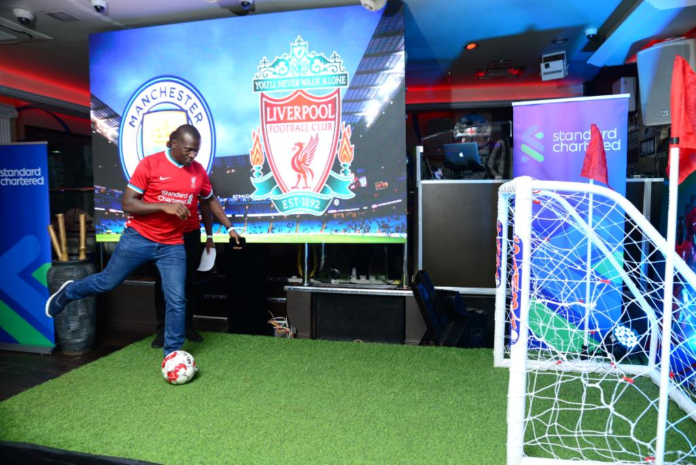
Standard Chartered Bank has announced the launch of BANK MORE, SCORE MORE season II campaign that will run between 01st April to 30th June 2022. This was unveiled during a match viewing party of the LFC Vs Manchester City game that took place at Guvnor.

The event had over 180 bank staff, customers, LFC fans and media who convened to support their beloved club as it journeys towards the championship cup.

The BANK MORE, SCORE MORE season II campaign is a digital league competition that offers the Bank’s customers an opportunity to open and fund accounts to win exciting prizes. Clients have been tiered and will get rewards when they open accounts and take up various products.

The more actions both new and existing customers undertake, the higher their rewards.

For new clients, they need to open a Digital Life Account on the SC Mobile App they download from the App store or google play store & fund it with at least Shs 100k which they need to maintain for at least 15 days while for existing clients, they need to fund their Digital Life Accounts (for the first time) with atleast Shs 100k for atleast 15 days to win an LFC Bag, a Sport Tritan Bottle and a Cashback of Shs 10000.

For clients who sign up for an investment / insurance product, they win an LFC Umbrella, LFC Bag, Sport Tritan Bottle and Earphones.

For clients who grow their local currency average balances by Shs 5m, they enter a draw for a chance to win a trip to Anfield or Equivalent. The top 30 clients with the highest growth will also get an LFC Umbrella, Bag, Cap, Earphones and a Sport Tritan Bottle.

To participate in the competition, new customers simply need to open and fund a Digital Life Account and take up more products to earn points in this campaign. Existing customers can also participate by taking up more products to earn additional points.

Moses Rutahigwa, Head of Consumer, Private and Business Banking at Standard Chartered Bank while launching the product said: “We are pleased to once again launch the “BANK MORE, SCORE MORE” campaign as a build up to a successful season I campaign. This campaign is offering an experience of a lifetime for LFC fans. We commit to offer our clients exciting LFC merchandise with the grand prize being an all-expenses paid trip to Anfield or its equivalent as might be determined by the prevailing global circumstances. I therefore encourage all our customers and all football fans who might not own accounts with us, to try our Digital Life account. This account comes with several benefits like: no monthly fees, no minimum balance, no ATM fees, free utility bill payments and free Standard Chartered to Standard Chartered Account transfers.”

 Margaret Kigozi, Head of Corporate Affairs, Brand & Marketing at Standard Chartered Bank added: “The Liverpool Football Club is amongst the most beloved football clubs in the world with over 770 million fans. Our partnership with the LFC club since 2010 has enabled us to launch campaigns such as the famous Road to Anfield, the SC Cup and now this.

Standard Chartered Bank and Liverpool FC have shared values and heritage that have enabled us to create unique opportunities for clients and LFC supporters around the world, so we are proud to host LFC football fans to this match viewing party as Liverpool FC goes head-to-head with one of its greatest rivals, Manchester City and to use this opportunity to launch our “Bank more, Score more” campaign. We look forward to watching BANK MORE SCORE MORE’s winners experience this initiative.”

Standard Chartered’s Liverpool F.C. sponsorship is the second-longest sponsorship deal in LFC history, and this has enabled the bank to reward and engage its clients through this partnership.

Stories Continues after ad

Court issues arrest warrant for Kakwenza’s sureties

Kakwenza Rukirabashaija

Buganda Road Magistrate Dr. Douglas Singiza has issued a warrant of arrest against the four people who stood surety for the Ugandan Novelist Kakwenza Rukirabashaija.

The four include; Ashanah Annah, Job Kiija, lawyer Julius Galisonga Kibande and David Lewis Rubongoya, the secretary general of the National Unity Platform (NUP).

According to the magistrate, the four didn’t appear before Court after they were served for failure to produce Kakwenza. Kakwenza, who is facing two charges of offensive communication, contrary to Section 25 of the computer misuse act 2011, was on 25th January 2022 granted Shs 500,000 cash bail as his Sureties were ordered to pay Shs 10 million non-cash.

According to the ruling, the writer was supposed to deposit his passport with court; however he fled into exile and is currently in Germany.

Last month, Dr. Singiza issued an arrest warrant against Kakwenza for failure to turn up for court proceedings. On the 23rd of March, prosecution led by Joan Keko asked court to extend the arrest warrant against the suspect and issue notice to his sureties to explain his whereabouts.

In his ruling, Dr. Singiza ordered that the sureties be arrested and pay Shs10 million they committed.

Meanwhile, Kakwenza launched a campaign aimed at saving his securities. He aims at collecting Shs40 million, a total amount required of the four sureties.

“My friends who stood surety for me owe Shs40m because I fled the country for my life. It’s upon me now to raise the money and pay court in respect of summons. I’m looking for 5,000 people who can send Shs 8,000,” Kakwenza said.

Stories Continues after ad

Jacob was a man called, and in death a fruit fallen unripe

DP President Norbert Mao

By Norbert Mao

In his work Twelfth Night, famous English playwright and wordsmith William Shakespeare tells us that “Some are born great, some achieve greatness, and some have greatness thrust upon ’em.” Jacob Oulanyah L’okori, the late Speaker of Uganda’s National Assembly, achieved greatness.

I joined Makerere University in 1988 where I was admitted to study Law. I was assigned to Mitchell Hall. It was in Mitchell Hall that I met Jacob. What first drew me to him was his ability to express himself with clarity and confidence.

This first came to my notice during one of the public lectures I attended. Every Tuesday there was something called the Tuesday Discussion hosted at the Department of Political Science. The organizers were those known then as Cadres among the student body. Among the most outspoken of these cadres were Noble Mayombo, Felix Kulayigye, Chris Turyatunga, Ngabo, Ofwono Opondo, Robert Masolo and Richard Karemire. Every week a guest speaker came from the military or government circles to speak on a topical issue. The purpose of the discussions were to enable students engage with those in charge of decision making in the country. The discussions were often heated and Jacob always spoke out strongly on the topical issues.

As one who had been among the best performing A-Level students in the country I was entitled to an annual cash allowance of Shs.16,000/-. I decided to use the money to buy a radio cassette player, some cups, plates and clothes. But I didn’t know Kampala well and feared getting lost. I asked Jacob to show me around as I went shopping. This he did graciously. Years later, Jacob told me that at that time he also didn’t know Kampala well. I was stunned by Jacob’s confidence!

It was the tradition of the Halls of residence to elect a Chief Fresher every year from among the newly admitted students. I registered my intentions and started canvassing for support. And one of my most fervent supporters was Jacob. The title of Chief Fresher sounds big but in reality the main work was that of a Cheer Leader for our sports teams. Other assignments included petitioning the powers that be in the Hall for redress of minor problems. The office attracted no privileges apart from being recognized in the Dining Hall by the kitchen staff.

The second political office I sought was on the Mitchell Hall Village Resistance Council Executive Committee. In the year 1989 there were countrywide elections of Resistance Council Executive Committees. Uganda was then under the Movement System. Parties existed only in name. Their activities were banned. The National Resistance Movement, the political wing of the National Resistance Army which had ousted the military government of Gen. Tito Okello, was in reality a State Party. Again I sought out Jacob for support. I was elected to the position of Secretary for Information and Mass Mobilization.

As a student leader, Jacob was a great advocate for the independence of student organizations. He developed early a strong love of reading. We exchanged many ideas based on our readings of history and political philosophy. His passion for human rights shone through his speeches. Jacob believed that everybody is entitled to the protection of the law, including those who despise the law.

Jacob initiated a discussion group known as the Ideological College. This entity raised serious questions about the democratic credentials of the NRM and its militaristic policies. This attracted the adverse attention of the security circles in Uganda. Based on the following he had, Jacob toyed with the idea of contesting for the position of President of the Makerere Students Guild. After he declared his intentions, some security operatives confronted him with severe threats. When he returned from what must have been a stormy encounter with the security operatives, Jacob told me that he would no longer run for Guild President. He declared his support for me and even some of his would be financial backers decided to contribute to my campaigns.

The Guild race attracted many candidates. I had to face the late Noble Mayombo as my main opponent. There were others like Amon Reeves Muzoora, Vuba Charles Londa from the populous Lumumba and Mary Stuart alliance and Sam Lyomoki from Northcotte Hall. When news reached us that Mayombo had launched his campaign in a colorful event in Nkrumah Hall where the over 300 participants each had at least three beers, I went to Jacob’s room to consult on how we would deal with a polished, eloquent and financially loaded opponent. Jacob’s advice was that we should not fear Mayombo but we should try to ensure that we project Mayombo as an apologist for the unpopular Structural Adjustment Program which the government has swallowed lock, stock and barrel. The Structural Adjustment Program which we christened “Stomach Adjustment Program” imposed austerity measures on the government leading to budgetary cuts on social services like education, health and security. Mayombo was a soldier holding the rank of Lieutenant. On his campaign poster his message was “Tilting the Balance of Forces in Favour of Makerere”! He was basically saying that he would be a positive influence on the government and the university would benefit. My campaign poster had the message “Solidarity, Guild Autonomy and Greater Student Power”. I wanted the students to assert their power.

Jacob was in the inner circle of my campaigns alongside other key players. One day we decided to plant a question which we thought would trip Mayombo. We deployed someone to put it to Mayombo that as a serving soldier he was a State agent. Mayombo’s being a soldier was largely a whisper because he was never seen in uniform. When the question was put, Mayombo did not deny that he was a soldier. Looking straight at the person who had asked the question, he went down on one knee, struck the table on which he was standing repeatedly saying “It is an insult to call me a State agent. I am the State!” Our secret weapon intended to turn our nemesis into a villain fell flat.

In the meantime, the campaign turned into a two horse race between Mayombo and myself. I was leading but Mayombo with his well-oiled campaign machinery, was capable of overtaking me. That is when I was approached by Bruce Kwarisiima, a final year law student proposing a meeting with Mayombo and some people from government. I turned to Jacob. I told him I expected them to ask me to step down for Mayombo because I was the only person in the race capable of defeating Mayombo’s strong and well financed campaign. I consulted Jacob and he said “What do these people think we are!” We then agreed that I should attend the meeting but under no circumstances should I agree to step down for Mayombo. We met at Campus Close Hotel in Wandegeya. The team from government told me that even though I was running a strong campaign, I could not defeat Mayombo because he was a flagbearer for the historical Movement. They promised to reimburse my expenses and to have Mayombo appoint me Vice President. I declined the offers and insisted that I would be in the race till the end. “If I lose, I lose”, I told them.

When I convened the meeting of the core campaign team members we agreed on a strategy of forming an alliance with one of the other key candidates. With Mayombo surging forward, we needed to do something that would demoralize his campaign. Jacob then proposed that while he agreed with the idea of the alliance, the timing would be critical. If we announced an alliance too soon Mayombo’s campaign would recover. He then suggested that we should form a last minute alliance and spread panic in Mayombo’s camp. Henry Mayega, then a residence of Complex Hall brokered the discussion which led to the Mao-Vuba Alliance. The alliance was announced on the eve of elections. The rest is history. We achieved a convincing win.

After my win, our team agreed that Jacob should get elected to the student parliament known as the Guild Representative Council (GRC). Indeed Jacob was elected to the GRC and we nominated him for the position of Speaker. His rival, unsurprisingly, from Mayombo’s camp was Adolf Mwesige, former Minister and currently the Clerk to Parliament.

I then held a meeting of the cabinet and proposed that we should present a motion to the GRC proposing that we should declare a lecture boycott given that our petition to the Education Minister Amanya Mushega had been ignored. The GRC adopted our proposal and recommended that we should table it before the General Assembly. But there was a problem. Holding a general assembly required the permission of the Vice Chancellor.

Within a few weeks we agreed that we should defy the Reguations requiring that before the Student’s Guild can hold a general assembly they must get the permission of the Vice Chancellor. Jacob and his deputy Kenneth Wanyoto, committed to presiding over the assembly. Despite the threats issued by the Vice Chancellor through Radio Uganda. Jacob joked that the assembly would surely be a success because of the Vice Chancellor’s announcements on radio. “The man has mobilized for us”, Jacob joked.

The General Assembly adopted the resolution that we go on strike. The strike went on for several weeks and there was a virtual stalemate as the government presented us in the media as spoilt and ungrateful children demanding for privileges. I’m glad that the government has now admitted that the Structural Adjustment Program was largely a disaster that handed over the rudder of our economy to foreign interests.

The prolonged strike polarized the student body and we considered and adopted a plan to call off the strike to give way for negotiations. We decided to call a general assembly on 10th December, 1990 – International Human Rights Day. Early that morning before I reached the Freedom Square, the venue of the Assembly, I heard gunshots. On my way there I met Jacob. He was looking frail and appeared to have been beaten badly. He simply told me “the situation is impossible, let’s go back!” I insisted on going where the bullets were still flying.

Later I learnt that Jacob had collapsed on reaching the Hall and had to be taken to Mulago hospital where he had to undergo an emergency surgery during which his spleen was removed. I also learnt that Jacob being dressed in the Speaker’s red gown was descended upon by security forces that had been deployed all over campus. They beat him, they kicked him, and they punched him and hit him with gun butts. The effect of this beating was great trauma to his internal organs. This was confirmed by Jacob’s lead physician in Seattle.

As I went to Gulu to vie for the Constituent Assembly seat of Gulu Municipality, Jacob was studying for his degree in law. I lost to Mzee Andrew Adimora. In 1996 I went back to contest the parliamentary elections to represent the same constituency. This time I faced the powerful Minister Betty Bigombe. I was cash strapped in that campaign. My nomination fee was a contribution from my boss Charles Kabugo of Kabugo and Company Advocates. I had a car but no cash to even fuel it. After nominations I took a bus to Kampala to seek out friends who could contribute. Most friends discouraged me when I told them who my main opponent was. They counseled me to wait because winning against Betty Bigombe looked impossible. Not so Oulanyah. As I wandered in Kampala, with zero contributions from friends, I met Jacob. I poured out my agony and the dire situation I was in. I had missed four days of campaigning and Betty Bigombe’s supporters were singing and dancing about my political demise. “Where is that boy with a big mouth? Where is he hiding? Is he hiding behind his mother’s gomesi?” Jacob was sympathetic. He put his hand inside his jacket pocket and pulled out a wad of banknotes. He counted some notes and as he was about to hand it over to me he decided to give me the whole bundle. That day he had received his salary and decided to give me the whole amount.

The next day I went to Gulu to continue my campaigns. The faith Jacob showed in me kept me going. After winning the elections I organized a first anniversary celebrations and asked Jacob to be the emcee. In 1998, I supported Jacob’s bid to become LCV Chairperson of Gulu. I sent my car to support his campaign and endorsed him emphatically. This race pitted him against Col. Walter Ochora. Gulu then comprised the current Gulu City and the four districts of Gulu, Omoro, Amuru and Nwoya. That was the campaign that introduced Jacob to Acholiland as a formidable leader of great potential. I believe he won that election but was simply rigged out.

In 2001, I again endorsed Jacob for the parliamentary seat of Omoro – the constituency he died representing. Against all odds and opposition by powerful leaders who claimed he was not a real Acholi, he won. In parliament Jacob found a platform where he excelled. He was elected Chair of the Legal Committee where I also served. We dealt with intellectual property laws like the Copyrights Act which he tabled as a private members and the Patents Act.

Jacob was a sticker for rules and procedure when our committee considered the Bill which proposed the constitutional amendment to remove presidential term limits. Those of us opposed to the amendment encouraged him to use technicalities such as quorum to delay or frustrate the Bill. Jacob insisted that the committee was a servant of parliament and it would be up to the parliament to make the final decision based on the findings of the committee. Indeed he processed the bill and even voted yes to get the Bill to the final stage. In the final vote he abstained! We disagreed on this matter and in the next elections I decampaigned my best friend. Jacob lost the election.

In the next five years Jacob encountered various tragedies. He lost his wife Dorothy. He lost his mother. He lost a big daughter. He also lost a baby. Despite our political differences, I stood with my friend. One time his daughter who was diagnosed with a heart condition needed surgery in India. Jacob needed money. In Pakwach I met President Museveni and I asked for a private audience in a public space. We stepped aside and I whispered into the President’s ears the situation Jacob was in. That is the famous picture where I’m pictured speaking into the president’s ear. That night, the president called Jacob and offered assistance. Unfortunately the young lady died before the surgery. In 2011 and since then I never decampaigned Jacob.

Years later in 2014 it was Jacob’s turn to rescue me from the jaws of death when I fell seriously ill and was admitted to Lacor Hospital. With life ebbing away from me, Jacob called Gen. Charles Otema and everybody else he could get in the UPDF, demanding that I be airlifted to Entebbe so that I could take a commercial flight to Nairobi. My father, who was a very good friend to Jacob, was always grateful that he saved my life. Without Jacob’s intervention, I would have certainly died on the road to the airport.

Finally, friends are relatives we choose. As friends we mourn Jacob because we are overwhelmed by the shocking end to a life of friendship and love. As a community recovering from the effects of a two decade long war, we are grieving for our dimming hopes caused by the death of a man so gifted and whose true potential this country will never know. When Jacob’s grave is closed, it will close over a man who has gone too soon and whose best years of public service were still ahead. Another fruit fallen unripe!  A man such as Jacob could not die without leaving an immense void in our National political life. He has been, closely and for a long time, part and parcel of the history of our country and the events that have defined its journey. To that extent, Jacob’s death has strummed the chords of public sympathy.

As a human being, Jacob is no more. He is no more as the representative of the people of Omoro County in the parliament. No more as the man who lit up any social gathering with his heartfelt laughter, animated conversations, social graces and dancing strokes. No more as a dependable friend to his social circles. No more as a father to his children and a pillar of his family and community. No more as the Speaker tirelessly defending the decorum, rules and traditions of parliament. He is no more. He is dead.

But methinks something good cannot die. I disagree with Mark Anthony when he says that that the evil that men do lives after them and the good is buried with them. Good deeds live and live forever. Good deeds live in the memory of those that have benefitted from the great actions of a deceased person. The records of deceased person’s intellectual endeavor live on. Above all, good deeds live on in the appreciation and respect that the public accords a dead man. Good deeds live on in the power of example that will continue to influence the lives and efforts of others.

As Daniel Webster wrote “A superior and commanding human intellect, a truly great man, when Heaven vouchsafes so rare a gift, is not a temporary flame, burning brightly for a while, and then giving place to returning darkness. It is rather a spark of fervent heat, as well as radiant light, with power to enkindle the common mass of human mind; so that when it glimmers in its own decay, and finally goes out in death, no night follows; but it leaves the world all light, all on fire, from the potent contact of its own spirit.”

Stories Continues after ad

Chipper Technologies Uganda Limited is a licensed broker – CMA clarifies

The Capital Markets Authority (CMA) has clarified and confirmed that Chipper Technologies Uganda Limited is a licensed broker after it was petitioned over a brokerage license it issued to them last year to invest in US stock markets.

A concerned citizen, Mr Samuel Obedgiu petitioned Capital Markets Authority (CMA) over a brokerage license it issued to Chipper Technologies to invest in the US stock markets.

In the petition, Obedgiu raised concern over Chipper technologies operations in the market, tasking officials at CMA to explain how the firm is encouraging Ugandans to invest in global stocks without issuing a prospectus as required by the CMA Act.

“The Capital Markets Authority’s attention has been drawn to an article titled: “Capital Markets petitioned over Chipper Cash global shares” that appeared in the Daily Monitor newspaper on Thursday, March 31st 2022 on page 31,” CMA wrote in a statement.

“The CMA confirms receipt of a written inquiry from Mr. Samuel Obedgiu. A similar inquiry was circulated on twitter by an account named ‘Strike Machine@MACHINEmakproj1,’” it adds.

Mr Obedgiu also noted that, among other issues, Chipper Cash had obtained a brokerage license from CMA yet the company has not utilised it and is not involved in any brokerage business at Uganda Securities Exchange (USE). 

“Chipper cash is offering securities to the public in Uganda without a prospectus. This [is] contrary to the law,” the petition reads in part.

Therefore, Obedgiu wrote, CMA must conduct investigations on grounds that it might suspect that it may be necessary to prohibit Chipper Cash from trading in securities.

The CMA replied; “This is to inform the public that “Chipper Technologies Uganda Ltd”, was licensed by the authority as a broker on 26th August 2021. Consequently, the firm applied for membership of the Uganda Securities Exchange (USE) as a broker. The firm is required to always comply with the Capital Markets (Advertisements) Regulations, 1996.”

“The inquiry received by the Authority refers to “Chipper Cash International Ltd” which is not licensed or approved by the Authority.”

One of the functions of CMA is to approve prospectuses and offering documents under which securities are offered to the public. 

A prospectus is a notice, circular, advertisement or other invitation offering to the public securities for subscription including an offer of shares/securities. 

Stories Continues after ad

Oulanyah’s death: Police summons his father, Bobi Wine, Kiwanda to explain poison utterances

Nathan Okori

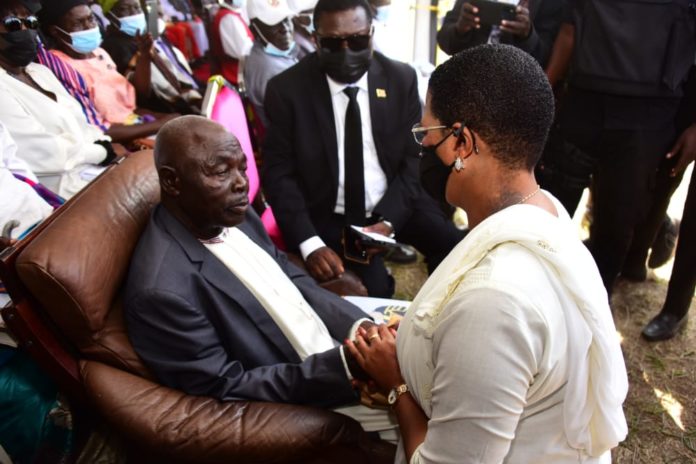
Police are set to summon Mr. Nathan Okori, the father of the fallen Speaker of Parliament Jacob L’Okori Oulanyah after he reaffirmed that his son was poisoned. Okori said during the sendoff of his son in Lalogi, Omoro District.

“I am not mourning in vain. I want to state clearly that Jacob Oulanyah was poisoned. He told me. The doctors tried to deal with the poison. It affected his health so badly that he could not recover,” he said on Friday.

Oulanyah died on 20th March 2022 in Seattle, USA barely two months after he was admitted in February this year. He was laid to rest on the 8th April 2022.

According to Police Spokesperson Fred Enanga, the cause of death of the Oulanyah was multiple organ failure: heart, lungs, liver, and kidney.

“From all the hospitals he went to, there was no poison detected. Any other cause of death is dangerous speculation and must be avoided. We are summoning all those other people with other causes of death. We want them to provide us with evidence of that other cause of death,” Enanga said.

These will include legislators, and politicians like Robert Kyagulanyi Sentaumu aka Bobi Wine and Mzee Nathan Okori, former Minister Kiwanda Suubi, Information Minister Chris Baryomunsi, MP Gilbert Olanya and others.

Oulanyah served as the Speaker of the 11th Parliament of Uganda after Speaker Rebecca Alitwala Kadaga, from 2021 until 2022. He was elected to that position on 24 May 2021, after defeating his tenacious rival the then incumbent Speaker Kadaga. Who had retained the seat for two terms (10 years). He served as Deputy Speaker of the Ugandan parliament, from May 2011 until May 2021.

Stories Continues after ad

Kakwenza launches Shs40m campaign to save his sureties

Kakwenza Rukirabashaija

Ugandan Novelist Kakwenza Rukirabashaija, who is currently in exile, has launched a campaign aimed at saving his friends who stood surety for him when court granted him bail.

The four include; Ashanah Annah, Job Kiija, lawyer Julius Galisonga Kibande and David Lewis Rubongoya, the Secretary General of the National Unity Platform (NUP).

“My friends who stood surety for me owe Shs 40 million because I fled the country for my life. It’s upon me now to raise the money and pay court in respect of summons. I’m looking for 5,000 people who can send Shs 8,000,” Kakwenza said.

According to Buganda road Court Magistrate Dr. Douglas Singiza the four sureties are required to explain why they have failed to produce Kakwenza before court.

On February 9, Kakwenza fled to exile, through Rwanda and arrived in Germany two weeks later to seek medical treatment after being tortured in jail.

Kakwenza was arrested at Kisaasi after a three days twitter feud with supporters of UPDF Land forces commander Muhoozi Kainerugaba. Kakwenza averred that Muhoozi’s supporters were allegedly bullying him for criticizing President Yoweri Museveni.

Kakwenza is charged with two counts of offensive communication, contrary to Section 25 of the computer misuse act 2011. The Lawyer pleaded not guilty and subsequently remanded to Kitalya prison till 21st January 2022. He was on 25th January 2022 granted Shs 500,000 cash bail as his Sureties were ordered to pay 10mshs noncash. He on February 9, 2022 fled into exile. He is currently in Germany.

Prosecution avers that Kakwenza on 24th December 2021 in the Kampala District, willfully and repeatedly used his Twitter handle to commit cases of offensive communication against the President of Uganda Yoweri Kaguta Museveni and the first son Lt Gen Muhoozi Kainerugaba, with no purpose of legitimate communication.

Rukirabashaija is the author of the novel The Greedy Barbarian, which takes on themes of high-level corruption in a fictional country. He was arrested on 13 April 2020 in Uganda, and held for seven days, during which time he was interrogated about his fiction and subjected to torture and later released. Rukirabashaija details this treatment in his latest work banana republic: Where Writing is Treasonous.

Stories Continues after ad

EC displays lists of verified Administrative Units ahead of Women Councils elections

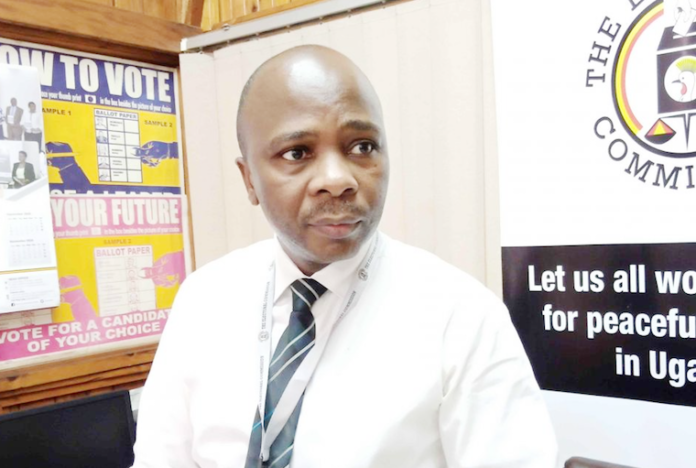
Mr. Paul Bukenya - EC Spokesperson

The Uganda Electoral Commission has started displaying lists of verified and administrative units (Villages/Cells and Parishes/Wards) countrywide in preparation for the Women Councils and Committee Elections.

Mr. Paul Bukenya, the spokesperson of Electoral Commission said effective Monday, April 11 to Wednesday, April 20, 2022, the commission will display the lists of verified administrative units for public viewing at the division and sub county headquarters in the respective cities and districts countrywide.

The display exercise according to Mr. Bukenya will be conducted during working hours throughout the above period including weekends under the direct supervision of the respective division and sub-county elections supervisors.

Bukenya said this is to enable the public to confirm that only existing administrative units (villages/cells and parishes/wards) and those created by April 9 2021 by way of a statutory instrument are included on the list.

“This will also enable the public to check for the correctness/accuracy of the details of their respective administrative units, that is, the parish/ward and village/cell and enable them to confirm that the administrative units are correctly located within their respectful and rightful sub-county/town council/municipal division and parish/ward,” he said.

He said any objection against the inclusion or omission of an administrative unit (village/cell or parish/ward) shall be raised to the respective district/city returning officer through the division/sub-county supervisor using the forms provided by the EC.

After the display exercise, Bukenya said the commission will produce the final list of administrative units which will be disseminated to all stakeholders by May 13 2022.

“All persons participating in the display exercise shall be required to comply with guidelines issued by the Electoral Commission in accordance with the government of Uganda and Ministry of Health measures against the spread of Covid-19,” he said.

Stories Continues after ad

The relationship between Agriculture, Tourism and ICT in creating opportunities for youth in Uganda

The South African High Commissioner to Uganda, Her Excellency Lulama Xingwana, recently addressed youth about the opportunities in agriculture during a one on one session organized by the MTN Youth Skilling Program

By Her Excellency Lulama Xingwana

The South African High Commissioner to Uganda, Her Excellency Lulama Xingwana, recently addressed youth about the opportunities in agriculture during a one on one session organized by the MTN Youth Skilling Program under the theme: Business Relations for Sustainable Partnerships. Below are the excerpts.

Uganda is among the leading producers of coffee in the world, hence my surprise to discover that there is no Ugandan coffee in South Africa.  I would like to believe that currently, coffee is Uganda’s best kept secret. I don’t know if you are able to sell or export it, but I think there is an opportunity for you to do more. For instance, we do not produce coffee in South Africa but we love drinking it.  Therefore, there is a ripe market for coffee farmers in Uganda to take advantage of in South Africa.  However, to do that, Ugandan coffee farmers must evolve beyond subsistence farming and into commercial agriculture with the ability to undertake agro-processing. Young farmers must look at opportunities in agro-processing, which will help them grow their markets from local or regional to International. Selling fresh fruit and vegetables has its limitations, but selling processed fruits and vegetables is more profitable as fruit juice or tomato paste which lasts longer and can reach a bigger export market hence making your products more profitable through value addition.

I am cognizant of the challenges of limited capital that hinder farmers’ ability to scale their operations to large scale farms and the heavy capital requirement for agro-processing. 

Start Small dream Big

However, it is important to remember that Rome was not built in a day. We all start small, but we must have the vision and ambition to start from small but to grow big and ultimately move to commercial agriculture and the export industry. This will greatly contribute to Uganda’s economy.

More importantly, the need to grow your business underpins the significance of building business relations for sustainable partnerships. I am aware that MTN is interested in supporting agriculture and especially agro-processing businesses. It is up to you therefore, to take up this opportunity as young farmers.

Business Relations for Sustainable Partnerships

Strong partnerships with banks, such as Stanbic, Absa and multinationals are important and can help grow your business. Donors can also assist in this regard. It is for those reasons that keeping good reports and audited financial statements is vital and will help you develop trust and confidence of your donors or partners (e.g Danida, Sida etc).  Partnerships are not designed for companies only, you can also harness a relationship with individuals. The introduction of agreements such as the Africa Continental Free Trade Area has opened a 1.4 Billion market (i.e. the African population) for African Farmers. Currently, African countries predominantly export to Asia, Europe and other continents, yet trading between Africans is still at 15%. Intra-Africa trade is still very low, which presents an opportunity for harnessing sustainable partnerships among African farmers. It is up to our youth to seize this opportunity. I know that Ugandans love goats, nyama ye mbuzi. We too have lots of goats in South Africa, so Ugandans can buy goats from South Africa and we can buy your pineapples, pawpaws or coffee. This is how we can start these partnerships. Farmers in Uganda can partner with farmers in South Africa such that we import and export between our countries, thus increasing Intra – Africa trade and growing the economies of our countries and the continent. Through these same partnerships, young Ugandan farmers can benchmark from South African farmers who are already working in agro-processing and have experience and equipment or machinery needed for such projects.

Agritourism

There is also a direct correlation between commercial agriculture and other sectors. Commercial agriculture can be the springboard for other sectors for example tourism and ICT to prosperity.  Through agritourism, a concept defined as a tourism programme that covers agricultural and farming areas where tourists can see local products and often participate in farm activities, Uganda can increase the number of tourists visiting the country. A common phenomenon in South Africa, providing additional income to farmers and contributing to our economy, agritourism particularly in wine production has proved profitable to local farmers in the country and the tourism sector.  In Cape Town, we have turned the grape and wine farms into great tourist destinations. People want to see where this bottle of wine from South Africa was produced. They go to Stellenbosch or Franchoek for wine tasting, they buy wine and stay there and experience the lifestyle in the wine farms. Wine farms and wine tasting have contributed a great deal to tourism and to our economy. Why can’t we have coffee tasting and farm holidays in the coffee farms of Uganda? This way more people will buy and import Ugandan coffee. Therefore, I appeal to you my dear youth who have been trained in nourishing your entrepreneurial spirit to move from subsistence to commercial Agriculture.

ICT

Growth of the agriculture and tourism sectors can also directly spill into the ICT sector. There has been a proliferation of innovations in the technology space created with the aim of  bridging gaps such as lack of market for agricultural produce and need for critical knowledge in agriculture.  There are also vast opportunities for ICT in the tourism sector such as travel apps, links to accommodation in the country, marketing the agricultural farms and the local experience to the outside world.

 It is even better now that the AU has adopted the Fourth Industrial Revolution led by our President His Excellency, Cyril Ramaphosa.  MTN and Multichoice are major players in this sector, and will support such projects. I also know that, as young people, you love this sector. I therefore appeal to all our youth to look into this area and develop projects that will empower young people and create jobs in the country.

Stories Continues after ad

LDPs to be absorbed in the army – Museveni

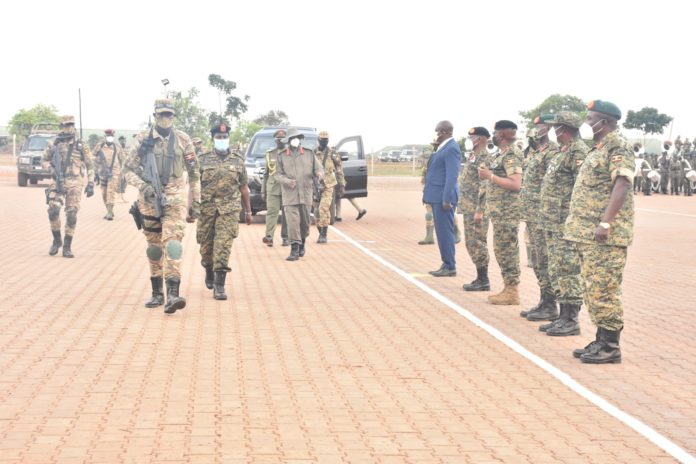
President Yoweri Museveni and Commander In Chief of the Uganda Peoples’ Defence Forces (UPDF) over the weekend passed out 6237 Local Defence Personnel at Kaweweta Recruit Training School, in Nakaseke District. This is the fourth Intake of LDPs to be passed out.

This group is the first of its kind. Originally LDUs as they were commonly known were under the command of Uganda Police when they were passed out. They are now directly under the UPDF and have been deployed to different units and divisions of the UPDF, not villages as the case was with the earlier groups.

In his remarks at the function President Museveni said that Local Defence Personnel are trained to remain in the reserve forces as they retain their original jobs.

The President, however, noted that to have specialized manpower, most especially in the infantry division, many if not all LDPs, that were passed out will soon be recruited in the army.

“It seems you will be LDPs for a short time because we want to recruit you in the army,” the President said.

He cautioned the newly passed out LDPs to maintain discipline and guard against risky behavior especially alcoholism and womanizing in order to preserve their health. “Once you keep your health, follow regulations of the army, train, and the future will be very bright,” he observed.

He mentioned that graduands acquired skills in the use of modern weapons as per the requirements of a modern army. He encouraged all commanders of units and formations to continue building the capacities of all soldiers so that they build a professional force.

The President continued that apart from the European wars; the country is stable at the moment with only a few negative elements to deal with like cattle rustler s in Karamoja sub-region and the Allied Democratic Forces in the DR Congo, the latter currently being neutralized under the combination of both UPDF and FARDC forces.

He applauded the UPDF leadership for continuing to develop the army training institutions like Kaweweta, Singo, Kabamba and others into specialized formations to create capacity among forces.

On land encroachment, the President cautioned all illegal occupants to stay away from army land.

“I am the one who told the army to come here because I was here fighting. I know the land myself. This land belonged to the Union,” he emphasized.

He thanked the people of Ngoma, Nakasongola, Luwero and Nakaseke for supporting the army. “When we were fighting, you supported us,” he concluded.

The Minister of Defence and Veteran Affairs Hon. Vicent Bamulangaki Sssempijja expressed sincere gratitude to the President for his unwavering support to the accomplishment of defence activities.

He noted that the water project and a first-class road network at the training school are a result of the defence ministry’s strong alliance with other Ministries Departments and Agencies.

He noted that the pass out was a result of the President’s strategy to build capacity within all UPDF units and formations so that the Forces can effectively deal with internal and external threats. He thanked the trainees for the commitment, and their families for allowing their children to undertake the training.

Hon Ssempijja also noted that UPDF is trying to increase the capacity of the engineers’ brigade so that it can be able to undertake bigger projects and for National Enterprise Corporation to engage more in commercial projects and the production brigade to increase production.

He reminded the President that he would soon present to Parliament a UPDF Amendment Bill and a paper in Uganda Air Cargo as earlier guided by him, and wished the graduands success at their fresh postings.

Speaking at the function, the Chief of Defence Forces Gen Wilson Mbadi thanked the CIC for his guidance in scaling up military capacity that can deal with arising national security issues.

“You must work hard to make Uganda a secure country and contribute to regional peace against terrorism, cybercrime, and pandemics that transcend national boarders,” Gen Mbadi told the fresh LDPs.

He noted that such security challenges require combat readiness to address them.

He was happy to learn that the Recruits Training School, Kaweweta had built the capacity to train over 6000 trainees in one go and asked them to continue developing the human resource to ensure that the vision of the school is achieved.

He encouraged LDPs to serve the country with pride and commitment observing its core values.

He implored the new units absorbing the new recruits to continue training them so that they become more mission relevant. “You rust, you rot,” he warned.

The Commandant of Recruits Training School, Kaweweta Brig Gen James Ruheesi, in his speech, acknowledged the shared joy for managing to train 6237 Local Defence Personnel, most especially the 947 females.

He said the training aimed at equipping trainees with skills in selective combat, discipline, and robust military skills so that they can effectively operate in the ever-changing environment.

The recruits went through tactical physical training; drills, obstacle crossing, range shooting, ambush shooting, ground order and terrain model, among others.

The recruits are Ugandan citizens with a minimum of UCE (S4) Uganda Certificate of Education. Some few exceptional cases with academic qualifications below UCE were admitted because of the exceptional interest and zeal they exhibited at recruitment.

The very enthusiastic class with high academic energy included 168-degree holders, 318 diploma holders, 1277 certificate holders of various disciplines, 600 UACE Certificate holders, 3788 UCE Certificate holders and 87 recruits with exceptional talent and conduct below UCE.

Kaweweta Recruits Training School is one of the schools under Kaweweta cantonment. Others include: Oliver Reginald Tambo School of Leadership and Pan African Centre of Excellence.

The pass out was also attended by UPDF Joint Chief of Staff Maj Gen Leopold Kyanda, Lt Gen Proscovia Nalweyiso, area MPs, UPDF Officers and Militants, and local leaders, among others.

Stories Continues after ad