Stanbic Bank
Stanbic Bank
27.6 C
Kampala
Stanbic Bank
Stanbic Bank
Home Blog Page 635

Young fashion designers hail MTN Pulse and Arapapa Mentorship Program

Some of Mickeydaddy's designs

Last year, MTN Uganda’s youth platform, MTN Pulse partnered with Arapapa by Santa Anzo to mentor the fresh fashion talent in the country. This mentorship program saw young designers getting hands-on mentorship from one of the most respected and seasoned designers in the country.

The young designers were trained in several disciplines such as marketing, product sourcing, design ideation as well as design presentation among others, that would see them carry their fashion businesses to the next level.

A 23-year-old fashion designer, Kaaku Mickeydaddy of the Mengo hill road-based Mickey designs and who has been in the fashion industry since 2018 says the mentorship program remains his highlight in the industry thus far.

“The mentorship program was very inspiring as I got to learn from the great Santa Azo on how to come up with creative designs and also got a chance to interact with other designers. We were able to share ideas and learn from each other. The program pushed me harder on how to market my business and it’s also increased my confidence as a designer and made so many people believe in me,” said Mickeydaddy who completed the mentorship program in the first position.

25-year-old fashion designer, Judith Kusiima of the Weekend fit designs shares similar sentiments about the mentorship program.

“As a new self-taught designer, I learnt a lot from both Santa Anzo and fellow young designers who have been in the business longer than myself. We are still in touch and still supporting each other, something that was made possible by the MTN Pulse and Arapapa mentorship program,” Kusiima says.

According to Mickeydaddy, the fashion industry is a very challenging industry, despite its glitz and glamor. He however notes that the challenges only push him to work harder and maintains that with synergy across the industry through programs such as the MTN Pulse and Arapapa mentorship program, that bring all designers together, such challenges can be turned into opportunities that can push the industry forward.

The industry challenges notwithstanding, Mickeydaddy has been able to build himself an admirable career over the years. He has dressed up people for events like miss Uganda, miss Tourism Uganda, Y+ beauty, little miss Uganda and little Miss Africa among others.

Besides winning the MTN pulse fashion mentorship Program, Mickeydaddy won the rising Fashion pearl Africa Award 2018, Designer of the Famous teen Awards 2019, best Designer Vision for Africa 2019. 

These awards have earned him great positions in the world of fashion such as; the Fashion Director Miss Tourism Uganda, managing Director Toto Awards Ug, country Director, little Mr and Miss Africa Uganda

Mickeydaddy is intent on nurturing fellow younger designers through passing down his learnings from the MTN Pulse and Arapapa mentorship program.

“Not only have you been a fantastic mentor to me, but you have taught me how to mentor other people am so lucky to work with someone (Santa Anzo) who is my mentor and inspiration. Thank you MTN Pulse, for creating that connection,” Mickey says.

As a young designer who immensely benefitted from the MTN Pulse and Arapapa fashion mentorship, Judith Kusiima looks forward to building her fashion brand that deals in creating casual weekend outfits for women, while making an impact in the society and beyond the borders of Uganda, a key lesson she learnt from her interaction with fashion icon, Santa Anzo.

“It was an incredible program and I hope more of these are arranged to support many talented designers in this country,” she says.


Stories Continues after ad

Ugandan American Entrepreneur and Socialite Juliet Zawedde bails out 30 students with school fees

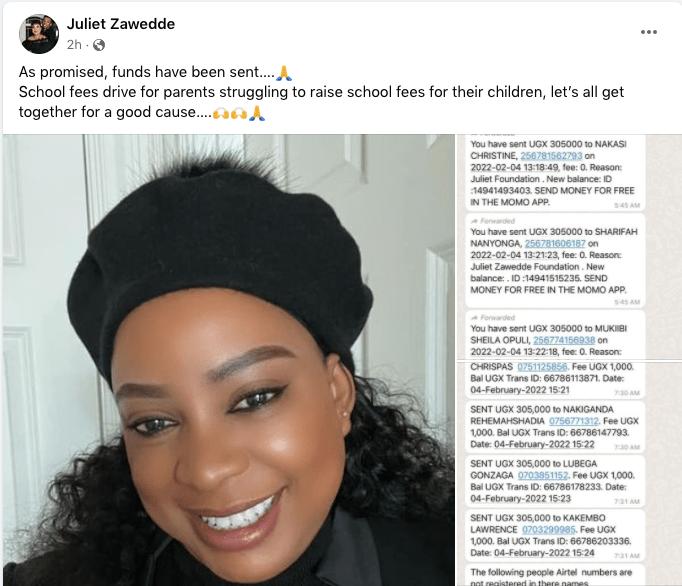
US-based Ugandan socialite, Juliet Zawedde aka the Boss Lady through her charity organisation, Juliet Zawedde Foundation has bailed out 25 students who have struggling with school fees.

Through her facebook page, Zawedde shared screenshots of Mobile Money transfers sent to 25 different numbers and revealed the money was meant for school fees.

Each student received Shs.305000, meaning she spent Shs.7,625,000 on 25 students.

‘’As promised, funds have been sent….School fees drive for parents struggling to raise school fees for their children, let’s all get together for a good cause.’’

Zawedde is known for splashing cash, living a good life and helping those in need.

Check her business website www.convenienthomecare.com

Follow her Instagram https://instagram.com/julietzawedde?igshid=YmMyMTA2M2Y=

Stories Continues after ad

Rajiv and wife welcome their first born

City businessman Rajiv Ruparelia and wife Naiya have given birth to their first born, a bouncing baby girl.

To celebrate the achievement of getting a second grandchild, Uganda’s richest man Dr Sudhir Ruparelia decided to host his fellow rich friends to a dinner in a magnificent restaurant in Central London, UK.

Dr Sudhir’s first grandchild Arie, is a daughter to Sheena (Sudhir’s daughter) and her husband Jay Sakaria.

Naiya and Rajiv got married in 2018 and she is the spirit behind the new life in their education sector.

Naiya who plays a key role in the Ruparelia schools including Victoria University, Kampala Parents School, among others, spent all her life in United Kingdom where she met Rajiv when he was a student at University. She agreed to relocate to Uganda and settle down with Rajiv to grow their father’s business empire into the second generation.

With their parents guidance, Naiya and Rajiv have joined their sisters in consolidating the gains Sudhir and his wife have made on the business and social front.

Stories Continues after ad

Nathan Okori confirms his son Jacob Oulanyah was poisoned

Nathan Okori

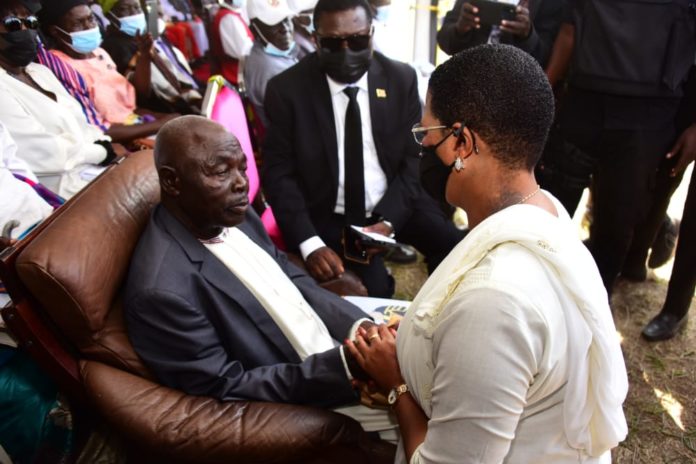
Mr. Nathan Okori, the father of the fallen Speaker of Parliament Jacob L’Okori Oulanyah has reaffirmed that his son was poisoned. He said during the send-off of his son in Lalogi.

“I am not mourning in vain. I want to state clearly that Jacob Oulanyah was poisoned. He told me. The doctors tried to deal with the poison. It affected his health so badly that he could not recover,” he said.

Oulanyah died on 20th March 2022 in Seattle, USA barely two months after he was admitted in February this year. On February 3, 2021; Oulanyah was flown to the US aboard a Chartered Uganda Airlines aircraft A330 to Seattle for expert medical attention after efforts by medics at Mulago National Referral paid no dividends.

Okori said Oulanyah was not only his son but to the whole country. Oulanyah was taking care of many people.

“I wanted to tell this to president Museveni himself but maybe because he had some other duties. The government should complete the house that Oulanyah started. I appeal to the government to look after the children Oulanyah was looking after, and pay fees for them to the highest level possible.”

He asked for the deployment of Harriet L’Okori, Oulanyah’s sister with a Master’s Degree in Law.

Atim Oulanyah, a daughter to the deceased speaker said; “Jacob Oulanyah was a family man who put us first. He was a man with his priorities in check. He would pause whatever he was doing to visit us at school on our birthdays. The other students felt that he was a ‘cool’ person.”

She said; “My father left us with no debts or pending expenses, no grueling burdens we have to carry besides the task of filling his shoes. We will unite as a family and country to achieve the Uganda he wanted.”

Harold Oulanyah who is also a son to the fallen speaker said; “We lost our mother about 13 years ago, and now, I know my father and mother are watching over us. My father was not a selfish man. He was not a fool. A fool cannot come from a small village in northern Uganda to the third top position in the country. I want us to bury my father with the dignity he deserves.”

He said Oulanyah was a fine man. He never let positions get to his head; he was a patriotic man and always thought about his family, country, and friends.

Oulanyah served as the Speaker of the 11th Parliament of Uganda after Speaker Rebecca Alitwala Kadaga, from 2021 until 2022. He was elected to that position on 24 May 2021, after defeating his tenacious rival the then incumbent Speaker Kadaga. Who had retained the seat for two terms (10 years). He served as Deputy Speaker of the Ugandan parliament, from May 2011 until May 2021.

Stories Continues after ad

New Project transforms maternal and newborn healthcare in Kampala health facilities

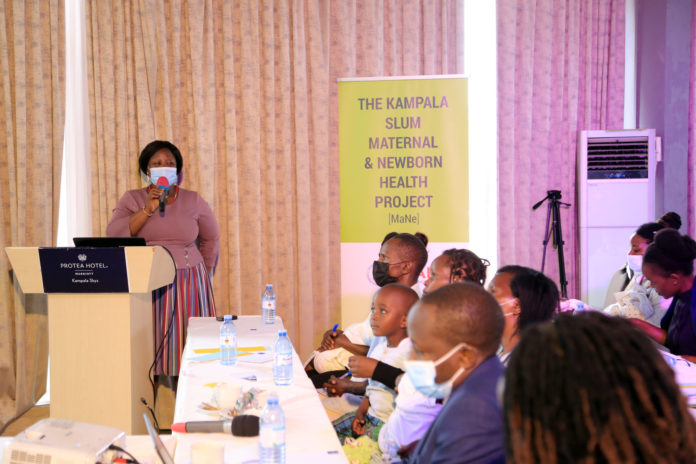
As Uganda grapples with high maternal and newborn mortality rates, the Kampala Slum Maternal and Newborn Health (MaNe) implementation research project has launched an innovative approaches aimed at addressing barriers for effective referral and provision of quality care for maternal and newborn health in urban slum settings in Kampala City.

The research was intended to provide evidence about the feasibility and scalability of selected MNH interventions within an urban setting.

Funded by the United States Agency for International Development (USAID), the MaNe project was a collaboration between Kampala Capital City Authority (KCCA) and Population Services International (PSI) Uganda. The activity was implemented in two of the five administrative divisions of Kampala City (Makindye and Lubaga).

MaNe’s mandates included   harnessing the public and private facility to provide quality and affordable maternal and newborn care services for the urban poor, strengthen referral linkages between public and private health facilities for maternal and newborn health care and to educate mothers, caretakers of newborns and spouses about appropriate actions on what maternal and newborn health services to seek and from where to access services.

The project’s interventions yielded several positive outcomes which included increased utilization of quality maternal and newborn health services at private health facilities.

The activity also stimulated improved delivery of respectful and affordable care to mothers and spurred the development of a digital ambulance transportation system to handle maternal emergencies.

Further, the number of mothers attending antenatal services (ANC) increased due to extended operation hours and workdays in KCCA facilities. For example, from no mothers attending ANC in October 2020 to 1,242 mothers attending by August 2021.

The innovation of an Uber-like mobile application to improve access to ambulances for pregnant mothers resulted in 1,642 referrals made through the MaNe supported KCCA call and dispatch center, ensuring the safety of these mothers.

The project worked with KCCA to accredit 20 private health facilities, enabling them to provide affordable quality maternal health care. For example, in Rubaga, a private midwife-led facility was able to reduce the prices of normal delivery for urban poor women from Shs 200,000 to Shs 120,000 and experienced a 141% increase in the number of pregnant mothers attending ANC.

Additionally, the activity’s collaborative partnership leveraged the support of other civil society stakeholders and the private sector including UNFPA, USAID Uganda Maternal and Child Health and Nutrition (MCHN) Activity, Uganda Red Cross, Outbox, White Ribbon Alliance, and MTN Uganda to provide equipment and services.

In his remarks at the project’s learning dissemination event on March 24, 2022, Dr. Charles Olaro, Director Clinical Services, Ministry of Health, said: “The MaNe project is well aligned to the government priority of universal healthcare including that of maternal and newborn health and this evidence generated will accelerate government efforts towards designing the urban reproductive maternal health policy.”

Dr. Olaro said KCCA-led mentorship, support supervision, and onsite service provisions should continue as it boosts community demand for services, motivates the private sector, and strengthens the linkages between the public and private facilities, which will lead to increased access to quality maternal and newborn health services.

Dr. Daniel Okello Ayen, Principal Investigator on the MaNe project and KCCA’s Director of Public Health and Environment added that: “The project showed us that multi-sectoral collaboration is invaluable in supporting the provision of equitable access to maternal health because of the innovations that arise from each actor.”

The project leaves behind a legacy.

Dr. Yvonne Mugerwa Kidza, MaNe’s Project Director is keen to see the activity’s innovations and tested approaches absorbed by partners at the sub-national, national, and global scale.

She surmises; “The MaNe project tested and has now shared successful innovations in; enabling urban poor access quality and affordable services by leveraging the private sector to get interested in being accredited by KCCA and providing affordable and respectful services for the urban poor;  ensuring availability of timely referral transportation for urban poor with MNH emergencies both in accredited private clinics and public facilities;  engaging Community Health Workers (CHWs) in working closely with accredited clinics to support appropriate care seeking and referral and access to post-natal care among urban poor; enabling urban poor women who cannot afford to seek ANC services during regular work hours to access quality services in public facilities.”

She added that these innovations should be absorbed by other partners to maintain the gains accrued in reduction of maternal and newborn morbidity and mortality among the urban poor. 

MaNe executed implementation research using systematic and rigorous methods to adopt and integrate evidence-based health interventions into clinical and community settings to improve individual outcomes and benefit population health. 

The implementation research supported and informed multisectoral collaboration including KCCA policymakers and planners to deliver appropriate and resilient maternal and newborn health services.

Stories Continues after ad

Three charged for tampering with electrical installations

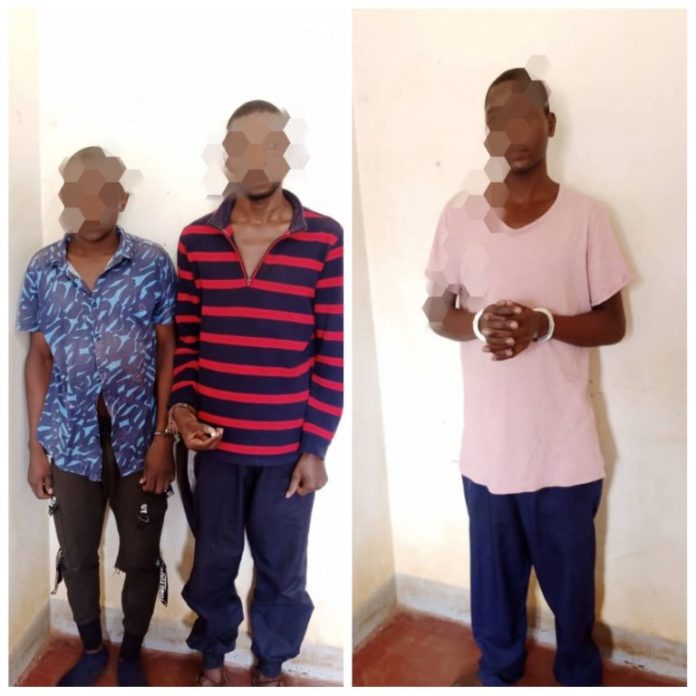
The Special investigations Division (SID) team of investigators at CID Headquarters investigating criminal acts of vandalism yesterday charged 3 people to Utilities Standard and Wildlife Court at Buganda Road with two counts of Tempering with Electrical Installations and Conspiracy to commit a felony Contrary to sections 81(1) and 390 of the Electricity Act, and Penal Code Act respectively.

The charged suspects include; Mukalazi Mukasa Twahiri, male aged37 years, a scrap dealer, resident of Wakiso District and Ssombwe Augustine aged 21 years, a scrap dealer, resident of Kirumira village, in Masaka District.

According to Police, it is alleged that on 23rd March 2022, at Nabbuzi village, Kamengo Sub County in Mpigi District, the duo was arrested red handed with 5 scrap carrying bags and Arc saw Blade, actively cutting stepping angle bars on one of the metallic electricity poles that carry electric high voltage wires along Kampala-Masaka high way.

The two were handed over to Special Investigations Division of CID, who upon carrying comprehensive investigations, charged them to Court.

Relatedly, SID has also charged Nangosya Robert aged 33 years, an Electrician, resident of Buzesoli village, Bushente Sub County, in Mbale District with charges of Tempering with Electrical Installation and Theft to the same Court at Utilities Court Buganda Road.

The suspect was on 18th March 2022 in Namutumba District arrested by some members of public for, tempering, damaging and stealing electric conductor AAAC-100 measuring approximately 1500 meters.

Despite government development initiative to generate, and transmit Electricity for both domestic and industrial purpose across the entire country, the country continue to witness criminal acts of vandalism of power transmission and distribution infrastructure.

“Such criminal acts undermine the government’s efforts of propelling the economy to the desired level of economic growth, considering the fact that electrified tools boost productivity. Important to note is that such acts of criminality compromise the reliability, continuity, and stability of power supply as well as National Security,” police said in a statement.

Police noted that vandalism of electricity infrastructure has a relationship with the unregulated scrap business scattered across the entire country who unfortunately fund the operations of crime and later buy the stolen items for their industrial use as raw materials.

“Police would like to assure the general public, visitors and the investors that their safety and security threatened by vandalism remains our priority, and further pledge to continue conducting several intelligence led operations until these senseless acts of vandalizing are completely put to an end.”

Police called upon citizens to provide them with credible information to help them in arresting some people they have caught committing such criminal acts.

Stories Continues after ad

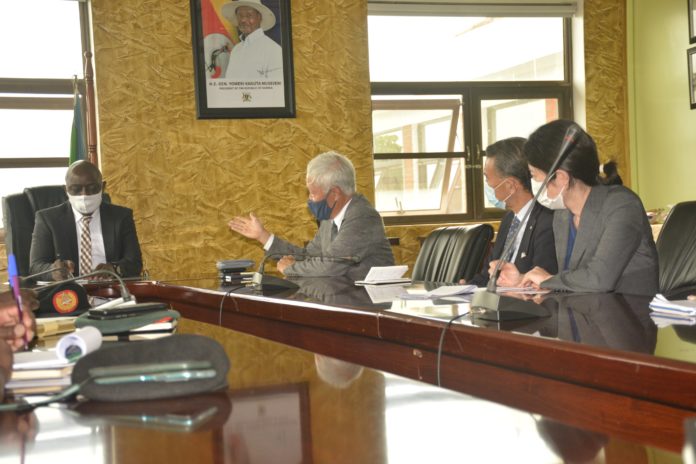
Defence Minister Ssempijja hosts Japanese Ambassador, commit to strengthening cooperation

The Minister of Defence and Veteran Affairs Hon Vincent Bamulangaki Ssempijja met the Japanese Ambassador Extraordinary and Plenipotentiary to Uganda His Excellency Fukuzawa Hidemoto at the Ministry Headquarters in Mbuya Kampala.

Ambassador Fukuzawa and his delegation paid a courtesy call on Hon Ssempijja and the two expressed mutual determination to strengthen relations between their two countries.

“We have enjoyed cordial relations with Japan and we know that Japan is a very reliable friend to Uganda,” Hon Ssempijja said.

On his part, Ambassador Fukuzawa applauded the Government of Uganda for accepting to host over one million refugees in the country.

In 2021, the Government of Japan committed approximately US dollars 9.8 million to support efforts towards settlement of refugees and supporting host communities in Uganda.

“It is not refugee camps, it is settlements and the host communities are also accepting these refugees” said Ambassador Fukuzawa. In his response, Hon Ssempijja said, “You cannot be happy when somebody is suffering. Even if they were Japanese, we would still host them.”

Ambassador Fukuzawa was accompanied by the Ambassador of Japan in Djibouti; His Excellency Otsuka Umio who shared that he was on this trip to get to know the region better.

Amb. Otsuka applauded Uganda for being an enthusiastic contributor to peace and stability efforts regionally and globally and commended the MoDVA/UPDF for keeping the country peaceful and stable. “Uganda has enjoyed peace and stability for a long time despite the insecurity in the region” observed Amb. Otsuka.

Hon. Ssempijja and Ambassador Fukuzawa reaffirmed their mutual commitment to increase their cooperation and to build more partnerships that will continue enhancing their mutual strategic objectives.

In attendance were; the Permanent Secretary of Ministry of Defence and Veteran Affairs Ms Rosette Byengoma, the UPDF Joint Chief of Staff Maj Gen Leopold Kyanda, Ministry of Defence Legal Officer Brig Gen Asingura Kagoro, UPDF Director of Training Brig Gen Fred Twinamatsiko, and other delegates from Japanese embassy in Uganda and Djibouti.

Stories Continues after ad

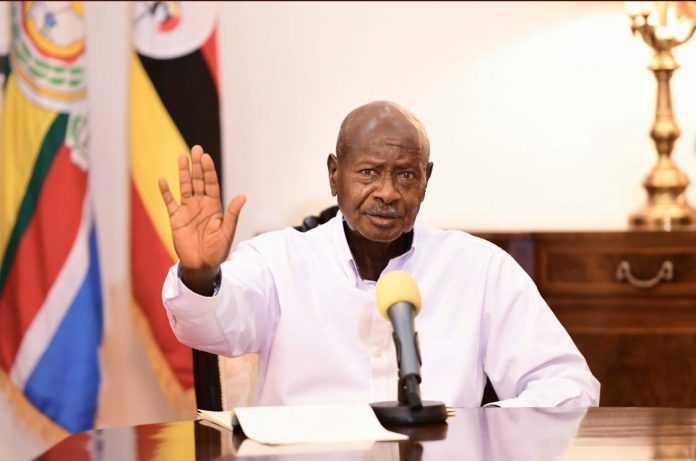
Museveni suspends Land Commission bosses, orders for investigations over mismanagement

President Museveni

President Museveni has suspended the Chairperson of the Uganda Land Commission Beatrice Byenkya and Secretary Barbarah Imaryo amid bribery and mismanagement of funds allegations at the commission.

In a letter addressed to the Inspector General of Government and the State House Anti-corruption unit, Museveni says the two have been suspended with immediate effect to pave way for investigations.

“Given the nature of allegations that are being made against the chairperson and the secretary that include corruption, embezzlement, double payments, paying ghost claimants etc, all leading to loss of huge sums of government funds, I there by suspend them with immediate effect to pave way for investigations.” Part of the letter reads.

“By copy of this letter, I instruct the director general of government and the State House Anti- Corruption Unit to investigate the above allegations and other offences that could have been committed with a view of prosecuting culprits.”

In October last year, Nabakooba instructed the chairperson Beatrice Byenkya and Secretary Ms. Barbarah Imaryo to step aside for two months to pave the way for the investigations into alleged cases of abuse and misuse of commission resources.

They were supposed to hand over office to State Minister for Lands, Dr Sam Mayanja by November 12.

However, in a legal opinion in January, Kiryowa advised Nabakooba to withdraw her directive and instead write to President Yoweri Museveni to take action as the appointing authority.

Stories Continues after ad

Ugandan lawyer Tabitha Namulinda named 2022 Ibrahim Leadership Fellow

The Mo Ibrahim Foundation has announced the 2022 intake of Ibrahim Leadership Fellows, which will see three emerging African leaders participate in one-year mentoring programmes at leading multilateral institutions.

The incoming Fellows are Joe Lemaron (Kenya), who will join the African Development Bank (AfDB); Ilsa Cá e Sá (Guinea-Bissau), who will join the United Nations Economic Commission for Africa (ECA); and Tabitha Namulinda (Uganda), who will join the International Trade Centre (ITC).

During their 12-month programmes, Fellows gain both technical and leadership skills, while contributing directly to research and policy design. A special feature of the programme is the opportunity to benefit from the direct mentorship of the heads of the host organisations.

Since 2012, 31 Fellows (including this year’s cohort) from across Africa have participated in the programme. Upon completion of their placements, Fellows become members of the Foundation’s Now Generation Network (NGN), a coalition of young and mid-career Africans from all 54 African countries, who are committed to moving the continent’s development agenda forward. 

Jendayi Frazer, Head of the Ibrahim Leadership Fellowships programme, said: “Many congratulations to our new cohort of Fellows, who have been selected from a short-list of exceptional candidates. I look forward to engaging with Joe, Ilsa and Tabitha, and indeed learning from their expertise over the next year.”

Mo Ibrahim, Founder and Chair of the Mo Ibrahim Foundation, said: “I’m thrilled to welcome the 2022 Ibrahim Fellows to the Foundation family. Through this programme, they will develop their expertise and gain first-hand experience in working on critical issues facing Africa today. I wish them all the best for what is set to be a transformative year.”

The 2022 Ibrahim Leadership Fellows include:

Joe Lemaron (Kenya), AfDB

Joe is a development professional with extensive experience in leading strategies in digital transformation, programme management, policy innovation, capacity strengthening, corporate communications and building impactful partnerships.

Ilsa Cá e Sá (Guinea-Bissau), ECA

 Ilsa is a graduate in International Relations, with a master’s degree in International Cooperation and Development Studies from the Technical University of Lisbon. She has programme management expertise having led development projects in Guinea-Bissau in areas such as food security and youth and civic leadership.

Tabitha Namulinda (Uganda), ITC

Tabitha is an international trade lawyer and an enrolled advocate working with Uganda’s Ministry of Foreign Affairs. She has been a negotiator in Geneva, Switzerland, representing Uganda in trade negotiations at the World Trade Organization.

Stories Continues after ad

WHO study: Over two-thirds of Africans exposed to virus which causes #Covid-19

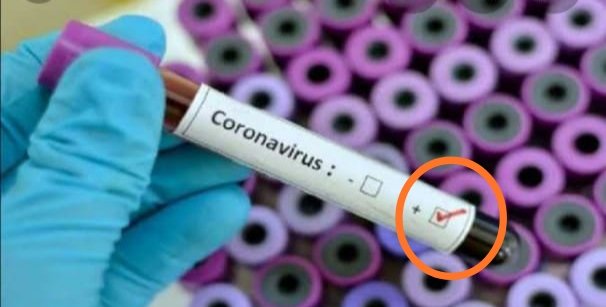
Covid-19 testing kits

Up to 65% of Africans have been infected by SARS-CoV-2, the virus which causes #Covid-19, a World Health Organization (WHO) analysis finds. The study finds that true infections on the continent were 97 times larger than reported confirmed cases.

The analysis, which is available as a pre-print under peer review, synthesized 151 studies published on seroprevalence in Africa between January 2020 and December 2021. It found that exposure to SARS-CoV-2 skyrocketed from 3% (1.0-9.2% range) in June of 2020 to 65% (56.3-73% range) by September of 2021, or 800 million infections compared with 8.2 million cases reported at that time. The study showed that exposure to the virus rose sharply following the emergence of the Beta and the Delta variants.

The analysis revealed that the true number of infections could be as much as 97 times higher than the number of confirmed reported cases. This compares to the global average where the true number of infections is 16 times higher than the number of confirmed reported cases.

However, seroprevalence varied widely within and across countries in Africa – higher in more dense urban areas than in less populated rural areas – and between age groups, with children aged 0-9 years having fewer infections compared with adults. Exposure to the virus also varied between countries and Africa’s sub-regions: seroprevalence appears to be highest in Eastern, Western and Central African regions.

The new analysis suggests that more than two-thirds of all Africans have been exposed to the COVID-19 virus. Globally seroprevalence studies have found a significant under-counting of cases occurring across the globe with 45.2% of the world’s population estimated to have been infected with the virus by September 2021. It is, however, difficult to compare figures for Africa with those of other regions, as many of the studies conducted cover different time periods.

The continent differentiates itself from other regions by its high number of asymptomatic cases, with 67% of cases having no symptoms.

 “This analysis shows that currently reported COVID-19 confirmed cases are only a fraction of the actual number of infections on the continent,” said Dr Matshidiso Moeti, WHO Regional Director for Africa. “This under-counting is occurring world-wide and it’s no surprise that the numbers are particularly large in Africa where there are so many cases with no symptoms.”

Seroprevalence studies provide data on asymptomatic or under-reported infections that may have been missed by routine diagnostic testing, which in Africa has focused on travellers and people who came to hospitals with COVID-19 symptoms. While this new analysis provides insight into the evolution of the pandemic, routine testing remains a critical component of the COVID-19 pandemic in all countries.

“Testing enables us to track the virus in real-time, monitor its evolution and assess the emergence of new variants. Countries must ramp up testing, contact tracing and surveillance so we can stay a step ahead of COVID-19,” said Dr Moeti.

As of 6 April 2022, there were 11.5 million confirmed cases and more than 252 000 deaths reported on the continent. It is likely that numbers of actual exposure to the virus have increased even more since September 2021.

Africa has had milder COVID-19 cases compared with other parts of the world because there is a comparatively smaller proportion of people with risk factors such as diabetes, hypertension and other chronic diseases that are associated with more severe cases and deaths. Africa’s youthful population is also a protective factor.

 “Despite Africa’s declining infections and high exposure to the virus, we cannot declare victory yet against COVID-19,” Dr Moeti said. “The seroprevalence analysis shows just how much the virus continues to circulate, particularly with new highly transmissible variants. The risks of more lethal variants emerging which overwhelm immunity gained from past infections cannot be brushed aside. Vaccination remains a key weapon in the fight against COVID-19.”

Multiple studies have shown that vaccination for those with prior infection is beneficial resulting in improved protection over infection-induced immunity alone. Africa has to date fully vaccinated 209 million people, or 16% of the population, administering 457 million of the 816 million vaccine doses received. WHO is working to support countries’ ramp-up vaccination.Dr Moeti spoke during a virtual press conference today. She was joined by Professor Guéladio Cissé, Coordinating Lead Author, Intergovernmental Panel on Climate Change, Swiss Tropical and Public Health Institute, University of Basel, Switzerland, and Dr Irene Owusu Donkor, Postdoctoral fellow, African Postdoctoral Training Initiative and Research fellow, Noguchi Memorial Institute for Medical Research, Ghana.

From the WHO Regional Office for Africa, Dr Joseph Okeibunor, Team Lead, Research Development and Innovations, Dr Thierno Balde, Regional COVID-19 Incident Manager, Dr Edinam Amavi, Vaccine Safety Officer, and Dr Brama Koné, Technical Officer, Climate Change and Health, were also on hand to answer questions.

Stories Continues after ad