Stanbic Bank
Stanbic Bank
28.7 C
Kampala
Stanbic Bank
Stanbic Bank
Home Blog Page 637

Stanbic Uganda unveils comprehensive insurance product for schools

Stanbic Uganda through its bancassurance services has launched School Comprehensive Insurance (SCI), a financial solution that protects school administrations against a range of risks including property damage, accidental injuries to students and theft of their personal effects.

The five main areas covered in the SCI scheme are Material Damage to School Property, Burglary of School Property, and Accident Cover for Students, Public Liability Insurance and Optional Life/Educational Benefit. Buildings, furniture, fittings and fixtures as well as office equipment all fall under school property.

Emma Mugisha, the Stanbic Bank Executive Director and Head of Business Banking said at the launch of the product at Golden Tulip in Kampala today; “As Stanbic, we have been revising ourselves and finding new ways through which we can be more relevant to our communities. By introducing School Comprehensive Insurance, we are providing solutions to challenges that schools have been facing like accidental fires that have been on the increase, we need to find comprehensive solutions to everyday challenges and that we can do by offering you an insurance partnership.’’

TicheMakonese, the Stanbic Bank head of Insurancesaid, “The Covid-19 pandemic and any other hindrances that may stand in the way of educating our learners need some kind of insurance. Some of the disruptions that schools face, like fire brazing up school buildings, students getting hurt on the playground, parents and guardians facing calamities and leaving learners without anyone to pay their school fees, are always out of our control. We may not always be in control of situations, but we must always find a way to prepare for and deal with such uncertainties, that’s why the bank is innovating more insurance products.”

Speaking at the same event, Mulindwa Ismael, the Director Basic and Secondary Education at the Ministry of Education and Sports applauded Stanbic Bank for being innovative and giving a helping hand to schools that were disrupted by the Covid-19 pandemic and other disruptions like accidental fires.

 “As a ministry, we have been concerned about the fires that have gutted the schools over the years, with some leading to loss of lives which is very sad. In many cases, schools have not been able to refurbish the affected infrastructure as well as compensate the affected students.  When I see Stanbic Bank coming out to support that particular issue, we can say there could not be a better timing for such a product,” he said.

Mike Kironde, Chairman Proprietors of Private Educational Institutions Association in Uganda said, “As an association, we are very excited that Stanbic Bank is coming up with a product that resolves some of our problems. This insurance is something key for the sector and we are ready to benefit from this.”

The Schools Comprehensive Insurance will cover Material damage includes fires, riots, strikes by students and other civil commotions, burglary like theft of computers, lab equipment, textbooks and related items and accident cover for students including medical expenses, permanent disability and last expenses.

The costs accrued in accidental injury or death to third parties on school premises or wrongful detention also at school premises fall under Public Liability Insurance.

Stories Continues after ad

Football clubs to observe a moment of silence in honour of fallen Speaker Oulanyah

RIP: Jacob Oulanyah

The Federation of Uganda Football Associations (FUFA) has announced a one-minute moment of silence to honour the former parliamentary Speaker Jacob Oulanyah who passed away on Sunday 20th March 2022 in Seattle, Washington, USA.

The moment of silence will be observed before kick-off of the games that will be played from April 6 to 10, 2022. All players will also wear black arm bands.

FUFA Communication Director Ahmed Hussein confirmed that all matches at the Districts, through Regions, FUFA Big League, women Competitions and the Uganda Premier League will observe the minute of silence for the period communicated.

“FUFA would like to inform all football clubs across Uganda to observe a minute of silence before kickoff of all FUFA match competitions (Women and Men) between Wednesday 6th and Sunday 10th April 2022 in memory of the fallen Speaker.”

All clubs, referees, players, officials and other football stakeholders have been requested to take this communication into action.

Oulanyah was a goalkeeper of the Parliamentary football team, served as Patron of the Acholi Province Drum Team and was the Chief Guest at the 2021 Airtel FUFA Awards in Munyonyo-Speke Resort when he unconditionally pledged his support to football in the Country.

Stories Continues after ad

Museveni eulogises fallen Speaker Oulanyah, commends him for fostering unity in Northern Uganda

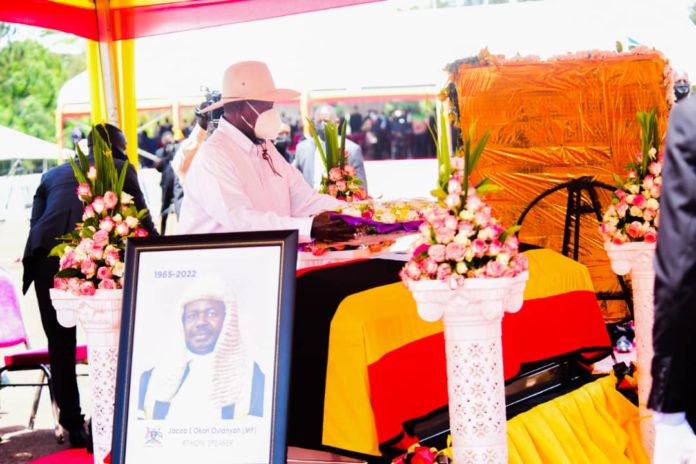
Museveni laying a wreath on the casket of the fallen Speaker

President Museveni has eulogised the fallen Speaker of Parliament Jacob L’Okori Oulanyah and commended him for fostering unity in Northern Uganda.

“Death robbed us of Jacob Oulanyah. He is a big loss to the country because we were going to get much from him. He played a critical role in unifying the people of Northern Uganda. He tried to foster unity. I commend and salute him,” Museveni said at Kololo Independence grounds.

Oulanyah died on 20th March 2022 in Seattle, USA barely two months after he was admitted in February this year. He was on February 3, 2021; Oulanyah was flown to the US aboard a Chartered Uganda Airlines aircraft A330 to Seattle for expert medical attention after efforts by medics at Mulago National Referral paid no dividends.

Museveni said Oulanyah’s impact was exhibited while he was chairing the Legal and Parliamentary Affairs Committee which handled a Bill that saw the removal of term limits in 2005.

The President castigated MPs from northern Uganda who were questioning his death and preaching sectarianism noting that Oulanyah was a Speaker of the Parliament of Uganda and not northern Uganda.

“Oulanyah was supported by the National Resistance Movement (NRM) after establishing that he is such an important leader. He was a nationalist and a Pan Africanist. When he saw the light in the NRM, he crossed from the Uganda People’s Congress (UPC),” he said.

The President asked Ugandans to take care of their lives noting that health is a weapon. “I came to know about Jacob Oulanyah’s health problem when he went to Dubai for treatment. If he had told me (earlier), I would have told him to concentrate on his health. He was busy involving himself in his work,” he said.

Earlier, Andrew Ojok, the late Oulanyah’s son, asked people to join them, not to mourn but to celebrate a man whose life was dedicated to his family, community, party, country and God.

“I thank President Museveni and Mama Janet for supporting our dad not only in his political aspirations but also when his health became critical. He was proud to call you a mentor,” he said.

The Archbishop Stephen Kazimba Mugalu who was the chief mourner called for revisiting the provision of the constitution of parliament which directs for immediate election of the Speaker of Parliament when his or her predecessor dies.

“The grave is the richest place on earth because it has taken many people down there. For the believers, there is life beyond death. Life does not end in the grave. There is hope amidst hopelessness. I think about all the brains that are buried in the ground. Recently, we were here for Mutebile. I think about our great musicians; Bongole’s songs that were never written,” Archbishop said.

“I was wondering how someone could win the votes, become a speaker but only to lead for nine months. God’s ways are not our words, he has authority over us. The grave is not a permanent place for us. It is a temporary home where we rest before we go to rejoice with God in heaven,” he said.

According to the burial program, Oulanyah’s body will be airlifted to Omoro, Lalogi village; the Speaker’s ancestral home where it will be received by the family and Acholi leaders. 

Thursday 7th April 2022 the body will lie at Lalogi for final respects by members of the public. Friday 8th April 2022 the burial ceremony will start at 9.00 am. The day will be observed as a Public Holiday as declared by H.E. the President.

Stories Continues after ad

Mo Ibrahim Foundation announces new updates to the Ibrahim Index of African Governance data portal

The Mo Ibrahim Foundation (MIF) has announced new updates to the Ibrahim Index Data Portal of African Governance (IIAG) on Wednesday 6 April 2022.

Data journalists, researchers, African citizens, civil society organisations and all those interested in the benchmarking of public governance in Africa are invited to explore the updated Ibrahim Index Data Portal from the Mo Ibrahim Foundation.

The Data Portal is an interactive presentation of the Ibrahim Index of African Governance (IIAG), a comprehensive dataset measuring the governance performance of each of the 54 African nations. The Index provides scores, ranks and trends for a wide range of governance dimensions, from rule of law and rights to health and economic opportunity, over a ten-year period. 

The new features, which enhance interaction and exploration of this vast dataset, include:

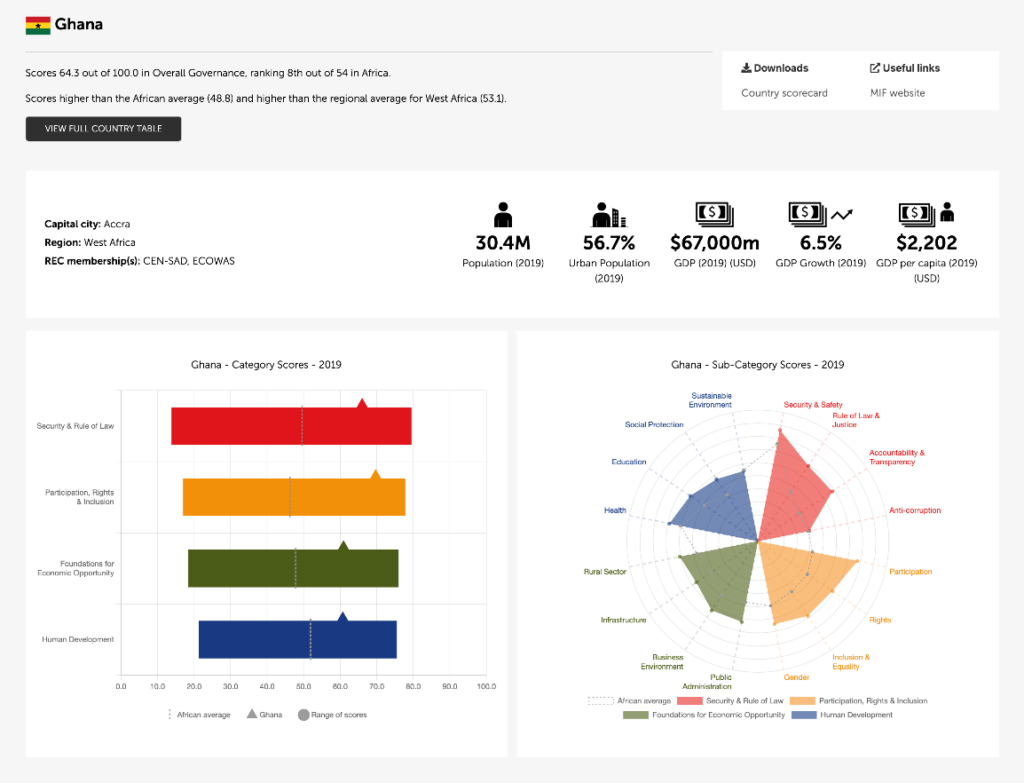
–          Country Profiles that summarise each nation’s performance in the Ibrahim Index during the last decade. Through charts and tables, users can explore the data behind each country’s overall governance and category scores, and see how these compare to continental averages.

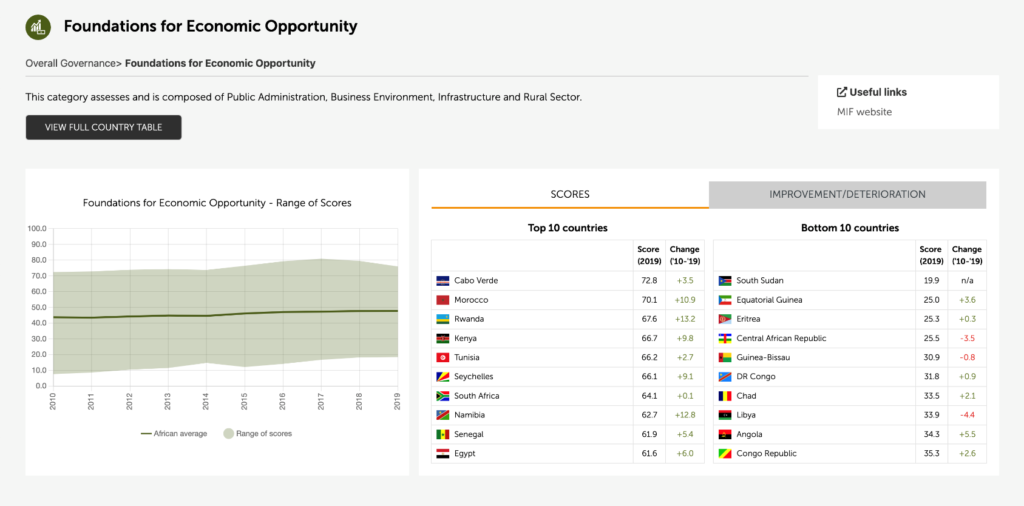
–          Measure Pages that allow users to easily contrast the performances of each African nation across the full range of measures used in the Ibrahim Index. Starting at category level, users can drill down into sub-categories, indicators and sub-indicators, exploring the most improved and most deteriorated countries at each level.

A video showcasing these features can be viewed here.

The Foundation will be announcing further updates to the Data Portal in the coming months, ahead of the launch of the next dataset in November 2022.

About the Ibrahim Index of African Governance (IIAG)

Published since 2007, the IIAG provides a comprehensive assessment of governance performance in 54 African countries. The Mo Ibrahim Foundation defines governance as the provision of political, social, economic and environmental public goods and services that every citizen has the right to expect from their government, and that a government has the responsibility to deliver to its citizens.

The IIAG dataset and Data Portal provide scores, ranks and trends at the African continental, regional and national level. The IIAG dataset is published every two years and provides comparable data for all African countries over a period of ten years. It is accompanied by an Index Report outlining the main findings of the Index, continental, regional and country data, and other resources and analytical tools. In the intervening year, the Foundation publishes an interim report, to further unpack and explore the latest IIAG dataset, with a focus on country results.

The latest dataset was published in November 2020 and covers the period 2010-19.

Stories Continues after ad

Africa faces rising climate-linked health emergencies

Climate-related health emergencies are on the rise in Africa, accounting for more than half of public health events recorded in the region over the past two decades, a new analysis by World Health Organization (WHO) shows.

The analysis found that of the 2121 public health events recorded in the African region between 2001 and 2021, 56% were climate-related. The region is witnessing an increase in climate-linked emergencies, with 25% more climate-related events recorded between 2011 and 2021 compared with the previous decade.

World Health Day is being marked on 7 April under the theme ‘Our Planet. Our Health.’ WHO is calling on governments to, among other recommendations, prioritize human well-being in all key decisions, stop new fossil fuel explorations and subsidies, tax polluters and implement WHO air quality guidelines.

“Climate change is one of the greatest threats to humanity. The entire foundation of good health is in jeopardy with increasingly severe climatic events. In Africa, frequent floods, water- and vector-borne diseases are deepening health crises. Although the continent contributes the least to global warming, it bears the full consequences,” said Dr Matshidiso Moeti, WHO Regional Director for Africa.

The WHO analysis found that water-borne diseases accounted for 40% of the climate-related health emergencies over the past two decades. In Africa, diarrhoeal diseases are the third leading cause of disease and death in under five children. A significant proportion of these deaths is preventable through safe drinking water, adequate sanitation and hygiene.

The analysis also showed that vector-borne diseases, notably yellow fever, accounted for 28% of the climate-related health emergencies, while zoonotic diseases, specifically Congo-Crimean hemorrhagic fever, were the third most prevalent. Congo-Crimean hemorrhagic fever is a viral disease transmitted to people from ticks and livestock and has an outbreak fatality rate of up to 40%.

Natural disasters have also spiked dramatically since 2010, with 70% of all-natural disasters occurring between 2017 and 2021. Floods were the most frequent event, accounting for 33% of all the reported natural disasters.

Africa is also grappling with other significant health impacts linked to climatic shocks including malnutrition and hunger due to adverse weather on agricultural production, long-term health and development challenges in children, as well as other infectious diseases such as malaria.

In Africa, climate change is likely to expand the range of malaria high-risk zones, according to a report by the Netherlands-based Global Centre on Adaptation. Even though malaria mortality has decreased from 840,000 deaths in 2000 to 602,000 deaths in 2020, the disease remains a major health challenge on the continent.

Stories Continues after ad

Vipers draw Wakiso Giants in Uganda Cup quarterfinals

Uganda Cup trophy

Uganda Cup holders Vipers SC will face Wakiso Giants FC in the Wakiso Derby which headlines fixtures from the quarterfinal draws that were conducted on Wednesday at FUFA Complex in Mengo.

Vipers who are currently top of the table in the League with 8 games to play will try to compete at both fronts as the search for an elusive domestic double continues.

The closest they came to winning both the League and the Cup came in 2017 but fell to KCCA FC in the Uganda Cup final played at Emokori Grounds, Bukedea.

Elsewhere, Booma FC and Mbale Heroes FC will hope to continue their Cinderella story by advancing to the semifinals.

The aforementioned teams have had a scintillating run in the Stanbic Uganda Cup and remain only the two regional league clubs in this year’s competition.

Mbale Heroes FC from Eastern Regional League stunned Police FC at the previous round while Booma FC on the other hand ejected TIPSA FC.

In the quarterfinals, Booma FC have been drawn at home to StarTimes FUFA Big League entity Maroons FC while Mbale Heroes FC will visit Mbarara City FC at Kakyeka Stadium.

In the other quarterfinal fixture, SC Villa will face BUL FC at FUFA Technical Centre, Njeru.

The games to be played between 23rd and 27th April 2022. They will be broadcast live on TV.

“All the games will be on television and we hope teams can give us good display and performance. Many people will watch from their homes and it important that people are given value for money,” FUFA Executive Committee member Rogers Mulindwa said during the draws.

 In case of a draw after normal time, extra time of 30 minutes will be played. If the score is even after extra time, then the winners shall be determined through penalty kicks.

The winners of the Stanbic Uganda Cup represents the country in CAF Confederation Cup.

Quarterfinal Draws

Mbarara City FC vs Mbale Heroes FC – Kakyeka Stadium

Booma FC vs Maroons FC – Masindi

Wakiso Giants FC vs Vipers SC – Kabaka Kyabaggu Stadium

SC Villa vs BUL FC – FUFA Technical Centre, Njeru

Stories Continues after ad

Centenary Bank, Red Cross start campaign to keep girls in school

Uganda Red Cross Society and Centenary Bank have launched a menstrual hygiene management initiative to support the vulnerable girls with sanitary pads through a drive dubbed “KAGIS.”

The two partners on Tuesday, 05 April 2022 donated reusable sanitary towels to students of St. Ponsiano Kyamula Primary School in Salaama, and St Mary’s Primary School in Makindye.

The Executive Director of Centenary Bank, Mr. Balikuddembe Joseph in his address at the handover of reusable sanitary towels said: “An empowered youth means strong businesses and ultimately, a sustainable economy.”

“These young ones with us here today are the future we are looking forward to and they need our support in all ways possible. It is for this reason Centenary Bank has set aside a total of UGX 10M towards this cause.”

“Every year we set aside 2% of our previous year’s net profit towards uplifting communities in such areas of health, education, environment, and community activities. We pledge to continue with this commitment to our people,” he concluded.

The Secretary General of the Uganda Red Cross Society, Mr Robert Kwesiga, said: “We thank Centenary Bank for this partnership and this isn’t the first time we are working together.

“Before lockdown, we worked on a project where we taught children how to administer first aid in cases of accidents. We are now working with Centenary Bank to reach out to the girl child and ensure that they stay in school and thrive in life,” he said.

Stories Continues after ad

Itel, MTN Uganda launch P17 and P17 Pro

itel and MTN Uganda have jointly launched the itel P17 series today following the recently launched partnership between the two companies.

The itel P17 and P17 Pro are the latest addition to the itel range of smartphones. Both phones have an impressive 5.5” screen and a long-lasting battery, whose single charge can last up to 3 days. The itel P17 which comes with 2GB RAM and 16GB ROM retails at Shs 235,000/=while the P17 Pro which features 2GB RAM and 32GB ROM will roll out into the market soon.

Based on the ongoing partnership between MTN Uganda and itel, MTN will provide a free 3GB monthly data bundle for the P17 devices which will latch onto the MTN network, for three months. In addition to the 3GB, all devices will enjoy 100% data bonus on every data bundle purchased for the first 3 months on the MTN network. The same offer applies to the rest of the itel devices currently on the market.

While speaking at the itel P17 launch press conference held at the MTN headquarters in Kampala, Ms. Thurraya Nakayima, itel Uganda’s Executive Trainer said that the partnership has enhanced the value of itel’s smart phones by making access to the internet more affordable and exciting.

“The itel P17 and P17 Pro are designed with close attention to our consumers’ needs. These phones, equipped with very durable battery lives, impressive features and attractive data offers from our partner will surely be appreciated by any consumer out there who needs a great smart phone at a friendly price.” Said Ms. Thurraya.

Somdev Sen, MTN Uganda’s Chief Marketing Officer noted that this partnership further demonstrates MTN’s commitment to championing digital inclusion.

“Our partnership with itel is showing great results. We recently launched the itel A58 which is doing well on the market and today, we are unveiling two more series of the itel P17. With such a diversity of itel smartphones on the market, we believe there is something for everyone. And what is even better is that all these itel devices come with attractive MTN data offers that enable customers to do more with their itel smartphones,” Somdev said.

itel, a leading mobile phone brand committed to providing budget-friendly yet high-quality entry-level devices partnered with Uganda’s Telecom giant, MTN, early this year in February to accelerate smartphone penetration. In this strategic partnership, itel provides affordable smartphones while MTN avails its best-in-class internet data offers with a common goal of bringing more Ugandans online.

This is but one of the many customer-centred device partnerships that MTN has undertaken to enable smartphone penetration and digital inclusion with a vision of delivering a bold new digital world to all its customers.

Stories Continues after ad

Government tasked to procure cancer equipment

Uganda's Health Minister, Dr. Jane Ruth Aceng.

The Speaker, Anita Among has directed the Minister for Health to report to the House within two months on the progress on the acquisition of a positron emission tomography (PET) scanner.

A positron emission tomography (PET) scan is an imaging test that can help reveal the metabolic or biochemical function of body tissues and organs.

The Speaker’s directive follows a motion by Dokolo District Woman MP, Hon. Cecilia Ogwal to amend the prayers of the motion to pay tribute to late Rt Hon. Jacob Oulanyah, to include a requirement of Government to acquire the machine.

She said the machine will facilitate the Uganda Cancer Institute in early detection and diagnosis of cancer.

Ogwal moved the motion following a post mortem report presented to the House by the Health Minister, Hon. Jane Ruth Aceng, that indicated that Oulanyah had been diagnosed with cancer.

“It is good for us to talk about Oulanyah, but it is my wish and the wish of every one of the 529 of us that this painful death should leave an impact,” Ogwal said.

The Speaker, however, said that the Ogwal’s concern did not require the amendment at hand, but was an issue that Parliament can follow up on.

Aceng said procurement of the machine is on course, with the process having commenced on Monday, 04 April 2022.

“This financial year, Parliament appropriatedShs45 billion to procure a PET scan for the Uganda Cancer Institute and the contract was signed yesterday. So we shall have a PET scan,” Aceng said.

She added that Parliament also appropriated money to construct a nuclear medicine unit which will house the PET scan and a linear accelerator, as well as offer other treatment like that which Oulanyah had sought in Seattle, USA.

Vice President, HE Jessica Alupo gave supplementary information on the matter, that operationalizing the cyclotron and PET machine requires shs250 billion, where shs90 billion has been received by the Health Ministry.

“The Health Ministry Permanent Secretary says additional funding is being provided annually. The PET scan cannot work without the cyclotron so the earlier we also get it, the better,” Alupo said.

She added that the bunker to house the equipment was completed two years ago, but said additional information on equipping Uganda Cancer Institute will provided in due course.

The Chairperson of the Health Committee, Hon. Charles Ayume said that besides the cancer equipment, the Finance Ministry should avail funding towards regional blood banks to cover the shortfalls of blood units across the country.

“We heard that there were issues to do with blood transfusion where our departed Speaker was being transfused every day. No money was appropriated this financial year for regional blood banks in Moroto and Hoima yet we have a shortfall of 150,000 units of blood,” Ayume said.

He added that in the policy statements presented , the regional blood banks have not been budgeted for.

Stories Continues after ad

Stanbic PMI: Economy stutters in March, outlook remains positive

Stanbic Bank

The headline Stanbic Purchasing Managers’ Index (PMI) posted 51.9 in March, down from 55.7 in February, but still signaling an improvement in business conditions as the health of Uganda’s private sector continues to strengthen during the last eight successive months.

Released today, the index shows that conditions improved towards the end of the opening quarter of the year, with output, new orders and employment all rising again in March.

However, there are ongoing inflationary pressures and signs that this has acted to deter customers in some cases.

Ronald Muyanja, the Head of Trading, Global Markets at Stanbic Bank Uganda said, “The absence of restrictions related to the Covid-19 pandemic and signs of improving customer demand helped Ugandan firms to secure greater new order volumes and expand their business activity in March. But that said, there were some reports that rising prices had acted to dampen demand somewhat.”

The PMI is a composite index, calculated as a weighted average of five individual sub-components: New Orders (30%), Output (25%), Employment (20%), Suppliers’ Delivery Times (15%) and Stocks of Purchases (10%). Readings above 50.0 signal an improvement in business conditions on the previous month, while readings below 50.0 indicate deterioration.

The monthly survey, sponsored by Stanbic Bank and produced by S&P Global, has been conducted since June 2016. It covers the agriculture, industry, construction, wholesale & retail and service sectors. The headline figure derived from the survey is the Purchasing Managers’ Index (PMI) which provides an early indication of operating conditions in Uganda.

Ferishka Bharuth, Economist – Africa Regions at Stanbic Bank said, “Uganda’s PMI still remains in expansionary territory at 51.9 in March though lower than 55.7 in February. The absence of Covid-19 restrictions has supported some improvement in consumer demand, but rising prices seem to also have restrained demand. Higher prices were largely a function

of increasing input costs, with companies increasing their selling prices for the seventh consecutive month.”

Output increased across the industry, services, and wholesale & retail sectors, but fell in agriculture and construction. Advertising efforts, good quality products and demand improvements all acted to support a further increase in new orders during March. New business has now risen in eight successive months. As was the case with output, however, there were some signs that customers were finding it more difficult to finance orders.

In contrast to the picture for total new business, new export orders dropped at Ugandan companies at the end of the first quarter of the year. New business from abroad has now decreased in 18 of the past 19 months.

Higher prices were primarily the result of increases in purchase costs. Purchase prices continued to rise in March, with more than 41% of respondents signaling an increase in their costs of purchases during March. In particular, fuel was widely reported to have risen in price, while there were also mentions of higher costs for cement, ink, paper, soap, sugar, transportation and utilities. In turn, companies raised their own selling prices for the seventh month running.

Further increases in employment, purchasing activity and inventories were recorded in response to higher new orders, helping companies to keep on top of workloads and deplete outstanding business.

Ugandan companies responded to higher new orders by taking on additional staff during March, the fourth time in the past five months in which job creation has been recorded. Agriculture was the only sector to buck the wider trend and post a decline in employment.

Companies remained optimistic that output will increase over the coming year, with close to 79% of firms expressing a positive outlook.

According to respondents, confidence reflected expected growth of new orders and hopes of greater stability in economic conditions and commodity prices.

Stories Continues after ad