Stanbic Bank
Stanbic Bank
24.5 C
Kampala
Stanbic Bank
Stanbic Bank
Home Blog Page 686

Dfcu makes losses in 2021

Net profits made by Dfcu for the year 2021 have fallen by at least 25%, the bank has announced.

The bank attributes the losses to the impact of Covid-19 on its customers’ business operations that resulted in an increase in loan provisions.

“The Board of Directors of dfcu Limited wishes to inform its shareholders and investors that the company’s financial statements for the year ended 31st December 2021 will indicate a decline in Net Profit exceeding 25%,” Dfcu said in a statement.

“The decline was occasioned by an increase in loan provisions made by the company as a result of the impact of Covid-19 on its business customers and the impairment of some loans and advances that formed part of the financial asset acquired by the company in the 2017.”

Dfcu said the detailed financial statements of the company will be published within the statutory timeline.

“The company remains robust and adequately capitalized. The detailed financial statements of the company will be published within the statutory timeline.”

Shareholders and potential investors have been advised to exercise caution while trading in the company’s shares.

Stories Continues after ad

Shell Uganda ordered to pay Shs200m rent arrears to family

The Court of Appeal has ordered Shell Uganda to pay Shs204m to a family as rent compensation for occupying their property they left behind after being expelled from Uganda by Idi Amin’s government in 1972.

The disputed property is on Plot 49 on Ben Kiwanuka Street in Kampala city centre.

A panel of four justices led by Geoffrey Kiryabwire quashed an earlier High Court ruling which had stated that expelled Ugandan citizens of Asian origin, who wished to avoid their assets being expropriated and vested in the Government, had to prove their citizenship before their departure from the country.

The property belongs to a family who owned a company called Hassanali Nathu Limited under which they all operated.

The case was later taken over by Mercator Enterprises Limited, which appealed the High Court ruling.

“With the great respect to the learned trial judge, he had no basis to hold as he did, because the issue of whether or not the predecessors in title to the appellant had to prove or proved their being Uganda citizens by birth did not at all arise with the pleadings by either party in the original suit filed in 1993,” Justice Kasule ruled.

He added that the respondent having assured the appellant that it was an agreed-upon admitted fact, the appellant’s rights in the property “were not affected by the Expropriation Decree” thus making it unnecessary for the appellant to prove the issue of Ugandan citizenship.

“The law applied and still applies to the properties that had been physically taken and managed by the Government under the expropriation process. It places these properties under the management of the

Government through the Ministry of Finance with the view of having the same returned to the Asian owners from whom they were expropriated, whether lawfully or unlawfully by the Idi Amin military regime,” Justice Kasule asserted.

The High Court had ruled that the predecessors-in-title of the appellant did not prove their citizenship when they were departing from Uganda in October 1972 and that by that reason their respective interests in the suit property became expropriated under the decree of December 1973.

Stories Continues after ad

Sudhir named again as the richest Ugandan

Sudhir Ruparelia, East Africa's wealthiest man.

Kampala Tycoon, Sudhir Ruparelia has again been ranked the wealthiest Ugandan valued at a net worth of $1.2 billion. According to the research titled Richest Ugandans 2021, Sudhir maintains his lead and is followed by Karim Hijri as the 9th richest Uganda at a net worth of $800 million.

Sudhir was ranked by Forbes Magazines as the richest man in East Africa

According to research, Charles Mbire, the chairman of the MTN board is the only native worth $400 million and he is ranked the 4th richest Ugandan.

Sudhir Ruparelia net worth $1.2b

According to the research, the chairman of Ruparelia Group of Companies Sudhir Ruparelia is also known as the Fortunate tycoon occupies the number one slot in Uganda. “He is known as a fortunate man because he started business with a meager sum of about $25,000”.

Sudhir’s area of investment are real estate, education, broadcasting, banking, Insurance and leisure and hospitality among others.

Karim Hijri net worth $800m

The chairman of the Dembe Group of accompanies is ranked the 2nd richest Ugandan with a net worth of $800 million. His area of investment are hotel and leisure, hotels under the Imperial group of Hotels and Charm Towers.

Alykan Khamali net worth $700m (Mukwano)

Mr Khamali

The Chief Executive Officer of the Mukwano Group of Companies is ranked the 3rd richest Uganda. The research says his major investments are in the area of manufacturing and banking. He is a non executive director of the Exim Bank where the Mukwano family maintains 36.5 per cent shareholding. He is said to have inherited business and riches from his father.

Mohammed Hamid (Tie) net worth $400m

The chairman and majority shareholder in Aya Group of companies, he is ranked 4th richest Ugandan who has made a fortune from sectors like transport, real estate, manufacturing and host of others. The researchers say ever since he bought a milling machine from Sudhir Ruparelia’s primer mills he has never looked back.

Charles Mbire (Tie) net worth $400m

Mr Mbire

According to the research, it ranks Charles Mbire as worth $400 million and it says he is the only native Uganda worth $400 million.

The research says Mbire investment interests are in communications, pharmaceuticals, real estate, energy production, Agrobusiness and finance.

Sikander Lalani net worth $300m

He is ranked the 6th richest Ugandan and the research say he is worth $300 million. Lalani’s area of investment are in the area of steel manufacturing under the Roofing Group in Uganda. They also say that before establishing in Uganda, Lalani ran a tyre business in Kigali.

Mr Lalani

Aaron M Mukooza net worth $200m

The researchers say Aaron Mukooza is a media guru who has interests in the media and banking sectors. According to the revelations by the researchers, he is ranked the 7th richest Ugandan. Mukooza has investments worth $200 millions.

Gordon Wavamuno (Tie) net worth $100m

The research places Gordon Wavamuno also at the 8th position and says that like other Ugandans, Wavamuno has also investment worth $100 million and his investments are in the area of media under his Wave FM, Wavah water GM Tampec Limited among others.

Mukesh Shukla (Tie) net worth $100m

Mukesh Shukla comes in at position number 8 with a net worth of $100 million. The research further says under his Shumuk Group, he has invested in a milk plant, money lending and foreign exchange bureau among others.

Mr. Bitature

Patrick Bitature (Tie) net worth $100 million 

The research say Bitature got his money from Simba Telecom that dals in airtime and other communications outfits. Bitature’s others dealings are in energy production, media, mining, real estate and leisure and tourism. The research claims from the above investment, Bitature is worth $100 million. He occupies the 8th position among the top ten richest Ugandans.

Stories Continues after ad

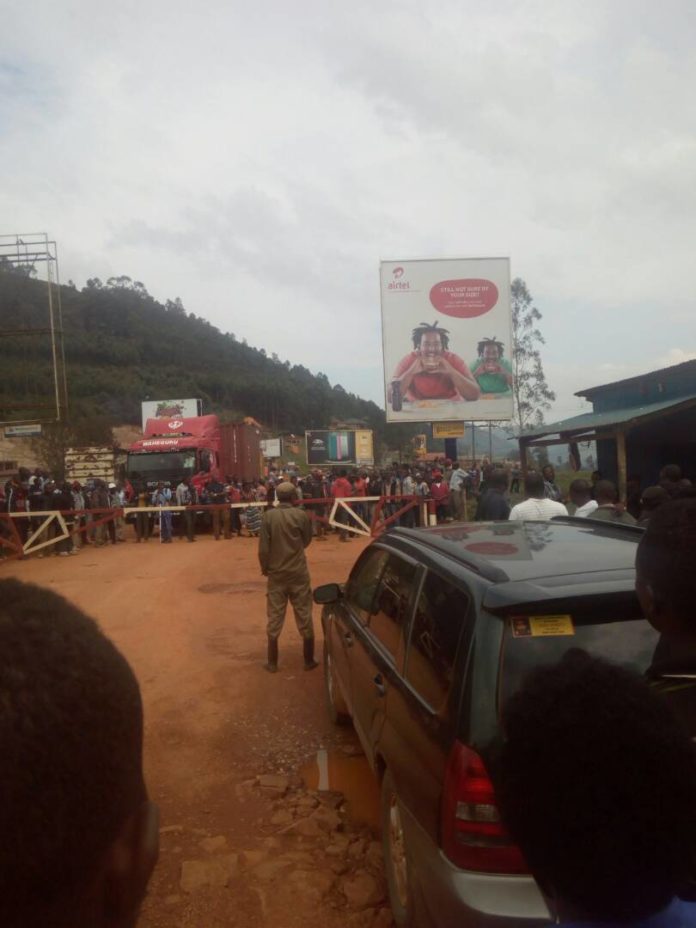
Rwanda says it is to re-open Katuna border with Uganda

Ugandans at the Katuna border after blocking traffic to the Uganda's southern neighbour, Rwanda

The government of Rwanda has announced that it is re-opening it Gatuna border with Uganda.

Rwanda says on January 31, 2022 the border will be opened after a closure of two years. It was closed in 2020 by Rwanda under the guise of expanding its construction.

“Following the visit to Rwanda of Lt. Gen. Muhoozi  Kainerugaba, Senior Presidential Advisor on Special Operations and Commander of Land Forces of Uganda People’s Defence Forces (UPDF) ON January 22, 2022, the government of Rwanda has taken note that there is a process to solve issues raised by Rwanda, as well as commitments made by the government of Uganda to address remaining obstacles” reads the statement.

It further continues “In this regard and in line with the communique of the 4th Quadripartite Summit held at Gatuna/Katuna February 21, 2020, the government of Rwanda wishes to inform the public that the Gatuna border post between Rwanda and Uganda will be re-opened from January 31, 2022”

Sources in Kampala say that although Kigali has used excuse of other issues to portray as if Uganda was in need of the re-opening of the border, the real pressure has been coming from Rwandan citizens as they were in need of crossing to Uganda to look for employment and food. It is on record that many Rwandans were killed and have been shot by their own forces while crossing into Uganda for food.

The statement further says both countries will put #Covid-19 guidelines and SOPs in place before the full re-opening.

“As it is the case for other land border posts in the country, health authorities of Rwanda and Uganda will work together to put in place necessary measures to facilitate movement in the context of #Covid-19. The government of Rwanda remains committed to ongoing efforts to resolve pending issues between Rwanda and Uganda and believes that today’s announcement will contribute positively to the speedy normalization of relations between the two countries”

Stories Continues after ad

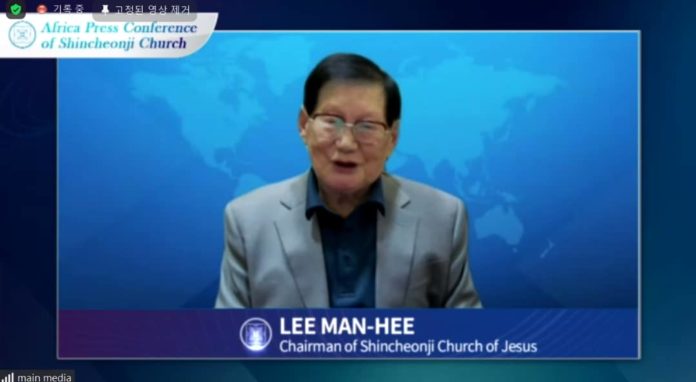
Africa Press Conference of Shincheonji Church attended by journalists from 55 African countries

Philippines, Americas after Africa! Online press conference with about 300 journalists from 55 African countries

I wish everyone across the world will come and study the word from Shincehonji seminar to change people’s life. – Ugnada, Stephen Ogwang, secretary general of born again churches

I have never encountered the word of God before, I have only learned from Shincheonji.

– South Africa, Daisyman Goniwe, Independent Methodist Church

On the 28th, an Africa Press Conference of Shincheonji Church: Testimony on the Parables of the Secrets of Heaven and Their True Meanings was held through the Zoom platform with Man Hee Lee, chairman of the Shincheonji Church of Jesus, the Temple of the Tabernacle of the Testimony(Shincheonji Church) and journalists from 55 African countries. This press conference was planned at the request of African journalists and pastors and was hosted by Shincheonji Church.

The organization of Shincheonji Church, announced that it had planned a press conference to inform the true meaning of the New Testament in the Bible. The press conference started with the introduction of Shincheonji Church. And after The results of the Revelation seminar held last year were shared, followed by the Shincheonji Online Seminar: Testimony on the Parables of the Secrets of Heaven and Their True Meaning, which started in January of this year.

Shincheonji Church of Jesus has testified the prophecies and fulfillment recorded in the Book of Revelation to the world through YouTube for a total of 10 weeks from October last year. It has recorded 8 million cumulative views on YouTube so far. Through this seminar, Shincheonji Church signed MOUs with more than 1,200 pastors and seminaries in 57 countries (of which 235 MOUs were signed in 16 countries in Africa). And now Shincheonji church is supporting the exchange of the word of the Bible to each church and seminary.

The journalists who attended asked questions about the Revelation seminar and introduction seminar, which they heard objectively from the reporter’s point of view, and how they felt about Shincheonji. The chairman Man Hee Lee, who was directly present at the press conference, answered plans after the MOU and questions about the seminars clearly.

Chairman Lee said that he especially loves Africa among global village and that he hopes Africans who have good faiths would come into the Word and get to understand God’s stance and His Will.

Along with that, he stated that the secret of the heaven is recorded with parables in the Bible, and he hopes that whole world would understand the true meaning of parable through word seminar so that they could believe in it and reach salvation.

Furthermore, Chairman Lee asked all the press associates to promote that there is a testimony on the prophecy and fulfillment of Revelation and the secrets of kingdom of Heaven available to everyone today.

“Testimony on the Parables of the Secrets of Heaven and Their True Meanings” which is an on-going seminar that uncovers the meaning of the parable begun on the 3rd of January will be broadcasted 2 times a week on Monday and Thursday through Shincheonji YouTube Channel in 24 different languages.

Stories Continues after ad

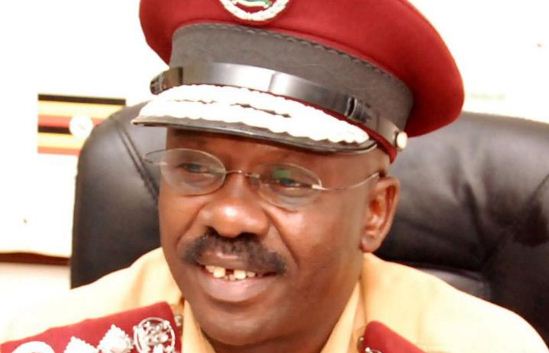
Prisons Boss Byabashaija, Deputy IGP Katsigazi to appear before Parliament for Vetting on Friday

Uganda Prisons Commissioner General Dr. Johnson Byabashaija

President Yoweri Museveni’s new appointees are to be approved by Parliament before they can get down to work, if given the nod on Friday, 28th January, 2022.

The Constitution provides that the President shall make appointments with the approval of Parliament from among Members of Parliament or persons qualified to be elected Members of Parliament.

Dr. Johnson O. R. Byabashaija was reappointed as Commissioner General of Prison while Maj Gen James Birungi, the new commander of Chieftaincy of Military Intelligence (CMI). Byabashaija has served as the prisons Commissioner General since 2005.

Born on 27th September 1957 in the South-West of Uganda in the Rukungiri District, Byabashaija studied Veterinary Medicine at Makerere University (1982) and a Post-graduate Master of Science.

Maj. Gen. Geoffrey Katsigazi

Maj. Gen. Geoffrey Katsigazi was appointed to the office of Deputy Inspector of Uganda Police Force (UPF) replacing Maj. Gen. Paul Lokech who died on August, 21st 2021. He is senior military officer specializing in aviation doubling as Deputy Commander Air Force.

Stories Continues after ad

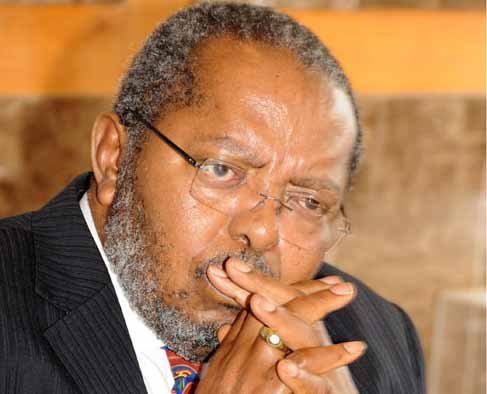
Gov’t to spend Shs409m on Mutebile’s send off as widow begs for house

Emmanuel Tumusiime- Mutebile

Government is set to spend Shs409 million on the deceased Bank of Uganda Governor Prof Emmanuel Tumusiime-Mutebile’s burial, Eagle Online has learnt.

Earlier this week, the Minister for Information, Chris Baryomunsi, revealed that the fallen Economist will be accorded official burial. Mutebile died on Sunday, January 23, 2022 at Aga Khan Hospital where he was admitted over diabetes-related complications.

According to the Budget obtained by Eagle Online, the government will spend Shs45.5 million on food, Shs27 million on drinks, Shs52 million on tents, Chairs, public address system, live TV, radio coverage, service providers and ushers.

Documents indicate on Friday, Saturday and the whole of next week after burial, government will spend Shs7.5 million of food, Shs10.5 million of drinks (this totals to Shs95 million for seven days) miscellaneous Shs20 million bringing to a total of Shs244.8 million.

The budget also shows that the government will spend Shs10 million on constructing honorary Kakiira road, Shs3.7 million on allowances, Shs15 million of 10% Contingency. Shs5.5 million of patching a road to Mutebile’s ancestral home and Shs131 million on security.

Unverified sources told this website that the deceased governor had five properties in upscale suburbs of Kampala contrary to the widows’ allegations that if they are evicted from BoU House they will become homeless.

The fallen Governor has been earning over Shs50 million every month for the last 20 years as the governor of BoU exclusive of the allowances. Mutebile is entitled to his gratuity and retirement benefits spanning for over 40 years in public service.

Stories Continues after ad

Eastern Africa Editors Society to hold 2022 World Press Freedom Day in Tanzania

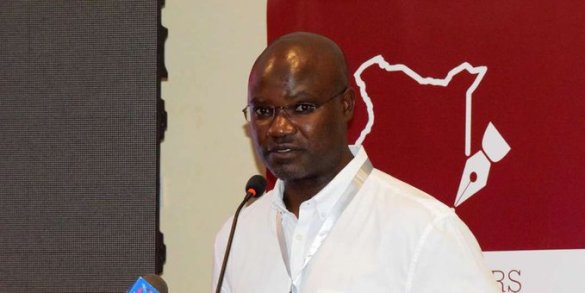
Churchill Otieno

The Eastern Africa Editors Society (EAES) an umbrella body bringing together editor organizations in Ethiopia, Uganda, Tanzania, and Kenya has in a statement confirmed that it will hold this years’ World Press Freedom Day (WPFD) activities in Tanzania on May 3, 2022.

“We are excited to being able to meet physically and discuss pertinent issues facing the media in the region,” EAES Chairman Churchill Otieno said.

Confirming the physical convening on Thursday morning, EAES Chairman Churchill Otieno said the Society looks forward to engaging robustly on freedom of expression, freedom of the media, and access to information issues in the region and beyond. This will be the third regional convening and the first to be held physically.

“We are excited to be able to meet physically and discuss pertinent issues facing the media in the region. We are also grateful to Tanzania and the Tanzania Editors Forum (TEF) for showing magnanimity in hosting the convening,” he said in a statement.

This year, the theme for the World Press Freedom Day is ‘Journalism Under Surveillance’ and the region is tangibly alive to these issues.

Deodatus Balile, the Chairman of the Tanzania Editors Forum, said they look forward to celebrating the day with colleagues from the region and beyond.

“Tanzania is happy to play host to editors, journalists, and media professionals in the region. Going by this years’ theme, it is apt that the Society saw it fit to not only hold it physically, considering that COVID-19 continues to ravage communities, but also to visit Tanzania. World Press Freedom Day celebrated in Tanzania will solidify the media fraternity bond across the region,” he noted.

Last year’s World Press Freedom Day, the Society contributed to the Windhoek +30 Declaration under the overall theme of World Press Freedom Day, “Information as a Public Good”. The issues discussed and tabled in Windhoek were adopted.

The Windhoek +30 Declaration takes forward the spirit of the original 1991 Windhoek Declaration but refers to nowadays persistent and new challenges to media freedom such as the risk of media extinction amid a severe economic crisis and disruption of traditional media business models, increasing proliferation, amplification, and promotion of disinformation and hate speech, as well as enduring and new threats to the safety of journalists and the free exercise of journalism, including killings, harassment of women, offline and online attacks.

Stories Continues after ad

Balkanisation, Dialogue and Conflict Transformation in DRC

Edgar Tabaro

By Edgar Tabaro

The aspirations of the Congalais are aptly captured in their national anthem “La Congolais” whose first stanza goes: “Arise, Congolese, United by fate, United in the struggle for independence, let us hold up our heads, so long bowed, and now, for good, let us keep moving boldly ahead, in peace. Oh, ardent people”.

The DRC has a long proud and not so proud history, Bas Kongo an ancient Kingdom in the far west at the Atlantic Ocean exchanged Ambassadors and were trade partners with Portugal in the 16 Century with a thriving civilization. In the precolonial period the eastern area (the Congo Forest areas) was an integral link in trade with the East African coast (Pwani), encompassing the Miombo woodlands, the plains of Eastern Kenya, the Interlacustrine region and the Sudan Savanah. This precolonial era, is probably the best epoch in the history of the land mass called Democratic Republic of Congo.

In 1885 The Congo Free State, a private estate of King Leopold was birthed where he proceeded to exploit it and execute a genocide that claimed 10 million lives. It turned out the biggest embarrassment of the 19th Century in world history. The immediate post-independence period ushered in instability arising from unstable central authority following the assassination of the legend Patrice Lumumba and attempts at secession of Katanga Province led by Moise Tsombe and its resulting Mulele rebellion aligned to the Lumumba orientation thinking that persist to date nostalgically lately by a charismatic and successful businessman Moise Katumbi owner of the TP Mazembe FC a brand name in African soccer.

There followed a brief period of stability (1967-77) under Mobutu Sese Seko Kuku Ngbendu Wa Za Banga who earlier as Chief of Staff of the Army through a close friend and CIA Director George Bush (later Vice President and President) had been hosted by Kennedy at the oval office and given special treatment to attend an elite military academy with a jet at his disposal for travel. As President, he was a regular visitor to the oval office, being hosted twice in 1970 alone under President Nixon. His closeness to the western powers gave him leeway to mismanage the country following a 10 year period of prosperity brought to the end following a coup attempt and wars in 1977 and 1978 in Shaba province. Mobutu retreated to country side Gbadolite Palace (famed for its opulence, in 1990 alone, ten thousand bottles of champagne was consumed there!) from where he ruled by remote control.

The country fell into a dysfunctional state. The eastern part fell into total collapse of the state. Basic services, such as agricultural extension, roads, schools, hospitals are lacking, yet it’s the richest minerals area in the DRC.

Prof. Mwesigwa Baregu in his seminal article “The Clones of Mr. Kurtz:Violence, War and Plunder in the DRC” in the African Journal of Political Sci. situates the conflict in the DRC through the epochs with a surgical analysis of the vicious cycle of violence that has become the face of the DRC in the result that a peace keeping mission MUNUSCO with 2000 that has consumed over 20 billion USD, the largest and most costly peace keeping operation in the history of the UN and yet the violence continues and multiplies unabated (eastern DRC is home to 133 militia groups).

Herein lies the challenge, the agenda of UN and other multilateral agencies is premised on peace keeping (as opposed to “peace enforcement” a new notion espoused by President Museveni) as well conflict resolution as opposed to conflict transformation). The approach of these bodies to which African intelligentsia are sold or conscripted is anachronistic to the values, ethos and interests of the African peoples. To this I will return herein later.

The eastern DRC conflict is essentially a subtly grounded in economic interests. This runs counter to the dominant narrative and agenda set by protagonists in the conflict, be they African or European. The sold narrative, the conflict is ethnic. It is my submission, the conflict is primarily over natural resources, the ethnic sentiments being secondary. Broadly, there are pastoralists, cultivators and the extractive industry as well as the commercial plantations. The three groups often clash in competition to access to these resources.

Importantly among these economic groups are fights within, that politicians and warlords have exploited in the lenses of ethicity. Among the Banyamulenge pastoralists of South Kivu are 3 contesting groups, Gumino, Twirwaneho and another linked to politicians in Kinshasa Azarius Ruberwa, Masunzu and Nyamusaraba crafted along immigrant Banyamulenge from Rwanda and natives in Congolese speak antoilette. These are largely pastoralists and a pitted against the Bashir who are cultivators. The contestation between real and perceived immigrants is central to the conflict in so far as the Kivus are concerned (to which return later).

The activities of the actors in the DRC are placated upon special interests often at variance with one another in the result that these interests have worked to obstruct the peace efforts in the DRC. The ever present challenge that we face is that the real and perceived interests drive the strategies and actions of the major actors in regional conflict.

The strategies and tactics adopted by the various actors before, during and after the negotiation of various peace agreements have been largely shaped by the logic of these interests, albeit, within the limitations imposed by the interests of other actors. Thus, there are times when some actors have collaborated in pursuit of their mutual interests and other times when they have conflicted because either their interests clashed or they have failed to come to some mutually beneficial arrangements, which can accommodate their mutual interests.

The efforts are overly presumptious, to the extent that every party in conflict has a vested interest in peace building and the resulting pre-occupation with negotiating peace agreements may be highly misplaced if major actors have vested interests in other objects such as the mineral wealth, and political gerrymandering at pronvicial, national and regional levels. Imperialists (African, and international ones), plunderers, warlords, gunrunners, drug-barons and such other predatory actors, in particular, tend to thrive in chaos in a relatively anarchic environment.

In North Kivu are cultivators from the Rwandaphone (Kinyarwanda speaking) community who in the past sided with cultivators from the Bafurero, and Nande and other cultivator Communities. Together they formed the Mutuelle Mutuelle agricole des Virunga (MAGRIVI) association of agriculturalist of Virunga of North but has over time been hijacked by Rwandaphone politicians to increase their state in RCD-Goma a special purpose vehicle crafted by a neighbouring state as a political party to compete in national elections (in the last parliament, out of 15 MPs for North Kivu 11 were RCD-GOMA Rwandaphones besides the Governor) thereby causing rifts with the other communities.

Enter the CNDP of Gen. Lauren Nkunda and Gen. Bosco Ntaganda aka “Terminator” both indicted by the ICC with the later serving time for war crimes, and acts of genocide representing pastoralists. The M23 (M Vigt trois) an offshoot of the CNDP attempted to craft an alliance of both pastoral and cultivator Rwandaphones, however, clashes arising access to proceeds from the illicit minerals trade bankrolled by external forces have increasingly undermined its power. Thus, the militias (133 at the writing of this article) impose taxes, and export minerals to sustain their livelihoods. The militia leaders have turned out soldiers of fortune and the lower rank and file mercenaries for external forces.

Earlier attempts at Disarmament, Demobilization and Resettlement have typically followed the scripts written for post conflict reconstruction with its attendant “one size fits all” approach. This, is what essentially failed the CNDP March 23rd 2009 Agreement that made it a condition for mixage (natives of Kivu being deployed outside of the home areas to other regions) for integration. The experiment, was a dismal failure giving birth to the M23 rebel movement that continues to threaten the existence of the DRC through an agenda of secession (locally called balkanization) of the Kivus with the support of expansionist forces in the region bent on establishing viceroy states.

Katanga province has picked the same sentiment. The DDR experiment failed principally because it only addressed the western approached tailored in the fashion and style of conflict resolution as opposed to conflict transformation, addressing social transformation, providing social amenities for their communities, integration of the communities into the formal East African trade, psychosocial support to address aspects trauma and importantly sudden change of lifestyle from war and mercenary life. The life of a mercenary is actually more profitable for them than formal integration!

Jason Stearns writes in “Dancing in the Glory of Monsters” the most comprehensive treatise on the DRC conflict wherein he estimates the dead at 5 million, “The most substantial challenge to ending the conflict, armed groups that have emerged in North Kivu have features in common, but there is no comprehensive theory that explains them all. They draw on three sources of instability: local, regional, and national. The Congolese state is decrepit and partial to private interests. It has neither the rule of law to guarantee property rights nor the force of law to suppress armed rivals. This weakness reinforces the belief that the only way of protecting property and individual freedoms is through armed force.

The premise of this untold violence has exacerbated tensions between local communities, in particular a rift between so-called indigenous groups—those communities whose presence is most entrenched—and the Rwandaphone populations, many of whom arrived as immigrants during the colonial and post-colonial periods in search of a better livelihood [see Edgar Tabaro “The Banyarwanda Citizenship Question in the Great Lakes”, Sunday Monitor 21st September 2020]. Most of the fighting today draws directly on this cleavage, hardened by four and half decades (the age of this writer) of total absence of the state.

Invariably the regional and Kivu business and warlord elite, have entrenched Nnorth Kivu stakes in armed groups, which are auxiliaries for their interests— either directly, by providing protection to businesses and their personal security, or indirectly, by bolstering their influence and giving them political leverage. This potent blend of principally, state weakness and elite interest has rendered the conflict intractable as well as inextricable.

But the armed groups also differ significantly. It is against this backdrop, that the task at hand for the UPDF that is deployed in the region at the invitation of the DRC, becomes more patently odious flowing from the predicament of inescapable engagement in establishing effective state presence and or control through administrative structures, roads construction etc. and combat engagement with intra, inter DRC as well as regional forces with embedded interests in the DRC destabilization as a sine qua non of the Responsibility to Protect under peremptory norms of international law under Article 51 of the UN Charter and UNGA Resolution 60/1 as interpreted in the ICJ Nicaragua Case concerning the US involvement against the Sundiata’s in 1986. This, I beg to add, ought to be situate in the very foundations of the conflict, economics as opposed to ethnicity.

Stories Continues after ad

Mutebile’s death: Widow says they will be homeless if vacated from Governor’s house

Emmanuel Tumusiime Mutebile.

Mrs. Betty Mutebile, the widow to the deceased Bank of Uganda Governor, Prof. Emmanuel Tumusiime-Mutebile has revealed that her late husband didn’t build a house around Kampala and if government evicts them from the Kololo based house, they will be rendered homeless. The revelation was made during Mutebile’s vigil at Kololo.

The widow’s plea sparked off criticisms in public domain with many asking why Mutebile’s family, which has been earning a monthly sum of over Shs 50 million, wants government property donated to them yet others vacated it.

Mutebile has been occupying the governor’s house for the last 20 years. The house was previously occupied by Leo Kibirango and Nyonyintono Kikonyogo and later left it when their time was up.

The Governor died on Sunday, January 23, 2022 at Aga Khan Hospital where he was admitted over diabetes-related complications.

Earlier today, Parliament paid tribute to the fallen governor for his contribution to the development of the country. During the plenary, Thomas Tayebwa, the Chief Whip raised the motion that the official residence for Governor be given to the Mutebile family.

Ms Anita Among, the Deputy Speaker backed the proposal informing Parliament that during the vigil at Mutebile’s home in Kololo, his widow expressed fears on where the family would relocate after the new Governor of Bank of Uganda is named and thus takes over the official residence.

“Whatever you are doing here, people are watching how insensitive you can be. The widow told all of us that Mutebile was corruption free and the widow said that when the Professor contract was ending, he asked the husband, where are we going and he said, God will provide and now you are becoming the God to provide,” Deputy Speaker said.

Deputy Speaker while paying tribute to Mutebile thanked God for blessing Uganda with a patriot who championed the socio-economic transformation of the country.

“As a Governor Bank of Uganda, he served with distinction, corrupt free with integrity. This nation will dearly miss Mutebile. I wish we could have more Mutebiles in this country,” Among said.

However, Bukhooli Central MP Solomon Silwany sought to amend the motion brought by the Government to pay tribute to the former Governor and include a clause urging the Government to construct a house for the family of Mutebile that would be managed by his widow Betty Mutebile.

Silwany said that Mutebile served Uganda diligently without any sense of corruption and it is only appropriate that the Government awards Ugandans who have served the country with dignity a befitting send off and settlement for the family.

“It is known knowledge that Professor Mutebile was a very honest man and the fact that he was governor for Bank of Uganda for a very long time, the family may not have where to go. But these days, if people are in such positions, they amass a lot of wealth which this gentleman wouldn’t do. It would only be good if this Parliament supports the family to get a befitting home,” said Silwany.  

Prime Minister Robina Nabbanja asked Parliament for time to go make wide consultations with cabinet before a decision is reached on the amended proposal to construct a home for the late Governor’s family.

“I have taken note of the concern of members and all of us know that when you leave this world sometimes, you may leave some gaps. I request that you allow me to go and inform the Government and consult widely. We shall come and inform you of the action taken,” said Nabbanja.

Nabbanja described Mutebile as a versatile economist who lived out his full potential and thanked Mutebile for restoring Uganda’s economic standing hence attracting investing and improving household income.

Finally, MPs approved an amendment to the motion mourning fallen Central Bank Governor, Prof. Emmanuel Tumusiime-Mutebile, urging the Government to construct a house for the family of the great economist. MPs say this will save the family from the pending eviction from the Governor’s home in Kololo.

Stories Continues after ad