Stanbic Bank
Stanbic Bank
27.2 C
Kampala
Stanbic Bank
Stanbic Bank
Home Blog Page 710

Kyambogo gets new University structure

Prof. Eli Katunguka, Vice Chancellor Kyambogo University. Photo by Ronard Shabomwe.

Kyambogo University has become the first among the public universities, to receive a new structure, leaving the one they have been with since 2006.

The university academic structure has changed through relocation and creation of new Faculties, Schools, Departments, and academic units. According to the Vice-Chancellor of the university, Professor Eli Katunguka Rwakishaya, the university had six Faculties and two Schools, and now the schools have increased from two to six and one Institute.

In a new structure, the university will be with six schools which include; School of Built Environment, School of Vocational Studies, School of Computing and Information Science, School of Education, School of Art and Industrial Designs, School of Management and Entrepreneurship, and one Institute-Institute of Distance Education, E-learning and Learning Centers.

The Vice-Chancellor, while addressing the press on Wednesday afternoon, noted that a lot has changed in addition to the massive growth of the university, and therefore, the restructuring has come at the right time.

He explains that the university had grown in stature, size, and programs, and the structure the Kyambogo has been using was that of 2006 which was old and no longer helped the university to achieve its mandate.

“Kyambogo University has grown massively and I think this new restructuring is due. We are ready for it and we shall work hard to make sure all has remained well with this University” Vice-Chancellor Katunguka said.

The restructuring has also seen the number of academic Departments increasing from thirsty -three-33 to fifty -six-56 in the new academic structure.

The new university structure was approved by the university council in August 2020 and later by the Ministry of Public Service in November 2020 as part of its plan to restructure Public Universities.

Professor Katunguka says that the validation of teaching staff has been completed and soon staff will be given letters indicating where they will continue to serve the University. He adds that this has been dictated by the qualifications and competencies of academic staff.

Professor further remarked that the university has started the Graduate Fellow Scheme to identify young talented people, the best in different disciplines for training and retention. He said Kyambogo has recruited sixty five-65 Graduate Fellows and forty seven-47 have completed their Masters degrees and have been absorbed as Assistant Lecturers, some have completed their PhDs, and a number of them have registered for doctorates.

Stories Continues after ad

UCC fines Sanyuka TV, orders presenters to apologise to Omulangira Suuna

Omulangira Suuna

The Uganda Communications Commission (UCC) has directed Sanyuka TV, a subsidiary of Next Media Services to pay a fine of USD 520 for distributing prohibited content contrary to UCC regulation 2019 and non-compliance with broadcasting standards.

In August Omulangira Suuna (OS) petitioned UCC calling for action against Sanyuka TV, its three presenters and their Guest Isma Olaxes aka Isma Kalevu.

He averred that on August 27, 2021 during their Morning Express gossip show on Sanyuka TV, the four said he is a witch doctor and not the rightful owner of a storeyed building and a pine tree plantation that he recently showed off. TV journalists include: Isaac Kawalya Semulondo aka Kayz, Williams Makuliro aka Mako, and Brian Kennedy Wako.

UCC however directed both parties to file their submissions about the matter. Upon analyzing their submissions, UCC said the Sanyuka TV didn’t comply with the minimum broadcasting standards and other applicable laws.

The Commission directed Sanyuka TV to retract statements which were made against OS during the Morning Express Show that aired on 27 August 2021.

“Retracing should be affecting an unconditional apology to the Suuna during the same program. The presenters should ensure that the apology is made with an equivalent degree of prominence and timing in accordance with Regulation 12 of UCC Regulations, 2019.” UCC said in a letter to Sanyuka TV.

“The TV should provide space and time to OS and his lawyers on the same show to give their side of the story in response to the allegations which were made against him.” UCC said.

The regulation body urged the TV Station to ensure that all the content broadcast during the show comply with the minimum broadcasting standards and other applicable laws.

The regulation body directed the station to pay a fine of USD 260 for distributing prohibited content contrary to UCC regulation 2019 and another USD 260 for non-compliance with broadcasting standards.

Stories Continues after ad

Court summons ‘Pastor’ Bugingo, Makula over illegal marriage

Pastor Aloysious Bugingo and his new fianceé Suzan Makula Nantaba

Entebbe Magistrates Court has charged the founder of House of Prayer Ministries and proprietor of Salt Media, Pastor Aloysious Bugingo and his new fianceé Suzan Makula Nantaba with three counts contrary to the Marriage Act.

Bugingo and Makula were dragged to Court by city lawyer Male Mabirizi for contracting Marriage by customary Law yet the pastor is still married to Teddy Bugingo.

The Court presided over by the Grade One Magistrate Stella Okwong Paculal ordered the duo to appear in Court on January 21, 2022.

On 20th December 2003 Bugingo got married to Teddy Naluswa Bugingo vide certificate number 376 through Church marriage at Victory Christian Center, Ndeeba after which the marriage was solemnized and it still subsists.

In 2019, Bugingo filed a divorce case at Kajjansi Chief Magistrates’ Court against his wife and sought for dissolution of their marriage. He accused Naluswa of being disrespectful to him. In her response to the divorce case, Naluswa maintains that she has never been disrespectful to Bugingo since they walked down the aisle many years ago.

However on 7th December 2021, Bugingo and Makula conducted a customary marriage at Kawuku, Katabi town council, Wakiso district contrary to Marriage Act.

According to the Act, Section 42 states that Any person who, being unmarried, goes through the ceremony of marriage with a person whom he or she knows to be married to another person, commits an offense and is liable on conviction to imprisonment for a period not exceeding five years.

Section 50 states that “Any person who, having contracted marriage under this Act or any modification or reenactment of this Act, during the continuance of that marriage contracts a marriage in accordance with customary law, commits an offense and is liable on conviction to imprisonment for a period not exceeding five years.”

Bugingo was a fortnight ago summoned to appear at Kawempe Police Station to answer criminal charges of contracting a new marriage.

Stories Continues after ad

Umeme connects 125,000 new customers to national grid in 11 months

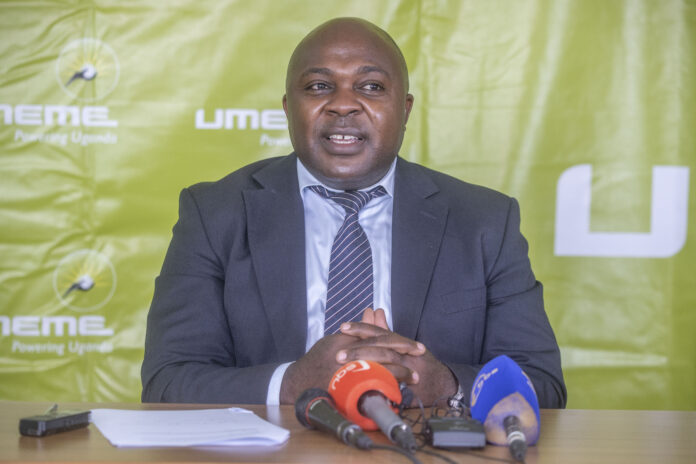
Umeme MD, Selestino Babungi.

Power distributor Umeme connected 125,000 new customers to the grid in the 11 months to November 2021.This represents a 54% growth in new connections from 57,000 recorded in the same period in 2020.

“Of the 125,000 connected customers, 53,000 were self-funded and the remaining 72,000 through the Government subsidised programme Electricity Connections Policy (ECP). However, we still have challenges financing the Electricity Connections Policy. We have about 217,000 pending connection applications, requiring a funding of Shs224 billion,” Mr Selestino Babungi, Umeme’s Managing Director, told reporters at the utility’s end-of-year press briefing.

He disclosed that the company was completing capital investment of Shs125 billion in different projects such as a concrete line from Tororo to Mbale, a new substation in Entebbe, converting the remaining 17,000 post-paid consumers to prepaid metering, feeder line refurbishments, network automation and among others.

“We believe that government will provide new funding to clear the current connections backlog. We look forward to building on the 2021 momentum and the anticipated opening of the economy to have more prospective growth in 2022. This is on the back of 10% growth in electricity demand registered in 2021, with industrial and commercial demand growing at 11% and 12% respectively,” he explained.

Mr Babungi said the Utility will expand the grid to evacuate power to consumers and connect more premises to the grid to increase demand.

It also plans to complete the conversion of the remaining post-paid consumers to prepaid metering, which will improve revenue collection to sustain the electricity sector.

To improve the resolution of technical faults, it will complete Geospatial Network Information System (GNIS) project that is under implementation to map customers’ premises as well as electricity installations to the distribution grid for the ease of pro-active location of network faults.

Mr Babungi said to achieve this, the utility would require regulatory support.

“Provide adequate resources for Umeme to deliver on its customer needs and expectations, mainly reliability of supply and pending connections in 2022. Provide for the full recovery of costs to recognise shareholders investments,” Mr Babungi requested.

Reducing energy losses from 17.5% remains a top priority of the business. Our strategy is focussed on simultaneously tackling technical and commercial losses.  Selestino, advised customers to desist from interfering with the network for their own safety and safety of the public. Customers should reach Umeme at the nearest service centre or through the digital channels.

To increase demand, Umeme continues to invest in synchronising its network to the transmission grid with the high load centres.

He welcomed the Electricity Regulatory Authority (ERA) and the Government initiatives to grow demand through the pilot Industrial Parks tariff, cooking tariff and declining block tariffs for domestic users.

The cooking tariff is meant to encourage domestic and public entity consumers to move away from using gas and charcoal to using electricity for cooking.

“Research has shown that using electronic equipment like electronic pressure cookers (EPC) saves time and cooking costs by half as compared to when using other sources of energy like charcoal.  We are working with the Regulator to see how we can ease ownership of appliances like cookers through appliance financing,” Mr Babungi added.

He said electricity demand underpins economic development and is fundamental in transforming the primary sector and driving the secondary and tertiary sectors of the economy.


Stories Continues after ad

US DIPLOMATS HACKING SCANDAL: The secret Uganda deal that has brought NSO to the brink of collapse

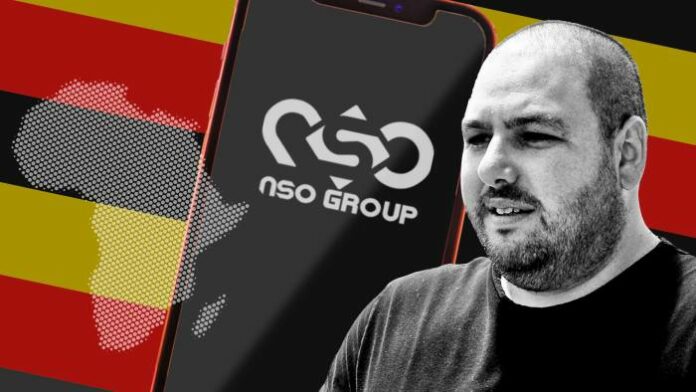
Chief executive Shalev Hulio of NSO travelled to Uganda to sell Pegasus. Shortly after these deals in east Africa, the US blacklisted the company © FT montage/Reuters


The Financial Times has reported that the Israeli spyware maker Pegasus is facing sanctions by the United States over its alleged hacking of phones for their Kampala Diplomats.

About two months ago, it emerged that phones of 10 US Diplomats at their Kampala mission got hacked by Pegasus.

Below is the full Financial Times story

In February 2019, an Israeli woman sat across from the son of Uganda’s president, and made an audacious pitch — would he want to secretly hack any phone in the world? Lt General Muhoozi Kainerugaba, in charge of his father’s security and a long-whispered successor to Yoweri Museveni, was keen, said two people familiar with the sales pitch. After all, the woman, who had ties to Israeli intelligence, was pitching him Pegasus, a piece of spyware so powerful that Middle East dictators and autocratic regimes had been paying tens of millions for it for years.

But for NSO, the Israeli company that created Pegasus, this dalliance into east Africa would prove to be the moment it crossed a red line, infuriating US diplomats and triggering a chain of events that would see it blacklisted by the commerce department, pursued by Apple, and driven to the verge of defaulting on its loans, according to interviews with US and Israeli officials, industry insiders and NSO employees. A few months after the initial approach, NSO’s chief executive, Shalev Hulio, landed in Uganda to seal the deal, according to two people familiar with NSO’s east Africa business. Hulio, who flew the world with the permission of the Israeli government to sell Pegasus, liked to demonstrate in real time how it could hack a brand new, boxed, iPhone. The eventual business was small for NSO.

A person familiar with the transaction said it brought in between $10m and $20m, a fraction of the $243m that Moody’s estimated the privately owned NSO made in revenues in 2020. But about two years after the sales pitch, someone deployed Pegasus to try to hack the phones of 11 American diplomats and employees of the US embassy in Uganda, according to two US officials, who spoke after notifications were sent out by Apple when the iPhone maker discovered and closed a flaw in its operating system in November. It is not clear who tried to hack the US citizens.

Uganda’s neighbour, Rwanda, had also been using Pegasus to hack phones inside Uganda, but the revelation shocked the US. NSO has always told its customers that US phone numbers are off-limits. In this case, all 11 targets were using Ugandan numbers, but had Apple logins using their state department emails, according to the two US officials. NSO said it shut down the hacking systems for “customers relevant to this case” and is investigating the issue. A person familiar with the company said it no longer has any business in Africa. The presidential press secretary for Museveni and the minister of information for the Ugandan government did not reply to a request for comment. A person close to Museveni said they “were not authorised to speak on the subject”.

Israeli and US officials declined to confirm that the Ugandan hack directly triggered a decision to blacklist NSO. But one US official who discussed the issue with Israel’s defence ministry said: “Look at the entire sequence of events here — this is careful, not by chance.” He added that putting NSO, one of the jewels of Israel’s tech community, on a US blacklist was designed to “punish and isolate” the company. The blacklisting, which came in November, means that NSO cannot buy any equipment, service or intellectual property from US-based companies without approval, crippling a company whose terminals ran on servers from Dell and Intel, routers from Cisco, and whose desktop computers run on Windows operating systems, according to a spec sheet from a sale to Ghana, in West Africa. In recent weeks, for instance, Intel asked all its employees to cease any ongoing business relationships with NSO, one person familiar with the matter said. Intel said in a statement that it “complies with all applicable US laws, including US export control regulations”.

A new CEO, Itzik Benbenisti, hired from Partner Communications, one of Israel’s largest telecom providers, quit two weeks into his new job after the blacklisting. And while the company tried to cheer up its employees with a Hannukah party in the beach resort of Eilat, Hulio — who retook the reins after Benbenisti stepped down — was less sanguine in a recent phone call with an old business associate. “We always knew this thing had an expiration date,” he told the friend, complaining that some clients had asked to shift their contracts to lesser-known rivals, according to a person familiar with the conversation. After spending a decade in the favour of the Israeli government, NSO now finds itself as an irritant in relations between Israel and the US, using up vital foreign “policy bandwidth we need to talk about Iran”, said a foreign ministry official who asked for anonymity.

That is a reversal for NSO, which former prime minister Benjamin Netanyahu used as a diplomatic calling card with several countries, including the UAE, Morocco, Bahrain and Saudi Arabia, which did not have official relations with Israel. The reputational damage has also made it difficult to keep hiring the most promising graduates of Israel’s elite signals intelligence units, who have the skills to repeatedly outwit the defences of both Android phones and iPhones. For example, when Google reverse-engineered the hack used against American diplomats in Uganda, they found an elegant, tiny piece of code that adapted software from 1990s Xerox machines to fit a so-called Turing machine — essentially a complete computer — into a single GIF file. “Pretty incredible, and at the same time, pretty terrifying,” said Google’s engineers. “Wow. Just wow,” tweeted Yaniv Erlich, an Israeli professor of computer science at Columbia University. “You can count on one hand the number of teams in the world that could create something like that,” said John Scott-Railton, a senior researcher at the University of Toronto’s Citizen Lab, which found the malware and brought it to Apple’s attention.

NSO said it had hired 30 new employees in recent weeks. “There is an understanding among our employees that there is a wide gap between media reports and the reality,” a spokesperson said. Meanwhile, NSO has also fallen into the crosshairs of Silicon Valley, after angering Apple and Meta by hacking into iPhones and WhatsApp. Apple’s two-pronged approach — it has notified many of the targets of NSO’s hacks, while suing the company in US courts — sent a “shockwave” through the industry, said a person familiar with the matter. Apple and Citizen Lab have also shared NSO’s technical secrets, worrying rival companies enough to ask their clients to dial down the use of other spyware, scared of getting caught in Apple’s dragnet, said a former senior executive at an Israeli tech group. “There is a sense that this is a full-on war against the entire industry,” he said, adding that high-level Israeli employees of NSO and other similar firms are “staying put” in Israel to avoid being pulled in for questioning in the US and its allies.

But Liron Bruck, NSO’s spokesperson, said she had personally visited the US twice in recent weeks with other senior executives and that NSO’s travel plans remain “unchanged”. For now, the US pressure had left NSO with few options, said company insiders. Moody’s has downgraded NSO’s debt as the company’s free cash flow turned negative in 2020 and is expected to remain negative this year. “There’s a high risk NSO might not be in compliance” with a covenant on the $500m in loans it took in 2019 to go private at a $1bn valuation, said Moody’s.

It has hired Moelis & Co, a NY-based investment bank to see if it can sell off parts of the company to raise cash, even offering to change Pegasus into a “defensive” product if that makes it more palatable to US investors. Last Wednesday, that window also narrowed — 18 US senators wrote to secretary of state Antony Blinken and Treasury secretary Janet Yellen to sanction NSO under the Magnitsky Act, alongside a handful of other cyber surveillance firms. If the US acts upon that request, NSO would be cut off from the US banking system and its employees would be barred from travelling to the US.

Stories Continues after ad

Uganda, DR Congo Speakers root for Regional Cooperation

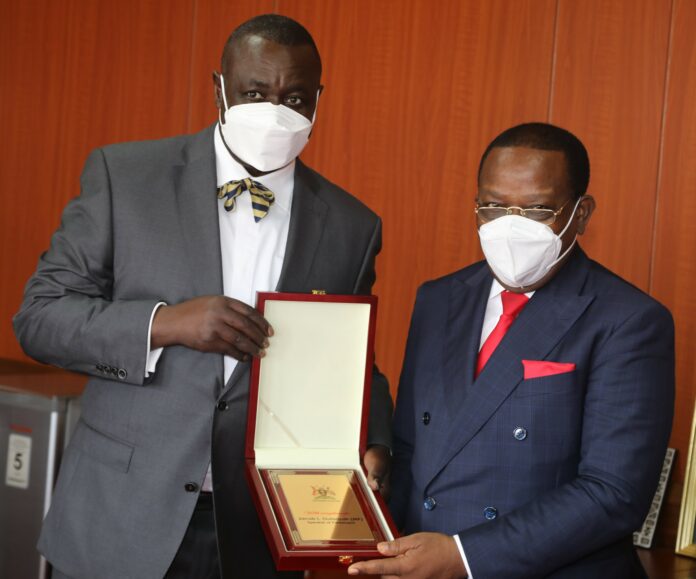
Oulanyah hands over souvenirs to Bahati Modeste Lukwebo the President of the DRC Senate

The Speaker of Parliament, Jacob Oulanyah and the President of the Senate of the DR Congo, H.E. Modeste Bahati Lukwebo have agreed to foster bilateral relations that better the lives of their people.

In their meeting on Tuesday, 21 December 2021 at Parliament House, Oulanyah and Lukwebo rooted for regional federation to ease market accessibility of goods and services if the two neighbouring countries are to attain regional economic transformation.

“Regional cooperation is of essence to build a strong business setting and this kind of engagement consolidates the relationship between the two countries and businessmen. It is us, the leaders who are supposed to help our people to break the economic barriers,” Oulanyah said.

The Speaker welcomed his esteemed counterpart to Uganda and remained optimistic that such bilateral engagements will help break the chains and barriers that curtail trade and commerce between DR Congo and Uganda.

Oulanyah also requested that the two countries exchange delegations to facilitate wisdom and experience sharing.

H.E. Lukwebo, who arrived in the country on Sunday for a three-day state visit, thanked Uganda for the hospitality extended to DR Congo in order to boost regional trade and security.

“Ugandans and Congolese are the same people; we are brothers and sisters because we share names, culture and even the language. Therefore, we must be each other’s market,” Lukwebo said.

Uganda’s Prime Minister, Robinah Nabbanja, thanked the DR Congo government for the support and collaboration aimed at building regional market and security.

Businessman Odrek Rwabwogo, who represented the Private Sector Foundation in Uganda, lauded the two governments for striving hard to create a favourable environment to facilitate trade and industry.

Uganda and the DR Congo enjoy excellent and cordial bilateral relations, reflecting a history of close political, economic and socio-cultural ties and common mutual interests pursued under the Joint Permanent Commission established in 1986 as a framework for bilateral cooperation.

Stories Continues after ad
Micho names Uganda Cranes squad for UAE trip

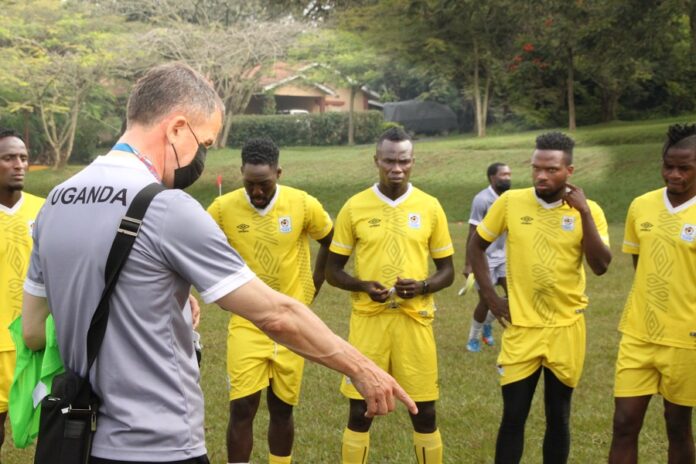
Micho during training

Uganda Cranes head coach Milutin ‘Micho’ Sredojevic has summoned 21 players for the upcoming trip to the United Arab Emirates where the team will have two high profile international build up matches.

The squad is a blend of the players from the StarTimes Uganda Premier League and the foreign based legion.

Two South African based players; goalkeeper Isma Watenga and Moses Waiswa are part of the team.

Uganda Cranes will play two AFCON bound teams Gabon and Mauritania.

The first game will be against Gabon on 30th December 2021 and the second game against Mauritania shall come on 1st January 2022. All matches will be played in Abu Dhabi.

The team departs the country on 29th December 2021 and shall return on 2nd January 2022.

“We are assembling the Uganda Cranes team that will competitive get engaged in several upcoming engagements as the AFCON 2023 and CHAN 2022 qualifiers. Such international build up matches are a perfect measure for early preparations,” Micho revealed.

The summoned team:

Goalkeepers: Watenga Isma (Chippa United), Mutakubwa Joel (Express), Komakech Jack (Vipers)

Defenders: Kizito Gavin (Villa), Iguma Denis (KCCA), Kayondo Aziz (Vipers), Juma Ibrahim (KCCA), Lwaliwa Khalid (Vipers), Najib Fesali (URA), Walusimbi Enock (Express), Semakula Keneth (SC Villa)

Midfielders: Byaruhanga Bobosi (Vipers), Kakooza Mahad (Express), Waiswa Moses (Supersport United), Kizza Martin (Express)

Forwards: Kaddu Patrick (unattached), Sentamu Yunus (Vipers), Orit Ibrahim (Vipers), Mutyaba Travis (SC Villa), Mukwala Steven (URA), Mohamed Shaban (Onduparaka)


International Build Up Games:

Gabon Vs Uganda Cranes – 30th December 2021

Mauritania Vs Uganda Cranes – 1st January 2022.

Stories Continues after ad

Government presents Budget Framework Paper

Ministers David Bahati and Justine Kasule Lumumba consulting with LOP Mathias Mpuuga after Parliament received the NBFP

The National Budget Framework Paper (NBFP) for Financial Year 2022/23 has been presented before Parliament.

The NBFP presented by the Minister of State for Finance, Planning and Economic Development (Planning), Hon Henry Musasizi, in line with the Public Finance Management Act at the last Parliament sitting for the year on Tuesday, 21 December 2021.

The Leader of the Opposition in Parliament, Hon Mathias Mpuuga, had earlier raised a procedural concern in regard to the minister presenting the NBFP.

Section 9 (3) and (5) of the law requires the Minister of Finance, Planning and Economic Development to prepare a National Budget Framework Paper and, upon approval by Cabinet, submit it to Parliament by 31st December.

The NBFP and the medium-term lays out planned interventions for enhancing Uganda’s economic growth, consistent with government’s Macroeconomic objectives.

The Speaker of Parliament, Jacob Oulanyah, prior to adjourning the House sine die, directed the Committee of Finance to scrutinise the NBFP when Parliament returns from its Christmas recess in January 2022.

Stories Continues after ad

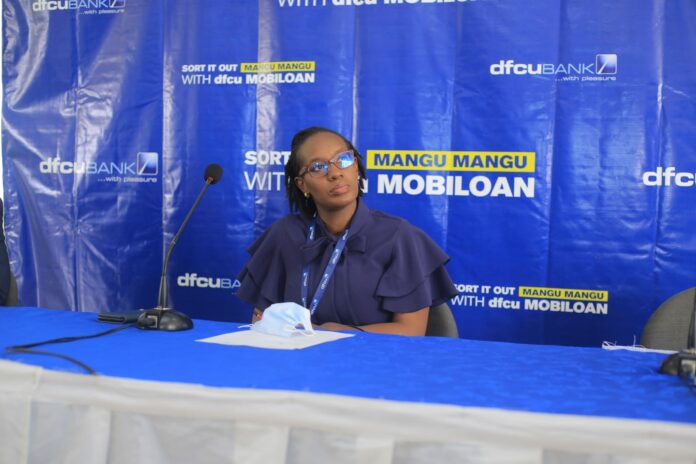
Dfcu Bank launches automated loan solution for its customers

The Head of Personal Banking, Miranda Bageine Musoke

dfcu Bank has launched an automated loan solution available to individual customers via the Bank’s online Banking Platform. The instant loan can be accessed using the Bank’s mobile app (Quick App), internet banking or USSD in less than five minutes.

The dfcu Mobi Loan is among several digital products and solutions that have recently been introduced under the Bank’s umbrella campaign dubbed ‘Banking at the Speed of U!”; to provide value and enhance customers’ experience.

Under the automated loan solution, customers can get a minimum loan amount of Shs 10,000 and a maximum of Shs 2,000,000. The acquired loans can be paid in a period of 30 days. All loans can acquired with 9% interest rate.

The system is designed with one off repayment once the loan is due. It also comes with an option of early repayment with no penalties.

The Head of Personal Banking, Miranda Bageine Musoke, said dfcu Mobi Loan is in line with the Bank’s strategic pillar of developing winning customer value propositions through digitisation.

“With the dfcu Mobi Loan, we have harnessed the power of technology to deliver our services and products more efficiently to our customers. The Mobi Loan provides fast, dependable, and safe loans to individuals who do not have the luxury of time with respect to solving urgent matters,” Miranda said.

“We have stripped away a large chunk of the processes required in the usual mode of accessing of loans and created a seamless experience which we are confident, will be of great benefit to our customers, countrywide. As we head into the festive season and prepare for the reopening of schools early next year, it is important to us that our customers can rely on the dfcu Mobi Loan to take care of their urgent needs, at anyplace and at any time,” Miranda concluded.

With the Mobi loan product, dfcu Bank customers and eventually, non- customers will be able to access instant loans from as low as Shs 10,000 using their mobile phones.

The dfcu Mobi Loan is a short-term facility that helps customers to bring a temporary financial gap for emergencies that just can’t wait.

Stories Continues after ad

CNOOC Uganda awards drivers in Heavy Goods Vehicle driving

CNOOC Uganda Limited, an oil and gas company has awarded certificates to drivers in Heavy Goods Vehicle (HGV) driving undertaken since October 2021. The drivers who were trained, certified and licensed can now professionally drive Heavy Goods trucks and trailers (class CH License) or rigid trucks (class CM license) and have been trained in accordance with the East African community curriculum.

The training was undertaken by Uganda Driving Standards Agency on behalf of CNOOC to meet the skills gaps in the logistics and transportation competencies especially in the oil and gas sector in Uganda.

Transportation is among the goods and services to be provided by Ugandan companies, Ugandan citizens and Registered entities as detailed in the Petroleum (Exploration, Development and Production) (National Content) Regulations, 2016. We have always put safety at the forefront of our business and that is why it is important to train these drivers who shall work with us or our contractors especially during the development stage.

Aminah Bukenya, Media and Publicity Manager said that, “the three months training has enabled the drivers to explore and acquire more expertise in Heavy Goods vehicles Driving and Road Safety which is well in line with the national content promotion guidelines”.

“We are happy with this initiative, we are thankful to CNOOC Uganda Limited who have trained us in Heavy Goods Vehicle driving. I feel like I am a blessed lady who can drive any big truck without any fear”,” said Irene Businge one of the beneficiaries.

This selection of trainees in this particular cohort was undertaken in partnership with Bunyoro Kitara Kingdom that supported the identification and selection of trainees from 6 districts of Kikuube, Hoima, Masindi, Buliisa and greater Kibaale together with the implementing service provider Uganda Driving Standards Agency (UDSA). The partnership with the Bunyoro Kitara Kingdom was aimed at Host Community content enhancement for potential beneficiaries from the Bunyoro Sub-Region that hosts the Kingfisher Project.

In the interest of ensuring that the training maintains national social distancing and the Training Standard Operating Procedures to prevent COVID-9, the program maintained 4 trainees per instructor per day and only 1 trainee in a truck during practical sessions. This arrangement enabled the student to have ample time with their respective instructors during the training.

Andrew Byakutuga Ateenyi, the Prime Minister of Bunyoro Kitara Kingdom stated that “We are grateful for the partnership between CNOOC Uganda Limited and Bunyoro Kitara Kingdom and we look forward to more opportunities of working together. We want our people to be skilled enough so that we can gain from the oil and gas resource”.

Ronald Nkata, the Chief instructor of the trained students stated that “This three (3) months program has provided an interactive forum for us to share, explore and discuss concepts and issues of HGV driving and Road Safety with our trainees. “

In addition, this year CNOOC Uganda limited has sponsored the training and Certification of 120 Welders in 2G,3G,4G, 5G and 6G Coded welding to AWS international standards, 84 Teachers in the Train the Trainer program that included 5 certified programs for teachers from UPIK and UTC Kichwamba, 150 SMEs in the Enterprise development program, the Engineering Construction Industry Training Board (ECITB) training and certification of 60 participants that provided the engineering construction industry workforce the skills it needs to meet the challenges of the future enabling development and qualification in a wide range of craft, technical and professional disciplines.

  1. As an energy company with a strong sense of social responsibility, CNOOC Uganda Limited is committed to National Content promotion to enable Ugandans to tap into the opportunities in the oil and gas sector. CNOOC Uganda Limited along with its key JV partners have been involved in long term planning and strategies to ensure the first oil by 2025. We are close to the finish line and we hope that we can work together to attain this dream.
Stories Continues after ad