Stanbic Bank
Stanbic Bank
24.7 C
Kampala
Stanbic Bank
Stanbic Bank
Home Blog Page 733

EC starts National Voters’ Register display exercise ahead of Local Gov’t Councils by-elections

voters

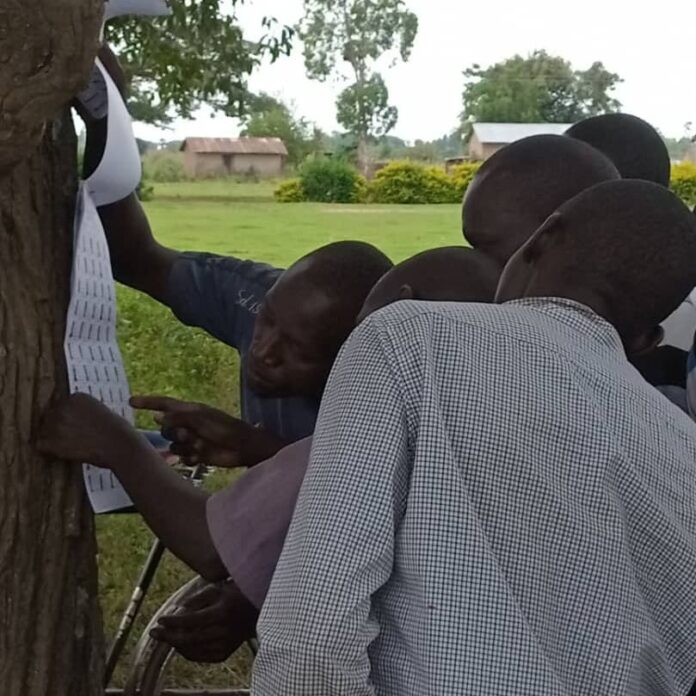
The Electoral Commission has started displaying of Voters’ Register at Polling Stations where Local Government Councils by-elections are scheduled to take place and issuance of Voter Location Slips by Parish Supervisors.

The exercise across 831 polling stations in 127 districts will end on Wednesday 17th November 2021.

Voters in the affected electoral areas have been urged to visit their respective Polling Station to check for the correctness of their particulars on the Voters’ Register, and confirm that the photograph appears against correct particulars on the Register.

EC will conduct by-elections for Local Government Councils, including Special Interest Groups (SIGs) in electoral areas across the country, where vacancies exist.

The categories to be filled during these by-elections include: District Chairperson (Kayunga District), District Women Councilors (DWC), District Directly Elected Councilors (DDEC), Municipality Directly Elected Councilors (MDEC), Municipality Women Councilors (MWC), Sub-county Chairpersons (SCCP), Sub-county Directly Elected Councilors (SCDEC) and Sub-County Women Councilors (SCWEC).

The Special Interest Groups (SIGs) Councilors include: People with Disabilities (PWDs), Older Persons, Workers and Youth.

The nomination of candidates will be conducted on 29th and S 30th November 2021 at the respective district headquarters.

Candidates’ campaign meetings will be conducted for a period of thirteen (13) days, that is, from Thursday 2nd to 14th December 2021.

Polling and tallying of results for elections of Councillors representing Special Interest Groups (SIGs) shall take place on Wednesday 15th December 2021.

Meanwhile polling for the District Chairperson, Kayunga, and other Local Government Councils shall take place on Thursday 16th December 2021, at all polling stations in the affected electoral areas.

Justice Byabakama Mugenyi Simon, the Chairperson of the Electoral Commission called upon all stakeholders in the affected electoral areas to participate in the activities in accordance with the guidelines for the by-elections.

Stories Continues after ad

Violent suspect shot dead by Police during scuffle

Police in Mayuge shot and killed a suspected boat engine thief. The incident arose from a case of aggravated robbery, of a boat engine that belonged to Agodo Zakaria Osako which occurred on the 17th July 2021, at Nduwa Landing Site, in Mayuge district.

The engine was robbed from two office workers by three men, armed with pangas. As a result, a search was conducted till the 6th November 2021 when marine officers recovered the engine from a one Baligeya in Dolwe Island in Namayingo district. The suspect revealed that Kapere Maka Umar was the one who sold it to him.

The OC police post in Musubi Landing Site was alerted, and on the 7th November 2021 at around 9:25am, two police officers attached to Musubi Police Post, at Musubi Landing Site, Muyanzi village, Bukaboli Sub-county in Mayuge district, went out to trace for the suspect.  The two officers included; CPL Wandyete Patrick, the OC post and PC Kataba Abubakar.

They arrested the suspect identified as Kapere Maka Umar, a 32-year-old fisherman connected to the theft of the boat engine.  In the process of cuffing him, they faced resistance, after the suspect turned violent and pounced on the police gun.  A physical altercation ensued and the officer was wrestled to the ground. His brother called Kapere Bampalana, also attacked PC Kataba and tried to disarm him as well.

Police spokesperson Fred Enanga said during the scuffle, CPL Wandyete fired several bullets, injuring the leg of the suspect. In the process he also injured both his legs, the hand and of the complainant Osako, and the brother to the main suspect too.

Unfortunately, the suspect Kapere Maka Umar, succumbed to the injuries at the scene. The other victims were rushed to Kigandalo Health Centre IV. However, Kapere was transferred to Jinja Main Hospital in critical condition, while the OC Post was rushed to Buluba Hospital for further treatment.

Stories Continues after ad

UMEME loses Shs24b annually through vandalism in Jinja

Umeme employees

The Jinja City Resident City Commissioner (RCC) Musoke Kyeyune has urged security agencies to act swiftly against vandals who are disrupting economic activity through vandalism of electricity infrastructure in the industrial city.

Addressing security officers in the region over the weekend, Kyeyune said the vice was causing a major shock to business and scaring away potential investors from Jinja and surrounding areas since power theft causes reliability issues.

“Jinja City, Jinja District and Njeru Municipality are home to the biggest number of industries in the country but the region has been hit hardest by anti-development agents who are stealing public infrastructure especially electricity lines. They are standing in the way of progress. For us to succeed, we need to be a team and work together to avoid the pitfalls such as the one that happened in Namulesa which could have been avoided,” he said.

Adding, “I am here to sound my support to energy sector players to ensure that we protect these important assets. I hate power theft and I will work with Umeme to make sure it’s curtailed.”

Umeme’s Chief Operations Officer, Florence Nsubuga, while addressing the meeting said they had taken a deliberate to engage with stakeholders across the Country to share about the dangers of power theft and vandalism of the electricity network which is taking some innocent lives and regression of development.

“Vandalism is a huge cost to this Nation. Besides causing network challenges and costing money, we are losing innocent lives. The public should protect these investments because they exist to serve them. We have also deployed technology to bring us closer to the customers through our 24 hour call centre, and the Umeme App where our customers can access all our services. In case of these vandals, please contact us or the Police,” she said.

Adding, “Power theft coupled with COVID and lack of money for free connections has seen an increase in people connecting themselves illegally.”

Umeme’s Rose Oyella, the Head of Regional Operations Kampala East which includes Jinja and Njeru said some of the key issues they discussed with the political chiefs was aggravated power loss and vandalism of Umeme’s infrastructure.

She said they will continue with these engagements with other key stakeholders to educate the masses on how they can connect on to the grid.

Jinja district serves 43,211 customers billing over Shs 1.5 Billion monthly. Of these 789 are commercial customers among which are 226 industries collectively billing Shs 11.3 Billion monthly. Jinja contributes 10 per cent of Umeme’s annual revenues and the region is of strategic importance to the country because of its industries.

Oyella said Jinja is served by three sub stations in Owen Falls Dam, Njeru and Jinja Industrial. However, the region is also one of the highest when it comes to energy losses which stand at 12.2 per cent.

“These losses translate into Shs 2 Billion monthly, Shs 24 Billion annually. This is because we are losing power to power theft and vandalism which affects the network stability,” she said.

Stories Continues after ad

CAA clarifies on the misrepresentations made by COSASE on Arua Airfield

COSASE members at Arua Airfield

The Uganda Civil Aviation Authority (CAA) has clarified on the misrepresentations made on some of the findings by the Parliamentary Committee on Commission Statutory Authorities and State Enterprises (COSASE) when the Committee members visited Arua Airfield in Arua last week.

According to the COSASE chairman, Joel Ssenyonyi, he said that the committee found out that Shs687 million was spent on a wire fence. Also, several baggage trolleys and seats were bought and the seats were interlocked; each single seat before interlocking cost Shs2.4m and each trolley Shs2.4m as well.

CAA said in a statement; “In reference to the cost for the on-going construction of a perimeter fence around Aura Airfield at Shs687,928,079 by M/s Lodina Investment Limited, it is important to note that the contract was awarded through a competitive open domestic bidding process in line with the Public Procurement and Disposal of Assets (PPDA) Act.”

“The perimeter fence is a chain-link mounted on concrete poles (with long service life in mind), and will cover a total length of approximately seven (7) kilometers around the airfield, on completion. The contract price also included relocation of a community access road and demolishing structures from the land recently acquired from the community.”

According to CAA, given the magnitude of the task, previous Engineering estimates had projected the cost to be in the range of 750 million shillings, but following the competitive process that the procurement was subjected to, the best evaluated bidder was at 687.9 million shillings only. The cost is very competitive and not exorbitant as may have been insinuated in certain circles.

“It is also important for the public to note that the perimeter fence for Arua Airfield is a chain link (not wall fence), just like that of Entebbe International Airport. The chain-link fence is preferred for safety reasons so that in case of an aircraft accident in the course of landing or take-off, the damage to the aircraft is reduced from what the case would be in case of crashing into a wall fence. This is a safety consideration.”

The other issue misrepresented in the public domain was the procurement of Airport Terminal lounge seats and baggage trolleys supplied for use at Arua Airport by M/s Eclipse/Edilsoil J.V.C Ltd, an authorized local partner of M/s KUSCH+Co GmbH, an internationally recognized Germany manufacturer of Airport furniture. The supply was for 60 lounge seats configured into 4-seater and 5-seater configuration plus 40 baggage trolleys at a cost of Uganda Shillings 243,386,680.

CAA says contrary to the wrong impression created that each lounge seat and trolley cost Shs2,400,000, the total cost of the project covered Travel Luggage Trolleys (40), 4-seater Bench Airport seats (5 units totaling 20 seats), 5-seater Bench Airport Seats (8 units totaling 40 seats), back-to-back connection bars, shipping, delivery and tax incidentals, among others. For the record, and in specific terms, each travel trolley cost Shs1.7 million, each of the lounge chairs in the 4-seater configuration cost Shs1.6 million and the chairs in the 5-seater configuration each cost Shs1.4 million.

“The procurement of the items went through an Open competitive bidding process and M/s Eclipse/Edilsoil J.V.C. Ltd emerged as the best evaluated bidder for delivery of the quality products that are expected to stand the test of time, with a life-span of over 20 years backed with a 10-year warranty. In case any of the items breaks before the warranty date elapses, the manufacturer is supposed to replace it.”

“Many airports procure such durable and high-quality furniture to be used for more than 15 years. It is not prudent to buy seats that would require replacement in a few months. The decision to procure this type is informed by high quality, durability and the need for standardization in order to have similar seats to those used by other international airports. The market survey had an estimate of Euros 48,425 (about Uganda Shillings 208,227,500), exclusive of taxes,” the statement read.

CAA further says some local companies competed in the bid, but did not meet the high product standard specifications, which are commensurate with similar products used at other airports in the world.

“In relation to the trolleys, for instance, they have an automated and effective breaking mechanism with self-adjustment, which enables a loaded trolley to stop as soon as the handler releases the handle, even when on a slope, among other advanced features. Such a trolley certainly does not cost the same as a basic one on the local market, let alone the materials from which it is made,” the authority said.

Stories Continues after ad

Entebbe Airport passenger traffic hits 2021’s all-time high in October

Entebbe-International-Airport

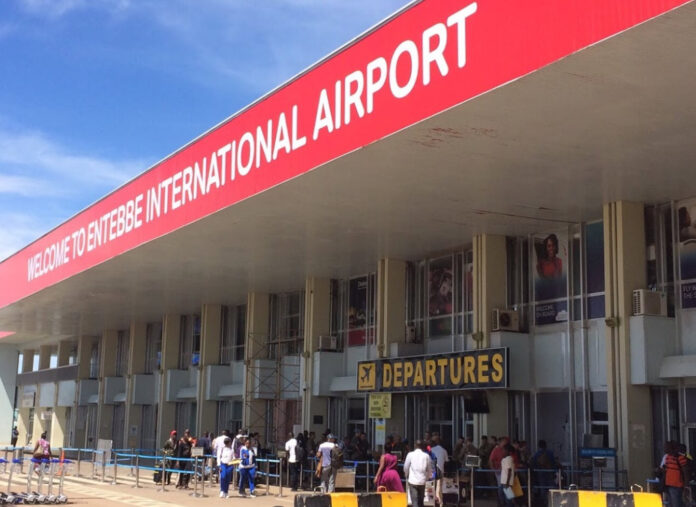
Entebbe International Airport recorded 100,455 international passengers in October 2021 (45,799 arrivals and 54,656 departures), an average of 3,240 passengers per day. This is the biggest number of passengers recorded at the airport in a month since resumption of commercial passenger operations in October 2020.

The airport recorded 79,192 passengers in September (36,971 arrivals and 42,221 departures), 71,360 passengers in August (33,941 arrivals and 37,419 departures), 52,731 in July (23,594 arrivals and 29.137 departures), 69,346 in June (29,209 arrivals and 40,137 departures), 71,307 in May (35,012 arrivals and 36,295 departures), 80,785 in April (35163 arrivals and 45,622 departures), 71,904 in March, 57,988 in February and 53,504 in January 2021. The figures exclude transit passengers.

The surge in traffic in October is attributed to a number of factors, including enhanced vaccination across the globe, commencement of flights in and out of Entebbe by new operators such as Airlink to South Africa and Air Arabia to Sharjah, commencement of Uganda Airlines flights to Dubai, removal of Uganda from the UK red list in early October and easing of travel restrictions on Ugandans to Dubai, among others.

In spite of the increased passenger traffic, the average of 3,240 passengers per day in October 2021 is still far below the average of about 5,000 passengers per day in 2019 before the advent of the COVID-19 pandemic.

On the side of cargo, the airport recorded 5,371 metric tonnes of cargo in October 2021 (2,243 imports and 3,128 exports).

Stories Continues after ad

Uganda receives more 3.4 million doses of Pfizer from US gov’t

The United States (US) has delivered a total of 3,488,940 doses of the Pfizer Covid-19 vaccine to Uganda. Combined with previous donations, the US has now provided more than 5.8 million Covid-19 vaccine doses to Uganda. Uganda has so far received over 10 million doses of Covid-19 and over 6 million doses have been rolled out.

Globally, there have been 248,467,363 confirmed cases of COVID-19, including 5,027,183 deaths, reported to WHO. As of 4 November 2021, a total of 7,027,377,238 vaccine doses have been administered. Uganda has 126407 confirmed cases of Covid-19 including 3223 deaths.

“These recently delivered 3.5 million Pfizer COVID-19 vaccine doses represent the largest ever donation of COVID-19 vaccines to Uganda and the third donation of COVID-19 vaccines from the people of the United States to the people of Uganda,” U.S. Ambassador to Uganda Natalie E. Brown said.

“This donation underscores the United States’ commitment to support Uganda’s COVID-19 response and protect the health of the Ugandan people. Ugandans can count on the United States to support their efforts to fight the pandemic and get their economy back on track,” Ambassador Brown further noted.

In addition to vaccine donations, the United States has provided further assistance valued at more than $113 million to support Uganda’s COVID-19 response. In support of Uganda’s national vaccine rollout, the United States has provided technical and financial support in data management, risk communication, health worker training, human resources support, supply chain strengthening, and cold storage capacity enabling vaccine uptake across Uganda.

The United States has also provided life-saving commodities including oxygen delivery equipment such as cylinders, regulators, and other intensive care unit (ICU) equipment; personal protective equipment (PPE); and supplies for infection prevention and control.

To date, the United States has donated more than 225 million COVID-19 vaccine doses to over 100 countries around the world. The United States is committed to sharing 1.1 billion vaccine doses where they are needed most to end this global pandemic.

Stories Continues after ad

#Covid-19, lack of funds hinder implementation of health and climate strategies in many countries – WHO

WHO

Countries have begun to prioritize health in their efforts to protect people from the impact of climate change, but only about a quarter of those recently surveyed by the World Health Organization have been able to fully implement their national health and climate change plans or strategies. Countries report that a lack of funding; the impact of COVID-19; and insufficient human resource capacity are major barriers to progress.

The 2021 WHO health and climate change global survey report finds, however, that over three quarters of surveyed countries have developed or are currently developing national health and climate change plans or strategies.

Some 85% of countries now have a designated focal point responsible for health and climate change in their ministries of health, while in 54% of countries, the ministry of health has established a stakeholder mechanism (such as a task force or committee) on health and climate change.

About two-thirds of surveyed countries have conducted a climate change and health vulnerability and adaptation assessment or are currently undertaking one, while virtually all (94%) countries incorporate health considerations in their nationally determined contributions (NDCs) to the Paris Agreement.

“The new WHO survey highlights how many countries are left unsupported and unprepared to deal with the health impacts of climate change. We are here at COP 26 to urge the world to better support countries in need, and to ensure that together we do a better job of protecting people from the biggest threat to human health we face today,” said Dr Maria Neira, WHO Director of Environment, Climate Change and Health.

Countries’ inability to protect health from climate change is most harmful for their most disadvantaged groups, including ethnic minorities, poor communities, migrants and displaced people, older people and many women and children.

“The health arguments for increased climate action are very clear. For example, almost 80% of deaths caused by air pollution could be avoided if current air pollution levels were reduced to the WHO Air Quality guidelines,” said Dr Neira.

The WHO survey finds that insufficient finance continues to be the top stumbling block to fully implementing national health and climate change plans, cited by 70% of countries (up from 56% in 2019). Human resource constraints are the second biggest barrier, whilst about one third of countries identified a lack of intersectoral collaboration as a key barrier.

About half of the countries report that the COVID-19 emergency has slowed progress on addressing climate change by diverting health personnel and resources, and continues to threaten national health authorities’ abilities to plan and prepare for climate-related health stresses and shocks.

The report also notes a potential missed opportunity to identify and optimize the health benefits of adaptation and mitigation efforts in other sectors, which could have fed into a clean, healthy recovery from COVID-19: structural and social determinants of health, such as education, equity, gender, urban planning, housing, energy and transportation systems was represented in fewer than half of the established multisectoral mechanisms.

The first report in this series was released in 2019. This second report provides a valuable snapshot of the overall progress governments have made in addressing the health risks of climate change.

““The challenge now is to remove the barriers that are preventing countries from finalizing and implementing plans,” said Tara Neville, Technical Officer at the WHO Department of Environment, Climate Change and Health and lead author of the survey report.

Stories Continues after ad

Marriage bridges unity, says Speaker Oulanyah as Amb. Masolo gives away daughter

Parliament Speaker join Amb. Masolo and his wife Donnah on the floor as they dance to the beats of Gisu lyrics.


The Speaker of Parliament Jacob Oulanyah has said marriage is a good avenue for bridging unity in the country as it brings together people of different backgrounds.

He said love isn’t imposed but it is an inner feeling of those in love, family, relatives and friends and therefore, it brings people of different backgrounds together.

“I am a promise keeper and believe that human connectivity should be built on trust, love sharing that under normal circumstances is the basis for which we attend functions and engage in joy as we celebrate. I have tried to be a promise keeper and believe this line is good for all of us” Speaker Oulanyah said.

Speaker Oulanyah was the Chief Guest at the giveaway ceremony of Ambassador Robert Masolo’s daughter, Lisa Masolo,that was held at their country home at Kyampisi village, Kakooge Sub County, Nakasongola District, on Saturday  November 6, 2021. Ambassador Masolo works with Ministry of Foreign Affairs, handling Great Lakes Region issues. Amb. Masolo is also the former Director General of External Security Organisation (ESO).

Among other dignitaries who graced the occasion was Foreign Affairs State Minister, Hon. Henry Okello Oryem; the Mufti of Uganda, Sheikh Shaban Ramathan Mubajje; Kenya Defense Forces General Michael Gichangi and UPDF Maj. Gen. Leon Kasura-Kyomukama, who is also Permanent Secretary Ministry of Agriculture.

The function was also attended by, among others, the NRM Treasurer and wife to Ambassador Masolo’s cousin, Haji Sulaiman Mafabi Lumolo; the wife of Rt. Hon. Amama Mbabazi, former Prime Minister, Madam Jacqueline Mbabazi, who relayed her husband’s apologies for not attending, due to other engagements; Members of Parliament, Irene Muloni; Nandala Mafabi; Seth Wambede. Judges Vincent Wagona Fort Portal resident judge, Lawrence Gidudu, the head of Anti-Corruption Court, city advocate Joseph Matsiko, Amb. Francis Butagira, Amb. Angelina Wapakhabulo and city businessman Hamis Kiggundu popularly known as Ham.

 

Also, in attendance was one of the candidates for the cultural leadership of the Bagisu, Mr. Jude Mudoma. The Retired Bishop of Mbale Diocese, Samwiri Wabulakha and Pastor Aloysius Bugingo prayed for the function.

Ambassador Masolo’s daughter is to be married in a Church ceremony this weekend to the son of one of the key business leaders in former Kabale district (now Rubanda District), Mzee Remigio Kataratambi. Some of Mzee Kataratambi’s children were brought up in the home of former Prime Minister, Dr. Ruhakana Rugunda.

The Kabale group was led by former Rubanda West legislator Henry Banyenzaki, other prominent people included Makerere University Vice Chancellor Prof. Barnabas Nawangwe, businessman Ponsiano Ngabirano of Capital Shoppers, Olive Kigongo of Uganda National Chamber of Commerce boss, Jolly Sabune of Cotton Development Authority, former minister Mary Karooro Okurut, Prince Crispin Junju and NTV General Manager Johnson Omollo.
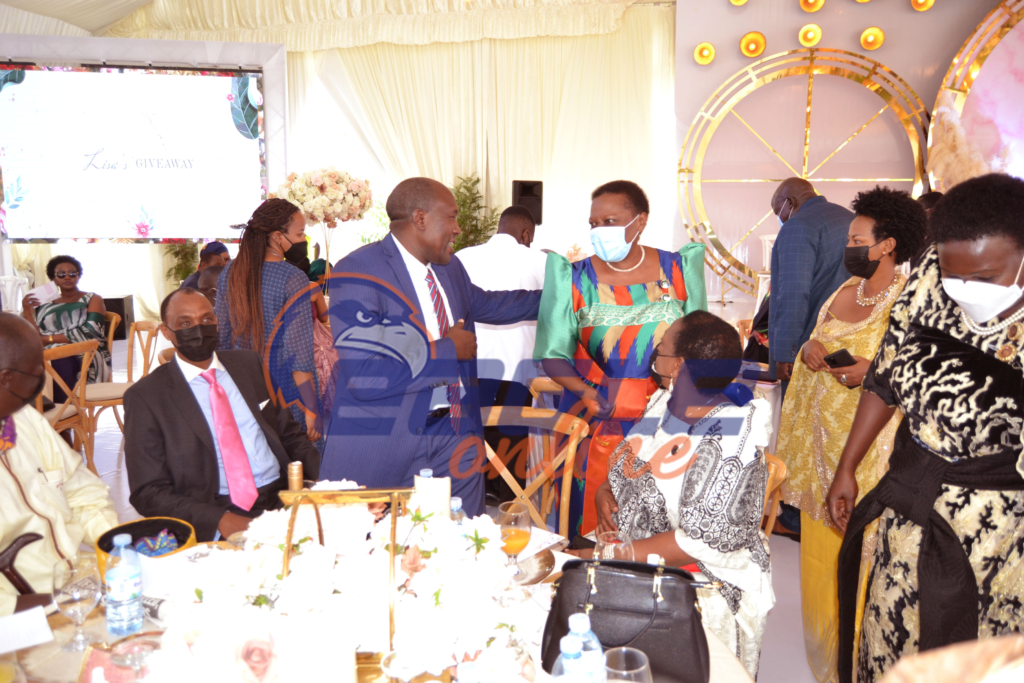
“Ambassador Masolo has brought us together not as strangers but for good reason. We are now a family and this is one point when we reflect on the good the Lord has been on our side by enabling us to have the type of friends gathered here. We have friends from the Diaspora, Kenya and our own purposely attending the Masolo family giveaway of their dear daughter. I view such ceremonies as a payback for the good connectivity, trust and love the Masolo family has built over a period” he said.

Earlier the State Minister for Foreign Affairs, Henry Okello Oryem rallied Ugandans to embrace the spirit of unity and live a life that benefits others. It is useless to live by yourself and want others to be on your side at particular times. I also believe that all the guests here have an attachment to the family of Ambassador Masolo from the different engagements both in private life and the Civil Service as a good servant and man of trust. He thanked Ambassador Masolo for his involvement in returning him from exile.

Ms Jackeline Mbabazi spoke about love and the essence of marriage as an institution and gave encouragement to the new couple, saying that many people talk about marriage being full of challenges but that the truth is about trust and identifying your own rules as a couple, adding that for her and her husband, they have been married for 48 years and are growing stronger every year.

The highlight of the function was when Lisa Masolo’s mother, Donnah Masolo, gave a very powerful and moving speech, which was crowned by Ambassador Masolo singing for his daughter a 1981 song by the ABBAS called “Slipping Through My Fingers”, attracting cheers and tears from many guests.


Stories Continues after ad

Heifer International donates tractor to Dokolo youth, farmer groups

Y


Dokolo-Youths farmer groups in Dokolo district Lango sub region have received Agri equipment farm tools worth Shs200 million to boost their owned agribusinesses and overcome the economic hardship of #Covid-19 from Heifer International Uganda.

Dokolo Young Oil seed farmer’s cooperative society Limited and Kwera Young Oil seeds farmer’s society Limited were the beneficiaries of the support after they were previously developed by Heifer Uganda since 2019 to stimulate youth employment in agricultural sector within the district.

The equipments include a tractor, TAFE brand (complete with a disc plough and trailer), and two tricycles, maize shellers, heavy duty weighing scales and grain moisture meters to improve on the annual agricultural production and productivity from the current 300MTs of oil seeds to 1,000 MT with growth in membership and production acreage in the next three years.

The tractor will improve on the transportation of products from the satellite stores to the central bulking center in Dokolo town council, the tricycles will support the hubs in grain aggregation from the hard-to reach households to the satellite bulking stores.

Rashid Acuma, the chairperson Dokolo young oil seed cooperative disclosed that the tractor they received will help them in improving their production since they were using hand hoes which were not efficient.

According to Musa Aluka the manager young oil seed cooperative, the equipments is a big boost to their livelihoods because they used to plant seeds late due to lack of mechanization hence low production.

Issa Ainamagara, the project manager learn for agribusiness is optimistic that the equipments fully procured, the youths will increase their productivity and household incomes

Speaking at the handover of the equipments at Dokolo district headquarter, Anna Odongo the Resident District Commissioner Dokolo reiterated government’s commitment towards improving livelihoods of young people through direct interventions and providing an enabling policy environment favorable for partners cautioning the cooperative boards to take good care of the machinery and benefit the intended users.

William Matovu, Heifer Uganda Country Director applauded Dokolo District Local government for closely collaborating with the organization through the learn for Agribusiness Project while recognized the support offered under the Agriculture Cluster Development Project) to the Dokolo Oilseed Young oil seed Farmers’ Cooperative to construct a storage site and installation of agro-processing machinery for cassava worth $89,954.

Mr. Matovu implored the district leaders for the two hubs to ensure the items are utilized optimally to benefit the youths in order to attract more to the farming fold.

The intervention is part of Learn for Agribusiness project activities implemented by Heifer International, EDUKANs and Dokolo district local government. To-date the project has supported 3,792 with 1,200 being members of the two cooperatives.

Heifer International seeks to expand its interventions in the oil seeds value chains especially (Soybeans, sunflower and sesame) to continue with its transformative work of driving more than 100,000 young people into self-employment in the next five years with the goal to place them on a path to achieve a Living income benchmark of $4,601 annually for a household of six members in Northern Uganda.


Stories Continues after ad

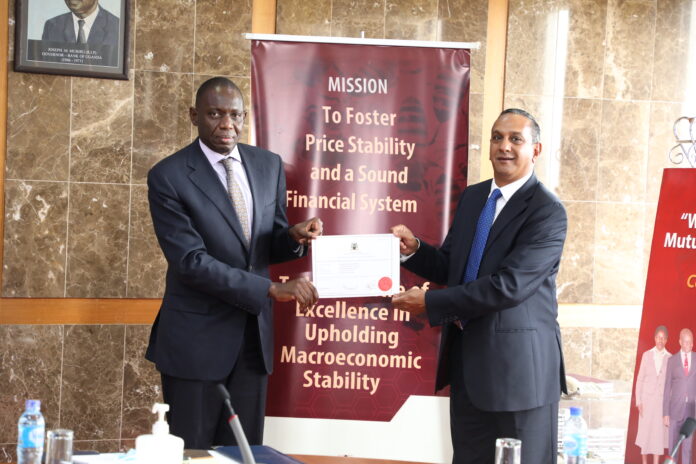
BoU clears I&M Bank (U) Ltd to conduct financial institution business in Uganda

License Handover

Bank of Uganda (BoU) has cleared I&M Bank (U) Ltd to conduct financial institution business after changing its name from Orient Bank (U) Ltd.

Having started in 1993, the precursor, Orient Bank (U) Ltd, has 14 branches and 14 ATMs across the country, serving corporate, SME, and retail clients. Orient Bank promoted cashless transactions in Uganda by pioneering the use of point-of-sale technology and deployed a rich suite of technology-driven services to include internet banking, mobile banking, Visa cards, American Express cards, Union Pay and agent banking.

“Congratulations to you for completing the new ownership structure, thereby changing the name from Orient Bank (U) Ltd to I&M Bank (U) Ltd. I&M Group Plc became the major shareholder, with a 90 percent stake, in April 2021,” the Deputy Governor Michael Atingi-Ego said.

According to Atingi-Ego, the innovative championing of digitalization made Orient Bank outstanding and remains one of the most attractive aspects in a world of technology-driven banking. “We anticipate that the enhanced financial muscle and cross-border banking pedigree brought on by the I&M Group that has subsidiaries across east Africa will substantially power the bank to its next evolution.”

Orient Bank, the forerunner of I&M Bank, has not succeeded in a vacuum. It has done well because the regulator, the banking sector, and the economy have also done well, for the majority of the last 28 years. Credible macroeconomic management, sound legal and regulatory policies, political stability, and an improving business environment have been key enablers along the way.

“We believe that the strong partnership between the Bank of Uganda and the banking sector has been constructive and will remain conducive for I&M Bank (U) Ltd going forward. But make no mistake about it; the central bank is a serious supervisor that sets high prudential standards. We impose tough prompt corrective actions, where required, to secure the stability of the banking system and safeguard the interests of depositors,” he said adding that, “We fundamentally believe in working with the banking industry, never against it. It is only through working with you as a bank and with the Uganda Bankers Association that, together, we will entrench a vibrant and competitive banking sector.”

The spirit of working together was demonstrated when the banking industry and stakeholders, with BoU’s leadership, undertook decisive measures to sustain electronic transactions, relieve individual and SME borrowers, among others, and maintain financial sector stability amidst the unprecedented Covid-19 pandemic and shutdown of the economy.

The comprehensive package of emergency measures and credit relief in a difficult period of widespread financial stress was achieved together in a spirit of cooperation. The credit relief measures expired in their broad scope at the end of September 2021; although they were sustained, on a case-by-case basis, for the sectors that remain shut down e.g., the contact intensive education, entertainment, and tourism.

He urged the banking sector to take appropriate and innovative measures to minimize the risks associated with unwinding the pandemic related concessions to borrowers and containing the financial strife facing the contact-intensive sectors, as the country works its way gradually towards the safe reopening of the economy.

Stories Continues after ad