Stanbic Bank
Stanbic Bank
16.8 C
Kampala
Stanbic Bank
Stanbic Bank
Home Blog Page 967

FDC’s Patrick Amuriat declares his intentions to run against Museveni and Bobi Wine

Patrick Oboi Amuriat

The President of Forum for Democratic Change (FDC) Patrick Amuriat Oboi has declared his bid to run for presidency in the 2021 general elections.

Amuriat announced that he will be picking nomination forms for the FDC Presidential flag bearer. This comes after they failed to convince former presidential candidate Dr. Kizza Besigye to carry the Party flag in the 2021 elections.

“I have this day of 17th August, 2020 taken a conscious decision to offer myself as candidate for President of Uganda. For this to happen I must subject myself to the internal selection process of my party, the Forum for Democratic Change (FDC),” Amuriat said in a statement.

“Accordingly I will be picking and completing the FDC forms for Expression of Interest tomorrow Wednesday 19th August, 2020 at 10:30 am and returning Nomination forms on 26th August, 2020 at 11 am. I count on you all to offer prayers and all forms of support as I make this journey to become the highest ranking servant of this country.”

He last week party spokesperson Ibrahim Semujju Nganda said that should Besigye accept to be the party’s presidential flag bearer then he will be endorsed as a sole candidate, but in the event that he doesn’t take up the mantle, then other candidates who offer themselves will go through internal elections as enshrined in the party’s constitution.

Amuriat is the FDC Party President having won elections on 24th November 2017, in the FDC 7th National Delegates Conference that was held at Mandela National Stadium, becoming the Third (3) President after Maj Gen. Gregory Mugisha Muntu (November 2012-November 2017) and Dr. Kizza Besigye (2005 – November 2012).

Stories Continues after ad

USA imposes financial sanctions and visa restrictions against two Ugandan Judges

The United States of America (USA) has imposed financial sanctions and visa restrictions on two Ugandan judges for their involvement in activities that victimized young children in a corrupt adoption scheme.

According to US Secretary of State Mike Pompeo, Ugandan judges Moses Mukiibi and Wilson Musalu Musene, and Ugandan lawyer Dorah Mirembe and her associate Patrick Ecobu, participated in a scam whereby young children were removed from their families and placed into a corrupt adoption network, aided by the facilitation of Ugandan officials.

“The U.S. government designated these four individuals pursuant to Executive Order 13818, which builds upon and implements the Global Magnitsky Human Rights Accountability Act.  The Department of State also designated Mukiibi and Musene under Section 7031(c) of the Department of State, Foreign Operations, and Related Programs Appropriations Act, 2020 (Div. G, P.L. 116-94) due to their involvement in significant corruption.” Reads in part of the statement

He said together, these individuals engaged in corruption to arrange the adoption of Ugandan children by unwitting parents in the United States.  Mirembe’s law firm used the services of intermediary parties to seek out vulnerable families in remote Ugandan villages, promising parents that their children would be moved to Kampala to further their education.  American prospective adoptive parents then traveled to Uganda to adopt children from an unlicensed children’s home in Kampala.

Mirembe, with the assistance of Ecobu, facilitated bribes to Ugandan judges and other Ugandan government officials to fraudulently procure adoption cases, either directly or through an interlocutor.  Mirembe paid bribes to get cases steered to judges Mukiibi and Musene.  Mukiibi and Musene are current or former government officials who have, directly or indirectly, engaged in corruption.

Under Section 7031(c), once the Secretary of State designates officials of foreign governments for their involvement, directly or indirectly, in significant corruption, those individuals and their immediate family members are ineligible for entry into the United States.  The law also requires the Secretary of State to either publicly or privately designate or identify such officials.

Today’s actions demonstrate the United States’ commitment to protecting the dignity of every human being and protecting the United States from those who seek to profit at the expense of others.  These individuals’ actions also resulted in the submission of false documentation to the Department of State for consideration in visa adjudication, a falsification the Department will not tolerate.

Stories Continues after ad

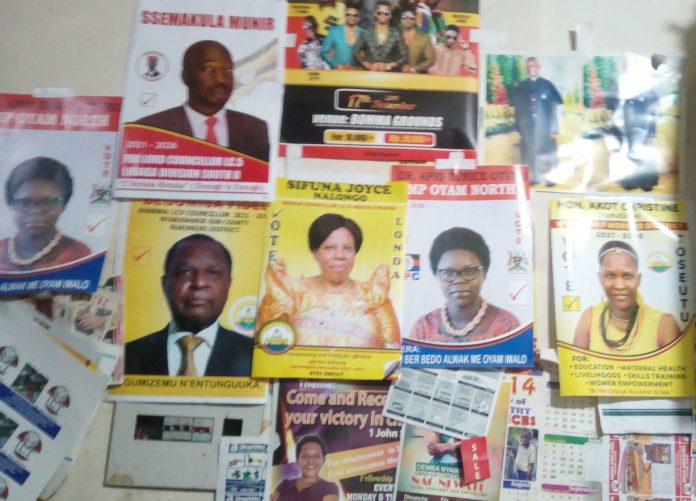
Printers of campaign posters decry low business

Campaign posters in one of the shops at Nasser.

The business community in Kampala involved in printing posters complains about the low business they are receiving this election period.

Commercial printers in Kampala say time for campaigns have usually been lucrative for them, but the current season is not bringing as much business as they anticipated.

Samuel Muwanga, a director of Cats Printers at Muzza printing industry Nasser road, says they have received fewer orders for campaign materials compared to 2016 when they were overwhelmed with orders and had to engage other printers.

According to Muwanga, the lockdown that people have been in for many months that affected the economy could have contributed to the low orders.

“A few daring ones mainly from the ruling National Resistance Movement and independents have, however, printed posters but in a few numbers.” He explains.

Muwanga also believes that the party primaries also could be the reason since many politicians cannot be sure whether they will be through primaries or not. He notes that this could be another reason for the low business.

Javiila Mukiibi, director of God’s son enterprises, a graphic designer, also at Muzza printing industry plaza, says candidates have tended to print fewer posters than in previous elections. He too believes it is a question of money.

Mukiibi says candidates have concentrated more on soft copy posters that they use on their social media platforms.

Posters are charged according to the number of posters and the size ordered, if someone wants more than 100 posters, they charge shillings700 for A3, and A4 shillings 300. The bigger posters like banners, each meter is shilling 30,000.

According to Uganda Printing and Packaging Association, Printing employs over 100,000 youths and women.

Nicholas Mutagubwa from Christo branding and advertising limited, says with many upcountry towns now powered, some printers have shifted bases nearer to upcountry customers, a factor that could explain why few upcountry customers have been coming to Kampala lately.

He further says that they are optimistic that maybe after party primaries, candidates might bring more because of the fact that the lockdown is being fully lifted.

Unfortunately , most materials that these people use to make posters like papers, tonna among others, are expensive because the providers think that the business is always in high demand this period.

Betty Nantale explains that a stock of hard papers used to cost shillings 93000 but now it costs shillings 100,000. Tonna is at shillings 250,000 unlike when it used to be at shillings 150,000.

Stories Continues after ad

#Covid-19: New case confirmed at NTV Uganda

NTV logo

The media fraternity has been thrown into panic moments after Vision Group confirmed that one of their employees tested positive of #Covid-19.

Sources at the Ministry of Health have now told Eagle Online that NTV Uganda has registered a case.

“It is true there is a case but wait for details.” the source said.

Stories Continues after ad

Vision Group employee tests positive for #Covid-19

Covid-19 testing kits

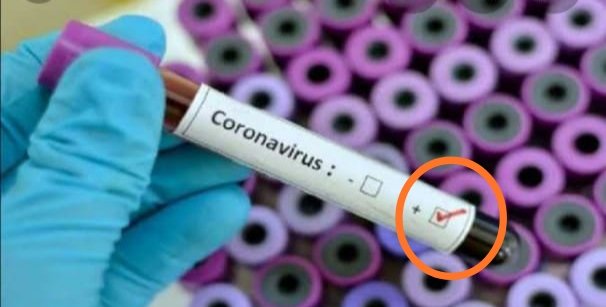
Vision Group has today confirmed that they have registered one positive case of #Covid-19.

Robert Kabushenga, the CEO of Vision Group released the statement below;

“I wish to inform you that Vision Group has registered a case of #Covid19. One of our staff working at the head office in Kampala tested positive over the weekend and the case id being handled together with and under the guidance of Ministry of Health.

“Management is tracking all possible contacts at the office and will collaborate with the medical workers to facilitate further tests. Those identified as having been in contact with the concerned staff will be required to stay home and isolate for a period of 14 days.

“The office will be disinfected at regular intervals and all other staff who remain at work will be required to follow the SOPs as directed by the Board of Directors. Access to our offices will be in accordance in the requirements of ministry of health.”

Three companies; Eagle Holdings, Megha Industries and Toyota Uganda last week temporarily closed after some of their employees tested positive for #Covid-19.

Stories Continues after ad

DPP petitioned over Kasekende, Bagyenda and Sekabira

The three officials who are subject of investigations.


The Director of Public Prosecutions (DPP) has been petitioned to prosecute the former Bank of Uganda Deputy Governor Louis Kasekende, former Director of Commercial Banks Supervision Justine Bagyenda and the Director for Financial Markets Development Coordination (FMDC) Benedict Sekabira

Mr Kakuru Sam Brian, a private citizen, sent the petition to the DPP today, detailing offences of abuse of office and causing financial loss,contrary to the Anti-Corruption Act that have been orchestrated by the officials.

In his petition, Kakuru states that the three officials masterminded the mismanagement of properties that were in the names of seven commercial banks that were closed by the central bank between 1992-2016.

In the his petition, Kakuru urges the DPP to take Interest yourself in the case that was filed by the Bank of Uganda against Sudhir Ruparelia and Meera Investments which was dismissed by both the High Court and Court of Appeal with huge sums of money to be paid in terms of costs to be paid by the tax payer in one way or another.

“Section 11 of the Anti-Corruption Act of 2009  creates the offence of abuse of office where a person employed by a public body or company in which a government has shares does or directs to be done an act arbitrary tor prejudicial to his employer or any other person in abuse of office,” reads the petition.

It adds: “Section 20 of the Ant-Corruption Act provides for the offence of causing financial loss which is committed by any person employed in a public body or company which government has shares or bank and or a public body who in performance of his duties does or omits to do any act knowing or having any reason to believe that his act/omission will cause financial loss to the government or financial institution.”

The petition by Kakuru to the DPP will further pile pressure on Sekabira who is facing another investigation from the CIID over his dealings in the central bank relating to land titles of closed banks.


Stories Continues after ad

Uganda needs reforms in the banking sector – Ham Kiggundu

Businessman Hamis Kiggundu.

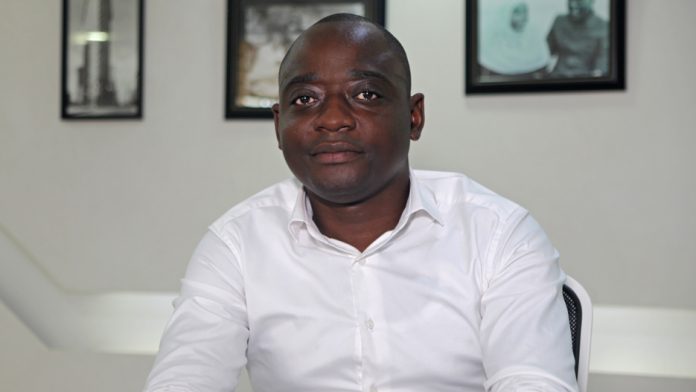
Tycoon Hamis Kiggundu, the CEO of Ham Enterprises Ltd has come out and explained that Uganda’s banking sector needs immediate reforms to help boost the country’s economic growth.

In a Facebook video recorded live from his office, the businessman said that one of the major factor that has frustrated our development in Uganda are the weaknesses in our banking structures and weak monetary policies. He added that Uganda needs banking reforms to take off with full economic independence.

“It is unfortunate that many Ugandans are either unbothered, unnoticed or simply don’t attend to structures and systems. Today in Uganda we have a very weak banking sector which is totally compromised. Yes we got our independence in 1962 but we lack economic independence,” Ham said.

Ham pointed out that most banks in the country are foreign owned and also employ majority of their top employees from their countries of origin which according to him is dangerous for local growth of skills in the sector.

“These banks mainly employ foreigners even when it comes to MDs, CEOs, and managers which I find so unfair to the country because Uganda has a better education system. I am of a view that we have qualified accountants and financiers that have got the capacity to hold those jobs.”

“I call on the government to make reforms for each and every bank operating in Uganda for MD to be Ugandan. It would be our advantage that we have a local manager that can easily solve financial problems of fellow Ugandans,” he said.

He also added that these banks are discriminative and repatriate the profits which would be necessary to enhance development in the country.

According to Kiggundu, if a local entrepreneur applies for a loan of sh1bn, he will only receive a half of it and to make matters worse, it would take as much as one year to get the loan yet a foreign businessman would get the whole of it and in the shortest time possible.

While foreigners get interest rates of 16 per cent on loans, Ugandans get 20 per cent and above which is unfair according to Kiggundu.

Ham pledged to write to Parliament with a view of ensuring that the badly required changes get looked into to streamline the structure of the Country’s financial structures.

Stories Continues after ad

FUFA allocates FIFA Covid-19 relief fund

FUFA president, Magogo and CEO Edgar Watson.

The FUFA Executive Committee which sat on Monday, 17th August 2020 has approved appropriation of the FIFA COVID-19 relief grant of USD 500,000.

The decision has been made in consideration of the FIFA COVID-19 Relief plan regulations.

The Executive Committee will reconvene soon to take a decision on the appropriation of the Women Football Grant based on the strategy submitted earlier to FIFA.

FUFA CEO Edgar Watson, confirmed the latest development in Circular number 1113 that has been communicated to the member clubs, member associations and other football stake holders.

fufa allocation

“FUFA wishes to announce receipt of USD 500,000 being the first part of Solidarity Grant earlier applied for and approved by FIFA. The FUFA Executive Committee deliberated on and approved the allocation of the funds.  As stipulated in the Regulations funds will be transferred directly to the beneficiary’s bank account within the next 14 days” noted Watson.

“FUFA is in the process of applying for the Women’s Football Grant and all stakeholders will be informed of any developments in this regard as soon as they occur. FUFA wishes to express its gratitude to FIFA for the timely support to football and its stake holders especially during this COVID-19 Pandemic period” added Watson.

Stories Continues after ad

Covid-19: Gov’t threatens to halt public transport

public transport

Government has threatened to halt public transport for failure to adhere to standard operating procedure (SOPs) peddled at curbing the spread of Covid-19 pandemic.

According to the minister of works and transport, Gen Katumba Wamala, passengers, boda-boda cyclists and taxi operators are undermining SOPs which include; wearing face masks, sanitizing, keeping social and overloading.

“Fellow Ugandans, it has come to my attention that some taxi operators and motorists are not obeying the #COVID19 guidelines in place. With the increasing cases of community transmission, we may be forced to halt public transport.” The minister wrote on twitter

Globally, there have been 21,260,760 confirmed cases of COVID-19, including 761,018 deaths, reported to the World Health Organization (WHO). Uganda has 1385 confirmed cases of Covid-19 and 12 deaths. The 12 deaths so far reported nationally, eight (8) are from the Kampala region alone.

Last week, the government closed three companies after several employees tested positive. Since the first COVID-19 case was reported in Kampala on 23rd March, 2020, a cumulative total of 160 confirmed cases have so far been registered.

Stories Continues after ad

INCB, WHO and UNODC call for procurement and supply of controlled medicines

The International Narcotics Control Board (INCB), the World Health Organization (WHO) and the United Nations Office on Drugs and Crime (UNODC) have called on governments to ensure that the procurement and supply of controlled medicines in countries meet the needs of patients, both those who have COVID-19 and those who require internationally controlled medicines for other medical conditions.

According to statement released by the three world organisations, there is a need to ensure access to controlled medicines such as sedatives and analgesics for intubation protocols for the treatment of patients with COVID-19. Non-COVID patients continue to require controlled medicines for the management of pain and palliative care, surgical care and anesthesia, mental health and neurological conditions, and for the treatment of drug use disorders.

“It is important to remember the needs of existing patients who require controlled medicines for the management of these health conditions. These patients faced barriers to accessing controlled medicines before the COVID-19 pandemic. The COVID-19 pandemic has further resulted in interruptions of the medicines supply chain, and it is critical that access to essential health services and medications not be forgotten or de-prioritized during this pandemic.”

As the pandemic increasingly affects countries with under-resourced health infrastructure and services, it is an ethical imperative to ensure that all people in all countries of the world are able to access essential medicines. This includes those medicines that are under international control.

They urged governments to ensure that sufficient quantities of internationally controlled medicines, of assured quality, are available and affordable to people under medical care.  Throughout the duration of the pandemic and beyond the acute phase of burden on the healthcare infrastructure, it is critical that governments work cooperatively to ensure that no country, no region, no district, no city and no patient is left behind. Competent national authorities, manufacturers, suppliers and distributors play a crucial role in ensuring that internationally controlled medicines urgently needed for medical treatment are available within and across national borders.  The supply chain is the foundation of quality medical care because without the necessary supplies, including essential controlled medicines, patients will suffer.

“Governments are reminded that in acute emergencies, it is possible under the International Drug Control Conventions to utilize simplified control procedures for the export, transportation and supply of medicinal products containing controlled substances, especially in those cases where the competent authorities in the importing countries may not be operating at full capacity.” Reads in part of the statement

Competent national authorities may permit the export of medicines containing narcotic drugs and/or psychotropic substances to affected areas even in the absence of the corresponding import authorizations and/or estimates. Urgent deliveries do not need to be included in the estimates of the receiving countries affected by emergencies. When possible, competent national authorities are also encouraged to issue electronic import and export authorizations through the INCB International Import and Export Authorization System (I2ES), PEN Online and share related contingency measures in the forum therein.

They implored countries to ease COVID-19 related transport restrictions for controlled medicines and consider local production solutions when feasible, to meet the COVID-19 driven demand spikes.

Stories Continues after ad