Stanbic Bank
Stanbic Bank
16.7 C
Kampala
Stanbic Bank
Stanbic Bank
Home Blog Page 968

Absa collaborates with Epic ERP and AJS to offer digital solutions to help clients run secure and efficient business

ABSA

Absa Corporate and Investment Banking (CIB) has collaborated with two major Enterprise Resource Planning (ERP) providers in the manufacturing and legal sectors Epic ERP and AJS respectively. This collaboration is to implement integrated seamless payment solutions which will reduce inefficiencies and minimise fraud and operational risks which are common with online banking payment systems.

John Molanda, Head Product Innovation, says many business clients perform their financial transactions using an online banking system, which creates inefficiencies due to recapturing data and increases the risk of payments files being intercepted. While the alternative is to create a host-to-host connection to transfer data between their line of business systems and the bank, this invariably results in high costs and is technically challenging.

The bank has been working with the two collaborators to launch seamless banking solutions like integrated payments and reconciliations. Furthermore, with the advent of Covid-19, this latest innovation is yet another example of how Absa is responding to adopting digitised interventions to limit manual processes, and enhance the client experience.

AJS is a leading provider of trusted business software applications for the legal and corporate markets. Justin Perfect, Support and Project Manager of AJS, says he is delighted to be associated with a financial partner like Absa, and looks forward to unlocking even more synergies that will naturally benefit both AJS and Absa clientele.

“Not only have we as a software development house embraced the integration with Absa, but more importantly our clients have too. They have experienced first-hand the motto of “more for less” bearing fruit, as a task that took more than twenty minutes, now takes five minutes to complete. Added to this is the reduction in risk to the firm that has put them at ease. As we continue our journey with Absa, we are excited by the value that we will be able to offer our clients,” says Perfect.

EPIC ERP is the master reseller for EPICOR software in Africa. Epicor primarily focuses on manufacturing clients in the mid-market segment.

Stuart Scanlon, Managing Director of Epic ERP, says the company is proud to be associated with a bank like Absa, whose ambition is to become the leading Pan-African corporate and investment business, through placing focus on collaborations at the core of creating innovative solutions and gaining access to new markets.

“We look forward to working with Absa as this relationship represents a powerful opportunity for Epicor and Epic ERP customers to not only improve banking processes but help in reducing fraud,” says Scanlon.

“Leading up to this collaboration, the Absa Transactional Banking teams conducted extensive client research, which substantially enriched our understanding of client operating environments. Through this research, we discovered that while bank platforms are pivotal in helping run a client’s business they can also be points of inefficiency and risk. With this understanding, we deliberately looked for organisations with whom we could collaborate to offer our clients an even more secure and efficient way of doing business,” he says.

“We have used bank API’s to connect to the ERP’s in this way we can ensure that we personalize the client experience and that the relevant bank response is real time. We are excited with the collaboration and this gets us closer to making sure that our clients can get business done,” says Molanda.

Absa’s transactional banking strategy is to build digitally scalable solutions for corporate clients. “This initiative forms a critical part of our digitisation journey. We are investing in critical API infrastructure to be able to offer our clients seamless banking experience.  Working with a technology like Epic ERP and AJS, has been great for us to be able to push the boundaries of our technical capabilities.  We are excited with the collaboration and this gets us closer to bringing our clients possibilities to life,” says Molanda.

Stories Continues after ad

Teso, Bugisu delegates endorse Oulanyah NRM bid

Speaker Jacob Oulanyah

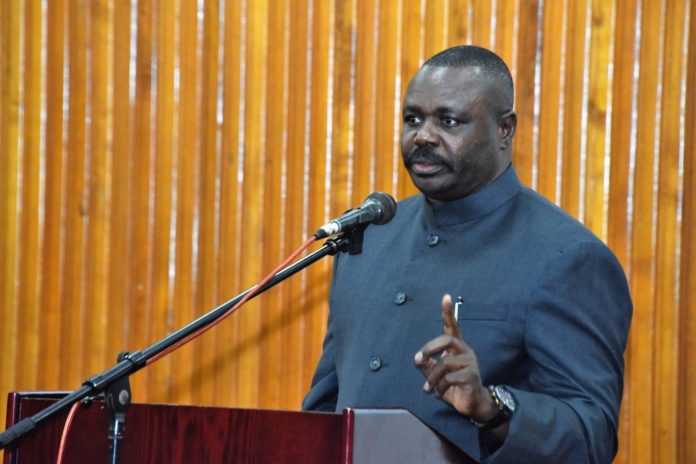
National Resistance Movement delegates from Teso and Bugisu sub regions have endorsed Deputy Speaker Jacob Oulanyah’s bid for Vice Chairperson, Northern Region.

In back to back meetings with delegates from the sub regions in Kumi, Ngora, Serere and Manafwa districts, Oulanyah was tasked with safeguarding party interests and working with President Museveni to revitalize party structures.

In Kumi, the delegates supported a motion by NRM National Youth League Publicity Secretary Mr Samuel Odongo, to unanimously support Oulanyah.

Mr Odongo said in the coming years, the party needs diehards who will not only support President Museveni and its agenda in and outside the Central Executive Committee, the party’s highest decision making body but also keep “the integrity of the revolution.”

“You [Oulanyah] are an NRM party diehard; we are coming into transition and we need people who will not embarrass the revolution [in Central Executive Committee],” he said.

Ms Christine Apolot, the Kumi District LCV Chairperson said the district leadership will work hard to guarantee Oulanyah’s victory.

“As the political head of the district, we shall do our best to ensure that you emerge the winner of the NRM Vice Chairperson Northern Region,” she said.

In Ngora, District Woman Representative Jacquiline Amongin (NRM, Ngora), supported Oulanyah’s bid, saying he has been instrumental in supporting the creation of the district and building its health infrastructure.

Amongin, also the Secretary General of the NRM National Women’s League, said Ngora delegates will stick with Oulanyah so that through him, they continue to lobby for health, education and infrastructure services from government.

Mr Andrew Oloya, the Resident District Commissioner, Ngora, said: ”You have been with us during all the challenges we have gone through and we shall [also ] be with you.

Oulanyah urged delegates to elect leaders who will support the party structures throughout their term in office and not just use the structures to win elections and abandon it thereafter.

He also warned delegates against leaders who go and sit in CEC, only to come out and antagonize President Museveni and the party’s position in public.

“Leaders must come, have discussions, make undertakings and account; I don’t want you to support someone who will sit in CEC and then come out to fight the president and humiliate the party,” he said.

Oulanyah told the leaders that his bid is centered on re-enegising party leaders and membership across board and building the confidence and credibility of grassroots leaders through making them take lead in the supervision of government programs in their areas.

Oulanyah said in the party’s over 12 million membership, it has a reliable cadreship that, if harnessed, should make the coming political season an easy ride for the ruling party.

NRM votes its CEC members on August 20, 2020. Oulanyah seeks to replace former Housing State Minister Sam Engola.

Stories Continues after ad

I cannot be summoned like a chicken thief, Sekabira tells off Police

Mr. Sekabira

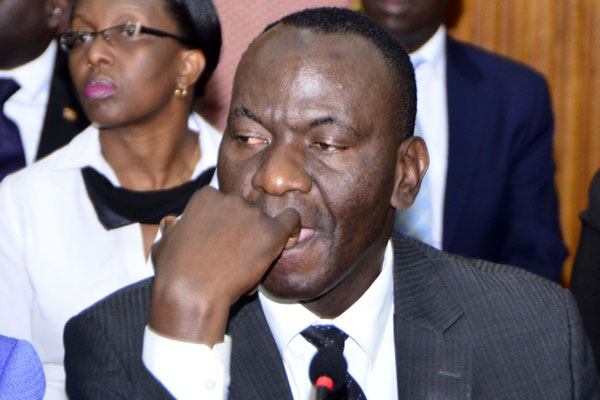
Troubled Bank of Uganda (BoU) Director for Financial Markets Development Coordination (FMDC) Benedict Sekabira has rebuffed summons by the Criminal Investigations and Intelligence Department (CIID), telling operatives that he cannot be summoned like a chicken thief.

Sekabira is wanted by Police to explain his role in the concealment and seizure of the land titles belonging to closed commercial banks.

However, after twice defying Police summons, Sekabira has now dared operatives, boasting that as a Director of the central bank, he cannot be summoned like a chicken thief.

“Am a full Director of Financial Markets Development Coordination (FMDC). I cannot be summoned like a chicken thief,” Sekabira told off the Police.

CIID Spokesperson Charles Twinne was last week quoted in the media saying Sekabira had defied summons, leaving Police with no option but to use other means of having him answer charges of illegally accessing land titles of closed banks.

“The only criminal file we have regarding the missing land titles is against Benedict Sekabira. It was sanctioned and Mr Sekabira was summoned two weeks ago, but he never reported. We are considering other alternatives to implement the advice of the Director of Public Prosecutions,” Mr Twiine said.

According to Mr Twiine, the other options that the CIID has  on the table include wither re-summoning Sekabira to record a statement or taking the case file straight to court for prosecution.

Stories Continues after ad

How Joshua Cheptegei broke 5000m world record in Monaco Diamond League

Uganda’s Joshua Cheptegei has set a new 5000m world record of 12:35.36 at the season-opening Monaco Diamond League breaking Ethiopian Kenenisa Bekele’s 16-year old world record of 12:37.35 set in 2004 in Hengelo.

The Ugandan, who annexed the world cross-country title as well as the 10,000m title last year, and set a world 5km record on the road in Monaco in February, extended his realm by attacking and conquering the great Kenenisa Bekele’s 16-year-old 5000m monument of 12:37.35 in a bravura solo performance.

The pace was so fierce that Cheptegei had run out of pacemakers by half way and the only other man in sight was Kenya’s Nicholas Kimeli. Within a lap the genial but ambitious Ugandan was alone in his quest for immortality, pressing on remorselessly with metronomic 61-second laps.

As he hit the bell at 11:35, it was apparent that the record was his for the taking and he came home in 60 seconds as the small socially-distanced crowd allowed him to attend the meeting and applauded.

Cheptegei had made no secret of his desire to take down Bekele’s mark and was not deterred by the seemingly unfavourably warm conditions at Stade Louis II. It was still 26 degrees and 78 per cent humidity as his attempt began.

“I think Monaco is a special place and it’s one of these places where I could break the world record,” he said.

“It took a lot of mind setting to keep being motivated this year because so many people are staying at home but you have to stay motivated. I pushed myself, I had the right staff with me, the right coach. I’m also usually based in Europe, but being based in Uganda with my family was actually great.”

Kimeli was the only other man who broke 13 minutes, as he finished a distant second in a lifetime best of 12:51.78.

In 2017, he became the silver medalist in the 10,000 meters run at the World Championship in London. In 2018, he set a world record for the 15km road race and became the World Cross Country champion in 2019. That year at the World Championships in Doha, he won a gold medal in the 10,000 meters men’s final.

In 2020 during the Diamond League competition, he set a new world road 5km record of 12:51 in Monaco, beating the old fastest time by Nine seconds.

Stories Continues after ad

Uganda joins Extractive Industries Transparency Initiative

OIL PIPELINE

Uganda has joined Extractive Industries Transparency Initiative (EITI), a global standard group promoting the openness and accountable management of oil, gas and mineral resources.

Uganda’s application to join the EITI, was approved by the organization’s board of directors, making it the 54th Member State and the 26th in Africa.

Uganda’s commitment to join the EITI was first made in the 2008 National Oil and Gas Policy and was reiterated in the updated 2012 Oil and Gas Revenue Management Policy. Participation in the EITI is also identified in the 2019-2024 Domestic Resource Mobilisation Strategy. In January 2019, the Ugandan Government approved the decision to present a candidature application, which was submitted in July 2020.

EITI Board Chair, Helen Clark, welcomed Uganda to the EITI community; “EITI implementation can help lay the foundation for transparent and accountable management of the country’s natural resource wealth. We welcome Uganda as an implementing country and look forward to the EITI promoting inclusive public debate.”

He said transparency is key to ensuring that potential revenues from oil and gas production are not mismanaged or lost to corruption. EITI implementation will require Uganda to publicly disclose information such as contracts, beneficial owners, revenues and payments, including payments related to the environment. These disclosures can in turn promote public oversight and debate.

Participation in the EITI is identified in the Government of Uganda’s 2012 Oil and Gas Revenue Management Policy as an action that will help create lasting value from oil and gas revenues. Proven reserves of over six billion barrels of crude oil have been identified in Uganda, of which 1.4 billion is currently deemed to be recoverable. Total and China National Offshore Oil Corporation (CNOOC) are active in the region and share an interest in license areas in the Lake Albert development project. If managed responsibly, expected oil revenues can contribute to national development plans such as infrastructure and social services.

Uganda’s Minister of Finance, Planning and Economic Development, Matia Kasaija, said the decision to join the EITI was informed by the appreciation of the value of transparency as we progress our plans to develop Uganda’s natural resource wealth. We believe that this initiative has the potential to strengthen tax collection, improve the investment climate, build trust among sector stakeholders and help create lasting value from our mineral and petroleum resources.

As a part of the EITI sign-up process, Uganda formed a multi-stakeholder group (MSG) in March 2019, composed of government, industry and civil society representatives.

Civil society advocacy has been an important part of Uganda’s journey to join the EITI. “Civil society has advocated the operationalisation of the policy objectives of joining EITI since the promulgation of Uganda’s National Oil and Gas Policy in 2008 and the Petroleum Revenue Management Policy in 2012,” said Onesmus Mugyenyi, Deputy Executive Director of Advocates Coalition for Development and Environment (ACODE) and a civil society member of Uganda’s Multi-Stakeholder Group.

“It is therefore our pleasure to see that the government has followed through with this policy commitment. EITI implementation provides an opportunity for deepening transparency and accountability in the management of Uganda’s oil, gas and mineral resources. I pledge our total support and commitment in ensuring that the EITI works for Uganda.”

In the wake of the Covid-19 pandemic, increased competition for investment underscores the need for transparency.  While Uganda’s oil industry is still nascent, Total, a founding member of the EITI internationally and a partner in the Lake Albert Development Project, sees only benefit for Uganda in committing to the EITI. Writing in support of EITI implementation, Total E&P Uganda, an active participant in Uganda’s Multi-Stakeholder Group, underscored the importance of contract transparency in contributing to a transparent and accountable sector.

“We look forward to working with government, industry and civil society partners to support EITI implementation through participation in Uganda’s Multi-Stakeholder Group,” said Total E&P Uganda’s General Manager Pierre Jessua.

Uganda’s initial disclosures in terms of the 2019 EITI Standard will need to be made within 18 months of being admitted as an EITI implementing country.

Stories Continues after ad

Gov’t to rebuild demolished St Peter’s Church Ndeeba

museveni visits site

President Yoweri Museveni has faulted the Judges who presided over the matter and their decision which led to demolition of St Peter’s Church, Ndeeba. Museveni said when he visited the scene where the Church was demolished.

The Church was demolished last week following a four-year standoff in Courts of law with a business man Dodovico Mwanje who allegedly acquired the piece of land from relatives of the deceased who reportedly handed over the land for establishment of the Church.

Museveni said the Judges should have limits and understand public interest. Demolishing a church is a curse. Also, ignore reports of those claiming the government demolished the church.

“I am saddened by this incident and I give the church assurances that those complicit will be punished. Even if the church was in the wrong, ordering demolition was extreme. Dialogue would have resolved this matter.” He said

He pledged to invite the Namirembe Diocese Bishop, the Rt. Rev. Wilberforce Kityo Luwalira, and engage with all parties involved in this conflict to find a lasting solution.

“The bottom line is that the Church will retain this land and we shall build a new church. I have now joined this war. I also noticed large groups of people gathering in Ndeeba as I inspected the site. This is wrong. Avoid crowding in light of the Covid-19 pandemic that we are grappling with.” He said

Stories Continues after ad

Military police drivers and riders passed out

updf

Uganda Peoples’ Defence Forces (UPDF) Military Police in partnership with Uganda Police Force have passed out 21 defensive drivers and 14 outside riders at Kololo ceremonial grounds.

The Director Human Resources Development (DHRD) of Uganda Police Force, AIGP Brigadier Godfrey Goloba, officiated at the pass out ceremony. He congratulated the trainees upon completion of the course and urged them to prepare their minds for the tasks ahead.

“This training was meant to prepare you for the challenges that may encounter while executing your duties such as driving amidst reckless road users, navigating through traffic jam and maneuvering on narrow roads. With this training and the demonstration exhibited, I guarantee that our visitors or Very Important Persons (VIPs) that you will drive or escort will be safe and enjoy their time while with you,” he said.

He however cautioned that that the drivers and riders would only be useful as long as they are disciplined, take good care of themselves and live a responsible and healthy lives.

AIGP Goloba reiterated the commitment of Uganda Police Force in supporting its sister Force, the UPDF, in specialized training whenever called upon.  He said the roles of the two sister Forces are complementary.

“The Military ensures greater security whereas Police ensures law and order. There cannot be law and order where there is no security,” he said.

The Commandant Military Police, Col Keith Katungi, underscored the significance of the training received from Uganda Police Force saying that it will help improve the capabilities within UPDF’s Military Police and that the training was a critical force multiplier. He stressed the importance of coordinated efforts from various government agencies in ensuring a better living environment for Ugandans.

PTE Layet Lydia, the only female rider, was recognized as the most courageous rider while PTE Anyiku Emmanuel emerged the overall best driver and Lance Corporal Osinde Bernard emerged in the second position.

The function was attended by Officers and militants from UPDF’s Military Police and Uganda Police Force.

Stories Continues after ad

Criminal Division kicks off second phase of Juvenile session

Justice Wilson Kwesiga

The Criminal Division has kicked off the second phase of a month-long juvenile session at Naguru Remand Home. The session was opened by the Head of Division, Justice Wilson Kwesiga.

Justice Kwesiga applauded his team for the great work done during the previous session where 20 cases were successfully handled and called for the same commitment in the new session.

He clarified that these sessions are not only taken to remand homes to avoid the threat of COVID 19 on children but because the law grants children in conflict with the law the right to be heard and tried from anywhere.

He emphasised that the main intention of these sessions is not to sentence the children but make them better human beings.

“In case a child is found guilty, we advise accordingly, engage them, and caution them not to repeat the same. We reconcile the parents too. For example, if a child defiles a child of a neighbor, you must create harmony between them for proper naturing. We don’t need to sentence them to prison,” he said.

The Judge added that the Court considers prevailing circumstances at the time of the commission of the offence.

“Some of these children are orphans, while others are exposed to the infiltrated society. Therefore we make sure that we counsel them and integrate them back to their homes for proper upbringing.”

The Criminal Division Deputy Registrar, Keitesi Mary Kisakye, said all the 34 cause-listed matters are ready for hearing.

Stories Continues after ad

Bobi Wine drags gov’t to court for suffocating his freedom of speech and association

Bobi Wine

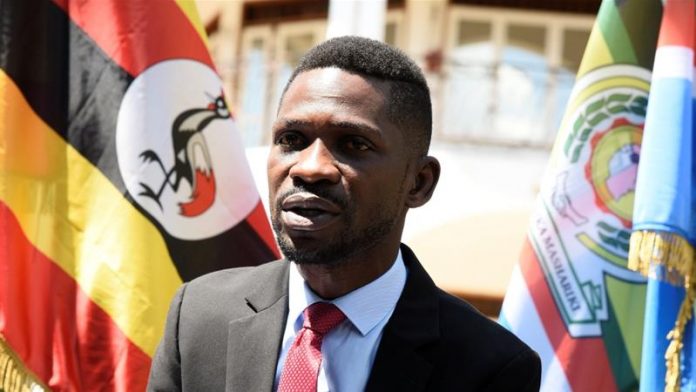
Presidential hopeful and Kyadondo East MP Robert Kyagulanyia Sentamu aka Bobi Wine has dragged the Government of Uganda to Court over continuous suffocation of his freedom of speech and association.

Over the weekend, Police and other security organs blocked Bobi Wine and his group from appearing on Mbale BCU FM Radio to sensitise people about his political party, National Unity Platform (NUP) and the 2021 general elections. The MP had paid Shs 1.2million to appear on the two hour show.

Bobi Wine through his lawyer Anthony Wameli wants the Attorney General William Byaruhanga, the Inspector General of Police Martin Okoth Ochola, Mbale District RDC Ogajo Barasa Suleiman, the district police commander (DPC) Fred Ahimbisibwe, the regional police commander (RPC) Wesley Nganizi, , the DISO Lt George Mwonda as well as the OC station, Mbale Central Police Station Kato Arafat to explain why they blocked him from appearing on BCU FM Radio.

“The acts of the respondents, their agents or persons acting under them are not acceptable or demonstrably unjustifiable in the free and democratic society and therefore an infringement on my right to freedom of speech and association and freedom of press and other Media contrary to article 21 (2) and 43(2) (a) and (c) of the 1995 constitution),” reads in part of the suit.

Recently, the chairman of the electoral commission, Justice Simon Byabakama declared that the 2021 general elections will be carried out through media and regulated rallies. He said the move is peddled at curbing the spread of Covid-19 pandemic.

He wants the Court to direct the respondent to personally and individually pay punitive damages for their high handedness and fragrant bleach of the law.

“We are going for the government as well as individual officers who are involved in actions of impunity against our people.  Like we have consistently said, we shall use all avenues, domestic and international, to push for the rights of Ugandans.” Bobi Wine said

He wants the court to issue an injunction restraining the respondents from blocking him from appearing on any radio station in Mbale and other parts of the country.

Stories Continues after ad

We are bordering on too much of a good thing with COVID-19 communication

Rukh-Shana

By Rukh-Shana Namuyimba

The role of effective, consistent, localized and recurring communication in the fight against the coronavirus cannot be underestimated. Governments, health organizations, brands and even individuals have for the past 8 months used every avenue at their disposal to help communities prepare for and adjust to a world that no longer plays by our rules.

It is worth noting that communication focused on behavioural change, socioeconomic changes and psychosocial adjustments is key to how humanity will recover from this crisis. But, like a famous adage goes, the science of doing “Everything in moderation” is as important to what lessons will stick with us and what will be washed away when the storm settles.

In communicating with internal and external audiences, how do companies ensure that their messages are relevant, practical and have a shelf life that will go past the week’s hashtag?

The diary of an over booked employee: For employees whose jobs involve team and project coordination, a calendar that’s fully booked for the next 2 months is expected. But for those who are tasked with the creation, development, testing and selling of products, spending 70% of work hours in meetings is detrimental and frustrating. Do online meetings offer flexibility? Yes. Do they take up less time or ensure more productivity? Not necessarily. Now may be a good time for companies to examine the ways in which we’ve turned internal communication into a never-ending and oftentimes, dragging activity and come up with systems that are sensitive to staff productivity and engagement.

It’s time for links, codes and meeting IDs to take a bow:  If we gave our customers a dollar for every online discussion that’s been marketed to them, they’d have a sizeable piggy bank. With each new engagement, audiences are subjected to eyestrain, data costs and information overload. “The new normal”, “Unprecedented times”, have become fodder for jokes from customers who have heard them one too many times.

A critical part of a holistic communication journey is analysis taking stock of efforts and making any adjustments if necessary; an action that doesn’t have to come at the end of this pandemic fight. Fewer but impactful activities will have deeper and lasting impact as opposed to frequent interactions which mix large panels with surface discussions.

The burnt-out Communications Specialist: As management teams task their Brand and Communications teams to continuously churn out internal, stakeholder and customer communication, they should consider the limits of their team’s creativity and productivity. Whether it be a one liner piece of copy, a press release report or campaign communication, the routine birth of content is a heavy task. Having a clear, phased plan allows your company to focus on dissemination of critical and effectual dialogues and allows your team to create memorable campaigns and content.

As each of us feels the effects of the pandemic, we can agree that the inevitable has already happened and life has indeed changed. But we cannot continue to act from an automated zone. On the one hand audiences are bombarded with online plus audio-visual content and limited time to process it or even apply it. On the other we have overstretched communications teams ticking boxes when what we really need to be doing is going back to the basics of effective communication which is about being deliberate, necessary and impactful.

Stories Continues after ad