The National Lotteries and Gaming Regulatory Board is projected to record unprecedented growth, with more than Shs14.1 trillion expected to be staked in the 2025/26 financial year.
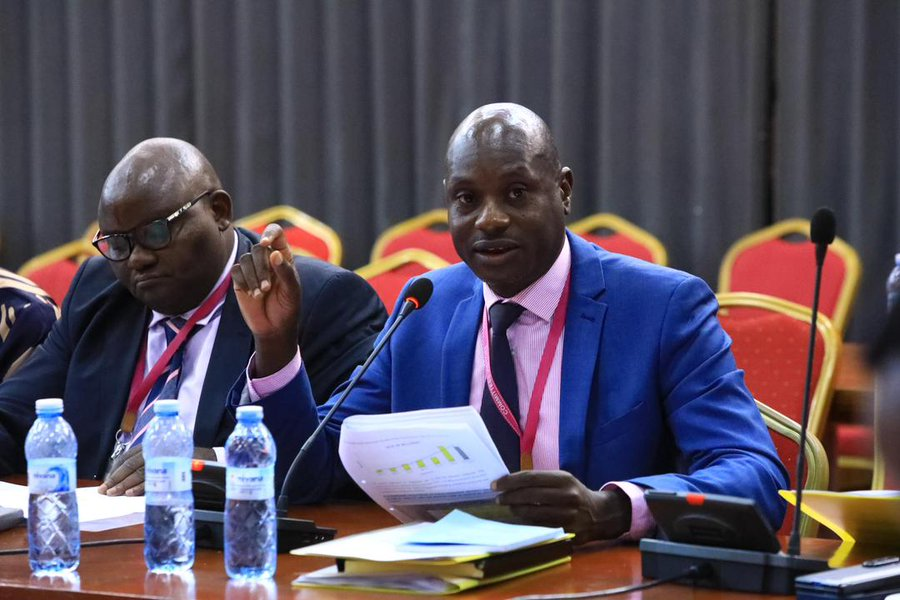
The projection was revealed by Bernard Winyi, the Senior Manager for Finance and Administration at the National Lotteries and Gaming Board, while appearing before Parliament’s Finance Committee on Wednesday, January 21, 2026, to present the Board’s 2026/27 National Budget Framework Paper.

Winyi told legislators that the electronic monitoring system has significantly improved visibility in an industry that was previously dependent on self-declarations by operators.
“So now, through the National Central Electronic Monitoring System, we have more visibility of the operators and the activity in the gaming industry,” Winyi said.
He explained that before the system was introduced, the government had limited insight into the actual volume of gambling activity across the country.

“In 2022/23, the level of money that people were gambling, that we were seeing, was Shs2.4 trillion. That was the money that was being declared by the operators,” he noted.
According to Winyi, the figures rose sharply once the monitoring system became operational.
“When we operationalised the system in 2023/24, those stakes grew to Shs4.3 trillion. In 2024/25, because of that visibility, it grew to Shs8.3 trillion,” he said.
He added that the Board is now projecting a dramatic increase in the current financial year.
He noted, “This financial year 2025/26, we are projecting that the amount of money that people will spend on gambling is Shs14.1 trillion. So the system has enabled us to get visibility and, by doing so, improve the tax collections.”
Winyi was responding to concerns raised by Amos Kankunda, the Rwampara County MP, who asked the Board to account for the effectiveness of the Shs6.833 billion National Central Electronic Monitoring System approved by Parliament.
“The new system that we approved, we have not talked about it. How is it working? Would it be responsible for the revenue leakages, or has it helped to improve?” Kankunda asked.
In response, the Board reported strong growth in revenue collections from the sector. Winyi disclosed that between July and December 2025, the government collected Shs176 billion from sports betting and casino gambling.
“In 2024/25, we realised Shs323 billion. In 2025/26, at half-year, we had collected Shs176 billion and we project to collect Shs391 billion by the end of the financial year,” Winyi said.
He further revealed that the Board plans to use its 2026/27 budget to boost gambling and gaming revenue by 15 per cent, targeting Shs450 billion in the next financial year.
“Our 2026/27 budget will be utilised to support increasing revenue by 15 per cent from the projected Shs391 billion this year to Shs450 billion in the financial year 2026/27,” he added.
However, Winyi warned that illegal gambling remains a major challenge, blaming weak penalties under the Lotteries and Gaming Act, 2016 for the persistence of unlicensed operations.
“Our law is weak in terms of curbing illegal operations; the law is not deterrent enough,” Winyi told the committee.
He cited Section 67 of the Act, which provides a fine of 48 currency points (about Shs960,000) or imprisonment not exceeding two years for operating an illegal gambling business.
“People plead guilty, go back to do the same thing, and pay Shs960,000. So we are already working on an amendment so that this can be more deterrent,” he said.
The proposed amendments come amid growing concern from legislators that enforcement costs often outweigh the penalties imposed. Dickson Kateshumbwa, the Sheema Municipality MP, urged the Board to work more closely with local governments to curb illegal gambling.
“I have a feeling that you are spending more money on enforcement than you are actually collecting,” Kateshumbwa said. “The fuel and cost of operations are probably higher than the yield.”
He further advised the Board to collaborate with Uganda Revenue Authority to stop illegal machines from entering the country.
“We don’t manufacture these devices here in Uganda. They are definitely imported. How do you collaborate to curtail these illegal machines from coming in at importation instead of running around the country to look for them?” Kateshumbwa noted.