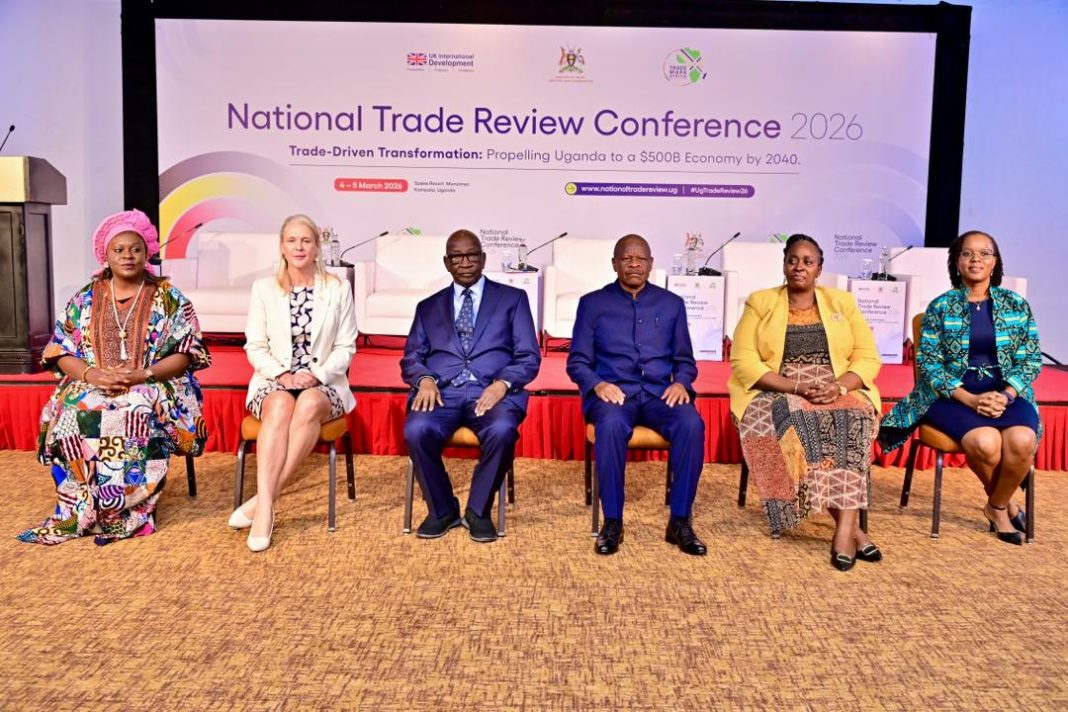
Uganda’s ambition to grow into a $500 billion economy by 2040 took center stage at the National Trade Review Conference 2026 held at the Speke Resort Convention Centre, Munyonyo, where the State Minister for Trade, Gen. Wilson Mbasu Mbadi, urged stakeholders to intensify efforts in driving trade-led growth and industrial transformation.
Addressing delegates under the theme “Trade-Driven Transformation: Propelling Uganda to a $500 billion economy by 2040,” Gen. Mbadi said the country’s trade and industrial reforms have laid a firm foundation for long-term structural change and prosperity.

He revealed that Uganda has registered historic export growth, with earnings surpassing $13.4 billion, alongside expanded industrial capacity across the country.
“Our trade and industrial reforms have established a strong base for achieving a $500 billion economy by 2040. The growth in exports and the expansion of industrial capacity demonstrate that Uganda is on the right trajectory,” Gen. Mbadi said.
The Minister credited strengthened quality and standards enforcement by the Uganda National Bureau of Standards for improving the competitiveness of Ugandan products in regional and international markets. He also pointed to enhanced export promotion initiatives spearheaded by the Uganda Export Promotion and Free Zones Authority as critical in widening market access for local producers.

Gen. Mbadi noted that Uganda has deepened regional trade diplomacy within the East African Community and the Common Market for Eastern and Southern Africa, while expanding access to strategic markets including the United Arab Emirates, the wider Middle East, China, and Europe.
He emphasised that the progress registered under the leadership of Yoweri Museveni, coupled with the strategic direction of the Minister of Trade, Industry and Cooperatives, has firmly positioned Uganda on the path toward structural transformation.
“The reforms we have undertaken are not isolated measures. They are part of a deliberate and coordinated strategy to drive industrialisation, expand exports and raise household incomes,”he said.
Gen. Mbadi urged participants to use the conference as a platform to reflect on achievements, strengthen coordination and accelerate implementation of the government’s Ten-Fold Growth Strategy.
He later invited the Minister of Trade, Industry and Cooperatives to deliver the official opening address, marking the next phase of discussions aimed at consolidating Uganda’s trade performance and fast-tracking its long-term economic ambitions.
Building on the Minister’s call for accelerated implementation, the conference also heard strong remarks from the Permanent Secretary in the Ministry of Trade, Industry and Cooperatives, Lynette Bagonza, who cautioned that Uganda’s long term ambitions must be anchored in real sector performance.
“A 500 billion dollar economy by 2040 will not be achieved by policy statements alone. It will be achieved by the strength of our industries, the productivity of our farmers and the ability of Ugandan goods to compete globally,” she said.
Bagonza pointed to macroeconomic stability as a critical enabler of trade expansion, noting that Uganda’s economy grew by 6.1 percent in the 2023/24 financial year, with inflation maintained within the 3 to 5 percent range and the fiscal deficit reduced to about 5 percent of GDP.
“These are important foundations. No country can expand trade sustainably without economic stability,”she said.
She highlighted the sharp rise in export earnings over the past five years, with exports growing from 4.5 billion dollars to 13.4 billion dollars. Imports also increased from 7.5 billion dollars to 15.7 billion dollars over the same period, a trend she said must be viewed in context.
“Most of our imports are machinery, fuel and raw materials. These are investments in Uganda’s future productive capacity, not simply consumption,”Bagonza explained.
On market distribution, she revealed that 38 percent of Uganda’s exports remain within Africa, underscoring the importance of regional trade. Beyond the continent, 26 percent of exports go to the Middle East, 20 percent to Asia and 13 percent to the European Union. More than 70 percent of Uganda’s manufactured goods, she added, are destined for regional markets.
Bagonza also placed Uganda’s performance within the broader global trade landscape. Global trade reached 33 trillion dollars in 2024, with services trade growing by 9 percent, outpacing trade in goods, while South South trade expanded by between 4 and 5 percent.
“For Uganda, these trends reinforce the importance of participating actively in regional and continental frameworks,” she said, urging policymakers and the private sector to position the country strategically within emerging global trade dynamics.