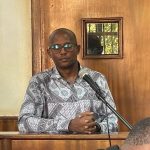
Former UPDF officer Michael Katungi Mpeirwe will be extradited to the United States next week after the Ugandan government has completed the final legal process authorising his surrender.
According to highly placed sources, all the necessary clearances have now been secured.

The planned transfer follows Justice and Constitutional Affairs Minister Norbert Mao’s signing of the surrender warrant on September 1, clearing the way for Katungi’s handover to authorised representatives of the US government to face terrorism, drug trafficking and firearms charges before the United States District Court for the Eastern District of Virginia.
Sources revealed that the process of extradition is now in its final implementation phase, with coordination between Ugandan authorities and US officials underway to facilitate his transfer from custody.
“The government has given the green light, and what remains is the logistical execution of the surrender in accordance with the law,” a source told Eagle Online.

Katungi was held at Murchison Bay Prison in Luzira after Buganda Road Chief Magistrate Ritah Kidasa Neumbe committed him to prison on August 28 pending the Minister’s final decision.
The extradition marks the conclusion of weeks of legal proceedings that saw the Director of Public Prosecutions successfully argue that the United States had met all the requirements under Uganda’s Extradition Act to seek Katungi’s surrender.
In the September 1 warrant, Mao invoked powers under Section 12 of the Extradition Act, Cap. 124, directing prison authorities to release Katungi to authorised US representatives.
“I hereby order that Michael Katungi Mpeirwe presently in lawful custody in Uganda shall be surrendered to the Government of the United States of America for the purpose of being conveyed to the United States of America to stand trial in respect of the specific offences for which his extradition was requested and authorised,” Mao stated in the warrant.
He further directed that the surrender be carried out in accordance with Uganda’s laws, applicable extradition arrangements and all governing conditions relating to the transfer.
Following the Minister’s decision, Buganda Road Chief Magistrate’s Court issued a release order directing the officer in charge of Murchison Bay Prison to release Katungi into the custody of officials facilitating his extradition.
The United States accuses Katungi of participating in an international criminal conspiracy involving cocaine trafficking, military-grade weapons and support for a foreign terrorist organisation.
He is expected to face three counts before the federal court in Virginia: conspiracy to distribute and possess with intent to distribute five kilograms or more of cocaine; conspiracy to possess firearms, including a machine gun and destructive device, in furtherance of a drug trafficking crime; and conspiracy to provide material support or resources to a designated foreign terrorist organisation.
US authorities allege that the designated organisation is the Cartel de Jalisco Nueva Generación, one of Mexico’s most powerful criminal organisations.
The court battle leading to Katungi’s extradition proved significant, with his defence raising several preliminary objections challenging the legality of the proceedings.
Among the issues raised were objections to the procedure used to initiate the extradition request, the authority of the Minister of Justice and Constitutional Affairs and the Solicitor General to process the request, claims of diplomatic immunity, and arguments that the Director of Public Prosecutions lacked legal standing to conduct extradition proceedings.
Chief Magistrate Neumbe dismissed all the objections.
The court ruled that diplomatic immunity applies only in the receiving state where a diplomat is accredited and does not shield a person from proceedings in Uganda or a third country, she ruled.
The court also affirmed that the Director of Public Prosecutions has the constitutional mandate under Article 120 of the Constitution to institute and conduct extradition proceedings on behalf of the State, she ruled.
During the proceedings, the court expunged an affidavit sworn by Michael D. Stanton after the deponent failed to appear for cross examination.
However, the magistrate found that the remaining evidence, including an affidavit by D/SSP Kule Yona together with authenticated documents submitted by US authorities, was sufficient to satisfy the committal threshold required under the Extradition Act.
The court further found that Katungi had been properly identified, that the offences were not political in nature and that the principle of dual criminality had been satisfied because the alleged conduct corresponds with offences recognised under Ugandan law, including drug trafficking, unlawful possession of firearms and terrorism-related offences.
“The evidence presented was sufficient to meet the legal threshold for committal under the Extradition Act,” the court held.
In her ruling, the magistrate emphasised that extradition proceedings do not require proof beyond reasonable doubt but only sufficient evidence to justify committal for surrender to the requesting state, she ruled.
The court also held that the absence of a Ugandan police investigation file did not invalidate the proceedings because the alleged offences were committed outside Uganda and were supported by duly authenticated documents from US authorities, she ruled.
His extradition will also be subject to the principle of specialty, meaning US prosecutors will only be permitted to try him for the offences specified in the extradition request approved by Ugandan authorities.