President Yoweri Museveni has urged NRM legislators to return to the grassroots, closely monitor Government programmes and ensure that interventions such as the Parish Development Model (PDM) deliver tangible benefits to ordinary Ugandans.
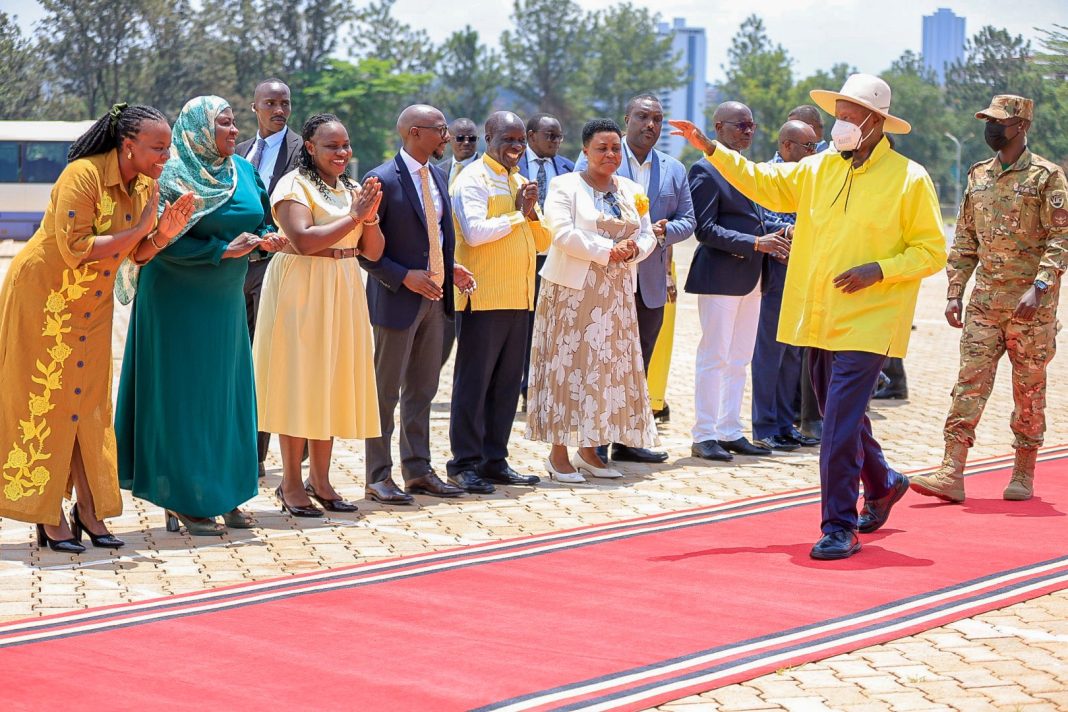
Museveni made the remarks on Friday, October 2, 2026, while addressing the NRM Parliamentary Caucus at Kololo in Kampala, where he challenged leaders to return to what he described as the “correct methods” of the NRM by following up Government programmes and ensuring that they reach the intended beneficiaries.

“I reminded our leaders to go back to the correct methods of the NRM, follow up Government programmes and make sure they reach our people,” Museveni said.
He singled out PDM as one of the key programmes that leaders must closely supervise, saying its success depends on whether the resources reach households and are invested in productive activities.
“This is why PDM must reach the people,” Museveni said, urging MPs to ensure that the programme delivers the intended economic transformation at parish and household level.

PDM is one of the Government’s major interventions aimed at moving Ugandan households from subsistence production into the money economy. The programme provides financing to organised groups and households to establish income-generating enterprises, with beneficiaries accessing loans of up to Shs1 million at an interest rate of 6% per year.
Museveni has repeatedly called on political leaders to monitor PDM on the ground instead of leaving its implementation entirely to technical officials. He has argued that MPs and other leaders should establish whether the funds are reaching beneficiaries and whether the money is being invested in productive enterprises.
The President also renewed his warning against the continued occupation and degradation of Uganda’s wetlands, directing that people who have settled in protected wetlands should leave while Government helps them adopt alternative sources of income.
“Those occupying them must get out. In Busoga, Bukedi and Kigezi, we shall help them move to fish farming, giving us income as well as water for irrigation,” Museveni said.
He linked wetland protection to the country’s agricultural transformation, arguing that Uganda cannot expand food production and irrigation while simultaneously destroying the natural systems that provide and regulate water.
Museveni has for years campaigned against wetland encroachment, repeatedly warning that the destruction of wetlands threatens water sources, agriculture and the environment. His Government has also promoted restoration of degraded wetlands and enforcement against illegal activities in protected areas.
His proposal to promote fish farming in Busoga, Bukedi and Kigezi is part of the wider effort to provide alternative economic activities to communities that depend on environmentally sensitive areas.
The President has previously promoted fish farming as an avenue for increasing household incomes and improving food security, while also creating an alternative source of income for communities that might otherwise depend on wetlands.
Museveni further told the NRM legislators that Uganda’s economy is projected to grow by 10.4% this financial year, which he attributed to what he described as following the correct economic path.
“By following the correct line, our economy is projected to grow by 10.4% this year. As the Bible says, you reap what you sow,” Museveni said.
The Government’s 2026/27 budget framework has projected strong economic expansion, supported by increased activity in agriculture, industry, services, infrastructure and the expected contribution of the oil sector.
Museveni said Uganda must now consolidate the progress by increasing investment and productivity across the sectors that generate employment, incomes and foreign exchange.
“We must now build on this progress by intensifying commercial agriculture, industry, ICT and services,” he said.
Commercial agriculture has remained at the centre of Museveni’s economic message, with the President repeatedly urging households to abandon subsistence farming and engage in enterprises that generate regular income.
He has similarly pushed industrialisation and value addition, arguing that Uganda must process more of its agricultural products locally instead of exporting raw materials.
ICT and services have also increasingly featured in the Government’s economic transformation agenda, with the sectors expected to create jobs for Uganda’s growing young population and expand opportunities beyond traditional agriculture.
Museveni’s latest message to the NRM Caucus therefore brought together several long-running priorities of his Government: ensuring that PDM reaches households, protecting wetlands, expanding irrigation and fish farming, promoting commercial agriculture and accelerating industrial and technological development.
He also reminded the legislators that their role goes beyond passing laws and attending parliamentary sessions, insisting that they must follow Government programmes into their constituencies and establish whether they are producing the intended results.
The emphasis on grassroots supervision comes as the Government enters another phase of its economic transformation agenda, with the President repeatedly arguing that Uganda’s development targets can only be achieved if public programmes are effectively implemented at community level.
For Museveni, the challenge before NRM leaders is now to ensure that the resources committed to Government programmes translate into productive enterprises, increased household incomes and broader participation in the money economy.