Government has capitalised the Uganda Development Bank (UDB) to Shs2.2 trillion, including an additional Shs442.2 billion injected into the bank during the 2026/27 financial year, to strengthen its capacity to finance industrialisation, export growth and strategic investments.
Finance Minister Henry Musasizi said the increased capital base will enable UDB to provide more affordable, long-term financing to businesses involved in agro-industrialisation, tourism, mineral-based industrialisation, science, technology and innovation.

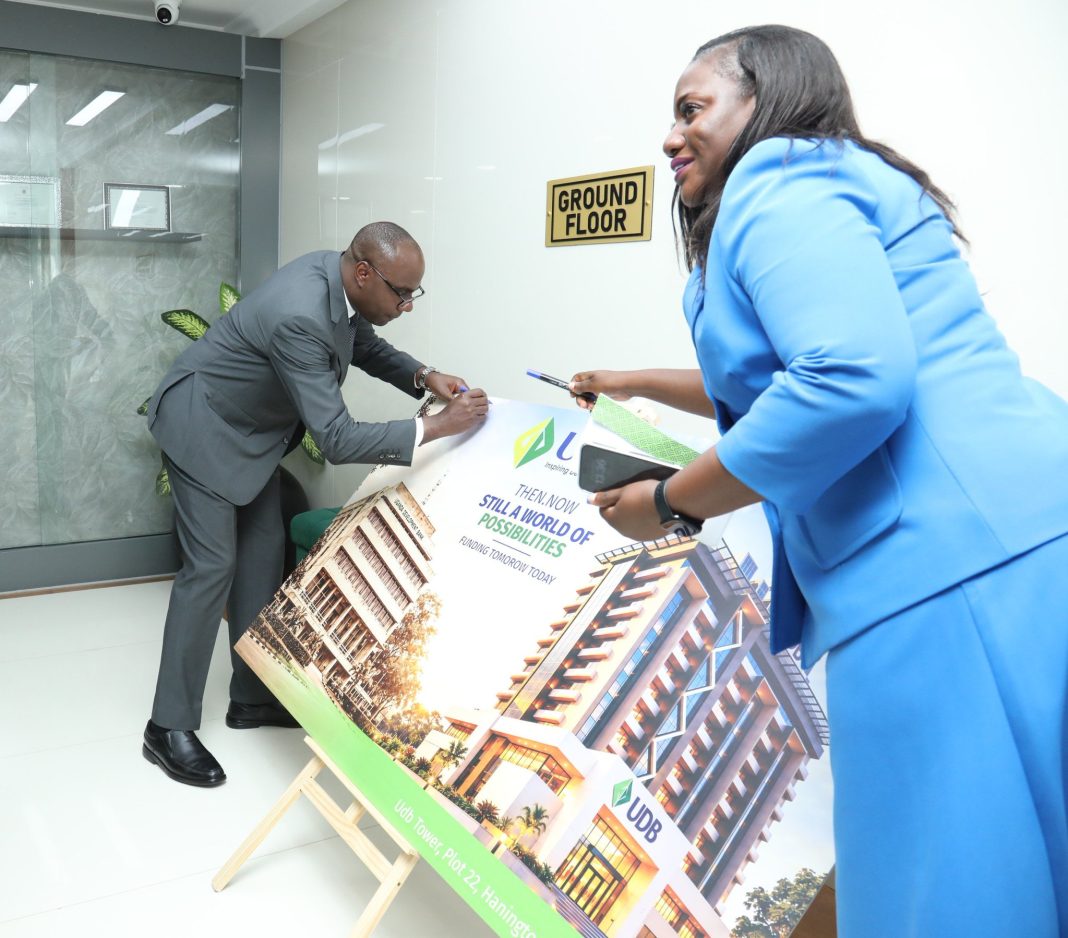
Musasizi made the remarks on Monday while officiating at the commissioning of UDB Tower, the bank’s renovated 14-storey headquarters on Plot 22, Hannington Road in Kampala.
He said UDB occupies a critical position in Uganda’s development architecture because it links Government’s development priorities to the capital required to turn them into productive investments.
“Uganda’s next phase of economic transformation requires strong institutions with the capacity to mobilise long-term capital and channel it towards productive investments,”Musasizi said.

The Minister said a stronger UDB would enable the bank to finance investments that expand Uganda’s productive base, create jobs, increase exports and improve household incomes.
Musasizi said the bank’s mandate is closely aligned with Government’s Tenfold Growth Strategy, which seeks to transform Uganda into a $500 billion economy by 2040.
He said achieving the target will require Uganda to mobilise substantial domestic and private capital, alongside foreign direct investment, to finance productive sectors of the economy.
The Minister also challenged UDB to expand its use of innovative financing mechanisms, including private equity, structured and project finance, corporate bonds, blended financing and public-private partnerships.
He said the bank should also use de-risking and credit-enhancement mechanisms to attract more private capital into sectors considered critical to Uganda’s economic transformation.
UDB Board Chairman Geoffrey Kihuguru said the new headquarters should not be viewed merely as a physical facility but as part of the bank’s long-term institutional investment.
Kihuguru said UDB must continue strengthening its governance, human resources, infrastructure and institutional capacity to mobilise capital and support productive enterprises capable of making a national economic impact.
“Our responsibility is to build a development finance institution that is not only relevant to Uganda’s needs today, but one that has the capacity and resilience to serve generations to come,” Kihuguru said.
UDB Managing Director Patricia Ojangole said the commissioning of the tower marks an important milestone in the bank’s institutional transformation.
She said the modern facility brings the bank’s staff and operations together while providing an environment designed to improve collaboration, innovation and service delivery.
Figures contained in UDB’s 2025 Development Impact Report show the economic contribution of enterprises financed by the bank.
The 525 enterprises assessed under the report generated Shs6.261 trillion in gross revenue, Shs1.158 trillion in net profit after tax and Shs387 billion in tax contributions.
The enterprises also created and maintained 69,202 jobs, including 50,221 jobs for young people and 27,641 jobs for women.
The businesses further generated Shs1.847 trillion in foreign exchange earnings, highlighting the contribution of UDB-financed enterprises to employment, government revenue and Uganda’s export capacity.
UDB currently has 904 direct customers and 112,399 total customers spread across 114 districts, with its operations covering three regions.
The bank plans to extend its geographical coverage to two additional regions during the current financial year as it seeks to widen access to development financing.
UDB Tower covers approximately 7,806 square metres across 14 floors and includes modern offices, customer-service facilities, meeting and training rooms, an innovation room, a boardroom and upgraded ICT infrastructure.
The building is also equipped with a 25-kilowatt solar-power system and smart energy-management systems, alongside features designed to maximise natural lighting and ventilation.