The National Water and Sewerage Corporation (NWSC) has announced plans to commission part of its ongoing water network expansion project in January 2027, offering relief to residents of Namugongo, Kasangati and surrounding communities who have endured disruptions caused by construction works.
The corporation says the wider rehabilitation and expansion of the Greater Kampala water distribution network is nearing an advanced stage, with the project expected to improve water supply reliability, reduce shortages and extend services to communities that have struggled to access adequate water.

The project is intended to address infrastructure bottlenecks that have prevented NWSC from fully utilising the production capacity of the Katosi Water Treatment Plant, which can produce 160 million litres of water daily but currently supplies only about half of that capacity because of limitations in the distribution network.
NWSC says the ongoing works will strengthen the transmission and distribution system, allowing more water to reach households and businesses across the Greater Kampala Metropolitan Area.
“Once completed, the improved network will enable the Corporation to distribute more of the water produced at Katosi, significantly improving reliability and extending supply to areas that have experienced persistent water shortages,” the corporation says.

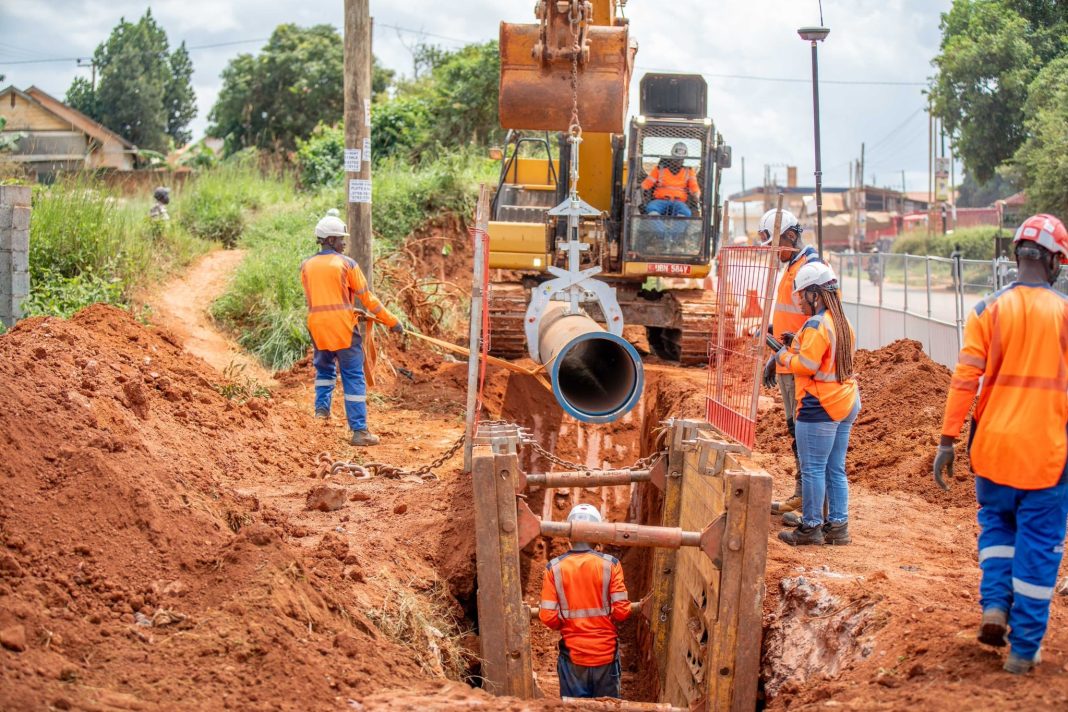
The project involves laying 69 kilometres of transmission pipelines, constructing water reservoirs at Kanyanya, Kabulengwa and Mutungo, establishing booster stations at Kungu and Kabulengwa, and upgrading the Supervisory Control and Data Acquisition (SCADA) system at major installations.
The expanded infrastructure is expected to benefit up to one million additional people in Kira, Kasangati, Namugongo, Buwaate, Bulindo, Mulawa, Gayaza, Matugga, Kawempe, Nansana, Wakiso and neighbouring communities.
The network is also being designed to accommodate the growing demand for water in Greater Kampala through 2040, as urbanisation and population growth continue to put pressure on existing infrastructure.
Although the entire project is scheduled for completion in August 2027, NWSC says residents in some areas will begin benefiting earlier, with the Namugongo-Kasangati pipeline earmarked for commissioning in January 2027.
Meanwhile, the corporation has acknowledged growing concerns among residents over damaged roads, excavations and other inconveniences arising from the installation of water pipes.
NWSC says road reinstatement works are expected to begin this month, with contractors instructed to restore sections affected by construction, including roads, road verges, walkways and other public infrastructure.
“Road reinstatement is part of the project, and contractors have been directed to ensure that all affected sections are properly restored once the pipe-laying and testing works are completed,” the corporation says.
Some restoration works have already started on gravel roads where pipeline installation and testing have been concluded, while additional sections will be handled progressively as construction activities are completed.
The corporation is also working with municipal authorities and the Ministry of Works and Transport to coordinate the restoration exercise and ensure that infrastructure affected by the project is addressed.
NWSC says it is prioritising utility corridors during the works to minimise the likelihood of future damage to roads and other infrastructure whenever water network maintenance or expansion is undertaken.
The corporation has appealed to residents to remain patient as contractors complete the remaining works, pledging that affected infrastructure will be restored to its original condition or better.
The project is expected to strengthen Greater Kampala’s water supply system, increase the number of households connected to the network and reduce the pressure on existing distribution infrastructure.
Its completion will also enable NWSC to make better use of the Katosi plant’s production capacity, ensuring that increased water production translates into improved access for communities across the metropolitan area.