
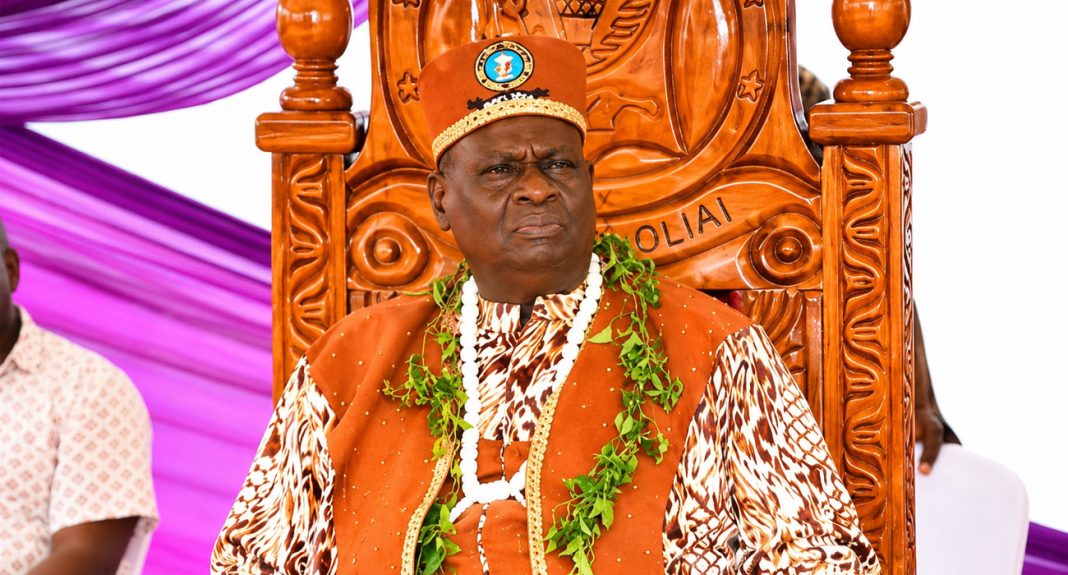
A group of Iteso clan leaders has petitioned the Ministry of Gender, Labour and Social Development seeking the withdrawal of government recognition of Paul Sande Etemoileng Emolot as the Emorimor Papa Iteso, accusing him of administrative incompetence, abuse of office, involvement in partisan politics and financial mismanagement.
The petition, submitted to the Minister of Gender, Labour and Social Development on November 1, 2026, and officially received by the ministry on November 18, 2026, calls for an investigation into the leadership and management of the Iteso Cultural Union (ICU), the institution responsible for preserving and promoting the cultural heritage of the Iteso people.

The petitioners, who identify themselves as legitimate clan leaders and custodians of Iteso culture, say the cultural institution has deteriorated under the leadership of Emolot, whom they accuse of turning an institution that once commanded respect into a politically influenced and financially mismanaged entity.
In their petition, the clan leaders argue that their complaint is not against the cultural throne itself but concerns the conduct of the person occupying it, whom they accuse of violating the ICU Constitution, the Traditional or Cultural Leaders Act and established customary governance principles.
“We, the undersigned clan leaders, being the legitimate and supreme owners of Iteso culture under Article 5 of ICU Constitution 2019, have watched with pain as Iteso Cultural Union under the current Emorimor Papa Iteso has collapsed from a respected cultural institution into a one-man, politically captured, failed managed and financially opaque entity,” the petition reads.

They further accuse Emolot’s administration of breaching the Constitution and abusing the authority attached to the cultural office, arguing that the alleged conduct has eroded public confidence in the institution and threatens the relationship between the Iteso community and its cultural leadership.
“This petition is not about the stool which we respect, it’s about the conduct of the holder of the Stool who has violated the Constitution, the Act, the Customary norms and leading to loss of public trust to the extent that Iteso may completely stop associating with ICU,” the petitioners state.
The petitioners say they have exhausted internal avenues of resolving the dispute, including cautionary letters, mediation by elders and intervention by religious leaders, but claim their efforts have not yielded results.
“We have exhausted all internal remedies, caution, letters, elders’ mediation, religious leaders’ mediation – all ignored. We now invoke your supervisory powers under section 21 of the Act,” the petition reads.
Among the key allegations raised are administrative incompetence, violation of Section 16 of the Traditional or Cultural Leaders Act relating to partisan politics, financial mismanagement, abuse of office and misappropriation of public donations.
The clan leaders also accuse the current cultural administration of breaching customary governance norms and its memorandum of understanding with the House of Elders, as well as illegally amending Iteso customs and the institution’s Constitution.
They want the government to withdraw its recognition of Emolot as the Emorimor Papa Iteso and remove him from office at the Iteso Cultural Union.
The petition also seeks government intervention to establish the circumstances surrounding the alleged financial and administrative failures, including a forensic audit of the institution’s finances.
According to the document, the petitioners are drawn from more than 148 clans domiciled in Soroti, Ngora, Kumi, Bukedea, Katakwi, Amuria, Serere, Kaberamaido, Kalaki, Kapelebyong, Tororo, Pallisa and the diaspora.
They include Auri anet, identified as clan leaders, Etem Ateker, described as the Council of Elders, members of the Ateker Women Union and youth leaders.
The petition identifies Emolot as the respondent and describes him as the Emorimor Papa Iteso of the Iteso Cultural Union, based in Soroti. It states that he was enthroned as the paramount chief of the Iteso and formally gazetted by the Government of Uganda.
In explaining why the Ministry of Gender should intervene, the petitioners cite provisions of the Traditional or Cultural Leaders Act, arguing that the government has a legal responsibility to ensure cultural institutions operate within the law.
They specifically refer to Section 10, which provides for government recognition of cultural institutions where they comply with the Constitution, and Section 16, which prohibits cultural or traditional leaders from joining or participating in partisan politics.
The petitioners argue that any cultural leader who engages in partisan politics is liable to withdrawal of recognition.
They also rely on Section 21 of the Act, which they say empowers the Minister to issue directions and institute an inquiry into the affairs of a cultural institution where there is a breach of the Constitution, abuse of office or administrative failure.
Additionally, they cite Article 16(2) of the 2019 ICU Constitution, which they say empowers the Ministry to intervene in disputes within the cultural institution.
Beyond seeking Emolot’s removal, the petitioners want the ministry to issue directions for a forensic audit, institutional reforms and protection of those who have raised complaints.
The proposed intervention is intended to address the breakdown in accountability and governance within the institution and restore confidence among the different clans that make up the Iteso community.