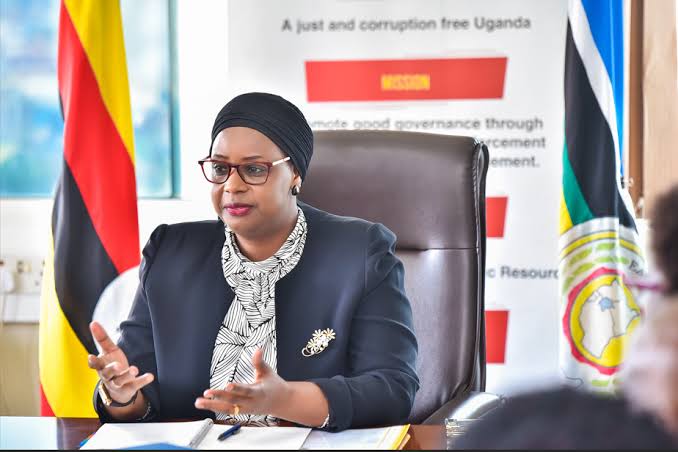
The Inspector General of Government Justice, Aisha Naluzze Bataala, has overseen the recovery of Shs83.55 billion and saved the government an additional Shs27.48 billion through investigations and interventions against corruption and misuse of public resources in her first year in office.
The two figures represent a combined Shs111.03 billion in recoveries and government savings, according to performance figures covering the Inspectorate of Government’s work during the reporting period.

The figures highlight the financial impact of the Inspectorate’s investigations, enforcement actions and interventions in government institutions since Naluzze assumed office on November 17, 2025.
The Inspectorate also separately reported recovering Shs16.69 billion in cash and physical assets, including five properties valued at Shs1.3 billion. It said 41 other properties had been frozen as part of efforts to prevent the loss or disposal of assets linked to investigations.
The performance report, covering November 17, 2025, to November 17, 2026, shows that the Inspectorate registered 3,931 new complaints, sanctioned 3,109 cases for investigation and completed 3,165 investigations.

Of the investigations concluded, 1,283 involved corruption, 1,061 concerned maladministration and other ombudsman matters, while 813 related to breaches of the Leadership Code of Conduct.
The enforcement figures also point to increased activity in the courts, with the Inspectorate filing 18 cases before the Anti-Corruption Division of the High Court, leading to 74 people being charged. It also secured 10 convictions out of 18 concluded cases during the reporting period.
At the Leadership Code Tribunal, the Inspectorate filed 72 cases and reported a 100 per cent conviction rate in the cases concluded.
The figures place both the recovery of public funds and prosecution of suspected offenders at the centre of Naluzze’s first-year performance.
Beyond prosecutions, the Inspectorate recommended compensation of Shs2.65 billion to individuals who suffered administrative injustice and reported that 384 administrative actions had been taken against errant public officers in ministries, departments, agencies and local governments.
These included 171 disciplinary and human resource management actions, 68 involving recovery of funds and financial accountability, and 30 concerning the recovery and protection of government property.
Another 60 actions related to project implementation and service delivery, including completion of stalled projects and correction of construction defects. Sixteen concerned public financial management and government programmes, particularly the Parish Development Model, while 26 involved institutional governance and administration.
The Inspectorate also intensified its monitoring of government-funded projects, inspecting 578 subprojects and identifying gaps in implementation which were forwarded to the respective accounting officers for corrective action.
It subsequently conducted 78 investigations into complaints arising from the monitoring exercises and inspections, with recommendations issued to address the identified weaknesses.
The interventions come at a time when government continues to face pressure to improve accountability in public spending and ensure that money allocated to development programmes translates into actual services for citizens.
Naluzze’s first year has also involved strengthening the institution’s operational capacity, particularly in transport, staffing and infrastructure.
When she assumed office, more than 80 per cent of the Inspectorate’s vehicle fleet was due for disposal, affecting field investigations, monitoring and operations across its regional offices.
The institution subsequently acquired 31 vehicles to improve staff mobility and enable investigators to carry out their work more effectively.
Staff numbers also increased from 409 to 427, representing an improvement in staffing levels from 77.3 per cent to 80.7 per cent of the approved establishment of 529 positions.
During the same period, the Inspectorate recruited 45 employees, promoted 38 officers and appointed seven officers to leadership and managerial positions, while filling 24 critical vacancies. The number of vacant positions consequently reduced from 120 to 102.
Her leadership has been guided by three principles which she outlined shortly after taking over the office.
“Integrity, Professionalism and Teamwork,” the IGG told the Inspectorate’s management team during her inaugural meeting in November 2025, saying teamwork would be central to advancing the institution’s anti-corruption agenda.
Naluzze was appointed by President Yoweri Museveni in October 2025, replacing Beti Kamya, whose tenure had ended. She officially assumed office on November 17, 2025, after being sworn in at a ceremony presided over by the President in Mbale.
Before her appointment, Naluzze served as a High Court judge in the Land Division, having spent approximately 18 years working with the Office of the Director of Public Prosecutions, where she rose to the position of Assistant Director of Public Prosecutions.
Her professional background in prosecution and judicial service gives her experience in handling criminal matters and the legal processes involved in pursuing public officials accused of corruption and abuse of office.
The Inspectorate’s institutional reforms have also included progress on its new headquarters located on Clement Hill and Yusuf Lule Road in Kampala.
The 15-storey office complex, whose construction began in July 2019, is estimated to cost Shs107.9 billion. According to the Inspectorate’s report to Parliament covering July to December 2025, construction had reached 86 per cent by December 31, 2025, against a planned 96.74 per cent.
The new headquarters is expected to reduce the institution’s reliance on rented office space. In September 2024, The Monitor reported that the facility was expected to save taxpayers Shs2 billion annually in rental costs once completed.
The Inspectorate is constitutionally mandated to investigate corruption, abuse of authority and maladministration in public offices, enforce the Leadership Code of Conduct and promote good governance.
Its latest performance figures are contained in a period during which the institution has continued reporting its activities to Parliament, including through its January to June 2026 report published on October 12, 2026.
However, the true measure of the Inspectorate’s performance will also depend on how effectively its recovery orders are enforced, how many public officials are successfully prosecuted, and whether government institutions implement its recommendations.