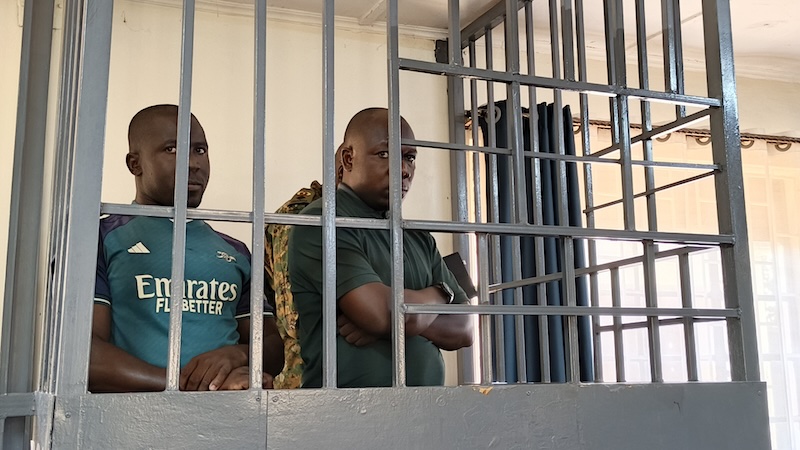
Two former security informers have been sentenced to death by the General Court Martial in Makindye for their involvement in a scheme that led to the deaths of two women in staged bomb operations at Munyonyo and Kalerwe in June 2025.
Hamza Lyavaala and Adil Walusansa were handed the death sentence on Wednesday, November 4, 2026, after the military court found that their actions in the two operations amounted to premeditated murder.

The court, chaired by Brig Richard Tukacungurwa, ruled that the offences were deliberately planned and executed, with the two men exploiting vulnerable women by recruiting them into purported suicide bombing missions without regard for their lives.
In his sentencing remarks, Tukacungurwa said the convicts had directly participated in delivering explosive devices to the victims and had willingly taken part in a second operation after the first one resulted in a fatal explosion.
“The two convicts intentionally delivered the bombs to the two victims. They directly participated in the fake suicide missions and, after the first one, willingly accepted to participate in the second one at Kalerwe Market. The death sentence is therefore justified,” Tukacungurwa ruled.

He added that the gravity of the crimes and the threat posed by the convicts to society outweighed the mitigating circumstances presented by their lawyers.
“The purpose of sentencing is not only rehabilitation but also must meet the ends of justice,” he said before sentencing both men to death.
The prosecution had asked the court to impose the maximum punishment, arguing that the murders were calculated, involved the exploitation of vulnerable individuals and were intended to create fear among the public.
However, defence lawyers Frank Kanduho and Maj Simon Nsubuga Busagwa asked for leniency, citing the convicts’ decision to plead guilty, their previous involvement in counter-terrorism operations and their cooperation with court proceedings.
The lawyers also presented their family responsibilities as mitigating circumstances, telling the court that Lyavaala had four wives and six children, while Walusansa had three wives and seven children.
The court acknowledged that the guilty pleas had saved judicial time and resources and considered their previous counter-terrorism work. However, Tukacungurwa ruled that these factors could not outweigh the seriousness of the crimes.
The court also considered Lyavaala’s history with the Allied Democratic Forces (ADF), including his recruitment into the rebel group in 2014 and subsequent arrest in 2022 over alleged involvement in its activities. Walusansa, on the other hand, had no known previous criminal record presented before the court.
The two were convicted on their own pleas of guilty after admitting to participating in the operations that led to the deaths of Sumayiya Byaruhanga and Azatu Sawiya.
According to prosecution evidence, the first operation was organised ahead of the June 3, 2025 Uganda Martyrs Day celebrations, with a planning meeting allegedly held about three weeks earlier at Gowers Gardens in Namulanda along Entebbe Road.
The prosecution told court that Lt Col Ephraim Byaruhanga, a former commander of special operations in the Chieftaincy of Military Intelligence (CMI), was involved in organising the operation and allegedly provided money to Lyavaala to find a woman who would be used in the mission.
Lyavaala subsequently travelled to Busoga, where he secured Sumayiya Byaruhanga, who was transported to a rented house in Kinawa, Nateete, as preparations for the operation continued.
Walusansa allegedly helped arrange accommodation for the group, while another individual, identified as Anthony Ssekalaala, was linked to the manufacture of the explosive devices.
On June 3, 2025, Sumayiya was transported to Munyonyo carrying an explosive device strapped to her body. The device exploded near Kagwa Bridge, close to Munyonyo Catholic Shrine, killing her and a boda boda rider who had transported her.
The prosecution alleged that Byaruhanga had informed the Joint Anti-Terrorism Taskforce (JATT) that a genuine terrorist operation was underway, prompting security operatives to respond to what they believed was an actual threat.
A second operation was allegedly organised on June 21, 2025, when another woman, Azatu Sawiya, was recruited and given an explosive device.
She was tracked by JATT operatives and later shot dead at Kalerwe Market before the device she was carrying could explode. The explosive device was subsequently detonated.
The prosecution maintained that the two operations were staged to create the impression that security agencies were dealing with genuine terrorist threats.
The case also attracted attention after Lyavaala made allegations during court proceedings that he had been pressured by military intelligence officers to implicate former CMI chief Maj Gen James Birungi in the alleged operations.
He accused Brig Gen Abdul Rugumayo of rejecting his initial statement because it did not implicate Birungi and alleged that he had been tortured before recording another statement. The allegations were presented as his testimony and have not been established as findings against Rugumayo.
The sentencing followed a series of dramatic developments in the proceedings. Lyavaala and Walusansa initially pleaded not guilty when they were jointly charged with Byaruhanga on July 6, 2026.
They later changed their pleas and admitted the two murder charges, leading to their conviction by the General Court Martial.
On October 12, 2026, however, the two attempted to withdraw their guilty pleas, saying they wanted to explain their roles in the incidents and testify about how they allegedly tried to save the victims.
The court subsequently heard their applications before the two changed their positions again on October 26, asking to maintain their original guilty pleas. Tukacungurwa accepted their decision and confirmed their convictions, paving the way for sentencing.
Their sentencing, initially scheduled for November 2, was postponed after the court failed to sit because one of its members had lost two relatives and the panel was therefore not fully constituted.
The court eventually delivered the sentences on Wednesday, November 4, giving both men 14 days within which to appeal.
Byaruhanga, who has denied the charges, remains a co-accused and is expected to face a separate trial over the alleged operations.
The case has raised serious questions about the conduct of intelligence operations and the alleged misuse of counter-terrorism activities, particularly where security operatives are accused of staging threats rather than preventing genuine attacks.