
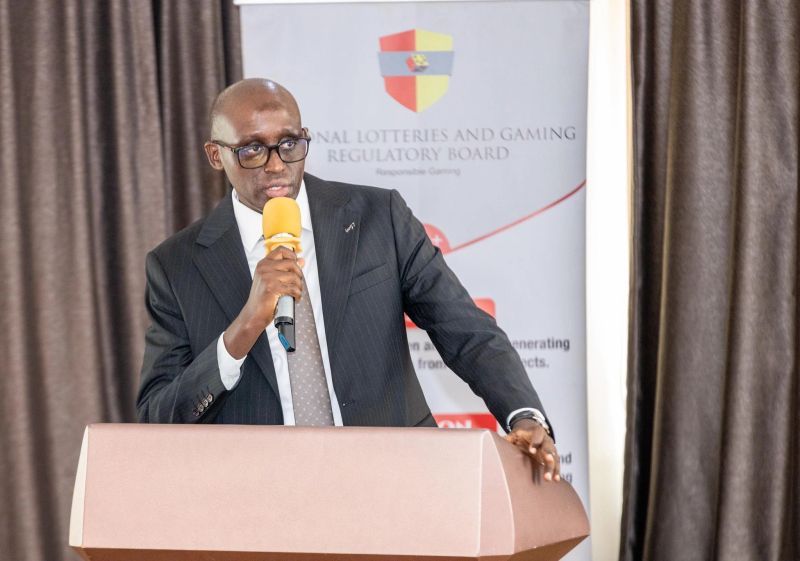
The National Lotteries and Gaming Regulatory Board (NLGRB) has warned betting companies and social media influencers against misleading gambling promotions targeting vulnerable people, particularly low-income earners, youth and school-going children.
The Board’s Chief Executive Officer, Denis Mudene Ngabirano, said the regulator was strengthening public protection through enforcement against illegal gaming activities, public sensitisation and tighter oversight of gambling advertisements on digital platforms.

Ngabirano said aggressive promotions on platforms such as TikTok and X risk misleading audiences about their chances of winning, especially when gambling is portrayed as an easy way to make money.
“Our public protection mandate applies equally to digital platforms, including TikTok and X. We assess whether promotions are accurate, communicate the risks and avoid misleading audiences about their chances of winning, with particular attention to vulnerable groups,” Ngabirano said.
He cautioned that gambling should never be marketed as a solution to poverty or an alternative to employment, warning that betting can become addictive and expose players to financial and psychological harm.

“Gambling must not be presented as a reliable route out of poverty or as a substitute for work. Promoting an individual win must not imply that others are assured of similar outcomes. Gaming is a game of chance, can be addictive and can cause psychological harm. Our message is to play responsibly and never use money needed for essential expenses,” he said.
The CEO said gaming operators were required to comply with the Lotteries and Gaming Act, Cap. 334, the Lotteries and Gaming (Betting) Requirements, 2017, and the regulator’s Advertising Guidelines.
He said the Board was also working with the Uganda Communications Commission to address illegal advertisements and ensure that online promotions meet the required standards.
“When illegal advertisements are brought to our attention, we liaise with the Uganda Communications Commission to have media houses block them. For online advertising, Google requires a letter of no objection from the National Lotteries and Gaming Regulatory Board,” Ngabirano said.
Beyond regulating advertisements, the Board has stepped up enforcement against illegal gaming operations, including the confiscation and destruction of unlicensed slot machines that expose players to unregulated gambling.
The regulator reported that it had confiscated 10,020 illegal gaming machines over the five years preceding November 2026, with 6,749 destroyed under court orders.
In May 2026, the Board also seized 169 illegal gaming machines during an enforcement operation across West Nile, targeting operators conducting gaming activities without the required licences.
The Board has worked with the Uganda Police Force and the National Enterprise Corporation to carry out enforcement operations and destroy confiscated machines.
The crackdown is intended to eliminate unlicensed gaming operations, protect players from exploitation and ensure that businesses in the sector operate within the law.
Ngabirano said public education was equally important in addressing gambling-related harm, particularly among young people who are increasingly exposed to betting advertisements and promotions.
The Board has intensified sensitisation campaigns in schools and communities, reaching 50,026 students across the country since 2025. Other groups targeted include market vendors, boda boda riders and corporate employees.
The campaigns seek to educate the public about the risks associated with gambling, responsible gaming practices, the dangers of illegal betting operations and the importance of seeking help where gambling becomes problematic.
The regulator has also encouraged members of the public to report suspicious gambling advertisements and illegal gaming activities, urging them to preserve screenshots, account names, links and dates to support investigations.
On complaints involving betting companies that refuse to pay winnings, Ngabirano said players had a right to seek explanations and challenge decisions where they believed an operator had unfairly withheld their money.
He explained that payout disputes could arise from identity verification, disagreements over settlement, technical faults, suspected fraud or disagreements over applicable terms and conditions.
“These are matters to investigate, not automatic grounds for accepting an operator’s refusal to pay,” he said.
He advised affected players to first submit written complaints to the betting operator and retain all supporting documents before escalating unresolved cases to the regulator.
“An affected participant should submit a written complaint to the operator and retain the reference. They should preserve the betting ticket or transaction number, screenshots, account history, withdrawal request and relevant correspondence. If the matter remains unresolved, they should bring it to the Board through its official complaints channels, info@lgrb.go.ug, or call 0800285800 for consideration under the applicable procedures,” Ngabirano said.
He also cautioned players against sharing passwords, mobile money PINs or one-time security codes when seeking assistance over disputed winnings.
The Board is mandated under Section 4(m) of the Lotteries and Gaming Act, Cap. 334, to receive, investigate and arbitrate complaints relating to lotteries, gaming, betting and casinos.
Ngabirano said every legitimate complaint must be handled fairly, with decisions based on evidence rather than assumptions.
“A legitimate complaint deserves a fair hearing, a clear explanation and an outcome grounded in evidence,” he said.