Stanbic Bank
Stanbic Bank
26.3 C
Kampala
Stanbic Bank
Stanbic Bank
Home Blog Page 1026

Uganda Premier League club owners revealed

Uganda Premier League logo

Federation of Uganda Football Associations (FUFA) has released information about the details of club ownership in the Uganda Premier League ahead of the 2020/21 football season.

The Uganda Premier League comprises of 16 clubs playing 30 games each in the season. The team with the most points at the end of the season is declared champions

At the end of the season, three teams are relegated and these are replaced by the same number of teams from the FUFA Big League (Second division).

In Uganda, there are four types of club ownership and each club aligns its ownership by choosing one of the 4 models. These are; Institutional clubs, Private clubs, Community-based clubs and Hybrid clubs

Institutional Clubs: These are owned by a government institution that is created by an act of Parliament or a Government parastatal. This model is principally setup as a PR and or CSR tool for the institution.

URA FC: Uganda Revenue Authority Football Club is fully owned by the tax collecting body.

KCCA FC: Started 1963, the club belongs to Kampala Capital City Authority, the body that is responsible for operations in Uganda’s capital city.

Police FC: The 2005 league winners are fully owned by the Uganda Police Force

BUL FC: The Jinja based club belongs to BIDCO Uganda Limited, a consumer goods company.

UPDF FC: Uganda People’s Defence Force Football Club (UPDF FC) formerly Simba FC is owned by the Army institution.

Private Clubs: Owned by a shareholding of natural and/or legal persons. This model is principally setup for football business purposes

Vipers SC: The four-time league champions are owned by three individuals. These include Dr. Lawrence Mulindwa (90%), Tadeus Kitandwe (5%) and Haruna Kyobe (5%).

Bright Stars FC: Bright Stars FC is owned by five persons namely; Soltilo (U) Limited (70%), Ronald Mutebi (19%), Ahmed Hussein (6%), Joseph Mubiru (3%) and Tadec Miiro (2%).

Mbarara City FC: This is owned by Hon. Mwine Mpaka Rwamirama who is also the Member of Parliament representing the Youth in the Western region.

Wakiso Giants FC: Wakiso Giants FC is owned by two people namely; Hassan Lule and Ahmed Mbabi.

MYDA FC: The newly promoted side is owned by five people that include Andrew Matovu (55%), Abdulahi Mohamadi (30%), Baker Musaazi (5%), Elisha Madanda (5%) and Catherine Nabweteme (5%).

Onduparaka FC: Based in Arua City in the West Nile region, Onduparaka FC is owned by Benjamin Nyakuni with majority share of 60% while Joe Erema has 40% shares.

Community Club: Owned by a membership of more than 100 or so fans. This model is setup for sport but proven most suitable for posterity and sports business.

Express FC: Express FC is owned by Express Sports Club limited.

SC Villa: SC Villa are the league record champions with 16 titles. The Club is owned by Sports Club Villa Limited.

Hybrid Model: A combination of the above models. This model is normally a compromise position of various inherited ownership, challenging to find suiting governance model practices.

Kyetume FC: Kyetume FC has elements of private and Institution. The 5 owners include; Reuben Kimera((60%), Hogi Nsubuga(21%), Kyetume CBHC Programme(15%), Henry Titus Kayondo(3) and David S. Kikabi(1%).

Busoga United FC: The majority shareholder at Busoga United FC is Dinah H.T Nyago with 51% shares. Jinja SS (board) has 35% while Busoga Kindom, Dr. Joseph Muvawala, Fredrick Gume Ngobi, Godfrey Bwire Osodo, Daniel Oketch, Robert Adotu and Samuel Mugabi have 2% each.

Stories Continues after ad

Yoweri Museveni’s sterling role in Uganda’s reconciliation journey

Amb. Mayega

By Amb. Henry Mayega

In order to end the impact of the horrendous tide of violence and dissension of the pre-1986 period and spur national reconciliation, Yoweri Museveni, Uganda’s best president, has over the years reached out to many of his opponents both armed and the purely political elite.

Before 1986, lack of rule of law, veritable usurpation of judicial authority by the executive arm, coups as well as take overs had conspired to, almost, turn us into a failed state and the level of citizens’ estrangement had reached fever point.

To spur reconciliation and national unity, yet many did not have similar qualms as Yoweri Museveni about that propitiation, he has over the years taken the following tread-boards:

First, right from the origination of his administration in 1986, he formed the broad-based government to calm the nerves of nationals who had suffered the brunt of insecurity for far too long ; that brought together politicians of all stripes drawn from UPC, DP, CP, monarchists, communists et al to work with his administration.

That cohabitation, one of Yoweri Museveni’s finest knacks, remarkably unheated the tempers of oligarchs from independence parties who had been pulling our country apart and for the very first time UPC and DP found themselves on the same side of the political aisle!

Secondly, Yoweri Museveni’s efforts to reconcile country men and women can be traced to the time when several fighting groups sprang up in parts of the country after 1986; including the UPDA, UPA, LRA, UNRF, Kirimutu’s rag-tag and Itongwa’s rebels etc.

Remnants of those demented and unhinged fighting groups were integrated, for re-schooling, into, initially, the NRA which later morphed into the UPDF; the alternatives would have been dire. This president, meticulously, took tread-boards to negotiate with those groups yielding the desired effect; for the first time guns went silent in the country.

Kiiza Besigye and Bobi Wine (a man who can’t explain basic economic concepts like inflation) whose job it has been to de-calibrate the president’s reconciliation initiatives should not be begrudged though because such propitiation by the president triggers tremors amongst their rank and file. Never did our country have such a fresh start at reconciliation since independence in 1962.

Thirdly, some less studious upstarts have failingly tried to down play the role of the LC structures in reconciling nationals of divergent political views; those structures, first applied in the bush war of 1981 – 1986, were particularly instrumental in pacifying the country by mobilizing nationals to co-exist.

The youth, women, workers and the disabled were brought to the fore of politics and got integrated with the other segments of the political elite drawn from all shades of political opinions and together they worked to preserve peace and reconciliation.

Fourthly, the New Vision of July 20, 2020 reported thus, “President visits Paul Muwanga’s family,” and earlier, the same paper had reported a meeting between him and “rebel MPs.” By meeting those MPs, he exhibited determination to preserve the culture of tolerance in the public sphere and validated the Biblical verses about lost sheep in Luke 15: 3-7.

Besides meeting former Vice President Paul Muwanga’s pedigree, he has reached out to genealogies of former heads of state; including the Mutesas, the Obotes, the Amins, the Okello Lutwas no matter whether they, politically, agreed with him or not. So, the  slow-witted and hare-brained tumult, from some that this President does not value reconciliation as imputed by a one Daniel Kawuma who stays in the US,  simply validates the dictum that a “far-away stick cannot kill a snake.”

The Bobi Wines should, without jaundiced eyes, look into the past when regimes would bludgeon their noisy and nauseating opponents to death and dump their bodies in Namanve thickets; which is, in these splendid times, an industrial park! I have heard Bobi Wine referring to President Museveni as a dictator, hopefully he comprehends the meaning of that locution!

Amb. Henry Mayega

Deputy Head of Mission

Uganda Embassy, Beijing, China

Stories Continues after ad

Young people confident in their skills to thrive despite COVID-19 slump

Youth as these need specialised skills to attain their potential.

A Standard Chartered survey finds that COVID-19 is significantly impacting personal finances globally, with one-third already earning less and more than half expecting the pandemic to further affect their income and/or employment. Yet young people (18-34) and those in emerging markets are the most confident in their digital skills and prepared to adapt and work harder to realise opportunities in a post-COVID-19 world.

The study of 12,000 adults across twelve markets offers insights into their financial wellbeing and employment outlook in these challenging times, and how banks can play a role in helping them manage their money.

It reveals a stark contrast between the financial reality that people face and their confidence in the future. This can be explained by a willingness particularly among young people and those in emerging markets to work harder, take steps to adapt income streams, and re-skill if they can, in order to earn more.

People in emerging markets, and the young, more confident in their digital skills and willing to adapt their approach to work post-pandemic, reveals new global survey

Young people are particularly confident, with 80% of 18 to 34-year olds feeling they have the digital skills needed to thrive post-COVID-19 compared to 63 per cent of those over 65. And, with many graduating or leaving school in the midst of a global recession, younger generations are also more willing, or able, to adapt to the current circumstances. For example, 75 per cent of 25 to 34-year-olds would consider setting up a second income stream compared to 40% of those over 55; and 72 per cent of all 18 to 44-year olds would re-skill compared to 37 per cent of those aged 55 and above.

Millennials and Generation Z are also more likely to respond to the crisis by starting a new business. 52 per cent of those aged 18 to 44 would consider doing so in the next six-months compared to 30 per cent of those 45 and above.

Globally, this level of flexibility, adaptability and entrepreneurialism tends to decrease with age, along with confidence, despite or perhaps because older generations are more established in their careers.

The divide is even more stark when comparing developed and emerging markets. Those in established global economies are not only less confident they have the digital skills needed to thrive amidst the downturn, they are also less willing to adapt and take steps to increase their income.

More than 88 per cent of people in Kenya, Mainland China, India and Pakistan said they would prefer to work more to get ahead than reduce their hours for less pay. Meanwhile, the UK and the US had the highest proportion of people who valued free time over more money (38 per cent and 33 per cent) respectively.

In terms of personal finances, respondents in Kenya (93 per cent), Mainland China (85 per cent), Malaysia (83 per cent) and India (82 per cent) report the highest proportion of people who want to better manage their money, to make it go further.

And while the pandemic has acted as a catalyst for the growth of online banking, with more than half globally using online services more, the shift has been more apparent in fast-growing markets. For example, increased use of mobile devices for banking services is most prominent in India (79 per cent), the UAE (72 per cent), and Kenya (69 per cent). Fast-growth markets are also more likely to want their banks to help improve their confidence at managing money digitally as they increasingly look to bank online Kenya (91 per cent), India (84 per cent) and Indonesia (84 per cent).

There is one clear area of almost unanimous agreement; a global desire for more flexibility when it comes to working arrangements post-COVID-19. For those for whom it is applicable, 71% would prefer to continue working from home at least two-days a week once restrictions are lifted and 77 per cent want more flexible working arrangements.

A 10 minute online survey of 12,000, 18+, nationally representative respondents across 12 markets  Hong Kong, Taiwan, Mainland China, Singapore, Indonesia, Malaysia, India, UAE, Kenya, Pakistan, the UK and the US was conducted between Friday, July 3rd and Monday, July 6th 2020.

Results are weighted on the latest national census in each market by age, gender and macro- region and should be considered representative of the online population.

Standard Chartered is committed to empowering young people to have the right skills to meet their full potential. Future makers by Standard Chartered is our global initiative to tackle inequality and promote greater economic inclusion in our communities. We provide young people from low-income households, particularly girls and people with visual impairments, with opportunities for skills development.

Stories Continues after ad

Ronald Mayinja apologises to Bobi Wine, joins NUP

bobi wine and mayinja

Singer Ronald Mayinja has apologised to the Kyadondo East MP Robert Kyagulanyi aka Bobi Wine and asked to join National Unity Platform (NUP). He was welcomed by the party president at their headquarters in Kamwokya on Thursday morning.

Mayinja, commonly known for lyrics such as Tuli Kubunkeke, literally meaning we are on tenterhooks, was a die-hard of the People Power, political pressure group led by fellow artist Bobi Wine.

“I was duped, am sorry, I beg to return home,” He apologized, adding that he is not in NUP to stand for any elective position but to participate in the growth of democracy in Uganda.

According to him, Mr. Museveni is exhausted and has no zeal of leading the Country. “I met him with the secretary general of National resistance movement (NRM) Justine Kasule Lumumba. I told her to leave us alone. I asked him of any plans taking us and Uganda forward and he didn’t have any.”

He went silent days after meeting President Museveni at Serena hotel in Kampala. The two met during Catherine Kusasira’s concert. During the concert the singer told Museveni off in his song ‘Bizzemu’ loosely meaning that what prompted you to take-up guns in the 1980s which included corruption, bribery, rigging of elections, is happening in his regime.

As he was taking on Mr. Museveni, Kusasira who had invited the president as the guest of honor tried to grab a microphone from the Mayinja, however she failed.  He was praised for being courageous to take on the president.

When he took up the microphone, Museveni said he disagreed with Mayinja who was saying ‘Bizeemu’ is as if the NRM government is committing crimes against its people. “I advise the artists to use their talents in ways that do not sow divisions based on lies,” he said.

Museveni further explained that the government of Uganda was working against all the threats and crimes against Uganda and her people.

Few days later, it was reported that the Bizeemu Singer met with the president at state house Entebbe and got a number of pleasantries in a bid to lure him from Bobi wine’s People Power. It is averred that Mayinja was given a brand new Toyota Prado and hundreds of millions.

He later resurfaced launching Peace for All, All for Peace, a movement advocating for peace and co-existence among Ugandans. The movement intended to carry out nation-wide tours to sensitise Ugandans on the importance of peace, compose music that promotes peace in different local dialects, and downplay divisionism.

Stories Continues after ad

Musicians petition Parliament over new rules and regulations

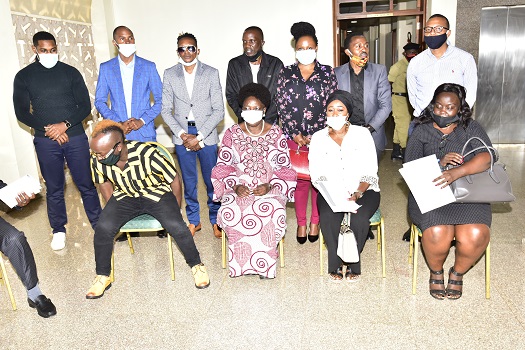
Performing artists under the National Union of Creative Performing Artists and Allied Workers have reached out to Parliament over the recently issued regulations to their industry terming them as draconian.

The group led by musician, Halima Namakula, met the Speaker of Parliament, Rebecca Kadaga, and argued that the new regulations will encumber the activities of the entertainment industry.

The meeting was held at Parliament Building on Tuesday 4 August 2020.

The National Union of Creative Performing Artists and Allied Workers includes actors, comedians, film producers and musicians from the entertainment industry.

The Stage Plays and Entertainment Rules 2019 issued by Uganda Communications Commission (UCC) requires that all content produced for film, stage and music content must be scrutinized by the Commission in order to maintain standards in the industry.

The petitioners said that the rules are a reincarnation of the Colonial Stage Plays and Public Entertainment Act 1943, which was aimed at curtailing the performing artists agitating for independence.

“The Constitution provides us the right to practice our profession for economic gain without any bias, be it political or not; so we should be allowed to practice freely,” said Hannington Bujjingo a comedian.

He said that the entertainment industry needed an umbrella body that understands its operations and to which issues of concern are addressed.

Speaking as a patron, Hon. Charles Bakkabulindi (NRM, Workers), said that Government needed to invest in the entertainment industry in order to earn from it.

“I reiterate the importance of having a government authority to help deal with the issues that performing artists face every day,” he said.

Alex Muhangi, another member and comedian said that it is unjust and unfair for the government to go through UCC to micro-manage everything artists do.

Speaker Kadaga said that the regulations regarding the Government censorship of performing arts products were passed without much scrutiny but can still be revisited for review.

“It is unfortunate that we did not thoroughly internalize these regulations when they are being passed. However, I will instruct the Committee of ICT to handle the matter and provide public hearings to your union,” she said.

Kadaga also said that it is important for the entertainment industry to have a ministry through which their issues will be addressed and present to the Cabinet. She promised to ask the President to consider appointing a ministry to the task.

Stories Continues after ad

MPs approve Shs868b loan for countryside roads

State Minister for Finance Mr David Bahati

A $235.4 million loan, which translates to about Shs868b has been approved by Parliament for the construction of a host of roads.

The roads are Namugumba – Budadiri – Nalugugu (29km), Katuna – Muko -Kamuganguzi road (104km) and Laropi – Moyo – Afoji (Sudan border) which is 37km.

Making a case for the loan, the Vice Chairperson of the Committee on National Economy, Hon Lawrence Bategeka said the roads will “enhance socio-economic growth of the project areas by provision of the area by attracting investments.”

MP Nandala Mafabi (FDC, Budadiri West) opposed the loan, arguing that the Namugumba – Budadiri – Nalugugu stretch should have covered the trail leading to Mount Elgon.

“If you really wanted to pay the people of Bugisu, you would have made the road up to Mount Elgon; because the coffee we produce supports the economy,” he said.

Speaker Rebecca Kadaga also took issue with the loan, saying Government has not paid extra attention to other areas where the road network is not satisfactory.

“It [the loan] was packaged in such a way that you cannot refuse; and the Gen [Minister of Works and Transport, Katumba Wamala] should tell us why there has not been a new road in North Busoga for the last 25 years,” she said.

Gen Edward Katumba Wamala, however, came to the defense of Government, promising to provide statistical evidence on the roads that the Ministry is constructing in the country.

“We are balancing the construction of roads in the country and I will come back and show for the next five years how the roads are going to be constructed region by region,” he said.

Hon. Jesca Ababiku (NRM, Adjumani district) supported the loan, saying it will support the livelihoods of the people.

“The roads that are going to be constructed are going to impact positively on the livelihoods of our people; the request is going to make our road from Atiak to Afoji complete and promote cross-border trade,” she said.

MP Bategeka, however, warned that the loans being acquired has increased the public debt and will only make sense if they facilitate investment to grow the economy.

“The recent loans acquired by Government and approved by Parliament during the Covid-19 pandemic could possibly push the ratios up in part due to weaker fundamentals including slower growth, exchange rate depreciation, weaker exports and a fragile domestic revenue base,” he said.

Stories Continues after ad

Judiciary PS Bigirimana asks CIID to probe lawyer Kasirye over fraud

Advocate Andrew Kasirye

The Secretary to the Judiciary Pius Bigirimana has written to Grace Akullo, the Director of the Criminal Investigations and Intelligence Department (CIID), directing that city lawyer Andrew Kasirye be investigated over US$ 48, 294, 26(about Shs 17b) that was paid to him.

In a letter, Bigirimina revealed that the of US$ 48, 294, 26(about Shs 17b) was paid to Kasirye, Byaruhanga and Co Advocates in favor of Entebbe Handling Services.
“Investigate whether these payments were fraudulently requisitioned or were genuine,”Bigirimana directed.

Court documents seen by Eagle Online show that on 16th January 2020, a request of US$ 48, 294, 26 (about Shs 17b) vide MIsc.Appln. 751 of 2009 arising from HCCS 495 of 2000 Entebbe Handling Services vs. Uganda Fish Parkers Limited was made.
The money was paid to Barclays Bank, Hannignton Road Branch, and Account No 6003645574 under the account name of Kasirye, Byaruhanga and Co Advocates.

Bigirimina’s letter indicates that the payment was again originated by a Court order signed by H/W Dr Agnes Nkonge.The requisition was originally made by H/W Tom Chemutai
On July 10th, Akullo wrote back to Bigirimana saying that she had directed D/ASP Twino Mansio Charles to handle the investigation.
The directive by Bigirimana to investigate will pile more pressure on the beleaguered city lawyer as security is conducting a separate investigation on him after it emerged that he tried to frustrate an inquiry by the Director of Public Prosecutions (DPP) on Mr Benedict Sekabira, Bank of Uganda’s Director for Financial Markets Coordination.

Stories Continues after ad

DPP withdraws charges against MP Francis Zaake

Francis-Butebi-Zaake

The Director of Public Prosecution (DPP) Jane Frances Abodo has withdrawn all charges leveled against Mityana Municipality MP Francis Zaake Butebi.

“This is to inform Mityana Magistrates Court that the DPP has decided to discontinue proceedings against MP Francis Zaake Butebi,” the DPP said.

The MP was grappling with charges of negligent act likely to spread infectious diseases contrary to section 171 of the Penal Code Act and disobedience of lawful orders contrary to section 117 of the Penal Code Act.

The MP was arrested in April for giving out relief food to his constituents a few days after President Museveni had announced the lockdown which aimed at stopping the spread of the deadly covid-19.

He was brutalized by security officers before aligning him before Mityana Grade one Magistrate. The magistrate however ordered security officers to first code the frail and ailing MP with treatment before he appears before the honorable Court. He was then released on police bond and is currently walking on sticks.

That was not the first time Zaake was brutalized. In 2018 he was brutalized by security forces in Arua as he campaigned for Arua Municipality MP Kassiano Wadri. He was charged with unlawful escape from police custody. Arua Grade one Magistrate, Mr Swaleh Asiku later acquitted him.

Stories Continues after ad

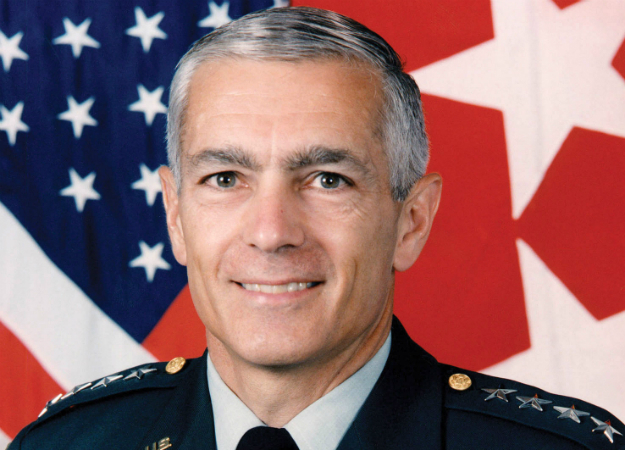
Gen. Wesley Clark should stop fooling Ugandans

Gen. Wesley Clark


I have been working in the Ministry of Finance, Planning and Economic Development and formerly in State House for some time but I am surprised today when I say top government officials and the #Covid-19 committee members praising Gen. Wesley Clark as a freedom fighter for Africans.

How really do you celebrate a donation of $100,000 when the so-called donor is taking away millions of dollars from you? Gen. Clark through his briefcase companies that don’t even go through procurement processes have been siphoning lots of our resources back their countries through dubious dealings. Ugandans and Africans have been fooled enough. He is the man behind the dubious SICPA company that was given a tender to supply stamps to Uganda Revenue Authority without being submitted to any procurement rules and at the same time, the tax payer has as of today paid Shs90 billion. Uganda government first paid Shs30 billion and just recently not even a month, an additional Shs60 billion was released to SICPA owned by him.

In their top management recently, Ministry of Finance rejected SICPA quality of stamps and the reason is that they are of low quality and overpriced. It was also revealed that the stamps are overpriced with each stamp going for Shs130 instead of Shs35. Through his agents, Gen. Clark and SICPA lied are to be paid Shs340 billion annually from the tax payers and yet had his company been subjected procurement, there would be value for money.

The argument is that why can’t Gen. Clark if he loves Uganda more than us print those stamps and empower our people with jobs? In their submission to the Ministry of Finance, they indicated that after government pay Shs340 billion, they would make a profit of Shs800 billion but they are running back to government to milk the unsuspecting tax payers.

Gen. Clark and his agents through their company GVG were given over $26 million by government of Uganda to supply an equipment meant to monitor telephone companies. The same equipment was overpriced but the news is that the equipment failed to work and yet Gen. Clark and his commission agents were paid. In a joint security meeting by chiefs and Uganda Communication Commission, his equipment was rejected as well like Tanzania did but who is going to compensate for the money lost?

I would wish to request the United States government to investigate such people like Gen. Clark who come her in Uganda and more Africa and in turn steal from here and yet claim to be clean and corruption free.

Gen. Clark is a director of companies in Switzerland and most of them have exploited Africa through their agents who collect commission on behalf of heads of states. Uganda ought to have done a due diligence on some of these companies before giving them contracts. Tanzanian President John Pombo Magufuli chased one of Gen. Clark’s companies. Most of his companies have dented with corruption scandals.

Dr. Magufuli suspended the head of the country’s telecoms regulator and disbanded the board, claiming the organisation has failed to monitor the industry and gather revenue for the state.

According to the office of the president, the Tanzania Communications Regulatory Authority (TCRA) installed a traffic monitoring system Global Voices Group (GVG) in 2013 but has failed to use it. The contract was signed by Ally Simba, the director general of the TCRA, who has been suspended.

The system was designed to allow 28% of international telecoms revenue to be paid to the government. According to the TCRA’s figures on its own website, international calls are charged at $0.25 a minute, out of which the international network operators get $0.13, “the government receives 7 cents, and the balance of 5 cents is shared by the consultant and TCRA for maintenance”.

This enables the country to earn about 20 billion Tanzanian shillings a year from the revenue share, says the TCRA – meaning that the TCRA’s revenue calculations are a long way short of the 400 billion shillings ($180 million) that the president says has been lost.

According to the TCRA, the contract for the monitoring system went – after an open tender – to a consortium of Société Générale de Surveillance (SGS) and Global Voice Group (GVG).  “The project was being financed under build operate and transfer, whose main advantage is that no funds are paid up front.”

According to their website, the Seychelles-based GVG says that it “is a pioneer in the development and implementation of telecom governance technologies”, with clients in 10 African governments.

Gen. Clark represents the unacceptable face, the perceived American standing and abuses African countries by giving peanuts with his agents. Therefore, it is a shame for him to donate peanuts and yet his been given preferential treatment and reaping big from Africa.


The writer is a Patriotic Ugandan


Stories Continues after ad

Museveni calls for stern sentences to discourage corruption tendencies in Uganda

MUSEVENI

President Yoweri Kaguta Museveni has called for stern sentences to all corrupt individuals saying this will help in curbing the vice which has retarded service delivery in the country.

Museveni said during the launch of a new anti-corruption campaign dubbed “Expose the Corrupt”. The campaign is peddled at creating awareness about the deadly vice and showing the best practices of how it can best be fought and manned down.

Uganda loses over Shs 600 billion annually in procurement frauds by government officials and other related corruption practices.

Museveni has raised concern with leniency from Judiciary when dealing with corruption cases. Giving examples of three national resistance army (NRA) soldiers who, in Semuto in 1982 who went to a bar, got drunk and killed three ladies using the principle of an eye-for-an-eye. The three soldiers were sentenced to death. The citizens of Uganda will appreciate sterner sentences that discourage the corruption vice.

Museveni directed the head of State House Anti-Corruption Unit Lt Col Edith Nakalema to keep in close contact with the business community saying that they have information that will aid in the fight against corruption in the procurement function of Government.

“Corruption is an ideological problem and therefore changing the mindset of citizens away from wanting quick wealth, using unscrupulous means is one of the best ways to man it down. The Anti-corruption institutions have been infiltrated making it a problem to fight corruption.” He said

“I was deliberate in setting up the various anti-corruption agencies. Previously, only the courts of law and the Police were the only agencies in place. The LC structure was supposed to the frontline in the fight against corruption, a people-led fight.” He said

He said the inspector general of government’s (IGG) focus is only public sector corruption, the graft in the private sector needs to be fought. That is one of the reasons why state house anti-corruption was created.

“Corrupt juniors don’t fear to be corrupt because they do things and get away with them. Top leaders, you are here to work for the people and not your juniors.” He said

He urged Col. Nakalema to get facts and expose the corrupt. “These people are easy to get but your work methods aren’t working. For instance why should there be corruption at the sub county level? Really the problem is the management of these institutions.” He said and implored the Col. Nakalema to link up with victims.

“We are using bureaucratic methods to fight corruption. The enemy has blocked the nose of institutions that are trying to expose the Corrupt. We therefore need to change how systems operate.”

Since inception, Lt. Col. Edith Nakalema’s state house anti-corruption unit has been working with the police and has arraigned 153 persons and 19 of these have been sentenced. The Unit has since intervened in murders, large scale land grabbing and theft in various regions.

Stories Continues after ad