Stanbic Bank
Stanbic Bank
26.9 C
Kampala
Stanbic Bank
Stanbic Bank
Home Blog Page 1029

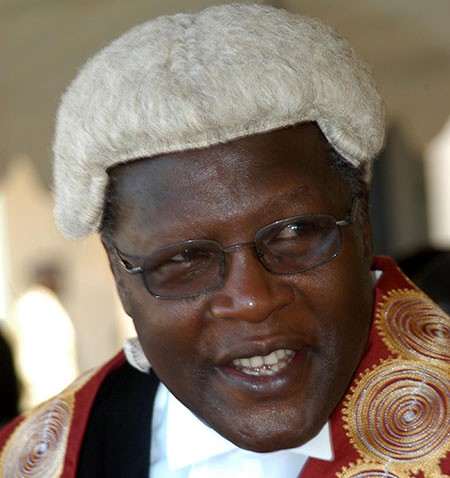
CJ Katureebe retires, Owiny-Dollo to be acting

Outgoing Chief Justice Bart Katureebe.

Outgoing Chief Justice Bart Katureebe today left office with Deputy Chief Justice Owiny-Dollo set to take charge in acting capacity.

A press statement from the Judiciary released this evening indicates that a brief handover ceremony will be conducted on Monday.
However, Deputy Chief Justice Alphonse Owiny-Dollo takes over the Chief Justice’s office with immediate effect.

“For me, I am very happy with where we have reached. Nearly everything of mine has clicked. The Electronic Case Management System is on course. The construction of the Appellate Courts is on course, those are my achievements. The Administration of the Judiciary Bill, which was passed by Parliament was assented to by the President,” Mr Katureebe was quoted in the press statement.

He said the terms and conditions of judicial officers have improved and it’s no longer (ex gratia (paid at will) and that judicial officers now have retirement benefits.

“When I joined the Judiciary in 2005, judges were getting Shs5 million. They are now averaging getting Shs 25m per month, “Mr Katureebe was quoted in the press statement.

Stories Continues after ad

Revised EC Roadmap maybe unreasonable but it’s legal

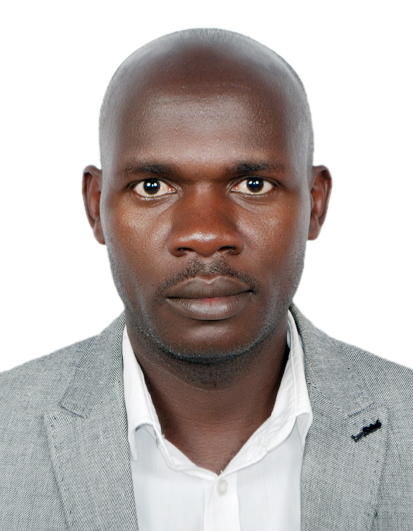
Mr. Deus Mukalazi

Mukalazi Deus Mubiru

Research Associate, Democracy and Rule of Law

Great Lakes Institute for Strategic Studies (GLISS)

deusmukalazi@gmail.com

On Tuesday 16th June 2020, the Electoral Commission (EC) launched a revised road map for the 2021 general elections after losing approximately three months due to the outbreak of Covid19 pandemic in Uganda and the control regulations there after that saw a freeze on all electoral processes.
The revised road map fits whatever was supposed to be done within the period between 22nd June 2020 to 8th February 2021 when all elections will have been held and all elective positions filled. This means that some of the key electoral processes that would be undertaken under ordinary circumstances have either been suspended or ignored like consultations for aspiring presidential candidates as per S.3(2)(d) of the Presidential Elections Act and giving each presidential candidate enough time of at least one day to campaign in each district as per Section 21(1) of the same Presidential Elections Act.

Stakeholders in the elections space especially political parties and those vying for political offices have received the revised road map with different reactions. Whereas the ruling National Resistance Movement (NRM) has positively received this, majority of players in opposition have criticised the road map and termed it illegal and unconstitutional. Some players like Presidential Aspirant, Joseph Kabuleta, have gone ahead to issue a notice of intention to sue should the EC go ahead with the road map. The biggest controversy seems to be on the issue of digital campaigns where candidates will not be expected to hold any public rallies because of the prevailing Control of Covid19 Regulations and will instead be expected to reach out to their voters through other ways including traditional media and social media.
The EC insists it acted within the law and within its powers to issue the road map. The EC Spokesperson clarified that they are yet to develop the guidelines and that the different stakeholders who claim they were left out of the process and never consulted still have a chance to share their views on how to best deliver a free and fair election within the shared road map.

Without a state of emergency in the country, it must be noted that the EC has no excuse not to organise and deliver the elections. The only situation where the thought of extending elections can arise is if the country had been under a state of emergency. A state of emergency can only be declared by the President in consultation with the cabinet as per Article 110(1) of the Constitution. Since the Government chose to handle the pandemic under Sections 11 and 12 of the Public Health Act, it is difficult for the EC to think of extending the elections. And inaction on EC’s part would lead to a constitutional crisis. Calls for extension of elections should not be directed at the EC but rather at Cabinet and the President plus the legislature.

True, the revised road map may be unreasonable and unrealistic but general life under the Covid19 has not been normal. Although the constitution under Article 1(4) gives power to people to express their will and consent on who should govern them through regular, free and fair elections of their representatives, and the EC is enjoined to deliver the same as per Article 61(1)(a), the prevailing circumstances of the covid19 pandemic make it difficult to do so without infringing on certain rights just like other rights have been curtailed during this period.
Whereas the law provides for delivery of a free and fair election, the same law provides for the delivery of the same within a certain time framework. Article 61(2) of the Constitution enjoins the EC to hold Presidential, general parliamentary and local government council elections within the first 30 days of the last ninety days before the expiration of the term of the President. Some provisions like Article 105(1) makes the extension of the tenure of office of the President and its extension would require a referendum as per Article 260(2)(f). Such provisions make it difficult for the EC to extend the time.

Section 50 of the Electoral Commission Act gives the EC special powers to bend the laws under certain circumstances. Clause 1 states, “Where, during the course of an election, it appears to the commission that by reason of any mistake, miscalculation, emergency or unusual or unforeseen circumstances any of the provisions of this Act or any law relating to the election, other than the Constitution, does not accord with the exigencies of the situation, the commission may, by particular or general instructions, extend the time for doing any act, increase the number of election officers or polling stations or otherwise adapt any of those provisions as may be required to achieve the purposes of this Act or that law to such extent as the commission considers necessary to meet the exigencies of the situation. Clause 2 adds, “For the avoidance of doubt, this section applies to the whole electoral process, including all steps taken for the purposes of the election and includes nomination.” With this section of the law, coupled with Article 67(1) of the constitution, which requires that elections are held at times fixed and notified in advance to the public. To the extent that the road nap and elections of the EC are legal, that is not in contention.

There is the argument of the non-consultation of stakeholders. Article 61 of the constitution and Section 13 of the EC Act provides for the independence of the commission and it is not subject to the direction or control of any person or authority. However, under the doctrine of legitimate expectation. A legitimate expectation is said to arise as a result of a promise, representation, practice or policy made, adopted or announced by or on behalf of government or a public authority.” Therefore, it extends to a benefit that an individual has received and can legitimately expect to continue or a benefit that he expects to receive. Procedural legitimate expectation refers to the expectation of an individual that he has a right to a certain procedure, such as the right to a hearing, as a result of the behaviour of the public body. Different stakeholders argue that the EC has always consulted them on matters of election and therefore they should have been consulted on this revised road map.

However, the doctrine of legitimate expectation is subject to certain conditions and considerations one of them being whether it would be unlawful for the authority to frustrate such an expectation. Upon reviewing a claim for the protection of a legitimate expectation against a public authority’s decision, courts will deliberate over three key considerations: the situations and circumstances in which legitimate expectations arise, instances in which it would be unlawful for the public authority to frustrate such an expectation, and the remedies that would be available to the aggrieved party if it is found that the public authority had unlawfully frustrated a legitimate expectation.

In view of the existing covid19 pandemic, the EC, strictly focusing on legal aspects has all the powers to announce and follow the revised road map. As rightly put by Professor Clement Fatovic, in his paper, “Emergencies and rule of law,” as governments have come to rely increasingly on various legal tools to handle emergencies, scholars have devoted more attention to the ways that lawful but extraordinary exercises of power also threaten the rule of law.The trend toward the legalization of extraordinary powers in times of emergency, along with the increasing normalization of emergency powers in ordinary circumstances, reveals challenges to the rule of law that are arguably every bit as worrisome as the lawless exercises of power that have alarmed thinkers for millennia. Rather than approach this from a legal position, those who feel the roadmap is unreasonable and unfair should consider a political solution rather than a legal one because it’s a political problem.

Stories Continues after ad

Infinix Mobile Uganda, Airtel Uganda partner to launch new Infinix NOTE 7

Infinix Mobile Uganda has partnered with Airtel Uganda to launch an all upgraded smartphone, the Infinix NOTE 7.

The NOTE 7 comes with free 5GB mobile data.

The launch is part of a new partnership between the two companies that will not only see Ugandans enjoy first class services using upgraded devices but also drive the digital inclusion agenda.

“Smart phones and internet data have become a basic need in Uganda, so when we were looking for a solution to our customers, our highly esteemed partner Airtel agreed to come on board. The free 5GB data provided is a starter for our customers on a journey with endless possibilities while using the best internet connectivity on the best smartphone on the market,” Mr. Alex Liu the Infinix Uganda Brand Manager said during the launch.

Speaking on behalf of Airtel, V.G Somasekhar, Airtel Uganda’s Managing Director said; “Affordability is one of our key aspects at Airtel – we believe that with our partnership with Infinix, we are giving our customers a chance to acquire a very advanced and affordable next-generation smartphone that comes with complimentary 5GB data for a month, all they have to do is dial *175*9*9# to activate the free 5GB data on any of the 5 selected Infinix devices. The offer will be valid for customers of NOTE 7, HOT9 Play, HOT9, S5 Pro and NOTE 7 Lite.”

The Infinix Note 7 runs Android 10 pie with XOS 6.0 on top. The device features a 6.95-inch HD+ (720×1, 640 pixels) IPS display along with a 20.5:9 aspect ratio and 480 nits of brightness. This is backed up with the Octa-core MediaTek Helio G70 processor.

“The Note 7 comes with an advanced processor – the G70 and the best way customers can experience this is while they are browsing the internet using the fast, reliable and affordable Airtel internet. The Infinix Note 7 is surely a smartphone beyond performance. ” Liu said.

The device also has a hole-punch display design and circular-shaped quad (four) back camera setup that includes a 48MP primary sensor along with an autofocus f/1.79 lens, 2MP sensor with an f/2.4 lens, 2MP tertiary sensor with a 25mm macro lens, and a low-light video sensor along with an f/1.8 lens and a 16MP selfie camera.

The Infinix Note 7 has 128GB of onboard storage that is expandable via Micro SD card up to 2TB. Connectivity options include 4G LTE, Wi-Fi 802.11ac, Bluetooth, GPS/A-GPS, MicroUSB, FM radio, and a 3.5mm headphone jack.

The device also includes its newest feature of the side-mounted fingerprint sensor module embedded with an array of sensors that includes an accelerometer, ambient light, magnetometer, and a proximity sensor. All this has been well supported by a 5,000mAh battery with the best-in-class 18W Supercharge 3.0.

With comparison to its predecessor the Note 6, the Note 7 will have the X-pen as an accessory and not part of the phone ensemble.

“We encourage all lovers of a cool, stylish and techy smartphone to get the Note 7 from any Infinix branded shops or Airtel outlets near them and enjoy a smartphone beyond performance that comes with free 5 GB data from Airtel,” Concluded Mr. Liu.

L-R Faith Bugonzi from Airtel Uganda with Remmie Kisakye (middle) Head of Brand and Communication and Derrick Katongole Branch Brand Manager Infinix Uganda.jpg

Stories Continues after ad

COVID-19: Movement of trucks resume at Mutukula border

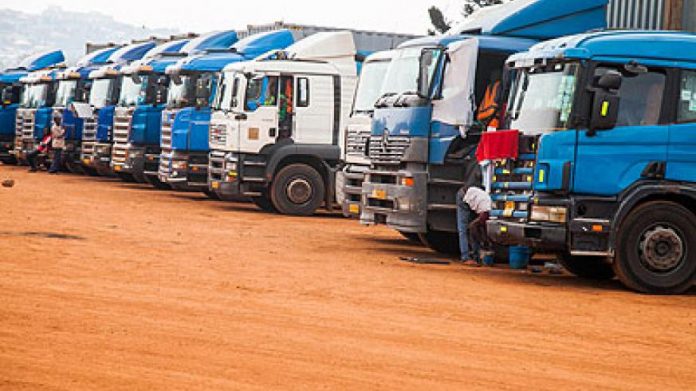
Trucks parked waiting for clearance

The movement of trucks between Tanzania and Uganda at the Mutukula border has resumed after the two countries reached a consensus on measures to implement while mitigating the COVID-19 pandemic.

According to Mr William Mkenda, Customs Officer in Charge at Mtukula border (Tanzania), truck drivers will now have to undergo mandatory COVID-19 testing in line with East African Community guidelines to tackle trans-border spread of the disease while minimising disruptions to cross border trade.

Mr. Mkenda was briefing a delegation from the EAC Secretariat led by the Deputy Secretary General in charge of Planning and Infrastructure, Eng. Steven Mlote, whose delegation was on an assessment mission to the Mutukula border.

The team is set to review the progress of the joint efforts by Tanzania and Uganda to ease congestion at the border.

Mr. Mkenda informed the Deputy Secretary General that the Covid-19 testing requirements for truck drivers were meant to ensure that health risks associated with the coronavirus were mitigated.

The EAC delegation also met and held discussions with the truck drivers at the border in a bid to assess the challenges encountered when crossing the border. During the discussions, some of the drivers registered their dissatisfaction with their treatment in implementing new measures put in place to combat the spread of the coronavirus.

On his part, Eng. Mlote told the truck drivers that Ministers and Permanent Secretaries responsible for Trade, Health and EAC Affairs have held meetings and issued guidelines on how the truck drivers should be facilitated on their cross border operations as Partner States enforce measures to fight Covid-19.

The DSG emphasised the need to to sensitize people against stigmatization of Covid-19.

“Parameters have been set, places where the testing should take place and modalities of how it should be carried out has been agreed upon by the Partner States’ governments. It is only implementation that is varying from one country to another,” he said.

He disclosed that EAC issued administrative guidelines for uniform implementation of measures to allow free movement of cargo as envisaged under the EAC Common Market Protocol.

“The EAC Secretariat has been at the forefront in ensuring that the region is prepared and ready to deal with epidemics, pandemics, disasters and events of public health interest. The Secretariat, under the EAC Mobile Laboratories Project, mobilised resources and has deployed mobile laboratories for each of the Partner States to facilitate rapid detection of highly pathogenic organisms such as Ebola, Marburg and Coronavirus,” added Eng. Mlote.

To date, mobile laboratories, PPEs (Personal Protection Equipment) and test kits (including COVID-19 kits) have been delivered to the Republic of Rwanda, Republic of Burundi, Republic of Uganda, the United Republic of Tanzania, Republic of Kenya and the Republic of South Sudan.

Stories Continues after ad

UPDF holds a scientific graduation, roots for research on operations other than war


Over 40 senior military officers have graduated from Uganda’s Senior Command and Staff College in Jinja having completed a yearlong Grade II course. Only 32 of the graduates are Ugandans, two each from every EAC partner state and one from the Republic South Africa.

The function was presided over by the Minister of State for Defence in-charge of Veteran Affairs, Christopher Kibanzanga.

Kibanzanga noted that Uganda has attained peace and stability, thanks to the tireless efforts of the UPDF supported by other security agencies and the peace-loving Ugandans.

However, the country and Africa at large continue to face new challenges in the ever changing current operational environment.

He, therefore, urged the graduates to venture in research, continuous reading and further training so as to develop individual and collective diverse competences to handle unique encounters.

“We must continue training to build our capacity to enable ourselves to handle new challenges such as those that require skills other than war, like locusts and COVID-19,” said Hon Kibanzanga.

The Chief of Defence Forces (CDF), Gen David Muhoozi appreciated the fact that graduation was happening under peculiar circumstances of COVID-19 which has given the country a test to display its military capabilities. He said the attainment of Grade II qualification is a milestone in the Officers’ military career and their individual output should reflect the training attained. “I congratulate you upon the successful completion of your Grade II course. You have been trained, be prepared for the tasks ahead to utilize the skills you have acquired,” he added.

The Commandant SCSC Kimaka Lt Gen Andrew Gutti said that the college has successfully conducted 14 courses since its inception in 2004 and that this was the 15th course. He added that, alongside the Grade II military course, the college also offers Masters in Defence and Security Studies (MDSS) and a Diploma in Strategy and Warfare (DISW), both affiliated to Makerere University and approved by the National Council of Higher Education.

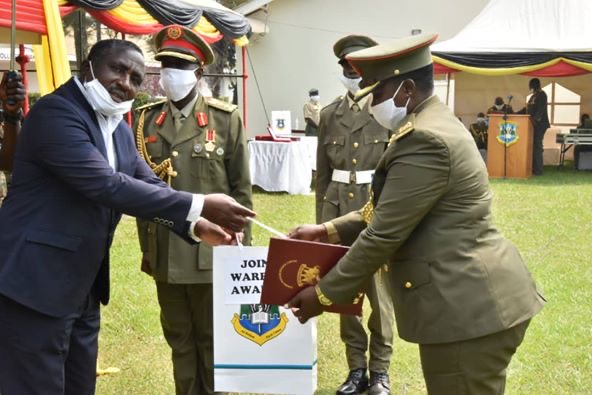
Maj Adnan Kaale from Uganda emerged as the best overall student, Lt Col SM Kitoni from Kenya was the best international student, Lt Col CT Wobugabe from Uganda was best in Commandant’s research paper and Maj Rogers Kabungo from Rwanda was best in central lecture hall discussion while Maj Olive Komutegeki from Uganda emerged best in joint warfare award.

Due to COVID-19 threat, this year’s function was characterised by all attendants wearing face masks and very few General Officers, Defence Attachés from the East African Community Partner States and members of academia being invited. No families or members of the public were this time round invited in order to have room for social distance.

Stories Continues after ad

Burundi’s Evariste Ndayishimiye is sworn in as president

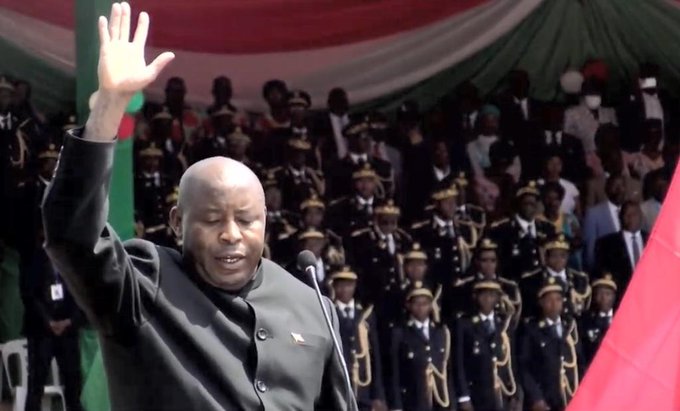
Burundi President, Gen. Ndayishimiye taking oath.

Burundi’s newly elected president, Evariste Ndayishimiye, has been sworn in two months earlier than planned.

No foreign heads of state were present when he took the oath of office in the administrative capital, Gitega, where he pledged to defend the nation’s interests and unify its citizens.

The fast-tracked ceremony comes after his predecessor Pierre Nkurunziza died suddenly last week.

Mr Ndayishimiye is a former rebel leader, like Mr Nkurunziza.

He was backed by his predecessor and was declared the winner of May’s presidential election, which the opposition said was rigged.Mr Nkurunziza died aged 55 on 8 June after suffering a cardiac arrest, the government said. There are unconfirmed reports that he was suffering from Covid-19.

After 15 years in power, Mr Nkurunziza was due to step down in August.
According to Burundi’s constitution, if the head of state dies in office then the president of the national assembly, currently Pascal Nyabenda, should succeed him.

But after a ruling by Burundi’s Constitutional Court, Mr Ndayishimiye’s inauguration in Gitega was brought forward.

Who is Evariste Ndayishimiye?
By Cyuzuzo Samba, BBC Great Lakes

The 52-year-old army general is regarded as a “humble” and “religious” man.

He has been among the most influential generals since 2005, when his close friend and colleague in rebellion, Pierre Nkurunziza took power.

Gen Ndayishimiye, commonly known as “Neva”, was a law student in the University of Burundi when the civil war erupted in 1993 following the assassination of President Melchior Ndadaye.

Like his predecessor Mr Nkurunziza, in 1995, Gen Ndayishimiye survived an attack on ethnic Hutu students at his campus in the then-capital Bujumbura.

He then fled the country and joined the rebel force that was formed to fight the then Tutsi-led government.

Gen Ndayishimiye worked closely with Mr Nkurunziza during the Arusha peace talks between the government and the FDD rebels.

Following the 2003 peace accord that saw FDD rebels share the power with the government, Gen Ndayishimiye deputised for the then army chief of Burundi.

In 2006 he was named minister of the interior, before becoming the president’s military adviser and then secretary-general of the ruling CNDD-FDD party.

Gen Ndayishimiye, a father of six, is known as a practising Roman Catholic, and like his predecessor emphasises the role of God in politics.

The new president is taking over a country that is diplomatically isolated and on bad terms with donors.

In 2015, the constitution was changed, allowing Mr Nkurunziza to seek a third term, triggering huge protests, an attempted coup and a widespread crackdown.

Thousands of Burundians have fled the country and into refugee camps in neighbouring countries.

Stories Continues after ad

In allowing debate on President and Deputy Speaker, Kadaga abused Parliament Rules

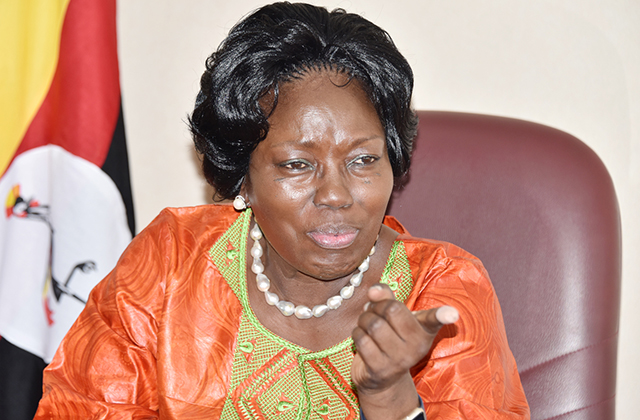
Speaker Rebecca Kadaga

By Batanudde Kiwanuka

Speaker Rebecca Kadaga has been in the eye of the storm since she dubiously presided over Parliament as MPs smuggled Shs 10b into a government supplementary request for funds to help in fighting the #Covid-19 pandemic.
Government had tabled a supplementary request to bolster the fight against #Covid-19, but the Speaker chaired a Parliament Commission meeting that devised strategies of smuggling Shs10b in the supplementary request.

Kadaga’s unsavoury ways were openly opposed by some MPs, like Hon. Cecilia Ogwal, Hon Karuhanga, Hon Nathan Mafabi and others MPs. Hon Ogwal actually called it a mafia way of handling the supplementary.

Speaker Kadaga had literally ran away with their loot but were stopped in her tracks by a court ruling that ordered the return of the money to the government, rightly ruling that the money had been irregularly allocated.That triggered the Speaker’s ire.

Since that time, Speaker Kadaga has been acting like a bull in a China shop; attacking all and sundry-the Executive, Judiciary and the Deputy Speaker.
But Kadaga’s short-temperedness and deficiency in parliamentary jurisprudence hit a nadir when she allowed a motion to be tabled to discuss the President, in blatant violation of the Rules of Procedure.
In tabling a motion condemning President Museveni, Parliament was basically proceeding under Rule 106 which stipulates the process of removing the President from office under the constitution.
The motion in question did not meet any grounds stipulated under Rule 106.
Most importantly, that motion should have been initiated by a notice in writing to the Speaker, signed by not less than one third of all the MPs, indicating their intention of moving a motion for a resolution for the removal of the President, as spelt out under Rule 106(2).

But the Speaker Kadaga, in her typical self, chose to ignore the rules and turned the August House into a village kangaroo court.
To make matters worse, Speaker Kadaga further allowed an MP to smuggle in a motion debating the Deputy Speaker.
For an experienced legislator like her, Speaker Kadaga ought to know the process of debating the Speaker and Deputy Speaker.
Rule 107(1)a says a resolution[or debate for this matter] for the removal of the Speaker or the Deputy Speaker from office shall be triggered by a seven days’ notice, signed by not less than one third of all MPs and given to the Clerk.

And Kadaga has a chequered past of abusing the rules she is meant to be a custodian of the rules.
In an unanimous ruling, the panel of five justices blamed the Speaker of Parliament for acting illegally by abdicating her constitutional responsibility of ascertaining whether there was quorum in the House before the Bill was passed.
In fact, the Constitutional Court in that ruling, wondered how a qualified Speaker would wantonly preside over an illegality, even as three MPs had brought the matter of lack of quorum to her attention.
Suffice to mention that Speaker Rebecca Kadaga was at the centre of the disputed passing of the Constitution Amendment Bill that led to the removal of age-limits. A final case is pending determination in the East African Court of Justice.

It was therefore, rather ironical that Helen Kawesa, Parliament’s Assistant Director of Communication and Public Affairs (CPA), claimed that Kadaga’s actions on the President and the Deputy Speaker were meant to save the office’s integrity. Helen Kawesa should therefore, desist from being dragged into battles that aren’t meant for her.

The writer is a senior Muganda living in Mukono

Stories Continues after ad

Anyone interested in the presidency ought to keep an eye on the incumbent’s use of propaganda

Mr. Kingdom

By Joshua Kingdom

We can by now count on our finger tips the months left before we go for national polls_ at least that is what the constitution says. And while there is a considerable calm for an otherwise chaotic season, recent developments show that we will likely hold elections come January. These include the pronouncement by the Electoral Commission on the new mode of campaigns early in the week as well as the joint press conference held between Bobi Wine’s People Power together with Dr. Besigye’s FDC.

For over four times now, there have been legally acceptable attempts at changing the possessor of the mantle of presidential power with very little success. Panelists have rightly said that this has a bearing on the weight of incumbency. While it is not known how the next race will play out chances are high this factor will still come in.

The incumbent has been big on tools such as police brutality, dishing money and to many of these the opposition has had responses here and there, an example is setting up demonstrations. In that regard however, less attention has been given to probably the most ruthless tool which for me is propaganda. Understandably, this feature is one whose impact comes indirectly thus hard to notice yet at the same time has far reaching consequences. Its fangs are manipulative and have the rare capability of infiltrating the receivers’ minds right to the bottom line. The result is blindfolding them from the reality.

The president has mastered this and as such he has employed all sorts of propagandists; from motherly and fatherly figures, to masters of blasphemy and blackmail, from fine intellectuals armed with selective statistics, sarcasm, and humor to ghetto fellows and religious preachers. Sometimes it is as small as a remark at the end of an RDC speech which explains how a given project is inseparable from the NRM government. Each of these is uniquely structured to target a different audience. They will use every opportunity, and they will do it swiftly and smartly.

As the claims come in little but consistent packages, the overarching effect is an entrenched portrayal of a life president. Many if not majority of Ugandans as a result can’t imagine a Uganda without the incumbent. It is a sad but important admission for those eyeing state house if they are to start off in the right direction. Consider the following arguments, I suggest that 70 per cent of Ugandans have come across at least two of them; one is that the president is a ‘god’ of sorts; two is that Uganda is a nation that can only be led by a military man. Others include the fact that no one in the opposition is as wise as the NRM chairperson as well as the notion that if there was to be a relinquishment of power as it stands, we would degenerate into a war zone.

I talked of people interacting with these ideals but for a country where only few individuals attain higher education later on quality higher education, coming across the same is as good as subscription to them. In addition, few people have time to decipher the propaganda talked of as they are busy struggling to find ways of surviving the following day.

The opposition on the other hand either because of excitement for first time runners, or ignorance driven egos tends to concentrate on one aspect i.e that the president is evil. While this is appealing to some people, it is certainly not for majority of the populace. You still have people for instance who think that a call for accountability is but disrespect for the elders. As an interested party, whomever it concerns ought to reason with everyone at their level of understanding.

The Writer is a student of Law at Makerere University

tcitizen24@gmail.com

Stories Continues after ad

Parliament asks Gov’t to waive water, power bills

Mathias Mpuuga

Parliament has passed a motion urging the government to waive the payment of water and electricity bills, as one way of assisting persons affected by the Coronavirus pandemic.

Masaka Municipality MP, Mathias Mpuuga, who moved the motion, said that the #Covid-19 pandemic has had devastating effects on the Ugandan economy, which would be mitigated by government paying for the utilities to the service providers, National Water and Sewerage Corporation and UMEME.

“I urge the government to consider a waiver of the payment of water and electricity due to the fact that many citizens have lost jobs due to closure of companies, workers being laid off, loss of earnings because some couldn’t reach their work places, rendering them unable to pay for essential services,” he said.

Mpuuga said that the measure, which would be in place for six months, would boost the campaign to wash hands with soap and water, which is a critical defence against the spread of #Covid -19.

He cited countries that have put in place measures intended to mitigate the negative impact of the pandemic.

“The Indonesian government provided extra funding for affordable food programme to help its low income households; Ghana announced free water for three months and three months tax holiday for its health workers,” he said adding that “I believe that the Government can provide a waiver for utilities by making some payment for the utilities to the company.”

Manjiya county MP John Nambeshe, said that the pandemic has had great negative effects on the population but that the heavy rains have helped with the water levels.

“Lake Victoria has experienced an increase of the water levels and there is no excuse from the service providers because the water is enough. This could be an incentive to waive some of these bills, by giving back to the population,” he said.

MP Rosemary Nauwat said that waiving the payments would help with the government messages reminding the citizens to frequently wash their hands.

“We have been passing on this information to the population deep in the villages to wash their hands more frequently and they were requesting to be provided with free water and also repair broken water sources,” she said.

Kawempe North MP Latif Sebaggala said that it was advisable for the government to devise other ways on how the population would be assisted.

“We had food relief but many people were not catered for. The waiver for utilities is the right step in the right direction which will help all people because most of them are still financially constrained. Our neighbouring countries have come up with various ways to handle this and Uganda can do this as well,” he said.

Parliament Speaker, Rebecca Kadaga, said, “We set up a select committee looking at the effect of Covid-19 on the population and part of the conclusion included waiver of utilities. As a government we have an obligation to ensure the supply of clean water to the citizens.”

Stories Continues after ad

Doreen Nyanjura appointed Deputy Lord Mayor as Sarah Kanyike resigns

Lord Mayor Erias Lukwago has appointed Doreen Nyajura as the Deputy Lord Mayor after the resignation of Sarah Kanyike.

Last week, President Kaguta Museveni proposed Sarah Kanyike Ssebagala’s name for a role of Director Gender and Community Service in Kampala Capital City Authority (KCCA).

Upon her appointment, the lord mayor offered a three-day ultimatum for her to remain in office or consider a proposal by president Museveni.

Yesterday, Sarah Kanyike confirmed that she is still the deputy lord mayor and a Councillor for Makindye East. She revealed that she has not received a communication as far as the appointment is concerned.

In a press briefing held earlier today, Lukwago confirmed that Kanyike resigned from her position. He appointed Doreen Nyanjura, the LC 5 Woman Councillor, representing Makerere University and Minister for Finance and Administration at KCCA as the deputy lord mayor.

KCCA Executive Director and Deputy Director are appointed by the president on the recommendations of the public service commission.

The president further appointed engineer David Luyimbazi as Deputy Director. Eng. Luyimbazi is credited with the designing and construction of Entebbe Express Highway and Jinja new bridge, Dr. Daniel Okello Ayen as Director Health and Environment and Dorothy Kisaka as the new Executive Director for Kampala City Authority replacing Eng. Andrew Kitaka who has been in acting capacity ever since Jennifer Musis left.


Stories Continues after ad