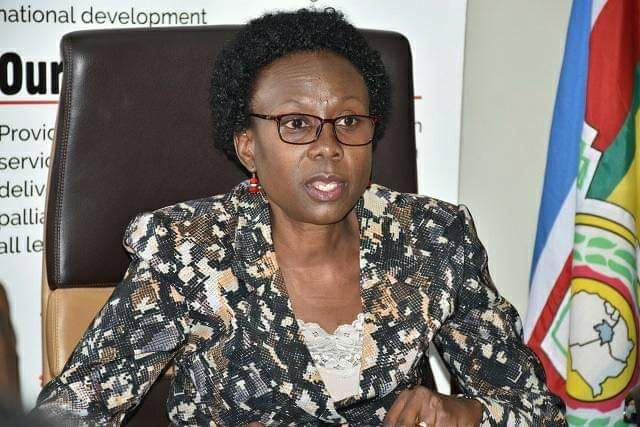
To : Geraldine Ssali Busuulwa
EX NSSF Deputy MD
NSSFS LETTER TO THE MINISTER OF FINANCE PLANNING AND ECONOMIC DEVELOPMENT
Good evening Madam !Yesterday I came across a dossier allegedly written by you addressed to the Minister Of Finance, Planning and Economic Development .The letter alleges that the said Minister did seek your advice /opinion regarding NSSF on covid19 relief for its members ;paying 20% each of members’ balance .
I am an ordinary citizen and active member of the NSSF who is deeply interested in any discussion that relates to social protection.
I must extol you for dexterously putting your ideas across on this sensitive subject .That said, I wish to respond to contents of your dossier .I will for the purposes of this rebuttal assume that opinions there in are those of the Ex-NSSF Deputy MD .
To begin with, looking at the current debate, one can easily get tempted to believe that NSSF has a messaging problem .While NSSF has a legitimate reason to tell us whether they can afford to pay 20% or not ,I think the most fundamental issue is whether the Fund can be used to provide short term covid-19 shock response /relief to members .I will absolve NSSF on that charge for now because the letter in issue was addressed to the Minister of Finance who I suppose needs complete information on all aspects of the fund in relation to issues at hand and any other relevant facts.
I am glad that you pointed out that the Minister gave u definite terms of reference to wit; covid19 relief for its members; paying 20% each of members balance.
The question of the day is, did you effectively address the issue? Where do we go from here?
At the start of the your dossier, you seem to question why NSSF should indulge in macro-economic impacts of the transaction .According to u it should be Bank of Uganda and Ministry of Finance to competently handle macroeconomic policy .I agree with u in part regarding the competence in handling macroeconomic policy but I strongly doubt if knowledge on the subject (macroeconomic policy) is a preserve of the two institutions.
I strongly agree with you that the core responsibility of NSSF is to provide social security but in so doing the Fund invests in real estate ,bonds/securities markets ,etcetera in Uganda and beyond to earn a profit for member’s benefit .These markets are highly predisposed by not only macroeconomic policy but also national and regional economic policy .I am very surprised that as the former Deputy Managing Director U can question why management applies macro-economic analysis in arriving at decisions such as the proposed pay out. The social security function is not sustainable if the economic fundamentals are not supportive because at the end of day a member of the fund expects a higher rate of return on his or her contributions. So, if application of the funds/assets at NSSF prejudices economic stability, it becomes a primary concern for the institution and members generally.
I will not go into the theories of the glass -whether half full or half empty but I seem to perceive your point being that NSSF management is not only being pessimistic ,but they are maddening the idea of the 20% from seeing the light of the day .You opine that their stance is not an inducement to voluntary contributions since the entity is not demonstrating relevancy and usefulness to existing members at such a time when governments are extending financial assistance to vulnerable citizens in form of social welfare programs.
I find this line of thought very distressing especially after acknowledging that in this situation Governments all over the world are stepping in to deliver targeted social welfare programs. I call them social protection interventions in my other world.
Madam, are u therefore reminding the Minister that his government has failed in extending the much-needed support to vulnerable people in Uganda unlike what other governments else where are doing? Are u therefore saying that NSSF is Government? Have u come across any country where covid19 or any other emergency response has targeted social security entities in the manner being suggested by you? Has NSSF replaced Government?
If you had stopped at Government role in providing social protection interventions in situations such as this covid19 pandemic ,you would have earned your place at the table of the people who appreciate the fact that social security funds are not a first line of focus for emergency response .By running way from this fact ,you seem to suggest that our dear government is incapable of addressing short to medium term economic shocks .The Minister should take this with a pinch of salt.
Madam ex MD ,allow me to demonstrate the role of Government in providing social protection interventions in situations such as the one at hand and why as a standard practice, Governments all over the world have made strategic interpositions in providing assistance including direct income support as opposed to raiding pensions/social security entities.
You should be interested to know that over 100 countries in the word have provided emergency response to curtail susceptibility from covid19 related impacts. In Africa alone, 21 countries have so far introduced new cash and in kind programs or made adaptations to existing programs to enhance safety ,speed ,convenience or benefit value to citizens .For avoidance of doubt these include ,Algeria ,BurkinaFaso,Cape Verde,Egypt,Ethiopia,Ghana,Guinea,Kenya,Madagasar,Malawi,Mauritius,Morroco,Namibia,Rwanda,SaoTome and Principe,Senegal,Sierraleon,south Africa, Tunisia and Zimbabwe. Some of these are small and poor countries and therefore by being bold or standing up to minister on the point you raised about government intervention ,you would not have been technically ,factually or even morally wrong .You would have provided the most appropriate solution to the Minister .By the way when u next talk to him, remind him that country is waiting for an economic emergency or stimulus plan just like what other Governments have done world over !!!
That said, it is misleading to say that voluntary contributions can grow if the Fund became flexible to give out money in case of emergencies! On the contrary no reasonable person would make a voluntary contribution to an institution that is not predictable. This is so because a members benefits are sustained by maturity periods NSSF investments take .I may not be qualified to discuss investment options at this stage but common sense tells me that the more one invests in long term products the higher the return and the higher the benefit value. I think that what can attract more people to NSSF are innovative products tailored around Uganda’s key social problems namely ,housing ,health education and sustainable access to income in old age or periods of extreme incapacity (Pension products).For those in business , access tagged to voluntary contributions or contributions over and above the statutory minimum can be quite endearing .
Interestingly, I haven’t addressed the role of NSSF yet! Many arguments portray the institution as simply a commercial bank, where you save money and expect to get it back any time. I have been struggling to understand how words ‘’save, savings sneaked into the social security messaging in Uganda .The NSSF Act is devoid of these words but I am temped to think that what you and other people call savings are contributions . Do you know why this is so? By calling payments to the Fund contributions as opposed to savings, the framers of the law were deliberate. They didn’t want a situation where people would confuse social security with any other venture. I think messaging highlighting contributions as savings in the strict sense of the word is responsible for current apathy on social protection in Uganda .You will appreciate that social security products may include benefits in cash or in kind and therefore consistently calling these savings has potential to create confusion when NSSF transits from giving benefits in cash to a mixture of benefits in cash and kind e.g. Old age pension and health insurance !
I know for sure that you are aware of the overall objective as to why NSSF was created and I wont waste time going into that direction .I however think that in determining the question of whether NSSF is capable of providing emergency pay outs such as the much talked about 20% ,attention should be drawn to section 19 of the NSSF Act which provides for benefits and their descriptions .These benefits include;age benefit, withdrawal benefit ,invalidity benefit, emigration grant and survivors benefit .
Using your experience where would the covid response payout of 20% fall? What would be the basis why 20% not 10% ,30% or even a specific figure such as ugx 1,000,000-? (Never mind 20% seems to be Uganda’s magic number even brokers ask for 20%), What will this do for the workers? Is it for food and if so, what would be the cost of a basket of goods that can sustain a household for a given period? In the unlikely event that this comes to pass, what would happen if the situation worsens? These are valid questions in my view that need to be addressed. If we don’t, we will trying to advocate for midterm access as opposed to having the Fund provide short term relief to members.
In seeking your opinion, the minister might have anticipated that you would you use your experience to interrogate these questions. Like I had already indicated, you choose to dwell on NSSF ability or lack of it to pay 20%.
I will not comment much about the donation of 380m apart from emphasizing that NSSF has a moral obligation to society and a contractual obligation to members .Members expect the Fund to pay swiftly and aptly all benefits that have accrued to members in this period .As part of Covid 19 response,NSSF should as a matter of urgency speed up payments for all eligible applicants. The same should happen in Public service regarding pension payments .In your dossier you never indicated at all any instance where the fund stands accused for neglecting to pay deserving claimants in this period (Those that have met statutory requirements) .I thus see nothing wrong in 380million donation to the public as part of corporate social responsibility.
While I appreciate that some families could be struggling ,I find it dishonest to accuse NSSF of failing to pay members part of their money without details or guidance on how this should be done in face of statutory limitations .People who read your letter get a perception that the fund has denied members their money which is grossly misleading .
I have carefully looked at the numbers you are alluding to justifying the affordability of the payout. I note the following.
1. The reserves of UGX125bn.You did not provide guiding principles for the application of these funds and I strongly believe that these funds are not available for any payout regardless of the reason.
2.UGX 280bn in current assets can be used by triggering an accident and emergency system. This is misleading considering that you have not highlighted any instrument or best practices that fit into the situation at hand. This statement risks portraying the entity as having idle money that can spend at will
3. Securities in Kenya and Local market! (1 trillion). This is where it gets complicated. I had hesitated to write to you because I found it difficult to fathom that a former top officer of any Social security entity can make these sweeping statements. You opine that it is not okay for NSSF to lend to Kenya. . Is a member of NSSF more interested in where the money is invested or the anticipated benefit? Are these investments arrived at with input from government of Uganda? Could it be that you are sending a veiled message to your friendly minister? Doesn’t abrupt liquidation of assets pose investment risks? who bares such risk? While the statement looks rosy, liquidating massive assets is not as predicable as you seem to suggest and impacts of such move can be far reaching. I expected you to know that held to maturity instruments cannot be liquidated without incurring losses and the risk reclassification of all bonds and which adversely affects a significant portion of fund’s investments .These risks could spill over to other Funds, business ventures in the long run thereby making the fund unsustainable .Specifically, for bonds held in other jurisdictions ,liquidating them abruptly would occasion forex loss in addition other risks that I have already hinted .This what you call pessimism but what I call the sad reality .
I had thought that our NSSF funding projects in Uganda and beyond can stir patriotic feelings! We have been told that the fund is not doing well but here it is still making uganda a relevant stakeholder in the region .That should make us proud in any case we are not donating this money but we are reaping so much from these countries .The 12% ,15% that have been handed out to members is as a result of this highly rewarding investment options .My opinion therefore is that the foregoing options are good on paper but complex.
You are suggesting that the assured fixed income from fixed deposits can be used to meet the proposed pay outs and the gap can be filled by monthly contributions from members! I think this would be the most realistic proposition. However, having rightly pointed out that members and businesses are facing hardships, it is difficult to hedge hopes of member or employer contributions to compliment fixed income as you propose. Not long ago, NSSF management handed out a grace period to employers on remittances of NSSF contributions. This source is not expected to perform strongly this year and thus this is equally unreliable.
4.The Fund is owned 75% by 100,000 members accounting for 4% of the total membership. This could be right but the assumptions that in an event of payout that these cannot come forward is very subjective
5. NSSF Collects 100bn from savers every month. While this may be correct (if numbers at NSSF say so), we have not assessed the impact of lock down measures yet. I have already pointed out that NSSF has given a grace period to Employers which will affect monthly collections significantly. This makes assertion misleading to that extent.
You also mentioned halting of other ventures to free up funds .This is easier where there are flexible contractual arrangements .For complex ventures such as those in real estate securing a no cost extension can be as hard as securing a ventilator in a Health Centre 2.
I also note that NSSF planned to spend about 800 billion in the economy in FY 2020/21 and therefore your assertion that 20% pay out can total to 2.6Trillion is misleading if all plans of the Fund go ahead as planned.
It goes without saying that the proposals regarding source of funds to spend are sweeping and not tested against technical assumptions as well economic viability. I also interest you to consider macro-economic situation when offering proposals affecting a fund as big as NSSF.
I can confidently state that proposals you have made looking appeal but very challenging to implement especially if our target is to raise 2.6 trillion on short notice .I find member contributions and income from fixed deposits more feasible but not adequate at the same time because of prevailing circumstances.
I would like to further bring to your attention a fact that money held in social security funds is money in pool to potentially benefit all members. This position remains true until a member qualifies for a payout in accordance with the law. Even when I may not need the 20% right now, it is obvious that the a pay out of this nature affects the Fund and untimely affects the benefit of every member.
It is just not enough to look at time as handing out 20% of the total amount contributions on a members account.
I would like to point out that this proposal is extremely complex because it is not only members who are interested. Employers are interested too. I have read your other comments on relevancy of NSSF to members, but I guess you know that the institution can only be relevant to members in line with implied contractual obligations and in accordance with the law.NSSF is a long term social security scheme incapable of dispensing short reliefs unless the fund’s structure and law is fundamentally altered . I know that a law can be changed but I guess you know that the law cannot be applied retrospectively. You should have advised the minister to come up with the law to accommodate emergency responses in future as specific products for people to contribute too.
I read with disbelief your statements discounting the legal gymnastics around management of NSSF funds .You aware that of the most recent NSSF MDs ,it only Richard Byarugaba who has not been admitted at Luzira Prison .Even then no regime at NSSF has survived legal battles including the one in which your were the complainant .It is only fair that the leadership of NSSF remains sensitive to members needs as well as the legal and policy environment .
All in all, there is no legal or policy backing for NSSF management to consider paying out any money for covid19 response as proposed .There equally evidence to suggest that NSSF funds to achieve that purpose .I am particularly happy that as a former deputy MD you acknowledge that there is no money seated at NSSF as members of public have been made to believe . I know for sure that this is a very unpopular finding but some time the truth must be presented the way it is.
It is therefore government’s responsibility to design short term social protection interventions for all types of shocks that affect all categories of people using a life cycle approach.
I hope you will get time to read my letter and where applicable respond to issues raised
Yours
Kiconco Katabaazi Patrick
c/o Rwamucucu.
15/06/2020
Stories Continues after ad