Stanbic Bank
Stanbic Bank
19.8 C
Kampala
Stanbic Bank
Stanbic Bank
Home Blog Page 1066

Juma Kisaame, William Ssekabembe fallout over Dfcu deals

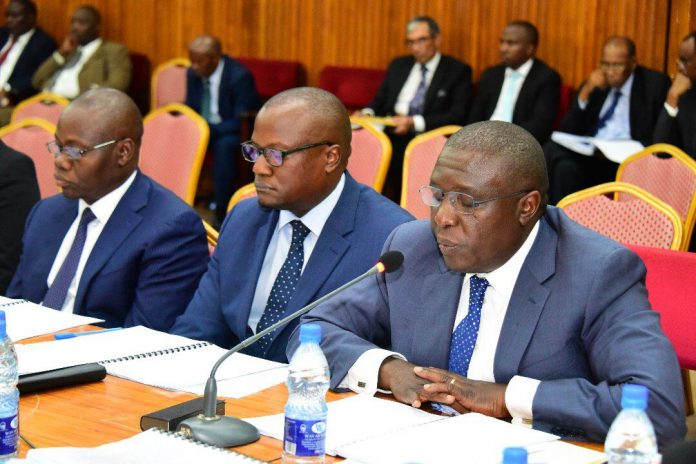
Bad blood between top heads at Dfcu bank


All isn’t well with two former buddies at the Dfcu bank Uganda as former Managing Director Juma Kisaame and Chief Executive Officer in charge of business development, William Ssekabembe are reportedly not seeing eye to eye over what sources say deals gone bad.

Eagle Online has reliably learnt that whereas Kisaame left the bank, he has kept in contact with some of the big clients whom he contacts direct over deals and yet such clients are supervised by Ssekabembe. However, that isn’t the big issue at hand as per say as sources say what is likely to result into fallout of the two is the allegations that Ssekabembe is the allegations that he reported all the under dealings Kisaame was involved in including the collusion between him and top Bank of Uganda leaders led by former Deputy Governor, Louis Kasekende and Ex-Executive Director in charge of Supervision Justine Bagyenda as far as the buying of Crane Bank Limited was concerned. Currently there several investigations on how Crane Bank in receivership was sold to Dfcu and failure to explain how Shs478 billion was utilized as Auditor General report only say over Shs 200 billion was accounted for.

Ssekabembe has never forgiven Kisaame as far as his return to Dfcu is concerned after he had quit for Kenya Commercial Bank only to be fooled by Kisaame and few board members who promised him that upon making a U-turn he would replace Kisaame. Upon returning, Ssekabembe was never given the job but humiliated and looked down upon when Kisaame instead recommended for Mathias Katamba and the continued frustration by Kisaame, he decided to go native and expose him.

Ssekabembe has reportedly threatened to exposure the loot by Kisaame including his state of the art school plus several houses and plots of land he allegedly acquired from clients who failed to service loans part of the pay back fight.

Stories Continues after ad

UNBS carries out exercise to verify quantity and safety of Liquefied Petroleum & Gas


 Uganda National Bureau of Standards (UNBS) has started an inspection programme aimed at verifying the weights and sensitizing distributors on the quantity and safety requirements of Liquefied Petroleum Gas (LPG).

The verification exercise was prompted by growing concerns of underweight LPG being sold on the market. The exercise is also aimed at providing distributors with information on the requirements of standards, codes of practice and processes.

Uganda Standard US 971-4 Liquefied Petroleum Gases (LPG) — Part 4: Specification addresses commercial liquefied petroleum gases consisting of either propane or butane or mixtures thereof. There are many uses for liquefied petroleum gases. Important uses include domestic, commercial, and industrial fuels, as a carbon source material in metal treating operations, as refinery raw materials for synthesis of gasoline components, and as petrochemical raw materials.

LPG, commonly known as gas has become a vital source of alternative energy especially in urban centres and is used in homes for cooking, heating and water heating in the residential and commercial markets. In agriculture, LPG is used for crop and animal production, grass cutting and weed control, and powering farm equipment such as irrigation pump engines. Industry relies on LPG for heating, drying, process heat and powering industrial trucks.

While its usage has become popular, there are unethical, unauthorized, or illegal practices that have emerged putting consumers at risk and creating unfair competition. It is likely that under-filling of cylinders is being done deliberately to cheat consumers. Over-filling of cylinders and containers may also be done due to poorly calibrated filling equipment which is dangerous and increases the probability of an uncontrolled loss of product.

UNBS is committed to enforcing policies and regulations that create a safe, equitable, and competitive environment for industry participants, and to ensure the benefits of LPG are not denied to those who rely on LPG for basic life needs.

The verification exercise will initially be carried out in the areas of Entebbe, Kampala and Mukono.


Stories Continues after ad

Anne Juuko is named new CEO Stanbic Bank

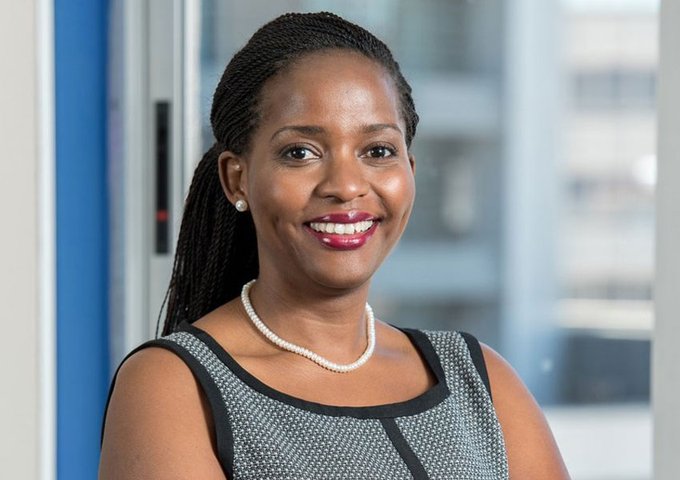
Ms Anne Juuko, CEO Stanbic bank.

The Stanbic Bank Uganda has announced Anne Juuko as its new Chief Executive Officer (CEO) effective March 1, 2020.

Ms Anne who has been serving as the head of global markets, was announced by Board of Directors on Tuesday evening. She replaces Patrick Mweheire who has been appointed Regional Chief Executive, Standard Bank Group

She becomes the first female to take charge of Stanbic Bank and the youngest, according to the bank’s announcement.

“She has been a part of the Standard Bank Group for over eight years having joined as Head of Global Markets for Stanbic Bank Uganda and was later appointed Head of Corporate and Investment Banking at Standard Bank, Namibia,” the bank said in a statement.

 According to the bank, Anne has exhibited exemplary performance, winning the highly coveted accolades such as the Primary Dealer of the Year award for six consecutive years. She has also demonstrated exceptional leadership and stellar performance that will see her set to achieve Stanbic Bank Uganda’s strategy and vision.

Mweheire, on the other hand has been moved to g Kenya where he will be working as the Regional Chief Executive, East Africa, for Standard Bank Group. He will commence work on March 1, 2020.

According to Stanbic, Mweheire will now be responsible for Standard Bank Group’s growth strategy in East Africa which comprises of Kenya, Uganda, Tanzania, South Sudan and Ethiopia.

Stories Continues after ad

Create lasting global solutions to water challenges – Museveni

President Yoweri Museveni has urged leaders in the water sector to deal with water issues in a holistic manner so as to create long lasting and effective global solutions to water challenges and threats.

“Issues of water cannot be talked about in a fragmented way. For instance, in such a conference, the Minister of Health should be in it because water also affects the country’s health”

The President made these remarks at the 20th African Water Association (AFWA) International Congress and Exhibition at the Kampala Serena International Conference Center.

AFWA is a professional association  established, enterprises and utilities operating in the areas of drinking water, sanitation and environment in Africa with over 100 utilities’ members from over 40 countries across Africa.

It holds an international congress and exhibition every two years to enhance the exchange of ideas and recent developments in the sector of water and sanitation. The last congress took place in the Malian Capital of Bamako in February 2018.

President Museveni, who launched the ‘Sustaining High Performing Public Enterprises’ book written by Dr. Silver Mugisha, the new president of AFWA, noted that one of the efforts necessary for water development and sustainability was the need to rightfully preserve the resource.

“Water is life. In order to use it, we must preserve it first. If we interfere with the local wetlands, we will be interfering with the rain. We must, therefore, recover those wetlands that have been encroached on,” he stressed.

He further noted that for water preservation to be done right, there was need for the African society to metamorphose from a primitive subsistence agriculture which made peasants encroach on wetlands as they looked for more land, to embracing industrialized system.

He reiterated that the African Water Congress should support the idea of leaving 500 meters of natural vegetation around the shores of water bodies to prevent silting and algae as well as bringing about fresh water. He also added that it would be difficult and costly to provide clean water to the population if the preservation was not done right.

Regarding the issue of increasing water in Africa, Museveni noted that there was need to embrace advanced levels of technology in order to intensify the efforts of removing salt from sea water to supply it at low costs. He advised the Congress to always advocate for the use of clean water, which he noted, prevents all water borne diseases.

He stressed to the African Water Ministers in the River Nile Region that there was no need to fight over the waters of River Nile because there are other alternative sources of more water supply.

“The water of the Nile is 85 billion cubic meters per year but you also forget that the River Congo has 3,000 billion cubic meters; but you hear people almost killing each other over the Nile,” he said.

State Minister for Water, Ronald Kibule, said that Uganda’s hosting of the Congress was a clear indication of the country’s tremendous achievements in the water sector. He expressed happiness to note that Uganda earns Shs3 billion every year from offering water consultative services to some African countries on account of the country’s success in water management.

The outgoing President of AFWA, Eng. Abderrahim El Hafidi, who handed over the instruments of power to new AFWA Dr. Mugisha Silver, noted that the Congress was highly relevant for the prospective African Vision of water and was a fulfillment of the United Nations’ Sustainable development goal 6 that called for clean water and sanitation for all people.

He also noted that the Board of AFWA had requested Uganda to host and establish the African Water and Sanitation Academy using the Uganda National Water and Sewerage Corporation (NWSC) as the utility.

Stories Continues after ad

Uganda spearheads EAC Member states in developing harmonized cancer registration guidelines

Cancer Machine

Uganda is spearheading East African Member states in developing harmonized cancer registration guidelines for East Africa.

The discussion of the second draft of harmonized cancer registration guidelines is ongoing at K-Hotels, Entebbe- Uganda.

The three-day discussions with representatives from East African member states aims at establishing a coherent framework for enhancing cancer registration and surveillance in East Africa to control the impact of cancer on the general population.

The member states are expected to discuss the second draft of the harmonized guidelines on cancer registration. This follows the first draft which was discussed in December 2019 in Nairobi- Kenya.

The first conference was held in Arusha, Tanzania at East African Community headquarters in August 2019, the second was hosted at Airport hotel, Nairobi Kenya in December 2019.

It should be noted that for a very long time, Uganda has been Africa’s research powerhouse having worldwide groundbreaking discoveries in cancer research and care. Therefore Uganda taking lead in this initiative indicates that East Africa recognizes the potential and contribution of Uganda towards cancer research through her implementing arm the Uganda Cancer Institute.

Cancer registration and it’s subsequent development of harmonized guidelines will standardize the process of establishment and operation of cancer registries in East African region; it will enhance high quality and comparable information on cancer burden in East Africa Community member states; will increase the cancer registry coverage in the region by involving various teams or authorities on the requirements and process of establishment of a population-based cancer registry and also enhance collaboration and networking among cancer registries in the region.

Stories Continues after ad

Tycoon Sudhir Ruparelia appointed Honorary Counsel of the Republic of Nepal to Uganda

Sudhir Ruparelia, East Africa's wealthiest man.


East Africa’s s richest man, Sudhir Ruparelia has been appointed the Honorary Counsel of the Republic of Nepal to Kampala.

In a bid to boost its relations and trade, the Republic of Nepal appointed Sudhir whose business ventures have continued to expend to cover many sectors of the economy.

According to sources at Ministry of Foreign Affairs, the formal ceremony will take place in the first week of March 2020 in Kampala when His Excellency Ambassador Jhabindra Aeyal Rajdoot.

About Nepal

Federal Democratic Republic of Nepal is a landlocked country in South Asia. It is located mainly in the Himalayas, but also includes parts of the Indo-Gangetic Plain. With an estimated population of 26.4 million, it is 48th largest country by population and 93rd largest country by area.

Nepal borders China in the north and India in the south, east and west while Bangladesh is located within only 27 kilometres (17 miles) of its southeastern tip and Bhutan is separated from it by the Indian state of Sikkim. Nepal has a diverse geography, including fertile plains, subalpine forested hills, and eight of the world’s ten tallest mountains, including Mount Everest, the highest point on Earth. Kathmandu is the capital and the largest city.

Nepal is a multiethnic country with Nepali as the official language.

Stories Continues after ad

Makerere, UCU ordered to stop admitting dental and medical students as KIU is shown green light

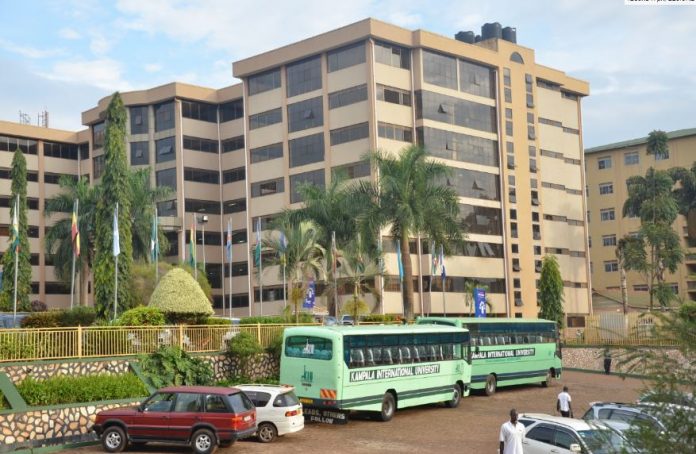
KIU library

Makerere University has been ordered to stop the admission of dental students over dentistry’s failure to meet minimum requirements for training of students.

Uganda’s oldest University was ordered by the East African Community (EAC), national medical and dental practitioner’s boards and councils following third joint inspection of medical and dental schools and teaching hospitals in Uganda. The inspection was carried out from 10th to 14th February 2020.

The inspection which was rolled out in seven universities offering medical and dental courses executed by a team composed of the chairpersons, registrars and the chairpersons of education committee of the EAC partner states medical and dental councils. The officials saw a number of gaps which need to be bridged for production of well qualified medical officers and dental surgeons.

The inspection took place in Uganda Christian University (UCU) School of medicine Mengo, Uganda Christian University (UCU) school of Dentistry Mengo, Makerere University dental school Kampala, Kabale University medical school, and Islamic University in Uganda (Habib medical school Kibuli), St Augustine International University medical school Bunga, Gulu university medical school, and Busitema University.

According to the report, the inspection peddled at establishing the conformity of the universities of the standards and guidelines governing medical and dental schools in the EAC with a view of improving the service and promotion of education and training in the region.

When we contacted the associated professional for KIU Janice Busingye, she acknowledged the receipt of the reports saying that they had been cleared in 2019. “Our effort is to produce credible and professional doctors,” she said. When we contacted the Makerere Public Relations officer Mrs Rita Namisango, she declined to comment on the matter.

“The inspection focused on major areas of governance and management, Academic programs, human resource, student affairs, infrastructure, monitoring and evaluation of programs, research and innovation. The joint team interacted with university management, teaching hospital management, academic staff and students,” read in part of the report.

The report says that Makerere University shall not admit any new dental students for the academic year 2020/2021 until a re-inspection by the joint EAC partner states’ medical board and councils is carried out at the university’s cost and approval given.

“The school of dentistry does not meet the minimum requirements for training of medical/dental students and therefore, upon qualification, their graduates shall not be eligible for reciprocal recognition within the EAC partner states as set out in the mutual recognition agreement and EAC inspect and recognition of medical and dental school guidelines,” reads the report.

The medical and dental practitioner’s boards and councils also ordered for the closure of Uganda Christian University (UCU) school of medicine and dentistry. The council urged the university to stop admission of students and separate the faculty of medicine from dentistry.  According to findings, UCU and Makerere had no single dental chair in the whole department.

The council also directed St. Augustine International University, Kabale University, Busitema University faculty of medicine, Gulu University to stop admission of new students and close both faculties of dentistry and medicines for failure to meet minimum requirements for training of students.

The board directed all universities which failed to meet minimum requirements to to purchase new equipment including dental chairs, compressors and instruments.

However,  report says Islamic University in Uganda met the required minimum standards but the institution was ordered to met some of the basics they were told to install by the inspection committee.

The committee which earlier inspected the universities, gave Kampala International University and Mbarara University of Science and Technology a green light as having attained the requirements.

Stories Continues after ad

BREAKING: Army withdraws guards from Gen. Tumukunde as a raid looms over a rumoured 2021 presidential ambition

Gen. Henry-Tumukunde.


The army has withdrawn all security details of former Security Minister Lt. Gen. Henry Tumukunde at his Kololo and Rukungiri homes.

Close sources to the retired army general confirmed the development to Eagle Online that an order to withdraw guards was given last weekend when the Gen. Tumukunde was up-country.

“It is true all the guards have been recalled back to Bombo and we are wondering why now because he is entitled as a retired general” The source told this website on condition of anonymity.

However, Eagle Online has established that the issue at hand pitting Gen. Tumukunde and the Kampala establishment is the rumoured presidential ambition he harbors to run against the incumbent Yoweri Museveni of the National Resistance Movement (NRM) party in 2021.

Apparently the sophisticated army general has silent been mobilizing masses across the country and has been endorsed by some members/ generals of the historical high command who are reportedly silently reportedly opposed to the continued dominance of President Yoweri Museveni.

Eagle Online can authoritatively reveal that as part of the wider plan to encounter the influential and well networked former spy master, there is an alleged raid to his home.

However, we couldn’t verify this information as Brig. Richard Karemire, the army Spokesperson couldn’t be reached on phone. 

So who is Gen.Henry Tumukunde

He was born on February 28,1959 in Rukungiri District in the Western Region. He attended Bishop Stuart College Demonstration School for his primary schooling. He studied at Kigezi College Butobere (Siniya) and Kibuli Secondary School for his O-Level and A-Level education, respectively

Tumukunde graduated from Makerere University with a Bachelor of Laws degree in 1981. He obtained a Diploma in Legal Practice awarded by the Law Development Centre in 2010. He also holds an Executive Masters in Oil and Gas Management, awarded by the Graduate Institute of Geneva in 2013.


Joining The NRA guerillas

During his time at Makerere, Tumukunde was involved in anti-government politics, which subsequently led to his joining of then rebels, the National Resistance Army, led by rebel leader Yoweri Museveni. Tumukunde was hounded by the government security services during his last year at the university and on completion, decided to join the struggle, along with two of his friends at the time, Major General Mugisha Muntu and Colonel Jet Mwebaze.

Obote’s security services at the time caught wind of their impending departure for the bush and mounted an attack on the NRA’s transit house (shop) in Kampala. It is said that Tumukunde alongside Muntu posed as shopkeepers, surviving what would have been sure torture and death. In the early stages of the war, Tumukunde was a machine gunner and eventually went on to become one of the senior officers in NRA, indicated by his senior number RA 0111.

Getting shot

In 1985, during one of the bigger battles with the Uganda National Liberation Front in Luweero District, Tumukunde was shot multiple times in his legs. The wounds were so major that it was thought he would not survive. He was, however, smuggled out of the country to Nairobi and eventually to London where he was operated on.

Post-Bush

On capturing power, Tumukunde was promoted to the rank of major and appointed first secretary and military attache at the Ugandan High Commission in the United Kingdom. Subsequently, Tumukunde was sent on a Command and Staff Course at the Armed Forces Command and Staff College, Jaji, in Kaduna, Nigeria from where he emerged as one of the best students. He later on returned to Uganda where he became the Army’s director of planning. Tumukunde served in this role for many years and was very instrumental in the setup of formal military structures in the UPDF, which had until then been a rebel army.

In 1994, Uganda held elections for the Constituent Assembly and Tumukunde sought to represent his home county Rubaabo. His main competitor was Prof. Mondo Kagonyera. Tumukunde, who was in early thirties at the time, was thought to be the underdog in the race; however, Tumukunde was a very good mobiliser and won by a landslide margin. Tumukunde then joined the CA, which formulated the current 1995 Ugandan Constitution. Tumukunde was known to be a regular and astute contributor to the sessions and debates that preceded the formation of the Constitution.

Following the set-up of the constitution, Uganda held elections and Tumukunde subsequently became a Member of Parliament representing the Army as a special interest group. He went on to serve as an MP until 2005. In addition to this, Tumukunde was promoted to the rank of lieutenant colonel and appointed chief of personnel and administration. In 1998, Tumukunde was again promoted to the rank of colonel and appointed chief of military intelligence and security. His tenure was arguably the most successful by any officer as it is during this time that Al-Qaeda’s plan to bomb the American Embassy was thwarted. There was also a time where bombings were rampant within the capital Kampala, and once again Tumukunde formed several intelligence committees within the city and the problem was managed. Tumukunde also built an amicable rapport with the Muslim community, which many had accused of spearheading the attacks, so much so that key intelligence information was forwarded to him with ease. Arguably, it was during his reign that the Ugandan intelligence apparatus was at its most efficient.

Tumukunde was then promoted to brigadier general and transferred to command the UPDF Fourth Division based in Gulu. At the time, the war with the LRA was ongoing and Tumukunde made significant headway during his time as division commanding officer in diminishing the threat of the LRA. It is also at the time when Ebola outbreak was first reported in Northern Uganda and Dr. Mathew Lukwiya and Gen. Tumukunde swung into action but bad enough Dr. Lukwiya lost to the Ebola battle.

Tumukunde was then appointed Director General of the Internal Security Organisation, Uganda’s civil intelligence body. During his time at ISO, Tumukunde set up structures that returned ISO to being the country’s foremost Intelligence gathering body, just as he had done with CMI. The Internal Security Organisation became renowned for its efficient and effective approach towards intelligence and counter-terrorism.

The fall out

Tumukunde’s fast rise to the upper echelons of both the political and military scene in Uganda marked him out as one of Uganda’s most popular and well-known figures and ultimately, this, alongside his very strong minded and unrelenting dedication to his country, brought him into the sights of the very institutions he helped to consolidate.

At a political retreat in 2003, Tumukunde, in the presence of the president and his cabinet, argued against the impending removal of term limits that would give President Museveni the right to stand for re-election on an infinite basis. Tumukunde stated that this would be in direct contravention of the rights that they fought to establish and that he was not willing to take part in what he considered to be grossly unconstitutional behaviour. Predictably, this put him at loggerheads with the establishment and more so the president.

Arrest and detention

Tumukunde was charged with the offences of abuse of office and spreading harmful propaganda. The abuses of office charges were eventually dropped in a manner suggesting that they had been politically motivated in the first instance. What followed was, however, a surprise to many. Tumukunde was on May 28, 2005, forced to resign from Parliament and subsequently arrested on the orders of the President Museveni

His home was surrounded by at least 50 soldiers commanded by then Brig. Kale Kayihura and Brig. Joshua Masaba who proceeded to arrest him. Gen. Tumukunde was then driven in a tightly guarded convoy to an officers mess turned detention center, where he was incarcerated for nearly two years, during which he had limited and tightly controlled contact with the outside world. His extrajudicial detention coupled with a series of controversial and uncertain court martial hearings seemed to backfire leading to irreversible pressure culminating in his release in 2007.
His arrest followed his opposing views to the proposed “third term” project that suggested a revision to the Ugandan constitution enabling one to serve more than two terms as president as was the case at the time.

On April 18, 2013, the UPDF General Court Martial sat to bring an end to the process that had lasted eight years and summed up its deliberations. The charge of spreading harmful propaganda was dropped while the joint charge of military misconduct was upheld and Tumukunde was subsequently sentenced to a severe reprimand.

Promotion and retirement

In September 2015, Tumukunde was promoted to the rank of Lieutenant General and then retired from the Army.

Appointment to cabinet

On June 6, 2016, he was appointed to the Cabinet as the Minister of National Security. He was relieved of his cabinet responsibilities on the evening of Sunday, 4 March 2018, in a presidential tweet, in which his nemesis, General Kale Kayihura, the former Inspector General of Police was also fired.


Stories Continues after ad

Police denies knocking People Power supporter says CCTV footage will tell the truth

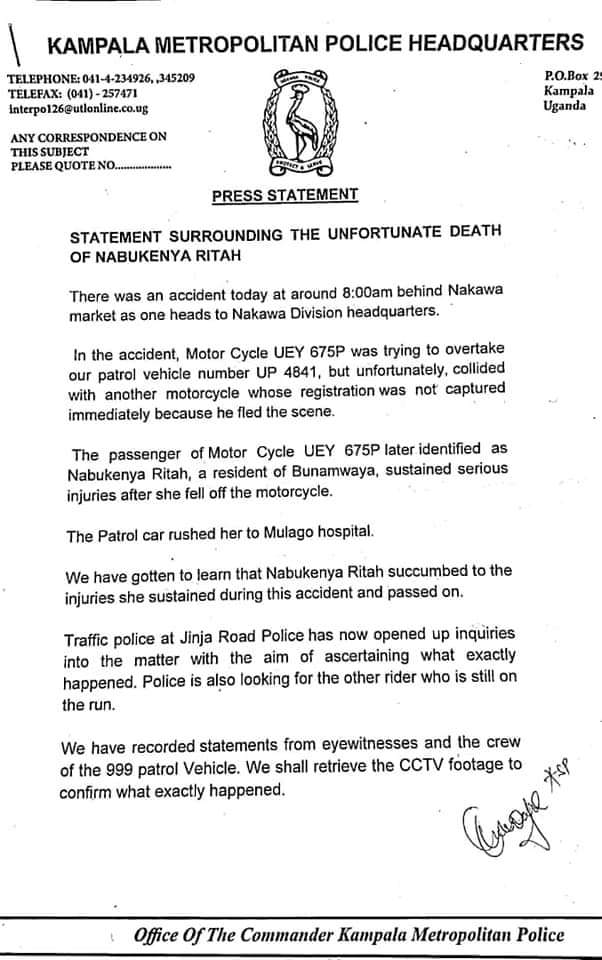
Late Nabukenya


Police has denied all allegations that it patrol knocked People Power supporter Rita Nabukenya earlier today in Nakawa division.

Ms Nabukenya was knocked by speeding police patrol as she headed to Buganda Road Magistrate’s Court for the hearing of disobedience of statutory case against their patron, Robert Kyagulanyi.

According to Joel Ssenyonyi, the Spokesperson of group, Nabukenya was clad in People Power attire this morning on a boda-boda (Motorcycle) in Nakawa heading to court and thereafter she was to proceed to Pope Paul memorial hotel where Bobi wine was schedule to have his consultative meting ahead of the 2021 presidential elections.

“A police truck saw her, chased after them and run over her. We have learnt that she has since passed on. We are now at Mulago mortuary, with police tossing us around” Ssenyonyi said.

Alluding to Kampala metropolitan deputy police spokesperson Luke Owesigire, the accident happened in the presence of the alleged police patrol but failed to arrest the other cyclist whose motorcycle collided with the one carrying Rita Nabukenya.

“In the accident motorcycle reg. UEP 675Y was trying to overtake police patrol UP 4841 and collided with another motorcycle whose registration number was not captured because he fled the scene. The passage of motorcycle UEP 675Y who was identified as Rita Nabukenya a resident of Bunamwaya sustained injuries after she fell of the motorcycle.” he said.

He said Rita was rushed to Mulago and later pronounced dead. He said Traffic police at Jinja road has open up injuries into the matter and have since recorded statement of eye witness and the crew of police patrol. Her body was conveyed to city mortuary for postmortem as investigation take shape.

He vowed to retrieve footage of CCT Cameras to confirm what exactly happened.


Stories Continues after ad
Parliament Pension Fund register growth of Shs 53.3billion

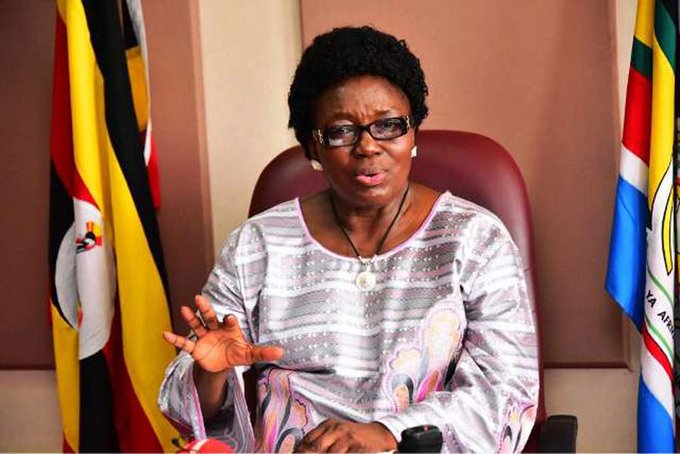
Minister for East African Community Affairs, Rebecca Kadaga

The Parliament Pension Scheme has realized an assets growth of 25.7 per cent from Shs204.55 billion in 2018 to Shs257.21 billion improving its financial and investment capacity.

According to Chief Operations Manager, Nightingale Mirembe, the growth is attributed to an increase in member contributions, returns on investments in the equity market and the employment of a new risk management policy.

Mirembe made this revelation at the Eighth Annual General Meeting of the Parliament Pension Scheme. “The use of a new risk management policy has helped us focus on investing in items that have less risk and greater return,” she said adding that the risk management is crucial since the core value of the scheme is in investing funds for value and mitigating risks.

Mirembe added that this helped the fund realise improvement in other aspects of the scheme like prompt payment of pension benefits and.

“We have been able to pay out pension benefits by the 15th day of the month and sometimes the 10th day; we have also reduced the unclaimed benefits from over Shs3 billion to Shs500 million,” she said.

Speaker Rebecca Kadaga pledged to support the Scheme and to remind the president of his pledge towards offering funds to boost it financially.

The Auditor General, John Muwanga commended the Board of Trustees for adhering to the Parliamentary Pensions Act, 2007, Public Finance and Management Act 2015; the Uganda Retirement benefits regulatory Act, 2011 and generally accepted accounting practices.

“In my opinion, proper books of account have been kept by the scheme so far, as appears from my examination of those books,” he said

Stories Continues after ad