Stanbic Bank
Stanbic Bank
24.6 C
Kampala
Stanbic Bank
Stanbic Bank
Home Blog Page 1071

Gen. Kyanda impressed by UPDF continued professionalization agenda at pass out

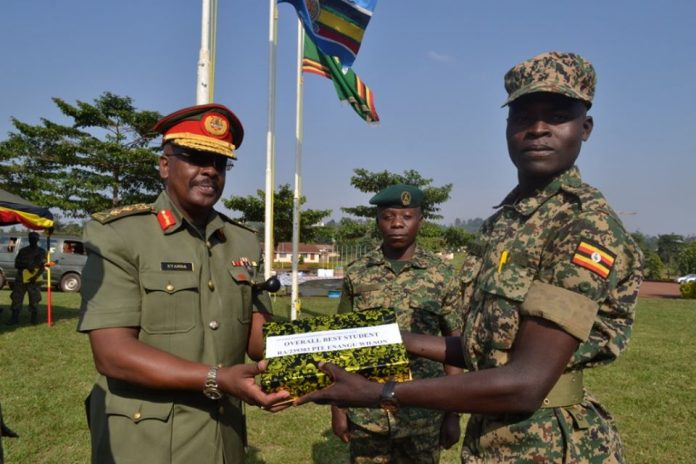
Gen. Kyanda handing over a certificate of excellence to one of the best candidates at the pass out.


Five hundred ninety soldiers have graduated from the Non-Commissioned Officers’ Academy (NCOA) at the Uganda Peoples’ Defence Forces’ (UPDF) Gadaffi Garrison.

The Chief of Staff Land Forces, Maj. Gen. Leopold Eric Kyanda presided over the pass out ceremony of 467 militants who completed six months Senior Non-Commissioned Officers’ (SNCO) Course Intake 16/19-20 and 123 who finished four months’ Level III Instructor’s Course Intake 04/19-20.

The Commandant of NCOA, Col. Saad Katemba said the courses were intended to impart skills and knowledge on the trainees as well enhance their individual capabilities to enable them perform their duties more effectively.

“I am confident that the courses have added a brick in the construction of a professional force. These graduands can now be entrusted with more responsibilities in the maintenance of security in our country and anywhere else the leadership may decide,” said Col. Katemba.

The Chief Guest, Gen. Kyanda was impressed by the demonstrations conducted by the graduands during the pass out ceremony which included range tactics, and drill and instruction exercises. He said that the excellent performance exhibited is a clear sign that the trainees greatly benefited from the training.

“This is a remarkable achievement for the UPDF and also a clear sign that the professionalization agenda is moving on a steady trajectory,” said Gen. Kyanda. He added that the UPDF leadership is committed to building the capacity of Non-Commissioned Officers (NCO) Corps and that such courses are part of the wider arrangement to empower the NCOs with leadership skills to manage soldiers under their command.

“The NCO training has taken priority on UPDF calendar because it is important to empower the NCOs who play a vital role of linking the Militants to Officer,” said Maj Gen Kyanda. He noted that it’s the NCOs who are closest to the soldiers and play an important role in ensuring an efficient, disciplined and effective Force.

He said the NCOs should on deployment ensure daily drilling and inspection of the troops under their command to ensure focus and combat readiness. He also told them to ensure regular physical fitness and battle drills training for their troops.

The best students were awarded gifts; overall best was Cpl. Juma Ronald. Cpl. Aseere Gloria excelled in class and Cpl. Omio John Bosco was the best in the field. The overall best in Instructors’ course was Pte. Enangu Wilson, while Pte. Akoba Innocent excelled in class and Pte. Ngobi Alone was the best in teaching.


Stories Continues after ad

Total Uganda partners with NWSC to launch the 20th African Water Association Congress

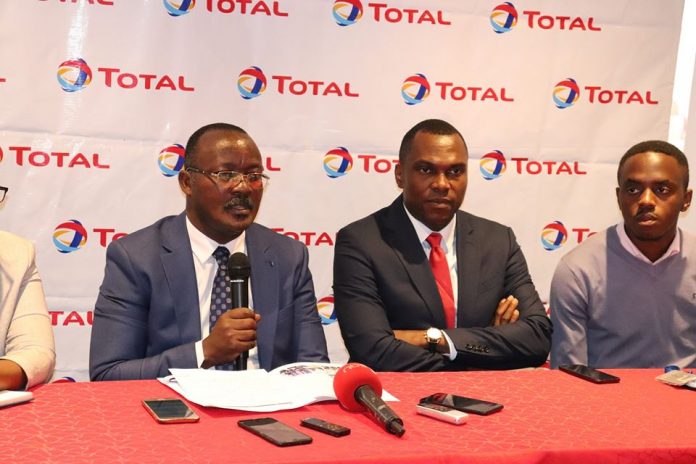
Eng. Mugisha and other officials at the launch.


Total Uganda and National Water and Sewerage Corporation (NWSC) have launched their partnership in hosting the 20th African Water Association (AfWA) Congress and Exhibition at the Total Head Office on plot 4 8th street.

The bi-annual congress held by the African Water Association as part of a mechanism to enhance exchange of ideas and seek for innovative solutions related to the water and sanitation sector.

The Congress is organised by AfWA in collaboration with the Ministry of Water and Environment and National Water and Sewerage Corporation on behalf of the Government of Uganda.

The AfWA Congress which will be officiated over by the President of Uganda, His Excellency Yoweri Kaguta Museveni, will focus on the new breakthrough solutions and innovations to address the current water and sanitation challenges in Africa. It will be held at the Kampala Serena Hotel from 24th -27th February under the theme; “Breaking New Grounds to Accelerate Access to Water and Sanitation for all in Africa”.

Total Uganda has contributed $25,000 towards the activities and preparations of the AfWA Congress and will be hosting various activities for over 2,000 delegates and exhibitors.

Speaking during the launch, Mr Obi IMEMBA, Total Uganda’s Managing Director said; “The importance of water and sanitation cannot be overemphasized. Total Uganda is guided by its goals to improve water and sanitation as a top priority in the communities we operate in.

Our partnership with NWSC shows our commitment to enhance the lives of people in our communities and ensure sustainable development. One of our main key focus areas is environmental sustainability and we believe that through our efforts, we can turn water and sanitation into a critical line of defence against climate change.”

Eng. Silver Mugisha, the Managing Director of NWSC said ; said “This partnership with Total goes to show that the concern in ensuring that there’s clean safe water for all is not only a government concern but that shared by the private sector too. This makes the drive to achieve the sustainable development goals come 2030 even more attainable.”

In the past, Total Uganda has been at the forefront of promoting health and sanitation in its areas of operation with donations to boost the fight against cholera in Hoima and Bulisa, aiding community health through donations of garbage bunkers and bins to Pakwach and Anaka towns and the rehabilitation of sanitary blocks destroyed by a storm at Kirama primary school in Bulisa district.


Stories Continues after ad

DCJ swears in new NIRA board, urges them to improve service delivery

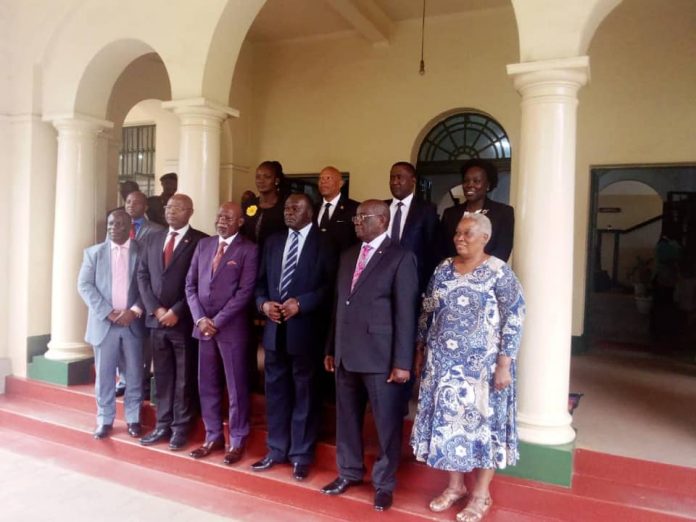
NIRA new board posing for group photo with Deputy Chief Justice.


The Deputy Chief Justice, Alfonse Chigamoy Owiny-Dollo has sworn in new members of the National Identification and Registration Authority (NIRA) and urged them to improve on the pace at which new National Identity Cards and replacement for the lost ones is done.

The new board includes Mr Joseph Biribonwa, a former commissioner at the Electoral Commission as the Chairperson, deputized by Ms former Kalangala district woman Member of Parliament, Ruth Nvumetta Kavuma. Other members are; Mr James Saka from NITA-U, Dr. Paul Kintu, Dr. Chris Ndatira Mukiza, Dr. Betty Nanyonga Kivumbi and Maj. Gen Apollo Kasita Gowa.

There has been a general outcry from the public about the slow pace officials process the National Identity cards. Some people registered in 2014 have never got their cards, while those who lost them have had to wait for years before getting replacements.

Justice Dollo told the NIRA Board that this must stop adding that Ugandans are entitled to speedy access to this service. He said being on the Board should not only be a prestige, but a commitment to serve the country.

He urged the members to ensure that Uganda’s National Identification Cards have value, integrity and security and that getting them should be an easy process.

“I have heard that it is a nightmare for people trying to replace national identity cards. I don’t’ know why. This is wrong because getting access to most of the public services is dependent on the national identity card, not police letters,” the DCJ said.

“So honourable Minister (Jeje Odong), one of the things this Board has to do is to speed up the process. When I lose my card I should be able to get a replacement easily. The only thing is the money because I have been careless and therefore, I have to pay for it,” Justice Dollo added.

He also shared how he had to produce a National Identity card during a job application.

“I wrote an application last week and the first item they wanted from me was my National Identity. Now if I did not have it or if I had lost it and I had to present a police statement to that effect, probably it would have worked against me. So please, let our people get these things as soon as possible and also go out to sensitise them on importance of these cards,” he said.

Gen. Odongo, the Minister of Internal Affairs said the selected people were the best available candidates to fill the positions as board members. He said the members were vetted and approved by the cabinet before final confirmation. He also urged them to work hard to improve things at the registration authority so that Ugandans can get their documents in time.


Stories Continues after ad

ADB rebuts World Bank president’s comments on Africa’s debt profile

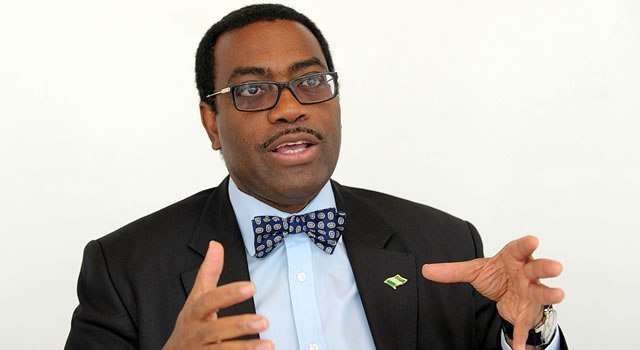
AWARDED NOBEL PRIZE FOR AGRICULTURE: Akinwumi Adesina, President of the African Development Bank (AfDB)

In several news reports, World Bank President David Malpass was recently quoted as saying some Multilateral Development Banks, including the African Development Bank, have a tendency to lend too quickly and in the process, add to the continent’s debt problems.

This statement is inaccurate and not fact based. It impugns the integrity of the African Development Bank, undermines our governance systems, and incorrectly insinuates that we operate under different standards from the World Bank. The very notion goes against the spirit of multilateralism and our collaborative work.

For the record, the African Development Bank maintains a very high global standard of transparency. In the 2018 Publish What You Fund report, our institution was ranked the 4th most transparent institution, globally.

The African Development Bank provides a strong governance program for our regional member countries that focuses on public financial management, better and transparent natural resources management, sustainable and transparent debt management and domestic resource mobilization. We have spearheaded the issuance of local currency financing to several countries to mitigate the impacts of foreign exchange risks, while supporting countries to improve tax collection and tax administration, and leveraging pension funds and sovereign wealth funds to direct more monies into financing development programs, especially infrastructure.

The African Development Bank’s Africa Legal Support Facility (ALSF) supports countries to negotiate terms of their royalties and taxes to international companies, and terms of their non-concessional loans to some bilateral financiers. We have been highly successful in doing so.

These are the facts:

The World Bank, with a more substantial balance sheet, has significantly larger operations in Africa than the African Development Bank. The World Bank’s operations approved for Africa in the 2018 fiscal year amounted to US $20.2 billion, compared to US $10.1 billion by the African Development Bank.

With regard to Nigeria and South Africa, the World Bank’s outstanding loans for the 2018 fiscal year to both countries stood at US $8.3 billion and US $2.4 billion, respectively. In contrast, the outstanding amounts for the African Development Bank Group to Nigeria and South Africa were US $2.1 billion and US $2.0 billion, respectively, for the same fiscal year.

With reference to the countries described as “heavily indebted,” our Bank recognizes and closely monitors the upward debt trend. However, there is no systemic risk of debt distress.

According to the 2020 African Economic Outlook, at the end of June 2019, total public debt in Nigeria amounted to $83.9 billion, 14.6 per cent higher than the year before. That debt represented 20.1 per cent of GDP, up from 17.5 per cent in 2018. Of the total public debt, domestic public debt amounted to $56.7 billion while external public debt was $27.2 billion (representing 32.4 per cent of total public debt). South Africa’s national government debt was estimated at 55.6 per cent of GDP in 2019, up from 52.7 per cent in 2018. South Africa raises most of its funding domestically, with external public debt accounting for only 6.3 per cent of the country’s GDP.

Development Banks continue to play critical roles in development efforts and in the aspirations of developing countries, most especially in Africa.

Given substantial financing needs on the African continent, the development assistance of the African Development Bank, the World Bank and other development partners remain vitally important, with increasing calls for such institutions to do even more.

The lending, policy, and advisory services of these development institutions in their respective regions are often coordinated and provide substantially better value-for-money to developing nations, compared to other sources of financing. As a result of the African Development Bank’s AAA-rated status, we source funding on highly competitive terms and pass on favorable terms to our regional member countries. Combined with other measures to ensure funds are used for intended purposes, it helps regional member countries finance debt and development in the most responsible and sustainable way.

With regard to the need for better lending coordination and the maintenance of high standards of transparency, the African Development Bank coordinates lending activities, especially its public sector policy-based loans, closely with sister International Financial Institutions (notably the World Bank and the IMF). This includes reliance on the IMF and World Bank’s Debt Sustainability Analyses (DSA) to determine the composition of our financial assistance to low-income countries; and joint institutional approaches for addressing debt vulnerabilities in the African Development Fund (ADF) and International Development Association (IDA) countries.

In addition, country economists of the African Development Bank fully participate in regional and country level IMF Article 4 missions. Contrary to suggestions, these are just a few concrete examples of historic and ongoing coordination between sister Multilateral Development Banks, IFIs, and development partners. The African Development Bank is committed to the development of the African continent. It has a vested interest in closely monitoring debt drivers and trends in African countries as it supports them in their efforts to improve the lives of the people of Africa.

We are of the view that the World Bank could have explored other available platforms to discuss debt concerns among Multilateral Development Banks. The general statement by the President of the World Bank Group insinuating that the African Development Bank contributes to Africa’s debt problem and that it has lower standards of lending is simply put: misleading and inaccurate.

Stories Continues after ad

More than 14 people perish in Busia-Namayinga highway accident

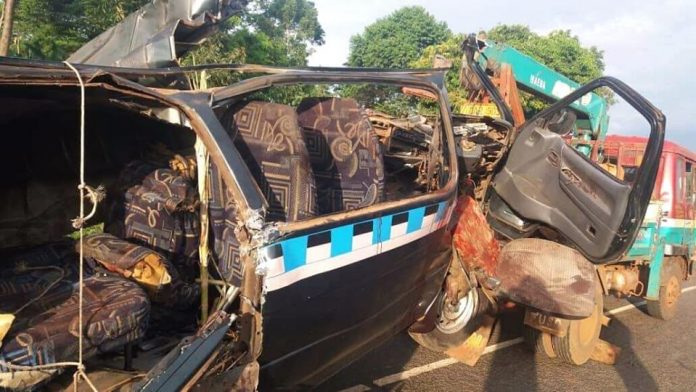
The remains of the taxi that rammed into a Tata lorry.

Police has confirmed that 15 people have perished in a road accident after taxi they were traveling in rammed into a stationary Tata along Busia- Namayingo – Musita highway.

According to Busoga East Regional police spokesperson, ASP James Mubi Taxi Reg number UBD 089A that was traveling from Namayingo to Kampala rammed into a stationary sugarcane Tata reg number UWP 616 at Imanyiro village.

“All the bodies of the deceased were taken to Mayuge health Centre IV for post Morten examination.” He said adding that police embarked on investigations to establish the cause of the accident are underway.

Mr. Mubi said that the deceased include 11 male passengers, three female passengers and a two-year-old child whose particulars were not readily available.


Stories Continues after ad
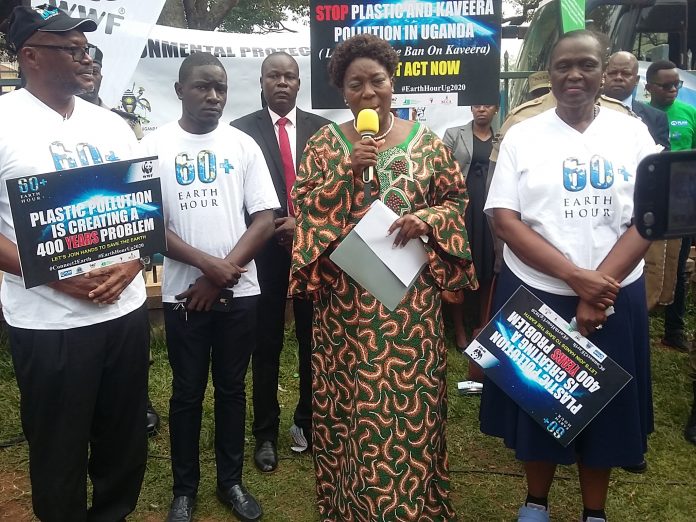
Kadaga calls for enforcement of laws against polythene bags below 30 microns

Speaker Kadaga during the function


Parliament is set to focus on the ban of polythene bags and plastics. The revelation was made by Speaker Rebecca Kadaga during walk against plastic carrier bags campaign peddled at creating awareness and saving environment.

In 2018, parliament passed the National Environment Bill 2017 banning polythene bags below 30 microns following a recommendation from the Committee on Natural Resources.

The walk against plastic carrier bag campaign was flanked by students from of Makerere, Kampala International University (KIU), Kyambogo and Muteesa 1 Royal University and pupils from various primary schools.

The walk which covered four kilometers from the City Square to Kampala Capital City Authority (KCCA) grounds Lugogo was organized by the World Wide Fund for Nature (WWF).

In her speech Kadaga appreciated the WWF officials and youths for this noble cause and encouraged them to spearhead the fight as the government supports them.

“I appreciate everyone here and urge you to fight tirelessly and conserve the environment. We will not sit back on this matter of saving the environment.” Kadaga said adding that parliament will render a hand to see that the law is enforced right from the Ministry of Water and Environment under the National environment Management Authority,

According to the WWF Director, David Duli, pollution has become a great challenge in Uganda and the world at large and there is little effort to towards checking increased plastic and Kaveera pollution, “But today it is our time to fight hard,” he added

“Everywhere you move, there are plastics and polythene bags dumped and this has caused a great risk to our soils, water and the aquatic animals. The littering is especially from the city to drainage channels and beaches,’ Duli urged.

He added that this has threatened the future of our country and the generation to come.

“Although doctors have played their roles of treating Ugandans and sensitizing them against pollution, many diseases have sprung up such as cancer that swept our great diplomat Gen. Benon Biraro .” He said

The Executive Director Youth Live Uganda, James Byarugaba said, “Ugandans have to embark on the climate change and stop being selfish and negligent about our lives and the future generation.”

He urged Ugandans should always carry usable bottles only to cub plastics in the country. “In this fight we are not against businessmen but on the betterment of Uganda.” He said


Stories Continues after ad

Parliament summons Finance Minister over delayed replacement of Kasekende at BoU 

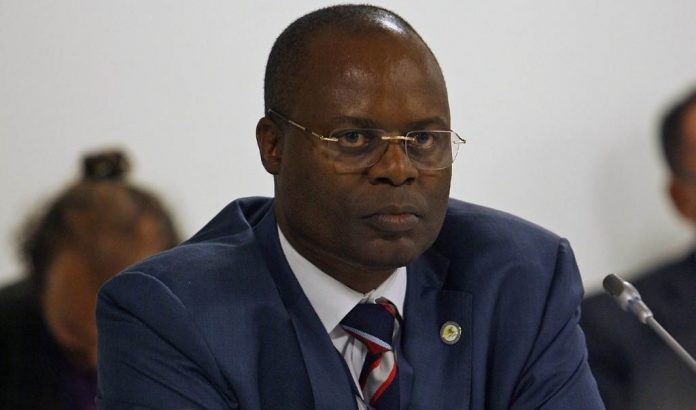
On the spot: Former Deputy Governor Dr. Louis Kasekende.

The Speaker of Parliament, Rebecca Kadaga, has summoned the Finance Minister, Matia Kasaijja to explain why government has not appointed the deputy governor of Bank of Uganda  replacing Louise Kasekende.

According to Kadaga it’s only Emmanuel Tumusiime Mutebile taking on all the responsibilities of the governor yet he is supposed to have a deputy

“I am concerned about this crisis, therefore, I hereby order the Minister of Finance Matia Kasaijja to appear before Parliament to tell us when the deputy governor is going to be appointed,” Kadaga said.

This comes after Igara County East Member of Parliament Michael Maranga Mawanda raised an issue of national importance in parliament tasking government to appoint a deputy governor for central bank.

“Madam Speaker, I am here to raise on an issue of national importance, I am currently working on the Bank of Uganda amendment bill 2019.But madam Speaker as I speak now, we don’t have a deputy governor for the Bank of Uganda, and the position is vacant. Can government explain to me why they are not appointing a new person?,” Mawanda said.

Former Bank of Uganda deputy governor Louis Kasekende contract expired on January 13 and he subsequently handed over his office to the governor after President Yoweri Museveni had declined to renew his contract.

Kasekende is one of the bank officials who witnessed dubious selling of seven defunct banks. Teefe in (1993), international credit Bank ltd in 1998, Greenland bank (1999), The Co-operative Bank (1999), National bank of commerce 2012, Global Trust Bank (2014) and the dubious sale of Crane Bank Ltd to Dfcu bank in 2016.

In 2018, Parliamentary Committee on Commission, Statutory Authorities and State Enterprises (COSASE) led by the then chairperson, Abdul Katuntu embarked on an investigation into the closure of banks after Auditor General’s (AG) report which showed irregularities into the sale and closure of banks.

COSASE established that, some banks including Crane Bank Limited were liquidated on telephone calls without thorough evaluation. Crane Bank Limited was in 2016 put under receivership and later sold to Dfcu bank at a mere Shs200 billion whose value was to be recovered from the bad book. Crane bank had initial capital of Shs478 billion.

When BoU sold CBL to Dfcu bank it also transferred to the same bank freehold properties of CBL/Meera Investments Limited without following the law. CBL was renting the properties from Meera that were wrongfully transferred to Dfcu bank.

It also established that Kasekende and Mutebile failed their mandate of adequately supervising the management in the process of liquidating the financial institutions.

Stories Continues after ad
Absa Group completes renaming of African ubsidiaries

ABSA

Absa Group Limited’s Barclays branded subsidiaries in seven African countries of Botswana, Ghana, Kenya, Mauritius, Seychelles, Tanzania and Zambia were renamed as ‘Absa’ today, completing the name change across the continent. Absa Group’s subsidiaries in Uganda and Mozambique were renamed in November.

The renaming of the remaining subsidiaries today marks another substantial milestone in Absa’s separation from Barclays PLC, a three-year process scheduled for completion by mid-2020.

“More than a name change, this is a milestone that brings us closer to realising our ambition as a leading African bank to support growth and development on the continent and beyond,” said Absa Group Chief Executive Daniel Mminele. “We are now united under a single brand in 12 countries in Africa.” Absa also has representative offices in London and New York.

The group-wide rebranding programme, one of the largest corporate rebranding projects in Africa currently, started with the launch of a refreshed visual identity in South Africa in July 2018 to reflect the group’s new identity as a standalone African bank. The name and brand change programme has seen the Absa logo replacing Barclays branding on thousands of asset types, including branches, offices, ATMs, uniforms, cards, stationary, forms, apps, websites and more.

“Today, we as the Absa Group, re-affirm our commitment to contributing to growth and economic development in Africa. We have a long-established and respected legacy in all our African markets, which will serve us well for the future,” said Peter Matlare, Absa Group Deputy CEO and Chief Executive of Absa Regional Operations. “By adopting the Absa name, we are leveraging our rich African heritage in order to drive relevant initiatives that will further unlock our continent’s potential, deepen regional integration and support accelerated growth,” he said.

The renaming of the subsidiaries is being celebrated with an array of events across the countries, as part of the marketing and communications drive to create awareness of the name change.

The rebranding programme unites Absa’s operations in 12 African countries behind a single identity, purpose and strategy.

Absa brand transition timeline

March 2016: Barclays PLC announces that it will reduce its ownership of Barclays Africa Group Limited (now called Absa Group Limited) from 62.3% to a minority shareholding, over time. This comes as global bank regulations tighten after the 2008 financial crisis, making it less attractive for international banks to own stakes in banks abroad.

December 2017: PLC concludes the sell-down, leaving the UK company with a 14.9% stake in the Group. Barclays PLC indicates that this is its long-term desired ownership level, and says that it does not plan to effect further sales at this time.

March 2018: Barclays Africa Group announces new Group strategy focused on growth, of which Absa Regional Operations (Absa’s operations outside of South Africa) is crucial.

July 2018: The Group’s name is changed from Barclays Africa Group Limited to Absa Group Limited, and the decision to change subsidiary names to ‘Absa’ is announced. A refreshed brand is unveiled in South Africa.

November 2019: Barclays Bank Uganda and Barclays Bank Mozambique are renamed as Absa

February 2020: All remaining Barclays-branded subsidiaries are renamed as ‘Absa’

Stories Continues after ad

African Development Bank approves $1m grant for Uganda to stem Ebola transmission

ADB President, Dr. Akinwumi Adesina

The African Development Bank has released a $1 million grant to Uganda to help the East African country tackle an outbreak of the Ebola virus.

The grant to support Uganda’s National Ebola Viral Disease (EVD) Preparedness and Response Plan, was approved in January. Funds have been disbursed through the World Health Organization (WHO), which is the implementing agency.

The grant follows a request by the Government of Uganda to the African Development Bank to support the country’s efforts in containing the Ebola scourge that has so far killed three people in the East African nation. The Bank is working with Uganda’s Ministry of Health, and the WHO, a specialized agency of the United Nations on health-related issues.

The agreement was signed by the Bank’s Uganda Country Manager, Kennedy Mbekeani,  Uganda’s Minister of Finance Planning and Economic Development, Matia Kasaija, and Dr. Rebecca Matshidiso Moeti, the WHO’s Regional Director for Africa.

The funds will be used for the management of suspected and confirmed EVD cases in Uganda, including the procurement and distribution of medical supplies, and care of people affected by Ebola. The grant will also be used to strengthen readiness and capacity at the national level and in high-risk districts, including training and emergency support. With this support, response teams will be quickly deployed and surveillance of the disease will be strengthened.

The Bank praised the Ugandan government for its vigilance, and called upon other development partners to support its efforts to stem transmission of Ebola infection and prevent new outbreaks in non-affected areas.

The Government of Uganda’s request for emergency relief assistance will help to save and protect lives, and restore the normal livelihoods and economic activity of people in 31 districts in the country. The request falls within the Bank’s revised policy guidelines and procedures for emergency relief assistance. Uganda’s Ebola response plan is aligned with the Bank’s High priority which aims to “Improve the quality of life for the people of Africa.”

Stories Continues after ad

Gen. Saleh’s daughter asks court to take ex-husband for mental checkup as he marries Kutesa’s girl

Esteri Mugulwa Akandwanaho and Eng. Ronald Ndizeye Sekaziga during their happier days.

The daughter of Caleb Akandwanaho aka Gen. Salim Saleh, Esteri Mugulwa Akandwanaho has petitioned  court to have her ex husband and father to her children Eng. Ronald Ndizeye Sekaziga, to have him psychologically evaluated.

The businesswoman and mother of three broke up with her former husband in 2017 due to irreconcilable differences and any attempts of mediating between the two parties were of no help.

On February 11, 2020, Ms Akandwanaho, through her lawyers at Kashillingi Rugaba Associates sought for an mental evaluation of her ex-husband Sekaziga after the former repeatedly refused to follow protocol and continuously put their children at risk by taking strangers to their schools. This is believed to have terrified the young mother who currently seeks sole custody of the divorcees three children.

However, sources close to the pair and their families believe there is more to the story than meets the eye. Although the two were madly in love with each other by the time they married in 2010, theirs was a short lived marriage as things took a turn for the worse shortly after that and the pair separated. A source who wishes to stay anonymous states that the two were majorly separated by the betrayal on the husbands part; after he fell in love with his wife’s best friend a daughter to Maj. Gen.Pecos Kutesa. It seems that any attempts to stay faithful to his wife failed, leaving he young bride without a husband and close friend.

This not only rocked the newly weds but also caused a huge scandal in the family as the two girls were not only close but family friends; further severing any Kutesa and Akandwanaho ties despite the families having been very close prior to the breakup.

Although Ms Akandwanho continues to fight for the custody of her children, Sekaziga on the other hand looks happy to move on as he plans to marry and settle with his new bride,…. This new development doesn’t seem to settle well with his ex-wife who quickly ruched to The Nakawa magistrate’s Court to have him mentally checked before anyone else can claim him as their own. Whether this is an attempt to besmirch the young engineer is not yet clear however it seems not have been powerful to halt any marriage plans as the new couple seem intent on tying the knot despite the sabotage from any family members or friends(ex).

Stories Continues after ad