Stanbic Bank
Stanbic Bank
18.4 C
Kampala
Stanbic Bank
Stanbic Bank
Home Blog Page 1073

Zimbabwe Minister courts Africa MPs over sanctions

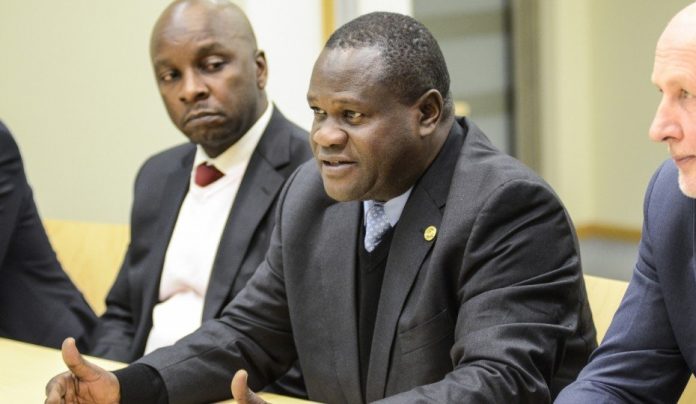
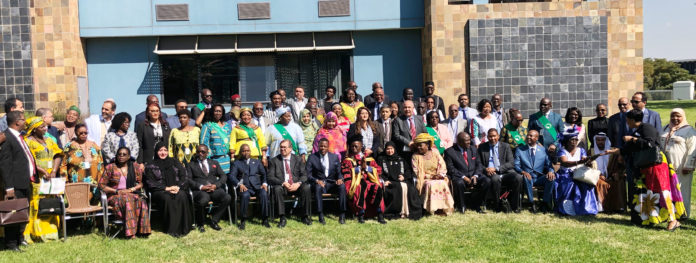
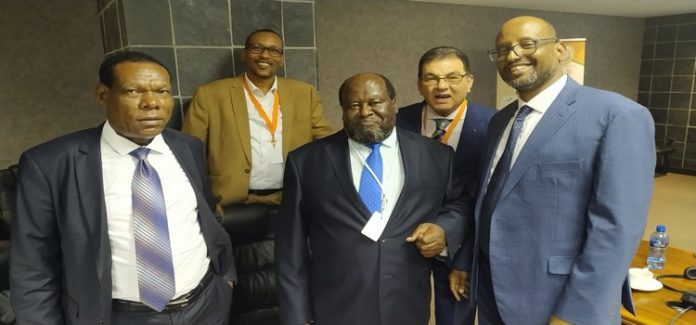
PAP Members of Parliament.

“We are counting on you in helping us make Zimbabwe great again,” said Zimbabwe’s number two top diplomat in a passionate appeal to the Pan African Parliament (PAP) on sanctions against his country.

Citing the continued untold sorrow and deterioration of the well-being of his countrymen, Dr David Musabayana, the Deputy Minister of Foreign Affairs and International Trade, told the continental legislators that they had incurred losses of about US$42 billion over the 18 years that the sanctions have been at play.

Between 2002 and 2003, the European Union and the United States of America imposed economic sanctions against the Southern African country over what they referred to as government excesses, including the contentious land reform programme.

The country faced with a Gross Domestic Product reduction of US$21 billion has also lost US$18 billion in commercial loans and US$12 billion from financing entities, the International Monetary Fund, the World Bank and the African Development Bank. Annually since 2001, Zimbabwe also lost US$4.5 billion in bilateral donor support.

“Take note of our challenges. As Zimbabwe, we call upon you to assist us lobby the West and the rest of the world to lift the economic sanctions so that we too, can participate in the global economy,” Musabayana told MPs on the Committee on Cooperation, International Relations and Conflict Resolution sitting at the PAP headquarters in Midrand, South Africa.

Dr Musabayana revealed that despite the change in the political, economic, electoral and legislative affairs of his country in the recent past, the sanctions, he referred to as a violation of Article 41 of UN Charter, continue to bite and also handicap the minerals sector from where the country would have been able to secure much needed funding for the government to meet its obligations to its citizenry.

Article 41 of the UN Charter states that,  “The Security Council may decide what measures not involving the use of armed force are to be employed to give effect to its decisions, and it may call upon the Members of the United Nations to apply such measures. These may include complete or partial interruption of economic relations and of rail, sea, air, postal, telegraphic, radio, and other means of communication, and the severance of diplomatic relations.”

“In the mining sector, we cannot sell directly as we have to go through third parties and yet we have a lot of gold and diamond. We are the second largest producer of platinum in the world after South Africa and for lithium, the fifth,” said Musabayana.

Abderahman Salek (Sahrawi Democratic Republic) said Libya and Sudan have also been victims of similar sanctions, which he, also referred to as illegal. “We need to follow up this matter during the plenary. We need a resolution condemning the suffering in Zimbabwe,” he added.

Libya’s Salem Gnan said he was full of regret about what is happening to the people of Zimbabwe and questioned the role the African Union (AU) is playing in lifting sanctions imposed against African countries and proposed that as a continent, ‘we could intra trade and overlook dealing with the West’.

Prof. Morris Ogenga Latigo (Uganda) said that there should be mechanisms to appeal to the new Chairperson of the AU, Cyril Rwamaphosa, also President of South Africa over the matter.

“PAP made

Workya Rouamba (Burkina Faso) said, needed the strength to start speaking with one voice on matters that affect the continent.

“The West always finds ways of putting pressure on African countries,” she said.

For Bala Ibn Na’allah (Nigeria), the solution to the standoff is blackmail. He said, “We need to blackmail those who impose sanctions because they fundamentally affect the livelihood of the citizens in the respective countries”.

Abdullahi Ibrahim Ali (Kenya) cautioned that rhetoric would not help salvage the situation and advised that the land in Zimbabwe be shared between the blacks and whites for harmony, like it was done in South Africa.

The PAP is scheduled to hold its plenary sittings in May 2020, wherein the request to lift sanctions against Zimbabwe is to be debated by the whole House and a position taken.

Zimbabwe’s former long serving President Robert Gabriel Mugabe, who ruled for 38 years until the better part of 2017 was ousted in bloodless coup. He died in a Singapore hospital on 6 September 2019, aged 95.

Stories Continues after ad

Kagame outlaws Kiganda, Kinyankore cultural music, traditional attires

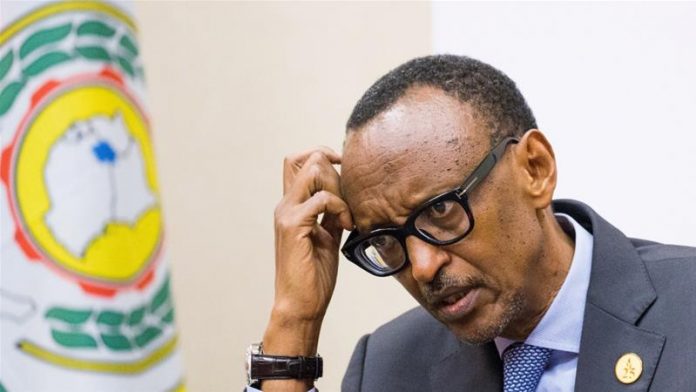
President Paul Kagame


KAMPALA-The Rwanda authorities continue to disassociate themselves from anything to do with Uganda as the relations between the two countries remain fragile.

The latest information from “the land of seven hills” shows that the Rwandan communities neighbouring Uganda have been barred dancing Kiganda and Kinyankore dances during the wedding ceremonies.

Most of the people living in the areas neighbouring Uganda migrated either from Ankole or Buganda and went to Rwanda when Rwanda Patriotic Front captured power in 1996.

They had grown in Uganda and they had mixed culture of Kinyarwanda and either  Kiganda or Kinyankore.

That’s’ why women have either been  putting on gomesi or Myenda during the weddings or other public functions.

Young ladies pose in Ankore attire Myenda

They would also dance Kiganda or Kinyankore cultural dances. But Eagle Online can reveal that in these areas, it’s now outlawed to do any of these two.

The relations between Uganda and Rwanda went from bad to worse after Rwanda closed its border with Uganda in February last year. But matters have worsened for the Kigali establishment after it became expensive for them to import food stuff like posh and beans from Angola.

The ongoing talks to have the border reopened are ongoing but Rwanda keeps changing demands every time the talks are being held.

Ganda traditional attire-Gomesi

During the recent talks between Presidents Museveni and his Rwandan counterpart Paul Kagame hit a snag after the anticipated agreement to reopen the border was postponed.

Both presidents agreed that Uganda investigates the allegations that Rwandan dissidents are using Ugandan territory to distabilise.

The two presidents agreed that within 30 days after the investigations have been concluded and no evidence is found that there are Rwandan rebels in Uganda, a summit would be held within 15 days to reopen the border.


Stories Continues after ad

Intelligence report rejects Ochailap, Kizza for Deputy Governor slot

Mr. Ochailap (middle) with other participants during a past event.


Hopes of two seasoned economist, Lawrence Kizza and Patrick Ochailap replacing former Deputy Governor Louis Kasekende has hit a snag after intelligence report on the two said they are unfit.

Mr. Ochailap who is about to retire at Ministry of Finance where he works as Deputy Secretary to the Treasury and Under-Secretary Ministry of Finance, Planning and Economic Monitoring was reportedly being fronted by some sections of ministry officials including an influential retired army general while Mr. Kizza  is said to be pushed by a section led by a State Minister in the finance docket.

This website has however learnt both gentlemen has been rejected by a report from Economic desk of Internal Security Organisation (ISO) after it alleged that both men are not clean given that they (a) above age of 60 years and having worked in finance ministry, they are complicated as one of the two was heavily implicated in bribery allegations with Tullow oil. (b) Whereas the other is said to be retiring, his working  relationship with bosses/seniors including those at Central Bank reads some of the sections of the reports which this website has seen.

The above comes out at the time when a senior minister and another top official at Bank of Uganda have also just authored their reports on the two. Eagle Online has been informed that due to the ongoing vetting process of the position of deputy governor, intelligence, line ministers and technocrats have been asked to have their inputs on whichever name/names are brought up.

Eagle Online has also established that Ministry of Finance Permanent Secretary and Secretary to the Treasury Keith Muhakanizi has also weighed in and rejected the two names. However, this website couldn’t verify this information as no one wanted go on record.

Meanwhile sources at the Inspectorate of Government reveal that an investigation  report on Mr. Kasekende is more-less ready for release.

Kasekende’s contract expired in January but efforts by him to have it renewed suffered a setback when he unsuccessfully tried to use clerics and Buganda kingdom officials to approach President Yoweri Museveni have it renewed or extended.


Stories Continues after ad

Byarugaba launches 5th NSSF Kampala Hash seven Hills Run

Mr. Byarugaba


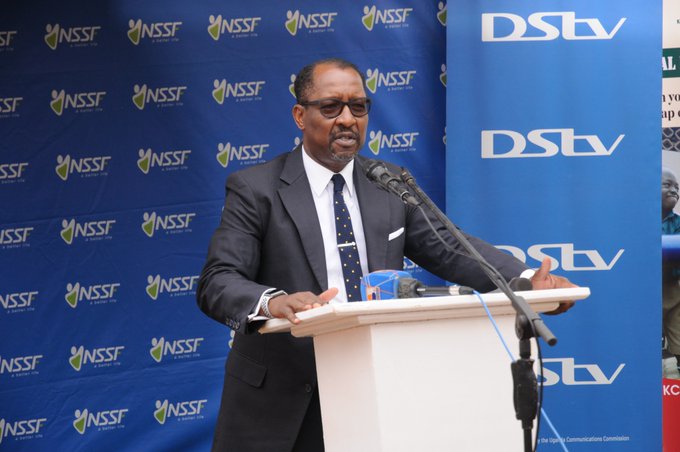
The Managing Director of National Social Security Fund (NSSF) Richard Byarugaba has launched the fifth edition of the annual NSSF Kampala Hash seven Hills Run that peddled at raising funds towards the improvement of learning conditions in public primary schools under Kampala Capital City Authority (KCCA) and in other parts of the country.

In 2016, NSSF embarked on a journey to refurbish the city’s dilapidated school infrastructure. The journey has however, seen a number of schools benefiting from the initiative. The benefited schools include; St. Ponsiano Kyamula P/S, Nakivubo Settlement P/S and Makerere University P /S.

The route traverses the original hills of Kampala namely, Nsambya Nakasero, Kibuli, Old Kampala, Namirembe, Rubaga, and Lubiri and will cover a distance of 21 kilometres.

There is also the 10 kilometres route for participants that prefer a shorter route.

Speaking during the launch of fifth run, Byarugaba said the funds aims at raising Shs 700 million to benefit five schools which include three new schools and completion of works at two other schools. “We need over 5000 individual runners who will pay Shs 25,000 each and participation from over 50 corporate companies if we are to realise our ambitious target this year” he said

Most of the underprivileged children attend public schools. It is befitting that our intervention in education goes towards improvement of learning conditions in these schools. There is no greater impact you can make on community than through education.

“Since we started in 2016, we have realised the magnitude of the need, not only in Kampala but across the country. That inaugural run set in motion a desire to aim for greater good, beyond just a one off contribution to KCCA but to sustain the support through the years.” He said at Mbuya Primary School.

“It is the cornerstone of our ‘Support to Education’ community social responsibility intervention. The Fund’s social responsibility agenda is to continuously make meaningful impact in response to challenge facing the underprivileged communities.” He said

He lauded Equity Bank, MultiChoice Uganda, Umeme Limited, ICEA, Kakira Sugar Limited Saracene Uganda, ICPAU, Capital Markets Authority and media partners which have been publishing stories about the NSSF run.

KCCA Spokesperson, Peter Kaujju who represented the Executive Director of Kampala, Eng. Andrew Kitaka said the average classroom to pupil ratio is 1:68; and in some schools, desk-pupil ratio is as high as 1:5. This means that 1 classroom accommodates at least 68 pupils, while 5 pupils share 1 desk. These are some of the challenges of learning environments in our schools.

‘The schools that are currently undergoing refurbishment from last year’s NSSF Hash Run proceeds are Mbuya C/U Primary School, Kampala School for the Physically Handicapped (KSPH) and St. Paul Nsambya.” He said

He said the School enrollment has gone up because of improvement in classroom facilities. Children now have access to good learning environments which has resulted into improved learning outcomes say at Nakivubo Settlement, the intervention resulted into increase in enrollment


Stories Continues after ad

Support parliament to get own chopper- Kadaga

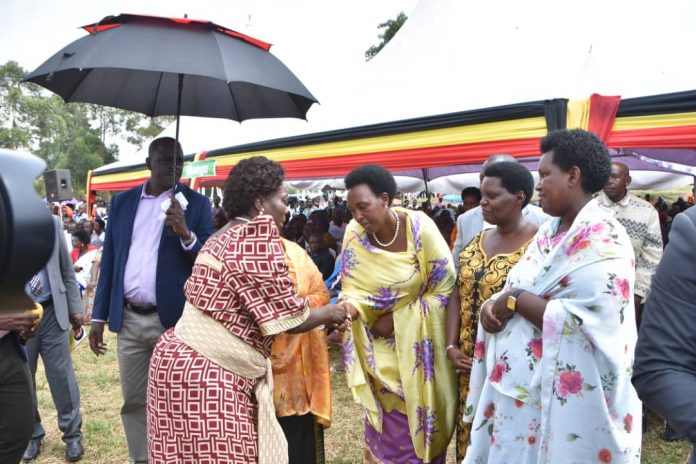
Speaker Kadaga being welcomed by Ms Kamukama.

Speaker Rebecca Kadaga has highlighted the need for a helicopter for Parliament, which she said will facilitate oversight visits.

Kadaga was speaking at a thanksgiving for new State Minister for Economic Monitoring in the Office of the President, Molly Nawe Kamukama.

The Speaker’s itinerary was disrupted after a privately charted helicopter lost track while airborne, landing in Mubende instead of Kazo, its intended destination.

Kadaga said the private helicopter had to be used since the army and police choppers are deployed to fight against desert locusts that have hit North Eastern Uganda.

“You know I have delayed because we normally use the army or police helicopters; but since they are being used to fight the desert locusts, we had to use a privately chattered helicopter that instead landed us in Mubende,” she said.

She then prodded Parliament Commissioner, Arinaitwe Rwakajara, also present at the function, to pursue the idea. “…the issue of the plane; I hope Rwakajara is listening,” she said.

Financial constraints on the part of the Parliamentary Commission have seen the shelving of the idea to procure a chopper for ease of the principles’ travel in the country-side.

The Speaker appreciated President Museveni for ‘promoting’ Kamukama from civil service job to Cabinet.

“I thank the President for elevating Kamukama from being a civil servant who is given directives to now a decision maker who will be consulted before decisions are made,” she said.

Kadaga asked young Ugandans to emulate Kamukama’s example.

“I have looked at Molly’s CV…she was an ordinary person but has succeeded; I want our children to use her as an example to believe in themselves that they can also succeed,” she said.

Kadaga promised to support Kazo, a new district curved out of Kiruhura, to access roads equipment, get seed schools and elevate the current Kazo Health Centre IV to a hospital in line with government policy.

Minister Kamukama, formerly President Museveni’s Principal Private Secretary, was named State Minister in a December 2019 Cabinet reshuffle.

“I appreciate President Museveni for appointing me minister; I thank him for taking care of me,” she said.

Stories Continues after ad

African MPs urged on online child sexual exploitation laws

Pan African Parliament MPs shortly after the official opening of the session

Members of the Pan African Parliament (PAP) have been urged to make appropriate laws that protect victims of Online Child Sexual Exploitation (OCSE).

Speaking to MPs of the continental parliament in South Africa, experts said that the interpretation of the laws on OCSE are ambiguous and continue to be a bottleneck in seeking justice for the victims of the vice across the globe.

OCSE is the abuse of children via the internet and remains a global threat with the rising internet connectivity. Many a time, the abusers are overjoyed to publish photos and videos of their exploits online to gratify their like-minded abusers.

“We are not interested as a continent in regard to legal and legislative solutions, which is linked to the culture within the African continent. We are quick to copy and paste laws that are not applicable to Africa,” said Dr Elvis Fokala, a researcher with the University of Stellenbosch in South Africa.

Dr Fokala signaled out Mauritania and South Africa for creating the best friendly child laws in his presentation to MPs at the two-day workshop on Online Child Sexual Exploitation.

The MPs are currently attending sittings of the PAP permanent committees in South Africa to generate house business for the plenary scheduled for May 2020.

Although there is a dearth of statistics because many of the victims and offenders involved in OCSE remain unidentified, available data for 2016 shows that the Internet Watch Foundation identified over 57,000 web addresses containing sexual abuse materials.

According to Interpol and ECPAT, a global network of civil society organisations that works to end sexual exploitation of children, boys and very young children are at greater risk of most severe online sexual exploitation.

Mr Andrew Rugege, the International Telecommunications Union (ITU) Regional Director for Africa said there were 4.1 billion people accessing the internet, with one in three being children.

Rugege said that although children have a right to enhance their digital skills, the use of existing and emerging technology exposes them to child pornography, bullying in schools and suicide, among others.

“I put it to you, honorable members, that the rights of the child should come first before their rights to the digital world,” he cautioned.

Anifa Kawooya from Uganda lashed out at African governments for being quick at signing agreements but very slow at implementation.

“Emphasis must focus on appreciation of our values as Africans because these gadgets used by the children are bought by us. We need to scale up the involvement of parents, especially mothers,” she said.

Rugege said whilst it was not possible to shut down the internet because of its amorphous nature, regulation and enforcement were critical to curtail online child sexual exploitation by deploying means such as use of malware, artificial intelligence, facial recognition and big data.

Malware is a software designed to disrupt, damage, or gain unauthorized access to a computer system while big data is very large data set that may be analyzed to reveal trends and associations relating to human behavior and interactions.

Calling on researchers to urgently support the MPs in creating the enabling laws, Hon. James Kakooza (Uganda) said that as the continent had forgotten its cultural values.

“We need awareness in homes. The man selling you the equipment will not tell you about the other side because they only want money,” he said.

Dr Adeola Romola, a lecturer in international law and legal studies at the University of Pretoria applauded the recommendation from the ITU in regard to setting up a digital law library as a point of reference that leverages on technology.

The digital library, if blessed by the MPs, will allow authorized users from across the continent to exchange information and share data with their colleagues. Some of the information therein will be include legislation, landmark rulings and precedents.

“This will facilitate referencing, benchmarking and harmonizing of best practices in the fight against the vice,” Dr Romola said.

Stories Continues after ad

 Political parties to meet Rugunda over violence

Former Prime Minister, Dr David Livingstone Ruhakana Rugunda.

The secretary generals of political parties with representation in parliament will this Wednesday meet Prime Minister Dr. Ruhakana Rugunda in an effort to harmonize political issues ahead of the 2021 general elections.

This meeting will be held under the auspices of the Inter Party Organization for Dialogue (IPOD). The meeting will be officiated by Secretary General of Forum for Democratic Change (FDC) Nathan Nandala Mafabi, the chairman of IPOD Council.

According to FDC party Spokesperson Semujju Nganda, the meeting should re-assert the right interpretation of the Public Order Management Act (POMA) arrived at between IPOD and Dr. Rugunda in 2015, has been necessitated by the continuing violence against the opposition ahead of the elections.

Last week a citizen Ritah Nabukenya was murdered by Police as she traveled to attend a consultative meeting by presidential aspirant Robert Kyagulanyi aka Bobi Wine. A second citizen Daniel Kyeyune was shot dead by Local Defence Unit as he traveled with Kyagulanyi from the burial of Nabukenya.

“FDC founding President and the People’s President Dr. Kizza Besigye was twice violently arrested as he went to attend FDC events in Jinja. In fact, on the second day, Police raided the hotel where he had stayed overnight and towed him away.”  He recounted

He said the meeting might be the last one that the FDC is participating in. “Rugunda on behalf of government, should tell us if his government has now outlawed political competition. He should tell us if multiparty system has now officially been overthrown. The FDC will if the Wednesday meeting fail to find solution, be reluctant to attend any other meeting.” He said.

In 2015  Dr. Rugunda, Attorney General Fred Ruhindie, Shadow Attorney General Abdu Katuntu, Police and Minister of Internal Affairs agreed on the interpretation of POMA. Rugunda was supposed to come up with regulations which he and government have failed to produce. In violently dispersing our meetings, “police is hiding under POMA to disperse gatherings. This game has got to stop. If the Wednesday meeting fails, as FDC we shall engage another gear”

Stories Continues after ad

UIA warns of illegal land titles at Namanve industrial park

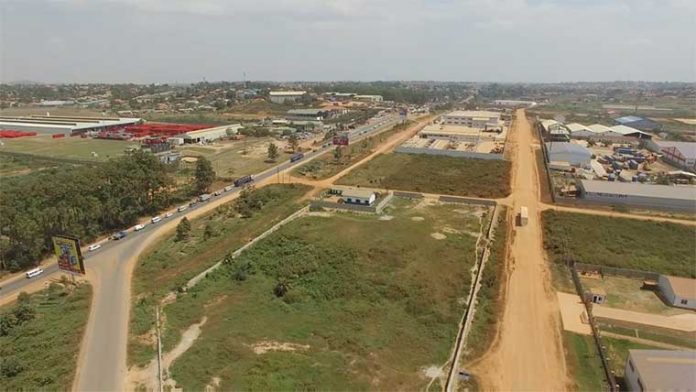
Namanve Industrial-Park Aaerial view-Photo credit, Observer .


Uganda investment authority (UIA) has warned people over illegal land titles in Kampala Industrial and Business Park (KIBP), also referred to as Kampala Business and Industrial Park in Namanve.

The park was developed by (UIA) as a central place where investors would be availed land for factories, warehouses, distribution centers, and other business offices.

Following various reports that individuals are selling plots in the park, UIA has come out to warn all individuals claiming to have plots saying that the land is vested in the name of Uganda Investment Authority not individuals.

The authority said illegal titles that include but are not limited to BLOCK 113, PLOTS 902, 955, 857, 858, 860, 861, 862, 866, 867, 868, 1084, 1287, 1288, 1289, 1422, 1480, 1488, 1489, 1490, 1494, 1495, 1496, 1604, 1611, 1612, 1613 and 1614 are not for individual development or sell.

UIA noted that Freehold register volume 379 folio 11 plot 964 and 965 Kyagwe block 111 and plots 59, 60, 61 and 62 Kyagwe block 113, Namanve, Mukono district and freehold register volume 379 folio 10 plots 1842, 1843, 2470, 2471 and 2472 block 236, Namanve, Wakiso district belongs to government.

“Any persons interfering with the said parcels of land as aforesaid stands to lose his/her /their money as Uganda Investment Authority will neither honor agreements, contracts or arrangements entered into with person purporting to have authority to transact the parcels of land whether in the manner above described or in any other manner whatsoever nor will it re-reimburse any monies paid in respect of such transactions.” Reads in part of the statement.

The authority warned that any purported allotment, buying, selling, letting, leasing, charging, subdivision, construction upon or dealings in connection with the said parcels of land in any other manner howsoever without Uganda Investment Authority consent is unlawful, illegal, fraudulent, and amounts to trespass.

“UIA noted that it is gross abuse of office for any officer in the Land Registration Department to entertain or register any application for any transaction over the illegally created Titles or to purport to create fresh Titles on top of the UIA Title.” The authority said

Further warned that any person interfering as aforesaid with the parcels of land under reference risk both criminal and civil action by this Authority.


Stories Continues after ad

Panic as Ugandan student dies in China

A Ugandan student has reported been found dead at Shenyang in Shenyang city in Chine the capital of Liaoning province.

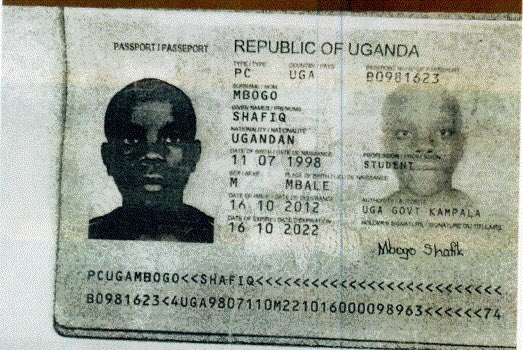
According to Acting Ambassador to China, Philip Kanyoonzi, Mbogo Shafiq and holder of passport number B0981623 was found dead outside his hostel yesterday 27th February 2020 at about 2:00 PM.

“Initial information indicates that Shafiq had died after he fell off from the balcony of his hostel.” Philip said adding that the ministry has contacted the management of the university and the public security bureau who confirmed his demise.

He said investigations are underway to establish the actual cause of death. Public security bureau has however ruled out homicide. Shafiq according to his travel documents, was a 22 year old, hailing from Mbale district.

He was fourth year private student undertaking his bachelor’s degree in international business and trade. His mother known as Dorothy Wagalinda currently lives in United Kingdom. The school revealed that they had already communicated to her about the death and her desire is to have a proper report about his death and have the body returned for decent burial.

Stories Continues after ad

Museveni appoints three deputy  directors of public prosecutions


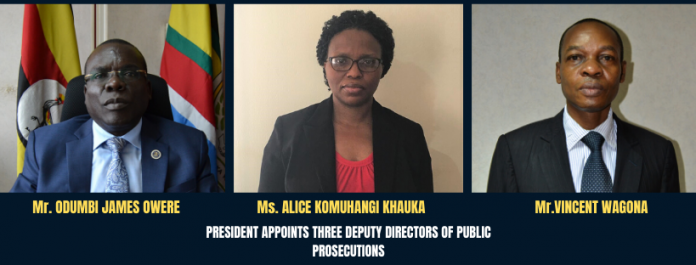
President Yoweri  Museveni has appointed Mr. James Odumbi Owere, Mr. Vincent Wagona, and Ms. Alice Komuhangi Khauka as deputy directors of Public Prosecutions.

The appointments are in line with the Office of the Director of Public Prosecution (ODPP)’s efforts to implement its revised structure in order to respond to improved service delivery requirements. The new ODPP structure provides for four directorates, three of which have not been having substantive heads. These are the Directorate of Management Support Services, the Directorate of Inspections, Quality Assurance, Research and Training, and the Directorate of International Affairs.

According to the new structure, the Directorate of Management Support Services is responsible for coordinating and managing administrative, logistical and other support services essential for the operations of the institution.

The Directorate of Inspections, Quality Assurance, Research and Training is responsible for enforcement of performance standards, measures, systems and practices to promote efficient and effective management of public prosecutions and fair administration of justice. And, the Directorate of International Affairs is responsible for management of cross-border crimes, international crimes and international cooperation in criminal matters.

The three directorates will be headed by the three appointees, who have accepted their appointments.

Mr. James Odumbi Owere, Mr. Vincent Wagona, and Ms. Alice Komuhangi Khauka are long serving career prosecutors with over 20 years work experience in the ODPP. Mr. Odumbi James Owere has been a Principal Assistant Director of Public Prosecutions caretaking the Directorate of Inspections, Quality Assurance, Research and Training.

Mr. Wagona has been a Senior Assistant Director of Public Prosecutions care-taking the Directorate of Management Support Services and serving as the Accounting Officer. Ms. Khaukha has been a Senior Assistant Director of Public Prosecutions heading the Anti-Corruption Department.

The ODPP celebrates the appointments and looks forward to experiencing improved leadership, inspections, quality assurance, research, training, and international cooperation.


Stories Continues after ad