Stanbic Bank
Stanbic Bank
20.1 C
Kampala
Stanbic Bank
Stanbic Bank
Home Blog Page 1084

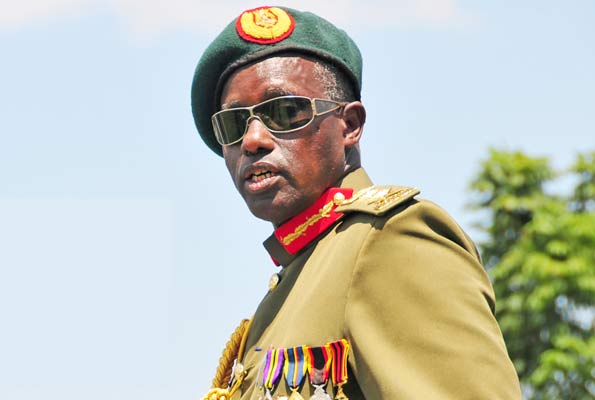
MP Mbwatekamwa presents  censure motion against Security Minister Gen Tumwine

Gen. Tumwine

Kasambya County MP, Mbwatekamwa Gaffa has presented a censure motion against Security Minister Gen Elly Tumwine over allegations of operating safe houses.

Last year, Kawempe north MP Latif Ssebagala supported by Arua Municipality’s Kassiano Wadri, successfully moved a motion to have the House investigate the alleged existence of safe houses.

Last week, the chairperson of the Committee on Human Rights, Jennifer Egunyu pinned Tumwine for obstruction. “The Minister for Security be held accountable for failing the committee work by denying the committee access to safe houses and for blocking the committee’s interaction with the security heads,” said Egunyu.

MPs then, in near unanimity heaped blame on Tumwiine and government security apparatus for alleged torture, and rebuked Gen. Tumwine for saying he would not permit the  committee’s interaction with Internal Security Organisation Director General, Col Frank Kaka Bagyenda and the Commander of the elite Special Forces Command (SFC), Maj Gen James Birungi, to interact with MPs.

According to rule 108 of the Rules of Procedure details the process of getting a Minister censured, which has to contend with the Member spearheading the censure notifying the Clerk to Parliament in writing, giving reasons and a proposed motion with the basis for the censure.

In his letter to the clerk of parliament, Mbwatekamwa accuses Gen Tumwine of contempt of Parliament as after he declined MPs from accessing safe houses, incompetence after he failed to implement parliament decisions on torture and maintaining the existence of safe houses.

He also accuses him of indiscipline noting that he undermined Human rights committee members when he last appeared of safe house.

Alluding to rules of procedure, the Clerk will within three days notify Parliament by pinning on the Members’ notice board and depositing a copy with the Sergeant-at-Arms for 10 working days.

At least one third of the Members of Parliament should appended their signatures on the list if the motion is to proceed. But if after 10 days elapses when one third the MPs have not signed on the list, the Notice of Censure shall lapse.

According to Rules of Procedure, Tumwine however has a right to defend himself on the floor of parliament.

Stories Continues after ad

Francophone Neo-Colonialism has captured African Union

Writer of the article David Matsanga.


By Dr. David Nyekorach -Matsanga in London


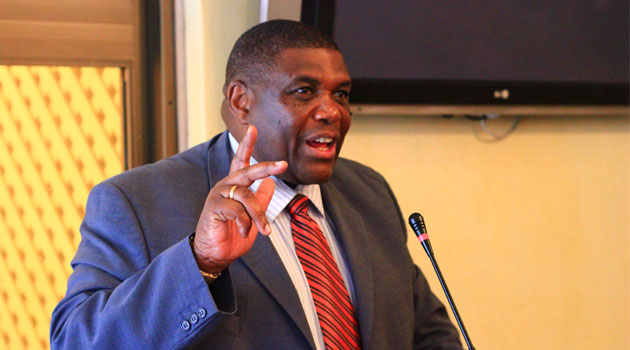
1.,The AU Heads of State Summit starts in Addis Ababa but I have little hope as an African that the dreams of Nkrumah, Jomo Kenyatta , Obote , Nyerere , Mugabe, Lumumba ., Haile Silesia ., Gaddafi and millions of those who mounded OAU have been met. I weep when I see conflicts killing the economies of Africa . Therefore, I will not attend the Summit that I have attend for the last 34 years in PROTEST against Moussa Faki . I pray that the conflicts in Nigeria Biafra where Buhari regime has slaughtered his own people will be discussed . I pray that conflict in Ambazonia where Paul Biya has killed his own people will be discussed .

2. I further believe that the South Sudan conflict will be brought to an end . Lastly I believe we shall pacify Somalia and bring sanity to that nation . I believe that the matter of bad elections in Africa that has brought conflicts will be discussed . I believe as Gaddafi lies in the grave and the one of our own in East Africa Late President Moi lies in state in Nairobi , those attending should ask why we were sold to highest bidder ?

3. The level of Foreign capture by non-African states has worried me and millions of Africans . I am therefore very determined that before God calls me back to him , I will work hard and tirelessly to restructure Africa union Commission so as to remove the current Chairperson Moussa Faki who has sold us out to the highest bidder .

4. The sacking of this Pan African lady from Zimbabwe has added to the hatred I had for the French paid mercenary in the AU chairperson’s office. Despite apparently going as quickly as it came up, the recent disagreement between the African Union (AU) and one of its employees created a few interesting insights into the current state of official Pan-Africanism, and also allowed an opportunity for reflection.

5. In summary, one Dr. Aneka Chihombori-Quao took to the fringes of radical African American media to begin denouncing the state of economic relations between France and the various West African countries descended from France’s colonial empire.

6. Her point was that an essentially colonial (by which she meant paternalistic and exploitative) relationship between France and Africa continues to exist. This, she contends, is a matter that the African Union, Africans and Africa’s well-wishers should all be concerned about, and be fighting against.

7. The medical doctor-turned-diplomat, and long-term resident of the United States previously, was to make a series of strongly-worded attacks on France. All this coincided with the announcement that the AU was to terminate her services as ambassador.

8. “Fourteen African countries are obliged by France through a colonial pact”, said Dr. Chihombori, “to put 85 per cent of their foreign reserve into France’s central bank under the French minister of finance’s control.”

9. She continued: “…… if you look deeper, of the roughly 68 coups that have happened in Africa, 61 per cent have taken place in so-called Francophone countries.

10. In other words, any African leader wanting to take his country out from under the economic control of France was subject to be overthrown by a French-engineered coup…A case in point: Togo’s first democratic leader was assassinated by Etienne Gnassingbe, an ex-French Foreign Legionnaire army sergeant who allegedly received a bounty of $612 million.

11. Similar things can be said of coups or political instability in Mali, Burkina Faso, Benin and the Central African Republic.” (Some of her statements have tested the bounds of credibility, especially in the financial figures she gave.)

12. These attacks then formed the basis of her criticism of the AU as an institution for failing, in her view, to end this robbery. Her insinuation was that the real reason for her sacking was because of criticising a powerful European country to which the AU was somehow beholden.

13. On its part, the AU defended itself not by answering the charges, but rather by challenging the credibility of the one making the accusation. Describing Dr. Chihombori as running a “misleading campaign” in an October 15th statement, Ebba Kalondo, the AU Commission chair’s spokesperson, explained that Dr. Chihombori’s tour of duty had simply ended, and that a string of irregularities were uncovered in the normal review undertaken at the end of such a cycle.

14. She stated that the ambassador had initiated a whole series of projects and activities without the knowledge or authority of her employer. These attacks then formed the basis of her criticism of the AU as an institution for failing, in her view, to end this robbery.

15. Her insinuation was that the real reason for her sacking was because of criticising a powerful European country to which the AU was somehow beholden. In so doing, the accusation goes, Dr. Chihombori utilised the African Union logo and official address so as to present these activities as official ones, and went on to appoint people to these tasks, as well as to solicit for funds from the private sector to support them.

16. Fraud, basically. The implication, it appears, is that these broadsides against France served as a diversion. But this is not really the problem: everything that the AU has said about their former employee can be true, without everything that the employee said about France-Africa relations being untrue. It is indeed a fact that the French government maintains an undue beneficial influence on fiscal matters among its former West African colonies.

17. This is an arrangement that began in all cases well before independence, and has continued long after it. It is also a fact that Official Africa, including the collectivity of the African Union, benefits from European Union and French aid largesse. Furthermore, there is ample historical evidence of France’s penchant for ripping off whole nations of black people.

18. From slavery to colonialism to post-colonialism After the enslaved Africans in the French Caribbean island colony of Haiti rebelled in 1791 by killing most of the slave plantation managers and defeating the resident French forces, the revolutionary government of France sent reinforcements at the request of the absentee slave plantation owners.

19. These forces – Napoleonic, no less – were also defeated, and the formerly enslaved of Haiti declared themselves an independent republic in 1804. In 1825, a decade after the end of Napoleon, twelve French warships armed, it is said, with 528 cannons, sailed to Haiti and delivered a demand: France was willing to finally recognise the new independent republic on condition that Haiti committed to paying France 150 million French francs in gold for the “loss of property” incurred during the rebellion.

20. What’s more, this was to be borrowed from French banks. Haiti, faced with the prospect of a naval blockade, accepted. This “debt” was kept in force until the final payment was made in 1947. That is a period of 122 years.

21. To complete it, Haiti had to take an additional loan from the United States. As a result, Haiti remains one of the poorest countries in the world. France continues to offer what I shall term “intervention services” aimed at resolving security problems in the various countries with which it has historical linkages to the tune of $665 million a year.

22. However, the line between friendly assistance, and imperial overlordship is quite blurred. Following a helicopter collision that caused the death of thirteen French soldiers in a November 26 combat operation against jihadis in northern Mali, France’s President Emmanuel Macron announced that he was summoning the heads of Mali, Burkina Faso, Mauritania, Niger, and Chad to a December 16 Paris meeting to explain themselves. (France has a heavy military presence in the Sahel, ostensibly to combat terrorism.) “

23. I can’t, nor do I want French soldiers on the ground while there is anti-French sentiment that is sometimes held by the leaders of some of the African countries,” declared Macron at a press conference during a NATO summit in London early this month. “

24. The leaders of five West African nations…should come to France on December 16 to provide clarifications,” he added, more than a little imperiously. Normally, revelations, such as the ones made by Dr. Chihombori, could promote a wider discussion of what effect a wholesale African rejection of Franco-African economic arrangements would have on the domestic French economy, and the wider European Union economy in which it is embedded.

25.,France is, after all, the EU’s third, and the world’s seventh largest economy. With the revolts taking place against power globally, it is worth reflecting on how France, already dealing with twelve months of Yellow Vest rioters protesting the general fall in the standard of living, would then cope if it were dropped any lower.

26. Indeed, there are already rumblings afoot regarding what should be the future of that financial relationship. The challenge of the imperfect messenger But the problem may be the challenge of the “imperfect messenger”. The challenge, rooted perhaps in the Christian foundations of Western-built discourse, is the expectation that those who offer us redemption must first be above all blemish themselves.

27. The New African magazine and has been beating the drum on French trickery in Africa for at least two decades. One hears a lot of things. For example, that Francophone countries are only allowed to access 10 to 15 percent of their own money held in the France Reserve Bank at any given time, and that any requests for more are charged at punitive rates, with the Bank having the discretion to deny the request.

28. Furthermore, that this power extends to French government officials sitting on the boards of more than a few West African central banks as representatives of France, and having veto powers. Normally, revelations, such as the ones made by Dr. Chihombori, could promote a wider discussion of what effect a wholesale African rejection of Franco-African economic arrangements would have on the domestic French economy, and the wider European Union economy in which it is embedded.

29. What Dr. Chihombori has done is perhaps what the writer Parselelo Kantai has described to me as the “privatisation of Pan-Africanism”. She would not be the first African person we have seen in our long history to take it upon herself to appear to speak for the whole race, and to establish organisations supposedly to advance this project.

30. The historical record of this is murky and riven with division and polarising interpretations. The principal and most famous of these, of course, is the story of the grandfather of Pan-Africanism himself, Mzee Marcus Garvey. Looking at the bare facts, there is much to cast doubt on Garvey’s credentials as a leader.

31. He had already been labelled as a charlatan by some other black activists in the period before he rode to global prominence between the two great European wars. By the time his political career was over, he had been successfully sued for criminal libel by a fellow activist, and had been sued by numerous journalists for non-payment for their contributions to his newspaper.

32. He had been married twice, after what can only be described as a chaotic short-lived first marriage, and somewhat messy divorce. He had overseen the failure of a number of business ventures seeded by money from his followers, and served a prison term for financial fraud before being immediately deported from the United States after the sentence was commuted.

33. The key point is this: If Official Africa will not step into the breach and actually do something effective about these long-running problems, then nobody should be surprised to see the rise of self-appointed lions. And therefore, nobody should be surprised that among those lions there may well be a good portion of chancers who have sensed an opportunity.

34. Neither Dr, Chihombori nor Marcus Garvey are necessarily either. What we need to note is the fact that that most well-known Africanist movements aimed at liberating black people, and whose legacy lives on today in a variety of ways, were not founded by a native African institution, nor an Africa-based political party, nor an African country; they were started by a person of African descent who did not speak a word of any African language, and who would reach the end of his life having never set foot on African soil.

35. This is in no way an attempted defence of Dr Chihombori and her actions. Nor is it an attempt to understand her initiatives. I am certainly not attempting to place her alongside Marcus Garvey. I am, however, making the point that when it comes to the politics of other wider Pan-African struggles, all will be condemned, be they prophets or phonies.

36. As things stand, the AU approach could be accused of being an attempt to reduce the whole incident to a matter of mere human resources management. And even within that context, no explanation was offered as to why any such irregularities were not picked up earlier by Dr. Chihombori’s superiors, nor how a person of such alleged dubious character came to be in the AU’s employ at such an important deployment in the first place. Instead the statement ended on an ominous note: “

37. The African Union Commission reserves the right to take any legal action, if necessary, against any use and/or misuse of its name, logo and resources by any unauthorised individuals or entities.” Whether that is a cover-up or a blind spot is a matter that only further discussions can bring out.

38. The fact remains that not just Africa as a continent but the people of African descent everywhere remain the most precarious on the planet in terms of the conditions faced by the continent’s people wherever they are interfacing with the modern world. Unlike Asia, where amidst the poverty, there are large economic classes of more or less indigenous wealthy people, and unlike South America, where, despite the weight of exploitative American capital and a large domestic class often descended from long-term European settlers, the ordinary people have sustained generations of resistance and are even now are in the midst of several uprisings.

39. In contrast, Africans on the continent remain dispossessed, and even the rich are not rich. As for the diaspora, they remain the targets of an institutionalised racism, whose underlying workings are only being fully exposed by a new generation of activists and researchers. Other questions arise.

40. The AU does have policies committed to a vision for relationships with and between the various African communities long domiciled in countries outside Africa, and, in particular, relationships with the First Diaspora comprising the descendants of those Africans taken from this continent during the various stages of Western and Eastern enslavements. Had there ever been any discussion on the implementation of those policies between Dr. Chihombori and the AU before she subsequently allegedly embarked upon her unauthorised initiatives?

41. Does the AU see any merit in and of itself in initiatives of the type begun by Dr. Chihombori Quao in the USA? Does the AU have its own plans, or even existing practical programmes, for such initiatives? If not, why not? The fact remains that not just Africa as a continent but the people of African descent everywhere remain the most precarious on the planet in terms of the conditions faced by the continent’s people wherever they are interfacing with the modern world.

42. Does the AU have a view on the justness, or otherwise, of the existing financial relations between France and some of her former colonies? Perhaps these are not matters discussed in the course of a sacking. However, they should be of interest with us. I did put these questions, and more to the AU communications office, using the provided official address.

43. I had not received a response by the time of submitting this article. Even before Macron’s Napoleonic reaction to the French soldiers’ deaths (one the worst losses of life in France’s military in decades) Bloomberg news agency had reported an announcement of intent by the West African Monetary Union, which is the mechanism created to maintain the currency unit binding former French colonies to France (while France, ironically, has no independent currency of her own anymore), to make a significant adjustment to the arrangement.

44. Benin’s President Patrice Talon announced that the Africans had “unanimously” agreed to repatriate some their cash reserves from the French treasury. This is no longer a private matter between them. In January this year, one Luigi Di Maio, a member of Italy’s populist Five Star movement, had already dragged the issue into an internal European Union quarrel over EU fiscal policy that he was having with Emmanuel Macron’s France. “

45. Therefore because of the points raised above I will not attend the AU Summits in any capacity until there the Chadian AU Chairperson leaves office and new Chairperson comes in . I will all those who have forgotten Gaddafi so soon and who meet to drink wine and champagne while Libya is bleeding because of FRANCE a good success in Addis Ababa Ethiopia

Thanks

Dr. David Matsanga of Pan African Forum (UK)Ltd

8.02.2020

London United Kingdom

Stories Continues after ad

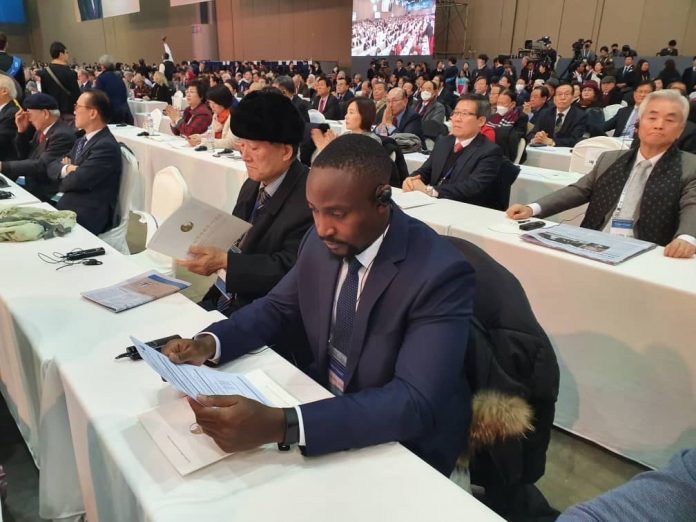
Kyabazinga in Korea for World Summit


In his auxiliary efforts to agitate for peace among Kingdoms,Busoga’s reigning monarch,His Majesty william Gabula Nadiope,IV is in the Republic of Korea’s capital Seoul for a World Summit.

In his remarks,the Kyabazinga enumerated the importance of Culture in modern times as the world embraces the digital era.He noted that cherishing cultural values among people is a symbol of identity.

“We are at a time of blending culture with modernity which is a good thing.However,of great importance is that the former is more ideal to us since it acts as our symbol of identity meaning that we should at all times defend it to deter its extinction”,the Kyabazinga emphasized before noting that he wishes for a world of peace where people would love one another, a world without poverty,hunger,conflict and suffering.

Running under the theme “Realizing World Peace through Interdependence,Mutual Proseprity and Universal Values”, the 2020 World Summit has drawn both current and former leaders like the former South Korean born UN Secretary General,Ban Ki Moon,H.E Good Luck,H.E Olusegun Obasanjo and several dignitaries.

At this very Summit,Senegalese President H.E Mackay Sall was awarded for Good governance,Ban Ki Moon for being an exemplary international leader among others.

Stories Continues after ad

Obesity-related diseases among top three killers in most countries,says World Bank

Very-large-male-belly

Long believed to be a problem exclusive to high-income countries, evidence shows that over 70 per cent of the world’s two billion overweight and obese individuals live in low- or middle-income countries. Faced with increasing disability, mortality, health care costs, and lower productivity, obesity is a growing concern for all countries regardless of income level, says a new World Bank report launched here today.

Obesity has a major impact on national economies and on human capital by reducing productivity and life expectancy and increasing disability and health care costs. It is projected that in the next 15 years, the costs of obesity will total more than US$7 trillion in developing countries.

The report Obesity: Health and Economic Consequences of an impending global challenge states that obesity-related diseases are now among the top three killers across the globe, except in Sub-Saharan Africa. Recent data show that since 1975 obesity has nearly tripled and now accounts for 4 million deaths worldwide every year.

Factors escalating the obesity epidemic include ultra-processed and sugary foods, reduced physical activity, and higher incomes, which often go hand-in-hand with a higher consumption of unhealthy foods.

“As countries grow economically and per capita income rise, the devastating impacts and burden of obesity will continue to shift toward the poor,” says Dr. Meera Shekar, Global Lead for Nutrition at the World Bank and co-author of the report along with Dr. Barry Popkin from the University of North Carolina.

In China between 2000 and 2009, health care costs associated with obesity grew from half a percent to more than 3 per cent of China’s annual health care expenditure. In Brazil, obesity-related health care costs are expected to double, from less than $6 billion in 2010 to more than $10 billion in 2050.

In addition to directly increased health care costs, there are also indirect costs associated with, for example, reduced work productivity, absenteeism, and early retirement, which affect individuals and societies.

Many countries across the globe are also suffering from what is referred to as the “double burden of malnutrition” high stunting and increasing obesity rates, further compromising their human capital.

“One of the most effective ways to address obesity and other non-communicable diseases is by ramping up investments in affordable, quality primary health care”, says Dr. Muhammad Pate, Global Director for Health, Nutrition and Population at the World Bank. “This makes sense both from a health and an economic perspective. Putting more resources on the frontlines to detect and treat conditions early, before they become more serious, saves lives, improves health outcomes, reduces health care costs and strengthens preparedness.”

The report stresses that in order to avoid the rise of obesity in future generations, governments and development partners must adopt a comprehensive approach. Effective primary health systems will be crucial together with a strong focus on preventative measures such as mandating the labeling of processed foods; increasing consumer education; reducing salt and sugar-sweetened beverages; and investing in early childhood nutrition programs.

The report also highlights the importance of strong fiscal policies, such as taxation of unhealthy foods; and enhancing urban design, such as playgrounds in schools and walking and bicycle paths.

Financial support for the preparation of the report was provided by the government of Japan through the Japan Trust Fund for Scaling Up Nutrition.

Stories Continues after ad
UCC board picks Irene Kaggwa in acting ED capacity as Mutabazi is sent packing

Outgoing UCC ED Executive Director Godfrey Mutabazi.

Ms Irene Kaggwa Sewankambo has been appointed in acting as the Executive Director of Uganda Communications Commission (UCC), replacing Eng. Godfrey Mutabazi, whose ten year contract expires on Sunday February 9.

Flamboyant Mutabzi replaced Eng. Patrick Masambu in 2010 as UCC ED. is credited for the growth of the communication industry but at the same time he was seen as barking dog of government especially in clamping down critical media houses who are sometimes accused of favouring the opposition.

Eng. Mutabazi has played a significant role in clamping down of all radio, TV shows that criticize president Museveni’s leadership claiming that the shows incite violence.

In May last year, Mutabazi ordered 13 media house to suspend 39 journalists who were accused of airing live videos and sound bites as police arrested Kyadondo East MP, Robert Kyagulanyi aka Bobi Wine on April 29, at Kalerwe market as he proceeded to Kibuli Police Criminal Investigation Department (CID) where he was summoned over allegations of breaching of police guidelines and traffic rules.

He was hence caught up in a feud with the Chief Executive Officer (CEO) of Metro FM, Capt. Francis Babu after Babu told him to mark where he stops in communication industry.

During, the former inspector general of police (IGP), Kale Kaihura’s reign, Mutabazi was frequently ordered to shutdown social media platforms infringing of people’s rights of access to information.

During, the former Inspector General of Police (IGP), Gen. Kale Kaihura’s reign, Mutabazi was frequently ordered to shutdown social media platforms infringing of people’s rights of access to information.

“Considering that the executive director’s tenure of office expires on February 9, 2020, he hands over office to avert an unlawful stay in office without a formal contract. That the director, engineering and communications infrastructure, Engineer Irene Kaggwa Sewankambo takes over as the acting executive director until a substantive director is appointed,” reads part of the February 7 letter written by Ms Nabakooba to the UCC board chairperson Eng Dr Dorothy Okello.

According to the UCC Act, the executive director shall be appointed by the minister on the recommendation of the board.

Stories Continues after ad

Over 16% fail UBTEB exams

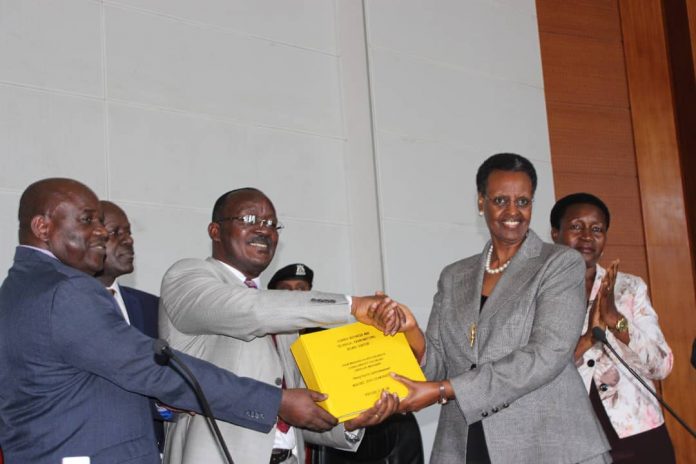
Education Minister, Janet Museveni receiving results


The Executive Secretary, Uganda Business and Technical Examinations Board (UBTEB) examinations, has said 16 per cent of the students who sat for last year’s exams failed.

A total of 4,102 (84 per cent) successfully completed their studies while 728 (16 per cent) have not acquired all the competences and will attempt the papers when next offered. Out of 5,251 who registered 4,895 representing 93 per cent sat the examinations while 356 candidates representing seven percent were absent. This category of examinations results were administered in 258 Examination Centres.

A total of 5,251 students, 991 Females and 4,260 Males candidates registered for Uganda Community Polytechnic Certificates (UCPC) and Advanced Craft programs. Only 4,895 representing 93 per cent sat the examinations while 356 candidates representing seven percent did not turn up for examinations.

In line with Uganda Community Polytechnics Programs a total of 82 356, 28,177 females and 54,179 Males registered for these examinations from 556 accredited examination centres countrywide.

Uganda Community Polytechnic Certificates in Carpentry and Joinery, Garment Design and Construction, Block laying and Concreting Practice and Motor Vehicle Mechanics performed very well with 90 percent, 89 per cent, 84 per cent and 82 per cent completion rates respectively.

According to Onesmus Oyesigye, there was an improvement in completion rate of four per cent from 80 per cent in 2018 to 84 per cent in the year 2019. The excellent performance is attributed to adequate syllabus coverage and continuous improvement in assessment mechanisms.

“The UBTEB board has enhanced its security measures and has contained examination malpractice, as such, there were no reported cases of malpractice during the conduct of these examinations.” He said

The Board Chairperson of UBTEB Dr. Silver Mugisha who is also the Managing Director of National Water and Sewerage Cooperation, (NWSC) said people should not come here telling us how we don’t have capacity to train practical skills. Even at NWSC, they have related programs the private sector is also willing to work with UBTEB to improve the capacity of our economy.

“We need only Shs5 billion to construct our offices as UBTEB, Madam First Lady we are tired of renting people’s premises. We are also very willing to employ these candidates at NWSC, Umeme and the private sector should employ them too” he said

On her part, Janet Kataha Museveni, Minister of Education and urged students take technical and vocational skills development seriously asserting that 728 trainees failed to complete their courses especially girls.

“Uganda like many developing countries is faced with unemployment, skills development has been brought in the country and the country is now emphasizing skills development than ever before to reduce unemployment and increase household income.” She said.

Adding “I note  the poor performance of mathematics and English, yet Mathethatics is the mode of communication in technical and English is the mode of socialization in technical. I urge the teachers in these subjects improve on learning materials.” She said

She implored partners in the public and private sectors to mentor young graduates as they serve their apprenticeship in industries and firms so that they are equipped with workplace attitude and practical skills to prepare them for self-employment.

Stories Continues after ad

$675m needed for new coronavirus preparedness and response global plan

A lady wearing protective gears against coronavirus

To fight further spread of the new coronavirus (2019-nCoV) outbreak in China and globally, and protect states with weaker health systems, the international community has launched a US $675 million preparedness and response plan covering the months of February through to April 2020.

“My biggest worry is that there are countries today who do not have the systems in place to detect people who have contracted with the virus, even if it were to emerge,” said Dr Tedros Adhanom Ghebreyesus, WHO Director-General. “Urgent support is needed to bolster weak health systems to detect, diagnose and care for people with the virus, to prevent further human to human transmission and protect health workers.”

The Strategic Preparedness and Response Plan (SPRP) for the new coronavirus lays out activities and resources needed by international health organizations globally, including WHO, to implement priority public health measures in support of countries to prepare and respond to nCoV-2019 for a period February-April 2020. The objectives of the plan are to limit human-to-human transmission of the virus, particularly in countries most vulnerable if they were to face an outbreak; identify, isolate and care for patients early; communicate critical risk and event information; minimize social and economic impact; reduce virus spread from animal sources; and address crucial unknowns.

“The effectiveness of outbreak response depends on the preparedness measures put in place before outbreaks strike,” said Dr Mike Ryan, head of WHO’s Health Emergencies Programme. “That is why we are seeking resources to safeguard the most vulnerable countries to protect people from the new coronavirus before it arrives on the doorstep.”

As noted in the SPRP, WHO assesses that the outbreak poses a very high risk in China, and high risk regionally and globally. The risk assessment was based on factors including the likelihood of further spread, the potential impact on human health, and the varying levels of effectiveness in national preparedness and response measures. Accelerated action, as called for in the plan, can address these risks and areas requiring support.

As of 10 am Central European Time on  February 5, 25 countries have reported confirmed cases of the new coronavirus, including China, where 24,363 people had contracted the virus, or over 99 per cent of all cases. In all other countries, 191 cases have contracted the virus.

Stories Continues after ad

 World Bank wants Mutebile’s powers trimmed as reforms take shape at BoU

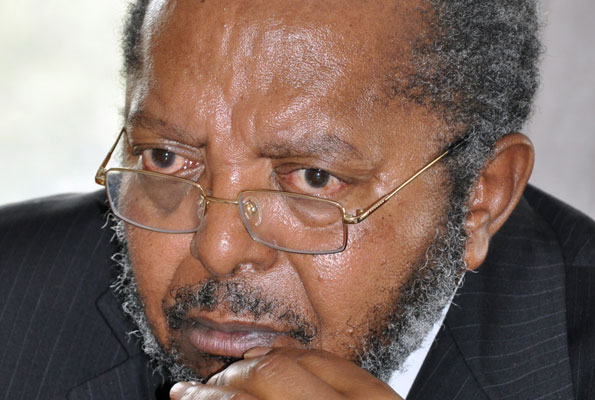
Bank of Uganda's Emmanuel Tumusiime-Mutebile

World Bank has in a wide range proposals suggested to government to trim the many powers Governor of Uganda enjoys.

Currently, Governor Emmanuel Tumusiime Mutebile is holds three titles at BoU. He is the governor, chairman of the board and chairperson of the disciplinary committee.

The redrafting of rules follows the recent flaws exhibited in the sale and closure of the seven defunct banks in Uganda.

The Constitution of Uganda under article 161 (40), provides that the governor and deputy shall be chairperson and vice chairperson of the board, however under the new rules, the position of chairperson and vice chairperson of the Board will be separated from the position of chief executive officer (CEO) and his deputy after Mutebi and Kasekende failed their mandate of adequately the management in the process of liquidating the financial institutions.

It is also averred that BoU will base on the recommendations made by Parliamentary Committee on Commission, Statutory Authorities and State Enterprises (COSASE) after thorough investigations into the closure and sale of banks.

Recently Finance Minister, Matia Kasaijja revealed that BoU with assistance from World Bank, they are in the process of putting up bank resolution unit they will be responsible implementation of the resolution framework.  Under this, the framework will cover the operation of the liquidator, maintenance of financial ledgers and records.

Government has also put a special committee that will draft financial sector crisis management plan.

In 2018, Parliamentary Committee on Commission, Statutory Authorities and State Enterprises (COSASE) led by the then chairperson, Abdul Katuntu embarked on investigating into the closure of banks after Auditor General’s (AG) report which showed irregularities into the sale and closure of banks.

The closed banks include Teefe in (1993), international credit Bank ltd in 1998, Greenland bank (1999), The Co-operative Bank (1999), National bank of commerce 2012, Global Trust Bank (2014) and the dubious sale of Crane Bank Ltd to Dfcu bank in 2016.

In its findings, COSASE established that, some banks including Crane Bank Ltd were liquidated on telephone calls without thorough evaluation. Crane Bank Limited was in 2016 put under receivership and later sold to Dfcu ta Shs 200billion who value was to be recovered from the bad book. Crane bank had initial capital of Shs478 billion.

When BoU sold CBL to Dfcu Bank it also transferred to the same bank freehold properties of CBL/Meera Investments Limited without following the law. CBL was renting the properties that were wrongfully transferred to Dfcu Bank.

In May last year, BoU would controversially extend the duration of Dfcu bank’s possession of freehold properties of Meera Investments Limited for extra 24 months after the first 34 months elapsed, having transferred CBL to Dfcu Bank on January 25, 2017 on account of undercapitalization.

Stories Continues after ad

IMF report:  Mutebile, Ssekabira, Margaret Kasule and others face exit at BoU

BoU Legal Counsel Ms Margaret Kasule whose accused of misleading on Crane Bank Limited legal status.


International Monetary Fund has cautioned government to retire senior servants at Bank of Uganda in public interest.

According to knowledgeable sources, Governor Emmanuel Mutebile is among those who the IMF report says should be retired or never retained. However, it is reported that Mutebile has refused to make the report public as he is among those being mentioned.

According to sections of the leaked report which a source at BoU have seen, several directors who are currently holding offices have been recommended for sacking or retirement in public interest.

The directors listed are head legal services, Margaret Kasule, Benedict Ssekabira, the director of Financial Markets Development Coordination (FMDC), Director Statistics Charles Abuka, Director Medical Administration, Olive Kamuli, Director Financial Markets, and David Sajjabi. Others are director Administrative Services plus a host of deputy directors.

However, this has created panic at the central bank saying the report is biased as it only affects those directors who are said to have forged their age.

Eagle Online has learnt that just last week, there was a bitter exchange between the governor and one of the lawyers brought in to defend those accused for falsifying the age.

BoU last week took the accused directors to disciplinary committee known as EXCOM. EXCOM is composed of the governor, deputy governor and executive directors. Currently BoU has 10 Executive Directors without the deputy governor.

As the meeting sat down to business, one of the lawyers for director Olive Kimuli objected to the constitution of EXCOM saying poorly constituted because the governor conflicted because he is a member of EXCOM at the same time chairman of the board which makes it hard for member implicated to appeal. The same lawyer also further expressed their reservation on why Executive Director in charge of Supervision was part of the meeting when he wasn’t confirmed by the board.

Nevertheless, it is here that the governor informed the meeting that whether they win or lose, the IMF report had implicated all those directors for dismissal. However, one thing that Mutebile didn’t tell the affected parties is that the same report recommends his for retirement or dismissal as well.

Parliament last year recommended that contracts of the governor Emmanuel Tumusiime Mutebile and his deputy, Dr Louis Kasekende should not be renewed, the report of the Parliamentary Committee on Commissions, Statutory Authorities and State Enterprises (COSASE) has recommended.

The report, which was tabled in Parliament last year by Abdu Katuntu, the then chair, accused the top management of the central bank of mismanaging the sale of seven commercial banks, including that of Crane Bank.

Other officials that COSASE wanted to be held culpable are Benedict Ssekabira, the director of Financial Markets Development Coordination (FMDC), Justine Bagyenda, the former executive director for Commercial Banks supervision; and Margaret Kasule, the legal counsel.

The IMF’s primary purpose is to ensure the stability of the international monetary system—the system of exchange rates and international payments that enables countries (and their citizens) to transact with each other. The Fund’s mandate was updated in 2012 to include all macroeconomic and financial sector issues that bear on global stability.

BoU lately has had challenges over its governance and management systems after it emerged that the bank has no developed template it bases on to supervise commercial banks.

The IMF report which was released late last year is the latest international report asking the Ugandan leadership to revamp BoU of the current leadership.


Stories Continues after ad

Ugandan economy continues to perform well- IMF

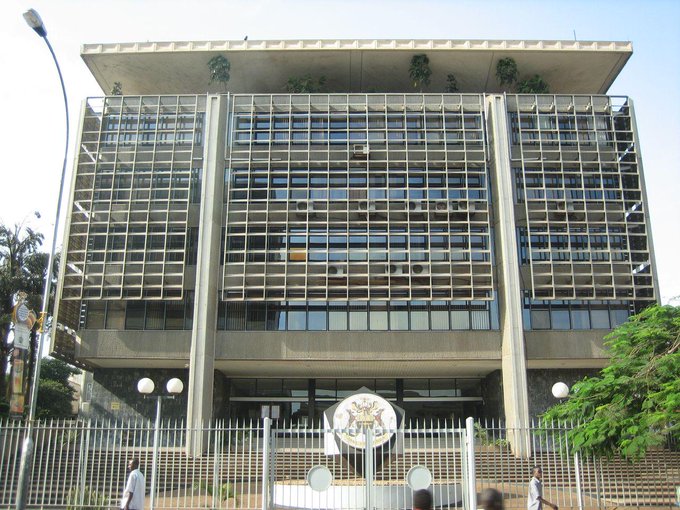
Bank of Uganda

The Ugandan economy continues to perform well with growth expected to reach 6 percent in financial year 2019/20 a minor slowdown from the earlier projection of 6.3 percent, indicates the international monetary fund (IMF).

Recently an International Monetary Fund (IMF) team, led by Ms. Clara Mira, visited Kampala from January 20 to 24, 2020 to discuss Uganda’s economic outlook, the budget for FY2020/21, and the direction of monetary policy.

The IMF mission met with Governor Tumusiime-Mutebile, Permanents Secretary/Secretary to the Treasury Muhakanizi, senior government officials, and private sector representatives.

According to IMF, the Bank of Uganda (BoU) monetary policy remains accommodative and the current account deficit widened to 9.7 percent of GDP in FY2018/19, largely due to private sector-related imports financed by foreign direct investments (FDI).

The re-basing of the GDP points to an increase in the size of the economy by 11.6 percent. Annual headline and core inflation were 3.4 and 3 percent, respectively and are projected to stay below 5 percent over the next 12–18 months.

“The Ugandan shilling has remained broadly stable. Overall, the banking sector remains healthy. Downside risks have increased linked to uncertainty related to oil production, the electoral period, and the complex external context.” The funds notes

The execution of the current budget continues to be challenging among revenue and financing shortfalls and large expenditure pressures, which have resulted in a supplementary budget and increased borrowing needs. The authorities have negotiated two commercial loans to address such needs.

The IMF noted implementation of the externally financed capital investment projects has lagged behind, underlying the need to continue efforts to strengthen public investment management. The team discussed with the authority’s potential revenue measures and the need to carefully prioritize and contain expenditure pressures, while protecting social spending.

Regarding the preparation of the 2020/21 budget, the team encouraged the authorities to prioritize the implementation of the new Domestic Revenue Mobilization strategy, targeting an increase in the tax-to-GDP ratio by O.5 percent per year.

Similarly, the large expenditure pressures should be carefully prioritized. Overall, the team encouraged the authorities to ensure that the budget is realistic, remains consistent with debt sustainability while avoiding exacerbating debt vulnerabilities, and is consistent with available domestic financing. It is also essential that the capital position of the central bank is strengthened to ensure that the BoU can continue pursuing its operations efficiently.

The mission team lauded the authorities for the productive and cooperative discussions.

Stories Continues after ad