Stanbic Bank
Stanbic Bank
24.8 C
Kampala
Stanbic Bank
Stanbic Bank
Home Blog Page 1085

MPs move to censure Gen. Elly Tumwine over safe houses

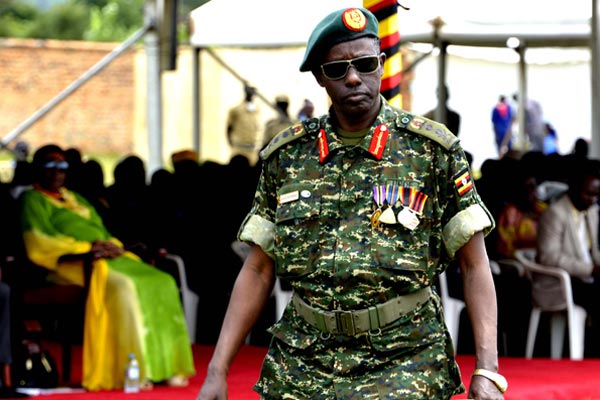
Former Security Minister Gen. Elly Tumwine.

Parliament has embarked on a process to censure Security Minister, Gen. Elly Tumwine over alleged operation of ‘safe houses’.

Shadow Internal Affairs Minister, Muwanga Kivumbi amended a report on ‘safe houses’, a generic term to denote torture chambers, to include the censure of Gen. Tumwine.

The Chairperson of the Committee on Human Rights, Jennifer Egunyu had earlier pinned Tumwine for obstruction. “The Minister for Security be held accountable for failing the committee work by denying the committee access to safe houses and for blocking the committee’s interaction with the security heads,” said Egunyu.

MPs then, in near unanimity heaped blame on Tumwiine and government security apparatus for alleged torture, and rebuked Gen. Tumwine for saying he would not permit the  committee’s interaction with Internal Security Organisation Director General, Col Frank Kaka Bagyenda.

The main committee report also sanctioned Col Bagyenda for shunning the Committee.

 “I propose that we amend the motion and have the Minister of Security censured by this Parliament,” said MP Louis Mbwatekamwa

Deputy Chief Opposition Whip, Roland Kaginda Mugume said Parliament should take the step to censure Tumwiine, saying that will form a basis for government to take Parliament seriously. “If we start with Tumwine, other Ministers will follow suit,” said Kaginda.

With Tumwine a no-show, it was up to the Minister for Karamoja Affairs, John Byabagambi, to defend government.

“The government does not at all condone the torture of anybody whether guilty or not; even the President [Yoweri Museveni] said there are civilised methods of getting information from suspects,” he said.

He added, “We have listened to the concerns of MPs genuinely; the government is going to take action; I will report to the Prime Minister on the concerns of MPs; whoever l has committed a crime will answer.”

Speaker Rebecca Kadaga, however, said government is taking so long to present treasury memoranda on human rights detailing actions taken against officers specifically named by Parliament.

“I would be happy if government would come up with a memorandum to Parliament on human rights with actions taken; show your commitment by taking action which everyone can see,” she said.

The pace was already set for MP Kivumbi to proceed with his amendment, which can threaten to end Minister Tumwiine’s tenure as Security Minister.

“…all safe houses and ungazetted detention facilities be closed with immediate effect; I also move that a motion of censure against Gen Elly Tumwine be initiated,” said Kivumbi.

His motion was unanimously endorsed.

Rule 108 of the Rules of Procedure details the process of getting a Minister censured, which has to contend with the Member spearheading the censure notifying the Clerk to Parliament in writing, citing the grounds and a proposed motion with the basis for the censure.

Last year, Kawempe MP Latif Ssebagala (IND, Kawempe North), supported by Arua Municipality’s Kassiano Wadri, successfully moved a motion to have the House investigate the alleged existence of safe houses.

Gen. Tumwine then told the Committee that he will not sanction Col Bagyenda and the Commander of the elite Special Forces Command (SFC), Maj Gen James Birungi, to interact with MPs.

Stories Continues after ad

Say a prayer of gratitude for our men in uniform

Mr Wanyama

By Don Wanyama


A vivid recollection of my childhood is that of a night, in 1984, when soldiers of the UNLA burst into our house at Tororo Girls School in the dead of the night, supposedly looking for guns.

The soldiers claimed my mother, a deputy headteacher, was hoarding guns and was a rebel collaborator. Of course the accusations were hogwash. The true story, as I learnt later, was that my mother was involved in a school leadership tussle with another senior administrator.

To sort out what was a professional issue, this administrator had bribed rogue soldiers and whereas they claimed to look for guns in the house, their exact intentions were more sinister, especially if my mother had been in the house that night.

Luckily, earlier in the day, my mother had travelled to Mbale and slept there. A househelp, my sister and myself took the brunt of the threats, with the househelp physically assaulted, hit with the butts of guns. They left, visibly disappointed but warning they would return to “sort out” my mother.

She could not take chances. When another teacher rode a bicycle to Mbale, about 50kms away, and briefed her, the instinctual reaction was to flee. She found her way to Malaba, Kenya, sent an emissary to pick my sister and I–and just like that, with our clothes as the only possession we could salvage, we began a decade of a challenging life in exile.

Listening to my mother and several victims of military brutality years later and reading multiple accounts of my country’s history, I totally appreciate why she could not stay around and try to seek justice.

The army, specifically the UNLA, had become the personification of state breakdown. Human Rights Watch estimates that UNLA soldiers between 1980 and 1985 killed over 300,000 innocent civilians.

Peter Bouckaert, a Human Rights Watch official, wrote: “Military exccesses by UNLA against civilians are believed to have exceeded the brutality of the Amin era…By 1984, 200,000 civilians were slaughtered by the Obote regime and the number was higher by 1985.”

The army had become a mercenary force, one that could be hired by politicians to fix opponents, businessepeople to get rid of rivals even professionals would use them to settle scores as it was with my mother.

In all this, those tasked with reining in the wayward soldiers looked the other side, looked on helplessly or actually encouraged this bloody  decimation of its own citizens.

In explaining the cornerstones of a functional state, scholars from as early as the Bible’s Old Testament, Plato’s “Republic” (375 BC) and a host of contemporary academics, the role of a disciplined army has always been emphasised.

At the heart of a state true to its word, is stability, an ingredient that is then able to facilitate the free functioning of the other arms of state like the Executive, Legislature and Judiciary plus support arms like the Media.

It is therefore true to assert that pre-1986 Uganda was in a deep crater and a failed state with the institution charged with enforcing stability instead superintending over and dishing out instability.

At the 1985 Nairobi Peace Talks, it was one of the salient issues raised by then rebel leader Yoweri Museveni, warning that he would not hesitate to move onto Kampala if the army did not stop killing innocent civilians.

So, what is my point and why the walk down memory lane? This Thursday, on February 6th, the country will celebrate 39 years since the National Resistance Army (now UPDF) was born, in what is dubbed “Tarehe Sita”.

The NRA of course has roots earlier than 1981, going way back to President Museveni’s student days and the first team of fighters he took to Montepuez for training.

To appreciate the general strides the country has been able to make across these 34 years, one must understand the cardinal role of the NRA/UPDF in this journey.

The ideological clarity for the NRA is unmistakable: You are a people’s army and subordinate to civilian authority. You are the keeper of Ugandans’ lives and property, not the destroyer. You unfairly take away a life using a gun, you lose yours too.

This has ensured an over-supply of peace. It is so much that many, especially young Ugandans, have no idea what it means to be flagged down at a roadblock and flogged just for speaking in English to a soldier who is holding your identity card (often called ‘diagram’) upside down, while demanding you introduce yourself.

At the heart of this impeccable conduct of the UPDF has been President Museveni’s stellar guidance as Commander-in-Chief. He stays as the army’s enduring chief strategist, ethicist, guide and disciplinarian.

Today, it all looks so effortless. From border to border, Uganda is pacified. The economy has grown, social life is booming, we go to bed sure that we shall wake up to a stable country the next day.

Beyond our borders, this army is helping stabilize the rest of the region. Numerous surveys place the UPDF at the apex of the public’s most trusted institutions. It is a complete cycle–from an institution that represented the worst of the state to now the fresh beacon of hope and trust.

In that kind of situation, it is possible to forget the effort of those, especially President Museveni, who has worked for decades to see a reversal in what had become a major national stain.

Here is my prayer and suggestion. This Thursday, take a moment to say a prayer of gratitude for our soldiers. If you know a man or officer in uniform, send them a text to appreciate them. It is the least we can do for those who literally lose their lives so that the rest of us can have ours.

The writer is the Senior Press Secretary to His Excellency the President

Stories Continues after ad

UN pledges support to Burundi in attaining peaceful, credible and democratic elections

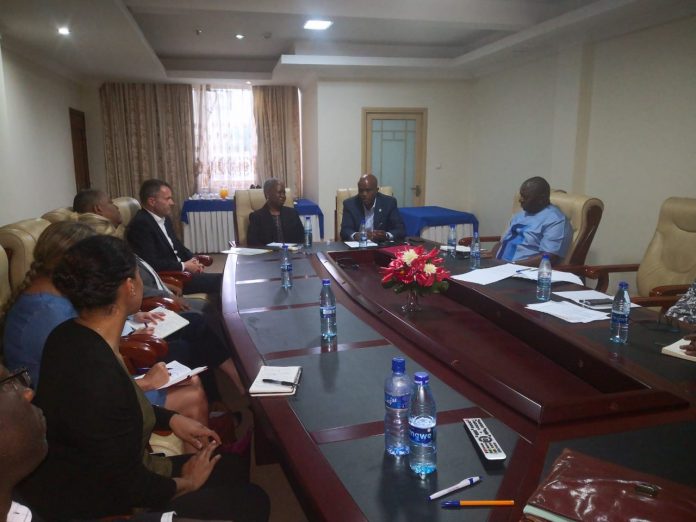
The United Nations Assistant Secretary General for Africa, Ms. Bintou Keita, has expressed the United Nation’s desire for peaceful, credible and democratic elections in Burundi.

Ms. Keita made the statement during a meeting with the EAC Secretary General, Amb. Liberat Mfumukeko, in Bujumbura, Burundi, adding that peaceful elections in Burundi were a prerequisite for political stability in the nation and the region as a whole.

Speaking on regional peace and security, Ms. Keita said the UN had high expectations that the EAC would play a central role in ensuring peaceful and credible elections in Burundi.

“We are willing and ready to work together with and support the EAC in this endeavour,” she added.

On his part, Amb. Mfumukeko informed the UN delegation that the EAC observes elections within the context of the National Constitutions of the Partner States.

He informed the delegation that preparations were underway for the launch of a long-term EAC Observer Mission that will monitor the Burundi electoral process in its entirety, as well as a short-term EAC Observer Mission that will monitor the polling only.

“I am confident that the peaceful spirit we have experienced during the party nominations will continue during and after elections,” said the Secretary General.

“The EAC is calling on all the people of Burundi to side-step violence, regardless of the situation,” he added.

In 2018, Burundi promulgated a new Constitution. The May 2020 elections will be the first elections under the new Constitution.

Amb. Mfumukeko was accompanied by the EAC Deputy Secretary General in charge of Planning and Infrastructure, Eng. Steven Mlote, and other EAC senior officials.

Stories Continues after ad

UPDF donates Shs30m to Bidabujja communities.

The UPDF Chief of Defence Forces Gen. David Muhoozi has donated Shs30 million to two development groups of Bida-Bujja village in Kasangombe Sub-County in Nakaseke district. The money which was delivered by the Joint Chief of Staff of the UPDF Lt. Gen. Joseph Musanyufu was handed over to Kasangombe stationers Association and Kasangombe Youth hatchery to develop themselves.

The cash donation was promised to the two groups at the regional launch of Tarehe Sita activities where the area L.C III chairperson Mr James Makanda requested the groups to be assisted.

Mr. Makanda promised continuous supervision of the groups so as to achieve the objective of the project.

The UPDF will celebrate 39th Tarehe Sita Anniversary in Nakaseke Butalangu grounds tomorrow 6th Feb 2020 under the theme “Consolidating the strategic partnership with the people to guard the gains of liberation”.

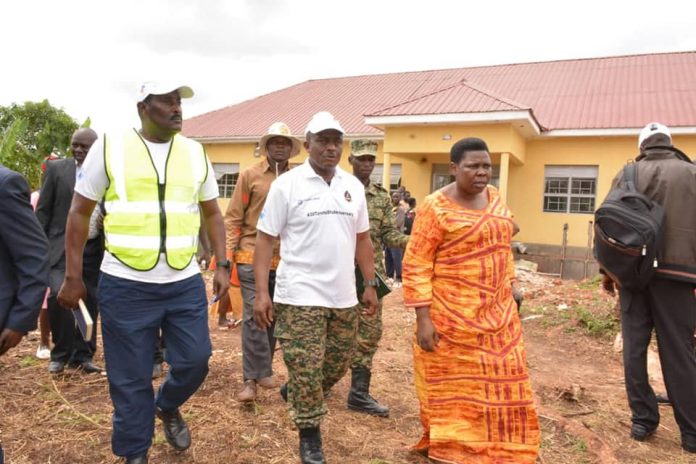
The UPDF together with Rose Namayanja Foundation is also renovating Bidabujja health center II in Kasangombe subcounty in Nakaseke district. This is part of the ongoing Tarahesita activities in Greter Luwero region.

Speaking at the inspection of the work progress Rose Namayanja who is also the chairperson Rose Namayanja Foundation thanked God for the wonderful things done to people of Nakaseke by UPDF.

“Bulemezi had a hand in the struggle and should celebrate Tarehe Sita based on the historical significance of greater Luwero”. She added.

Tarehe Sita always leaves a trail behind basing on a series of activities and development done in the communities where it is celebrated.

Namayanja applauded UPDF for the support, quality and speedy work done in the construction of the health centre.

Stories Continues after ad

Coronavirus: 71 Ugandan students trapped in China, call for evacuation

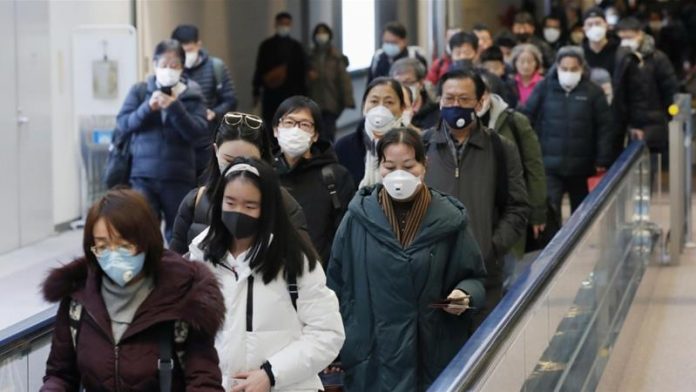
People wearing preventative gears China.


Ugandan students trapped in Wuhan, the Chinese epicentre of the coronavirus epidemic, have called on government to take swift action that will see them evacuated from China.

According to Uganda’s deputy Ambassador to China, Henry Mayega, and Uganda has a total of 71 students in Wuhan, a province where the virus was first confirmed. Chinese authorities have since assured Ugandans of safety following the outbreak of coronavirus in China.

As of January 3, 2020, World health organisation (WHO) reported that 17336 cases of acute respiratory disease were confirmed in 24 provinces, regions and cities and 21558 suspected cases in China. The virus has claimed 362 people.

Over 50 cases of the virus have also been confirmed in other countries in Europe and Asia. Progress as so far been registered with 505 cured cases. So far no case of novel coronavirus has been confirmed Uganda.

According to government Spokesperson Ofwono Opondo, Ugandans in Wuhan have been advised by President Museveni Yoweri Kaguta Museveni to remain there and observe all the precautionary measures placed by the Chinese government.

Yesterday, the President of Kenya, Uhuru Kenyatta said they have embarked of the program to see Kenyan students back home.  “I am sure all East African students in Wuhan can fit in a KQ B787. For the spirit of the EAC please evacuate our Ugandan brothers and sisters too. Reach out to whoever you can reach out to Evacuate Ugandans in Wuhan” one Musoga wrote.

Following government failure evacuate them, students led by Thomas Kanzira, a Ugandan medical student in Wuhan have resorted to moving hashtag dubbed #EvacuateUgandansInWuhan sharing their agonizing stories since the outbreak of the virus.

“Hi Uganda Ministry of Foreign Affairs, I am 100 per cent sure that you’re seeing this tweet. I’m only here to beg you to Evacuate Ugandans in Wuhan. The situation in China as portrayed in the media isn’t what it really is. No shops or pharmacies with gloves, sanitizers and face masks. Nothing.” Thomas wrote on twitter.

“For two weeks we have cried and have been told to keep calm. We cannot keep calm down, we are frustrated, and we have run out of supplies and masks. The number of those infected is increasing rapidly. Help us” he said

He said two weeks back there were 639 cases and 17 deaths at the time of initiation of the Wuhan Lockdown, today there are 28,000 cases and 563 deaths…do you think these 28,000 people did not take ‘precautionary measures’.

“Please I don’t want to be the next person in those body bags. Is this the same Wuhan the Gov’t says we’re safer in, if I die here my body will be cremated. My people won’t even get a chance to bury me.” He said.

The Minister of Health, Jane Ruth Aceng, has since urged the Ugandan business community travelling back from China to adhere to our strict rules of isolation too. She said the ministry will continue screening all travelers since the virus is spread to many other countries but travelers from China will be isolated for 14 days for follow up.

“Please let’s do this willingly to ensure our country is safe. I appeal to all of you to wash hands at all times and report any suspected cases to nearest health facility” she said.

Stories Continues after ad

Freelyformd, Reinventing The Delivery of Software Development Solutions in Uganda

Software Development and incorporating IT solutions to business has over the years become an important part and a driving mechanism for the sustainable growth of a company or Small Medium Enterprises (SMEs) if it wishes to even reach its first birthday in the sector.

Founded in 2017, Freelyformd is a Ugandan-headquartered provider of IT consulting services and custom software development with IT professionals located internationally.

The company handles complex business challenges, building all types of custom and platform-based solutions and providing a comprehensive set of end-to-end IT services with customer satisfaction in mind.

Freelyformd brings custom and platform-based solutions to large and mid sized companies in Healthcare, Banking, Retail, Telecom and other industries. Cloud Core Systems, Water for People, Jaguza, URSB, Multiplex, Tegeka, Safarishare, HERS-EA, Proggie and Hire the Youth along with other companies that rely on their solutions in their daily operations.

From the development stage to the end result, the client is able to interface with the developing team which creates a bond like no other. Freelyformd offers services such as Dedicated developer teams, Mobile App Development, Web applications and Website Design,

Enterprise software development, software testing & QA, Security Audit, IT Consulting, DevOps, USSD, and Startup partnerships.

The company has exclusive experience and the expertise to build custom web & mobile solutions of any kind for any client as well as IT consulting, software development and testing as can be testified by many clients.


For any of your IT Solutions and needs, look no further than Freelyformd.

Stories Continues after ad

Police, UPDF join hands to counter all forms of raids in Karamoja

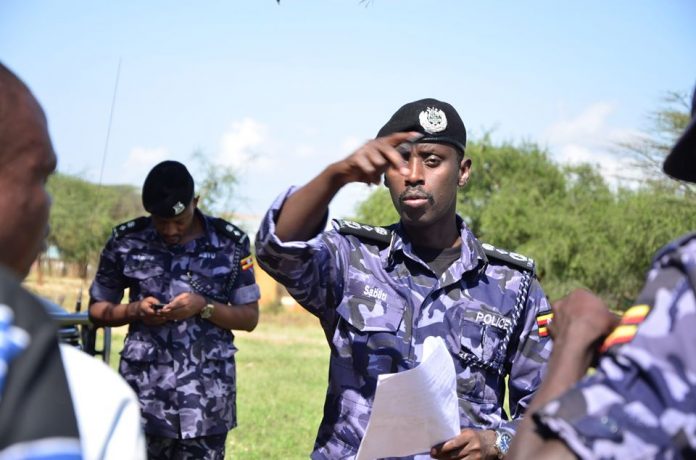
Gen. Sabiiti briefing his men on the security risk in the Karamoja region.


The Chief of Defence Forces (CDF) Gen. David Muhoozi and the deputy Inspector General of Police (DIGP) Maj. Gen.  Sabiiti Muzeeyi, have expressed their determination to counter all forms of raids and counter raids in order to bring perpetrators of such acts to justice.

They made their commitment at the 3rd Divisional Headquarters in Moroto following concerns about growing insecurity and violence due to raids and counter raids in the Karamoja region by legislators under the Karamoja Parliamentary Association.

The DIGP and his team embarked on a critical security assessment in the entire Karamoja sub region, where all detaches and deployments along the borderline and within our borders were thoroughly reviewed; areas for the construction of border posts to regulate entry and exit were identified, the re-positioning of our forces through the creation of new detaches, additional logistical and manpower supplies to ensure better response to armed raids, better surveillance of intelligence led processes.

In last two months of December and January, out of the 31 incidents reported to police, 287 stolen cows were recovered and efforts to recover 616 still in place.

The major concerns raised include; fears of counter raids from across the borders between Uganda, Kenya and South Sudan due to the porous borders, inadequate police and military presence, gun trafficking and the re-emergence of guns, hostile alliances among ethnic groups to mention but a few.

According to the statement released by police, the two security agencies resolved to reorganize and boost manpower, use of aerial capabilities like aircraft’s and drones to counter raiders, regulation of entry and exit through the creation of border posts, faster recovery of raided animals through quicker response, troop mobility and continuous forceful disarmament in grazing areas, identification of violent warriors and perpetrators of raids for arrest and prosecution, training and retraining of personnel.

“ police and UPDF agreed to carryout continuous sensitization and awareness programs across governments, diversifying means of survival through education and commercial farming, dialogue and peace committee meetings to reduce acts of violence, regulating Turkana movements in and out of the country, opening up security roads, effective use of Interpol and the EAPPCO mechanisms in the recovery of raided animals, creation of special courts with deterrent punishments for perpetrators and the possibility of legalizing the Nabilatuk resolution.” reads in part of the statement.

All stakeholders strongly condemned the acts of raids and counter raids and the violence committed by armed criminal groups, from the neighboring countries and also from within the local communities in Karamoja. Members emphasized the importance of a comprehensive approach to combating the threats posed by raids and counter raids including hostile alliances and the illegal re-arming of criminal elements in the community.


Stories Continues after ad

Stanbic Bank, UNOC enter into partnership to promote participation of Ugandan companies in the oil and gas sector

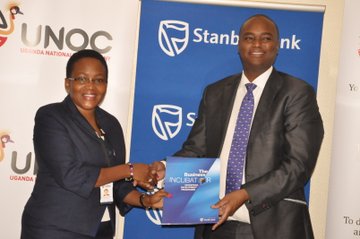
Stanbic CEO, Patrick Mweheire and UNOC CEO, Proscovia Nabbanja


Stanbic Bank Uganda through its business incubator has entered into a partnership with the Uganda National Oil Company (UNOC) to promote national content through capacity building. The memorandum of understanding (MOU) has been signed at Stanbic Bank head offices in Kampala.

Recently the bank established the business incubator with aim to reach as many small and medium enterprises (SME) as possible to support their growth and development across the nation.

To ensure participation of Ugandan companies in the Oil and Gas activities, an estimated $15 billion will be invested in the Oil and Gas sector. To make sure Ugandan SMEs get a significant piece of that pie, the Stanbic business incubator prepares them to leverage the upcoming opportunities in Uganda’s emerging Oil and Gas sector.

Speaking at the signing, Patrick Mweheire, the Chief Executive Officer (CEO) of Stanbic Bank said; “We are pleased to be partnering with UNOC in a critical initiative that aims to facilitate participation and development of national content in the oil and gas sector.”

“We know that the oil sector is a game changer for Uganda’s economy and the only way Ugandans will benefit from this discovery is by having as many local companies participating in its development.” He said

According to MOU, Stanbic Bank will also offer business training for entrepreneurs, sector information sharing and enterprise development.

“Partnerships with institutions like Stanbic are instrumental in promoting national content through providing training and information on the opportunities for local businesses in the oil and gas sector.” Proscovia Nabbanja, Chief Executive Officer UNOC

Head of Business Development Stanbic Bank Uganda, Comrade Otoa said Stanbic Business incubator will provide training to SMEs recommended by UNOC and avail its centres across the country for use by UNOC in its National Content programme.


Stories Continues after ad

FIFA President Infantino: Project African football to the top of the world

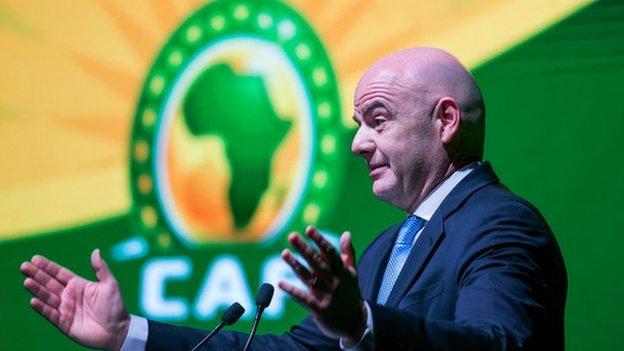
Gianni Infantino

FIFA President Gianni Infantino has outlined his wish to ‘project African football to the top of the world’ that is peddled at development of competitions and infrastructure in African football.

Infantino said during the seminar held in Rabat, Morocco. It was attended by the Presidents of FIFA and CAF, delegates from each of CAF’s 54 Member Associations (MAs), African football legends, representatives from the international banking and investment industries and the media, with the aim of harnessing commitment, determination and passion of all of those involved in African football to raise it to the highest levels of the world game.

In his address to delegates, the FIFA President underlined his belief in the immense potential for positive growth and expansion of African football. “Our objective must be to project African football to the top of the world,” he said. “We have been talking about the development of African football for many years. Pelé once said that an African team would win the FIFA World Cup, but this hasn’t happened and it seems we are not making progress. Today must be the day we turn that page.”

The FIFA President then unveiled a joint FIFA/CAF strategy for the elevation of African football focused on three key pillars: Refereeing, investment mobilisation and competition development.

Refereeing will see the creation of a group of professional referees financed and organised by FIFA in partnership with CAF. “Referees have to be above and beyond doubt and to do that we have to protect them,” the FIFA President said. “We will take 20 of the best African FIFA referees, professionalise them, and give them permanent, professional contracts. They should be the guardians of the rules of our game and we must protect them and make them totally autonomous.”

For investment mobilisation, FIFA and CAF will assemble a panel of partners and a minimum fund of USD1bn to make solid and sustainable infrastructural investments in Africa, from which FIFA will ensure that this funding is managed via transparent accountable procedures. “We are elaborating a proposal to mobilise USD1bn to build at least one top stadium in the countries of each of FIFA and CAF’s 54 Member Associations,” Mr. Infantino added. “In the countries where there is already at least one very good stadium, the investments can be done in other infrastructures.”

In relation to competition development, FIFA will seek a range of new initiatives: the creation of a world nations league for women’s football, more frequent youth world championships, more youth competition categories, a re-positioning of the African Cup of Nations to be played every four years and the creation of a new pan-African club competition.

The new pan-African club competition, proposed by the FIFA President, would comprise 20 permanent member clubs and would be supported by additional clubs that qualify via regional competitions. The permanent member clubs would be urged to provide an investment of USD20m to the project annually over five years, taking their total investment to USD100m. They would also have to meet other participation criteria such as investment in youth and women’s football. In this way, the competition would have the potential to generate a revenue of USD3bn over a five-year cycle – and would also create the conditions for African football to be able to retain some of most talented players in the continent.

“We have to reflect about how we can revolutionise African football,” the FIFA President said. “I want to create a real pan-African league that would feature 20-24 clubs with a maximum of maybe two clubs per country that would still play in their national leagues but that would play during the year so we can really crown the club champions of Africa.”

The FIFA President issued a rallying call to African football, concluding: “Let us show the world what we can do. This day is special it’s the start of a new chapter for African football.”

Stories Continues after ad

FIFA bans Ugandan footballer for life over his indulgence in match fixing

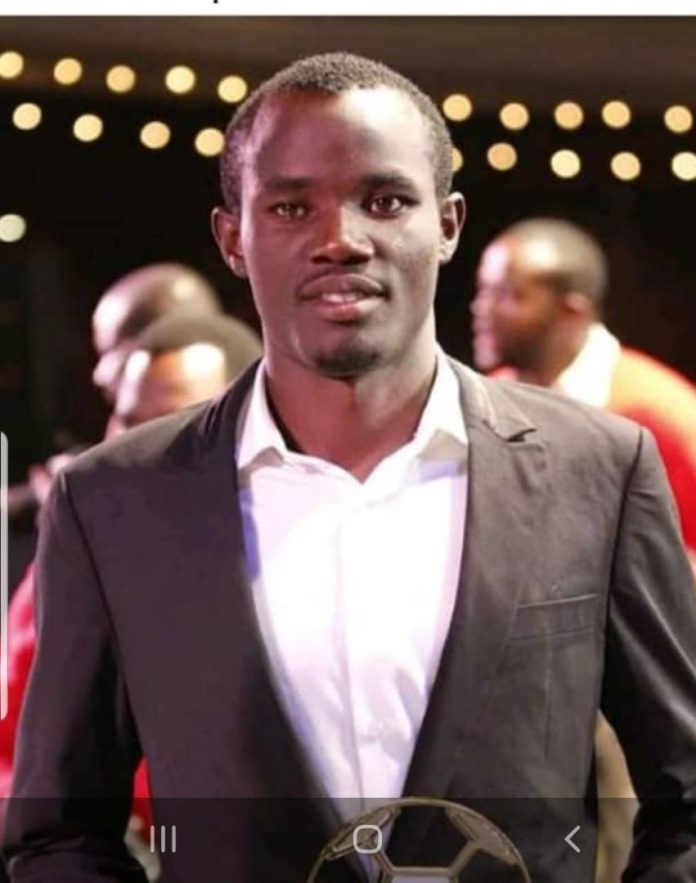
The international governing body of football, FIFA, has banned Ugandan footballer, George Mandela for lifetime over his involvement in match fixing.

According FIFA, the disciplinary committee found him and several players guilty of having been involved in match manipulation in violation of article 69 paragraph one of FIFA disciplinary code of 2017.

“In particular given his central role in the conspiracy, the player George Mandela, Uganda has been banned from taking part in any kind of football related activity on national and international level for life,” FIFA said.

Three other Kenyan individuals; Moses Chikati, Festus Okiring and Festo Omukoto were banned from taking part of football related activity on national and international level for a period of four years.

The four banned players were at the time attached to Kakamega Home Boyz FC playing in the first division of Kenya premier league.

The formal disciplinary proceedings against the aforementioned individuals stemmed from an investigation onto various matches in Kenya premier league in 2019.  The investigation alluding to FIFA was conducted through its integrity department with the consent of and in cooperation with relevant stakeholders and authorities.

Stories Continues after ad