Stanbic Bank
Stanbic Bank
17.7 C
Kampala
Stanbic Bank
Stanbic Bank
Home Blog Page 1101

Kyabazinga rallies Basoga in diaspora for development


Basoga based in South Africa have been challenged to prioritize investing back home as a way of preparing for their future.

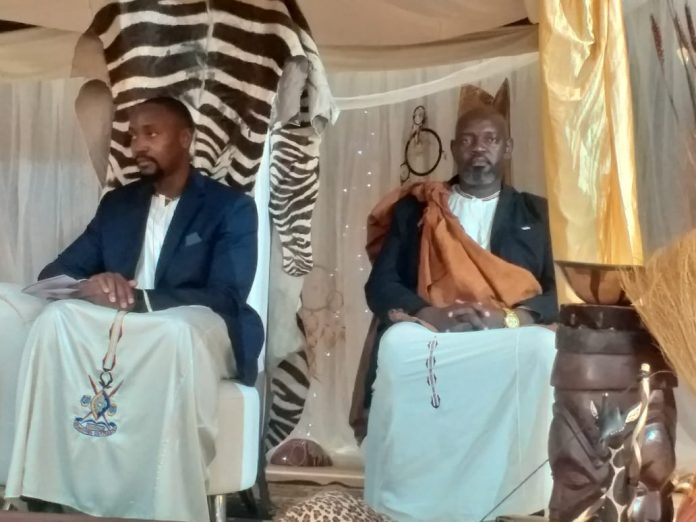
Winding up his official visit to one of Africa’s developed economies, His Majesty William Gabula Nadiope,IV, Isebantu Kyabazinga of Busoga tasked his subjects to work towards development of their motherland.

“As a Kingdom, we consider people in diaspora as partners in development. Going by what we have planned as an institution, I challenge all of you to be considerate by putting several investments back home”, the Kyabazinga guided before giving a chronology of events that have taken place.

The Kyabazinga flanked by the Kingdom Premier, Owek. Dr. Joseph Muvawala Nsekere, notified the attentive gathering that tourism promotion for example of kagulu hill, nendha hill, source of the Nile are a top priority.

He also revealed that regularly heath camps are organized to address the different heath complications in addition to education where over 5000 scholarships have been offered at all levels from primary to university education in just five years.

Notable in the Kyabazinga’s speech was the 4th edition of Ekigangu kya Busoga that aims at promoting Busoga’s cultural values, norms, customs, meaning of traditional names, clans, totems.

On his part, Owek. Dr. Joseph Muvawala Nsekere assured the South Africans that the Kingdom is open door that promotes popular participation of all the people.

“We appreciate the unity exhibited here. Be rest assured of our support towards the development of Busoga and Uganda as a whole”, the Premier accompanied by Owek. Joan Machora Kitto, foreign affairs Minister noted.

During the interface, the hosts formed a Busoga Senate(chapter) which unites all the people of Busoga in Madibaland.

Several guests attended the function including but not limited to the Baganda, Bagwere, Bagishu, abakosa from South Africa

Dr. William Ddamulira who is Kabaka’s representative in Cape Town too attended the function.

The Kyabazinga when pleased will select a representative/committee to cater for the needs and represent other people of Busoga in Johannesburg, Capetown, Durban, Pretoria among others.

The group offered eight routers for internet connection to cover the kingdom offices and they are to deliver an ambulance early next year.

Stories Continues after ad

Museveni launches electronics plant at Namanve

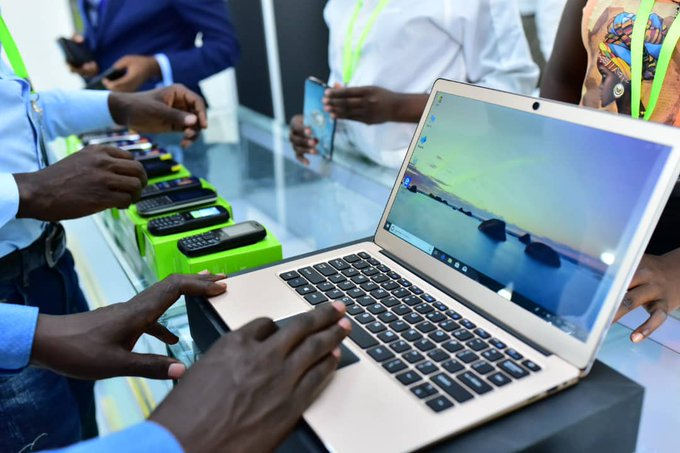
Museveni gets feel of the assembled phones

President Yoweri Museveni has launched Uganda’s first phone and computer assembling plant in Namanve.
This is after government signed an agreement with Chinese firm, SIMI technologies to promote the manufacturing of ICT electronics in the country.

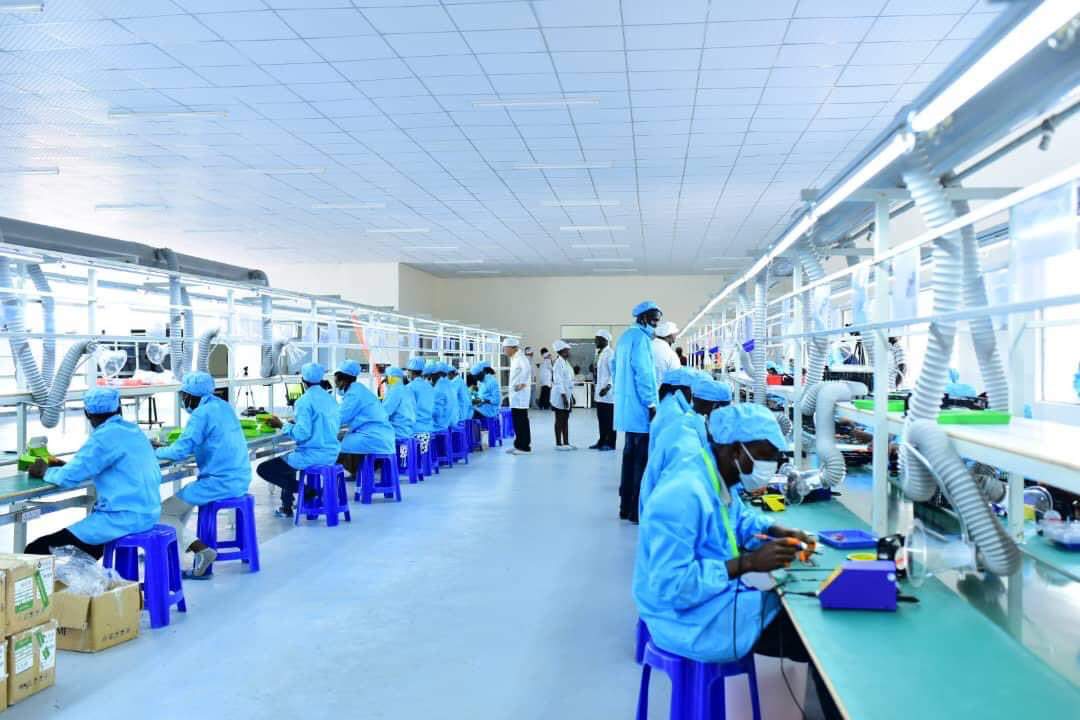
The plant  will run three production lines; each line with daily production of 2000 feature phones, 1500 smart phones, 800 laptops, 2000 chargers, 4000 USB cables and 4000 sets of earphones and directly employing more than 400 staff.

These S1 laptops are as slim and light as the Mac Air. A better substitute for the Ugandan market.

“I am very happy with the Chinese solidarity with Uganda and Africa. Uganda is moving very well, the economy has grown to $35 billion using the normal method of calculating GDP,” Museveni said.

He said the only remaining challenge for his government to overcome was corruption of public servants.

“We now have electricity, we are going to solve the problem of transport costs. We have also started solving the problem of ICT,” he said.

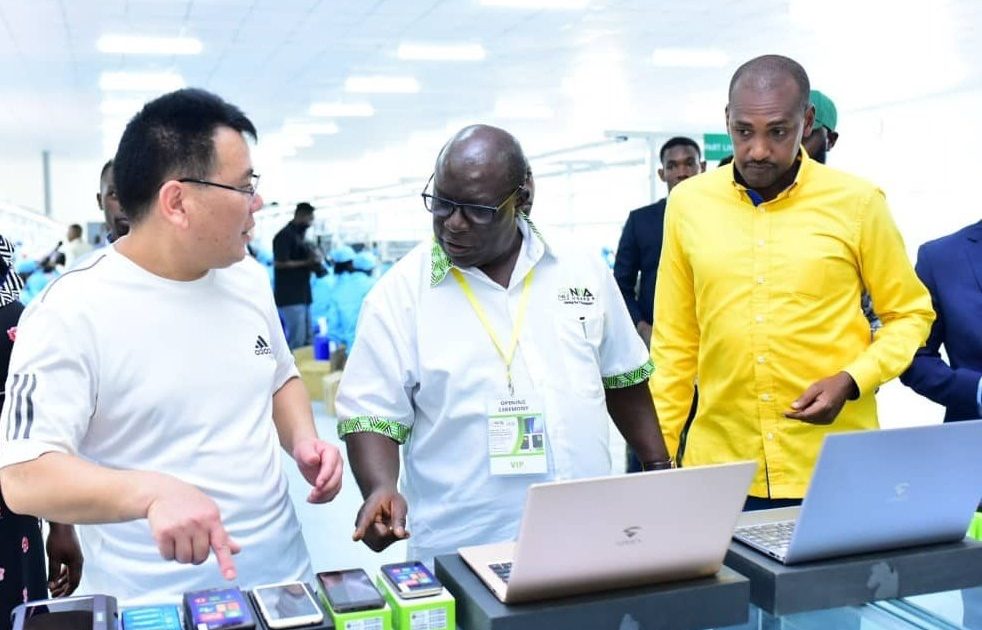
ICT minister Frank Tumwebaze (in yellow shirt) at the plant

State Minister for Investment and Privatisation, Evelyn Anite said that manufacturing the phones locally will reduce the country’s import bill.

“We are going to have a reduction in the importation of phones. The message I want to send to Ugandans today is to buy the products made in Uganda for the growth, development and betterment of our country,” she said, adding that the phone would cost Shs20,000.

Workers at the plant

Speaking at the event ICT Minister, Frank Tumwebaze, said one of the cost-push factors for internet is failure by people to afford devices that are able to connect to the internet.

“The phones we saw cannot connect to the internet but they are going to make smart phones,” he said. A plan, he said, is underway to connect all industrial parks to the national backbone infrastructure. Investors will not have to incur high costs of internet connectivity which in this day and age is an essential component of any industrial operation,” the minister said.

Stories Continues after ad

DHL Express scoops 24 Top Employer Awards for sixth consecutive year

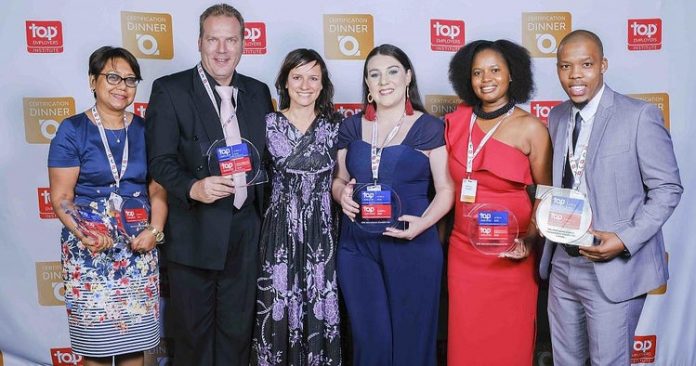
Winners show off awards

DHL Express has been recognized as a Top Employer in Africa for the sixth consecutive year by the prestigious Top Employer Africa Institute, highlighting the company’s ongoing commitment to being an employer of choice.

Paul Clegg, VP Human Resources for DHL Express Sub-Saharan Africa, said that being recognised as a Top Employer yet again is a massive point of pride for the company, especially in a year where DHL celebrates its 50th anniversary.

“Having been in business for 50 years is a huge milestone, and we could not have reached our current success without the scores of passionate employees that have dedicated their time and energy to the company over the last half century. With this in mind, we remain committed to investing in our employees, helping them unlock their highest potential well into the future.”

DHL Express received 24 certifications across 23 countries in Sub-Saharan Africa this year, including the coveted Intercontinental Award for having the most Top Employer certifications on the continent. Countries for which DHL Express received certifications include;

Angola, Botswana, Cameroon, Cote d’Ivoire, Democratic Republic of Congo, Ethiopia, Gambia, Ghana, Kenya, Madagascar, Mauritius, Morocco, Mozambique, Namibia, Nigeria, Reunion, Rwanda, Senegal, South Africa, Tanzania, Uganda, Zambia and Zimbabwe.

Additionally, DHL Express South Africa has been recognised as the industry leader in South Africa, in the Transport and Logistics sector.

“We view effective employee engagement programs that drive motivation and employee engagement as an integral part of business operations. Not only does it enable us to provide great client service, it helps us to maintain our customer-focused culture across the globe,” he says.

According to Clegg, the business’ use of employee initiatives and programs, including the company’s Certified International Specialist (CIS) cultural change program, has helped to unlock the potential of the company’s employees across Sub-Saharan Africa. “We made the decision some time ago to put strong emphasis on up-skilling and empowering our middle-managers and supervisors, as this rung of leadership is crucial to supporting our growth in the coming years.”

To be certified as a Top Employer in Africa, a company needs to operate in four or more countries and have exceptional employee conditions. The Top Employers Institute conducts comprehensive and independent research by completing HR best practice surveys amongst employees of the relevant companies.

The Top Employers Institute survey assesses human resource strategy, policy implementation, practices and employee offerings to reveal whether the company provides exceptional employee conditions, develops talent on all levels and demonstrates leadership through optimizing the development of its employees and employee practices.

“We are beyond honored and thankful to have achieved this huge milestone once again and we look forward to ensuring that we maintain our focus on attracting, retaining and developing our people across the sub-Saharan Africa region,” said Clegg.

Stories Continues after ad

We don’t host or deal with RNC rebels – Uganda blasts Rwanda’s sympathisers

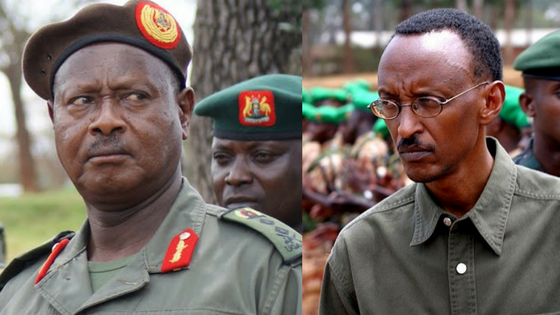
Kagame and Museveni

The Government of Uganda, in a media statement released Friday, has castigated ‘elements’ yet to be identified claiming that the country recently hosted a meeting for the purposes of election of a committee of a shadowy rebel group, the Rwanda National Congress (RNC).

The Executive Director of Uganda Media Centre and government spokesperson, Ofwono Opondo in the media statement maintains that Uganda does not deal with RNC as alleged.

“Uganda reiterates that it doesn’t know, host or deal or deal in any way with such a group, a fact that has been ably communicated through the appropriate channels to the Government of the Republic of Rwanda. Uganda does not harbor any intentions or interests of destabilizing the Government of Rwanda.”

Ofwono says that Uganda is committed to implementing the Luanda Memorandum of Understanding signed in September 23rd without any hesitation. He says Uganda has already proposed and awaiting response from the Government of Rwanda on the formation a joint verification committee to follow up on and resolve any outstanding issues.

He warns that Uganda will not be distracted by any “provocative malicious propaganda in the media because it believes that bilateral and diplomatic channels avail will resolve any possible misunderstanding.”

Rwanda in April 2019, accused Uganda of supporting RNC rebels Kigali says want to topple President Paul Kagame’s Rwanda Patriotic Front (RPF) that captured power in 1994.

Rwanda has also accused Uganda of dealing with Democratic Forces for the Liberation of Rwanda (FDLR).

The RNC is a rebel group led by some of Rwanda’s most prominent dissidents including South Africa-based Kayumba Nyamwasa. Its founders say it is a political party.

Relations between the two nations soured after Rwanda blocked Ugandan cargo trucks from entering its territory at the busiest crossing point, Katuna, and barred its nationals from crossing into Uganda.

Stories Continues after ad

Ignoring the health of people in prisons now comes at a high cost for society later – New WHO report

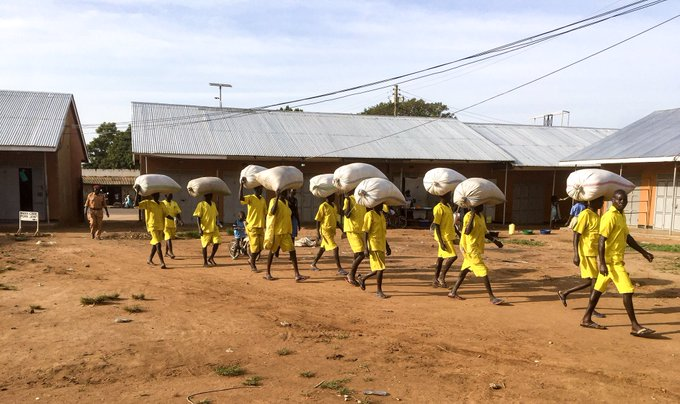
prisoners

The WHO status report on prison health in the WHO European Region presents an analysis of data collected on the health status of people in prison and prison health systems for 39 countries in the Region. The WHO survey collected data from Member States between 2016 and 2017 to enable monitoring and surveillance of health in prisons.

The report reveals that the general state of monitoring and surveillance systems for health in prisons is poor. This affects the development of evidence-based policies that effectively target the needs of the prison population.

“We only have data from 39 countries, but the data that we have indicate an enormous difference in the general health of people in prison compared to those in the outside world. Collecting this data is essential to enable the integration of prison health policies into the broader public health agenda benefiting the entire society,” says Dr Carina Ferreira-Borges, Programme Manager for Alcohol and Illicit Drugs at the WHO Regional Office for Europe.

An estimated 6 million people are incarcerated each year in the Region. After release, rates of reoffending and returning to prison are high. The report points out that this cycle between prison and community often leads to disjointed and ineffective health care outside of prison.

During the early days of a person’s release, the risk of suicide, self-harm and drug overdose is increased. This means that continuity of care during this transition is critical. Gaps in care during this period have significant negative public health implications and can constrain a country’s ability to address inequalities.

“A large proportion of people in prison return to the community every year, so viewing prison as a setting for public health opens an opportunity for public health actions and for improving health literacy to support and protect vulnerable populations,” says Dr Bente Mikkelsen, Director of the Division of Noncommunicable Diseases and Promoting Health through the Life-course at the WHO Regional Office for Europe.

“A prison sentence takes away a person’s liberty; it should not also take away their health and their right to health,” she adds.

Prisons and other places of detention have an opportunity to deliver preventive and risk-reduction interventions and treatments to a population that previously may have lacked or had limited access to health care and a healthy lifestyle.

According to the report, prisons must be seen as settings in which health interventions can address existing health conditions and contribute to positive lifestyles and behaviour changes. Time in prison can also be used to improve people’s skills to help them find a job after release and reintegrate into society.

“The prison population, with its disproportionate disease burden, is one that cannot be forgotten in WHO’s pursuit of the United Nations Sustainable Development Goals. To achieve universal health coverage and better health and well-being for all, as in WHO’s vision, it is vital that prisons are seen as a window of opportunity to change lifestyles and ensure that no one is left behind,” emphasizes Dr Mikkelsen.

Stories Continues after ad

Suspended NGB boss drags Ofwono Opondo to court

Ofwono Opondo

The Executive Director of the government-owned Uganda Media Centre, Ofwono Opondo, has been dragged to court for allegedly  uttering defamatory and slanderous statements targeting Edgar Agaba, the suspended Chief Executive Officer of the National Gaming Board (NGB).

Agaba dragged Ofwono to court on November 13, 2019 through his lawyers of M/S T-Davis Wesley & Co. Advocates and Solicitors.

Agaba avers that the defendant defamed and slandered him on October 23, 2019 during a press conference at the Uganda Media Centre in Kampala.

Agaba wants Ofwono to pay him general damages for uttering defamatory and slanderous statements about him while addressing journalists on the said date.

Ofwono is required to file his defence within fifteen days from the date of service of sermons. He received the sermons on November 22, 2019.

Stories Continues after ad

Strengthen regional collaboration to combat corruption – Kadaga

Speaker of Parliament Rebecca Kadaga

The Speaker of Parliament, Rebecca Kadaga has called upon anti-corruption authorities to strengthen regional collaboration and combat corruption.

Kadaga made this call while officiating at a dinner where the heads of the anti-corruption authorities from East, Western Africa and West Balkans were meeting for their Annual General meeting on at Speke Resort Munyonyo.

The Speaker said the ant-graft agencies work under difficult conditions but strive to achieve their targets.

“Sometimes as we go through the reports of the Public Accounts Committee, we are amazed at how much money is stolen. This country is wealthy; Africa is wealthy if only the money is used correctly,” she said.

She encouraged the authorities to work together since the countries were globalized and the crimes and solutions were.

The Inspector General of Government, Irene Mulyagonja said that the meeting was geared at joining with other partners to fight against corruption.

“IGG Uganda is proud to host the 13th Eastern Africa Association of Corruption Agencies (EAAACA) annual general meeting. As a region we have agreed to continue with the fight against corruption,” she said.

This year’s conference themed “Strengthening Regional Collaboration to Prevent and Combat Corruption” attracted heads of Anti-Corruption Authorities from Kenya, Burundi, Tanzania, Djibouti, Ethiopia, Tunisia, Senegal, Cote d’lvoire, Ghana, Serbia, South Sudan, Albania, Macedonia, Botswana and the hosts Uganda. The conference will run from 18th to 24th November 2019.

Stories Continues after ad

Look for the hunter gene in every new venture founder

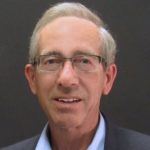
Martin Zwilling

By Martin Zwilling

Most entrepreneurs believe they are “different,” but they can’t quite understand how. They usually explain it by insisting that they are driven to follow their passion, need to be their own boss, want to get rich quick, or want to change the world. I now believe that the roots of the difference may go back more than 10,000 years, when hunting and farming became two different lifestyles.

The classic book, “Hunting in a Farmer’s World: Celebrating the Mind of an Entrepreneur,” by serial entrepreneur and business coach John F. Dini, tied together several threads I have often seen in my own experience of mentoring and helping aspiring entrepreneurs. Dini makes the case that entrepreneurs are hunters, while the rest of us (large majority) are farmers.

This is not a statement of good or bad, right or wrong, but just an explanation of why some people see and do things one way, and others do it another way.

In business, entrepreneurs hunt for new innovative solutions to problems, new ways of beating competitors, new markets, and new customers. Farmers are the management that comes after the hunt, to build repeatable processes, do seasonal planning, and make sure all employees are well-fed and trained.

All this made more sense to me as Dini defined the types of entrepreneurs into four categories. Within each of these types, I can easily highlight strengths and weaknesses that we both see every day in startups:

Technicians. The good news is that technicians are entrepreneurs who have previously learned a skill or job so well that they can do it without a manager. The bad news is they may not be good at managing people, or even managing basic business. Technicians can become true hunters when they learn to provide for both employees and family.

Inheritors. These are former employees who find themselves thrust into owning a business, due to family ties or evolution. Unfortunately, most inheritors have been farmers for too long, or never had hunting instincts. The best ones learn to be hunters, or revert to that mode, allowing their business to grow and change with the requirements.

Acquirers. Entrepreneurs who are willing to acquire an existing business, and believe they can make it a better business than previous owners, are clearly hunters. Farmer acquirers, who want to manage a proven opportunity, with no change, buy a franchise. Hunter franchisees move on quickly, or end up owning the entire franchise system.

Creators. These are the ultimate hunters. They build businesses as their lifestyle, not as a job. They love the continuous hunt, for investment capital, resources, talent, and new markets. Only a few of these slide into farming, as the company grows in employees and products. The remainder usually exit within five years, to start the process over again.

In addition to the right type, there are clearly traits that every aspiring entrepreneur should recognize as critical for business success and happiness:

Creativity. Hunters thrive on the challenge of the unknown. They look at every situation as a puzzle that has an answer. Success at any level always brings a new set of problems. Hunters live for solutions and change. Farmers live for repeatable processes, minimal risk, and predictable results to feed the family.

Tenacity. Hunters never quit. There are no defeats, only setbacks. Success is always just a little further down the road. “Never” is not an option. If a solution doesn’t work, there is always another, then another, and another. Farmers are easily frustrated by setbacks, and count on “leadership from the top” to give them new fields for growth.

Business sense. Hunters need “street smarts.” If you are looking to create a business, you better have a strong “gut feeling” or “third eye” for business that goes beyond the usual five senses. Farmers have a narrower view of what is required, to optimize quality production, customer satisfaction, or close a sale.

There once was a time in mankind’s history when almost everyone was a hunter, for survival. Our civilization has evolved now almost to the other extreme, where the vast majority of the people in business are farmers (managers and employees).

For those of you who have the hunter gene, or the yearning to learn, the time has never been riper to be an entrepreneur. How long has it been since you have taken a hard look in the mirror?

The Writer is a veteran startup mentor, executive, blogger, author, tech professional, professor, and investor. Published on Forbes, Entrepreneur, Inc, Huffington Post, etc.

Stories Continues after ad

Will the rebased economy numbers kill Uganda’s debt sustainability debate?

Patrick Kiconco Katabaazi

By Patrick Kiconco Katabaazi

Ministry of Finance, Planning and Economic Development recently informed the nation that Uganda’s gross domestic product (GDP) had grown to Shs122.7 trillion ($32.8 billion) from Shs109.9 trillion ($29.4 billion) reported at the end of 2018/2019 financial year.

The increase in the value of the economy arises out of a rebasing of the Uganda’s GDP calculations by the Ministry of Finance, Planning and Economic Development to tap into emerging sectors such as gold exports and oil projects.

It is worth noting that Uganda’s debt to GDP ratio which had previously been estimated at 42.1 per cent and reported to be in the region of 47% at the end of FY 2018/19 declined to 37.2 % after the rebase.

According to projections by the International Monetary Fund (IMF) Uganda’s ratio of debt to GDP was projected to hit the 50% threshold set by the East African Community Macroeconomic convergence criteria. Going beyond the 50% mark would mean that the national debt has hit unsustainable levels.

There has been mounting pressure from civil society organisations, academia and the development partners in regard to the issue of debt sustainability and numbers from the rebasing of the economy is a relief to government. At 37% of debt to GDP ratio, the government has solid answers.

It should be recalled that there are a number of loans yet to be approved and in the next three years it is very possible that the country’s debt will soon get to 40% and beyond. There, therefore, need for government to rethink the debt strategy especially since rebasing can only provide relief in terms of threshold but cannot take away the fact that the country needs UGX 46 trillion (more than the total national budget for 2019/20) to deal with the current debt stock.

Civil society organisations, technocrats, development partners, academia and other policymakers should work together to ensure  that the national debt is kept within sustainable . There is a need for the government to improve on the issue of effectiveness and absorption capacity to minimize waste and promote value for money culture in project implementation.

Government is urged to build capacity and finance the newly created department of projects appraisal and evaluation to ensure that all loans contracted are properly appraised.

The writer is Writer Executive Director, Centre for Budget and Tax Policy (CBTP)

Stories Continues after ad

Gender equality: It’s time for disruption, time to shatter the status quo, we can’t afford to wait!

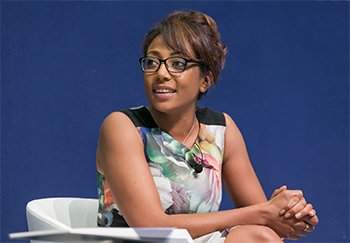
Vanessa Moungar

By Vanessa Moungar

If you are a gender champion, then you are familiar with the discussions around the glass cliff.  The story of women eager to defy the odds, accepting leadership roles at times of crisis, when the chance of failure is the highest. The truth is that many bold glass cliff climbers have succeeded without falling off.

Two of such champions come to my mind: the former Xerox CEO Anne Mulcah and Tokunboh Ishmael, co-founder of Aliethiea IDF.

Mulcah, Ishmael and likeminded agents of change have already shattered the status quo. So, when the first Global Gender Summit held in Africa kicks off on November 25th in Kigali, Rwanda, the international community will hurtle towards heeding the calls to dismantle barriers to women’s full participation and advancement economic development on the continent.

Women make up over 40% of African business owners yet only 2% are able to access finance according to a Mckinsey report. One in four women globally who start in a business come from Africa (Global Entrepreneurship Monitor).

The Summit, organised by the Multilateral Development Banks’ (MDBs) Working Group on gender, will be held in Africa for the first time ever, from the 25th to 27th November 2019 in Kigali, Rwanda. This year’s summit is hosted by the African Development Bank in partnership with the Government of Rwanda and supported by other multilateral development banks as key partners.

Under the theme “Unpacking constraints to gender equality,” the Global Gender Summit will share best practices and seek innovative solutions that can be harnessed to empower women and girls in Africa and around the world.

We are excited to be bringing the world to Rwanda, a country that has set a strong example when it comes to promoting women’s rights and representation.

Rwanda was the first country in the world with a female majority in parliament, currently at 67.5 %, following October parliamentary polls. Out of a total parliamentary membership of 80, women occupy 54 seats. This feat puts the nation ahead of even the most developed nations.

From the massive financing gap for women-led enterprises, inadequate data, laws and cultural norms that negatively affect women, to a lack of representation in business and politics, the challenges are great.

But the opportunities are there too.

Discussions will focus on the main barriers to achieving gender equality and women’s empowerment, namely: scaling up innovative financing, fostering an enabling environment and ensuring women’s participation and voices. Sectors to be addressed will include climate change, the digital revolution, private sector and human capital and productive employment.

In Africa, women-led enterprises face a whopping $42 billion financing gap. One of the Bank’s flagship gender-focused projects is its Affirmative Finance Action for Women in Africa (AFAWA), which seeks to accelerate growth and employment creation across African economies, by closing the financing gap for women.

Over the next 5 years, AFAWA is expected to unlock $3 billion in private sector financing to empower female entrepreneurs through capacity-building development, access to finance as well as policy, legal and regulatory reforms to support enterprises led by women.

Our Fashionomics Africa initiative supports the African textiles and fashion industries by building the capacities of small and medium-sized enterprises in the textile and clothing sector, especially those run by women and youth. By using technology as a driver for the development of skills and capacity in Africa’s creative industries, the African Development Bank aims to stimulate job creation on the continent. At the summit, we will unveil an innovative online marketplace for designers across the continent.

That’s just some of the exciting news. We will use the opportunity of the Global Gender Summit to launch a number of initiatives to dramatically transform the landscape of access to finance for women across the continent.

These include the Africa Gender Index- a joint African Development Bank and the United Nations Economic Commission for Africa (UNECA) report that assesses African countries on gender equality.

The launch of the AFAWA/AGF Risk Sharing Facility, which will de-risk lending to women through AGF’s partial, guarantees to financial institutions and its capacity development to women entrepreneurs.

As well as these continent-wide initiatives, we at the African Development Bank understand that change begins at home. That is why in 2018, the Bank rolled out its gender marker system to process, monitor, and promote gender mainstreaming in all its operations, with gender specialists as part of project teams and Bank operations.

By the end of last year, 40% of public sector Bank operations had been organised under the gender marker system, a major shift in the Bank’s way of doing business and commitment to gender mainstreaming.

We continue to support and build the individual power of girls and women across the countries we work in and never has the time been more urgent.

We expect the Global Gender Summit, to be a milestone event in the empowerment of women in Africa and beyond.  See you there.

This year’s Global Gender Summit, is hosted by the African Development Bank in partnership with the Government of Rwanda and supported by other multilateral development banks as key partners.

The Writer is the Director of Gender, Women and Civil Society

Stories Continues after ad